How Can You Develop Your Badminton Backhand Smash Technique Through Training (Backhand Smash Guide)
The backhand smash is the shot players ask about with a particular look: the one hit from the rear backhand corner, racket across the body, shuttle suddenly diving at the front court when a forehand seemed impossible. It looks like a trick shot, and it is taught like one far too often, in highlight clips and gym folklore. In truth it is a rescue finish with a plain mechanical heart: a backhand grip with the thumb doing the pushing, a short forearm turn, contact taken high and in front, and angle doing the work that power cannot. This page builds it in that order, and it is honest from the start about what the shot is for: a rare, earned answer, not a second smash.

Backhand Check #1
What A Backhand Smash Really Is
A backhand smash, in the way this page uses the term, is an attacking downward shot played on the backhand side from the rear court, struck with a backhand grip and powered mainly by forearm rotation and the thumb, used when the shuttle has passed to the backhand side and the round the head forehand is no longer honestly available. Its family is the backhand clear and the backhand drop, which share its grip and its shape; the smash is the steepest member, trading flight time for angle. It is graded by its steepness and its landing area, never by its speed, because its speed will always sit below a forehand smash struck from a similar position. Judged on the right scale, it wins rallies. Judged on the wrong one, it disappoints players who were promised a cannon.
The cost of a weak backhand smash is paid at the net and in the shoulder. Struck with a forehand grip rolled over, or swung like a forehand across the body, the shuttle floats: it leaves flat, arrives slowly, and is killed or driven back past the striker before his follow through ends. Struck late and low, because the player waited to see whether the forehand was possible, it hits the tape or feeds the front player a gift. And forced repeatedly from poor positions, it loads the shoulder and elbow with a lever they were not built to repeat, so the shot that was meant to rescue rallies starts costing the arm that plays everything else. The backhand smash forgives honest use and punishes theatre, which is why its technique and its choosing are trained together.

Backhand Check #2
Grip And Thumb: The Backhand Engine
The base of the shot is the grip, and the grip is specific. The hand takes the handle in the backhand hold: the thumb comes up onto the wide flat bevel of the grip, the fingers wrap the handle with the hold resting in them rather than clenched in the palm, and the racket face points the way the thumb points. That thumb placement is not a detail. On the backhand side the thumb is the lever that pushes the racket head through the last part of the swing, the only lever the shot honestly has, and a thumb left curled around the side of the handle leaves the head to be dragged by the arm. Players changing from a forehand grip borrowed mid rally will feel the difference in one feeding set: same feed, same position, and the shuttle finally leaves downward.
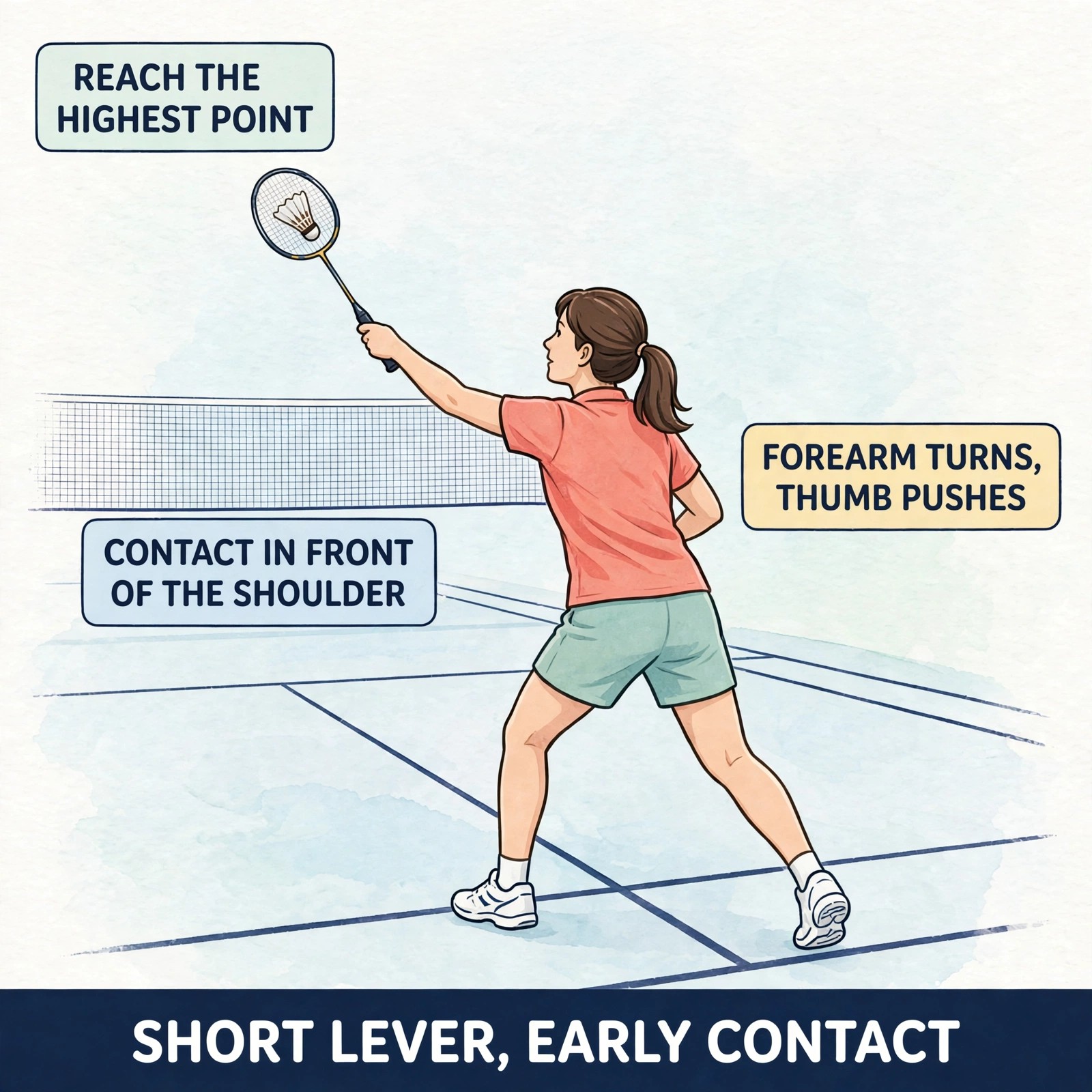
The power itself comes from a short chain, and it is worth naming honestly because the folklore names it wrong. The shot is not driven by the legs and hips the way a forehand smash is; the body is turned across, the lower body mostly buying position and balance. The head speed comes from the upper arm setting the line, the forearm rotating through contact, the fingers tightening at the last fraction, and the thumb pushing through the bevel as the face meets the shuttle. It is a lever measured in centimetres, and that is exactly why the shot is about timing rather than strength: the chain is too short to muscle. Groove the sequence until it is one motion, because a backhand smash assembled in parts during a rally is a backhand clear with ambitions.
Backhand smash faults repeat on a short list. The first is the borrowed grip, a forehand hold rolled across, which caps the angle and floats the shuttle. The second is the late decision: the player drifts toward the backhand corner still hoping for the forehand, arrives with the shuttle dropping beside the shoulder, and swings from underneath. The third is the forehand swing, a long across body arc that reads early and lands weak. The fourth is the painted target, the attempt struck at the sideline or the tape’s edge, donating errors the shot’s honest areas would have kept. Each fault maps to a repair in this page’s order: grip first, contact second, targets third, choosing last.
Backhand Check #3
Contact And Angle: Steep From A Short Lever
Contact is where the backhand smash is won, because the short lever leaves no room for a late one. The shuttle is met at the highest reachable point in front of the turned shoulder, while it is still travelling toward the striker rather than falling beside him, and the face is angled down through it. A contact at that height starts the shuttle downward at once, which is the whole ballgame for a shot whose speed is modest: steepness, not pace, is what beats the front player. Let the shuttle drop to shoulder height and the same swing produces a drive the defence steps into. This is why backhand smash training spends so long on arrival and the turn: the contact point is built by the feet a second before the racket is involved at all.
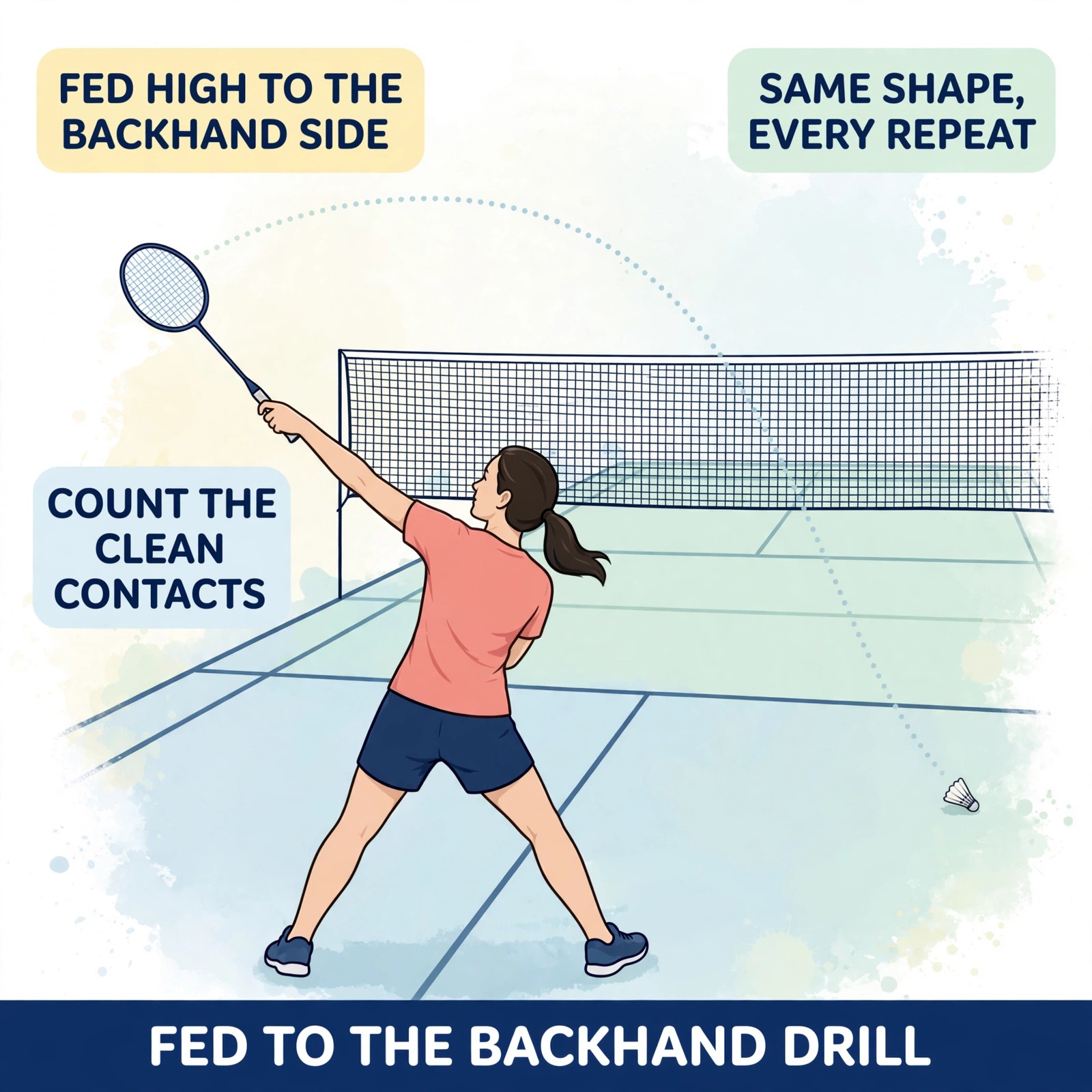
The honest backhand smash target is an area, never a line and never the tape. The middle of the far front area and the tramline free middle of the mid court are the addresses: areas with plain court on every side, where a shuttle struck a fraction early or late in the forearm turn still lands in, still steep, still ahead of the front player’s racket. The highlight version, skimmed over the tape and clipped onto the sideline, is a shot with two error borders touching it, and over a season the donations outnumber the applause. In training the count is plain: out of ten backhand smashes, landings inside the area against landings long, wide or into the net, and the second number is the one the target choice controls.
Because the round the head forehand exists, choosing the backhand smash is a decision with a default answer. The forehand is stronger, safer and struck from a position that recovers better; whenever it is honestly reachable, it is the shot. The backhand smash earns its place when the shuttle has passed the line where the forehand stays honest: deep into the backhand corner, or arriving fast enough that only the backhand shape can still meet it high. It also earns against a front player standing off the net, who has sold the front court to guard the clear. What it never earns is the role of habit: a player who chooses it twice a rally is a player whose forehand opponents have stopped respecting. Rare, earned and never forced is the standard this page trains to.

Backhand Check #4
Choosing The Moment: Rare, Earned, Never Forced
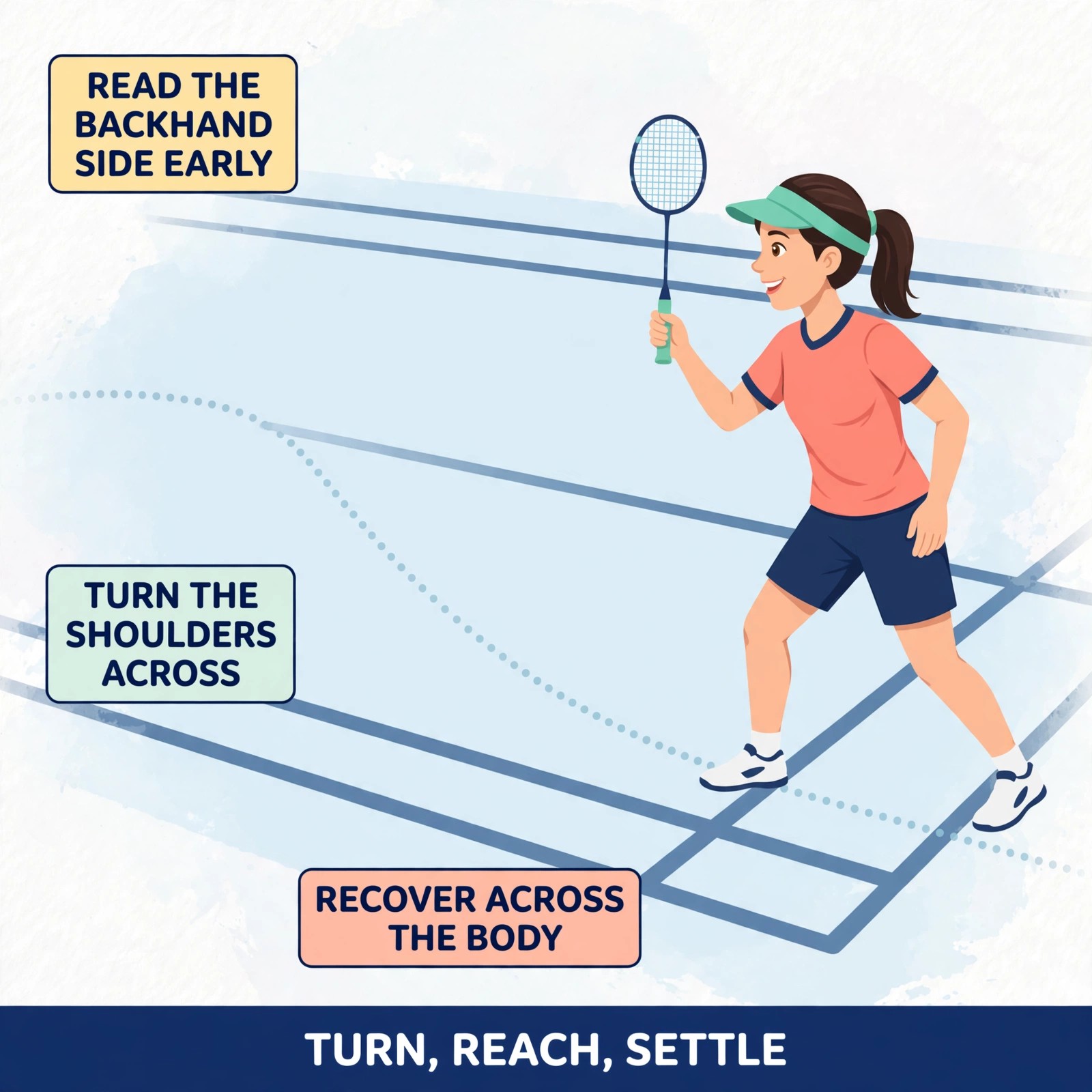
Arrival on the backhand side is a turn, not a reach. The read comes early, the shoulders turn across as the player moves back, and the racket side stays available rather than trailing behind the body; the last steps take the player behind the shuttle’s line with the balance set, so the racket can meet the shuttle in front of the shoulder instead of beside the ear. Players who arrive still facing the net play the shot across their own chest, and the face never gets behind the bevel properly. In training we score the arrival with the shot: a backhand smash only counts when the striker is turned, settled and meeting the shuttle in front. The pattern feels slow for a week and then, quietly, the steep ones start arriving.
The recovery from a backhand smash crosses the body, which is why the shot’s cost is counted in the rally, not the highlight. The follow through finishes in front, the turned shoulders have to reopen toward the court, and the first step back to base starts later than after a forehand from the same corner. The trained pattern accepts this honestly: strike, let the follow through end in front of the body, push back toward the middle with the racket recovering up, and expect the reply to test the forehand side you turned away from. In doubles the partner’s cover is part of the pattern, called before the shot when the position allows. A backhand smash that wins the point and loses the next two was a loan, and training counts it as one.
Care with the arm is part of this shot’s technique, not an afterthought. The backhand smash loads the forearm, elbow and shoulder through a short lever at speed, and sensible training treats volume as a budget: quality sets counted in tens, stopped when the shape goes, never ground out in hundreds. Claims about this shot are kept honest here: good shape and sensible volume lower the risk of straining the arm, they do not remove it, and pain during or after backhand work is a stop signal, not a milestone. A player whose arm complains repeatedly, or whose pain is sharp, worsening or slow to settle, should have it assessed by a doctor or a physiotherapist before building the shot further. The shot will wait. Arms are less patient.
Backhand Check #5
Backhand Smash Drills That Build The Shape
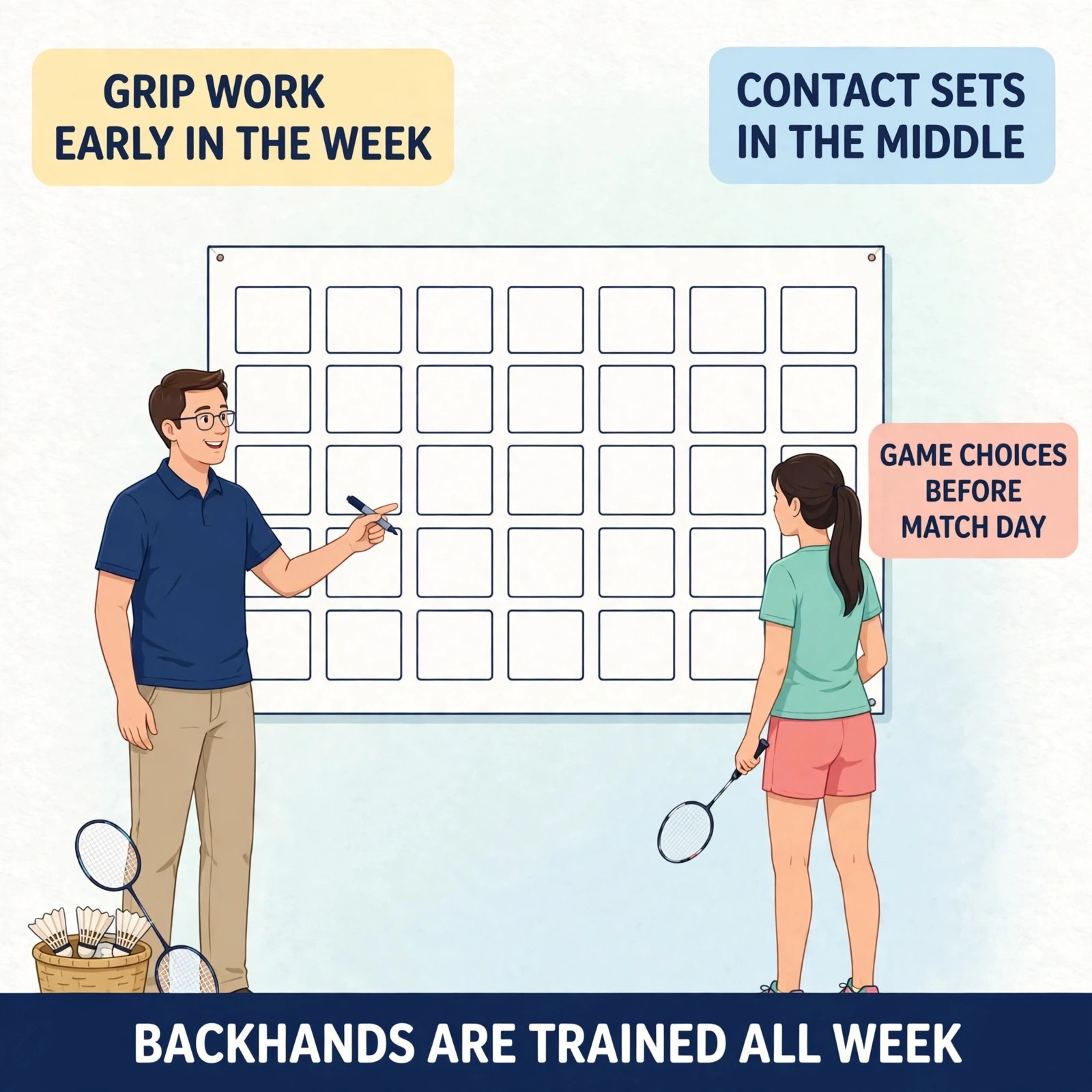
We train the backhand smash in an order that protects the shape. First, grip and wall work: the thumb on the bevel, the short turn grooved without a shuttle until the hold is the default the hand finds itself. Second, contact sets: feeds high to the backhand side, landings counted inside the area, contacts filmed or called for height. Third, choice sets: feeds split between the round the head line and the backhand line, the striker deciding early and the calls graded with the shots. Last, game sets: the shot allowed inside rallies, used rarely by design, with forced backhand smashes scored against the striker. Each stage removes a hiding place the stage before left standing.
Progress is counted in steepness and landings, not in how hard the shot felt. Landings inside the area out of ten is the headline figure every backhand smasher should know about herself. The error split is kept beside it: into the net, long, and wide counted separately, because each points at a different repair, contact height, face angle or target choice. And the decision split: backhand smashes chosen when the forehand was honestly gone against backhand smashes chosen for show, graded by a coach watching the rally. Feelings are unreliable witnesses on the backhand side, since a forced one that scores feels like genius. The counts strip the story away. When area landings rise and forced choices fall, the shot is genuinely improving.
The signs a backhand smash has taken hold are mostly quiet. Front players start standing a half step closer to the net against you, because the deep backhand corner has stopped being a safe address, and that half step is room your clears and drops will spend later. Your own errors change shape: the misses become landings a fraction long of the area rather than floaters the front player steps into, the errors of a shot living near its limits. And the shot appears less often in your matches while mattering more, which sounds backwards and is the surest sign of all: rescue finishes are judged by the rallies they save. That is when the work widens, to the backhand drive and the crosscourt backhand drop off the same grip and shape.
Myth vs Reality
Myths About Backhand Smashes
Myth: the backhand smash should hit nearly as hard as a forehand smash, and a player whose does not is doing it wrong. Reality: the levers are different lengths and the numbers were never going to match. The forehand smash is powered by the legs, the trunk turn and a long arm chain; the backhand version runs on a forearm turn, a finger squeeze and a thumb. What the backhand smash offers instead of pace is angle: struck high and in front, it dives steeply into areas the front player is not covering, and steepness scores points pace cannot reach. Players who chase forehand numbers on the backhand side swing longer, arrive later and float the shot they were trying to strengthen.
Myth: the backhand smash is swung like a forehand on the other side, with the same big arc mirrored. Reality: the mirrored swing is the floater’s recipe. A long arc across the body gives the front player a full read, drags the contact beside the shoulder, and turns the face the wrong way at the moment it matters. The trained shape is compact: turned shoulders, short lever, forearm rotation, the thumb behind the bevel, contact high and in front. It looks like less and produces more, because everything in it serves the two things the shot owns, the early contact and the steep angle. Film a good backhand smash beside a good forehand smash and they share almost nothing except the shuttle’s direction.
Myth: because the backhand smash is a weapon, players should hunt it, choosing it whenever the shuttle visits the backhand half. Reality: hunting it dismantles the rally it was meant to rescue. Every backhand smash chosen over an honest forehand trades power, margin and recovery for theatre, and opponents learn quickly: they feed the backhand corner on purpose, watch the forced reply float, and step in. The shot’s value is precisely its rarity inside a forehand first game: it answers the one shuttle in twenty that passes the forehand’s honest reach, and it answers it steeply. Players who use it rarely are feared for it. Players who use it constantly are fed it, which is a different thing entirely.

Why Choose Us
Why Players Choose ST Badminton Academy
Players choose ST Badminton Academy for backhand smash work because we coach the shot at its real size: a specialist finish with a specific grip, a counted contact and honest targets. Your thumb placement is checked before your angle is admired, your landings inside the area are counted out of ten with the errors split beside them, and your choices between the forehand and the backhand are graded in rallies, so the shot stays a rescue and never becomes a habit. In a group of no more than four students, there is time to stand at the side and call your contact height shot by shot. Many sessions admire the spectacular. We also count it, because the player whose numbers are honest knows exactly what to train next.
The sessions run the way this page describes. Backhand smash work sits inside regular training: grip work early, contact sets with landings called aloud and error types split, choice sets against feeds on both lines, and game sets where the shot is allowed but forced uses count against the striker. Coaches watch the thumb and the contact height together, since the shot fails when either one goes, and the notebook records area landings out of ten and the forced choice count for every backhand block. Volume is kept honest too: sets stop when the shape goes, because the arm’s budget is part of the plan. A student can point to the week her net errors halved, and to the drill that did it.
We are based in Setapak, Kuala Lumpur, and students join us from across the Klang Valley, some travelling in from Wangsa Maju, Gombak and Setiawangsa for evening sessions. Backhand coaching sits inside regular badminton sessions, not in a separate trick shot clinic: your grip, your contact and your choosing are trained in the same hour as your forehand overheads, your defence and your games, because that is where the shot has to hold, against lifts placed in the corner on purpose. A backhand smash grooved only against friendly feeds is a rumour about yourself. The choice sets in the same hour settle whether it is true.
FAQs: Backhand Smash And Badminton Training in Malaysia (KL)
These are the questions players ask us most about developing a backhand smash, before they book and during their first weeks of working on it. The short version runs through all of them: thumb on the bevel, contact high and in front, targets as areas, and the shot kept rare. The longer answers follow, including the ones about the shot floating under pressure, practising the grip and the turn alone without a feeder, and how a first session with us actually works.
Can a beginner learn an honest backhand smash in training in Setapak or Gombak?
Yes, with honest expectations. The backhand smash is a grip, a turn and a timing rather than a strength contest, so beginners who can already play a backhand clear have its base. Start with grip and contact work in our Setapak sessions, in groups of no more than four students, and count steep landings early.
What is the first backhand smash habit a new player should build in KL?
The first habit is the grip: backhand hold, thumb resting up the wide flat bevel of the handle, the handle sitting in the fingers rather than clenched in the palm. The forearm turn, the squeeze and the thumb push all hang on that placement, and the shuttle starts leaving downward within one feeding set.
Why do my backhand smashes keep floating at a serious level?
At a serious level the decision goes late: players drift toward the corner still hoping for the forehand, arrive with the shuttle dropping beside the shoulder, then swing across the body to rescue it, and rescued swings float. Around the same games the aim creeps toward the sideline, so the errors multiply.
My backhand smash works in drills but floats in matches. Should I swing harder or rebuild the grip first?
Rebuild the grip first. Harder swings with a borrowed grip only make the floaters arrive faster. We restore the thumb on the bevel and the contact high in front, count ten landings inside the area, and only then test the shot in rallies where the forehand was honestly available to refuse.
How can I practise the backhand smash when I train mostly on my own in between classes?
Yes, more than most shots. The grip and the short forearm turn can be grooved with a racket alone until the thumb finds the bevel by itself, and shuttles can be tossed and struck at a marked area inside the far front court, counting landings and splitting the errors by type.
Do you coach the backhand smash beside badminton training near Wangsa Maju?
Yes. We coach the backhand smash from our base in Setapak, a short drive from Wangsa Maju, and players from that side train with us every week. The work sits inside regular sessions rather than a separate clinic, so your grip, contact and choosing are coached beside your forehand overheads and games.
Where does ST Badminton Academy teach badminton training in Malaysia?
We teach at our base in Setapak, Kuala Lumpur, and students travel in from across the Klang Valley. Sessions run with no more than four students per group, because the backhand smash is learned from contact heights and landings counted shot by shot, and that coaching needs a coach close enough to call your turn.
How do I book a trial session to test my backhand smash?
Message us to arrange a trial at a time that suits your week. Bring your racket and court shoes, and we will watch your backhand side for the first part of the session, then feed you ten lifts to the corner and count area landings and error types, so your first repair comes from evidence.
What makes Mr Eric Chuar a suitable coach for the backhand smash in badminton?
Mr Eric Chuar coaches the academy sessions himself, with more than 15 years of coaching in Malaysia and Singapore, so the person judging your grip is the person who built the programme. His backhand coaching is plain spoken: thumb on the bevel, contact in front, targets as areas, and the shot kept rare.
Badminton Backhand Smash Training in Action


We benchmark our backhand smash coaching against World Badminton (BWF) coaching standards and our own academy values: before any player trusts a training plan, they deserve honest checks. You can verify our coaches' credentials through the Badminton Association of Malaysia (BAM) coach education pathway.
One standard governs how we coach the backhand smash: the grip judges the shot first, and the landing area judges it second. A coach here will ask how many of your last ten backhand smashes landed inside the area, and how the errors split between net, long and wide, before asking how hard any of them felt, and will check your thumb before admiring your angle. We also hold an honesty rule about what backhand coaching can promise: a trained backhand smash rescues the deep corner and finishes rallies the forehand could not reach, and it cannot promise forehand pace, because the levers are different and pretending otherwise builds floaters. What coaching promises is one honest grip, an early contact and landings counted in the open.
| Factor | The Rescue Finisher | The Theatre Smasher BACKHAND |
|---|---|---|
| Frequency | 1 or 2 times a week. Mostly for fun and sweat. | The theatre smasher treats the backhand smash as a second forehand: a borrowed grip rolled across, a long swing over the body, contacts taken beside the shoulder and targets painted on the lines. The shuttle floats often enough that front players step in for a living, and the rare steep one is remembered as proof the method works. |
| Drills Focus | Basic static feeding. Minimal footwork pressure. | The rescue approach builds the shot at its real size: thumb on the bevel, a short forearm turn, contact high and in front, targets as areas inside the far front court, and landings counted out of ten with the errors split into net, long and wide. The forehand stays the default; the backhand answers only what the forehand honestly cannot reach. |
| Physical Conditioning | Rarely included. Just playing games on court. | Core, agility, and speed training included in every session to prevent injury and build stamina. |
| Tactical Awareness | "Just hit it over." No real game plan. | Video analysis, point construction, and learning to read the opponent's game. |
| Coach Ratio | Large groups (8-10 kids). Coach barely watches you. | Max 4 students. Mr Eric Chuar personally corrects every stroke and movement detail. |
| Goal Setting | Fun and exercise. | Because the counts separate area landings from forced choices, a bad week shows up as numbers rather than as a story about courage. The coach sees which of grip, contact or choosing slipped, the player sees the same rows, and the next block of work is chosen by evidence instead of by whoever remembers the one highlight. |
| Long Term Result | Good recreational player. | The high-performance backhand smasher owns a rare, steep, honestly chosen finish struck off a specific grip and an early contact. The casual version spends effort on theatre: long swings, painted lines and forced attempts; the grooved version removes the waste in a fixed order and counts what is left. |
Badminton Backhand Smash Training in Kuala Lumpur
Your backhand smash starts with one honest set of ten. This week, have a partner feed high to your backhand corner and play ten backhand smashes at a target area in the middle of the far front court, then write down two numbers: how many landed inside the area, and how the rest split between the net, long and wide. Then bring those numbers to a session with us and we will check your thumb, your turn and your contact height, and rebuild the fault the counts point at. No bigger swing first. Just the grip, the short turn, and a shuttle diving where you chose.






