Best Holiday Camp in KL: Building a Workable School-Break Routine (Routine Guide)
Every school break arrives with the same quiet negotiation. The child hears freedom; the calendar hears empty days; the parent hears a familiar worry that the weeks will dissolve into screens and drift, or the opposite worry, that they will fill it so full of improvement that the break stops being a break. A workable routine is the middle answer, and it is a smaller thing than either fear imagines: a light frame of days a family can actually keep, with some badminton inside it, rest defended on purpose, and family time treated as an appointment rather than as whatever is left over. This guide shows how such a frame is built, honestly and without pressure.

Routine Check #1
What A Workable Routine Really Is
A routine, said plainly, is not a timetable. A timetable is a grid of obligations, every hour spoken for, kept by willpower and abandoned by the second week. A routine is a rhythm a household can hear: some days hold a session, some days hold nothing planned at all, meals and sleep sit roughly where they always sit, and the child can describe the shape of the week without a chart. For a school break that difference decides everything. The break’s job, alongside any learning in it, is rest and family weather. A frame that serves that job survives the break. A grid that fights it becomes one more thing the family quietly fails at, and children are expert at noticing which adult projects collapse.
It helps to say what a workable routine is not. It is not a training camp reconstructed at home, with drills in the garden measured against a coach’s standard. It is not a promise that a child who follows it will return to class ahead of anyone, because breaks do not work that way and children develop at different rates through them. And it is not a copy of another family’s arrangement held up as the correct one; households differ in work, siblings, grandparents and distance, and a routine is honest only when it is cut to the family actually living it. Workable is the whole standard. Not impressive, not identical to anyone’s, workable.

Routine Check #2
Inside The Frame: Fixed Points, Short Sessions, Defended Rest
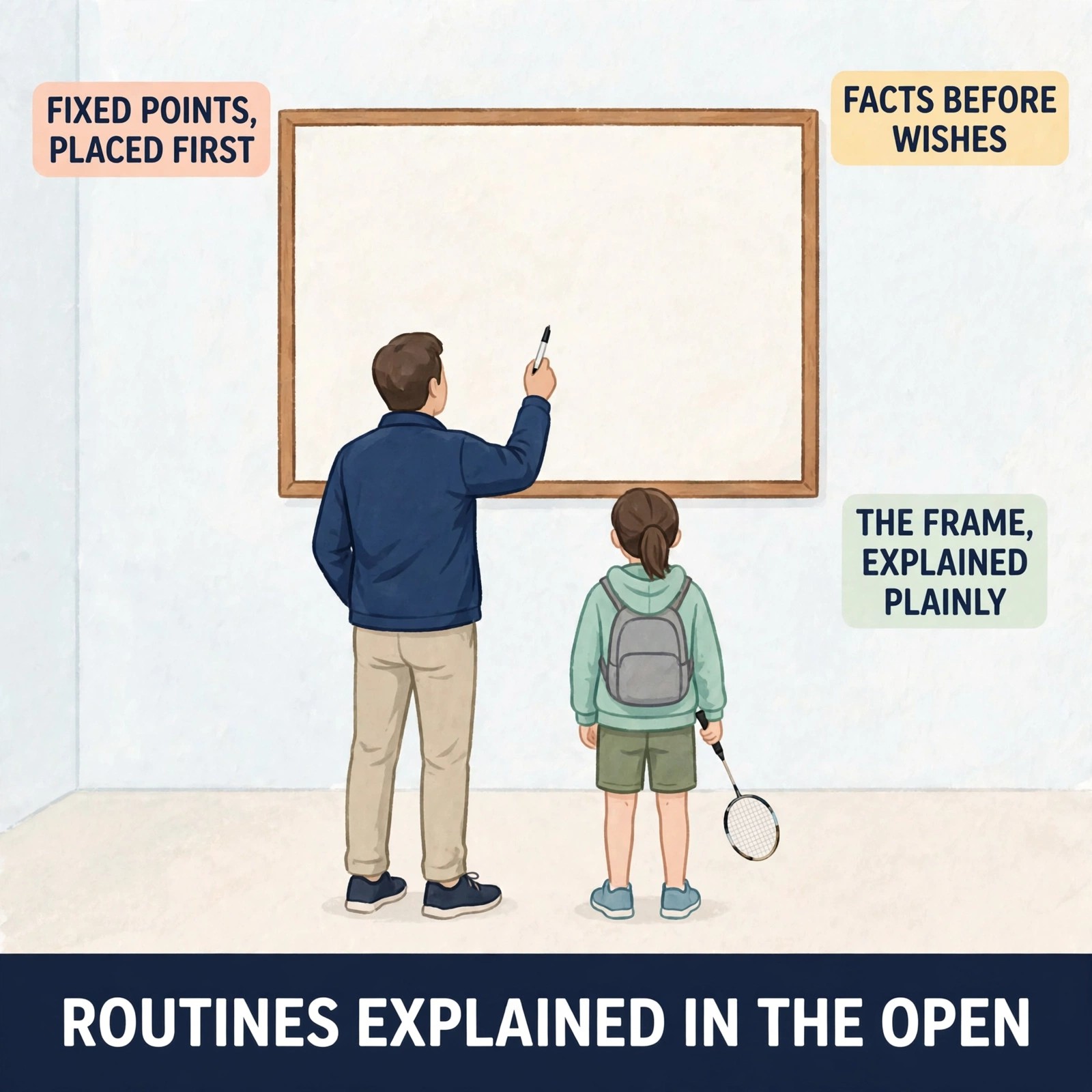
Start with the fixed points that are not yours to move, because a routine is built around life rather than over it. Work days, a sibling’s commitments, a family trip, the camp or class sessions already confirmed with the provider, each goes onto the week first, in ink. What remains is the true building material, and it is usually less than the parent feared and more than enough. Building from fixed points outward prevents the classic error: a beautiful plan drawn on an empty week that never existed, collapsing on contact with Tuesday. Ask the provider for the current arrangements and practical details in confirmed form before placing sessions in the frame, because a routine is only as honest as the facts inside it.
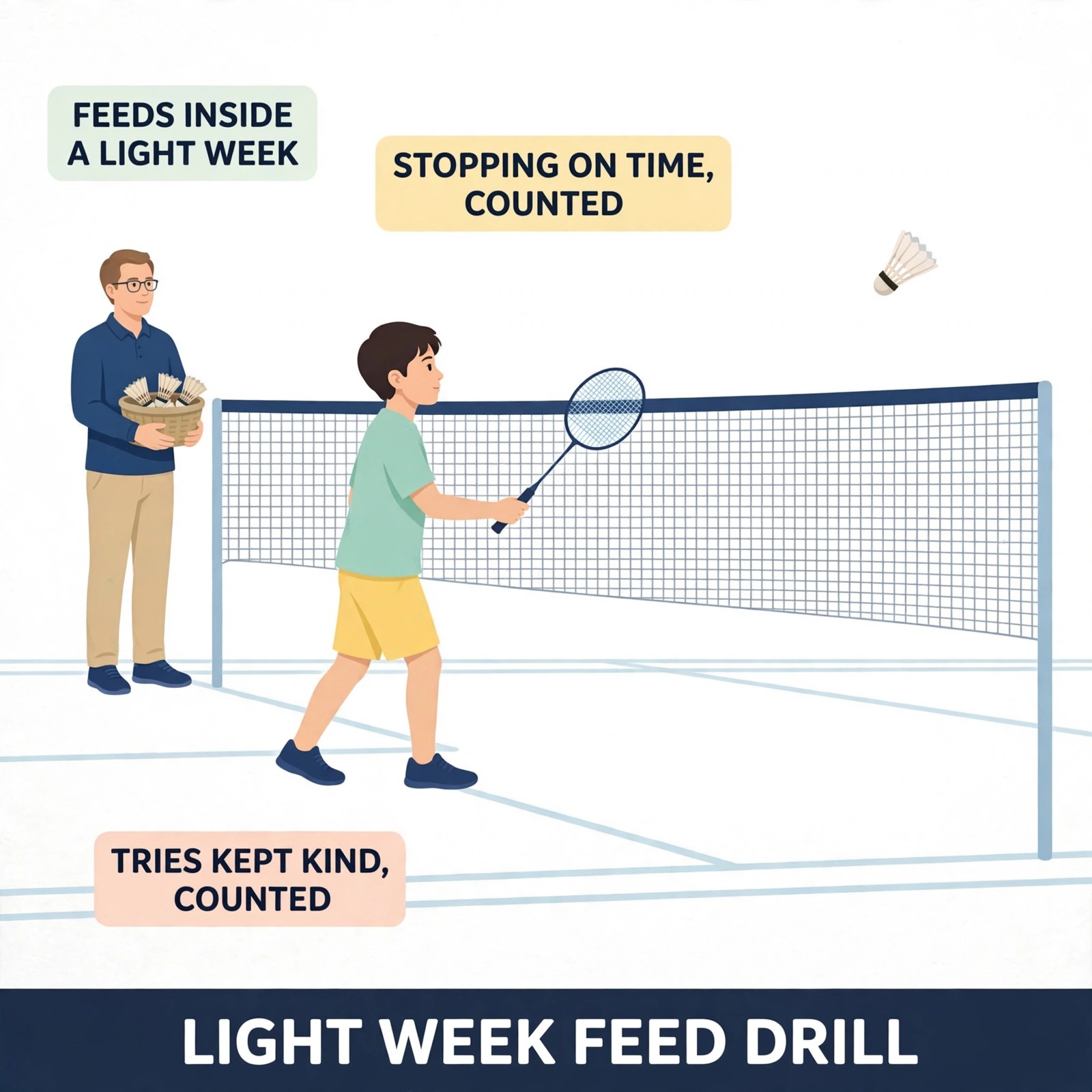
Next, place the badminton, and place it short. A session in a break week serves the learning best when it is sized like the other good things in a child’s day: long enough to be real, short enough to be finished while the child still likes it. Where a coach is involved, the session is the coach’s to shape; where the family plays together, keep it to games and simple visits of one thread at a time rather than reconstructed drills. The test of a placed session is the afternoon after it: a child who returns from the court to the break, rather than recovering from it, has been given the right size. Frequency matters less than this fit. A few sessions a child enjoys do more across a break than a daily obligation ground through out of duty.
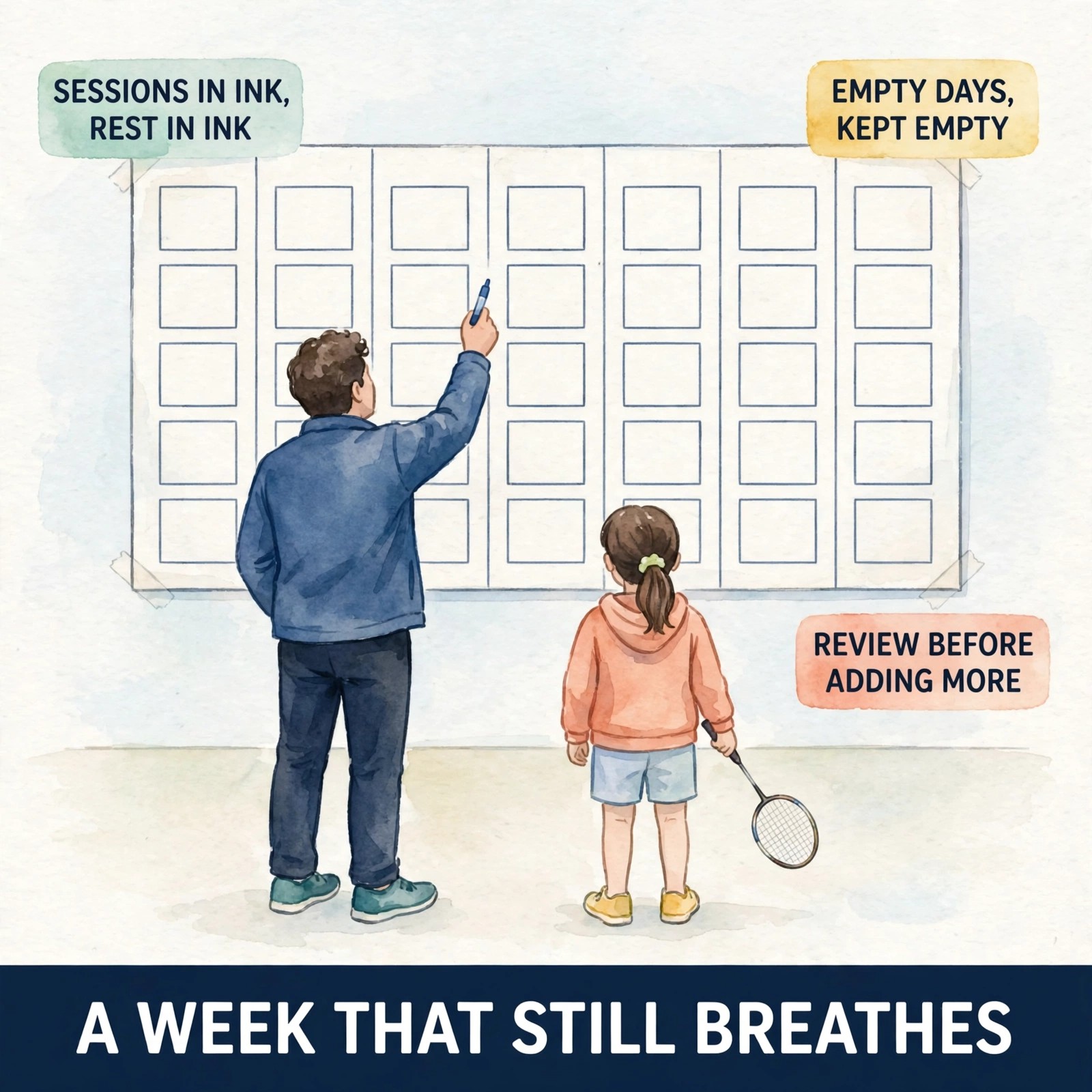
Finish by defending the empty spaces on purpose, because a routine that does not protect rest will be renegotiated by exhaustion. Mark the rest days as plainly as the session days, and let them mean it: no make up sessions creeping in, no gentle drills offered as a compromise, nothing that teaches the child the frame’s promises are negotiable whenever an adult grows anxious. Family time belongs in the same ink, a meal out, a visit, an afternoon that is nobody’s project. A break in which the good empty hours were kept is remembered by children as a good break. The sessions inside it are remembered kindly partly because they never tried to eat the whole week.

Routine Check #3
The Honest Cost: When The Break Is Spent Before It Starts
The honest cost of the packed timetable lands first on the child’s reading of the break itself. A child whose holiday arrives pre-spent, every day carrying an improving obligation, learns that rest is something adults announce and then withdraw, and starts defending their free time the way anyone defends a resource under threat: by hiding in it. Screens, so often blamed, are frequently just the bunker. The sessions inside such a break are paid for twice, once in money and once in the goodwill they need to work, because a child drilled through a crowded week brings a spent attention to every court they enter, including the good ones.
The second cost lands on the routine’s survival. A frame sized beyond a family’s honest capacity does not bend; it breaks, usually in the second week, and the breaking is total because the plan was one piece. The sessions stop, the chart comes off the fridge, and the child files the lesson that plans are things adults make and abandon. A lighter frame survives precisely because it has give in it: a session missed for a family day is absorbed, the rhythm continues, and the child learns the far more useful lesson that a plan can flex without dying. When you choose between a heroic routine and a modest one, you are choosing which lesson about promises the break will teach.
The third cost is quieter: the comparison built from other families’ breaks. Holiday conversations and group chats fill with camps attended, trips taken, skills polished, and a parent measuring their own light frame against that noise will feel it shrink. But other families’ reports are edited highlights of weeks whose hard days never get posted, and children were never consulted in the editing. Your child’s break is allowed to be modest. A few sessions, real rest, family weather, and a child who returns to term willing: that is not a small break. Measured in the currency that matters, it is a rich one.

Routine Check #4
Choosing Lightly: Building The Frame, Honestly Built
So what should a parent actually do before the break begins? Confirm the provider’s current arrangements first and put those sessions in ink. Lay the family’s own fixed points beside them. Place a small number of sessions where they genuinely fit, sized to finish while the child still likes them, and mark rest days and family time in the same ink with the same status. Then show the child the shape of the week and let them react; a child who has seen the frame and had one honest say in it keeps it far better than a child it was announced to. Finally, agree aloud what happens when a day goes sideways: the frame flexes, the week continues, nobody makes anything up in a panic.
Judge the routine by how the break feels while it is running, not by a session count at the end. The signs are plain ones: the child mentions the next session without being reminded, or at worst without flinching; rest days are actually rested in; the frame has survived one disruption without ceremony; and the family has not started negotiating against its own plan at the dinner table. Some breaks will hold more badminton than others, and that variation is the design working rather than failing. Children develop at different rates and households live at different speeds, and a routine honest about both will look different every single break.
A gentle word for the parent staring at the empty calendar feeling the two accusations trade places: leave the days empty and you are wasting the break; fill them and you are stealing it. Underneath the swing sits a wish any parent would sign: that the child rest deeply and grow a little, in the same weeks, without either eating the other. That wish is achievable at modest scale, and modest scale is exactly what a break is for. Build the light frame, keep its promises including the empty ones, and let the weeks be judged by the child who lived them. And if the worry keeps circling beyond anything the days show, it deserves a kind conversation of its own, with someone you trust.
Routine Check #5
Routine Habits That Keep A Break Kind
The routine habits in this guide are plain enough to keep on one small card. First, facts before frame: sessions enter the week only when the provider has confirmed them, and family fixed points are placed before any wishes. Second, short and liked beats long and endured: every session sized to end while the child still wants the game. Third, emptiness defended in ink: rest days and family time written with the same status as sessions, and make up creep refused kindly. A family running those three habits will find the break organises itself around them, because the habits are mostly refusals of the things that break routines rather than demands for new effort.
Notice what these habits are quietly teaching beyond the break. A child who lives inside a frame that flexes without breaking learns the adult skill no syllabus names: keeping a promise to yourself at a size you can honour. They see rest treated as a commitment rather than a leftover, and absorb the idea that their own energy is a fact to plan with, not a weakness to plan against. Parents tell us the change they noticed first was not in the badminton. It was their child, near the break’s end, describing the week as a good one in full sentences, sessions and lazy days listed side by side without apology for either.
There is a moment in most breaks when the light frame proves itself: the disrupted day. A trip runs long, a grandparent visits, the session that was inked cannot happen, and instead of the familiar collapse the week simply breathes, the frame flexes, tomorrow is still tomorrow. The child watches a plan survive contact with real life without anyone being blamed, and files it away. That is the whole ambition of this guide, stated plainly. A routine is not a monument to a parent’s intentions. It is a rhythm a family can keep on its worst week as well as its best, and a break kept that way returns a child to term both rested and still fond of the game.
Myth vs Reality
Myths About School Break Routines
The myths around school-break routines are usually numbered. The first says a break is wasted unless it is filled, as if empty days were a leak in the child’s education. Rest is not the absence of the break’s purpose; it is half of it, and a child who returns rested has gained something no session sells. The second myth says a proper routine looks the same for every family, one correct grid to be copied from whoever sounds most certain. Households differ too honestly for that: work, siblings, elders, distance and money draw different weeks, and the only grid that works is the one the actual family can keep.
A third myth claims that if a session is missed, the routine has failed and the week is written off. That belief does more damage than any missed session, because it converts a single disruption into a total surrender, and children watch it happen and learn that plans die at the first obstacle. A frame built with give in it treats a missed session as weather: noted, absorbed, the rhythm continuing. Which of those two lessons a break teaches about promises is decided by the routine’s size long before the disruption arrives. Build small enough to flex, and the break teaches resilience by example rather than by lecture.
The truth underneath the myths is modest. A workable routine is a light frame of confirmed sessions, family fixed points and defended rest, cut to the household that will live it, and flexed rather than abandoned when life leans on it. Here, the promise is checkable before the break starts. Ask us what a realistic break rhythm around our sessions looks like for a family like yours, and ask for the current arrangements and practical details in confirmed form, so the frame is built on facts. Judge any plan, including one we sketch with you, by whether it survives your family’s worst ordinary week on paper. If it cannot survive the paper, it will not survive the break.

Why Choose Us
Why Players Choose ST Badminton Academy
Families choose this academy for the teaching first, and the teaching is planned in the same spirit as this guide: groups kept small, tasks sized per child, and no family asked to organise its life around our timetable. Sessions here are confirmed plainly and in good time, so a parent building a break frame knows exactly which facts are ink and which arrangements are still being settled, and nothing in our pages pretends a schedule exists before it does. For a routine builder, that plainness is the practical heart of the matter. You cannot frame a week around fog.
Parents also choose how the frame is respected here. A child arriving from a rested break is received as a rested child, not interrogated about the sessions they did not do; a family that kept two sessions and four lazy days will hear the two sessions discussed, not the four days audited. Nobody will suggest your break failed a standard, sell you a denser one for next time as the price of belonging, or describe another family’s arrangements as the measure of yours. The agreement runs both ways: families tell us honestly what the break can hold, and the academy fits its teaching inside that honesty rather than against it.
There is a final reason that grows on families across the years of breaks. Children develop at different rates, and breaks are where the differences are kindest: one child’s break holds a camp and cousins and daily garden games; another’s holds two sessions and a great deal of doing nothing beautifully. Both children return to the same class and both are met inside their own line, against their own starting point, with no league table of holidays consulted. Parents tell us the relief they felt first was describing a modest break at the gate without apology, and finding the description received as a plan rather than as a confession.
FAQs: School Break Routines and Camp Weeks in Malaysia (KL)
These are the questions parents ask us most about building a school-break routine, before a break begins and while one is being planned. The short version runs through all of them: facts before frame, sessions short and liked, rest defended in ink. The longer answers follow, including how sessions are confirmed here, and how to ask us about current arrangements.
Can a light routine really hold a school break in Setapak or Gombak?
Yes, provided workable is the standard. A light frame of confirmed sessions, family fixed points and defended rest survives a real break, including its disruptions. Judge it by whether the week still breathes in its second half, not by how full the first sketch looked on the fridge door.
What should a parent fix first when building a break routine in KL?
Fix the facts first: the provider’s current arrangements in confirmed form, then your family’s own fixed points, work, siblings, trips. Place a small number of sessions where they genuinely fit, sized to end while your child still likes them, and write rest days in the same ink.
Why do packed holiday timetables worry parents at a junior level?
Because a packed break reads as a promise the family must keep under pressure, and parents can feel the second week coming. The worry is arithmetic: too many obligations, one child, finite goodwill. A lighter frame answers it, because the plan was sized to the household from the start.
Our break is mostly empty. How much badminton should we actually place in it, honestly?
Less than instinct suggests, and sized kindly. A few sessions your child genuinely enjoys, placed where the week has room, will carry the game warmly through a break. Daily obligation usually buys resistance instead of progress. Children develop at different rates; the right amount is the amount your family can keep happily.
How can parents keep a routine kind at home in between sessions?
Protect the frame’s promises, including the empty ones. Keep rest days rested, refuse make up creep kindly, and let family time hold its appointment status. When a day goes sideways, flex and continue rather than surrendering the week. Your child learns more from a plan that bends than from one that breaks.
Do you welcome routine questions beside badminton training near Wangsa Maju?
Yes, gladly. Tell us honestly what your break can hold, work shifts, siblings and all, and we will help you frame our confirmed sessions inside it. Nobody here will sell you a denser break as the price of belonging, or audit the lazy days your family kept on purpose.
Where does ST Badminton Academy teach badminton training in Malaysia?
We teach at our base in Setapak, with classes in the Setapak and Wangsa Maju area and in Singapore. Mr Eric Chuar coaches the academy sessions himself, with more than fifteen years of coaching in Malaysia and Singapore, and sessions are confirmed plainly so families can plan real weeks around them.
How do I book a trial session to test my child’s fit inside our break routine?
Message us with the shape of your break as it truly is. We will arrange a trial session, confirm the current arrangements and practical details directly, and help place it inside a frame your family can keep, rest days and family time written in the same ink.
What makes Mr Eric Chuar a suitable coach for children in light break routines in badminton?
He coaches the academy sessions himself, in small groups, and plans them to be kept: tasks sized per child, sessions confirmed in good time, and no family asked to organise its life around our timetable. He receives rested children warmly and never audits what a break left empty.
Workable Routine Coaching in Action


We benchmark our workable routine coaching against World Badminton (BWF) coaching standards and our own academy values: before any player trusts a training plan, they deserve honest checks. You can verify our coaches' credentials through the Badminton Association of Malaysia (BAM) coach education pathway.
One standard governs breaks here: no family is handed a timetable to obey, and no break is graded. We confirm our sessions plainly, fit the teaching inside the family's honest frame, and receive rested children without auditing their empty days. We also hold an honesty rule about what a routine can do. A light frame can keep a break kind and keep the game warm; it cannot promise a child will return ahead of anyone, progress at any named speed, or love a schedule that was built for a different family, and a provider who implies otherwise is selling something other than teaching.
| Factor | The Light Frame Hall | The Packed Hall ROUTINE |
|---|---|---|
| Frequency | 1 or 2 times a week. Mostly for fun and sweat. | The packed hall fills the break before it starts: every day carrying an improving obligation, rest announced and then withdrawn, and a chart on the fridge that collapses in the second week, teaching the child that plans are things adults make and abandon. |
| Drills Focus | Basic static feeding. Minimal footwork pressure. | The light frame hall builds from fixed points outward instead: confirmed sessions in ink, a few sessions sized to end while the child still likes them, and rest days and family time written with the same status as sessions, so the frame flexes under disruption instead of breaking. |
| Physical Conditioning | Rarely included. Just playing games on court. | Core, agility, and speed training included in every session to prevent injury and build stamina. |
| Tactical Awareness | "Just hit it over." No real game plan. | Video analysis, point construction, and learning to read the opponent's game. |
| Coach Ratio | Large groups (8-10 kids). Coach barely watches you. | Max 4 students. Mr Eric Chuar personally corrects every stroke and movement detail. |
| Goal Setting | Fun and exercise. | Because the count is sessions kept happily, rest days actually rested in and frames that survive a disrupted day, real routine shows up as numbers rather than as guilt. The family sees whether the facts, the sizing or the defending was off, and one part of the frame is repaired instead of the break being written off. |
| Long Term Result | Good recreational player. | The high-performance version produces a child who returns to term rested and still fond of the game. The casual version spends the break on obligations; the light frame version removes the guesswork in a fixed order and counts what each week actually held. |
Workable Routine Coaching in Kuala Lumpur
Your start can be one honest sketch before the break: the confirmed sessions in ink, your family's fixed points beside them, a few sessions sized to be liked, and rest written in the same ink. Send us the shape if you like and ask whether it sits well around our sessions, and ask us for the current arrangements and practical details in confirmed form before anything is placed. Bring the week as it truly is, work shifts and grandparents and all. We will help you frame that week, not an imaginary one.






