Best Badminton Coach in Malaysia: When the Teaching Language Is Hard to Understand
When a child finds the teaching language difficult, start by identifying the exact instruction that is unclear. Ask the coach to connect a short cue to a demonstration, then check what the learner understood. Speaking confidently and understanding a badminton task are different things. Families searching for the best badminton coach in Malaysia may use English, Malay, Mandarin or another language at home. That background deserves consideration without assumptions about the child’s ability or a promise that every class supports every language. This guide offers practical questions for discussing badminton training at ST Badminton Academy in Kuala Lumpur or another provider. Confirm actual teaching arrangements with the academy. Images are AI-generated teaching illustrations showing generic people, not photographs of Eric Chuar or actual students.

Locate the missing meaning
Which part of the instruction is actually unclear?
A general statement such as ‘my child does not understand English’ may hide several different questions. The child might know ordinary conversation but not a particular badminton word. Another learner may recognise the words yet be unsure which action the coach expects. Ask about one real instruction and the activity in which it was used. What did the child hear? What did the child think it meant? This gives the coach a useful place to begin, rather than treating the family’s language background as a complete explanation of every difficult attempt.
Listen without turning the conversation into a language examination. A child can describe the uncertain part in familiar words, point to the relevant place or show where they became unsure. These responses provide information; none should be treated as a diagnosis of ability. The parent can help convey the question at a suitable time. Avoid demanding that the child repeat a technical phrase perfectly before receiving help. The immediate teaching purpose is to make an activity understandable enough to attempt, while respecting the coach’s responsibility for the lesson.

Connect words to a visible task
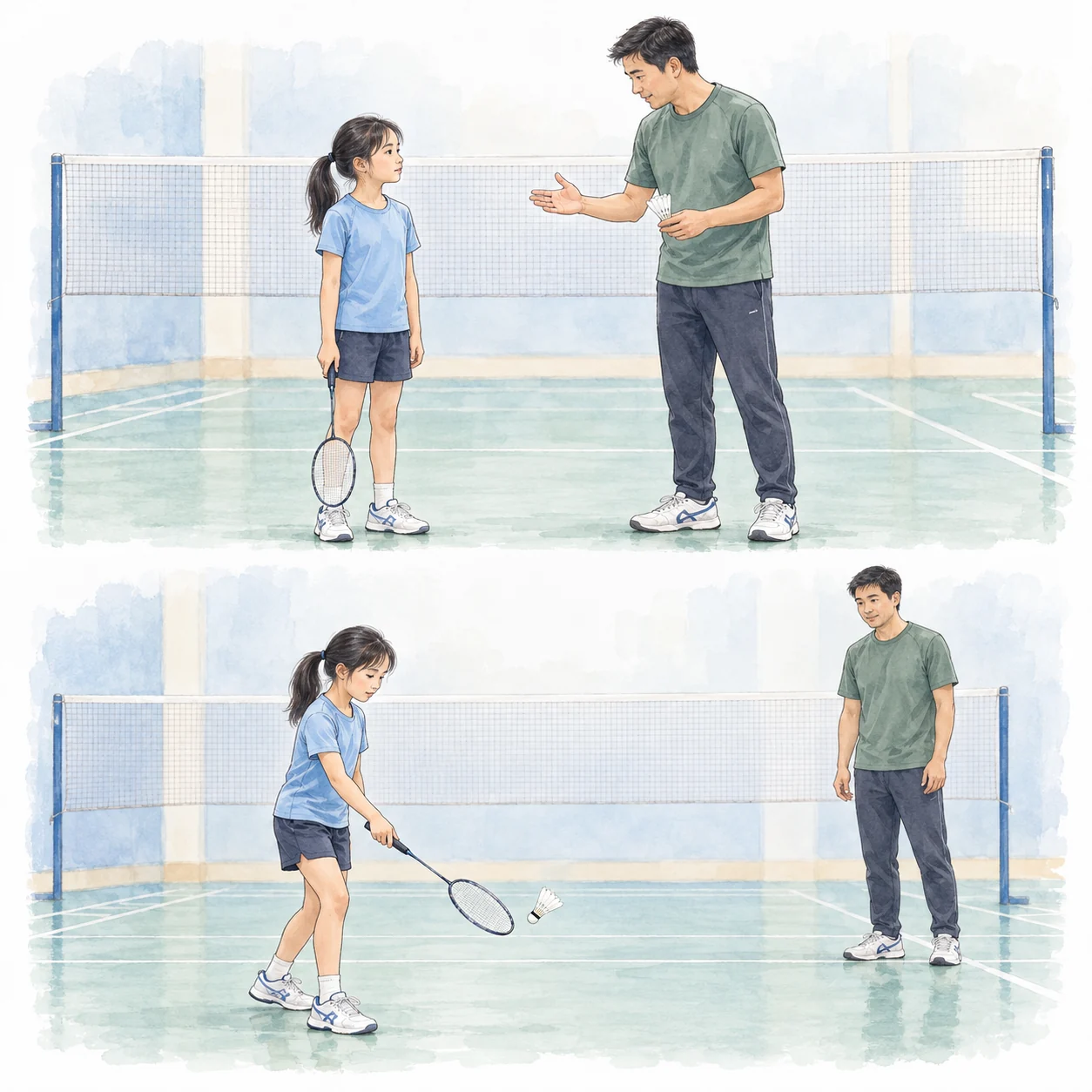
Can a demonstration make one instruction more concrete?
A demonstration can help connect an unfamiliar word to the task being taught. Ask what the child should notice rather than expecting the learner to copy every visible detail at once. The coach might demonstrate a starting action or point out the agreed area for a simple activity. These are examples, not instructions for a particular stroke. The useful link is between the short explanation, the relevant visual detail and the learner’s next attempt. Watching a skilled performance alone does not establish that a beginner understood its purpose.
Let the coach choose a suitable demonstration and a safe place to observe it. Parents should not step onto a playing area to recreate an explanation without agreement. If the demonstration leaves the child unsure, ask which part could be shown again or explained more simply. More elaborate movement does not necessarily make meaning clearer. A smaller example may be easier to connect to the current question. The family can notice whether the words and the activity match, rather than judge the lesson by how impressive the coach’s demonstration looks.

Use a shared cue
How can the learner recognise the same meaning next time?
After the task is explained, agree the short cue the child should use in that activity. A familiar phrase can help a learner recognise the intended action without processing a long new sentence during every attempt. Ask the coach how the cue relates to the demonstration. This is not a request to translate a whole training manual on the court. It is a question about one manageable instruction. The phrase should be connected to an understood task, rather than becoming a word the child recites correctly while remaining unsure what to do.
Where appropriate, a parent can explain how the child describes the task in a home language. Present that wording as helpful context, not an instruction that the coach must adopt without checking. Everyday translations can lose a technical meaning or introduce another interpretation. Confirm the intended action with the responsible coach before treating two phrases as interchangeable. The aim is a shared meaning for this activity. It is not necessary for every adult to use exactly the same sentence, provided the child is not left with competing directions.

Check understanding gently
What tells you more than a polite nod?
A nod, smile or repeated phrase can show engagement without demonstrating complete understanding. Ask how the coach checks that the instruction arrived as intended. The child might describe the purpose in simple words or show an agreed starting action. The check should fit the learner and the task; it does not need to become a public performance. A quiet child should still have space to communicate uncertainty. Understanding can be discussed without insisting on confident speech in front of the entire group.
Parents can notice whether a question receives a usable response and whether the learner knows what to try afterwards. Avoid interrupting every attempt to ask for a translation or explanation. That can add another layer of instructions while the coach is already observing the task. Agree a suitable opportunity to discuss an unclear point. If the child has misunderstood, clearer wording or another demonstration may be appropriate. The response should address the missing meaning rather than simply increase volume, speed or the number of reminders.

Keep one teaching direction
Should a parent translate throughout the session?
Do not assume that continuous translation from the sidelines is the best arrangement. Ask the provider how communication can be supported while the coach supervises the activity. A parent may be able to help with an initial question, but actual classroom arrangements differ. Confirm what is permitted and what the child should do when an instruction is unclear. This protects a coherent teaching direction and helps the family understand its role. It also avoids promising a particular translation service that the academy has not confirmed.
If a parent is helping with meaning, keep the task and the coach’s intended cue intact. Adding a second technical opinion is different from translating an explanation. The child should not have to combine an English instruction, a different home-language correction and advice from another spectator during one attempt. Clarify uncertainties with the coach at an appropriate time. When wording seems inconsistent, identify the actual activity and expected action before deciding which sentence is right. A shared cue can reduce confusion without requiring adults to agree on every technical expression.
Explain practical communication needs before joining a programme. Mention the language the child is most comfortable using and the type of instruction that has been difficult. Ask what support is realistically available in the relevant class or camp. Do not infer that a multilingual website guarantees a teacher who speaks every website language in every session. Written information, coaching language and individual staffing arrangements are separate questions. Confirm them directly so the family can judge suitability using current facts rather than assumptions.
Review the learning connection
How can you tell whether the explanation is becoming useful?
Review the same teaching question after suitable practice opportunities. Can the child recognise the cue, describe the task or begin an appropriate attempt with the agreed support? Ask the coach which observation is relevant. A learner may understand an explanation before being able to perform consistently, so do not use every missed shuttle as proof of a language problem. Equally, one successful shot does not confirm that all instructions are clear. Keep the words, the task and the amount of assistance visible when discussing what has changed.
There is no universal number of lessons after which a child must understand every badminton term in another language. Discuss a realistic next check tied to what was actually taught. If confusion remains, bring a specific example instead of saying the child cannot learn. The coach may need to simplify wording, demonstrate a detail or reconsider the starting activity. The family can also reassess whether the confirmed communication arrangements are suitable. A constructive review identifies the next teaching question without making the child responsible for solving the adults’ communication difficulties.

Choose using relevant evidence
What should families ask a badminton academy in Malaysia?
When comparing a badminton class for kids, ask how the coach handles an instruction the child does not understand. Can a short explanation become clearer? Is the learner given an appropriate way to ask or show uncertainty? Does the next task connect to that explanation? Playing experience and qualifications provide background, but these teaching responses still deserve attention. A former national player may communicate very well with beginners; the title alone does not answer the question. Assess what happens in the actual learning situation rather than rank coaches by the language of an advertisement.
Families enquiring with ST Badminton Academy can describe the child’s experience, preferred communication language and one unclear teaching example. Ask about current badminton coaching arrangements in Kuala Lumpur and how the starting task would be discussed. The application provides information for that conversation; it does not confirm a place, a particular staff language or a learning result. The best next step is to match the learner’s needs to arrangements that have actually been explained. A multilingual page can help you read about the programme, while direct questions establish what the relevant session can offer.
Teaching language in badminton: questions parents can use
Language support should make a real task clearer. These answers organise a conversation with a coach; they do not announce the languages available in any particular STBA class.
Does everyday English fluency guarantee understanding of badminton instructions?
No. A child may understand conversation but be unsure about a particular cue or when an action belongs in the current task. Ask about one instruction and what the learner thought it meant. The coach can connect the explanation to an appropriate demonstration or check, rather than assume conversational confidence settles every teaching question.
What should I ask when my child says the coach’s words are confusing?
Ask which instruction was unclear and which activity it belonged to. Let the child describe the uncertain part using familiar words or a simple demonstration. Convey that question at a suitable time. This provides a useful starting point without turning the child’s language background into a broad judgement about badminton ability.
Is copying the coach’s demonstration enough?
Not necessarily. A learner may copy visible movement without understanding its purpose. Ask what detail the child should notice and how it connects to the next attempt. A smaller demonstration can sometimes answer the question more clearly than a full performance. The responsible coach chooses an appropriate example for the actual task.
Should the cue be translated word for word?
Confirm the intended action first. A literal translation can miss the meaning of a technical instruction. Familiar wording can provide context, but ask the coach whether it describes the same task. The goal is a shared understanding that the learner can use, rather than identical sentences that sound correct but suggest different actions.
Does a nod show my child understood everything?
A nod can reflect recognition, politeness or partial understanding. A suitable explanation or starting demonstration can provide more information. Ask how the coach checks meaning without making it a public language test. The child should have a respectful way to show uncertainty and receive a clearer next instruction.
Can I translate continuously during class?
Ask the provider about the actual arrangement before assuming that role. Continuous sideline translation can add competing directions while the coach is supervising. A short agreed contribution may help in some circumstances, but it should preserve the intended task. Confirm how the child can ask for clarification and when a parent can discuss a question.
Does a nine-language website mean every coach speaks nine languages?
No. Website translations describe written information; they do not establish the languages available in every session. Ask directly about the relevant class, current staffing and communication support. Do not treat a translated page as a promise of a particular teaching language or an interpreter throughout the lesson.
How should we review whether communication is improving?
Connect the review to the task actually taught and the support provided. Ask whether the child can recognise the cue, explain its purpose or begin the agreed activity. Do not use a universal lesson deadline or one missed shot to judge all understanding. A specific remaining question is more useful than a fixed label.
What information should I give STBA about language needs?
Share the learner’s experience, the language they are comfortable using and one instruction that has been difficult. Ask what current arrangements are available for the relevant programme. The application begins an enquiry, not a confirmation of staff language, a place or a guaranteed result. Use the response to assess practical suitability.
Teaching illustrations: shared meaning and a clear next task
Four steps for a clearer teaching conversation
Identify one unclear instruction in its actual activity. Ask the coach to connect a short explanation with an appropriate demonstration. Agree a cue that the learner can recognise, then discuss a suitable way to check understanding. Keep this conversation separate from a public language test or an extra technical lesson from the sidelines. Confirm available communication support before deciding whether the class arrangement meets the child’s needs.
| Situation | Adds confusion | Supports understanding Compare the meaning |
|---|---|---|
| Starting question | Treat language background as a complete explanation | Identify one unclear instruction and its task |
| Demonstration | Expect copying every movement to prove understanding | Connect a relevant detail to the next attempt |
| Home wording | Add a competing correction during practice | Check that the familiar phrase has the intended meaning |
| Learner response | Assume every nod means full understanding | Allow a suitable explanation or starting demonstration |
| Parent support | Assume continuous translation is always permitted | Confirm the provider’s actual arrangement |
| Website language | Assume all staff speak all website languages | Ask about the relevant session’s communication |
Ask about a badminton class your child can understand
Looking for badminton coaching in Malaysia while your child is more comfortable with another teaching language? Tell ST Badminton Academy about the learner’s experience and a specific instruction that has been difficult. Ask what current arrangements can support a clear starting task in Kuala Lumpur. Confirm the relevant session’s communication approach and suitability before making plans. An application opens the discussion; website translations do not guarantee a particular coaching language or available place.