Win At Mixed Doubles With Proven Badminton Tactics (Mixed Doubles Guide)
Mixed doubles is the most tactical game in badminton. Two pairs stand on the same court, but the rallies are not won by the two best players. They are won by the pair with the clearer plan: who owns the net, who covers the back, who takes the shuttle down the middle, and how the pair attacks the space between the opponents. A strong mixed pair looks simple from the stands because every rally has been agreed before it starts. This guide covers mixed doubles tactics the way we coach them at ST Badminton Academy in Setapak, Kuala Lumpur: the two shapes, the serving plan, the calls, and how to read and adjust against a real pair.

Pair Check #1
Why Mixed Doubles Is a Different Game
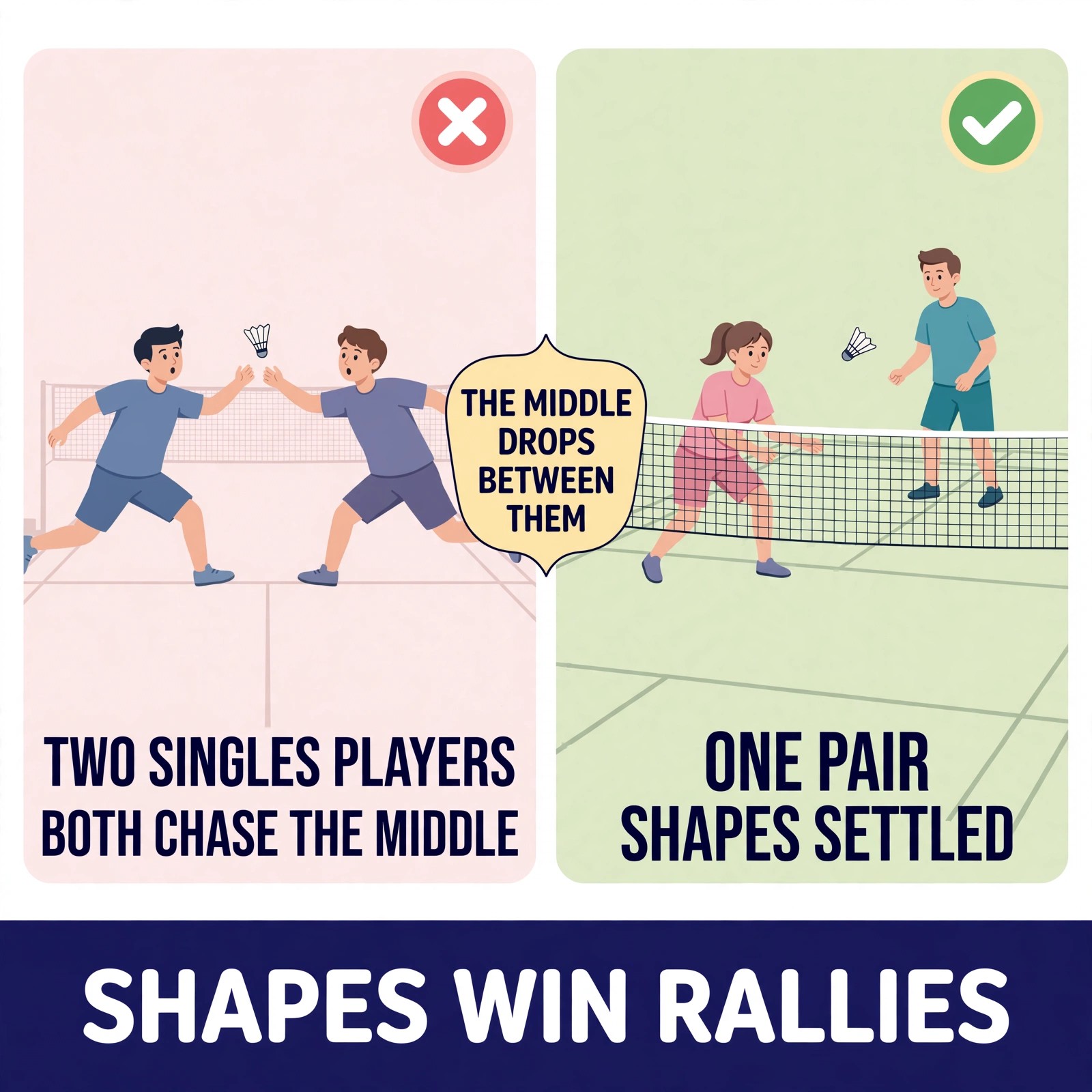
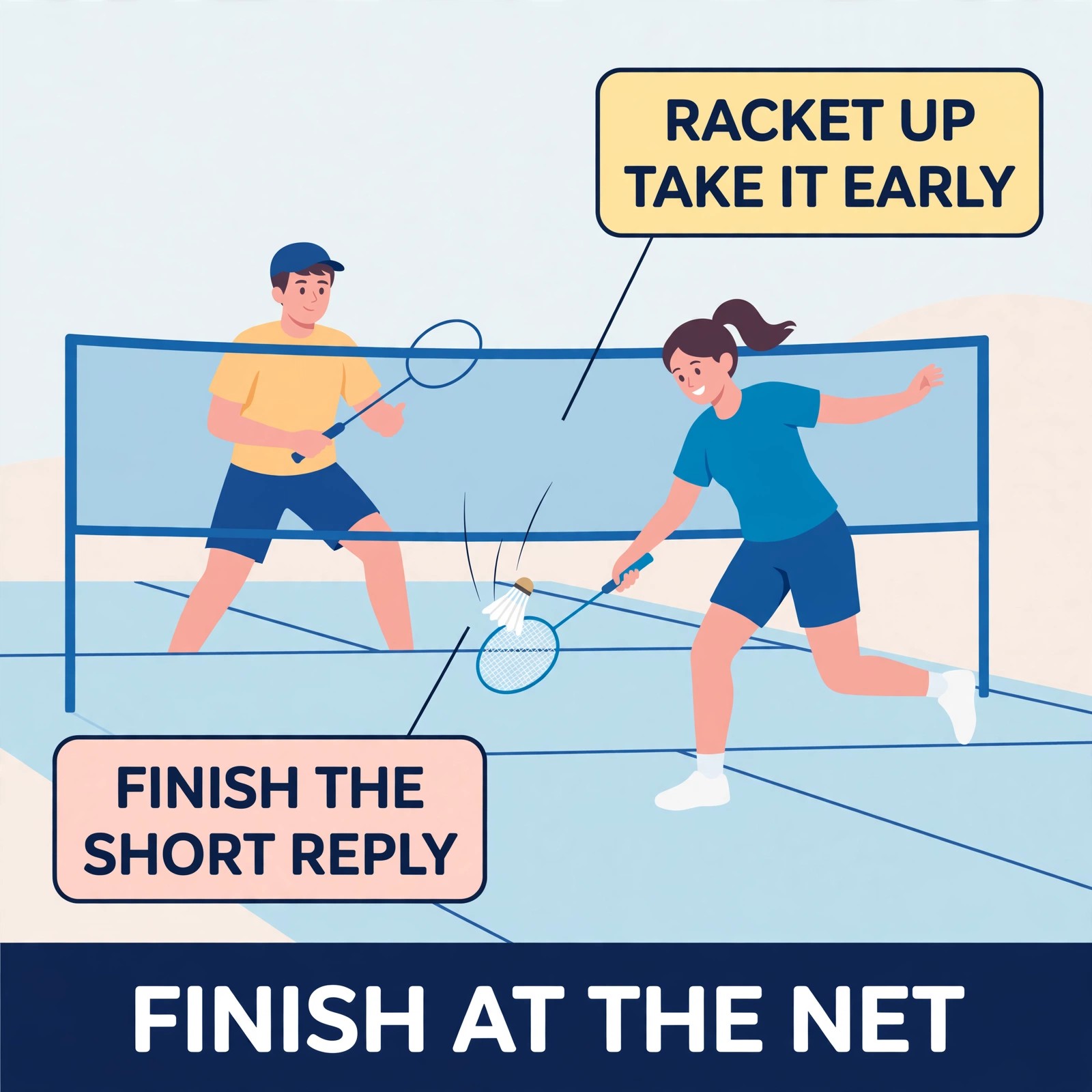
In level doubles, both partners share every job. In mixed doubles, the jobs are split on purpose. The front player, usually the woman, owns the net: she intercepts, she plays the tight net shots, and she finishes the short replies. The back player, usually the man, owns the deep court: he covers the clears, builds the attack, and hits the smashes. When a pair ignores the split, you see the classic mixed doubles picture: both players chasing the same shuttle, or both watching the one down the middle drop between them.
The other pair is split the same way, and that is where the tactics live. Every rally is a small argument about position: can you move their front player away from the net, can you turn their back player around, can you make the two of them hesitate over one shuttle? Pairs who only play their own shots trade rallies and hope. Pairs who play the opponents’ shape choose where the rally goes. The pair that decides who hits which shot, on both sides of the net, usually decides the match as well.
Pair Check #2
Two Shapes, One Pair
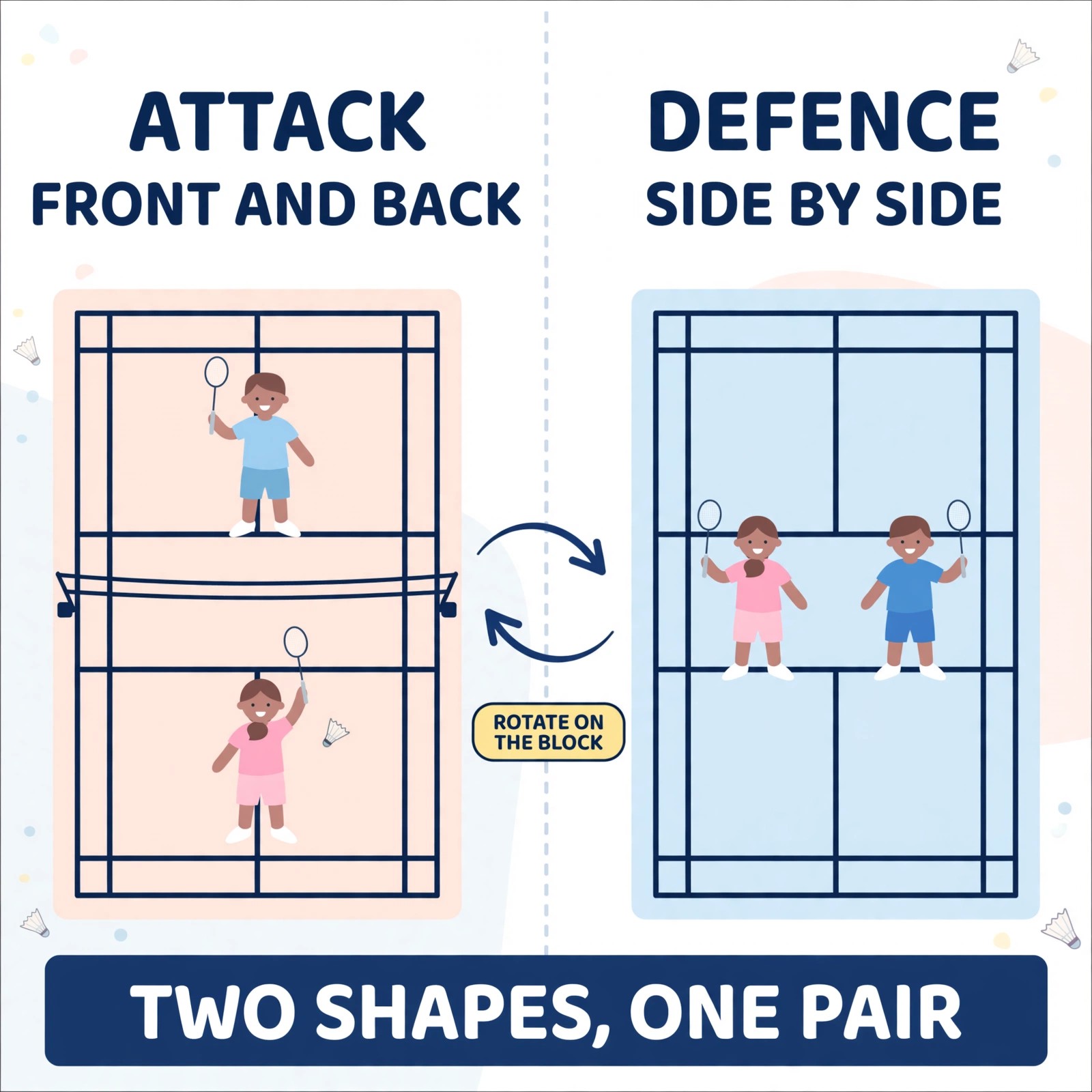
The attacking shape is front and back. It is the shape your pair wants, and most rallies are about earning it and keeping it. Your front player stands close to the net, racket up, ready to intercept anything loose and to finish the weak reply. Your back player stands behind, covering the full depth of the court, ready to smash or to keep the pressure on with fast drops and drives. You earn the shape whenever the opponents lift, and you hold it by hitting down and forward, never by clearing back into their attack.
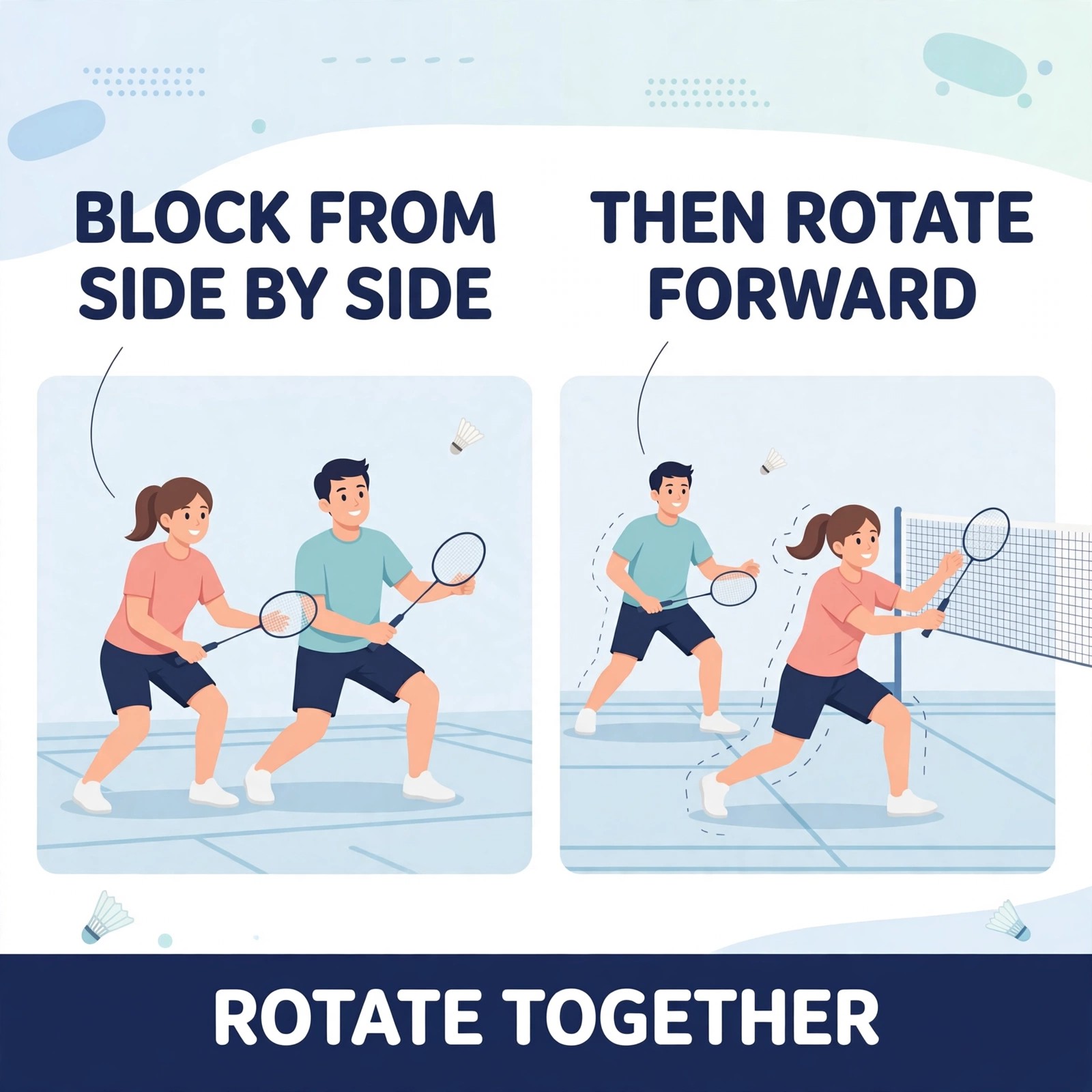
The defensive shape is side by side. When the opponents are smashing, front and back becomes a hole: the front player is too close to react and the smash passes her into the space behind. So the pair flattens out, each player covering one half of the court, rackets in front, ready to block and drive. Defence in mixed doubles is not passive. A block that lands tight at the net, or a drive that passes the smasher, turns the rally around, and the pair rotates straight back into the attacking shape.
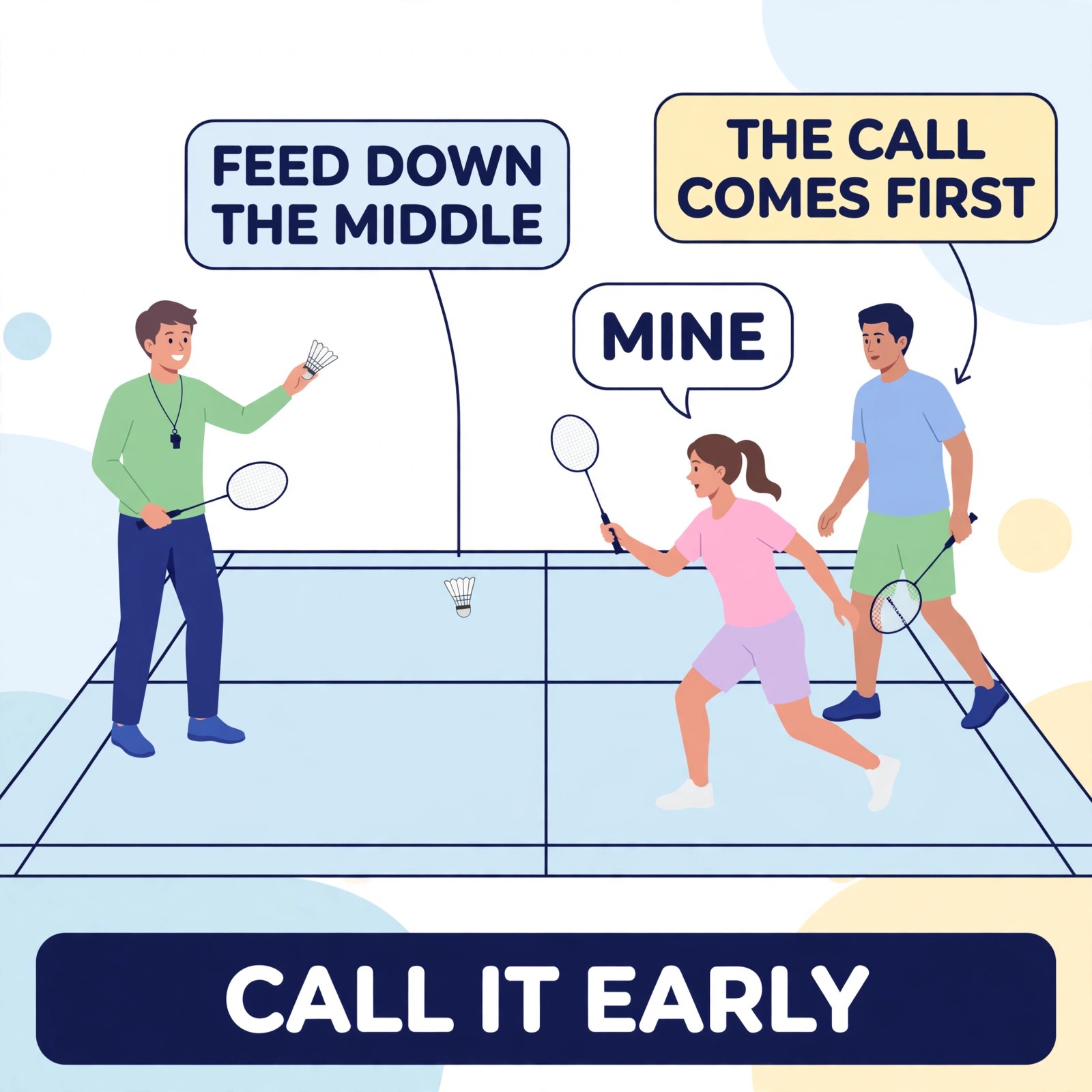
Rotation is the movement between the two shapes, and the middle is where pairs break down. Shots down the centre cause more arguments than any smash, because both players can reach them and neither is sure. Settle it before the match with one simple rule. In our classes the default is this: the forehand side takes the middle, the player moving forward has priority, and whoever goes, calls early and loudly. One clear rule, agreed when everyone is calm, is worth more than talent when the score is 19 all.
Pair Check #3
Start the Rally Right: Serve and Third Shot
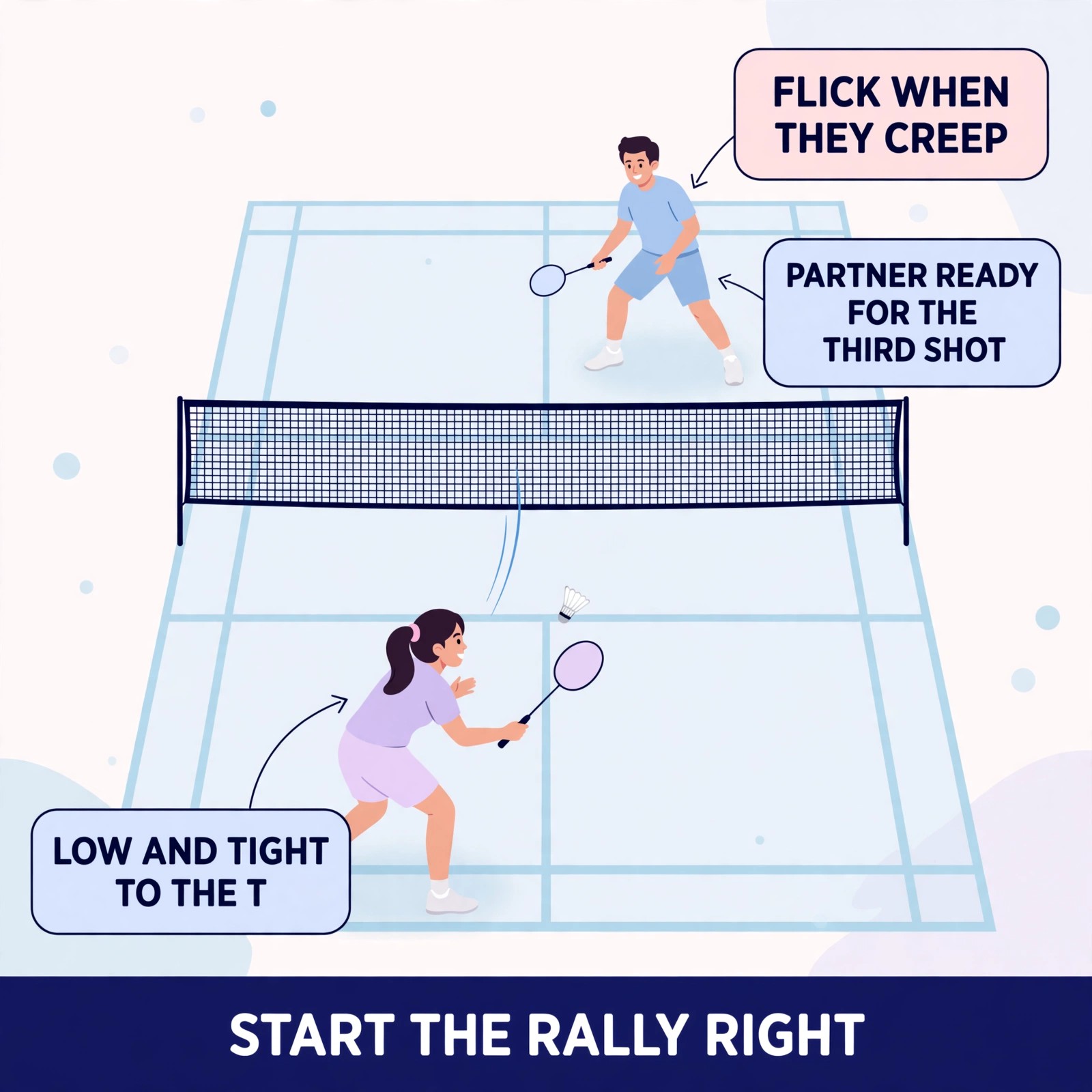
Most mixed pairs put the woman serving from the front, and the serve is where the plan starts. The low serve travels below 1.15 metres, lands tight to the service line, and refuses the receiver a clean attack. Serve mostly to the T and at the receiver’s body, the two spots that limit the return. The flick serve is the partner of the low serve: use it when the receiver starts creeping forward, and it buys respect for the next ten low serves. A serve in mixed doubles is not a start to the rally. It is the first shot of the attack.
After the serve, the rally has one job: earn the lift. The front player threatens the net so the opponents cannot play soft shots, while the back player uses drives, pushes and fast drops to rush them into a defensive clear. Once the lift comes, the pattern is set: the back player hits down, straight or at the body, and the front player moves in to finish anything short. Patience wins here. Two or three building shots played at the right targets create a better smash than one hopeful smash from a bad position.
Aim at the seams of the other pair. The shot between the two opponents makes both of them pause. The flat push at the front player’s racket hip rushes the shot she wanted to play softly. The cross court push drags their front player wide and opens the middle for the next shot. And protect your own front player the same way: if the opponents keep driving at her, the back player steps in a half step, the pair shortens the rally, and the picture changes. Tactics are mostly this: small targets, chosen early, hit with a reason.
Pair Check #4
Talk Before Trouble: Calls and Trust
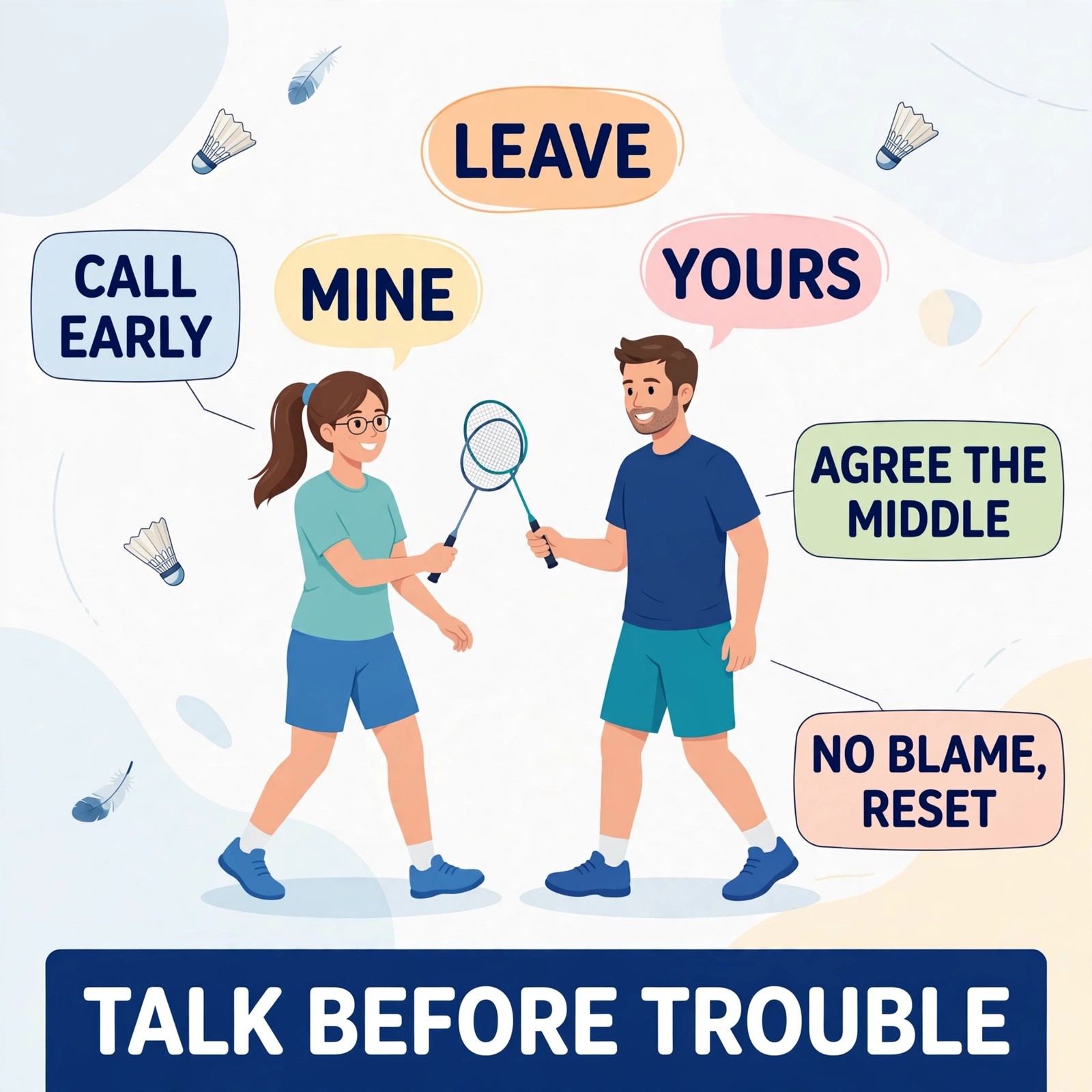
Good pairs sound simple. Their whole vocabulary is a few short words: mine, yours, leave, switch. The call comes early, while the shuttle is still travelling, not as the rackets clash. Calling is a skill like any other and it can be drilled: a coach feeds down the middle, and the pair practises the call until it is automatic. Quiet pairs are not calm pairs. They are pairs whose mistakes arrive silently, two players learning the same lesson at the same time, one rally too late.
Trust is what the calls stand on, and it is tested after errors. A partner who sighs, stares or goes quiet after a missed net shot will get fewer net shots played with confidence, and the pair shrinks. The pairs that last have a reset habit instead: a word, a tap of rackets, straight back to the shape. Save the analysis for the interval, where it belongs. On court, your only job after your partner’s error is to make the next rally easy for them to play well.
Know your partner’s game in writing, not just by feel. Sit down together and list, honestly, what each of you does well, what each of you avoids, and which shots each of you trusts at tight scores. Then build the plan around the real list. If her net game is the pair’s strength, the tactics should create net chances. If his defence is the rock, the pair can afford longer rallies. A plan built on the players you wish you were breaks at 15 all. A plan built on the players you are holds.
The Interval
Read the Other Pair, Then Adjust
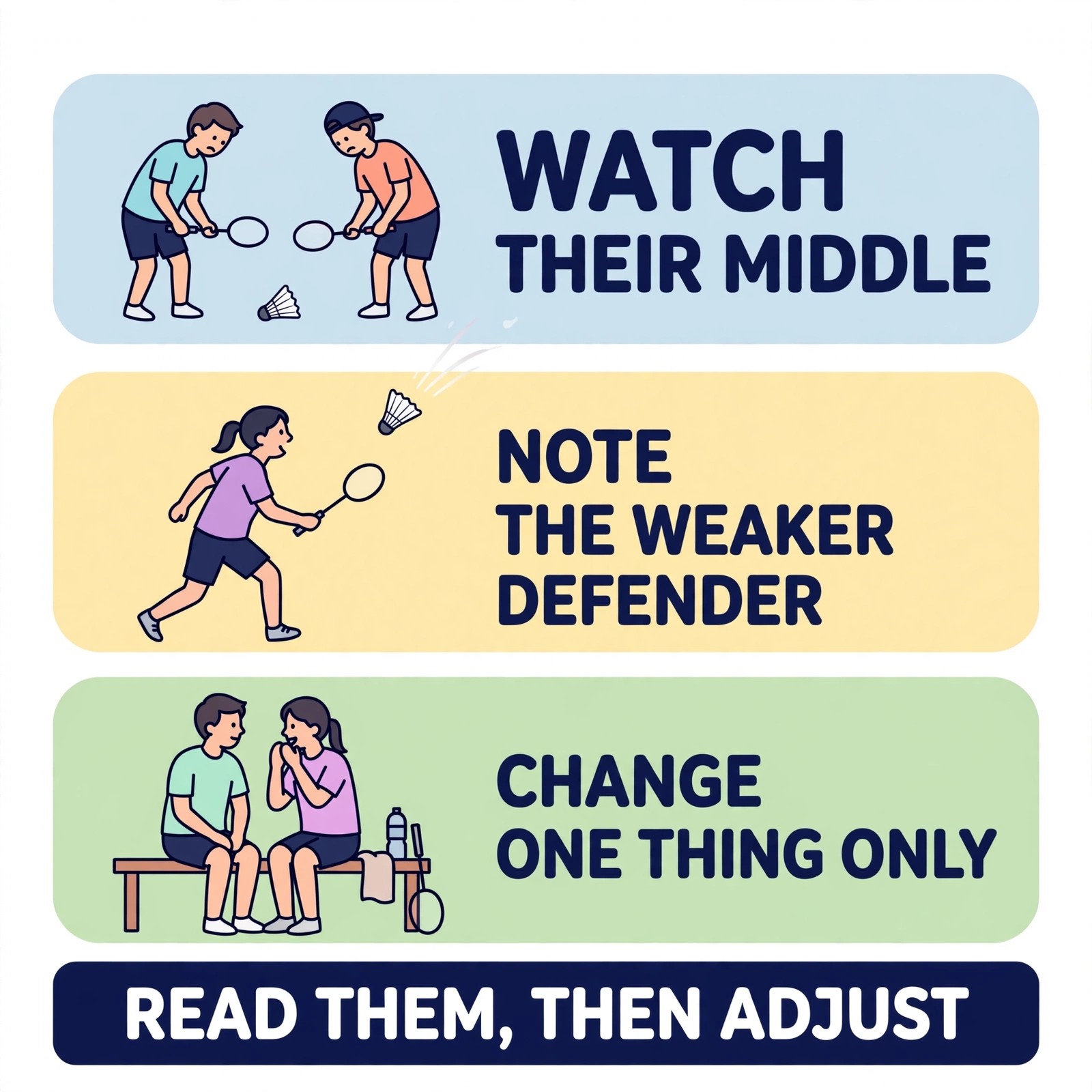
Across the net, the other pair is showing you their plan in every rally. Watch who takes their middle balls, and whether the call is early or late. Watch which defender turns sideways against the smash, and which front player creeps so far forward that the flick will punish her. Two or three honest observations by the interval are enough. You are not collecting trivia. You are choosing the targets for the rest of the match, and a pair that knows its targets plays faster without hurrying.
At the interval, change one thing. Serve at the body for a while. Play flatter and take the net earlier. Attack the backhand corner of the defender who turns. Pairs who rewrite the whole plan at the interval lose the parts that were working, and spend the next ten rallies learning a new plan instead of playing. One change, agreed by both players, repeated until the opponents answer it: that is how a match turns without drama.
Sometimes the honest tactic is to protect your own partner. If the opponents have found a weakness and keep playing on it, shorten the rallies, take a half step more of the court yourself, swap your defensive sides, or change the serve to change the picture. Support is a tactic, not just a feeling. The pair is the unit that wins or loses, and a plan that leaves one player exposed and shrinking is a bad plan, however correct it looks on a whiteboard.
Myth vs Reality
Myths About Mixed Doubles
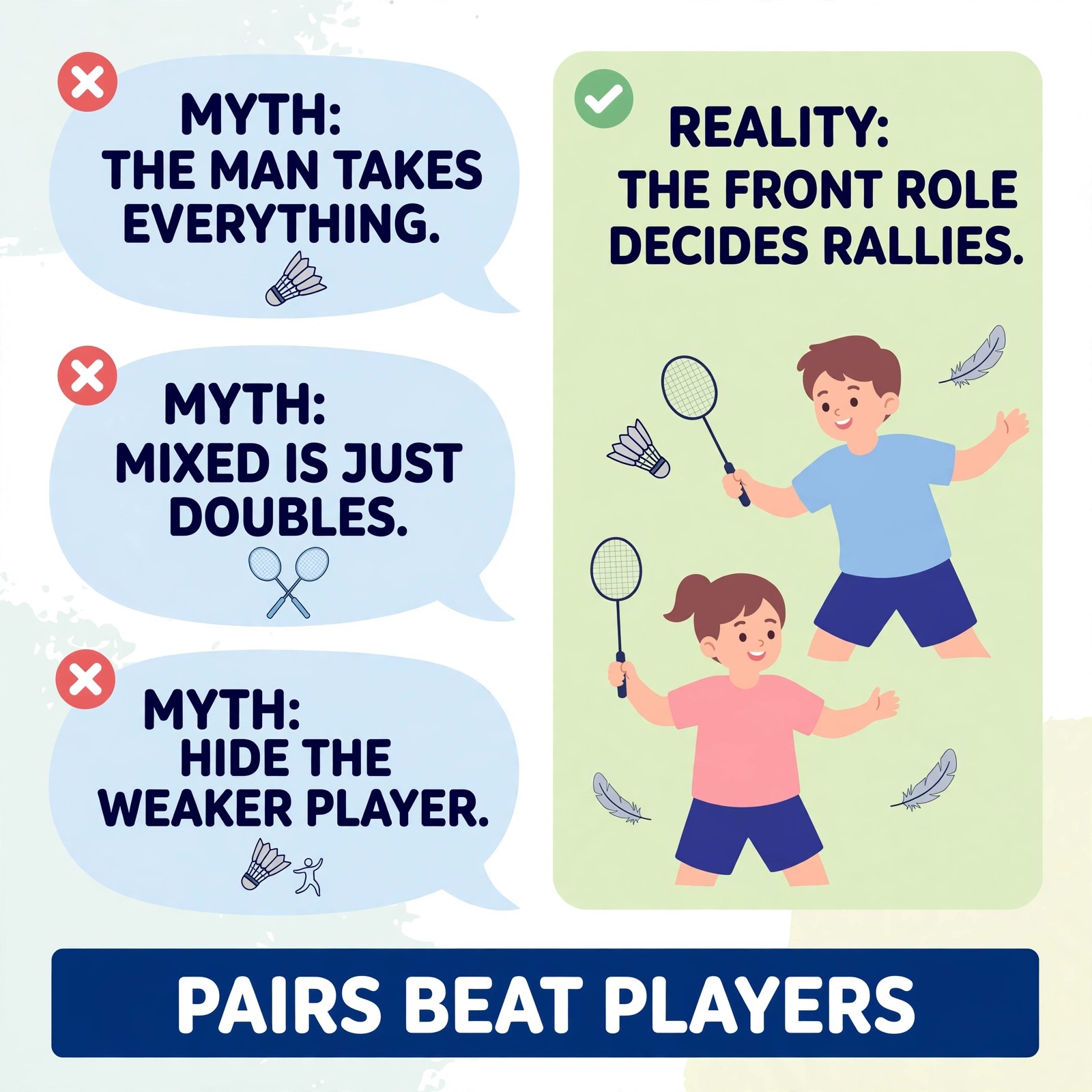
Myth: “The man should take every shot he can reach.” Reality: the front player owns the net, and a back player who charges forward to take her shots leaves the deep court empty behind him. The pair’s shape is the system. A shot taken out of shape has to win the rally outright, or it has simply handed the opponents the open court.
Myth: “Mixed doubles is just doubles with a different partner.” Reality: the formations, the serve and the targets are different, and pairs who play level doubles shapes in a mixed match leave the middle open all evening. Myth: “The woman is the weak link to hide.” Reality: the front role decides more rallies than any other. Strong pairs build the plan around a front player who finishes.
Myth: “Calling is for beginners.” Reality: professional pairs call constantly, because the middle ball does not care how experienced you are. Myth: “When a pair loses, one of them played badly.” Reality: pairs mostly lose to plans: wrong shape, wrong target, no agreed rule for the middle. Fix the plan first. It is usually the honest answer, and it is kinder too.
Why Choose Us
Mixed Doubles Coaching, Trained as a Pair
At ST Badminton Academy KL, mixed doubles is coached inside small group classes capped at max 4 students. Four students means the coach watches both partners at once: the front player drifting too deep, the call that comes a half second late, the rotation that leaves the back corner open. Pairs train the shapes, the serving plan and the middle rule together, then test them in practice games against other pairs.
Mr Eric Chuar has over 15 years of coaching experience in Singapore and Malaysia. His rule for mixed doubles is plain: shapes first, shots second. He sets a pair’s formations and calls before he touches their technique, because most mixed doubles problems are two good players standing in the wrong places. In his classes, a pair hears one message together, so the plan is shared, not translated.
Our academy is based in Setapak, Kuala Lumpur, convenient for players from Wangsa Maju, Melati Utama, Danau Kota and Gombak. If your pair keeps losing the middle, trading blame after errors, or winning the rallies you should lose and losing the ones you should win, bring the pair to a session. We will look at your shapes and your calls before we change a single shot.
FAQs: Mixed Doubles Tactics in Malaysia (KL)
These are the questions pairs ask us most about mixed doubles in Malaysia. If your question is not here, message us, tell us where rallies usually break down for your pair, and we will give you a straight answer about what to settle first.
How can I learn mixed doubles tactics if I live in Setapak or Gombak?
Start by training as a pair, not as two singles players. In our Setapak sessions, inside small groups of max 4 students, mixed pairs learn the two shapes, the middle rule and the calls together, then test them in practice games against other pairs at your level.
What matters most in mixed doubles tactics in KL?
The shapes and the middle rule. If your pair switches cleanly between front and back in attack and side by side in defence, and you have agreed who takes the shots down the middle, most rallies become simple. In training we settle those two things before we touch shot technique.
How many sessions a week should a pair train together to reach club level?
Two sessions a week together is a strong rhythm for most club pairs: one for drills and one mostly games. What matters more than the number is that you train as a pair, with the same calls and the same plan, so match day feels familiar instead of new.
My partner and I keep leaving the middle open. How do we decide who takes the middle shots?
Agree one rule and say it out loud before the match: in our classes the default is that the forehand side takes the middle, and whoever goes, calls early. Then drill it: a coach feeds down the middle while you practise the call until it is automatic.
What local badminton tournaments should a new mixed pair first enter?
Start with social and club level events where the draw is friendly and you will get several matches. Winning early rounds matters less than playing real pairs under score pressure. Tell us your level and we will point you at the right kind of event to begin with.
Do you coach mixed doubles tactics in classes near Wangsa Maju?
Yes. Mixed doubles is coached inside regular group classes at our Setapak base, a short trip from Wangsa Maju. Pairs train formations, serving plans and calls in small groups of max 4 students, against other pairs, so the tactics are tested honestly before you enter any event.
Can the academy help our pair prepare for a club competition in Malaysia?
Most pairs feel the shapes settle inside a school term of steady training together. The calls come first, then the rotation, then the trust at tight scores. Pairs who only meet on match day improve much more slowly, because every match is spent relearning each other.
Where is ST Badminton Academy KL located for mixed doubles training?
We are based in Setapak, Kuala Lumpur, close to Wangsa Maju, Melati Utama, Danau Kota and Gombak. Sessions run in small groups of max 4 students. Message us for the current class schedule and we will place your pair in a group at your level.
What makes Mr Eric Chuar a suitable coach for mixed doubles badminton?
Fifteen years of coaching in Singapore and Malaysia, and a simple order of work: shapes first, shots second. Eric reads a pair the way he reads a grip, small causes first, and corrects positioning and calls inside small groups where both partners hear the same message.
Mixed Doubles Tactics in Action

What It Takes to Win as a Pair
A pair meets our mixed doubles standard when five habits hold: the shapes switch cleanly between attack and defence, the middle balls follow one agreed rule, the front player finishes at the net and the back player covers deep, every call comes early, and errors are answered with a reset rather than blame. When those five hold, the pair plays as one.
| Factor | Two Singles Players | One Real Pair PAIR |
|---|---|---|
| Frequency | 1 or 2 times a week. Mostly for fun and sweat. | Before the rally, the pair already agrees the shape: who owns the net, who covers the back, and who takes the shots down the middle. |
| Drills Focus | Basic static feeding. Minimal footwork pressure. | During the rally, the pair moves as one unit: front and back in attack, side by side in defence, rotating on the block and the drive. |
| Physical Conditioning | Rarely included. Just playing games on court. | Core, agility, and speed training included in every session to prevent injury and build stamina. |
| Tactical Awareness | "Just hit it over." No real game plan. | Video analysis, point construction, and learning to read the opponent's game. |
| Coach Ratio | Large groups (8-10 kids). Coach barely watches you. | Max 4 students. Mr Eric Chuar personally corrects every stroke and movement detail. |
| Goal Setting | Fun and exercise. | At tight scores, the pair trusts the plan instead of chasing: serve to the agreed target, build the lift, and let the front player finish. |
| Long Term Result | Good recreational player. | A pair that wins rallies before the first smash is hit, because the shape, the calls and the trust were settled in training. |
Mixed Doubles Training in Kuala Lumpur
This page covered mixed doubles tactics from the plan outward: why the format splits the jobs, the attacking and defensive shapes and the rule for the middle, the serve and the shots that earn the lift, the calls and trust that hold a pair together, and how to read the other pair and change one thing at a time. Bring your pair to Setapak and let us build your plan together.




