Valuable Badminton Coaching Tips For Aspiring Players (Coaching Tips Guide)
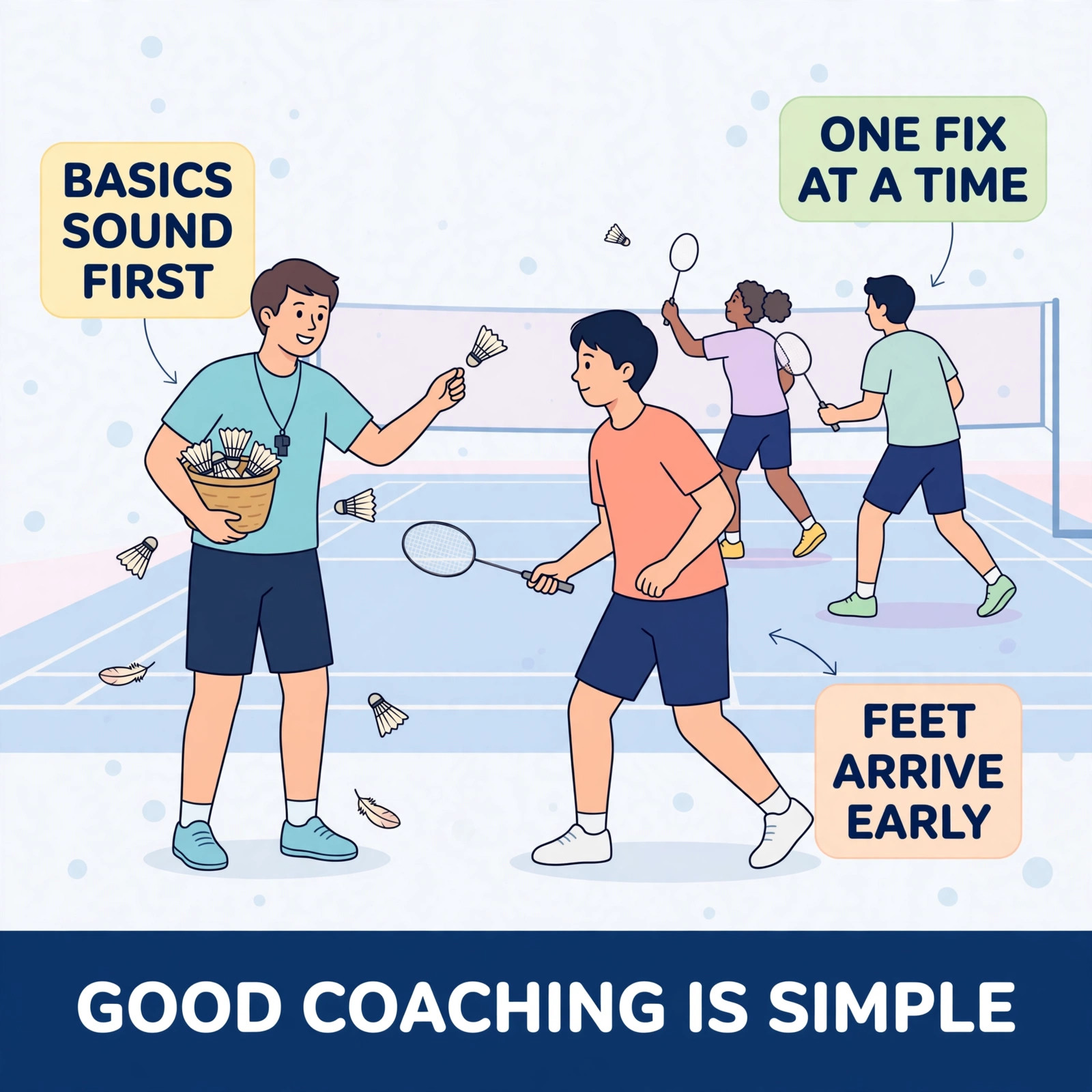
Every aspiring player asks the same question in different words: what should I actually work on? The honest answer is less exciting than a trick shot and far more useful. Players improve fastest when the basics are sound, the feet arrive early, practice has a plan, and faults are fixed one at a time by someone who can see them. This guide sets out the coaching tips we give aspiring players at ST Badminton Academy in Setapak, Kuala Lumpur: the order to build your game in, the drills that carry it, how to read matches, and the habits off court that decide how far the work on court can take you.
Player Check #1
Basics Before Tricks, Always
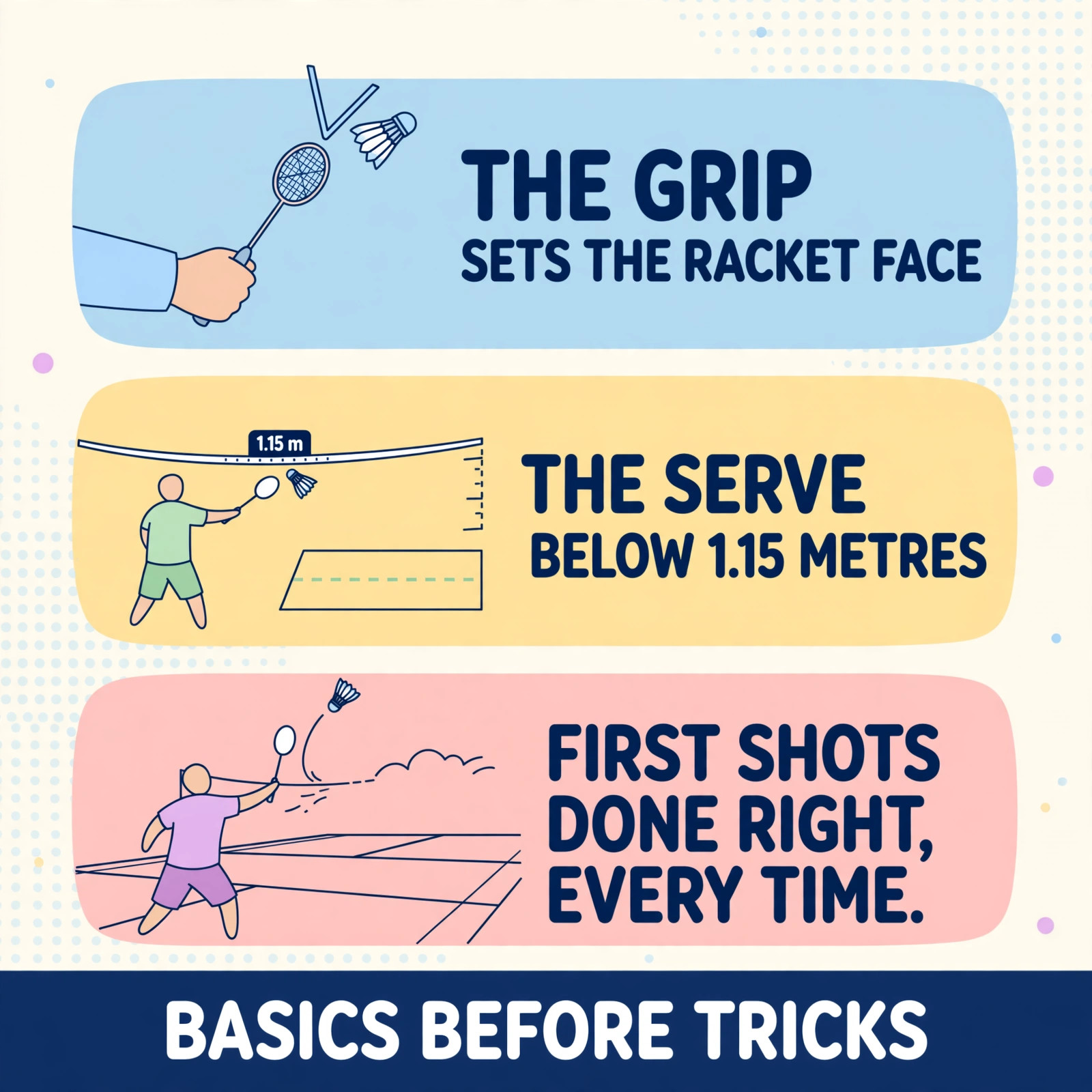
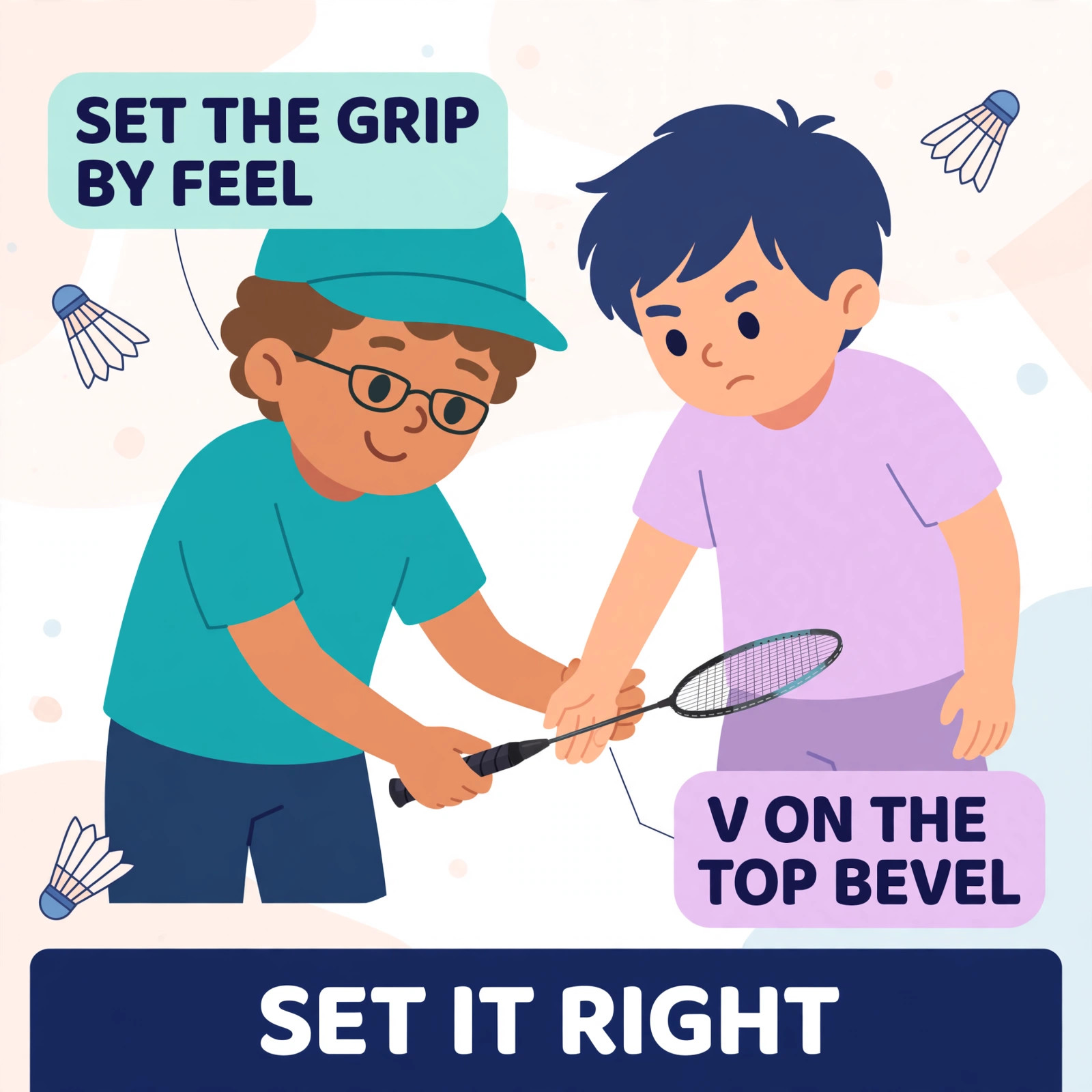
Basics are not the beginner stage of badminton. They are the load bearing part of every level above it. The grip comes first, because the grip sets the racket face, and the racket face decides where the shuttle goes before your swing has any say. A forehand grip with the V on the top bevel and a relaxed hand, a backhand grip with the thumb ready to push: players who set these two early stop fighting their own racket, and every later skill becomes easier to coach.
The serve is the second basic, because it is the only shot you play completely on your own terms, and it starts every rally you will ever play. A low serve that travels below 1.15 metres and lands tight to the service line, a flick serve kept as a surprise, and a return of serve with a plan: these are small skills with an outsized effect on your results. Add the first rally shots, a clear with real length, a drop that lands tight, a net shot taken early, and your basics are a game, not a warm-up. Aspiring players who rush past this layer spend years renting skills their basics cannot hold.
Player Check #2
Feet Before Shots, Every Time
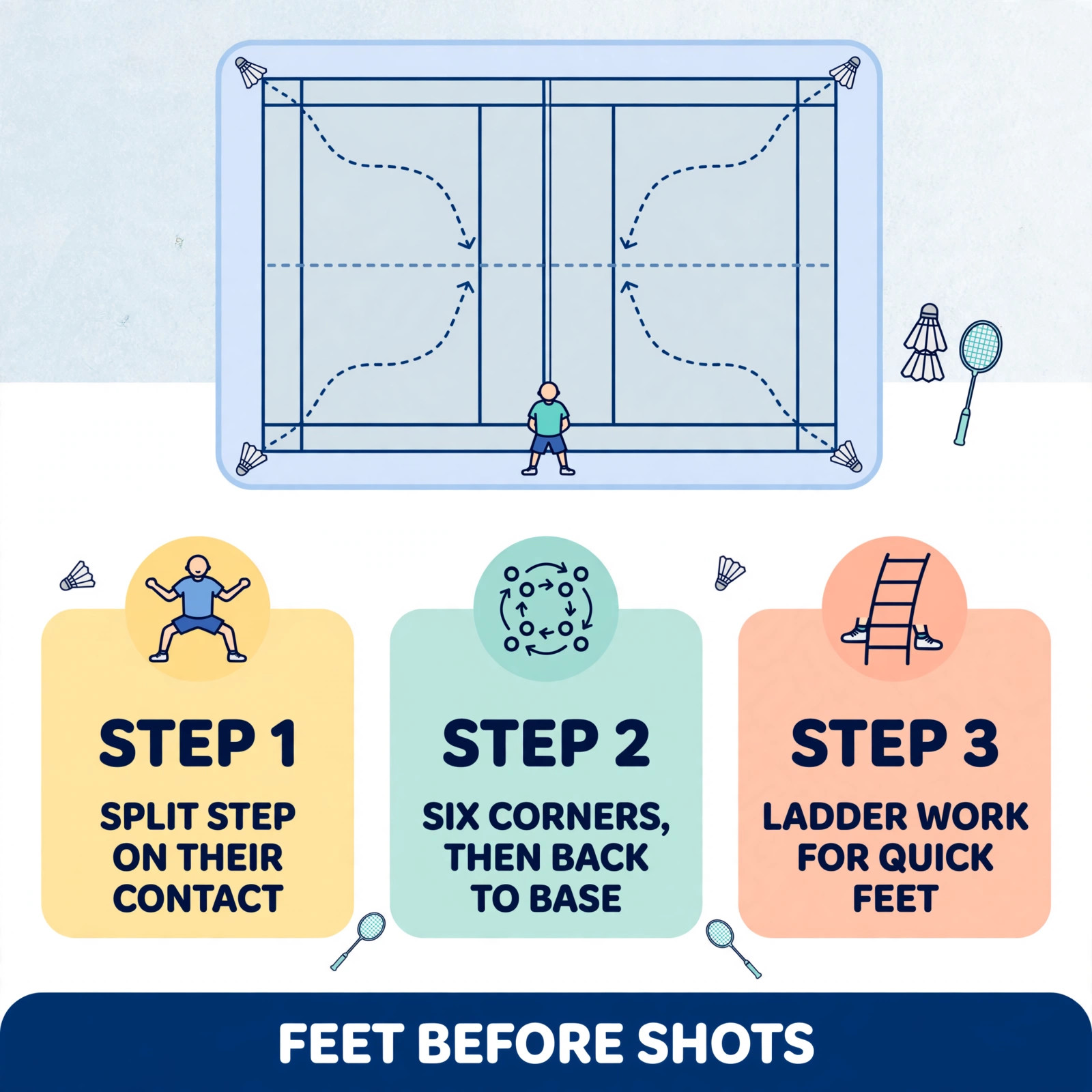
Coaches have a saying that survives because it keeps being true: feet before shots. Most shots that look weak are footwork arriving late wearing a disguise. The patterns are few and learnable: split step as your opponent strikes, lunge to the front corners, chasse and cross steps to the sides and rear, and a recovery back to base after every shot. When the feet arrive early, the body is balanced, the racket has time, and shots that felt hard become ordinary.
The drills are simple and they work. Shadow footwork walks the six corners without a shuttle, so the pattern can be grooved at a speed your brain can check. Ladder work and quick feet drills wake up the small, fast steps badminton is built on. Cone drills and random feeding add the part matches demand: reacting to a direction you did not choose. None of this needs equipment beyond a court and some shuttles, and fifteen honest minutes of it, twice a week, changes how a player moves inside a month.
Court awareness grows alongside the feet. Know where you are without looking down: how far the back tramline is behind you, whether you are standing in the half your partner is covering, where the open space is on the other side. Good movers look calm because they are rarely surprised by distance. In our classes, awareness is trained with conditioned games that reward the right position, not just the winning shot, so players learn to feel the court instead of searching for it.
Player Check #3
Practise With a Purpose
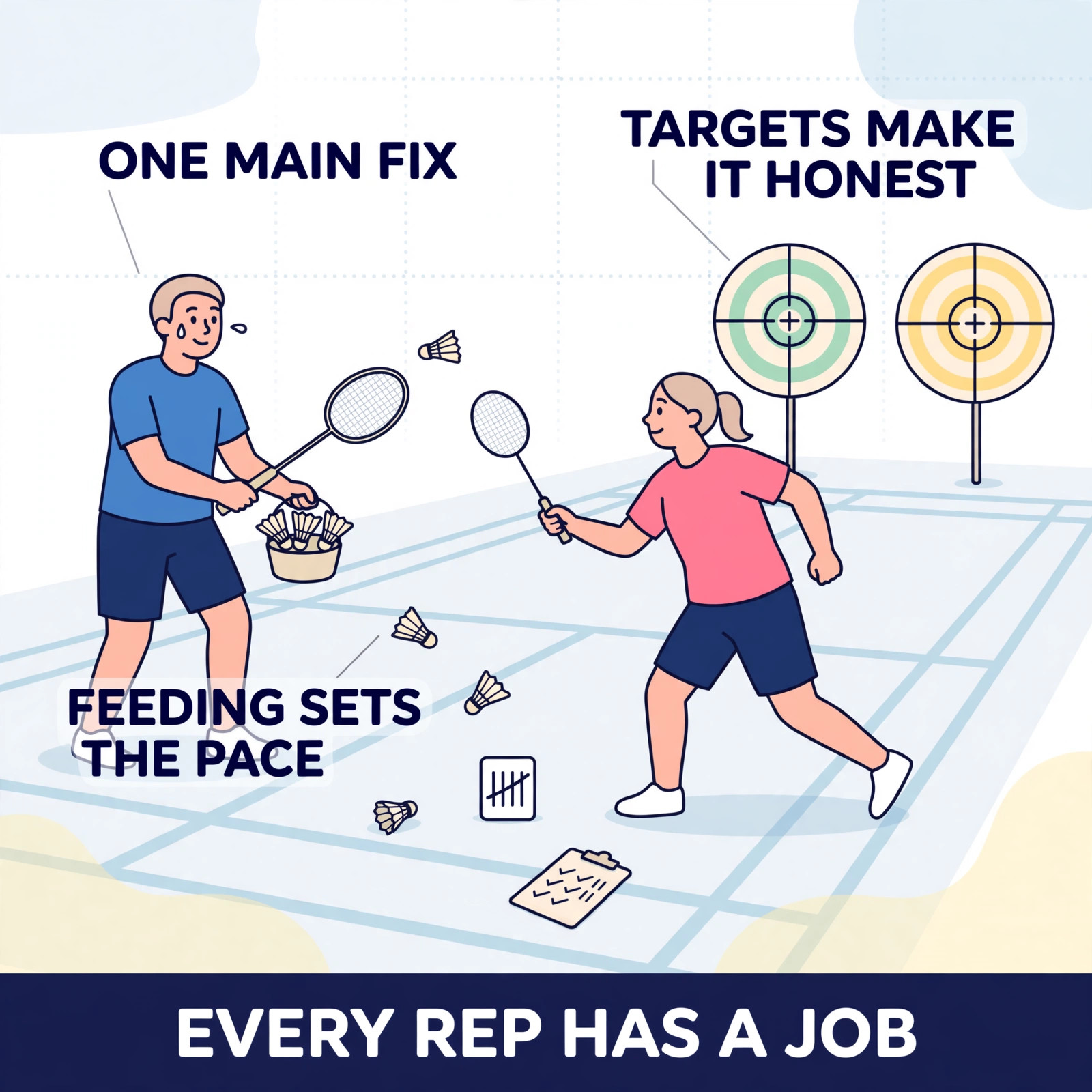
Random practice feels productive and teaches very little. An hour of mixed hitting touches every shot and fixes none of them. Coached practice works the other way: one main fix per session, chosen from your real matches, drilled until the new pattern holds, then tested in a game. One fix at a time is not a limitation. It is how movement patterns actually change. A body asked to change five things at once changes none of them and keeps the faults company.
Feeding is where the fix gets its repetitions. A coach feeding shuttles can set the pace, the corner and the pressure exactly at the edge of what you can handle, and correct the fault the moment it appears instead of twenty rallies later. Targets make it honest: a zone to hit, a count to reach, a standard to hold when tired. When you practise, borrow the same rule. Every drill should be able to answer one question: what is this for, and how will I know it worked?
Consistency is the quiet skill underneath all of it. Long rallies are built from shots you can repeat when tired, and matches at every level are lost more often by the player who gives points away than by the player who is outplayed. Count your unforced errors for one game and you will meet the opponent who beats you most often. Training that builds consistency, rally drills with a target length, conditioned games that punish the loose shot, turns that opponent into a training partner instead of a result.
Player Check #4
Read the Game, Pick Your Shots
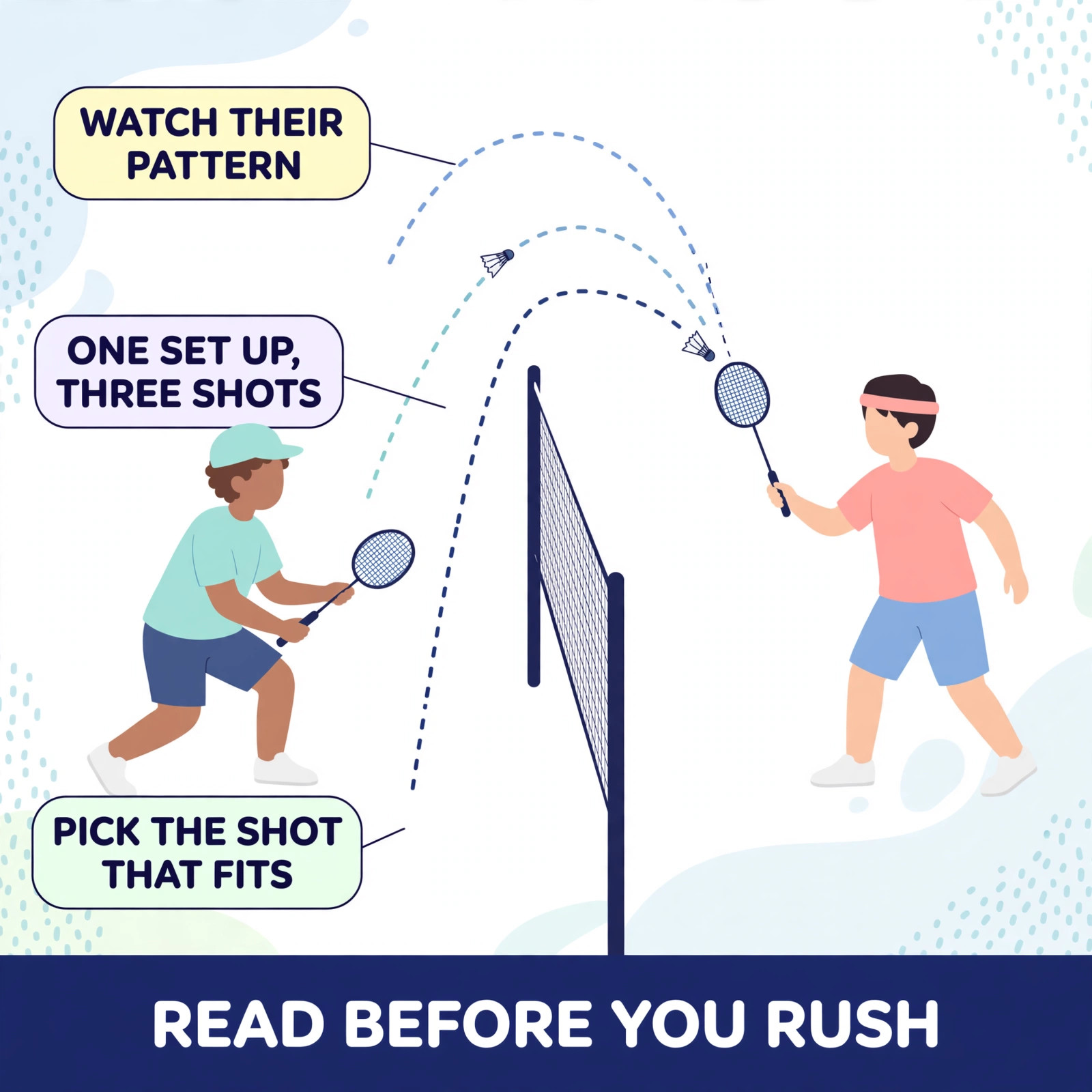
Technique wins rallies against players who let you use it. Reading wins the rallies against everyone else. Watch what your opponent repeats: the favourite shot under pressure, the corner they defend late, the serve they trust at tight scores. Patterns are honest even when players are not, and two or three observations are enough to build a plan. Then play the plan with patience, working the corner you chose until the reply shortens, instead of hunting a winner from the first rally.
Deception belongs to this section too, used honestly. The best fakes in badminton are not tricks; they are one preparation hiding several shots. The same set up for clear, drop and smash means your opponent cannot move early, and late movement is worth more than raw speed on most courts. Build it from the basics layer: the shots must look the same because the grip, the feet and the swing genuinely are the same until the last moment. A fake built on sound basics is just good badminton arriving quietly.
Shot selection is where reading becomes points. The right shot is rarely the most impressive one available. It is the one that fits your balance, the score and the space: the deep lift when you are stretched, the patient block when you are set, the attack saved for the shuttle you have earned. Aspiring players often know more shots than their results suggest. What they are missing is the choosing, and choosing is trainable, in conditioned games where the coach stops the rally and asks one question: why that shot?
The Player
Body, Habits and Sportsmanship
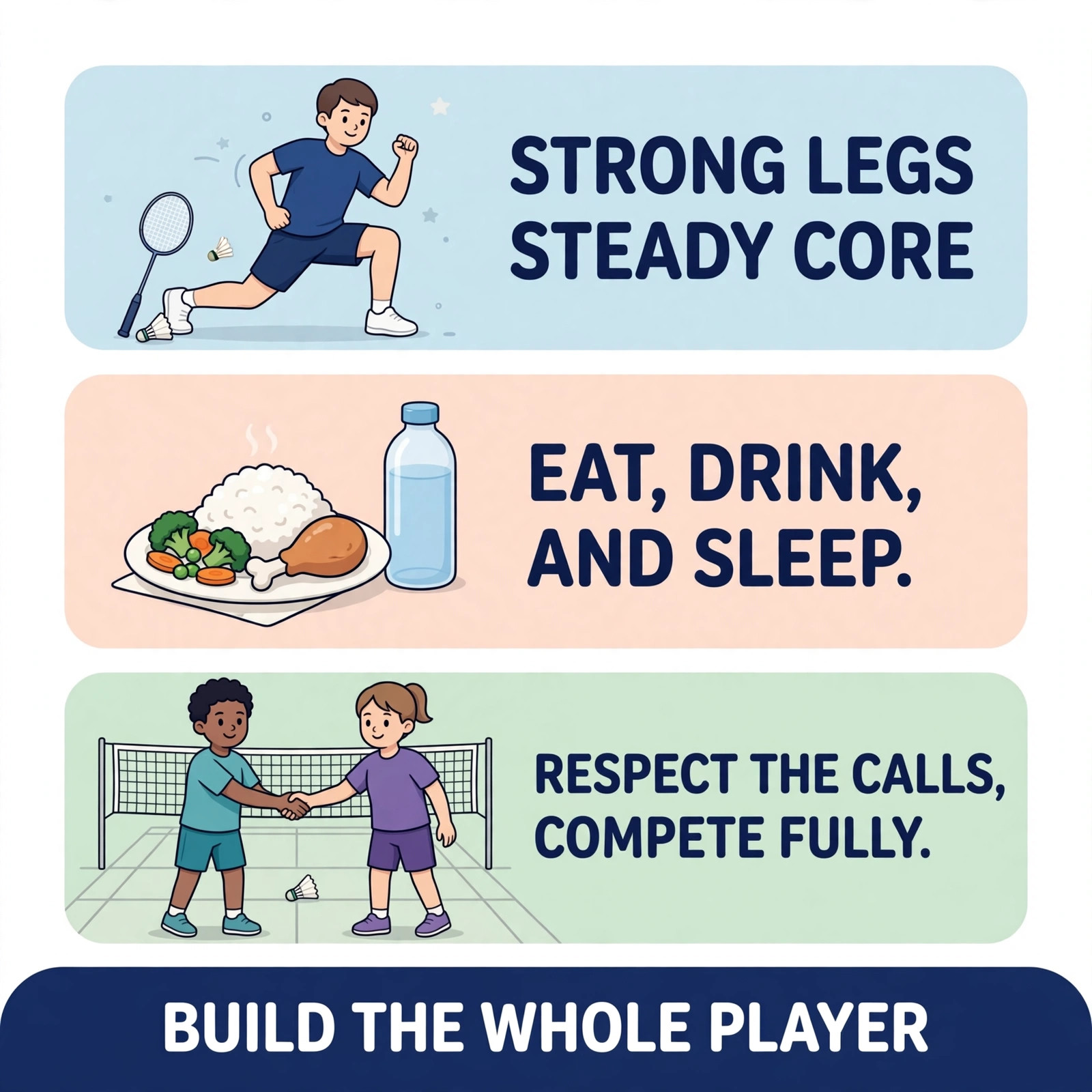
Your body is part of your equipment. Legs that can lunge and recover for three games, a core that holds your shape while you twist, shoulders that stay healthy under overhead volume: these are built with simple work done regularly. Squats, lunges, calf raises, planks and band work for the shoulders, added gradually and kept honest, support everything you do on court. Strength work for badminton players is not bodybuilding. It is insurance for your movement, and it lowers the risk that an ordinary session becomes an injury week.
Recovery and food carry the training you already did. Sleep is when the body banks the work; a player who trains hard and sleeps badly is paying for adaptations they never collect. Eat a proper meal a few hours before hard sessions, drink water through the day in our heat, and refuel with protein and carbohydrates afterwards. None of this is exotic. The aspiring players who stall are rarely missing a secret. They are missing the plain habits, repeated on the ordinary days.
Character is a coaching topic too, because it decides how long you stay in the sport. Respect the calls, including the close ones that go against you. Respect opponents, partners and the players waiting for the court. Compete as hard as you like inside those lines. Coaches notice the player who argues less and adjusts more, because that player is coachable, and coachable players improve for years while talented arguers plateau. Good sportsmanship is not decoration on a player. It is part of the engine.
Myth vs Reality
Myths About Getting Better
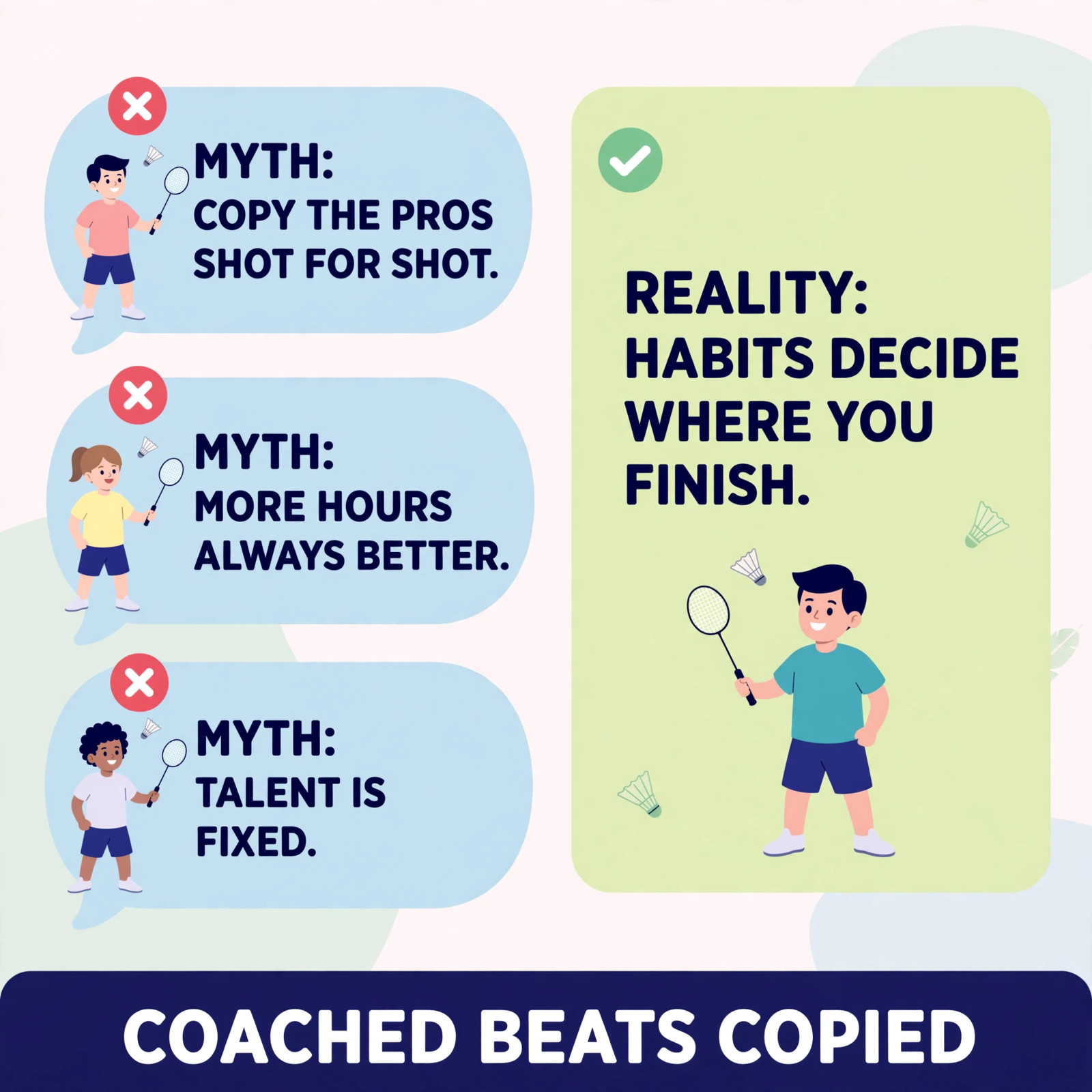
Myth: “Aspiring players should copy the professionals shot for shot.” Reality: professionals are playing shots their basics, feet and reading can hold. Copy the order they built in, basics, feet, consistency, reading, and the advanced shots arrive on a foundation that can use them. Copying the last layer first gives you a highlight reel and a losing record.
Myth: “More hours automatically means more improvement.” Reality: hours multiply whatever is in them, including faults. Two focused hours with one fix and honest feedback outbuild five hours of random hitting. Myth: “You either have talent or you do not.” Reality: talent decides where you start. Habits decide where you finish, and habits are the part a player actually controls.
Myth: “A coach is only for juniors and tournament players.” Reality: a coach is for anyone whose faults have stopped being visible to themselves, which is most players after the first year. Myth: “Expensive equipment speeds up improvement.” Reality: a suitable racket helps and a wrong one hinders, but no racket fixes a late arrival or a grip that fights the shot. Feet and feedback beat gear.
Why Choose Us
Real Coaching for Aspiring Players
At ST Badminton Academy KL, aspiring players are coached inside small group classes capped at max 4 students. Four students means your coach actually sees your game: the grip that slips under pressure, the corner your feet reach late, the shot you choose when a plan was agreed. Each player trains with one main fix at a time, tested in conditioned games, so improvement is something you can point to rather than something you hope is happening.
Mr Eric Chuar has over 15 years of coaching experience in Singapore and Malaysia. His order of work with aspiring players is plain: basics, feet, consistency, reading, in that order, and no layer skipped because it looks slow. He names one fault at a time, feeds at the pace that tests exactly that fault, and sends players home knowing what they are practising and why. Players stay with him because the plan keeps making sense.
Our academy is based in Setapak, Kuala Lumpur, convenient for players from Wangsa Maju, Melati Utama, Danau Kota and Gombak. If you have played for a while and your game has stopped moving, or you are starting out and want the order right from the beginning, bring it to a session. We will read your basics and your feet first, and build from the layer that is actually holding you back.
FAQs: Badminton Coaching Tips in Malaysia (KL)
These are the questions aspiring players and parents ask us most in Malaysia. If your question is not here, message us, tell us how long you have played and what feels stuck, and we will give you a straight answer about which layer of your game to work on first.
How can I improve fastest if I live in Setapak or Gombak?
By building in the right order, with feedback. In our Setapak sessions, inside small groups of max 4 students, we read your basics and your feet in the first session, set one main fix, and drill it until it holds in games. Players improve fastest not by doing more things, but by fixing the right thing first.
What should an aspiring player work on first in KL?
The basics, and it is not close. Grip, serve and the first rally shots decide whether everything after them can work. In your first sessions with us we check exactly those, plus how your feet arrive, before any advanced shot is touched. Aspiring players are often surprised how much of their game was waiting on two or three basics.
How many times a week should an aspiring player train to keep level?
Twice a week is a strong rhythm for most aspiring players: enough to groove patterns, spaced enough to recover and to play social games in between. One session a week still works if the practice inside it is focused. What matters more than the count is that every session has a plan and one fix it is serving.
I have played socially for years and my bad habits feel fixed. Can coaching still change them?
Yes, and it happens in our groups often. A habit feels fixed because it has been repeated for years, but repetition is also how it gets replaced: one correction, fed at the right pace, practised until the new pattern survives in games. It is slower than learning fresh, and it is very doable with honest feedback.
What should parents look for when choosing coaching for a junior player?
Look for three things: groups small enough that the coach sees every player, a clear order of work rather than random games, and feedback you can repeat back in plain words. In our classes, capped at max 4 students, parents can ask any week what their child is working on and get a specific answer.
Do you offer coaching for aspiring players near Wangsa Maju?
Yes. Coaching for aspiring players runs as part of regular group classes at our Setapak base, a short trip from Wangsa Maju. Adults and juniors train in groups at their level, capped at max 4 students, each with their own main fix inside the shared session, so nobody waits and nobody hides.
How long before an aspiring player sees real improvement in Malaysia?
In pieces, and sooner than most players expect. Feet arrive earlier inside the first month. The chosen fault starts holding in the second. Match results follow after that, because they are the last layer to move. Players who train twice a week with one fix at a time usually feel a different game inside a school term.
Where is ST Badminton Academy KL located for aspiring player training?
We are based in Setapak, Kuala Lumpur, close to Wangsa Maju, Melati Utama, Danau Kota and Gombak. Sessions run in small groups of max 4 students. Message us for the current class schedule and we will place you, or your child, in a group at the right level with a plan from the first session.
What makes Mr Eric Chuar a suitable coach for aspiring badminton?
Fifteen years of coaching in Singapore and Malaysia, and one order of work he does not break: basics, feet, consistency, reading. Eric names the first fault honestly, feeds at the pace that tests it, and explains every drill in plain words, inside small groups where every player is seen every session.
Badminton Coaching Tips in Action


What It Takes to Become a Complete Player
A player meets our aspiring player standard when five habits hold: the grips are set correctly without thinking, the serve and return start rallies with a plan, the feet arrive early enough for balance, practice runs on one fix at a time with feedback, and matches get reviewed for patterns instead of just scores. When those five hold, improvement stops being an accident.
| Factor | Random Practice | Coached Practice PLAYER |
|---|---|---|
| Frequency | 1 or 2 times a week. Mostly for fun and sweat. | Before the session, there is a plan: one main fix, drills chosen for it, and a way to tell at the end whether it moved. |
| Drills Focus | Basic static feeding. Minimal footwork pressure. | During the session, every drill has a job and every repetition gets feedback, so good movements are repeated and faults are named while they are still small. |
| Physical Conditioning | Rarely included. Just playing games on court. | Core, agility, and speed training included in every session to prevent injury and build stamina. |
| Tactical Awareness | "Just hit it over." No real game plan. | Video analysis, point construction, and learning to read the opponent's game. |
| Coach Ratio | Large groups (8-10 kids). Coach barely watches you. | Max 4 students. Mr Eric Chuar personally corrects every stroke and movement detail. |
| Goal Setting | Fun and exercise. | In matches, the player reads patterns, picks shots with a reason, and reviews what happened instead of only remembering the score. |
| Long Term Result | Good recreational player. | A player who improves a little every week, on purpose, and knows exactly what they are working on next. |
Badminton Coaching Training in Kuala Lumpur
This page covered the coaching tips that actually move aspiring players: basics before tricks, feet before shots, practice with one fix and honest feedback, reading opponents and choosing shots, and the body, food and character habits that carry the work. Bring your game to Setapak and let us build it in the right order with you.




