Swiss Men’s Singles Badminton Star
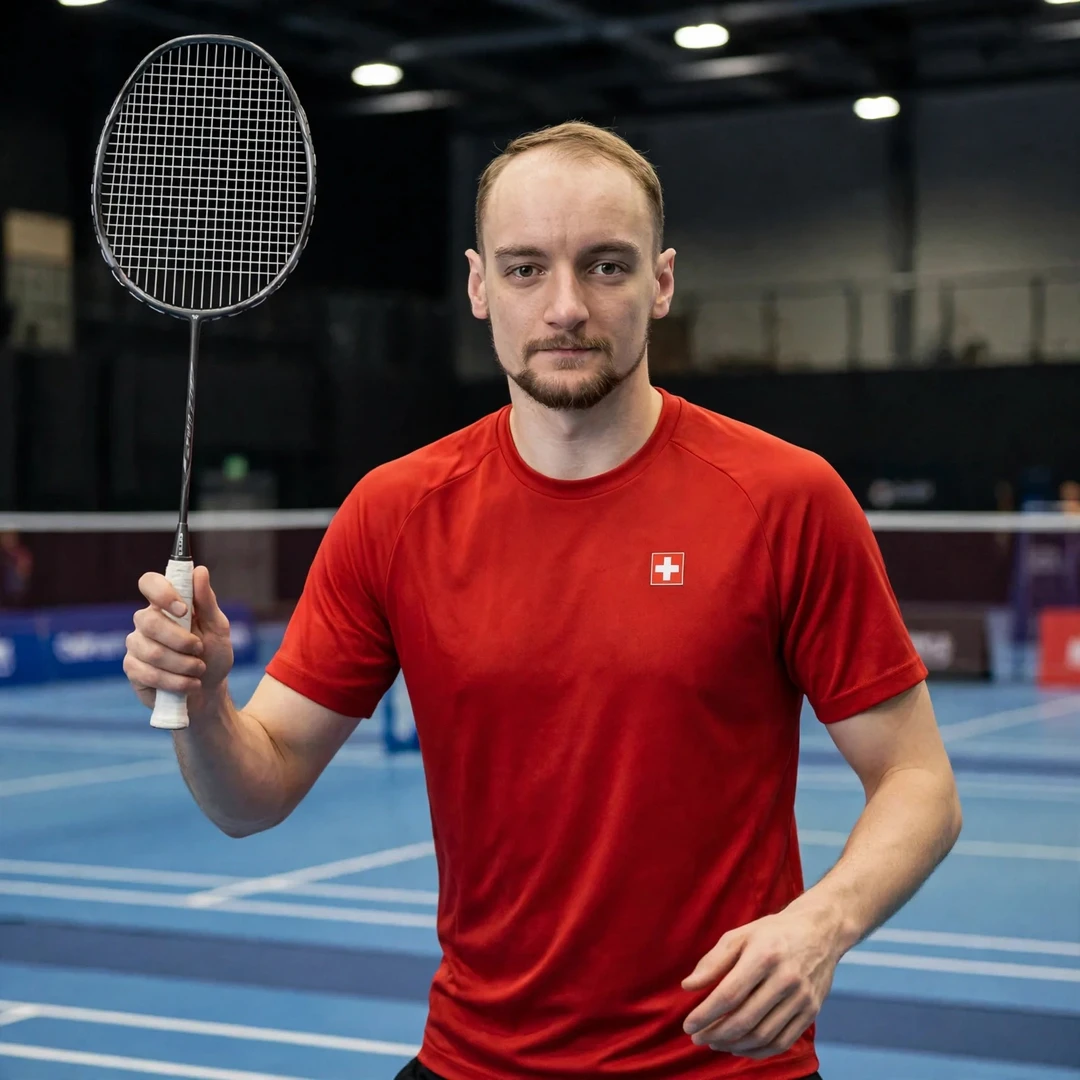
Tobias Kuenzi

Switzerland
Player Event: Men’s singles
From Würenlingen, Canton Aargau · Born: 18 February 1998 · Right-handed · Height: 184 cm · Four-time Swiss national champion · Paris 2024 Olympian
Playing Style: A calm, consistent all-court rallying game built on reach, patience and a very low error count — the game of a tall right-hander who defends every corner and makes opponents win the rally twice.
Known For: Becoming only the third Swiss badminton player ever to qualify for the Olympic Games and winning a match on his Paris 2024 debut; four Swiss national singles titles; four European Championships last-sixteen finishes; and a career-high world ranking of No. 88.
Teams: Switzerland national team · Coached by Rajiv Ouseph
Understanding Tobias Kuenzi (Swiss Badminton Star)
Tobias Kuenzi is a Swiss professional badminton player — for most of the past decade, the standard-bearer of men’s singles in a country where badminton lives in the shadow of skiing, football and tennis. In the BWF Week 43 world rankings, published on 20 October 2026, he stands at world No. 122 with 15,845 points collected across 15 tournaments. Born on 18 February 1998 in Würenlingen, in the canton of Aargau, the 184 cm right-hander has been on the BWF ranking list since he was seventeen, climbing all the way from No. 1,740 to a career high of No. 88. He is a four-time Swiss national singles champion and a four-time European Championships round-of-16 player, and in Paris in 2024 he became only the third Swiss badminton player in history to compete at the Olympic Games — winning a match while he was there. In 2025 he reached his first senior international singles final, in Venezuela. This profile traces how a player from a small town in Aargau built an eleven-year international career out of patience, consistency and an almost stubborn refusal to go away.
Early Life in Würenlingen and Junior Career
Würenlingen is a small municipality in the canton of Aargau, not far from the Rhine and the German border — farming country and commuter towns, about as far from a badminton powerhouse as Switzerland gets. Swiss badminton is a small, close-knit world: there is no giant academy system, no production line of professional teenagers, and the senior national scene revolves around a handful of clubs and the annual Elite Championships. Kuenzi came through that system as a junior in the 2010s. There are no prodigy headlines in this story and no famous academy at its centre — what the record shows is a tall boy from Aargau who entered the Swiss junior pathway, worked his way onto the international ranking list while still at school, and then simply never left it. That steadiness, visible right from the beginning, became the defining feature of his whole career.
Ranked at Seventeen: The Long Apprenticeship
The BWF’s ranking history for Kuenzi contains 528 weekly entries, and it begins on 22 October 2015 with a seventeen-year-old standing at No. 1,740 in the world. From there, the apprenticeship ran through the long, unglamorous European satellite circuit — the Italian International, the Austrian Open, Welsh, Polish, Hungarian, Spanish and Portuguese events — qualifying draws, small halls, and the slow arithmetic of ranking points earned a few hundred at a time. Those years rarely make headlines, but they are where a professional game is built: hundreds of matches against the same tier of European opponents, learning which rallies to chase and which to let go, how to win on bad days as well as good ones. By the end of the decade Kuenzi had climbed from the 1,700s into the world’s top 150 — and, more importantly, he had learned how to stay there.
Swiss Champion at Twenty-One and a First Title in Cyprus
2019 was the year the apprenticeship turned into a breakthrough. At twenty-one, Kuenzi won his first Swiss Elite Championships singles title, announcing himself as the country’s leading men’s singles player. The same summer brought the biggest home event in Swiss badminton history: the World Championships in Basel, where he represented Switzerland in men’s doubles alongside Oliver Schaller in front of a home crowd. He was also part of the Swiss squad at the 2019 Sudirman Cup in Nanning, the world mixed team championship — team duty that has been a constant thread of his career. A first national title, a home World Championships and a Sudirman Cup debut inside twelve months: by the end of 2019, the boy from Würenlingen was no longer a prospect. He was Switzerland’s number one.
Match Points Against Europe’s Best
His first international title arrived the same year, though not in singles. At the Cyprus International in 2019, Kuenzi won the mixed doubles crown with Jenjira Stadelmann, beating Ukraine’s Mykhaylo Makhnovskiy and Anastasiya Prozorova 21–11, 21–14 in the final — a straight-games win that underlined how complete his all-court game already was. The national crowns kept coming in his main event too: Swiss singles champion again in 2020, and again in 2021, three consecutive titles that made him the undisputed reference point of Swiss men’s singles. Playing doubles and mixed alongside the singles grind is a pattern worth noting for young players: it sharpens net skills, defensive reactions and tactical reading, and Kuenzi’s coaches used it deliberately to round out a game built for long rallies.
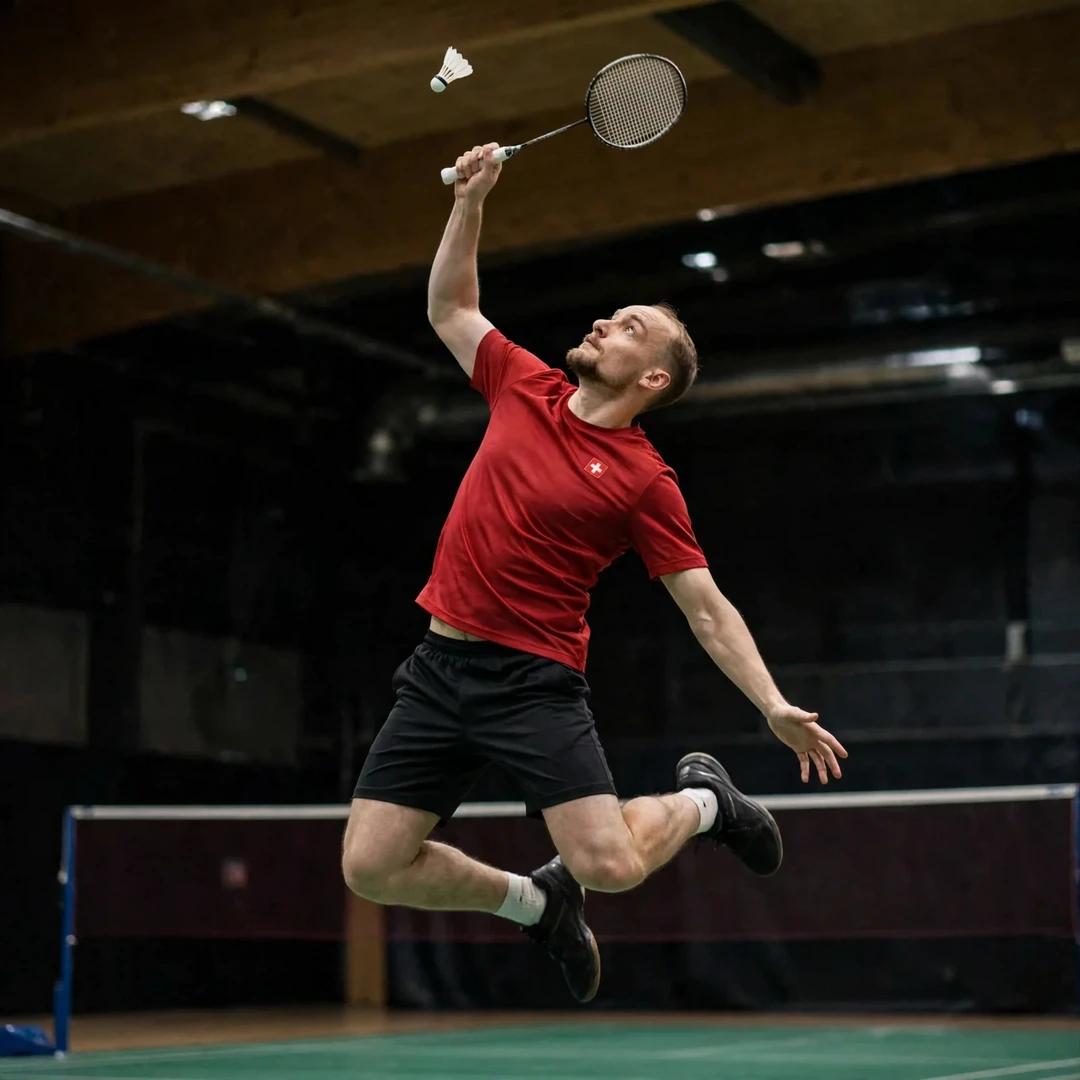
Career Milestone #1
Career-High No. 88 and the Road to Paris
If the early 2020s confirmed Kuenzi at home, they also taught him how fine the margins are in Europe. At the 2022 European Championships he reached the round of 16 and stood within a single point of the quarter-finals against Denmark’s Hans-Kristian Vittinghus, one of the continent’s most experienced campaigners. The Swiss federation’s account of that campaign is precise and a little painful: Kuenzi fought his way to match points — and Vittinghus escaped. Losing a match you were one rally from winning is the hardest result in badminton to process, and it would not be the last time the sport tested him in exactly that way. What matters for this profile is what he did with those afternoons: he kept coming back to the same stage, against the same level of opponent, year after year.
At the European Games in Kraków in 2023 he was at it again: group wins over Portugal’s Bernardo Atilano and Estonia’s Karl Kert took him into the last sixteen, where Israel’s Misha Zilberman survived — the federation records that Kuenzi once more held match points and once more had to watch them slip away. The same year he collected his fourth Swiss national singles title. Then, at the 2024 European Championships in Saarbrücken, he produced his cleanest continental run yet: a 21–17, 21–16 win over Italy’s Fabio Caponio and a 21–18, 21–11 win over Kert, before fifth seed Rasmus Gemke of Denmark ended the run 15–21, 11–21 in the last sixteen. Three major European events, three last-sixteen finishes — the near-misses were becoming a body of work, not an accident.
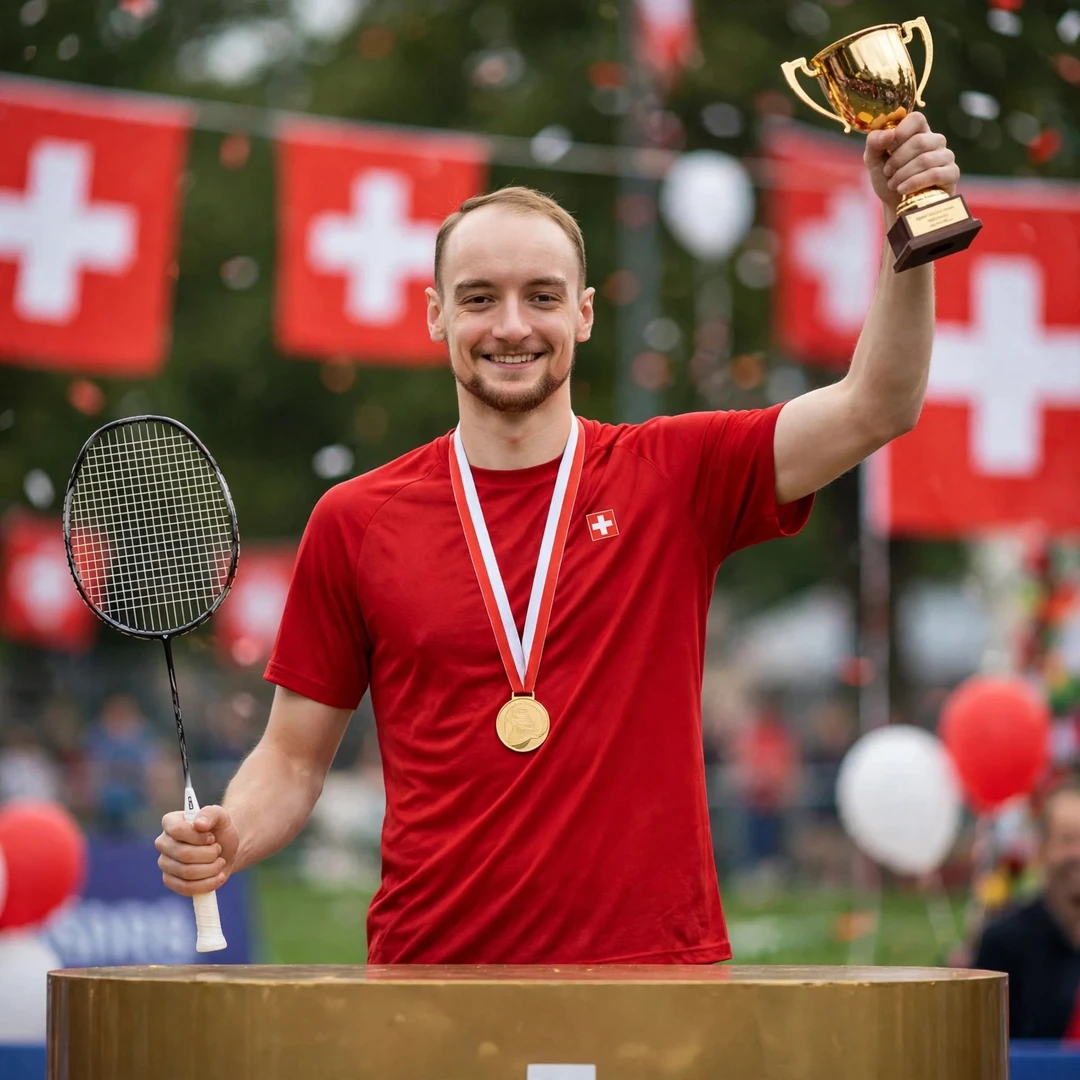
Career Milestone #2
Olympic Debut: A Win in Paris
The spring of 2024 carried Kuenzi to the summit of his career so far. On 23 April 2024 he reached world No. 88, his career-high ranking — a number he would hold again in June and November of that year — and the ranking points gathered across that period carried him to the landmark of his life: qualification for the Paris 2024 Olympic Games. Only two Swiss badminton players had ever reached the Olympics before him. There was no wildcard and no shortcut; Switzerland does not receive gifted places, and Kuenzi’s ticket was earned the hard way, through years of satellite events and European Championships runs, through 15,000-plus ranking weeks of accumulated points. At twenty-six, the apprentice from Würenlingen was an Olympian.
The Olympic draw placed Kuenzi in Group N at the Adidas Arena in the Porte de la Chapelle district of Paris, alongside China’s Li Shifeng — the sixth seed and one of the tournament favourites — and Nigeria’s Anuoluwapo Juwon Opeyori. There is no gentle introduction at an Olympics, and Kuenzi opened against Li. He lost 13–21, 13–21, but the scoreline only tells part of it: Swiss coverage of the match noted that he had convinced despite the defeat, competing rally for rally with a player ranked eighty places above him rather than being swept aside. For a debutant from a country with two previous Olympic badminton players in its entire history, standing on that court and making the sixth seed work was itself a statement.
Everything about Kuenzi’s Olympic story is contained in his second group match. Against Opeyori, he found himself staring at defeat in the very first game: the Nigerian held three game points. Kuenzi saved all three, stole the game 22–20, and then closed the match 21–14 in the second — an Olympic victory, earned from the edge of losing the opening game, in the loudest arena of his life. He finished second in Group N behind Li Shifeng; only the group winner advanced, so the campaign ended there, with Swiss broadcasters describing a dignified farewell for the Swiss players. But the result stands in the record books: a Swiss men’s singles win at the Olympic Games, from a player who had needed eleven years to get there.
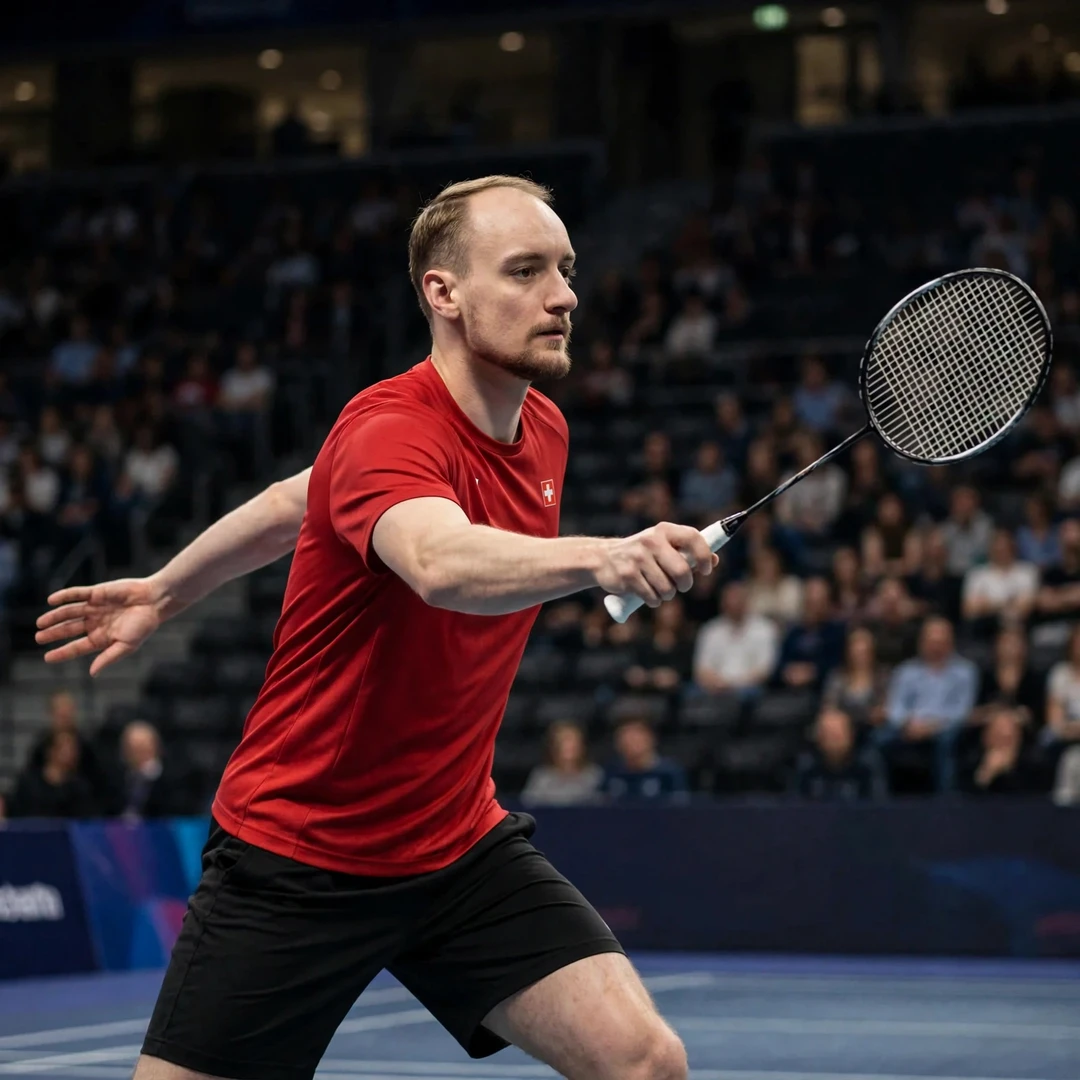
Career Milestone #3
Back in Paris for the World Championships
Thirteen months later he was back in the same arena. At the 2025 World Championships in Paris, Kuenzi led Switzerland’s largest World Championships delegation in history — eight athletes — as the country’s sole men’s singles representative. His reward for the occasion was one of the hardest opening draws available: Malaysia’s Leong Jun Hao, a top-25 player. Kuenzi lost 12–21, 14–21 in under half an hour, and there is no dressing that up — but the significance of the week sat around the match rather than inside it. Switzerland had never sent eight players to a World Championships before; its standard-bearer was the same man who had carried its singles game for a decade, returning to the arena of his Olympic debut as the head of his country’s team.
In October 2025, Kuenzi added a milestone that had eluded him for ten years on tour: his first senior international singles final. At the Venezuela International in Caracas he played his way through the draw to the title match, where Sri Lanka’s Dumindu Abeywickrama — himself a rising name on the satellite circuit — waited. Kuenzi took the first game 21–10, a dream start, before Abeywickrama turned the match and won 21–10, 18–21, 12–21 from the Swiss player’s perspective. A runner-up finish is never the goal, but context matters: at twenty-seven, on his third continent of finals appearances, Kuenzi had finally put himself into a senior singles final — the natural next step for a player whose career keeps producing firsts later than most.
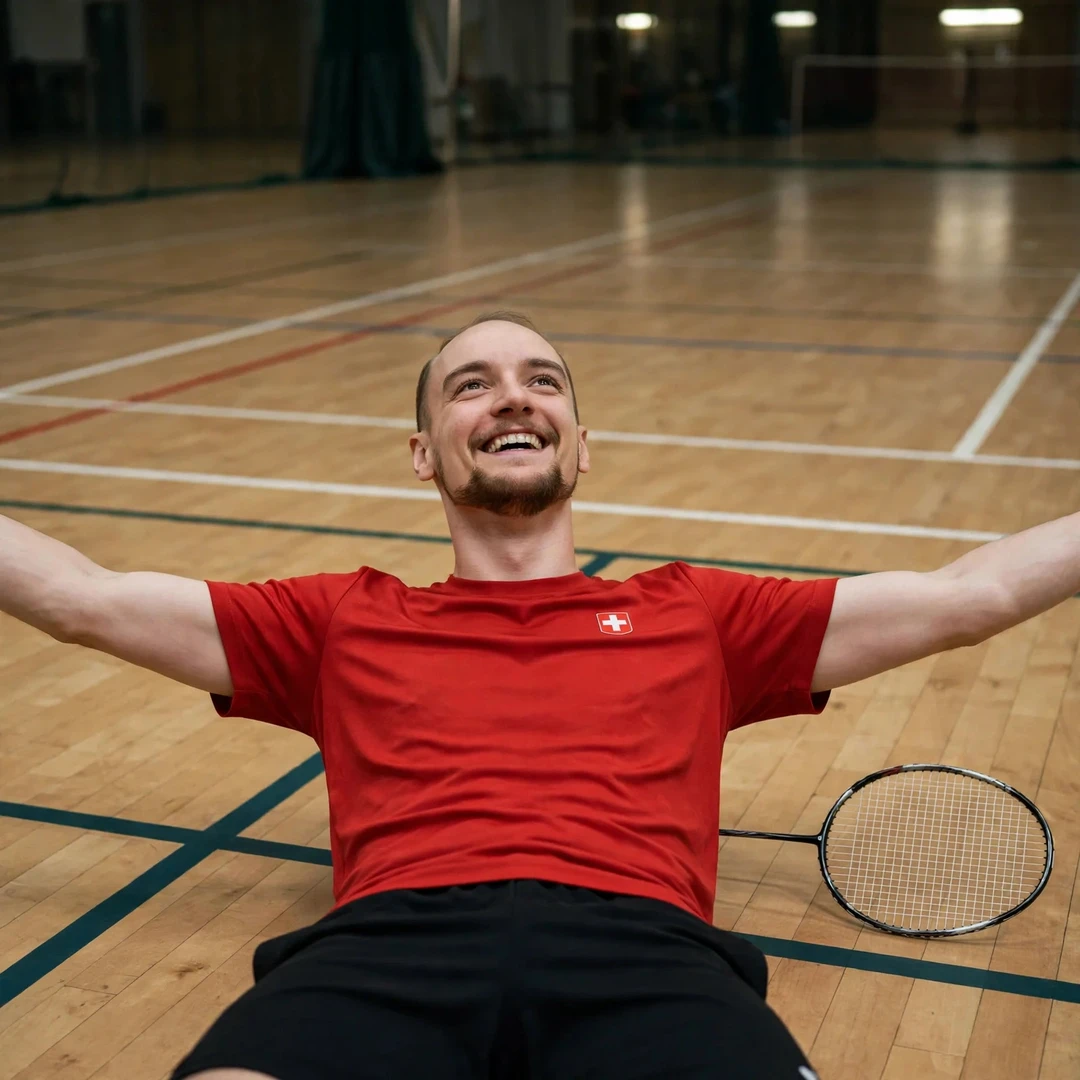
The milestones kept coming. In December 2025, in the European Men’s Team Championships qualifiers in Dublin, Switzerland beat Ireland 3–2 with Kuenzi and Nicolas Franconville winning the deciding doubles 21–17, 17–21, 21–17 — after Kuenzi had lost a three-game singles earlier in the tie, a measure of his value to any Swiss team. Then came Huelva in April 2026 and his fourth European Championships last sixteen: a 21–12, 21–9 dismantling of Portugal’s Bruno Carvalho, then a 63-minute epic against Slovakia’s Milan Dratva, won 21–17, 10–21, 21–19, at the end of which this famously reserved man lay down on the court and celebrated. Top seed Anders Antonsen stopped him 12–21, 11–21 in the last sixteen — but the week had already made the Swiss federation’s point: Kuenzi was, once again, among the sixteen best players in Europe.
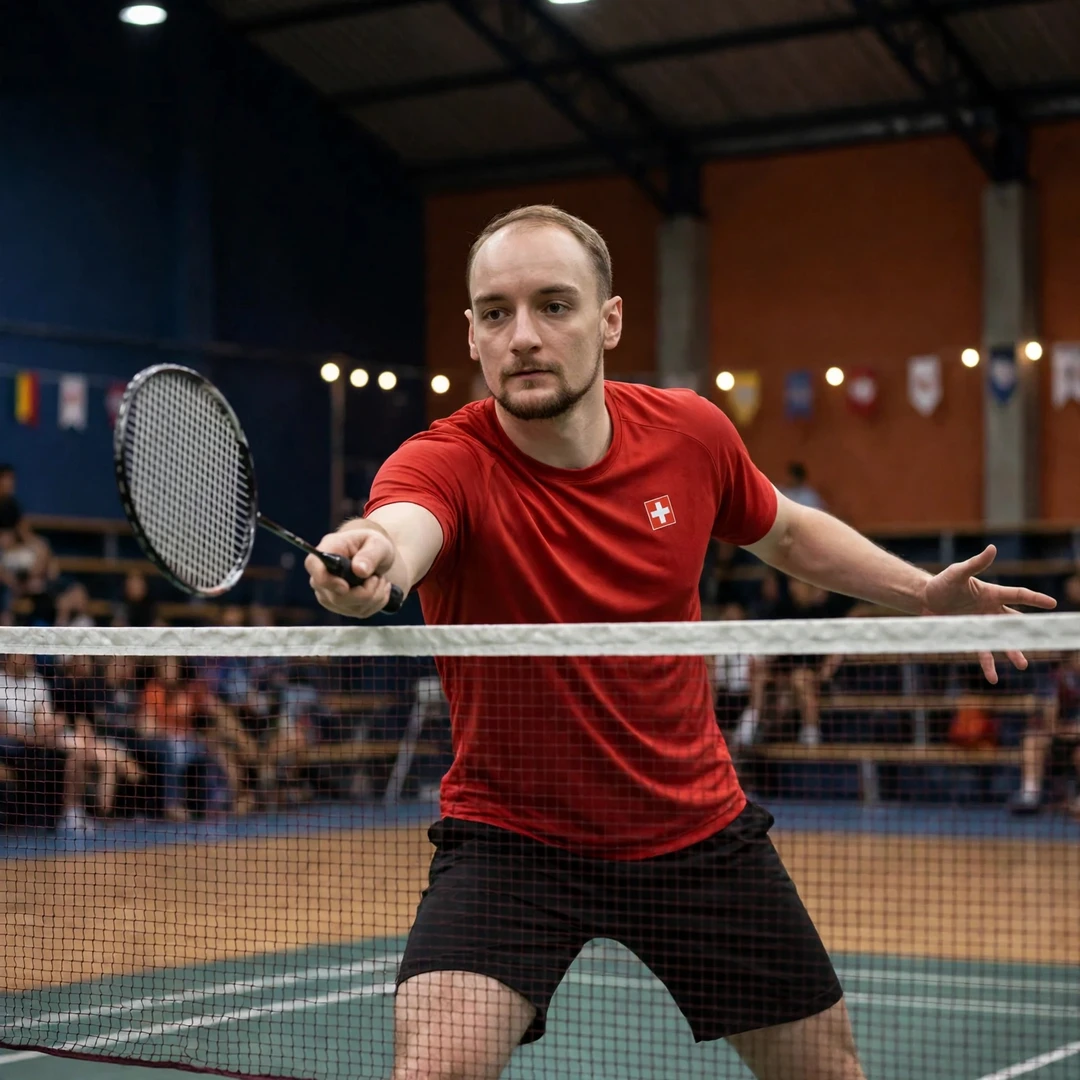
Career Milestone #4
A First Singles Final and a Fourth European Last Sixteen
Step back from the individual results and a pattern emerges that no single scoreline captures. Four European last-sixteen finishes — 2022, the 2023 European Games, 2024 and 2026 — put Kuenzi in a small group of players who reach the business end of continental championships again and again without ever quite breaking into the medal rounds. Two of those runs ended after he had held match points. Players with less resolve would have folded after the second heartbreak; Kuenzi’s response was to add a fourth and cleanest run in Saarbrücken and then a fourth last sixteen in Huelva, sealed with the most emotional celebration of his career. The federation’s verdict after Kraków — that he had established himself among Europe’s leading players — reads less like consolation than description.
Which brings the story to the present. In the Week 43 rankings of 20 October 2026, Tobias Kuenzi stands at world No. 122 with 15,845 points from 15 tournaments — three places behind his compatriot Julien Scheiwiller, giving Switzerland two men inside the world’s top 125. The number deserves context: this is a player who has now appeared on the BWF ranking list for eleven consecutive years, who peaked at No. 88, and whose résumé — Olympian, four-time national champion, four-time European last-sixteen player, senior international finalist — is considerably larger than a three-digit ranking suggests. At twenty-eight, with the European circuit’s long calendar ahead of him, Kuenzi remains what he has been since 2015: a fixture. The names around him change every season. He does not.
Playing Style
The Calm Rallying Game
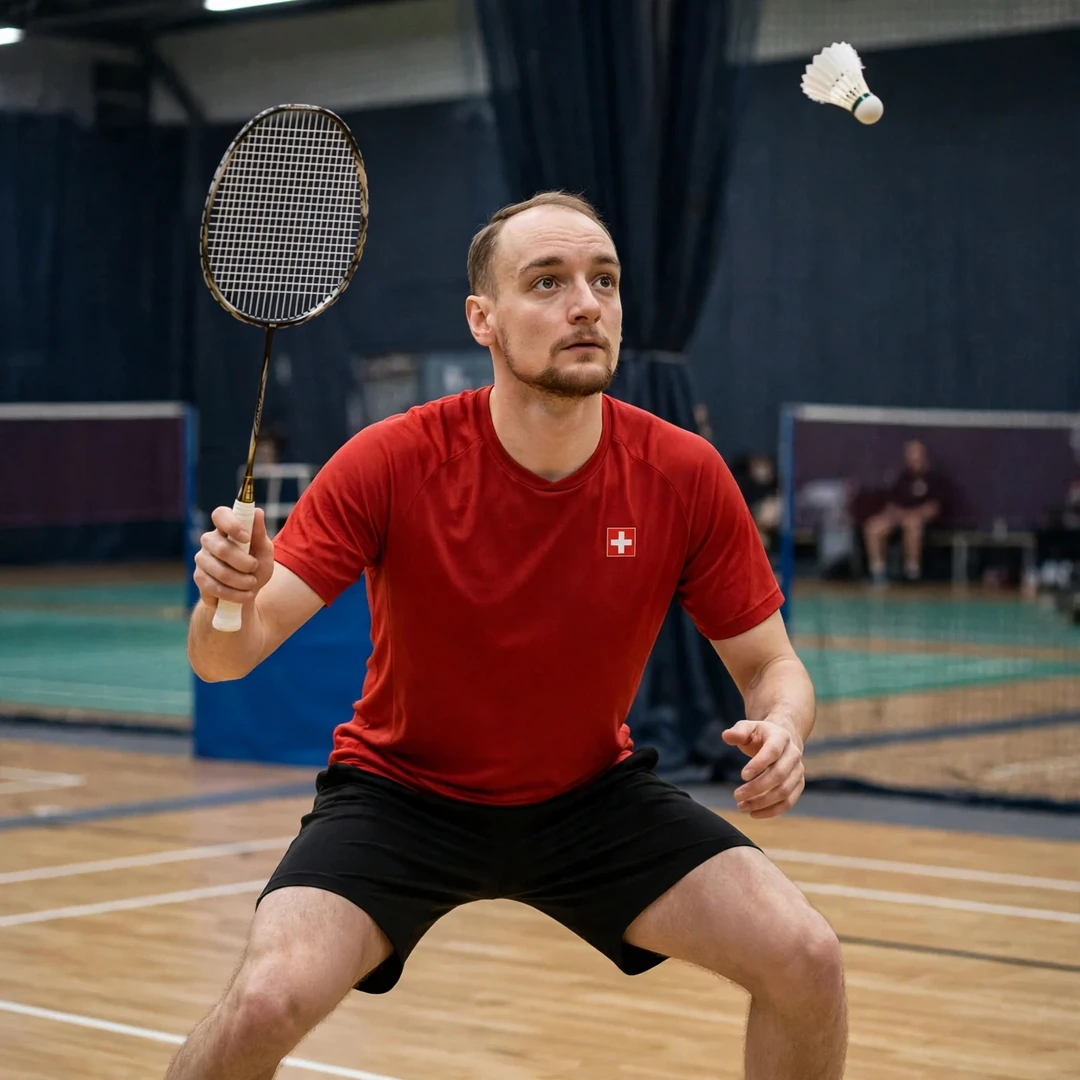
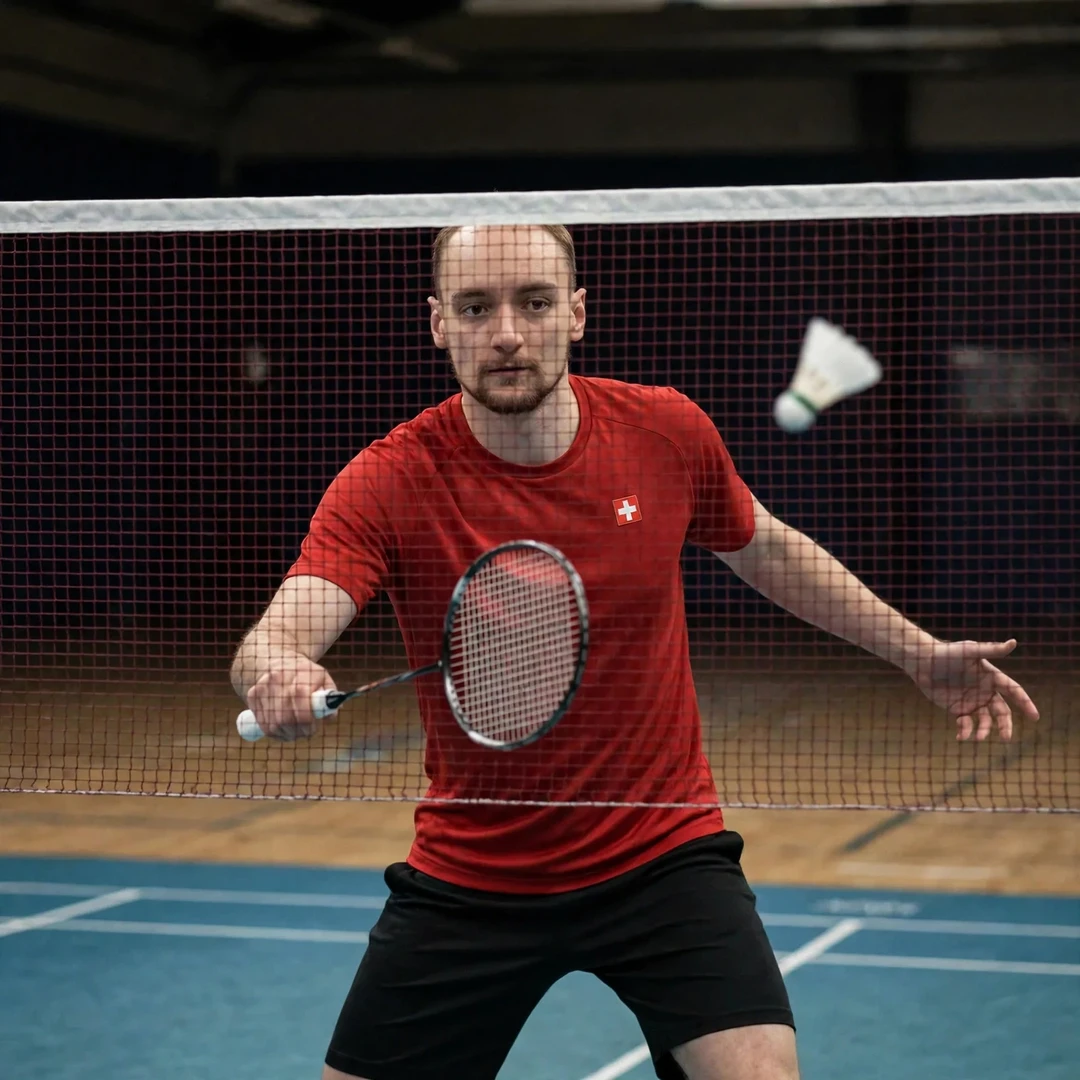
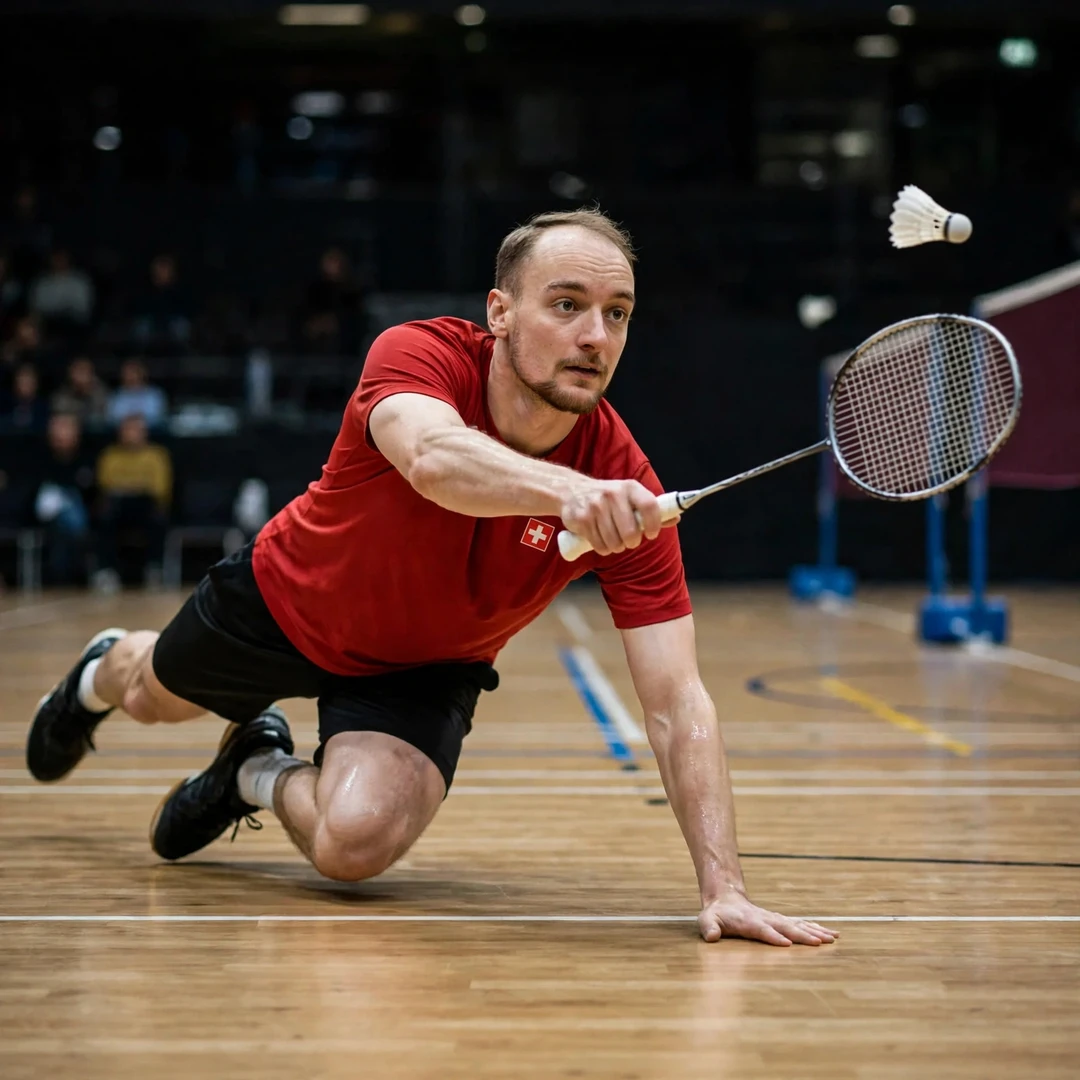
Kuenzi’s game starts with his frame. At 184 cm he owns one of the longer reaches in European singles, and he uses it the way patient players do — not to lunge theatrically, but to arrive early, take the shuttle high, and make the court feel small. Around that reach sits a defence that keeps rallies alive long past the point where most opponents expect them to end. The statistical shape of his career follows from this: long matches, three-game deciders, 63-minute marathons like the Dratva win in Huelva, and opponents who visibly age inside rallies. He is not a one-shot killer; his winners are usually the last shot of a rally he has already won three times over, by placement, patience and the refusal to donate errors.
The second half of the game is temperament. Swiss Badminton describes Kuenzi as a man who rarely shows big emotions on court — which is precisely why his celebration after the Dratva match in Huelva made federation headlines: when a player that composed finally lets go, everyone notices. Between points he is a study in routine: same walk back to the service position, same reset, whether the rally before it was won brilliantly or lost from match point up. The second game of that Dratva match finished 10–21 against him; the decider’s biggest points went his way anyway. Young players often ask what mental toughness looks like. It looks like that — not the absence of disappointment, but a game that returns to its defaults the moment the next rally starts.
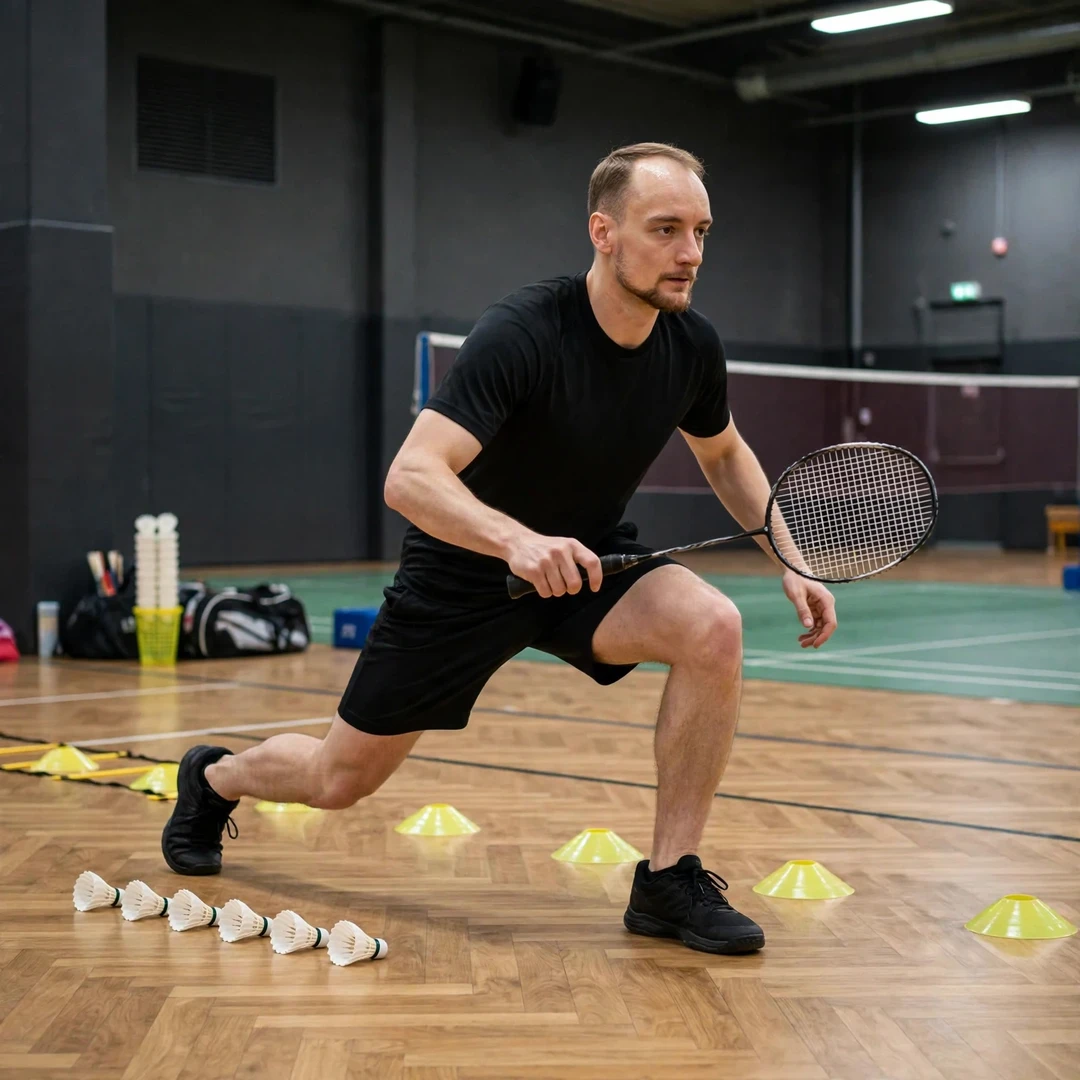
For developing players, the useful lesson in Kuenzi’s game is how ordinary its ingredients are. Watch the matches that define him and the shots that decide them are not trick shots: high clears that pin the back line, lifts that buy him time to recover, tight net shots that stop opponents attacking, and a cross-court defence that turns pressure into neutral rallies. What makes it professional is the duration — the same footwork patterns, the same shot quality, sustained for sixty or seventy minutes without the error count climbing. That is a trainable quality. It comes from thousands of multi-shuttle sessions and footwork repetitions rather than talent, and it is exactly the quality that smaller badminton nations can build in their players: you cannot coach someone to be 190 cm with a 350 km/h smash, but you can coach consistency.
Mental Strength
Patience, Consistency and Quiet Belief
The final strand is his record in deciding moments, which reads like an argument with itself. In 2022 and 2023 he held match points in European last-sixteen matches and lost both. In Paris, facing three game points against him in an Olympic group match, he saved all of them and won. In Huelva, the federation noted that in the closing phase against Dratva he won the majority of the important points — the same situations that had twice broken his heart, now closing in his favour. Coaches would call this learning; Kuenzi’s career suggests something simpler and more encouraging: the skill of winning late points is itself trained by losing them, publicly, and coming back. His story gives junior players permission to treat heartbreak as tuition rather than verdict.
Consider the arc as a whole. No. 1,740 in the world at seventeen. No. 88 and an Olympic debut at twenty-six. A first senior singles final at twenty-seven. Four European last-sixteen finishes spread across five seasons. Five hundred and twenty-eight weekly ranking entries and counting. Almost nothing in that list arrived early, and none of it arrived by luck: Switzerland offers no home World Tour event, no giant federation budget, no wildcards into the biggest draws. Kuenzi’s career was assembled from qualifying rounds, team trips to places like Dublin, satellite finals in places like Caracas, and a national-championship rivalry with himself — staying Switzerland’s best for long enough that the big stages eventually came to him. It is, in the best sense, a craftsman’s career.
The practical lessons are unusually transferable. Start where you are: Würenlingen is not a badminton capital, and it did not need to be. Build the complete game: his Cyprus mixed doubles title, his Basel World Championships doubles appearance and his Dublin doubles decider all fed the singles career rather than distracting from it. Treat national titles seriously: four Swiss crowns kept his winning habits alive through seasons when international draws were cruel. And plan for a long peak: the modern men’s game rewards durability, and Kuenzi’s best results — career high, Olympics, first final — all arrived between twenty-six and twenty-eight. A junior who is not the best in Europe at eighteen is looking at exactly the career map they need.
Learning Reference
ST Badminton Academy Connection
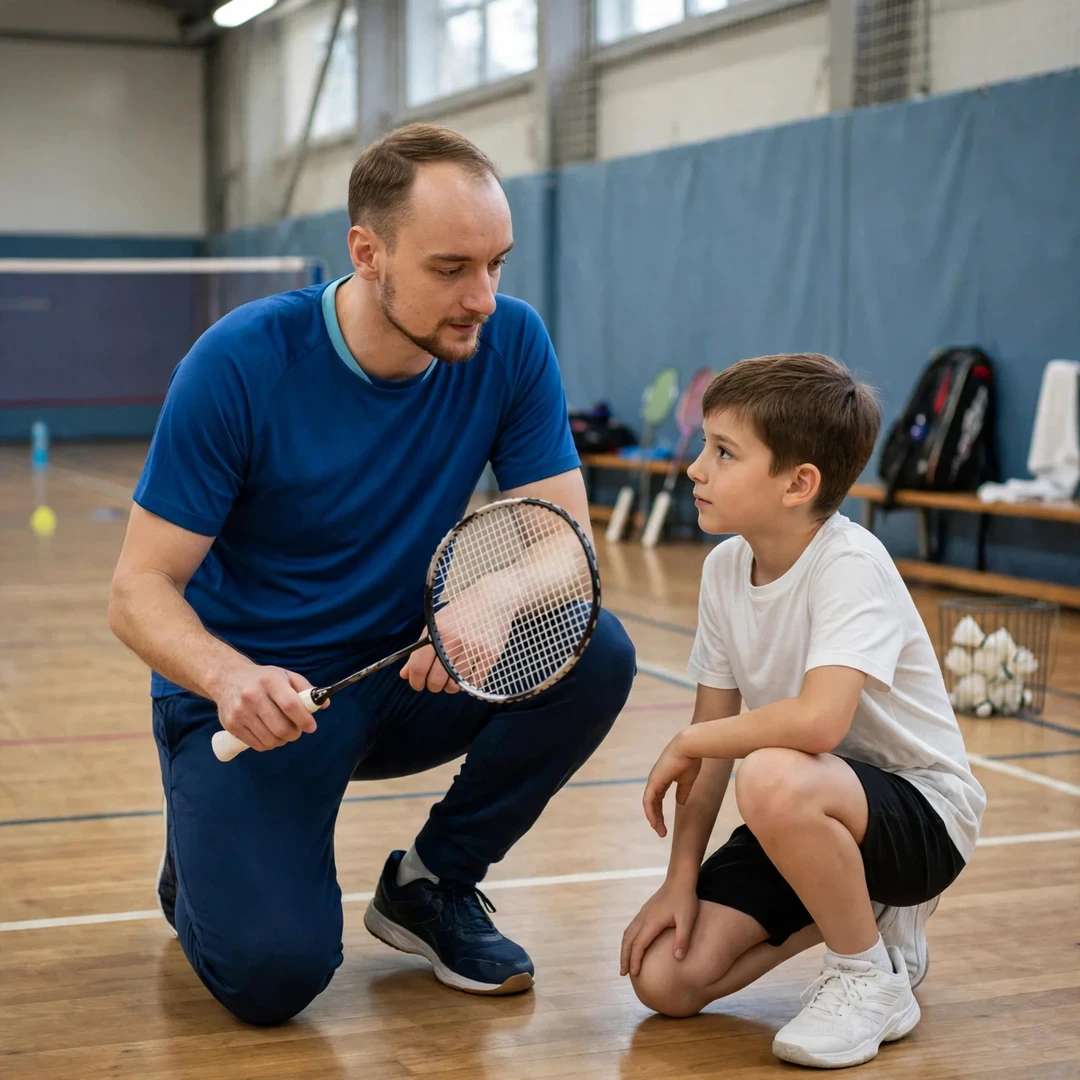
ST Badminton Academy is not affiliated with Tobias Kuenzi and does not represent him or Swiss Badminton. We publish this profile because his career — built from a small town in Aargau to the Olympic Games — teaches lessons our students in Malaysia can use: that consistency compounds, that late developers have a map to follow, and that a player from a small badminton nation can earn a place on the biggest court in the sport. All results, rankings and biographical details are drawn from BWF, Olympic, federation and news records available at the time of writing.
For players and parents who want to study Kuenzi properly, four matches teach almost everything. Start with Paris 2024 against Opeyori: three game points saved and an Olympic win, the purest footage of his composure that exists. Then Huelva 2026 against Dratva: sixty-three minutes, a second game lost 10–21, and a decider closed 21–19 — watch only the last ten rallies if time is short. The Saarbrücken win over Fabio Caponio shows the controlled version of the game, straight games against a top Italian. And the Kraków group win over Karl Kert is a lesson in doing the professional job against a player you are expected to beat. Between them: pressure, recovery, control and professionalism — a syllabus in four matches.
Sometimes a remarkable career is not built in a famous badminton nation at all. Tobias Kuenzi built his in a country of nine million people where badminton shares the stage with winter sports and football, in a town most badminton fans could not find on a map, one ranking week at a time — 528 of them so far. He has been his country’s best player for the better part of a decade, an Olympian, and a fixture of European championships. For every young player in a small hall in a small town wondering whether the long road is worth it, his career is the answer walking around in a red shirt: keep the rallies long, keep the errors low, and keep going.
FAQs: Tobias Kuenzi Swiss Badminton Player
Here are answers to common questions about Tobias Kuenzi’s career, achievements and what young players in Malaysia can learn from the Swiss right-hander who carried his country’s men’s singles game onto the Olympic stage.
Who is Tobias Kuenzi and which country does he represent in badminton?
Tobias Kuenzi is a Swiss professional badminton player and his country’s leading men’s singles player of the past decade. He was born on 18 February 1998 in Würenlingen, in the canton of Aargau, plays right-handed, stands 184 cm tall and represents the Switzerland national team, coached by Rajiv Ouseph. In the BWF Week 43 rankings published on 20 October 2026 he is world No. 122 with 15,845 points; his career-high ranking is No. 88, reached in April 2024.
What are Tobias Kuenzi’s biggest badminton achievements?
His biggest achievements are qualifying for the Paris 2024 Olympic Games — only the third Swiss badminton player ever to do so — and winning a match there against Nigeria’s Anuoluwapo Juwon Opeyori. He is a four-time Swiss national singles champion (2019, 2020, 2021 and 2023), won the Cyprus International mixed doubles title in 2019 with Jenjira Stadelmann, reached his first senior singles final at the Venezuela International in 2025, and has finished in the last sixteen at four European Championships or European Games. His career-high world ranking is No. 88.
What is Tobias Kuenzi’s playing style?
Kuenzi plays a calm, consistent all-court rallying game. At 184 cm he has a long reach and an excellent defence, keeps unforced errors very low, and wins by extending rallies until opponents break down — the style behind his many three-game wins, including the 63-minute decider against Milan Dratva at the 2026 European Championships. He is right-handed, shows famously little emotion on court, and is at his most dangerous in the closing points of deciding games.
How did Tobias Kuenzi perform at the Paris 2024 Olympic Games?
At Paris 2024, Kuenzi played in Group N. He lost his opening match to China’s sixth seed Li Shifeng 13–21, 13–21, then beat Nigeria’s Anuoluwapo Juwon Opeyori 22–20, 21–14 — saving three game points in the first game — to finish second in the group. Only the group winner advanced to the knockout rounds, so his debut ended there, but he left Paris with an Olympic match win, a rare achievement for Swiss badminton.
How can my child learn from Tobias Kuenzi’s training approach?
Two parts of his approach transfer directly. On court: rally patience, a structured defence and footwork economy — the qualities his coach Rajiv Ouseph, the former England international, has refined in him. Off court: the patience to build over a decade, treating setbacks like his two match-points-lost European defeats as lessons rather than endings. At ST Badminton Academy we use his 21–19 decider win over Milan Dratva as a teaching example of how to play the final rallies of a close match.
How many Swiss national singles titles has Tobias Kuenzi won?
Four. Kuenzi won the Swiss Elite Championships men’s singles title in 2019 — his first, at twenty-one — and then in 2020, 2021 and 2023. Swiss Badminton describes him as the four-time Swiss singles champion, and the national titles made him the reference point of Swiss men’s singles from 2019 onwards.
What are Tobias Kuenzi’s best World Championships results?
Kuenzi has played at two World Championships. At Basel 2019, in front of a home crowd, he represented Switzerland in men’s doubles with Oliver Schaller, and he was also in the Swiss squad at the 2019 Sudirman Cup. At Paris 2025 he led Switzerland’s largest-ever World Championships delegation — eight athletes — in men’s singles, losing his opening match to Malaysia’s Leong Jun Hao 12–21, 14–21 at the same arena where he had made his Olympic debut a year earlier.
What playing style should young players learn from Tobias Kuenzi?
Learn the patience game. Kuenzi’s biggest wins — over Opeyori at the Olympics and over Dratva at the European Championships — were decided not by spectacular power but by keeping the rally alive, defending every corner and staying calm enough to take the last points of deciding games. Young players who build low-error fundamentals, strong defence and a repeatable routine between points are copying the exact skills that took a player from Würenlingen to the Olympic Games.
Does ST Badminton Academy have any connection with Tobias Kuenzi?
No. Kuenzi represents Switzerland, is coached within the Swiss system by Rajiv Ouseph, and competes on the BWF circuit from his home country; he has no connection with our academy. ST Badminton Academy is an independent academy in Kuala Lumpur, Malaysia, and we feature international players like Kuenzi in these profiles purely as study material for our students and readers.
Tobias Kuenzi Career Highlights
Career Statistics and Rankings
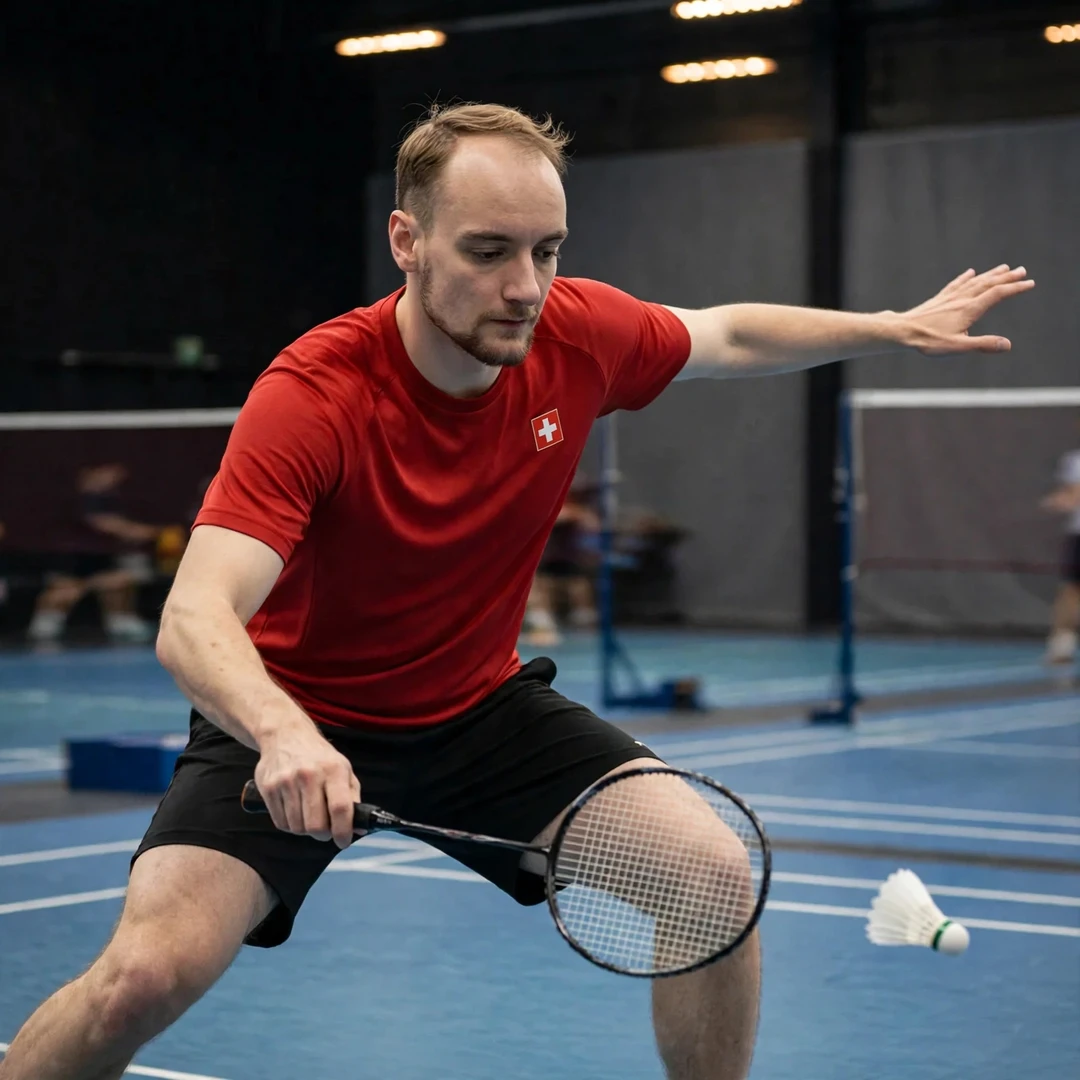
Tobias Kuenzi’s rise is a lesson in how far consistency can travel: a teenager from Würenlingen ranked No. 1,740 in the world, a four-time Swiss champion, a man who held match points against Europe’s best and learned, eventually, to close those matches instead — an Olympian who won a match in Paris, a finalist in Venezuela, and, at twenty-eight, still standing inside the world’s top 125 in the Week 43 rankings of October 2026. The next chapter writes itself from the pattern of all the others: another season, another European spring, and a push back towards the top 100 he first reached in 2024.
| Development Area | Common Misconception | What Tobias Kuenzi's Career Shows REALITY |
|---|---|---|
| Junior Foundation | Talent alone decides who becomes a champion. | Kuenzi developed through the small Swiss junior pathway in Würenlingen, Aargau, and was ranked in the world from the age of seventeen — a structured junior base came first. |
| Playing Style Priority | Kids should copy the flashiest attacking shots. | Kuenzi built a complete rallying game first; his defence, reach and low error count are the foundation, and the attacking shots are the finishing touch. |
| Fitness Importance | Juniors can out-train everyone without rest. | Built his career from satellite events and team duty rather than sparring depth — his rise to world No. 88 came from smarter scheduling, not more hours. |
| Mental Approach | Top players never get nervous or upset. | Held match points in two European last-sixteen defeats and kept coming back, reaching the last sixteen twice more — mental skills are trained, not inherited. |
| Attacking Training | Smashing harder is always the answer. | His Olympic win over Opeyori at Paris 2024 (22-20, 21-14) and his four Swiss national titles came from rally placement and patience, not raw power. |
| National Milestones | Only world titles matter. | A first international title in Cyprus in 2019 and a first senior singles final in Venezuela in 2025 — the milestones of a small-nation standard-bearer, built step by step. |
| Career Timeline | Champions peak once and fade fast. | From world No. 1,740 at seventeen to world No. 88 and an Olympic debut at twenty-six, Kuenzi proves sustained development beats a short peak. |
Study Tobias Kuenzi's Consistency and Professional Approach
This profile explains who Tobias Kuenzi is — but for a parent in Kuala Lumpur, Cheras or anywhere in Malaysia wondering whether a child from a small town in a small badminton country can really reach the Olympic Games, his story carries the answer in full: from Würenlingen to Paris, built rally by rally. Book a trial class with ST Badminton Academy on WhatsApp at +60 17-684 2136 and let your child begin building the fundamentals — patience, defence, footwork and composure — that carried Switzerland’s standard-bearer to the top of the sport.