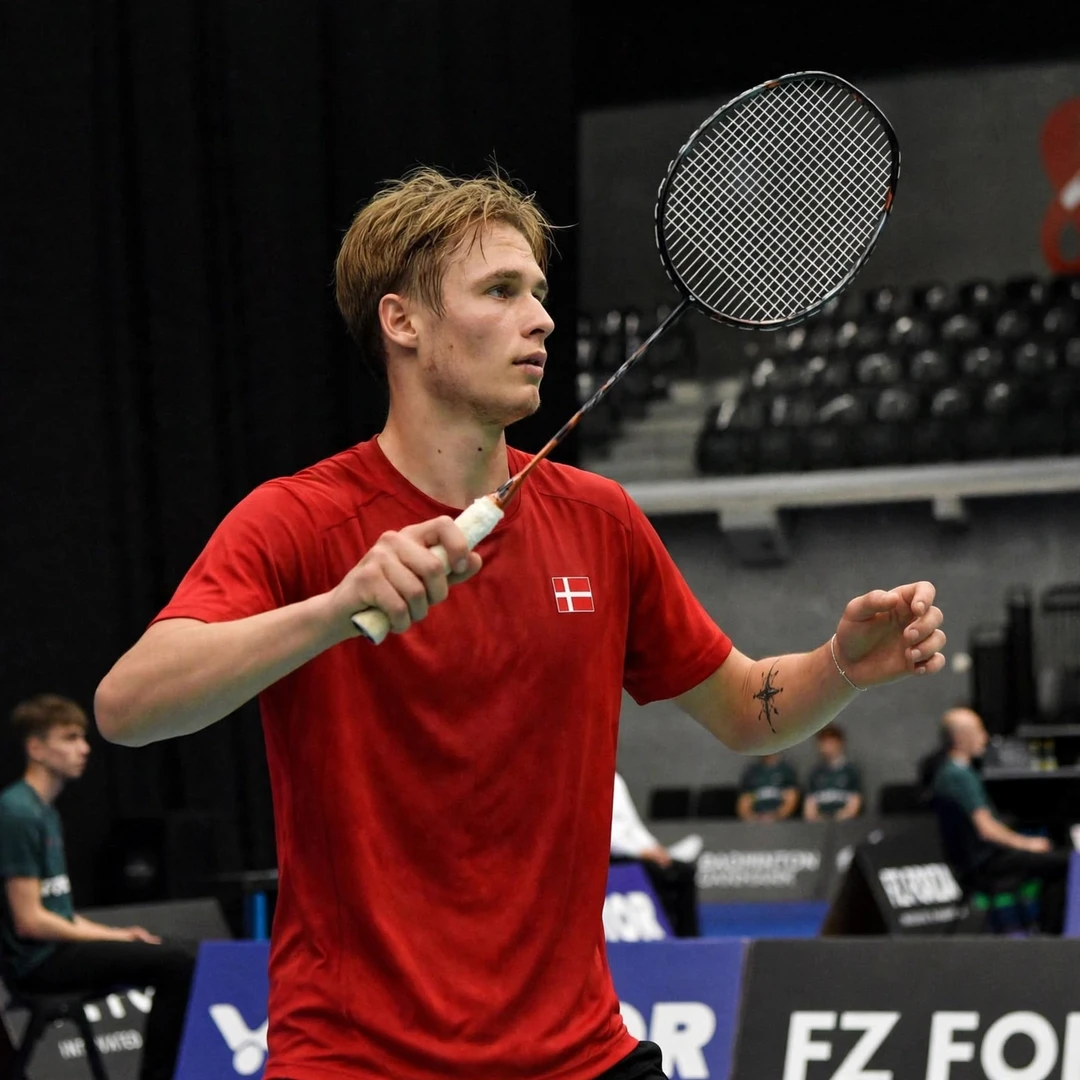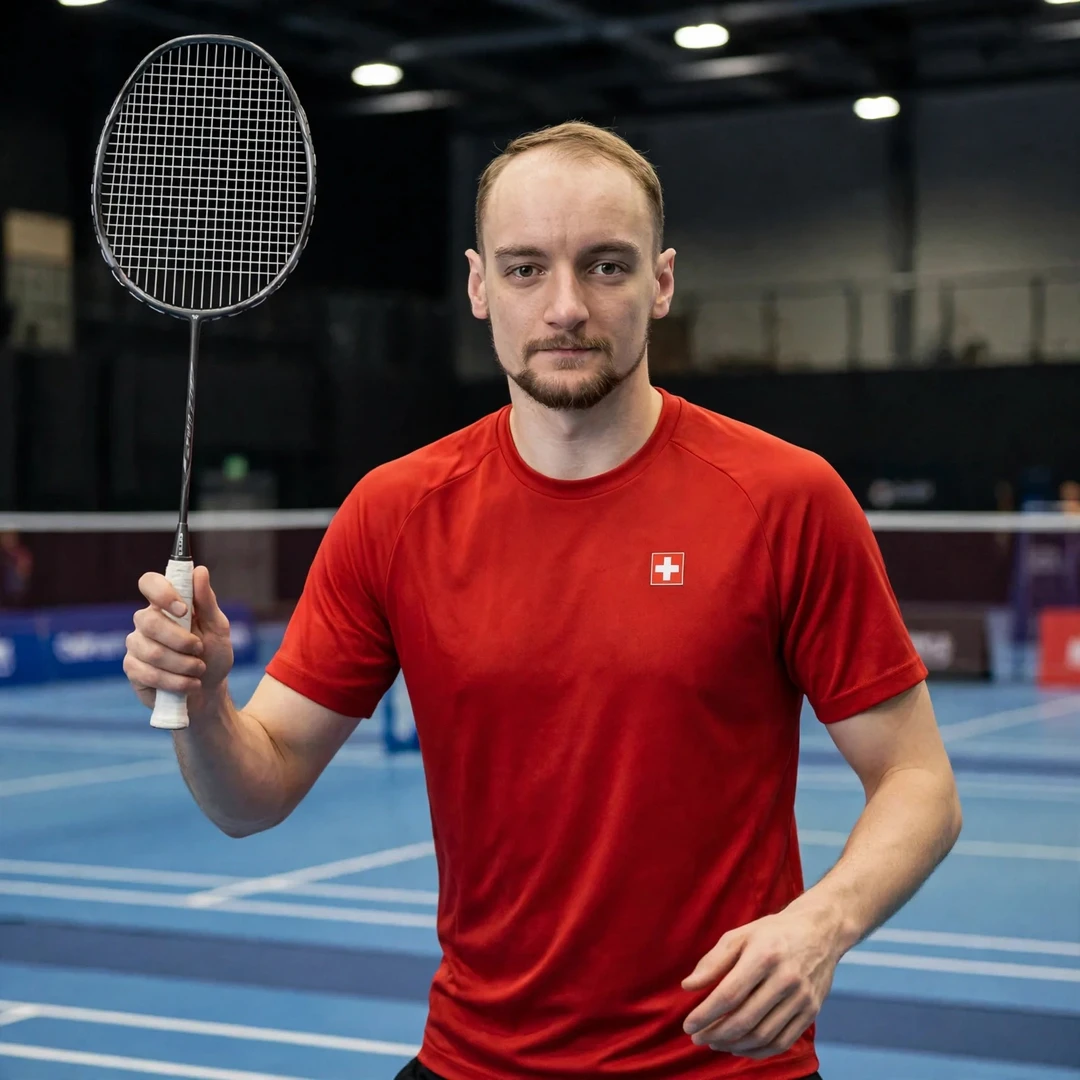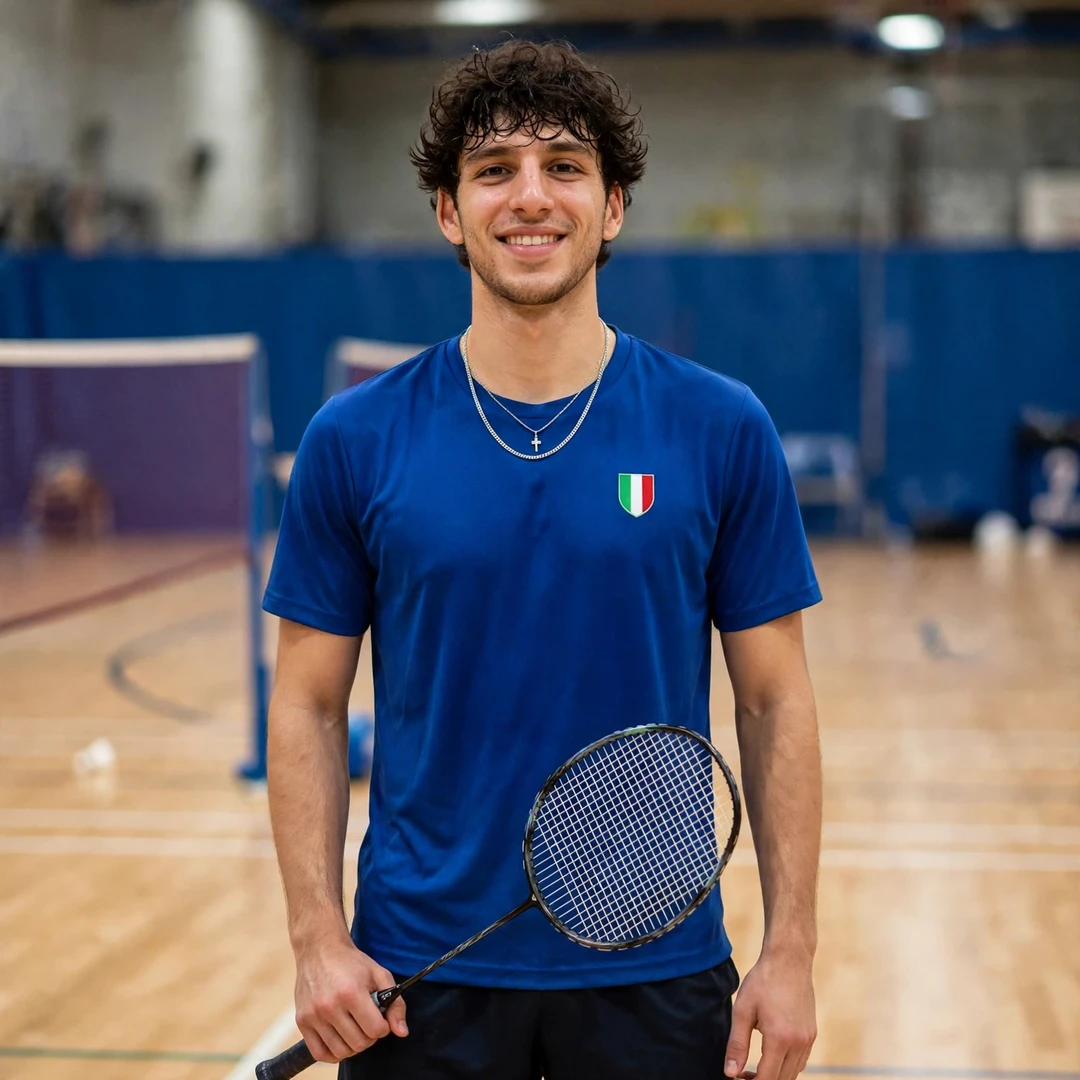
Italian Men’s Singles Badminton Star
Fabio Caponio
Italy
Player Event: Men’s singles
From Santeramo in Colle, Puglia · Born: 26 March 1999 · Right-handed · Height: 181 cm · CS Aeronautica Militare athlete · Graduate in Economics and Management, LUISS Guido Carli
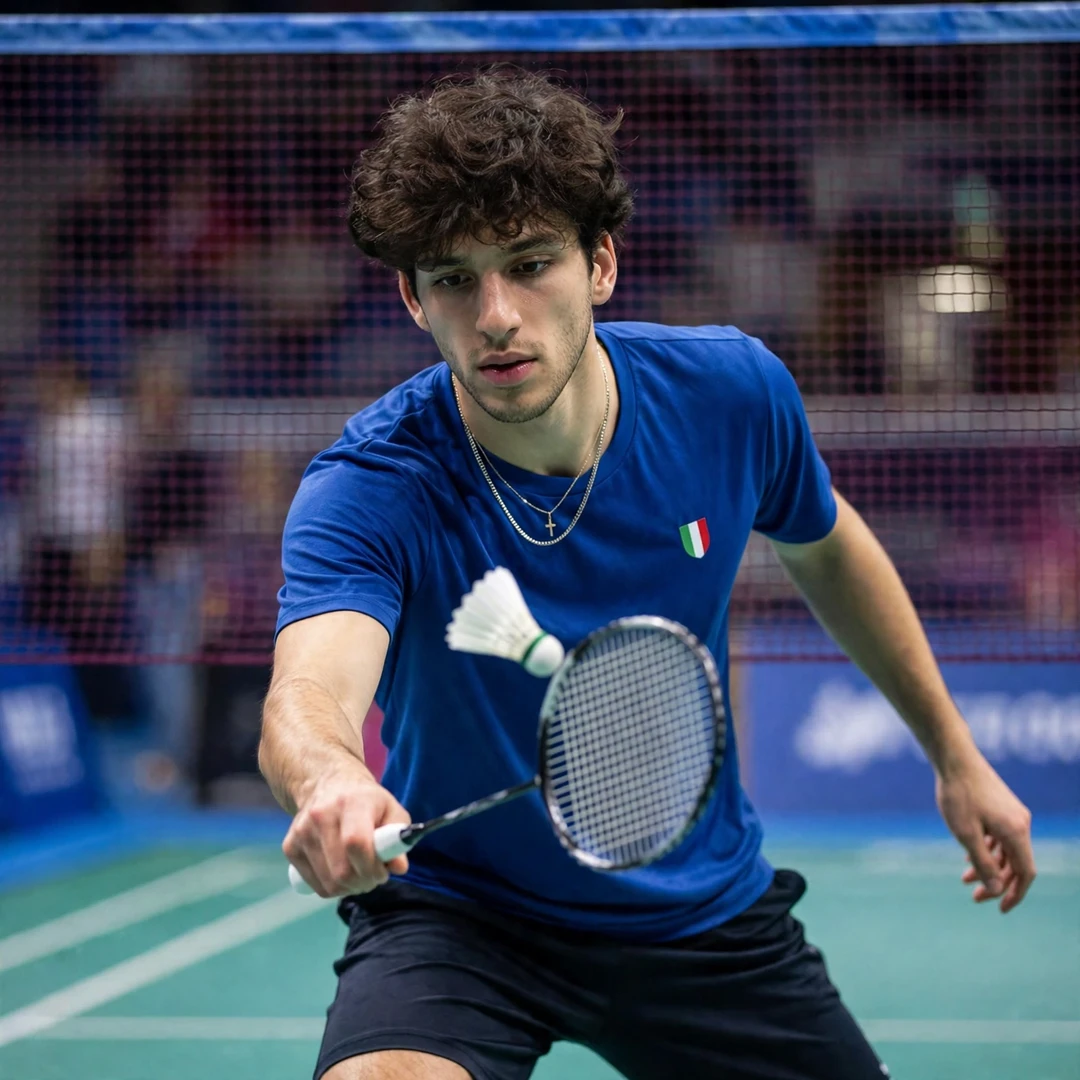
Playing Style: A disciplined all-court game built on speed, concentration and rally control — shaped by years of international doubles before his singles breakthrough.
Known For: Winning the men’s singles gold medal at the Taranto 2026 Mediterranean Games — the first Italian ever to win the title — beating Croatia’s Aria Dinata 22-20, 21-19 in the final; Mediterranean doubles bronze at Oran 2022; and becoming Italy’s youngest senior national champion at sixteen.
Teams: Italy national team · Centro Sportivo Aeronautica Militare (Italian Air Force)
Understanding Fabio Caponio (Italian Badminton Star)
Fabio Caponio is an Italian professional badminton player — and, as of the summer of 2026, the owner of the most important result in Italian badminton history. In the BWF Week 43 world rankings published on 20 October 2026 he stands at world No. 121 with 15,852 points collected across 18 tournaments. His career-high ranking is world No. 83, reached in October 2023. Born on 26 March 1999 in Santeramo in Colle, in Italy’s southern Puglia region, the right-hander plays for the Italian national team and the Italian Air Force sports centre. In August 2026, on home soil in Puglia, he won the men’s singles gold medal at the Taranto Mediterranean Games — something no Italian man or woman had ever done in the sport. This profile traces how a boy who found badminton by accident in a village gym became a national champion at sixteen, an economics graduate, an airman — and finally a history-maker at twenty-seven.
Early Life in Santeramo in Colle and Junior Career
Caponio’s badminton story began by accident when he was seven years old. One day he went with his grandfather to the local gym to pick up his cousin, who trained there. Watching the other boys play, he later told his university’s sports magazine, he felt something special inside — a crazy desire to pick up a racket and hit his first shots. When he got home he immediately asked his parents if he could try. In Santeramo in Colle, a town in Puglia far from Italy’s traditional sporting centres, that small gym was the whole of his badminton world — and it was enough to start a journey that would take him to a Mediterranean Games gold medal twenty years later.
A Racket at Seven, a New Home in Milan at Thirteen
The talent was spotted early, and it demanded a sacrifice most children never face. Selected for the Italian national set-up, Caponio moved at thirteen years old to the national technical centre in Milan, because Puglia simply had no facilities capable of developing an elite player. Leaving home, family and friends at thirteen to live and train at the other end of the country is the hidden price behind many Italian badminton careers, and he paid it without complaint. The Milan years gave him daily high-level training, national-team coaching and the discipline of an athlete’s routine — the foundation everything else in this profile stands on.
Italy’s Youngest Senior Champion at Sixteen
At sixteen he produced the result that announced him to Italian badminton: he won his first Italian senior national title, becoming the youngest player in the country’s history to do so. At the 2016 Italian championships he went further still, taking gold in the men’s singles and the mixed doubles and silver in the men’s doubles — a teenage sweep of the senior national podium. For a player who had left Puglia three years earlier precisely because there was no path at home, the titles were proof the gamble had been right — and they fixed his name in the record books before he had even finished school.
Doubles Gold in Ethiopia and Mauritius
His first international titles arrived in doubles, and they taught him the complete game. In 2016 he won the men’s doubles at the Ethiopia International with Matteo Bellucci, beating Austria’s Lukas Osele and Kevin Strobl 21-17, 19-21, 21-13. A year later he won the Mauritius International doubles title with Giovanni Toti — the partner he would share a decade of Italian badminton with — defeating Aatish Lubah and Julien Paul 13-21, 23-21, 21-16. In 2017 he also joined the Centro Sportivo Aeronautica Militare, the Italian Air Force sports group, where he holds the rank of senior airman. Further doubles finals followed in Mexico and El Salvador in 2021. The doubles years were not a detour: the defence, net skills and rally reading they built became the base of his singles game.
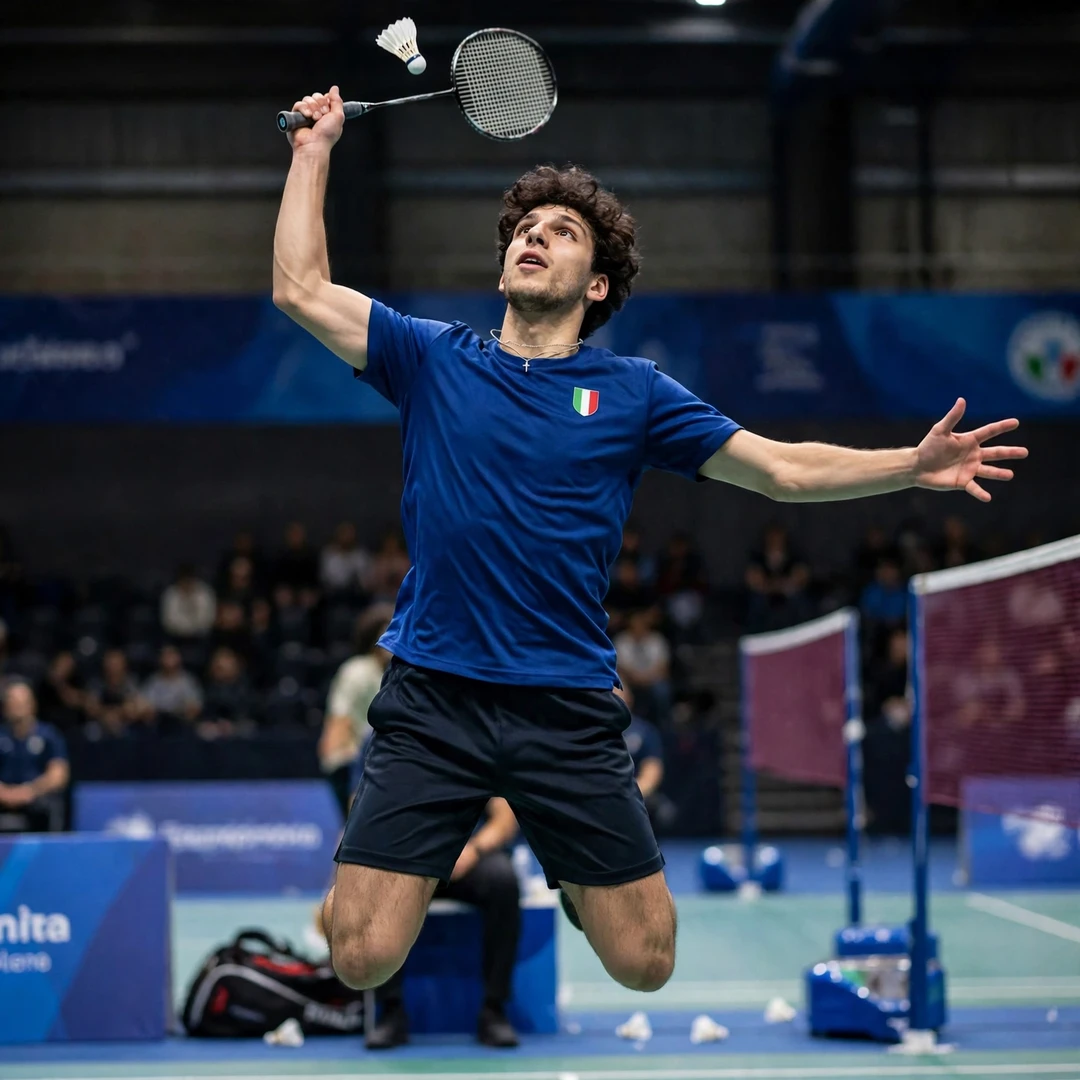
Career Milestone #1
Senior Singles Titles in Chile and Peru
Caponio is also that rare thing in elite sport: a graduate. After a diploma at a sports-science high school, he earned a degree in Economics and Management at LUISS Guido Carli in Rome, as part of the university’s Top Athlete programme for elite sportsmen and women. Asked what badminton gives his studies, he answered in one word — discipline: in study, as on court, the skill is dedicating one hundred per cent of your concentration to the little time available. His university sums up his athletic qualities just as neatly: speed, concentration and discipline. Those three words describe both the student and the player, and this profile will return to them.
His first Olympic dream was broken by the pandemic. Through 2019 and early 2020 Caponio was on the qualifying trail for the Tokyo 2020 Olympic Games — the long, expensive circuit of smaller tournaments through which a player from a minor badminton nation must fight for a ranking place. Then COVID-19 closed the world. He was unable even to enter Jamaica, where the penultimate trial event of his qualifying campaign was being played, because of the pandemic travel restrictions. The Tokyo dream ended not on court but at a border. Plenty of players would have walked away from the grind at that point; Caponio went back to the circuit and kept building for six more years.
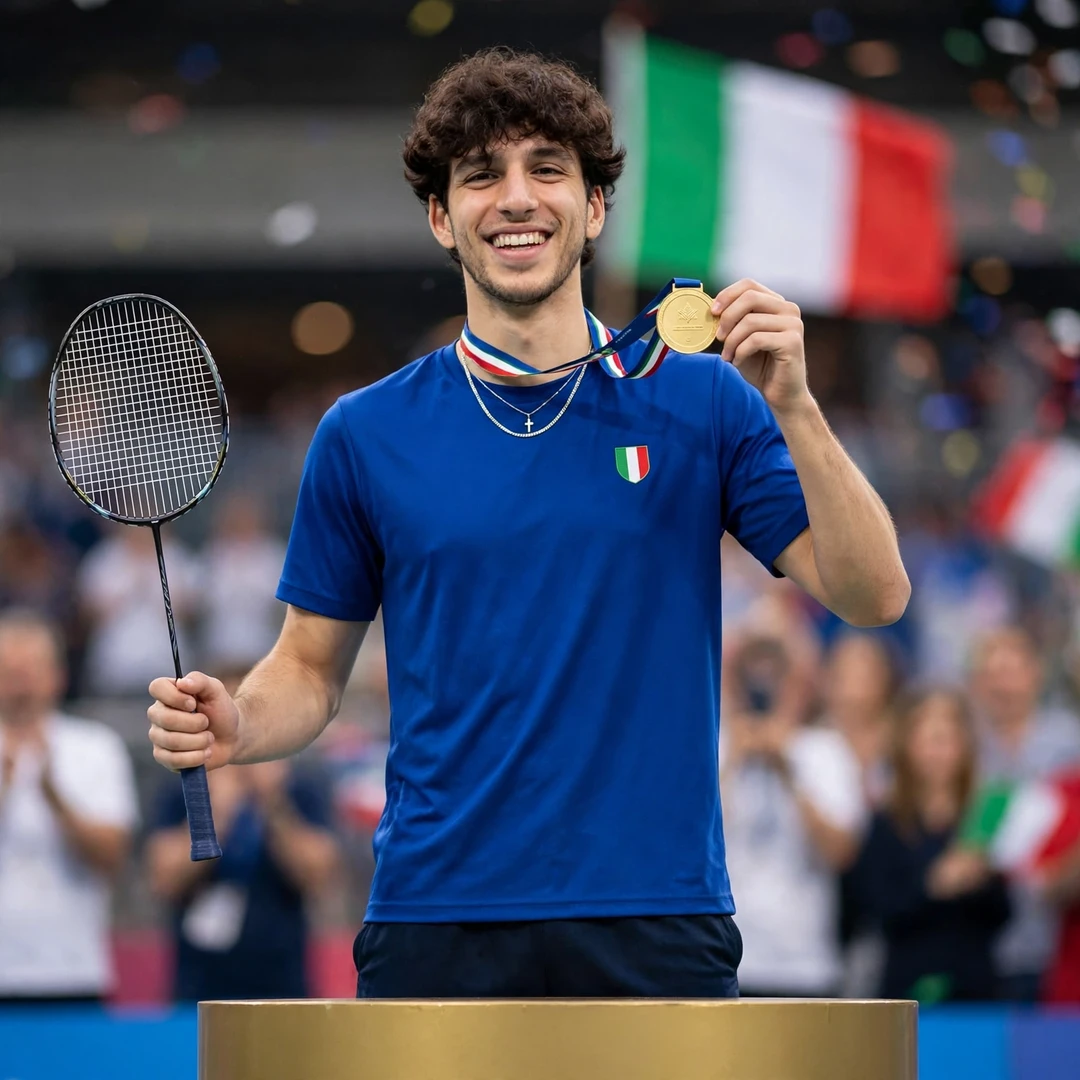
Career Milestone #2
Mediterranean Bronze and a Career-High No. 83
His first major senior medal came at the Oran 2022 Mediterranean Games in Algeria. Reunited with Giovanni Toti in the men’s doubles, the pair swept Portugal’s Diogo Marreiros and Gabriel Rodrigues 21-11, 21-8 to reach the semi-finals, where they took the first game off Spain’s Pablo Abián and Luis Enrique Peñalver before falling 21-17, 15-21, 19-21 — close enough to a final to hurt, far enough to settle for bronze. It was Italy’s landmark badminton medal of those Games. Interviewed afterwards, Caponio was already looking past it: the next challenge, he said, was to climb the podium in singles as well. He would keep that promise four years later.
The singles breakthrough arrived in 2023, in a South American swing few European players attempt. At the Chile International he won his first senior singles title the hard way, edging Kevin Arokia Walter 21-19, 25-27, 21-19 in a three-game final. In Venezuela he reached another final and lost an all-Italian battle to his old partner Giovanni Toti, 12-21, 20-22. Then, in Peru, he completed the set: a 21-11, 21-18 win over El Salvador’s Uriel Canjura brought him the Peru International title. Back home, the numbers confirmed the leap — in October 2023 his world ranking peaked at No. 83, the career high he still holds, built almost entirely on the unglamorous International circuit.
In October 2025 he struck again in North Africa. At the Algeria International, Caponio won the men’s singles title by beating Noah Haase in a final that swung violently: a runaway first game, a lost second, and a decider taken 23-21 — 21-8, 9-21, 23-21 the final score. The same autumn swing brought a semi-final at the Egypt International, more ranking points and more evidence of the pattern this profile keeps documenting: when a match reaches the last few points of a deciding game, Caponio is an unusually calm man to be standing across the net from.
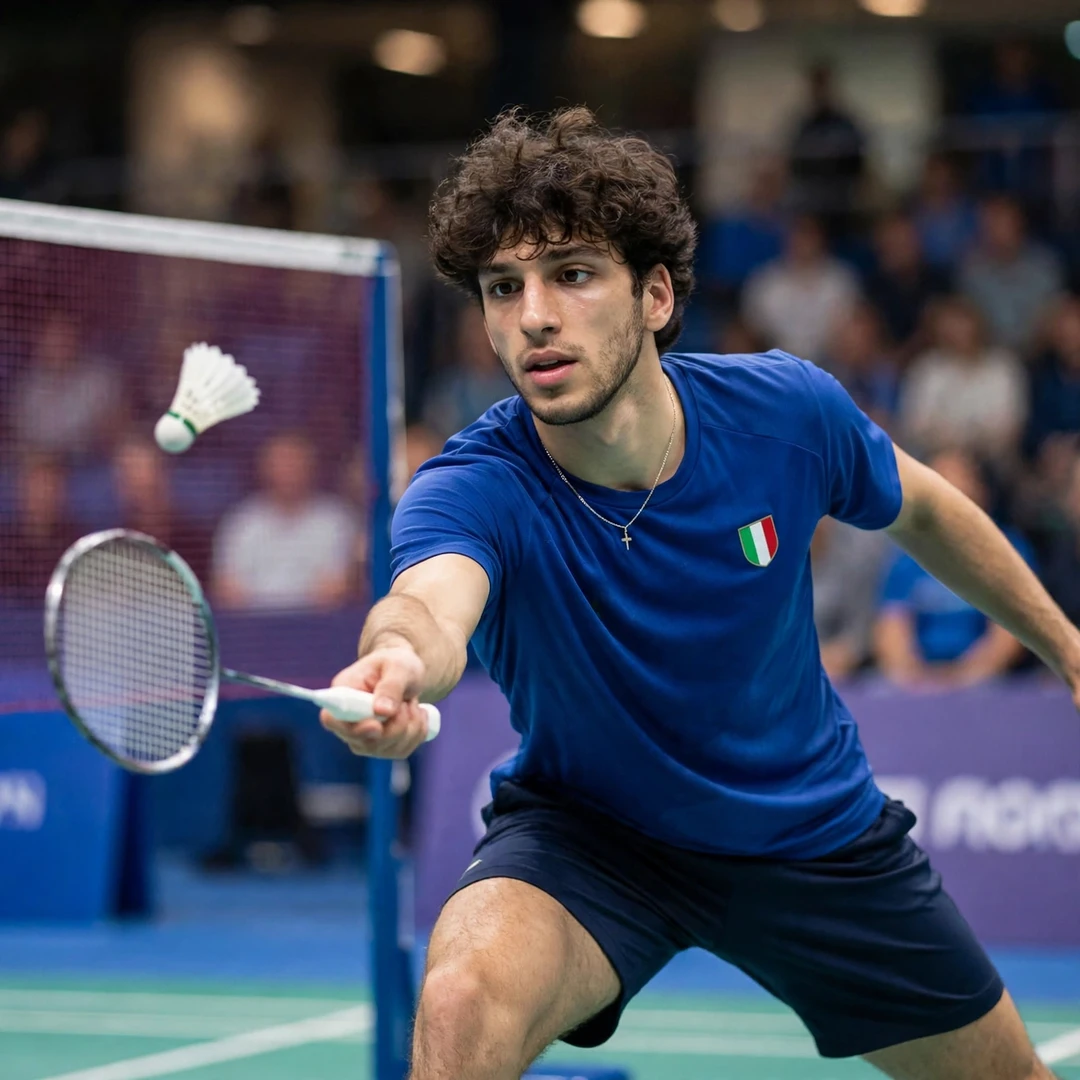
Career Milestone #3
Algeria Gold and a Second Italian Crown in 2025
Six weeks later came a coronation at home. The 48th Italian Absolute Championships were held at Palermo’s PalaMangano from 28 to 30 November 2025 — the nationals’ return to Sicily after twenty-five years — and Caponio, representing the Air Force, owned the men’s singles draw. He dismissed Simone Piccinin 21-12, 21-10 in the quarter-finals and beat Enrico Baroni 21-10, 21-12 in the final to stand as Italian champion again, ten years after the teenage title that had made him the youngest champion in the country’s history. A champion at sixteen and a champion at twenty-six: the two titles bookend a decade of work.
The 2026 season kept him in the world’s top 130 and on its biggest stages. In Mexico he reached the final of the Mexican International, losing to Brazil’s Jonathan Matias 11-21, 14-21. At the European Championships in Huelva, Spain, he reached the second round before bowing out after a hard-fought match. And in August he travelled to New Delhi for the BWF World Championships, where his run ended in the round of 64 against Singapore’s Jia Heng Jason Teh. None of it made Italian headlines. All of it was preparation — because three weeks after the Worlds, the tournament of his life was waiting for him at home.
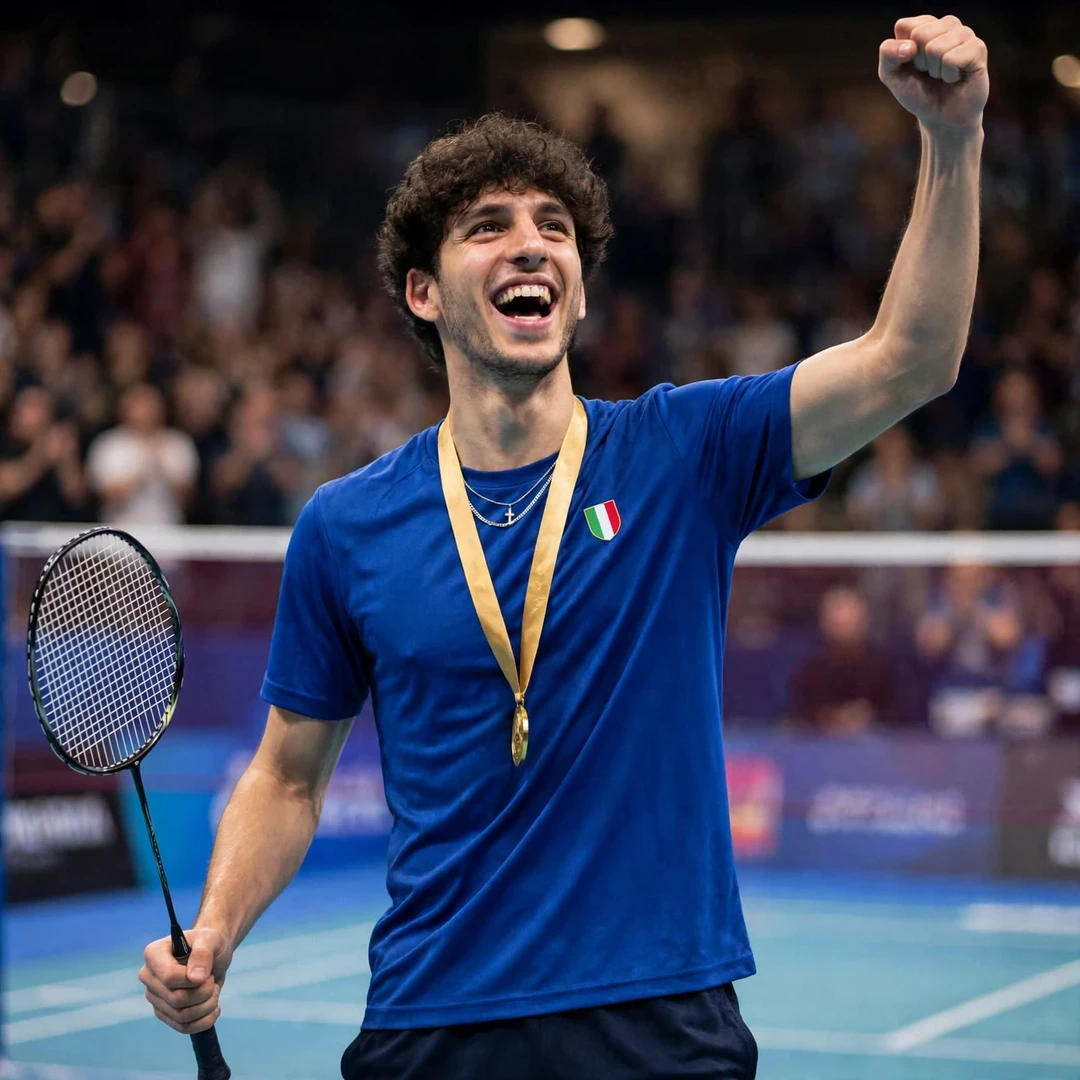
The Taranto 2026 Mediterranean Games were played in Puglia — Caponio’s own region, a short drive from Santeramo in Colle — at Francavilla Fontana. His draw ran like a story written for him. After a first-round bye he crushed Cyprus’s Aristotelis Aris Kattirtzi Ranjbar 21-5, 21-9. In the quarter-finals he lost the first game 11-21 to Portugal’s Diogo Marreiros Gloria — and answered with a 21-3 demolition in the second, closing the match 11-21, 21-3, 21-16. In the semi-final he beat the Spanish veteran Pablo Abián, a giant of Mediterranean badminton, in straight games, 21-14, 21-18. Then, on Wednesday 26 August 2026, came the final against the tournament’s number one seed, Croatia’s Aria Dinata. Two games, both taken by two points: 22-20, 21-19. Gold.
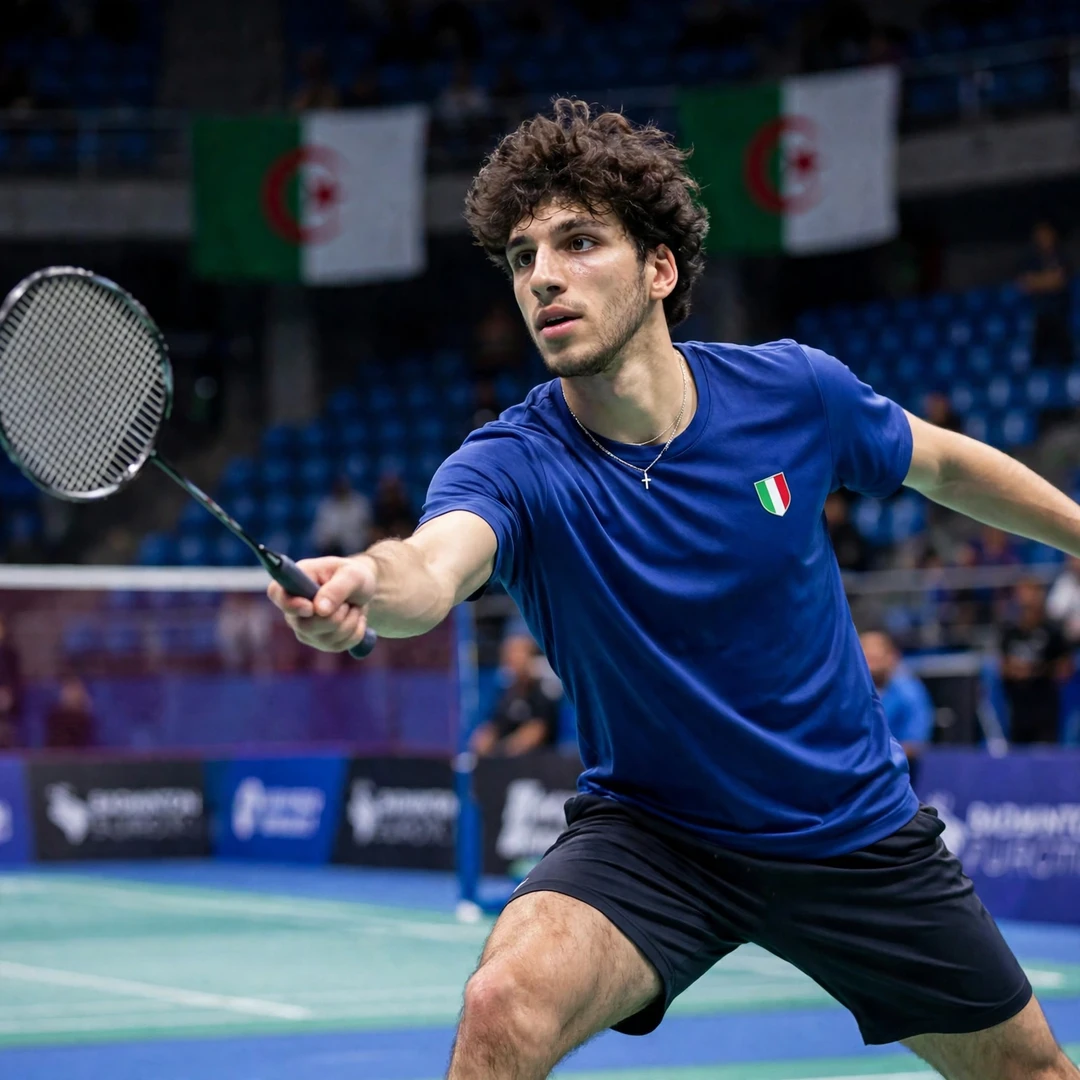
Career Milestone #4
Historic Mediterranean Gold on Home Soil at Taranto 2026
Understand what that gold medal means. No Italian — man or woman — had ever won the singles title at the Mediterranean Games; Badminton Europe called him the home hero who delivered Italy’s first gold of the tournament, and reported that Taranto’s gold medallists earn direct qualification for the Los Angeles 2028 Olympic Games. Giovanni Toti, his partner of a decade, completed the podium with bronze. Caponio’s own words afterwards said everything about what it cost and what it meant: ‘It’s an incredible emotion, I still have to realise it. Winning gold in Italy, but above all in my region, Puglia, is something I will never forget. In front of my family, the Air Force, the federation, friends and relatives — it really felt like being in the San Siro stadium.’ The boy who had to leave Puglia at thirteen to find a badminton future had come home and won the biggest prize of his life in front of everyone he left.
Which brings the record to the Week 43 list of 20 October 2026: world No. 121, 15,852 points from 18 tournaments, a small slip from No. 112 the previous week as older results roll off. Read plainly, the number undersells the man. The ranking does not show a Mediterranean Games gold medal won seven weeks earlier, a career high of No. 83, Italian titles a decade apart, a university degree earned on the road, or an Air Force career running alongside it all. At twenty-seven, with Los Angeles 2028 now a realistic horizon rather than a dream deferred by a pandemic, Fabio Caponio’s arc is still rising — and the next chapter will be written by the most patient player Italian badminton has ever produced.
Playing Style
The Disciplined All-Court Game
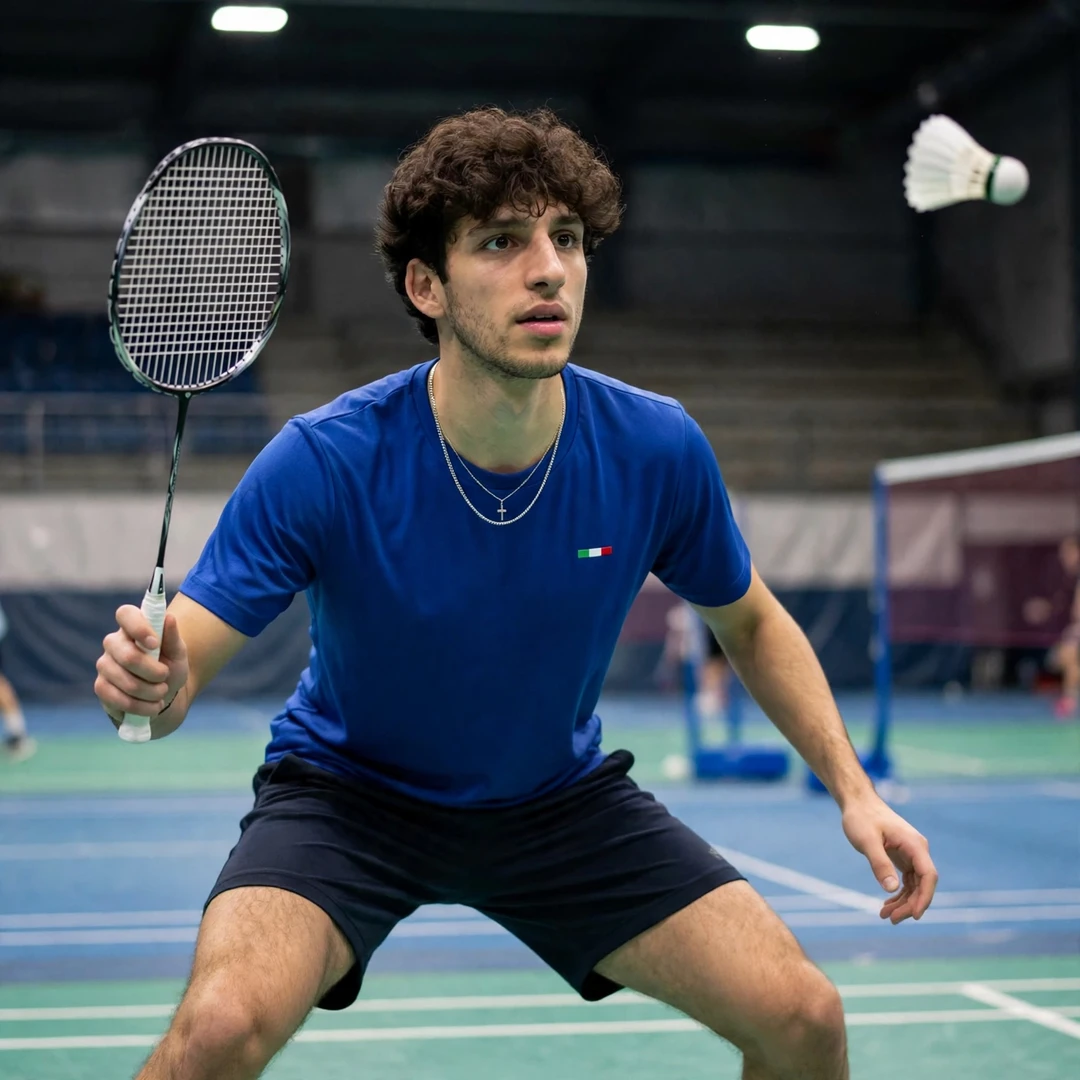
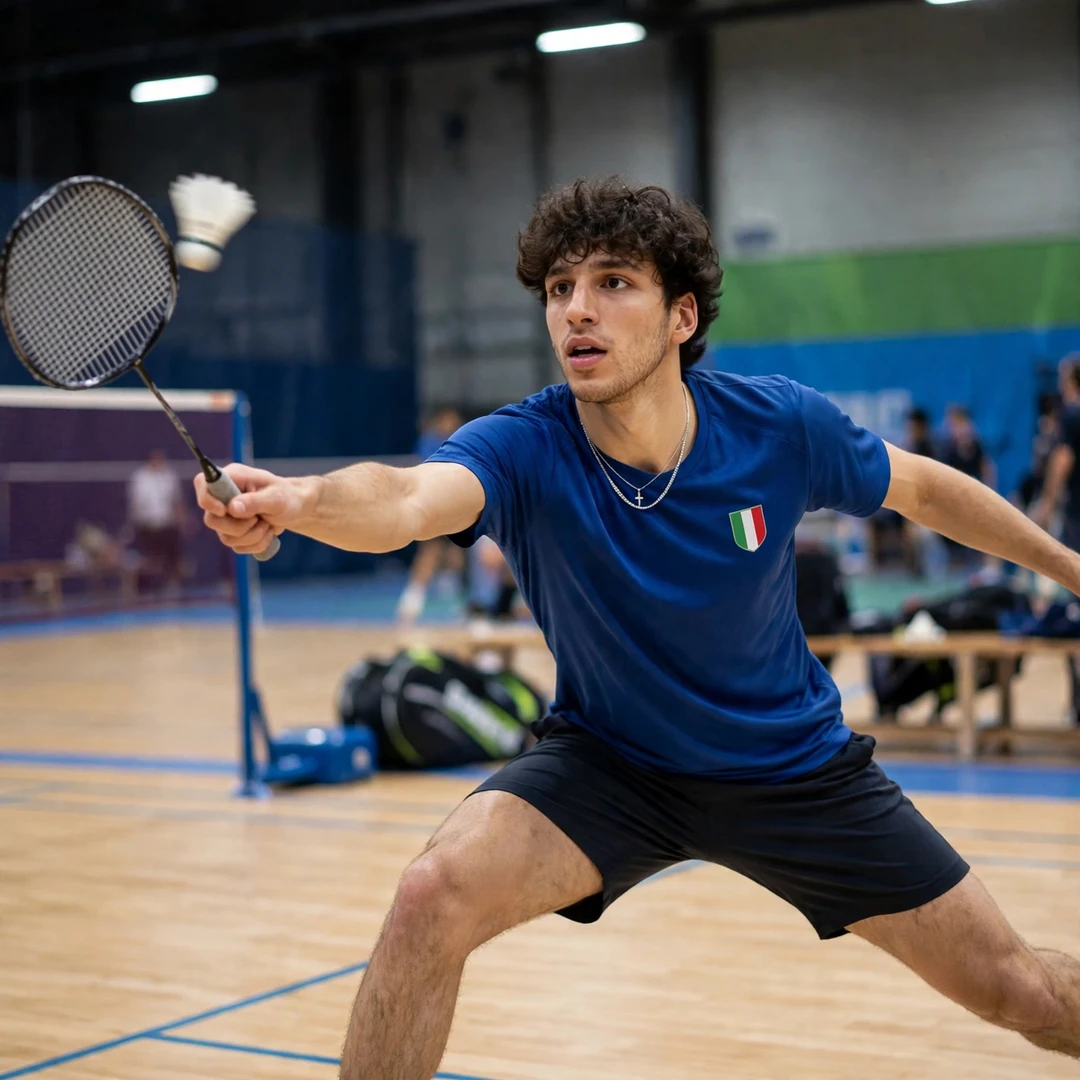
Caponio’s game starts with completeness, and the completeness starts with doubles. Years of international doubles built a player who defends every corner, reads rallies early and owns a net game most singles specialists never develop. His university’s scouting summary of him lists three qualities — speed, concentration and discipline — and they are the right three. He is fast enough to play the whole court from a central base, concentrated enough to hold a tactical plan for three games, and disciplined enough to keep his error count low while the rally stretches past twenty shots. There is no single famous weapon. There is, instead, an absence of weaknesses for an opponent to aim at.
His second signature is deciding-game nerve, and the evidence is spread across three continents. In Chile in 2023 he lost a second game 25-27 and still closed the final 21-19 in the third. In Algeria in 2025 he took a final 23-21 in the decider. At Taranto he produced the most extreme version of all: down 11-21 in a Mediterranean quarter-final, he changed the match so completely that the second game finished 21-3. Then, with a gold medal on the line, he won the two closest games of the tournament — 22-20 and 21-19 — against the top seed. Pressure, in his career, is not a problem to survive. It is the part of the match where his concentration advantage is worth the most points.
For young players, his style carries a lesson bigger than any single shot: build the complete game first. Caponio did not reach world No. 83, or a Mediterranean gold medal, on one spectacular smash. He got there with footwork that holds up in the third game, a defence schooled by doubles, net skills honed in two disciplines, and shot selection calm enough to win finals by two points on two continents. The highlight shots come later, if they come at all. The base — movement, defence, patience, concentration — is what carries a career across a decade.
Mental Strength
Speed, Concentration and the Long Road
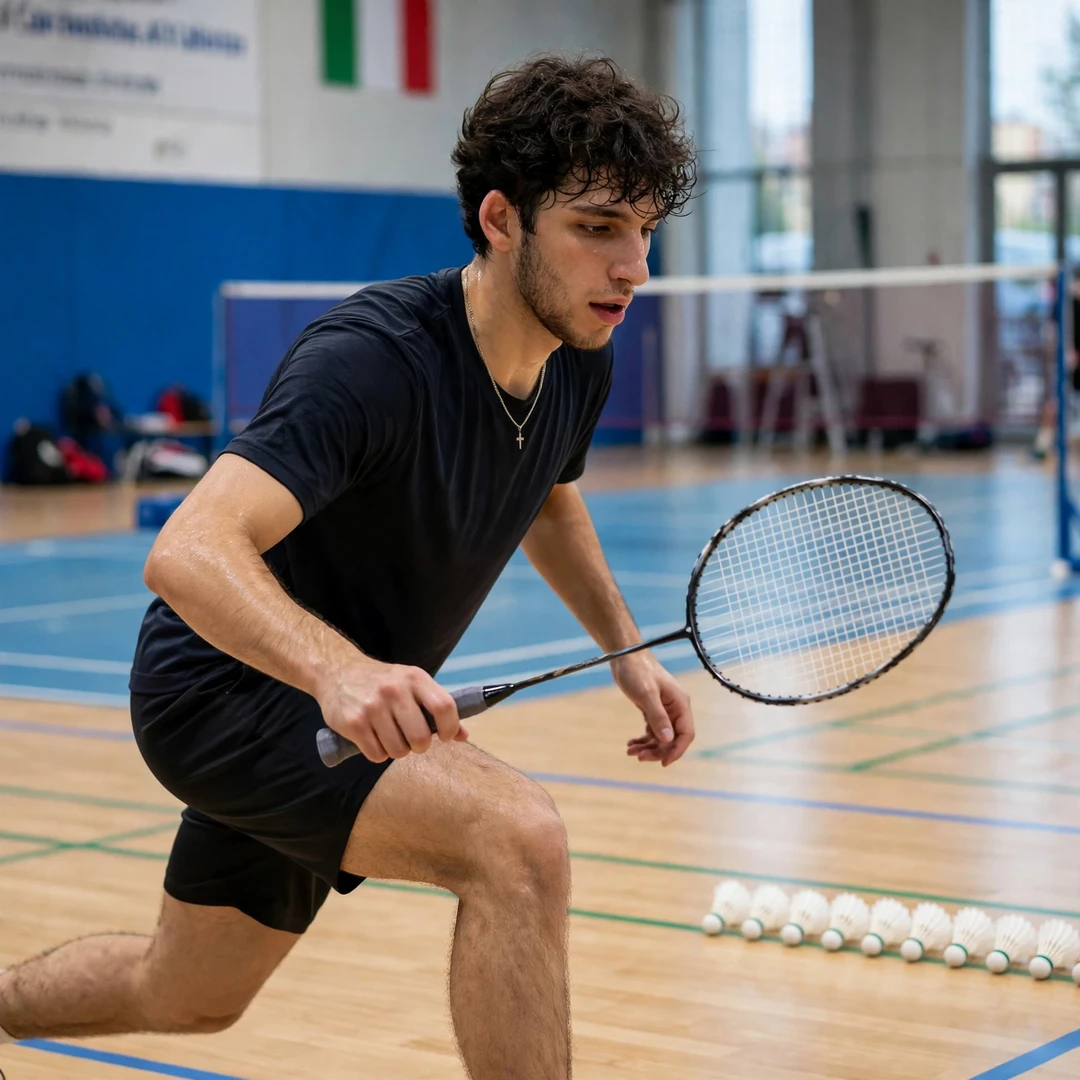
His comeback pattern deserves its own honest reading. The Taranto quarter-final is the cleanest example: a first game lost 11-21 could have ended the home Games story before it began. Instead he treated the score as information — adjusted his length, raised his pace — and won twelve of the next fifteen rallies’ worth of momentum in a 21-3 second game. Coaches call this problem-solving under pressure. Caponio has done it in finals in Chile and Algeria as well, always the same way: no panic, no wild attack, just a colder reading of the match than the man across the net.
His resilience story is a timetable of refusals to quit. He refused to quit on elite badminton when it meant leaving home at thirteen. He refused to quit when a pandemic ended his Tokyo qualifying campaign at a Jamaican border in 2020. He refused to quit through six more years of International-circuit grind — the small halls, the qualifying draws, the ranking points collected two hundred at a time — while the country’s badminton attention sat elsewhere. When the biggest tournament of his life finally arrived, it arrived in his home region, at twenty-seven years old, and he was ready for it. That is not luck. That is what a decade of staying ready looks like when its moment comes.
Practical lessons from his journey include starting wherever you are — his first court was a village gym in Puglia, found because his cousin trained there; moving for your development when you must, as his move to Milan at thirteen built the base for everything; treating education as a foundation rather than a distraction, exactly as his LUISS degree in Economics and Management runs alongside his Air Force career; using doubles to build a complete singles game, as his Ethiopia and Mauritius titles schooled the defence and net play his singles now stands on; and trusting a long timeline — his first Italian title came at sixteen, his historic gold at twenty-seven, and the best may still be ahead.
Learning Reference
ST Badminton Academy Connection
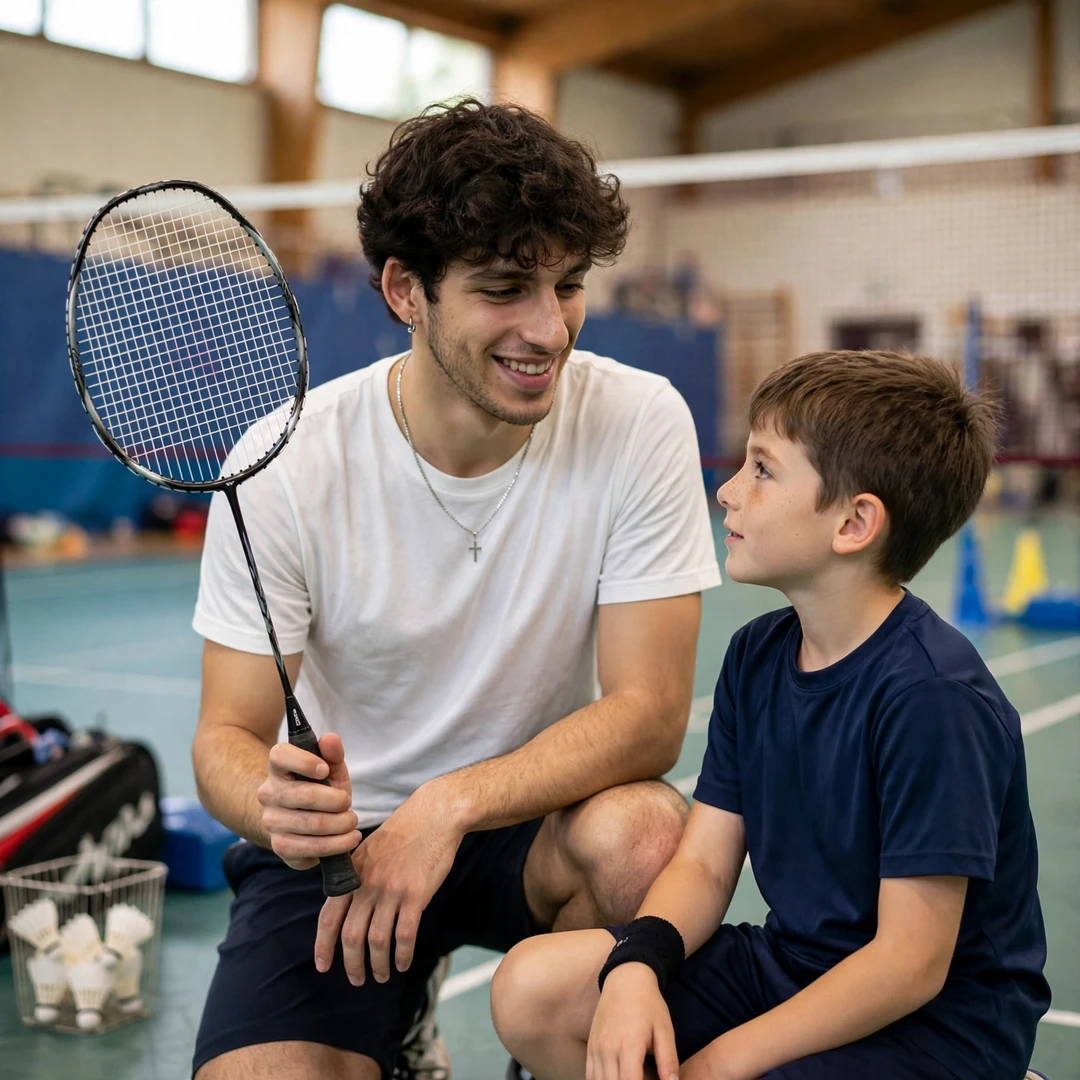
ST Badminton Academy is not affiliated with Fabio Caponio and does not represent him, the Italian Badminton Federation or the Centro Sportivo Aeronautica Militare. This profile is published purely as an educational case study for parents and junior players who want to understand how a right-hander from Puglia built a complete game through doubles, earned a university degree on the road, and climbed to a Mediterranean Games gold medal and a career-high world ranking of No. 83.
Many of our students study his matches to understand how completeness beats reputation: the Taranto 2026 final against Aria Dinata for two-point game management with a gold medal at stake; the Taranto semi-final against Pablo Abián for straight-games control of a veteran; the Algeria International final against Noah Haase for winning a 23-21 decider; and the Chile International final against Kevin Arokia Walter for closing a three-game final after losing a game 25-27.
We encourage our students to observe how he prepares — a boy who left home at thirteen for a national centre, a student who finished an economics degree between tournaments, an airman-athlete who trains inside a military sports group, and a player whose career peak arrived at twenty-seven because he simply never stopped being ready. Sometimes a career is not built close to home. Sometimes it is built by leaving home early, working quietly for a decade — and coming back to win gold in front of everyone.
FAQs: Fabio Caponio Italian Badminton Player
Here are answers to common questions about Fabio Caponio’s career, achievements and what young players in Malaysia can learn from the Italian right-hander who became the first Italian ever to win Mediterranean Games badminton singles gold.
Who is Fabio Caponio and which country does he represent in badminton?
Fabio Caponio is an Italian professional badminton player competing in men’s singles. Born on 26 March 1999 in Santeramo in Colle, Puglia, he is a right-hander who plays for the Italian national team and the Centro Sportivo Aeronautica Militare, the Italian Air Force sports centre. He stands at world No. 121 in the BWF Week 43 rankings of 20 October 2026 with 15,852 points, and his career-high ranking is world No. 83, reached in October 2023.
What are Fabio Caponio’s biggest badminton achievements?
His biggest achievement is the men’s singles gold medal at the Taranto 2026 Mediterranean Games — the first Mediterranean singles title in Italian badminton history, won by beating top seed Aria Dinata 22-20, 21-19 in the final. He also won men’s doubles bronze at Oran 2022 with Giovanni Toti; three BWF International singles titles (Chile and Peru in 2023, Algeria in 2025); two international doubles titles (Ethiopia 2016 and Mauritius 2017); and Italian national singles titles ten years apart — the first at sixteen, when he was the youngest champion in Italian history, and the second in Palermo in 2025.
What is Fabio Caponio’s playing style?
Caponio plays a disciplined, all-court game built on speed, concentration and rally control. The right-hander defends the whole court, reads rallies early thanks to his years of international doubles, and keeps his error count low while pressure builds — then strikes on the points that decide games. His finals record shows the pattern: a 23-21 deciding game to win in Algeria, a three-game win in Chile, and 22-20, 21-19 to win Mediterranean gold against the top seed.
How has Fabio Caponio performed at the Mediterranean Games?
The Mediterranean Games define his career. At Oran 2022 he won the men’s doubles bronze medal with Giovanni Toti, beating Portugal’s Marreiros and Rodrigues 21-11, 21-8 before losing a three-game semi-final to Spain’s Abián and Peñalver. At Taranto 2026, on home soil in his own region of Puglia, he won the men’s singles gold medal — the first in Italian history — beating Cyprus’s Kattirtzi Ranjbar, Portugal’s Marreiros Gloria (from a game down), Spain’s Pablo Abián in the semi-final and Croatia’s Aria Dinata 22-20, 21-19 in the final.
How can my child learn from Fabio Caponio’s training approach?
Young players can study Caponio’s approach in two parts. On court: build a complete, low-error game, use doubles to school your defence and net play, and practise deciding-game composure — his biggest finals were won by two points. Off court: copy his structure — national-centre training from thirteen, an Air Force sports career, and a completed university degree in Economics and Management at LUISS. At ST Badminton Academy we use his Taranto final as a video lesson in staying cold-blooded at 20-20 with everything at stake.
Did Fabio Caponio win any junior titles?
His junior-era landmark was extraordinary: at sixteen he won the Italian SENIOR national title, the youngest champion in the country’s history, and at the 2016 Italian championships he took gold in men’s singles and mixed doubles plus silver in men’s doubles. With Giovanni Toti he was also a boys’ doubles finalist at the 2016 Croatian Junior International and the 2017 Italian Junior International. In a small badminton nation, his junior career is remembered less for junior medals than for beating the seniors while still a schoolboy.
What are Fabio Caponio’s best World Championships results?
Caponio played the BWF World Championships in New Delhi in 2026, where his run ended in the round of 64 against Singapore’s Jia Heng Jason Teh. At the 2026 European Championships in Huelva he reached the second round. His biggest championship stages so far remain the Mediterranean Games — bronze in 2022, historic gold in 2026 — and, with Badminton Europe reporting that Taranto’s gold medallists earn direct qualification for Los Angeles 2028, an Olympic debut is the open target of the next chapter of his career.
What playing style should young players learn from Fabio Caponio?
Young players should study how Caponio wins with completeness and calm rather than one big weapon: the rally patience that stretches opponents into errors, the doubles-trained defence and net game that leave no corner open, and the deciding-game nerve that won finals 21-19, 23-21 and 22-20, 21-19 across three continents. Just as important is the mindset — a player who left home at thirteen, lost an Olympic qualifying campaign to a pandemic, and still peaked at twenty-seven.
Does ST Badminton Academy have any connection with Fabio Caponio?
No, Fabio Caponio is not a student, coach or ambassador of ST Badminton Academy. He represents Italy, plays for the Centro Sportivo Aeronautica Militare and is based between the national centre in Milan and his native Puglia. However, coaches at our academy in Kuala Lumpur regularly use his matches as teaching material, because his journey — a village gym in Puglia to Mediterranean Games gold and world No. 83, with a university degree earned along the way — shows what discipline in two arenas at once can achieve.
Fabio Caponio Career Highlights
Career Statistics and Rankings
Fabio Caponio's rise is a lesson in how far patience can go: a seven-year-old who found badminton by accident at his cousin's gym, a thirteen-year-old who left home for Milan, a sixteen-year-old national champion, an economics graduate and airman — and, at twenty-seven, the first Italian ever to win Mediterranean Games singles gold, in his own home region, in front of his family. The next checkpoint is written in the opportunity that gold has opened: the road to the Los Angeles 2028 Olympic Games.
| Development Area | Common Misconception | What Fabio Caponio's Career Shows REALITY |
|---|---|---|
| Junior Foundation | Talent alone decides who becomes a champion. | Caponio started at age seven in a gym in Puglia where his cousin trained, and moved to Italy's national centre in Milan at thirteen — a structured junior base came first. |
| Playing Style Priority | Kids should copy the flashiest attacking shots. | Caponio built a complete game first — years of international doubles made his defence, net play and rally reading the base that his singles titles stand on. |
| Fitness Importance | Juniors can out-train everyone without rest. | Caponio balanced a full degree in Economics and Management at LUISS with the world tour — his Mediterranean gold came from smarter scheduling and discipline, not more hours. |
| Mental Approach | Top players never get nervous or upset. | Caponio lost his Tokyo 2020 qualifying chance to pandemic travel restrictions, then kept rebuilding for six more years — mental skills are trained, not inherited. |
| Attacking Training | Smashing harder is always the answer. | His 22-20, 21-19 Mediterranean Games final win over Aria Dinata and his 2025 Algeria International title came from controlled rally placement and deciding-game nerve, not raw power. |
| National Milestones | Only world titles matter. | Caponio's Mediterranean bronze in 2022 and historic singles gold in 2026 made him a national hero in Italy — continental milestones build a career step by step. |
| Career Timeline | Champions peak once and fade fast. | From Italian champion at sixteen to Mediterranean Games champion at twenty-seven, Caponio proves sustained development beats a short peak. |
Study Fabio Caponio's Discipline and Professional Approach
This profile explains who Fabio Caponio is, his major achievements, and what developing players can learn from his journey. Whether you are a parent in Kuala Lumpur, Cheras or anywhere in Malaysia wondering whether a child from a small town can reach the top of a sport, Caponio's story carries the answer: from a village gym in Puglia to a historic gold medal — book a trial class with ST Badminton Academy on WhatsApp at +60 17-684 2136 and let your child begin building fundamentals that will hold up anywhere.