Best Badminton Coach in Malaysia: Using Video Feedback Without Publicly Posting Children (Video Guide)
The coach raises a phone at the side of the court, and most parents feel two things at once. Video could genuinely help: a child who can see their own movement understands in seconds what a month of descriptions could not give them. And a clip of their child is not content: it should not travel, gather an audience, or sit forever on a stranger’s device. Both instincts are right, and they do not have to fight. Video feedback is a strong teaching tool with a simple condition: it stays private, or it should not happen at all. This page works through how filming is handled here: consent asked first, one short clip for one named purpose, watched together, never posted anywhere, and deleted when its job is done.
Video Check #1
What Private Video Feedback Really Means
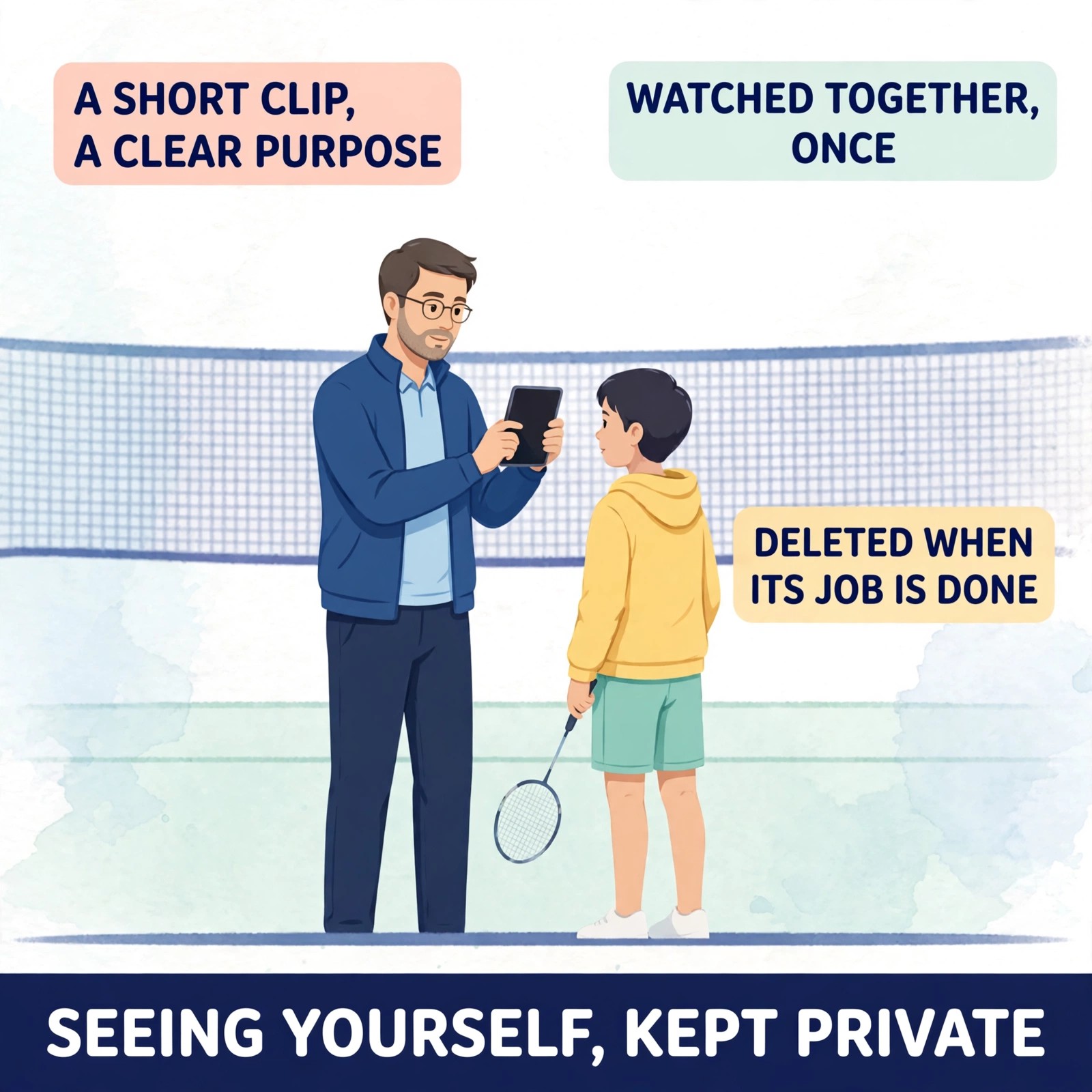
Private video feedback, in the way this page uses the term, is a short clip filmed for one named teaching purpose, watched by the coach, the child and the parent together, kept off every public channel, and deleted once its job is done. Each part of that definition is load bearing. One named purpose keeps filming rare and aimed. Watched together keeps the child an author of what the clip means, not a subject of it. Off every public channel means exactly that: no posting as praise, no sharing as pride, no exceptions dressed as celebration. And deletion is what separates a teaching tool from an archive. The moment a clip is posted, forwarded or kept as a trophy, it has stopped being feedback and become something else, with a child’s face in it.
The cost of careless filming is paid in trust, and trust is the currency all coaching runs on. A child who suspects the camera might be watching starts guarding themselves: playing smaller, hiding mistakes, performing for an audience instead of risking the new movement the lesson is actually about. Parents pay a second cost in control: a clip sent onward cannot be unsent, and arrangements made casually in a hall cannot be renegotiated once a file has travelled. Other children pay a third cost without ever being asked, caught in the background of someone else’s lesson video, filmed as scenery in a stranger’s teaching. None of this needs a bad intention anywhere. It needs rules settled after the camera instead of before it, which is the only order that protects anyone.
Video Check #2
Inside The Clip: Film, Watch And Delete
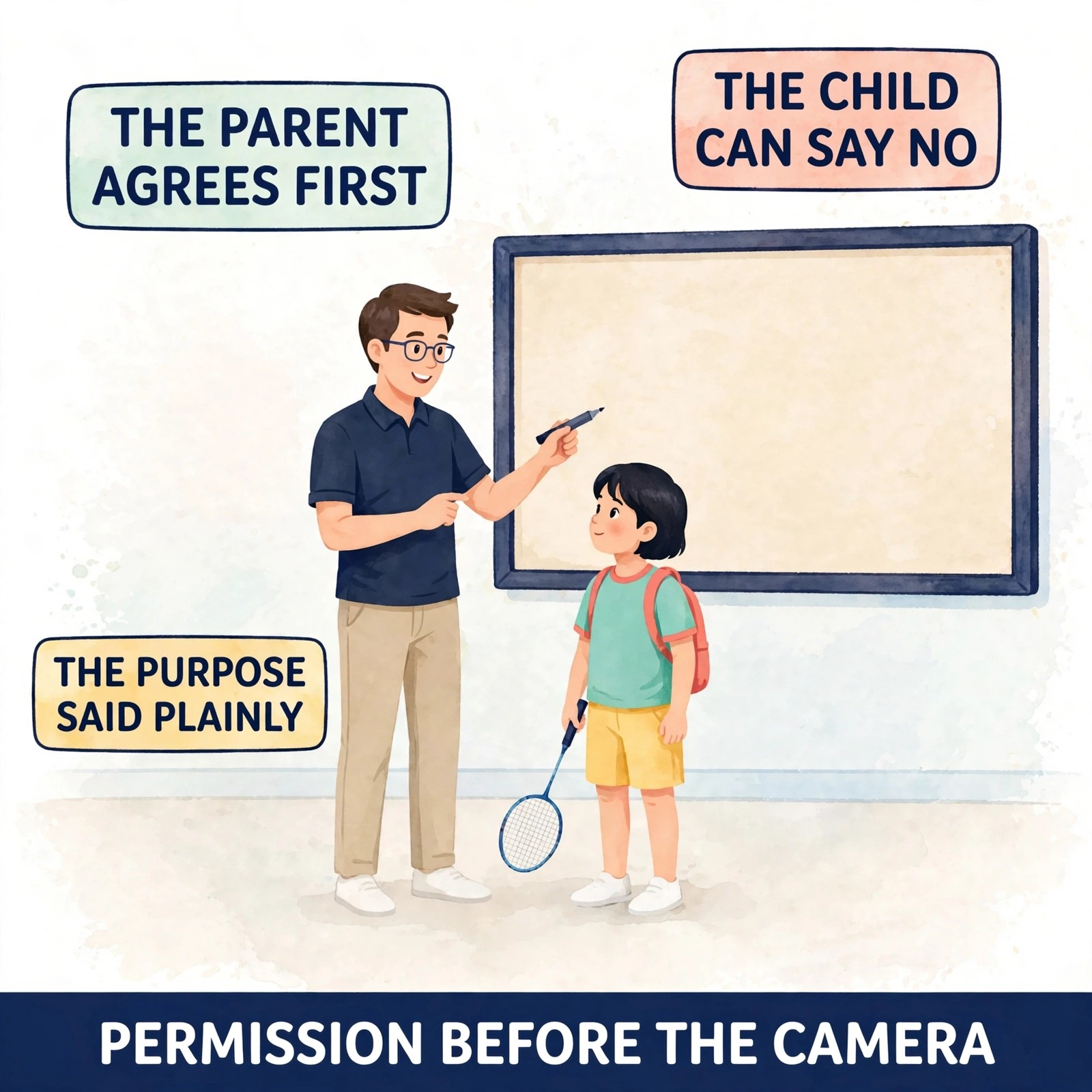
Start with consent, because consent is the gate everything else walks through. Permission is asked of the parent first, in plain words, covering five things: what will be filmed, why, who will see it, where it will be kept, and when it will be deleted. The child is asked too, separately and genuinely, and a child’s no is a complete answer that needs no reasons and earns no persuasion. Consent is also specific: agreement to one clip, for one purpose, is not agreement to a season of filming, and it can be withdrawn at any point, including after a clip exists, at which point the clip is deleted. A hall that treats consent as a signature to collect has missed the point; consent here is a standing agreement that the family controls, renewed by being honoured every single time.
Then name the purpose, because a purpose is what keeps filming small. One clip answers one question: does the preparation start where the coach described, what does the landing actually look like, where does the racket face point at contact. A purpose that fits in one sentence produces a clip that lasts seconds and a viewing that lasts a minute. Filming everything just in case produces the opposite: an album nobody needs, watched by nobody, carrying every risk this page exists to prevent. If the purpose cannot be said plainly, the honest conclusion is that the clip is not needed yet, and the teaching continues by demonstration, mirrors of words and slow practice, which carried young players for generations before any camera entered a hall.
Careless filming repeats on a short list. The always on camera, recording whole sessions because storage is cheap and deciding later felt easier. The celebration post, where a child’s clip is shared publicly as praise, still a posting of a child who agreed to teaching rather than to an audience. The background sweep, where other children are filmed as scenery without anyone asking their families. The forever phone, where clips live indefinitely on a personal device, unlabelled and undeleted. And the group chat share, where a proud moment is forwarded into rooms the family never chose. Each fault has the same repair: consent asked first, one named purpose, watched together only, and deleted when the job is done.
Video Check #3
The Honest Cost: When A Clip Becomes Content
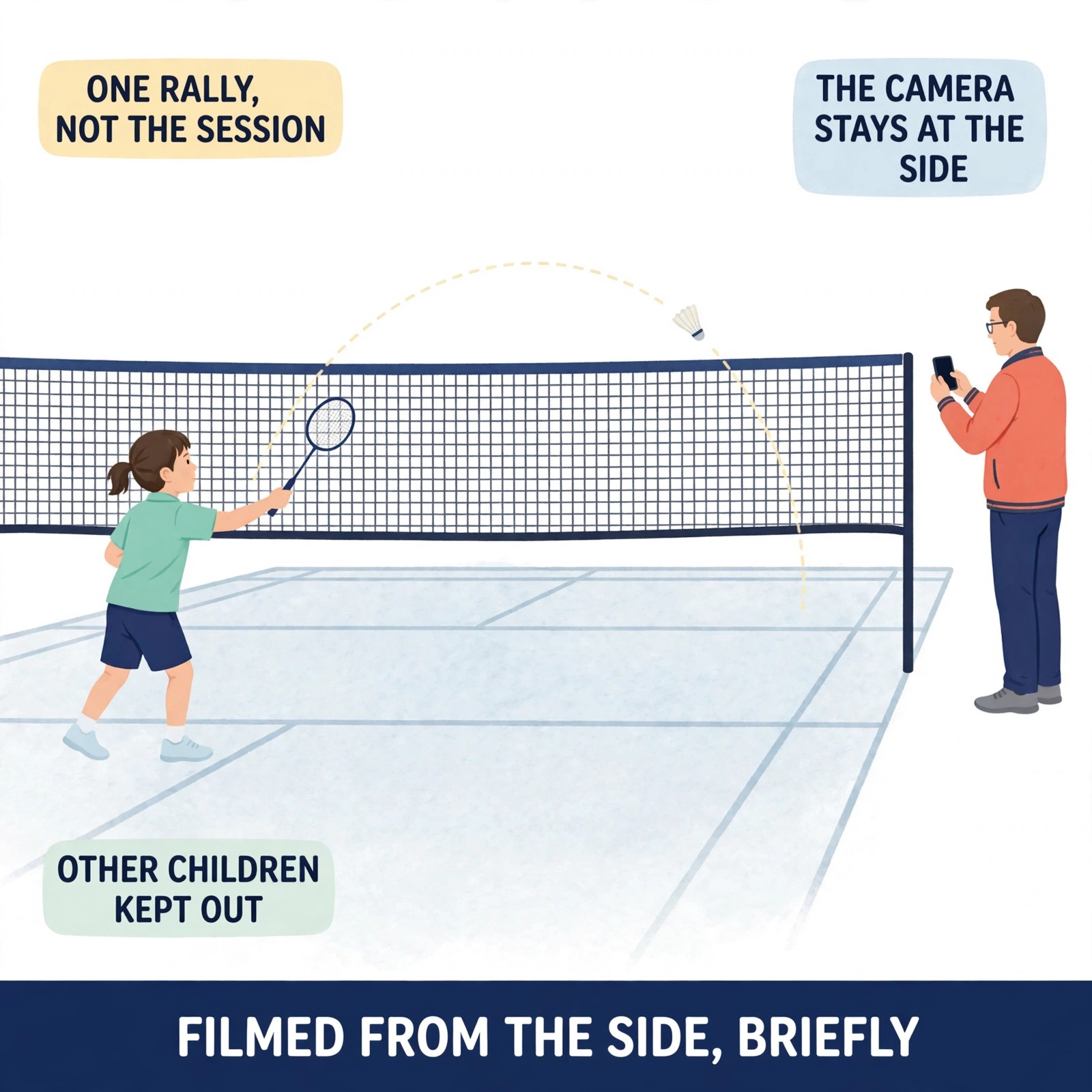
Film briefly, from the side, and let the session stay a session. One rally, or one short set of the drill the purpose names, is enough; the camera is raised for that passage and put away for everything else. The child knows when filming starts and when it ends, because surprise filming is a contradiction of consent even when consent exists. The camera stays at the side of the court, aimed at the one child whose family agreed, framed so other children stay out of it. Nothing away from the task is filmed: not arrivals, not rests, not the ordinary private moments of a training evening. A clip gathered this way is small in every sense, easy to watch, easy to delete, and impossible to mistake for content.
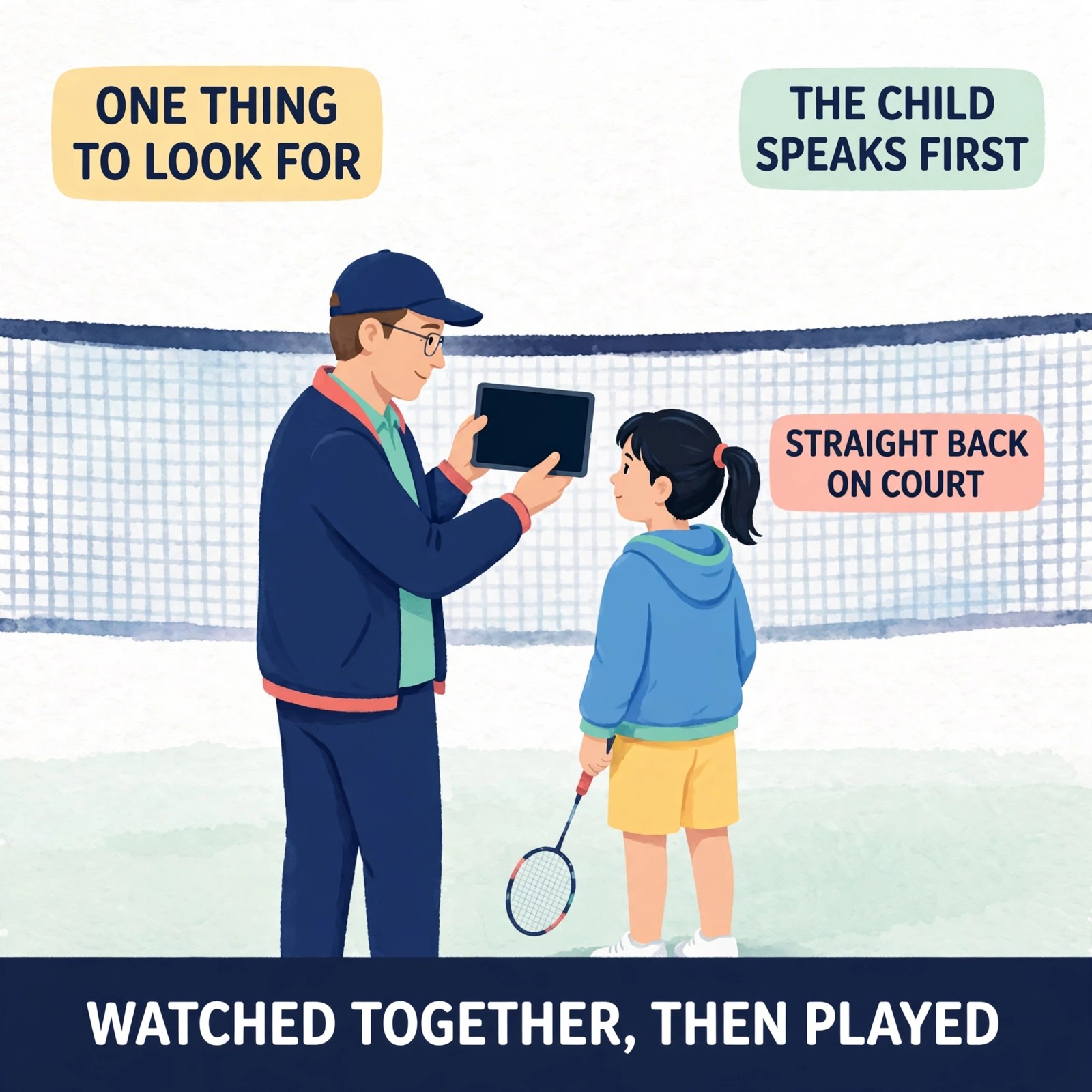
Watch it together, and let the child speak first. Before the screen is shown, one thing to look for is named: watch your landing, watch where the racket starts. The child then says what they see, before any adult explains, because the seeing is the learning and an adult summary delivered first replaces it. The clip is paused, replayed once, talked about in the plain words of the purpose, and then everyone goes straight back on court to try the change while the picture is fresh. Watching is kept short and kind: one watch point, honestly seen, is worth more than a catalogue of faults. A child should leave a viewing feeling they understand their own body better, never feeling exhibited.
Home handling matters as much as hall handling, because most clips travel from a parent’s phone rather than a coach’s. Receive the clip directly from the coach, never through a group chat. Watch it with your child around the one kind watch point the coach named, and let your child speak first about what they see, at home as in the hall. Never forward it, and never post it, however proud the moment makes you: pride is something to say to your child’s face, where it lands as love, rather than to an audience, where it lands as content. Delete your copy once the teaching point is done, and ask the coach to confirm the same on their side. Rules kept evenly by every adult are the whole protection; a single forwarding breaks what everyone else maintained.
Video Check #4
Choosing Carefully: Consent First, Honestly Kept
Agree the privacy rules in writing before the first frame, all four parts of them. First, consent: asked of parent and child, specific to purpose, withdrawable at any time. Second, purpose: one named question per clip, said in one sentence before filming. Third, viewing: watched together by coach, child and parent only, never posted, never forwarded, never shown to other families as an example. Fourth, deletion: the clip is deleted when its teaching job is done, and the parent is told when that has happened. Written down, those four parts take less space than this paragraph. Unwritten, they are a mood, and moods do not survive a busy season, a new phone, or a moment of pride.
Sometimes the honest answer is no filming at all, and the rules should make that answer easy. A child who dislikes being filmed learns worse under a camera: guarded, smaller, unwilling to risk the mistake the lesson needs. For that child, demonstration, slow practice and the coach’s eyes carry the same teaching a clip would, slightly slower and entirely safely. Video is a tool, never a requirement, and no child’s progress here depends on agreeing to it. Equally, a family that says yes to one purpose and no to another is using consent exactly as intended. The camera earns its place clip by clip, or it stays in the bag, and either outcome is a success of the system rather than a failure of anyone in it.
A gentle word for the parent who hesitates when the camera appears. That hesitation is not difficulty, technophobia or a lack of trust in a coach you otherwise rate. It is a safeguarding instinct doing its job, and it carries real information: you are the person charged with knowing where images of your child exist in the world. A good hall will welcome the hesitation as the start of the rules conversation, answer every question plainly, and accept a no without a flicker. Judge the arrangement by that response across time, not by one reassuring afternoon. And if a worry about a clip keeps circling after the rules are settled, it deserves to be raised directly and answered in plain words, because no parent should sit alone with a question about their child’s image.
Video Check #5
Video Drills That Use One Honest Clip
We use video in an order that keeps privacy load bearing at every stage. First, consent is asked of parent and child, and the purpose is named in one sentence, before any device appears. Second, one short clip is filmed from the side of the court, inside an ordinary drill, of the one child whose family agreed, with other children kept out of the frame. Third, coach and child watch it together once, the child speaking first, around one named watch point, and go straight back on court to try what they saw. Last, the clip is deleted when its teaching job is done, and the parent is told. Each stage follows from the one before, and a family can audit the whole chain with four plain questions at any time.
A clip is counted inside the task it served. Contacts made with the watched point, out of the attempts the task offers, is the headline figure. Beside it sit two quieter counts: the child describing what they saw in their own words, because a picture a child can narrate is a picture they can aim at, and the watched point appearing uninvited in rallies, because that is when seeing has become doing. Nothing about any clip is counted, shared or displayed anywhere public, and results are never attached to a child’s image. The counts belong to the family and the coach, in writing, and they exist to judge whether the filming earned its place, which is the only judgement a clip should ever face.
The signs private video is working are quiet ones. Your child relaxes around the camera because its rules are boring and predictable: asked, brief, together, gone. The watched point starts appearing in ordinary rallies without being set up, which is the surest sign seeing turned into doing. You, the parent, can state the rules back without notes: who sees it, where it lives, when it goes. Filming stays rare, a few clips across a term rather than a few each week, because purposes stay named and most teaching travels by demonstration as it should. And your child talks about the clip the way they talk about a drill, as a tool that was used and put away, never as a performance that might be watched by strangers.

Myth vs Reality
Myths About Filming Young Players
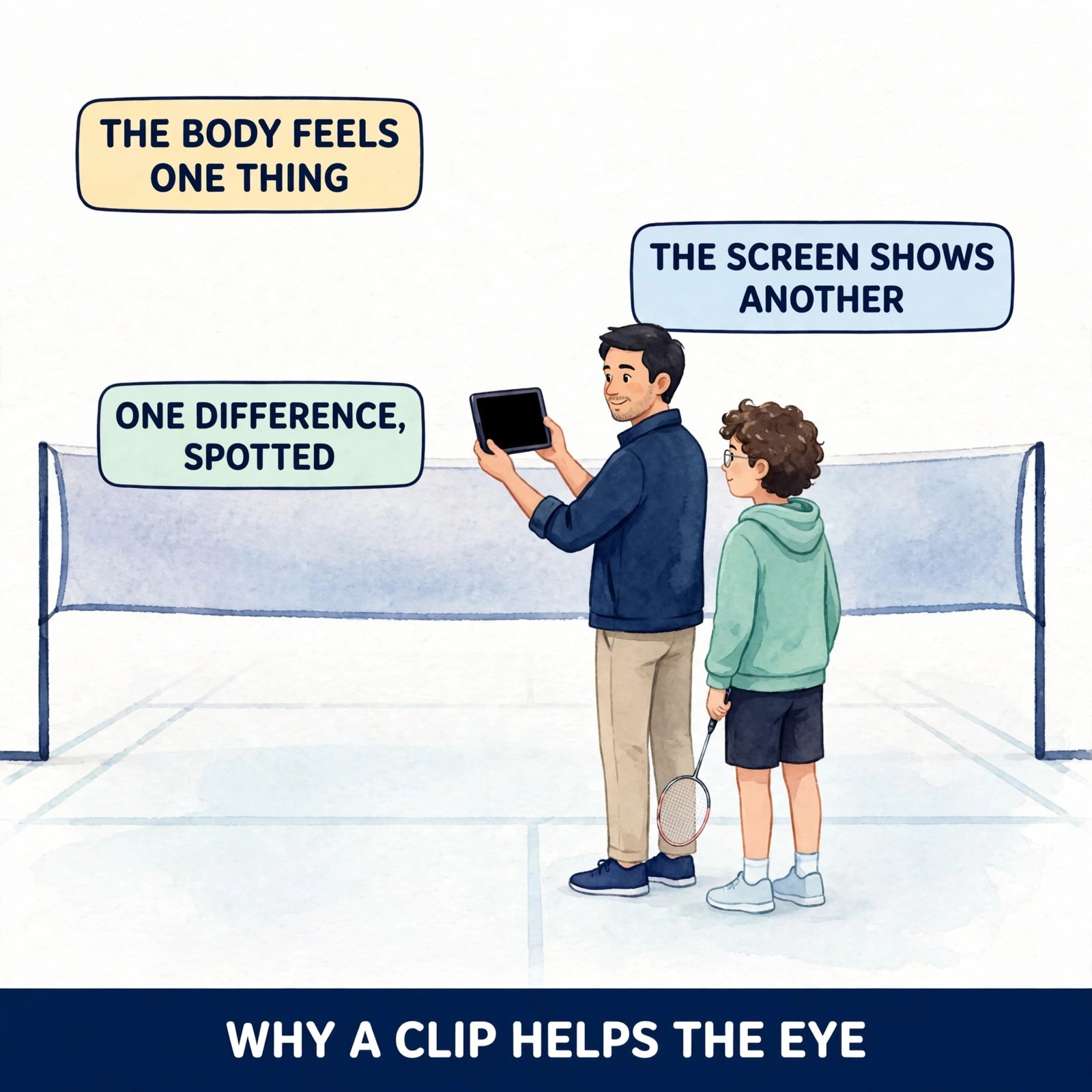
Why does one honest clip teach what a month of description cannot? Because a movement feels one way from inside the body and looks another way from the side, and coaching words describe the view from the side to a child who only has the view from inside. That gap is where explanations go to die: the child nods at a picture they cannot locate in their own limbs. A clip closes the gap in seconds, because the child sees their own body, unarguably theirs, doing the thing being discussed. That directness is exactly why the rules on this page are strict. A tool powerful enough to show a child themselves deserves handling careful enough that the child stays the owner of the image, its audience and its ending.
What does a private video agreement actually contain? Five plain parts. The consent: parent and child asked, purpose by purpose, free to refuse or withdraw. The purpose: one named question per clip, said before filming. The viewers: coach, child and parent, and nobody else, ever. The prohibitions: no posting, no forwarding, no use as an example for other families, no keeping as a souvenir. And the deletion: a point agreed in advance, when the teaching job is done, carried out and confirmed to the parent. Notice what is missing: no platforms named, no accounts created, no library quietly growing. The discipline is in the omissions. An agreement that runs long usually does so to protect the filming rather than the child; five parts, sayable before a drink of water, is what a family can actually hold a hall to.
Deletion is the rule that protects all the others, because a clip with a known ending cannot quietly become an archive. Archives drift: phones are replaced, folders are copied, a file made for one honest purpose outlives everyone who remembers the purpose. A clip deleted on schedule has no future accidents in it. Deletion also disciplines the filming itself: a coach who must delete asks, before raising the camera, whether this clip is worth its own ending, and purposes get named more honestly under that question. When in doubt, delete earlier rather than later; a teaching point can always be filmed again under fresh consent, while a file that travelled can never be called home. That asymmetry, easy to redo and impossible to undo, is the whole argument in one line.

Why Choose Us
Why Players Choose ST Badminton Academy
Parents choose ST Badminton Academy for video feedback because the privacy is the product as much as the picture is. We will ask consent before any camera appears, name the purpose in one sentence, watch the clip with your child rather than about them, and delete it when its job is done, telling you when we have. In a group of no more than four students, filming one child never needs to sweep a class into the frame, and the viewing can happen per child, quietly, at the side of the court. Many halls film generously and govern loosely, leaving families to discover the arrangements afterwards. We would rather hand you the agreement first and the clip second, because trust given a written shape is trust that survives a busy season.
A first session with us shows the approach, if you know where to look. Bring your privacy questions before any filming is discussed as a plan. Watch whether consent is asked before the camera is even described, whether the purpose is named in one sentence rather than a speech, and whether deletion is offered by us before you have to request it. Afterwards, ask three questions. Who exactly sees a clip of my child? Where does it live, and on whose device? When is it deleted, and how will I know? The answers describe the whole method in miniature. Compare them with any arrangement that begins with the camera already raised, and the difference explains itself.
Parents complete the privacy from their side with the same plain habits. Give or withhold consent plainly, purpose by purpose, and never apologise for either answer. Watch clips with your child around one kind watch point, letting them speak first, at home exactly as in the hall. Keep every clip you receive off every channel: no forwarding to family chats, no posting, however proud the moment, because the agreement your child was filmed under did not include an audience. Delete your copy when the teaching point is done. And if another family ever receives a clip that includes your child, say so at once, plainly and without drama; the system only works when the people inside it report its edges. Four adults’ worth of care, held by two, is what private actually means.
FAQs: Private Video Feedback For Young Players in Malaysia (KL)
These are the questions parents ask us most about video feedback and privacy, before they book and whenever filming is first suggested. The short version runs through all of them: consent first, one purpose per clip, watched together, never posted, deleted when done. The longer answers follow, including whether a child can simply say no, and how a first session with us actually works.
Can video feedback stay completely private for a child coached in Setapak or Gombak?
Yes. Video feedback stays completely private for a child coached with us in Setapak, a short drive from Wangsa Maju, in groups of no more than four students. Consent is asked first, one short clip serves one named purpose, and nothing is ever posted publicly.
What should a parent ask first about video feedback in KL?
Ask who will see the clip, where it will be kept, and when it will be deleted. Follow with whether your child can say no, and whether anything is ever posted. A hall with settled rules can answer every one of those questions plainly, before any camera appears.
Why does filming children worry parents at a junior level?
Because a clip of a child cannot be unsent once it travels, and parents are asked to trust arrangements they cannot watch. The worry is fair, and it is information rather than difficulty: it deserves settled rules, agreed in the open, before the first frame is ever filmed.
A coach wants to film my child. Should we agree straight away or settle the privacy rules first?
Settle the privacy rules first. Filming agreed in a hurry tends to inherit nobody’s rules: who sees it, where it lives, when it goes. Consent, one named purpose, private viewing and a deletion point take minutes to agree, and a clip filmed after that agreement can be judged fairly against them.
How can parents handle video feedback at home in between classes?
Receive the clip directly from the coach, watch it with your child around one kind watch point, and let your child speak first about what they see. Never forward it and never post it, however proud the moment makes you. Delete your copy once the teaching point is done.
Do you keep video feedback private beside badminton training near Wangsa Maju?
Yes. We keep video feedback private beside regular training from our base in Setapak, a short drive from Wangsa Maju, and families from that side train with us every week. Clips sit inside ordinary junior sessions, watched together once, and deleted when their teaching job is done.
Where does ST Badminton Academy teach badminton training in Malaysia?
We teach at our base in Setapak, Kuala Lumpur, and families travel in from across the Klang Valley. Sessions run with no more than four students per group, because a clip is watched with one child at a time, and filming one child never sweeps the rest of the group into the frame.
How do I book a trial session to test my child’s private video feedback?
Message us to arrange a trial at a time that suits your week. Bring your child’s racket and court shoes, and bring your privacy questions with you. We will show you the agreement we would settle with you before a single frame of your child is ever filmed.
What makes Mr Eric Chuar a suitable coach for private video feedback in badminton?
Mr Eric Chuar coaches the academy sessions himself, with more than fifteen years of coaching in Malaysia and Singapore, so the person asking consent is the person who films, watches and deletes. His video style is plain spoken: permission first, one purpose, watched together, never posted.
Private Video Coaching in Action


We benchmark our private video coaching against World Badminton (BWF) coaching standards and our own academy values: before any player trusts a training plan, they deserve honest checks. You can verify our coaches' credentials through the Badminton Association of Malaysia (BAM) coach education pathway.
One standard governs how we film young players: the watched task judges the clip first, and the child's comfort judges the rules second. A coach here will show you the agreement before filming anything, accept a refusal without discussion, and report what a clip actually showed rather than what filming generally achieves. We also hold an honesty rule about what video can promise: it cannot promise a particular improvement, or change by a chosen date, because children learn at different speeds and pictures are only ever one part of teaching. What coaching promises is consent honestly asked, privacy honestly kept, and a clip that is deleted the moment its honest work is done.
| Factor | The Private Hall | The Filming Hall VIDEO |
|---|---|---|
| Frequency | 1 or 2 times a week. Mostly for fun and sweat. | The filming hall raises a camera whenever a moment looks good, posts the proud clips as celebration, and keeps everything forever just in case. The child learns to perform instead of risk, other children appear as background without being asked, and nobody can say where the files live or when they end. |
| Drills Focus | Basic static feeding. Minimal footwork pressure. | The private hall asks consent of parent and child first, names one purpose in one sentence, films one short passage from the side, and watches it together once with the child speaking first. Nothing is posted or forwarded anywhere, and the clip is deleted when its teaching job is done, with the parent told. |
| Physical Conditioning | Rarely included. Just playing games on court. | Core, agility, and speed training included in every session to prevent injury and build stamina. |
| Tactical Awareness | "Just hit it over." No real game plan. | Video analysis, point construction, and learning to read the opponent's game. |
| Coach Ratio | Large groups (8-10 kids). Coach barely watches you. | Max 4 students. Mr Eric Chuar personally corrects every stroke and movement detail. |
| Goal Setting | Fun and exercise. | Because the counts follow the watched point inside its own task, real learning shows up as numbers rather than as footage. The coach sees whether the purpose, the watch point or the trying again failed, the parents see the same rows, and the clip itself is judged by the change it produced before it is deleted. |
| Long Term Result | Good recreational player. | The high-performance version produces a child who owns their image and understands their own movement. The casual version spends the term collecting clips; the private version removes the guesswork in a fixed order, counts what the seeing changed, and deletes the evidence on schedule. |
Private Video Coaching in Kuala Lumpur
Your start is the rules, not the camera. Bring your privacy questions to a first session with us, before any filming is on the table. We will show you the agreement we would settle with you: who is asked, what is filmed, who sees it, when it is deleted. Only then, if you and your child are content, would a first short clip ever be made, for one purpose you chose. No footage first and questions later. Just consent, a picture that teaches, and a file that ends when its job does.


