My Child Uses the Same Grip for Every Badminton Shot (Grip Change Guide)
Parents notice it in different ways. The backhand shots pop up and die into the net. The net shots lift high when they should tumble. The defence on one side looks late no matter how early the feet arrive. Very often the cause is a single quiet habit: your child uses the same grip for every badminton shot, usually the forehand grip they learned first, held bravely into corners it was never built for. This page explains why one grip cannot do everything, what the two grip families are, how the change between them is taught, and how parents can tell whether the new habit is taking hold.

Grip Check #1
What Grip Changing Really Means
A grip, in the way this page uses the term, is how the hand holds the racket handle: which way the thumb sits, how the fingers wrap, and how loose the hold is between contacts. Badminton is played mainly with two grip families. The forehand grip serves most overheads, clears, drives and smashes. The backhand grip, with the thumb resting flat on the wide bevel of the handle, serves the backhand side, much net play and most defence. Neither grip is better; they are tools for different addresses on the court. The skill between them, changing grip while moving, is a skill in its own right, and it is the one this page builds.
The cost of one grip for everything is paid exactly where parents see it. Backhand shots struck with a forehand hold cannot push properly, so they float, pop up or fall short, and opponents learn to feed that side. Net shots played without the backhand thumb behind the handle lift when they should spin and fall. Defence arrives a fraction late because the racket face points the wrong way at the moment of need. Worst of all, the child works harder and improves slower, because every backhand lesson is being attempted with a tool set for a different job. The child is not careless. They are using the only grip anybody grooved into them, and habits answer to coaching, not to blame.

Grip Check #2
Two Grip Families: Forehand And Backhand
The base of both families is the same loose hold. The handle rests in the fingers rather than being squeezed in the palm, the thumb and fingers guide the racket face, and the hold firms only at the moment of contact. A loose hand can change grips with a small roll of the fingers; a clamped hand cannot change at all, which is why looseness is taught before either family is named. Children who squeeze the handle from the moment they pick it up are not being stubborn. Nobody has yet shown their hand the resting way to hold it, and young hands copy the squeeze they see in every playground sport unless a coach replaces it early.
The backhand grip is the one most children have never been given. The thumb comes up and rests flat along the wide bevel of the handle, pointing the way the racket face points, and the fingers stay loose beneath it. That thumb is the engine of the backhand side: it pushes the racket head through the last part of the swing, which is why backhand clears, net shots and defensive blocks all stand on it. Children taught only the forehand hold try to play backhands by rolling the whole arm across, a shape that reads early, lands weak and tires the shoulder. The thumb placement looks like a small detail from the viewing area. On the court it is the difference between a backhand that works and one that apologises.
Stuck grip faults repeat on a short list. The thumb wrapped around the handle on backhand shots, so nothing pushes. The forehand grip carried into the backhand corner, face pointing sideways at contact. The pan handle hold, flat and squeezed like a frying pan, borrowed from other games. The change attempted with both hands, a small juggle that arrives after the shuttle has passed. And the death grip, squeezed from the warm up to the final game, which slows every swing it touches. Each fault has the same repair in this page’s order: loosen the hold first, place the thumb second, groove the change third, and count the smooth ones until the new way stops feeling new.

Grip Check #3
Signs And Reads: When The Grip Stays Stuck
Grip choice is also a reading skill, because the shuttle decides which family is needed. A feather shuttle is read by its arc, its height and its speed: a high shuttle to the backhand corner asks for the backhand shape early, a flat drive at the body asks for a quick small change, a tumbling net shot asks for the thumb and soft fingers. Children who read the flight early give their hands time to change; children who watch the shuttle arrive and then think about grips are changing under pressure, which is when the old habit grabs the handle back. This is why grip work is never drilled in a vacuum here. The read and the change are practised as one habit, the way rallies will demand them.
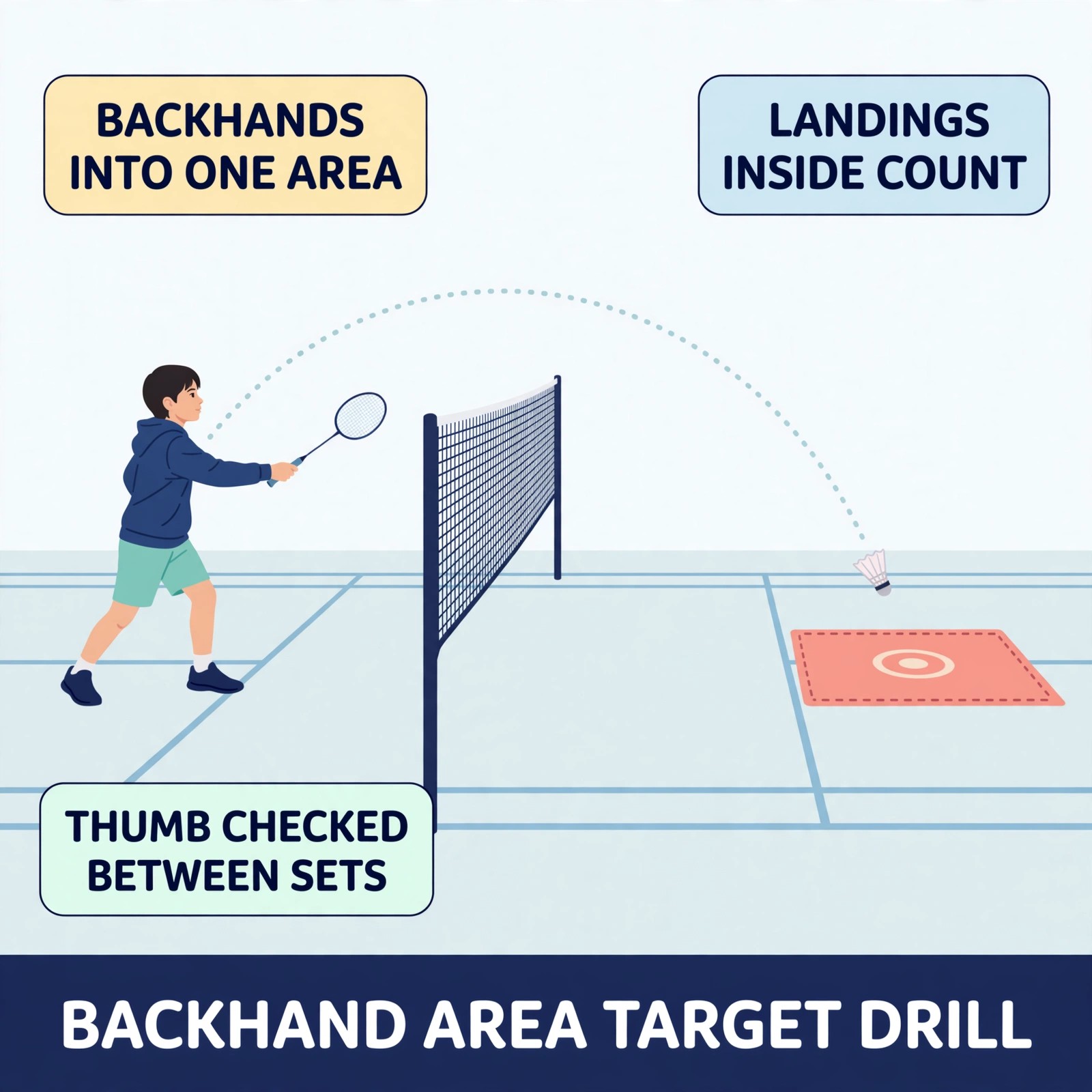
The honest targets for a new grip are forgiving ones. While the change is young, backhands are aimed at broad middle areas of the far court, where a slightly early or late thumb still lands the shuttle in and still teaches the hand something. Aiming a brand new backhand grip at lines and corners splits its errors into lucky winners and donations, and children learn quickly to avoid the shot that donates. As the change settles, the areas shrink and the feeds quicken. In training the count is plain: smooth changes made without a pause, out of a set of feeds, and backhands landing inside the broad area, and both numbers belong to the child rather than to any scoreboard.
Choosing the grip is a decision the hand learns to make early. The trained pattern is unglamorous: read the flight, decide the family while the feet are moving, change in the fingers during the steps, and arrive with the grip already set so the swing itself is simple. Young players often reverse that order, arriving first and changing at the last moment with the shuttle already falling, which turns a learnable skill into a panic. The coaching answer is feeds with time in them at first: high, kind feeds to the backhand side that let the change happen during the movement, then feeds that arrive flatter and faster as the decision speeds up. Nobody is asked to change faster than their reading allows.

Grip Check #4
Choosing The Reply: Which Grip, Which Shot
The change itself is small, and that is worth saying to a child who imagines something dramatic. The fingers loosen for a moment, the handle rolls a fraction inside them, the thumb finds the bevel or leaves it, and the hand is set again. All of it happens inside the hand, during steps the feet were taking anyway. What makes it hard at first is not the size of the movement but its timing: it competes for attention with the feet, the read and the swing, and attention in a young player is a small budget. That is why the change is grooved first at walking pace, then inside slow footwork, then inside feeds, and only last inside games. Small skill, patient order.
Expect the old grip to keep visiting, especially in games. Under pressure every player falls back on the habit with the longest history, and a child’s first grip has a long history by the time coaching starts changing it. The return of the old grip in a hard rally is not failure; it is information about where the new habit currently ends. Coaches mark it kindly, count it, and feed the situation again in practice until the new grip survives a little more pressure each week. Parents can help by not policing grips from the side during games. The practice blocks are where grips are changed. The games are where everyone finds out how the changing is going.
A gentle note on hands and arms. Grip work is light work, and sensible coaching keeps it that way: short sets, plenty of variety, and a racket light enough for a child’s hand to hold loosely without effort. A child whose hand, wrist or arm aches during or after grip and racket work should rest it, and pain that keeps returning deserves proper advice from a doctor or a physiotherapist before the load grows. Claims stay honest here: a loose correct hold lowers the strain a session puts on a young arm, it does not remove it, and no grip, however correct, is a promise that nothing will ever hurt.

Grip Check #5
Grip Drills That Build The Change
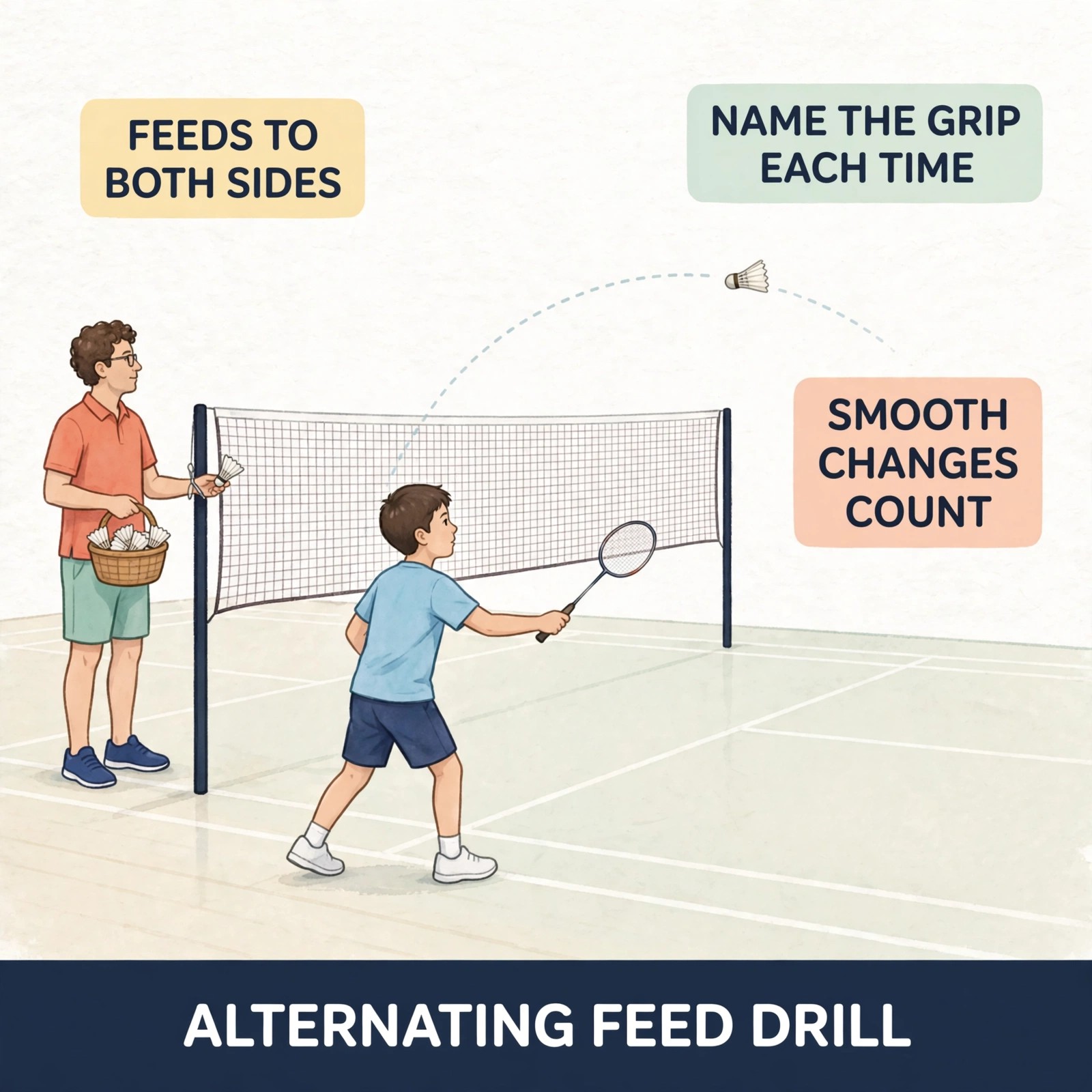
We teach grip changing in an order that protects the new habit. First, the loose hold: the resting grip grooved without a shuttle until the hand finds it on its own. Second, the thumb: backhand placement shown, touched and checked, with gentle wall touches and soft feeds to the hand. Third, the change inside movement: feeds split between forehand and backhand sides at a kind pace, the switch made during the steps and counted when smooth. Last, games: rallies where both families are demanded, with the stuck changes named kindly and fed again next session. Each stage removes a hiding place the stage before left standing.
Progress is counted in smooth changes and honest landings, not in how the grip looks standing still. Changes completed without a pause, out of a set of mixed feeds, is the headline figure every grip student should know about themselves. Backhands landing inside the broad area sits beside it. And the pressure count: changes that survived inside games, because that is where habits are finally graded. Feelings mislead here, since a child can feel clumsy while the counts quietly double, and can feel smooth in easy feeds while games expose the old hold. The counts keep the story straight. When smooth changes rise and old grip visits fall, the new habit is genuinely taking hold.
The signs the new grip has taken hold are mostly quiet. The thumb finds the bevel without the child looking down. Backhand shots stop popping up and start arriving with a shape the other side must respect. Net shots played off the thumb begin to tumble and fall instead of lifting. And the change disappears from the child’s attention entirely, which is the surest sign of all: the hand is deciding while the player thinks about the rally. That is when the work widens, to faster feeds, deceptive holds and the backhand drive, each built on the same loose hand and the same patient thumb.
Myth vs Reality
Myths About Grip Habits
Myth: one strong grip is enough, because good players can hit everything with the forehand hold if they practise hard. Reality: the forehand hold cannot push a backhand. Without the thumb on the bevel there is no lever behind the racket face on that side, and no amount of effort replaces a lever that is not there. Players who seem to manage with one grip are winning in spite of the missing shots, feeding opponents avoid their corners, and their ceiling sits exactly where the missing grip would have lifted it. Two families, one loose hand, and a grooved change: that is the whole honest equipment of a complete player.
Myth: squeezing the handle harder adds power, so a child should grip tightly to hit harder. Reality: a clamped hand slows the swing it is trying to strengthen. The forearm cannot turn freely through a squeezed handle, the racket head arrives later and slower, and the contact sprays. Power in this sport comes from timing, a loose hand that firms at contact, and the thumb pushing where the thumb belongs. Children who squeeze also tire their hands across a session and arrive at the last games holding the tool worst exactly when they need it best. Loose is not lazy here. Loose is where the speed is.
Myth: a child who keeps the same grip for every shot is being careless, and telling them to concentrate will fix it. Reality: grips are habits, and habits do what they were trained to do. A child whose first grip was grooved by months of playground rallies will use it everywhere until a different habit is built with the same patience: shown, touched, fed kindly and counted. Concentration cannot replace a movement the hand has never been taught, and blame cannot groove one either. When parents hear a coach say the grip is a habit rather than a flaw, that is not softness. It is an accurate description of how hands actually learn.

Why Choose Us
Why Players Choose ST Badminton Academy
Parents choose ST Badminton Academy for grip work because we teach the hand before we judge the shots. Your child’s hold is checked for looseness before any grip is named, the thumb placement is shown and touched until the hand finds it alone, and smooth changes are counted out of mixed feeds so everyone can see the habit arriving. In a group of no more than four students, there is time to stand beside a child and watch the actual moment of change, rally by rally. Many sessions blame the backhand. We rebuild the hold that plays it, because a player whose numbers are honest knows exactly what to train next.
The sessions run the way this page describes. Grip work sits inside regular training: the loose hold checked early, backhand feeds with the thumb called, mixed feeds where the change is counted, and games where the surviving changes are graded kindly. Coaches watch the hand and the contact together, since a grip fault and a late contact usually travel as a pair, and the notebook records smooth changes and backhand landings for every grip block. A student can point to the week the backhand stopped popping up, and to the drill that did it. A parent can ask to see the same counts and hear the same story.
We are based in Setapak, Kuala Lumpur, and families join us from across the Klang Valley, some travelling in from Wangsa Maju, Gombak and Setiawangsa for evening sessions. Grip coaching sits inside regular badminton sessions, not in a separate hand clinic: your child’s hold, change and reading are trained in the same hour as their footwork, their defence and their games, because that is where the grip has to hold, against feeds placed on both sides on purpose. A change grooved only against kind feeds is a rumour about a hand. The games in the same hour settle whether it is true.
FAQs: Children’s Grips And Badminton Training in Malaysia (KL)
These are the questions parents ask us most about a child who uses one grip for every shot, before they book and during their first weeks of grip work. The short version runs through all of them: loosen the hold, place the thumb, groove the change while moving, and count the smooth ones. The longer answers follow, including the ones about a child who panics when feeds come to the backhand side, practising the change at home, and how a first session with us actually works.
Can a child who uses one grip for everything be coached in Setapak or Gombak?
Yes. One grip for everything is one of the most coachable habits in junior badminton. In our Setapak sessions, in groups of no more than four students, the loose hold is checked first, the backhand thumb is placed and shown, and smooth changes are counted from the first weeks of mixed feeds.
What is the first grip habit a child should build in KL?
The loose hold, with the handle resting in the fingers instead of being squeezed in the palm. Every grip change travels through that looseness: a clamped hand cannot roll the handle or move the thumb in time. Once the hold rests, the forehand and backhand families both become easy to reach.
Why does one grip for every shot hold a child back at a junior level?
Because the forehand hold has no lever behind the racket face on the backhand side. Without the thumb resting flat on the wide bevel, backhand shots cannot push, so they float, pop up or fall short, and defence arrives with the face pointing the wrong way at the moment of need.
My child panics when feeds come to the backhand side. Should we drill only forehands or build the backhand grip first?
Build the backhand grip first, with kind feeds and time to change. Forehand-only practice makes the strong side stronger and the panic worse, because rallies keep sending shuttles to the side the hand cannot play. Gentle mixed feeds, counted when the change is smooth, turn the feared side into a practised one.
How can we practise grip changes at home in between classes?
Keep it playful and short. Rolling the handle loosely in the fingers while watching television, finding the thumb bevel with eyes closed, and gentle throw and catch games all groove the hold without pressure. Bring us the count of smooth changes your child manages and we will build from there.
Do you coach grip work beside badminton training near Wangsa Maju?
Yes. We coach grip work from our base in Setapak, a short drive from Wangsa Maju, and families from that side train with us every week. The work sits inside regular junior sessions rather than a separate hand clinic, so the change is practised against real feeds on both sides.
Where does ST Badminton Academy teach badminton training in Malaysia?
We teach at our base in Setapak, Kuala Lumpur, and families travel in from across the Klang Valley. Sessions run with no more than four students per group, because a grip change is built from moments watched one by one, and that needs a coach close enough to see the thumb.
How do I book a trial session to test my child’s grip habits?
Message us to arrange a trial at a time that suits your week. Bring your child’s racket and court shoes, and tell us which shots worry them most. We will check the hold, place the thumb, and count a first set of smooth changes together.
What makes Mr Eric Chuar a suitable coach for grip work in badminton?
Mr Eric Chuar coaches the academy sessions himself, with more than fifteen years of coaching in Malaysia and Singapore, so the person checking your child’s hold is the person who built the programme. His grip coaching is plain spoken: loosen the hand, place the thumb, and count the smooth changes.
Badminton Grip Coaching in Action


We benchmark our grip coaching against World Badminton (BWF) coaching standards and our own academy values: before any player trusts a training plan, they deserve honest checks. You can verify our coaches' credentials through the Badminton Association of Malaysia (BAM) coach education pathway.
One standard governs how we coach grips: the hold judges the change first, and the counts judge it second. A coach here will ask how many of the last set of mixed feeds were changed smoothly before asking how any rally ended, and will check the thumb placement before admiring a backhand that landed. We also hold an honesty rule about what grip coaching can promise: a grooved change gives a child both sides of the court to play with, and it cannot promise a date by which the old grip will never visit again, because habits fade at their own pace. What coaching promises is a loose hand, a placed thumb and changes counted in the open.
| Factor | The Changing Hands Player | The One Grip Player GRIP |
|---|---|---|
| Frequency | 1 or 2 times a week. Mostly for fun and sweat. | The one grip player carries the first hold they ever learned into every corner: backhands float without a thumb to push them, net shots lift, defence arrives with the face pointing the wrong way, and every lesson is attempted with a tool set for a different job. Nothing about the hand is ever counted, so the habit looks like a talent problem. |
| Drills Focus | Basic static feeding. Minimal footwork pressure. | The changing hands approach builds the grips in order: a hold resting loose in the fingers, the thumb placed flat on the wide bevel for backhand work, the change grooved inside the steps at a kind pace, and mixed feeds where smooth changes are counted. Smooth changes without a pause is the headline number, with backhand landings counted beside it. |
| Physical Conditioning | Rarely included. Just playing games on court. | Core, agility, and speed training included in every session to prevent injury and build stamina. |
| Tactical Awareness | "Just hit it over." No real game plan. | Video analysis, point construction, and learning to read the opponent's game. |
| Coach Ratio | Large groups (8-10 kids). Coach barely watches you. | Max 4 students. Mr Eric Chuar personally corrects every stroke and movement detail. |
| Goal Setting | Fun and exercise. | Because the counts separate smooth changes from lucky ones, a hard week shows up as numbers rather than as blame. The coach sees whether the hold, the thumb or the timing slipped, the player sees the same rows, and the next block of feeds is chosen by evidence instead of by frustration. |
| Long Term Result | Good recreational player. | The high-performance changing player arrives at rallies with both sides of the court available. The casual version spends the season forcing a forehand tool into backhand corners; the grooved version removes the waste in a fixed order and counts what is left. |
Badminton Grip Coaching in Kuala Lumpur
Your child's grip work starts with one honest set of feeds. This week, have a partner feed gently to alternate sides, forehand then backhand, and count two numbers: how many changes happened without a pause, and how many backhands landed inside the middle area of the far court. Then bring those numbers to a session with us and we will check the hold, place the thumb, and rebuild the fault the counts point at. No blame first. Just a loose hand, a thumb on the bevel, and a change that arrives in time.


