How Can Parents Tell Whether a Badminton Lesson Is Teaching Their Child (Parent Watching Guide)
It is the question every paying parent eventually asks, usually from the side of the hall with a phone in one hand: how can I tell whether this lesson is actually teaching my child anything? The worry underneath it is fair. An hour of badminton can look busy and teach very little, and it can look calm and teach a great deal. The good news is that teaching leaves visible signs, and a parent does not need to know the sport to read them. This page works through those signs in order: the purpose being named, the skill being shown, the turns coming quickly, the corrections being kind and specific, and the progress being counted honestly.

Watch Check #1
What A Teaching Lesson Really Looks Like
A teaching lesson, in the way this page uses the term, is an hour in which a child leaves knowing or doing something they could not do at the start, and can usually say what it was. Its parts are plain: each block of the lesson has a named job, the coach shows the skill before asking for it, every child attempts the task many times, mistakes are corrected with a cue the child can act on, and the hour ends with the new thing tested inside a game. None of that requires noise, trophies or exhaustion. It requires intention, and intention is exactly what a watching parent can learn to see.
The cost of an hour that entertains without teaching is paid slowly. The child has fun, sweats, and comes home happy, and the parents renew the fees, while the grip stays wrong, the feet stay planted and the same errors harden into habits that later coaching must unpick. There is a second cost: the child quietly decides they are not improving, when the truth is that nobody ever showed them the parts in an order they could hold. Fun matters, and this page is not arguing against it. Play is how children stay in a sport. The argument is only that fun and teaching belong in the same hour, and parents are allowed to check for both.

Watch Check #2
Purpose And Demonstration: The Lesson Base
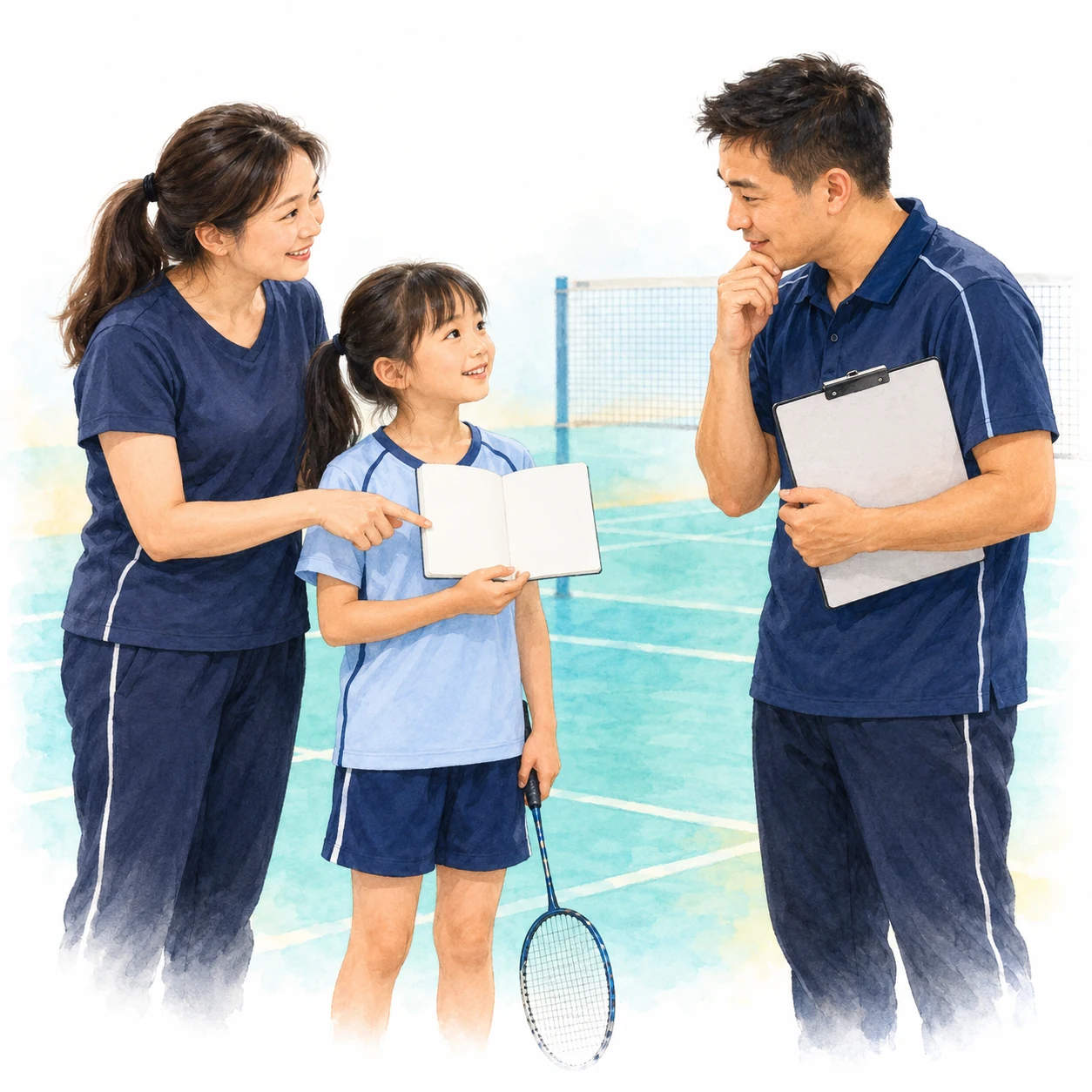
The first sign is purpose, spoken out loud. In a teaching lesson the coach names what each block is for before it starts: today we are learning to hold the racket for backhand shots, or today the feet learn to come back after a shot. The words are simple and the children hear them too, because a child who knows the job of a drill tries it differently from a child who is only filling time until the games. Parents can listen for this from the side without understanding a single technique. If every block arrives with a reason, teaching is being planned. If the hour is one long unnamed activity, it usually is not.
The second sign is demonstration. A coach who teaches shows the movement first, slowly, more than once, and often from the side the children stand on, so small eyes can copy a shape instead of guessing one from words. Then comes one cue, a single short instruction the child can hold while trying: thumb here, racket up, come back to the middle. Watch what happens after the demonstration: in a teaching lesson the children try the thing straight away, while the picture is fresh. A lesson that is all talking produces children who can repeat the words. A lesson built on showing produces children who can do the movement.
Weak lessons repeat on a short list. The endless line, where each child waits many minutes for a single turn and spends the hour queuing instead of learning. The shouting correction, loud and general, aimed at everyone and usable by no one. The permanent match, games from start to finish with no skill ever isolated, named or repaired. The favouritism drift, where the strongest children get the coaching and the quiet ones get the leftover minutes. And the mystery hour, where even the children cannot say afterwards what the lesson was about. Each fault has the same repair: name the task, show it, shorten the lines, correct one thing kindly, and count what changed.

Watch Check #3
Turns And Corrections: Every Child Active
The third sign is turns. Learning a movement is built from attempts, and attempts need turns that come quickly. Watch a single child, any child, for a few minutes and count how many times they actually strike a shuttle or practise the movement. In a teaching lesson the number climbs steadily, because groups are small, feeds are organised and partners rotate. In a weak lesson the same child may touch the shuttle a handful of times in an hour and spend the rest watching stronger children play. Parents do not need a stopwatch for this. The difference between a child who is busy learning and a child who is busy waiting is visible from any seat in the hall.
The fourth sign is the correction. Every child in every lesson makes mistakes; what separates teaching from supervision is what happens next. In a teaching lesson the coach notices the error, names it kindly and gives one cue to try, then watches the next attempt to see whether it landed. The correction is specific enough to act on: not try harder, but racket up earlier, or come back after your shot. Parents listening from the side will hear their own child corrected by name, gently, several times in an hour. A coach who never corrects is being polite at the child’s expense. A coach who corrects everything at once is asking for more than a child can hold.
The fifth sign is honesty about pace. Children develop at different rates, and a teaching lesson makes room for that instead of pretending otherwise. The child who needs the feed slower gets it slower. The child who is ready for more gets more. Nobody is shamed for being where they are, and nobody is measured against the strongest child in the group as if that were the standard. Parents can watch for this in how groups are arranged and how praise is handed out: teaching praise names the thing done well, so the child knows what to repeat. Empty praise and public comparison are both signs the hour is being run for appearance rather than for learning.

Watch Check #4
Choosing A Lesson: Pace, Kindness And Fit
What a child brings home is evidence too. After a teaching lesson, most children can answer a simple question: what did you learn today? The answer may be small and in their own words: we learned the thumb grip, we practised coming back to the middle. That small answer matters, because understanding is a layer of progress in its own right, and it tells the parent the lesson had a shape the child could carry away. A child who week after week can only report who won the games may still be enjoying themselves, and the enjoyment is real, but the parent has learned something worth asking the coach about, kindly and early.
Parents help most by watching kindly and reporting honestly. Tell the coach what your child says at home: what felt confusing, what felt too easy, what they practised in the living room without being asked. That report is coaching gold, because the coach sees one hour and the parent sees the week. Resist the two temptations at the side of the court: coaching over the coach, which gives a child two sets of instructions to fail between, and comparing aloud with the child on the next court, which teaches a young player to watch other children instead of the shuttle. Ask questions after the lesson, as often as you need. A teaching academy expects them.
A word of calm for the parent who worries they have chosen badly. Almost every academy has stronger and weaker hours, new coaches learning and good coaches having flat days, so judge the pattern across a few weeks rather than one visit. Look for the trend: is your child attempting more, understanding more, joining in more readily than in their first lessons? If the answers stay flat for a long stretch, that is worth a proper conversation, and a good coach will welcome it and answer with specifics. Lasting worry that does not settle deserves support beyond the hall too, and there is no shame in a parent talking it through with someone they trust.

Watch Check #5
Watching Drills That Show The Teaching
We run our lessons in an order a parent can follow from the side. First, the welcome and the warm up, with the day’s skill named out loud. Second, the demonstration block, where the coach shows the movement and gives the one cue the children will use. Third, the practice block, short lines and quick turns, feeds matched to each child, corrections between sets. Last, small games where the new skill is tested inside play and the children discover whether it holds. A parent watching that order knows exactly where the hour has reached, and a child inside it always knows what they are practising and why.
Progress is counted in attempts and understanding, and the counts are the same ones parents can follow. Contacts made with the new grip or the new shape, counted kindly out of a set. Instructions followed without the drill stopping, which says the size of the teaching fits the child. Turns taken in the small games, because joining in is itself being learned. And the home report: can the child say what the lesson was about? None of these counts compares your child with anyone else’s. Each compares your child with their own earlier lessons, which is the only comparison that measures teaching fairly.
The signs a lesson is teaching show up quietly over the weeks. Your child holds the racket the taught way without being reminded. They can name the cue the coach gave them and use it on purpose. Their attempts grow braver and their mistakes change shape, landing a little nearer the target instead of scattering. They ask when the next session is. Those signs arrive at different speeds for different children, and the speed is not the point. The point is that the signs keep arriving. A lesson programme that teaches produces a child who is visibly becoming a player, one named skill at a time, and a parent who can describe how.

Myth vs Reality
Myths About Watching Lessons
Myth: a lesson full of sweat and running is a lesson full of learning, so the most tiring hour is the best one. Reality: effort and learning are different things, and children can run for an hour while repeating every fault they arrived with. Sweat measures work. Teaching is measured by what changed: a grip corrected, a return step added, a read understood. The best hours do contain plenty of movement, because turns come quickly inside them, but the movement is organised around a named skill. Parents should ask what the running was for. If nobody can answer, the hour was exercise wearing a lesson’s clothes.
Myth: matches alone prove quality, so a lesson that is mostly games must be the most advanced kind. Reality: games test skills; they rarely build them. A child thrown only into matches practises whatever they already do, under pressure, with the weakest parts touched least because opponents avoid feeding them. The teaching sequence is older and plainer: name it, show it, practise it in pieces, then test it in a game. Matches belong at the end of that sequence, where they show the coach and the parent exactly what survived. A lesson that skips straight to games has skipped the teaching and kept only the test.
Myth: a good parent can judge a lesson by comparing their child with the strongest child in the group. Reality: that comparison measures different starting points, different amounts of earlier play and different rates of growing, and it measures them unfairly. The strongest child in the group is not the standard; they are simply further along a road your child is also walking. The honest ruler is your own child across time: attempting more, understanding more, joining more readily than last month. Coaches who teach well will offer you exactly that comparison when you ask. Coaches who offer only the other kind are telling you something about their teaching.

Why Choose Us
Why Players Choose ST Badminton Academy
Parents choose ST Badminton Academy because our teaching is done in the open, where it can be watched. Every lesson names its skill, every skill is demonstrated before it is asked for, and every child in a group of no more than four students is corrected by name with one cue at a time. We count contacts, turns and returns, and we can tell you plainly what your child worked on this week and what comes next. Many lessons keep parents at a distance and ask for trust. We would rather earn the trust in front of you, one observable hour at a time.
The sessions run the way this page describes. Lessons sit inside regular training: the skill named at the start, the demonstration and the cue, the practice block with feeds matched to each child, and the small games at the end where the skill is tested. Coaches watch the attempts and the understanding together, since a lesson fails when either one goes missing, and the notebook records contacts, corrections and turns for every block. A parent can ask afterwards what the counts were and what they mean, and point to the week a fault started shrinking. That traceability keeps everyone honest, including us.
We are based in Setapak, Kuala Lumpur, and families join us from across the Klang Valley, some travelling in from Wangsa Maju, Gombak and Setiawangsa for evening sessions. Watching is welcome at our sessions rather than tolerated: parents sit where they can see, hear the cues their child is given, and ask about them afterwards. Lesson quality is easier to judge when nothing is hidden, and a first lesson is easier for a child when a parent’s face is somewhere familiar in the hall. Bring your questions with you. They are part of how the teaching stays honest.
FAQs: Watching Lessons And Badminton Training in Malaysia (KL)
These are the questions parents ask us most about judging a lesson, before they book and during their first weeks of watching. The short version runs through all of them: listen for the purpose, watch for the demonstration, count the turns, hear the corrections, and judge your child against their own start. The longer answers follow, including the ones about a child who comes home happy but cannot say what was learned, supporting lessons from home, and how a trial session with us actually works.
Can parents watch a lesson and judge its teaching in Setapak or Gombak?
Yes. Parents are welcome to watch our Setapak lessons, and we will happily tell you what to look for: the skill named at the start, the demonstration, your child attempting it many times, and one kind correction at a time. Our groups run with no more than four students.
What should a parent watch first in a children’s badminton KL?
Watch the start of the first practice block. A teaching coach names the skill, shows the movement slowly, and gives one short cue the children can hold while they try. If your child can repeat that cue back to you afterwards, the lesson had a shape they could carry home.
Why can a busy lesson with lots of running teach very little at a junior level?
Because running repeats whatever a child already does, including every fault they arrived with. A busy hour can be honest exercise while teaching nothing new. Teaching adds a named skill, a demonstration and corrections, then tests the change inside games. Sweat measures work; changed habits measure teaching, and parents deserve both.
My child comes home happy but cannot say what was learned. Should I worry or ask the coach what to watch?
Ask kindly, and ask for specifics. A teaching coach can tell you what your child worked on, what cue they were given, and what their attempts looked like this week compared with last month. Happiness matters and enjoyment keeps children in sport, but understanding is the evidence worth asking about.
How can parents support lessons at home in between classes?
Keep it light and curious. Ask what they learned, let them show you the movement in the living room, and share anything confusing with us at the next session. Short playful practice they choose themselves helps; turning home into a second lesson with corrections usually undoes the fun that learning needs.
Do you coach lessons parents can watch beside badminton training near Wangsa Maju?
Yes. We coach watched lessons from our base in Setapak, a short drive from Wangsa Maju, and families from that side train with us every week. Parents sit where they can see the practice blocks and hear the cues, because teaching done in the open is easier to trust.
Where does ST Badminton Academy teach badminton training in Malaysia?
We teach at our base in Setapak, Kuala Lumpur, and families travel in from across the Klang Valley. Sessions run with no more than four students per group, because teaching is built from attempts watched one by one, and that needs a coach close enough to correct kindly and often.
How do I book a trial session to test my child’s lesson fit?
Message us to arrange a trial at a time that suits your week. Bring your child’s racket and court shoes, and watch the session with the signs from this page in mind. We will name what we would teach first and show you the counts we would keep.
What makes Mr Eric Chuar a suitable coach for children’s lessons in badminton?
Mr Eric Chuar coaches the academy sessions himself, with more than fifteen years of coaching in Malaysia and Singapore, so the teaching you watch is the teaching he designed. His lesson coaching is plain spoken: name the skill, show the skill, correct one thing kindly, and count what changed.
Badminton Lesson Coaching in Action


We benchmark our lesson coaching against World Badminton (BWF) coaching standards and our own academy values: before any player trusts a training plan, they deserve honest checks. You can verify our coaches' credentials through the Badminton Association of Malaysia (BAM) coach education pathway.
One standard governs how we run lessons: the teaching must be visible to anyone watching, and the counts must be speakable out loud. A coach here will tell a parent how many contacts their child made with the new shape and how the attempts are trending before talking about results, and will name the cue being worked on without being asked twice. We also hold an honesty rule about what lessons can promise: regular teaching makes a child steadily more skilful, and it cannot promise a speed of progress or a place in any team, because children differ and selectors decide for themselves. What coaching promises is named skills, kind corrections and progress counted in the open.
| Factor | The Teaching Hour | The Busy Hour WATCH |
|---|---|---|
| Frequency | 1 or 2 times a week. Mostly for fun and sweat. | The busy hour keeps children moving and happy: long lines, permanent games, general shouting, and no skill ever named, shown or repaired. The month ends with tired children and the same faults they arrived with, and nobody can say what was learned because nothing was ever counted or corrected by name. |
| Drills Focus | Basic static feeding. Minimal footwork pressure. | The teaching hour builds the lesson in order: the skill named out loud, the movement demonstrated, short lines with quick turns, one kind cue per correction, and small games at the end to test what survived. Contacts with the new shape is the headline number, with turns taken and cues used counted beside it. |
| Physical Conditioning | Rarely included. Just playing games on court. | Core, agility, and speed training included in every session to prevent injury and build stamina. |
| Tactical Awareness | "Just hit it over." No real game plan. | Video analysis, point construction, and learning to read the opponent's game. |
| Coach Ratio | Large groups (8-10 kids). Coach barely watches you. | Max 4 students. Mr Eric Chuar personally corrects every stroke and movement detail. |
| Goal Setting | Fun and exercise. | Because the counts compare each child with their own earlier lessons, a flat month shows up as numbers rather than as a worry at the gate. The coach sees whether the task, the pace or the correction slipped, the parent sees the same rows, and one part of the lesson is adjusted instead of the child being judged. |
| Long Term Result | Good recreational player. | The high-performance teaching lesson produces a child who can say what they learned and show it a week later. The casual version spends the term entertaining while habits harden; the teaching version removes the waste in a fixed order and counts what is left. |
Badminton Lesson Coaching in Kuala Lumpur
Your next visit to the hall can be a watching visit. This week, pick one child, yours or any other, and quietly count two things during the practice block: how many times they strike the shuttle, and how many times the coach corrects them by name with a cue. Then ask your child afterwards what the lesson was about. Bring those three answers to a trial session with us and we will show you the same counts inside our lessons, and name what we would teach your child first. No expertise needed. Just eyes, ears and one honest question.