Better Badminton Training: From Fixed Practice to Simple Rally Choices
A large basket of shuttles can make badminton training look productive. Feeding and repetition have important uses, but their quantity alone does not show what a child is learning to notice or decide. A useful question is how a familiar action connects to a simple situation: what does the child see, what choice is available and how can the action fit that choice? This guide explains a gradual approach for parents considering a badminton academy or badminton class for kids in Kuala Lumpur, Malaysia. It does not prescribe one universal lesson plan or promise match results. ST Badminton Academy’s approach should be discussed against the learner’s current foundation. Images here are AI-generated teaching illustrations, not photographs of STBA lessons or real students.

A clear foundation
Give fixed practice a purpose
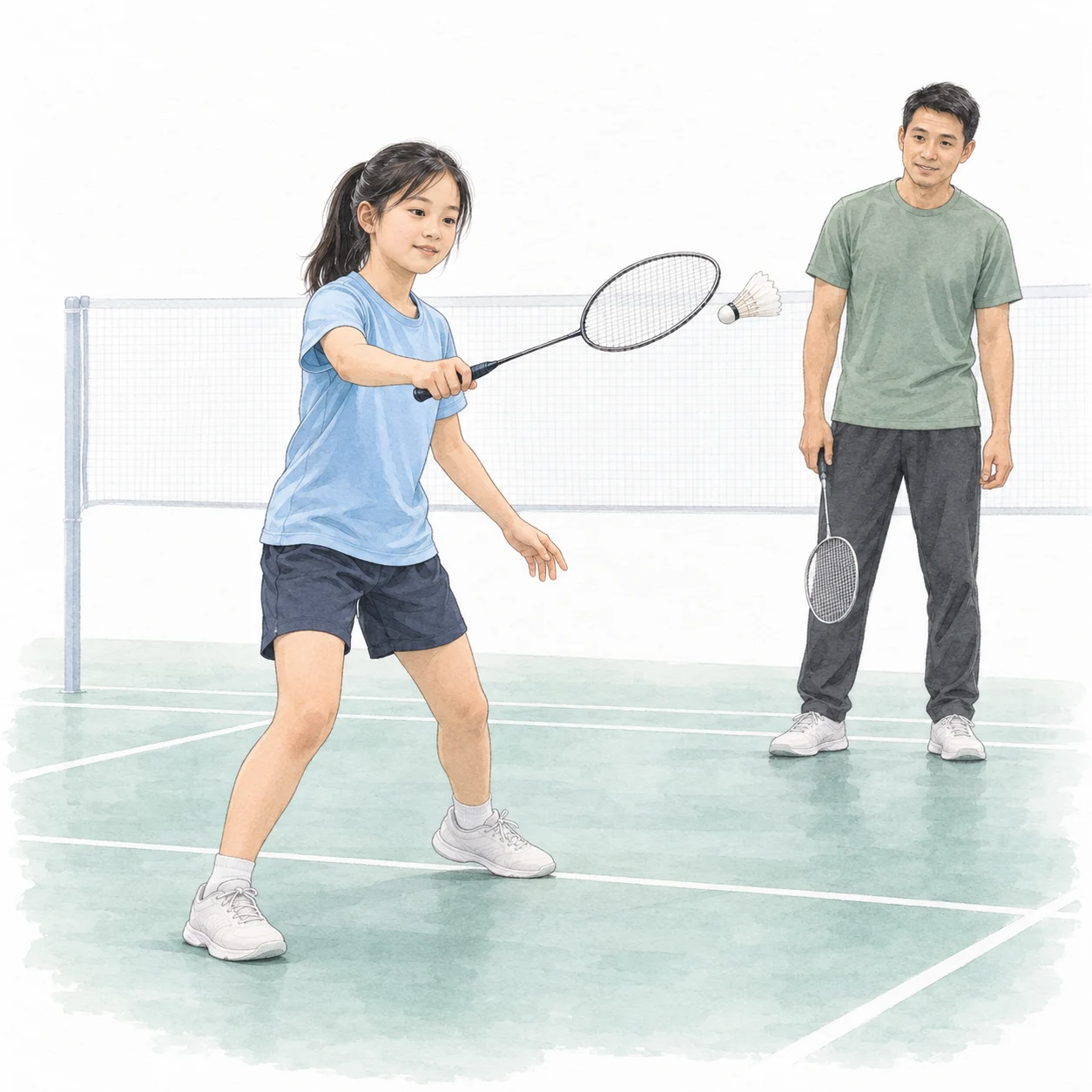
A predictable task can help a learner understand a starting position, an intended racket action or a direction. That is a legitimate reason to use simple feeding. Ask what the repetition is meant to clarify and what the child should notice after an attempt. For a hypothetical example, a child receives a gentle feed and tries to direct it towards a marked area. The useful observation is not only how many shuttles were supplied. It is whether the child understands the target, has suitable instructions and receives feedback connected to that purpose.
Fixed practice also has limits. A familiar feed can remove the need to decide where the shuttle is going or what response is suitable. That may be intentional while a foundation is being explained. It does not make the drill worthless, and it does not prove the child can use the action in every situation. Ask how the coach knows when the current task is understood enough to introduce a small change. Repetition and variation should have a relationship, rather than being treated as rival methods with one always superior to the other.
See before choosing
Make the relevant information visible
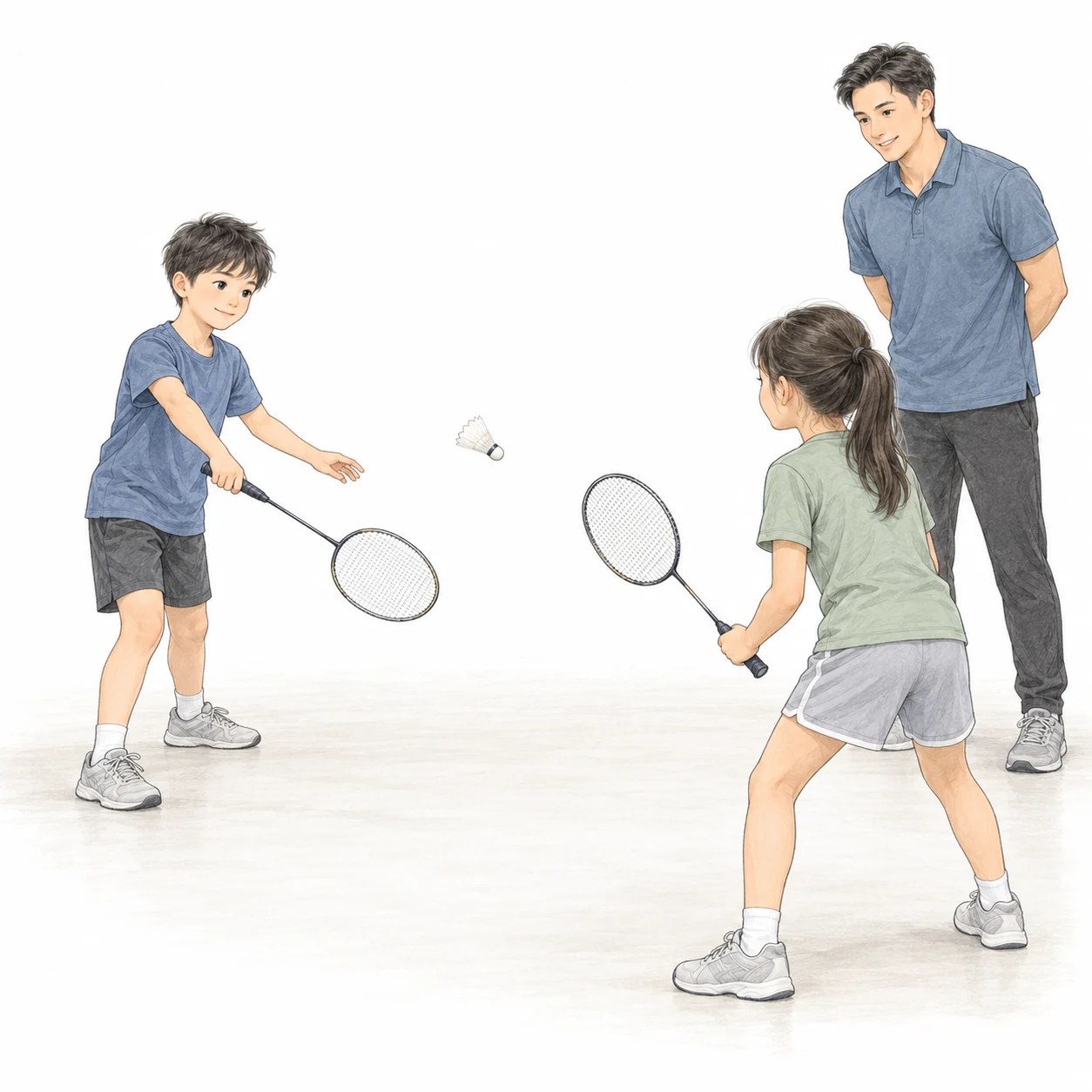
Before a child can make a useful choice, the child needs to know what information matters. In an appropriate simple activity, that might be the shuttle’s direction, a clearly marked target or a starting position. Explain the cue and allow enough simplicity for the child to recognise it. A complicated rally with many unfamiliar demands can hide the teaching point. Ask what the learner is supposed to see, not just which stroke name is being practised. The coach should select information that fits the current task and explain it in words or demonstrations the child can understand.
A hypothetical progression could keep the feed gentle while changing between two clearly defined target situations. The child first identifies what changed, then attempts the related action. This is an illustration of a teaching possibility, not an STBA lesson schedule or a claim about what every beginner should already do. If the child cannot recognise the relevant cue, the coach can make the contrast clearer or return to one situation. More speed is not automatically a better learning task. The connection between the information and the intended response matters more than making the activity look advanced.

One manageable decision
Add a choice without adding every difficulty
A choice can be introduced on a small scale. Rather than adding several directions, movement demands and scoring rules together, a coach can consider one relevant contrast. The child needs to understand the available responses and why each might fit the situation. In a hypothetical activity with two suitable target options, the purpose is to notice the stated cue and choose between those options. It is not to guess what the coach secretly wants. The task should be explained, and the action required must remain appropriate to the learner’s foundation.
Observe the whole sequence: seeing the cue, selecting a response and attempting the action. A child may choose appropriately but execute imperfectly. Another may make a tidy contact without noticing the cue. These observations point to different teaching questions. The first may need technical clarification; the second may need help recognising information. Do not reduce both to the same count of successful shots. Ask what the coach is reviewing and how the next task addresses that part. This keeps decision practice connected to instruction rather than simply adding random feeds.

Connect it to play
Use a simple situation before demanding a full match
A short, clearly explained rally situation can connect the foundation with an appropriate choice. It need not reproduce every uncertainty of a match. The coach might limit the possible responses, slow the activity or use a clear restart so the teaching focus remains visible. Those are possible adjustments, not a claim that STBA uses one fixed format. Ask why the situation was chosen and what the child should attend to. A suitable small situation can offer a meaningful question without requiring the learner to manage all match demands at once.
Review can bring the activity back to the foundation. If the intended action disappears when a choice is introduced, the coach may simplify the situation and revisit the relevant movement or racket action. If the action is understood but the cue is missed, the next explanation may focus on seeing. The lesson can move between familiar repetition and a manageable situation as needed. This is not a guaranteed route to winning rallies. It is a way to keep teaching decisions specific and to avoid assuming that either endless feeding or unrestricted games alone answer every learning need.

Myths and teaching reality
Quantity and game complexity are not complete measures
Myth: the class with the most fed shuttles must provide the best badminton training. Reality: feeding quantity describes activity, while useful instruction also involves purpose, suitable difficulty, observation and feedback. A basket can support a well-chosen task, but it cannot explain what the child understood. Ask how the next attempt relates to the teaching point. Avoid inventing an ideal contact count or treating a busy-looking session as proof of learning quality.
Myth: basic repetition has no place once decision-making is mentioned. Reality: a manageable repeated task may help clarify the action needed for a later choice. The question is whether its purpose is understood and whether the coach connects it to suitable use. A beginner does not need to abandon clear foundations in order to practise noticing. Equally, a familiar pattern repeated without review should not automatically be called decision training. Look for a stated link between foundation, information and response.
Myth: putting a child into full games automatically teaches match decisions. Reality: games can provide learning opportunities, but many simultaneous demands may obscure a particular point. A simple situation, focused feedback or a return to a clearer task may be more appropriate for the current question. The coach should explain the choice of activity. Neither complex play nor simplified practice guarantees a result. Assess what the child is asked to see and do, and how the activity is reviewed.

Eric’s teaching commitment
Teach the reason for the action
I am Eric, and I want parents to examine the purpose behind my teaching rather than only the volume of activity. I aim to explain a foundation carefully and connect it to a situation the learner can understand. I value the teaching goal of a child recognising why an action fits, instead of merely copying a movement because I called it out. I find satisfaction in working towards that understanding. These are my commitments and efforts, not an invented student success story, a promise of wins or a claim to be objectively the world’s best coach.
Parents can ask calmly after a suitable activity: what did you notice, what were your options and what did you try? A child can show the idea rather than give a polished explanation. An uncertain answer is a reason to clarify, not a verdict on ability. Ask the coach which part of the sequence was being taught and what support was available. Avoid inserting a different tactical instruction while the lesson is running. The conversation should help connect the learner’s response, the teaching purpose and the next manageable step.

A practical next step
Ask about progression, not just feeding volume
When comparing a badminton coach or academy in Kuala Lumpur, ask how fixed tasks are selected, how understanding is checked and how suitable variation is introduced. Ask what the child will be expected to notice and how feedback separates a choice from its execution. You can also ask when the coach returns to simpler practice. A useful answer explains the current learner’s needs instead of promising one ideal formula for everyone. Consider the child’s experience and practical commitments alongside the teaching approach. The proposal matters more than a generic label such as advanced or best.
To discuss ST Badminton Academy in Setapak, begin with the website’s online application. Describe previous badminton experience, your concerns about the learning process and any questions about foundations and play. Read the intake and application rules before using the training contact information for remaining questions. An application starts a discussion; it does not reserve a place, confirm a timetable or guarantee results. Review the actual proposal before deciding. Keep the aim specific: a clear task, useful information, a manageable choice and an action that can be discussed and tried again.
Questions about repetition, choices and rallies
These answers explain how different activities can serve a learning purpose without treating one training format as a universal solution.
Is shuttle feeding useful for children?
It can be useful when the task, difficulty and feedback fit the learner. Ask what the feed is intended to clarify and how the child understands the purpose, rather than judging only the quantity.
Does more feeding always mean better training?
No. Quantity alone does not show understanding, suitable challenge or application. Consider what the child is learning to notice and whether the next attempt uses relevant feedback.
Must beginners choose between many shots straight away?
No. The choice should fit the foundation and the task. A clearly explained small contrast may be considered; adding several unfamiliar demands together can obscure what is being taught.
What does seeing, choosing and acting mean?
It means noticing relevant information, selecting an appropriate available response and attempting it. The coach can review these parts separately instead of treating every unsuccessful shot as the same problem.
Can an imperfect shot contain a good decision?
Yes, a suitable choice and its execution are different observations. Ask which part was being learned and what feedback addresses it. This does not mean ignoring the technical foundation.
Should training only use full games?
Not necessarily. Games, simple situations and foundation tasks have different uses. The coach should select and review the activity according to the learner and the current teaching question.
Is returning to a fixed drill a step backwards?
Not automatically. It can clarify a foundation that became unclear when a choice was added. Ask how that practice will reconnect with the situation instead of assuming that simpler means less valuable.
Can this approach guarantee match results?
No. This guide describes teaching questions and possible progression, not a guarantee of wins or a timeline. Review actual instruction and the learner’s response without converting the approach into promised outcomes.
How do we ask STBA about suitable training?
Start with the online application and describe the child’s experience and concerns. Read the intake rules, then use the training contact information for remaining questions before deciding on the proposal.
From a clear foundation to a simple situation
Four steps from task to review
These steps describe a manageable learning situation. They are not statistics, a fixed timetable or a promise that a drill will transfer automatically to match play.
| Teaching question | Activity without a clear learning link | Practice connected to a suitable situation Teaching approach |
|---|---|---|
| Repetition | Count feeds without checking the purpose | Clarify the foundation the task serves |
| Information | Expect a choice without explaining the cue | Show what the learner needs to notice |
| Variation | Add several demands without checking understanding | Introduce a manageable relevant change |
| Feedback | Treat every miss as the same problem | Review the choice and the action separately |
| Progression | Assume either drills or games answer everything | Connect simple practice, situations and review |
| Comparison | Use quantity or complexity as a guarantee | Ask about suitability and the learning response |
Begin with a clear online application
Tell ST Badminton Academy about the child’s experience and your questions about training progression. Submit the online application first, read the intake rules and discuss the actual proposal before deciding. Applying does not confirm a place, a timetable or match results.