The Best Badminton Nets For Home And Outdoor Use (Net Guide)
A net turns any flat space into a badminton court, and a home net turns a driveway, a garden or a school hall corner into practice that actually transfers to real games. Choosing one well comes down to five things: how it stands, whether it can hold the official height, how its mesh, depth and top tape are made, how you set and check the height, and how you care for it outdoors. This guide works through those in order, with the real numbers stated plainly. Home sets vary a lot, and this guide will say so where they do. There are no brand names and no prices here, only checks you can run yourself.
Net Check #1
Two Ways to Stand a Net: Portable Frames and Fixed Posts
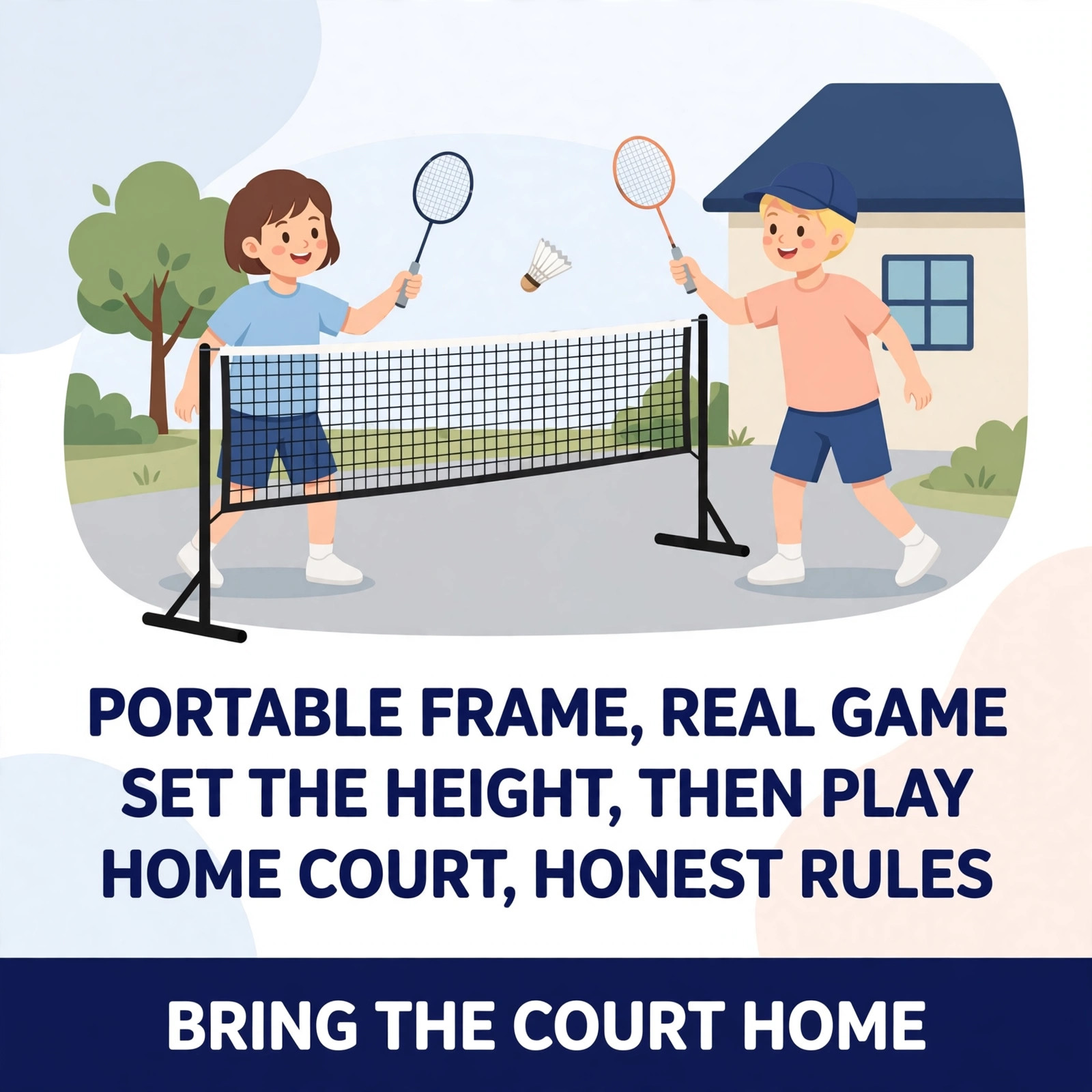
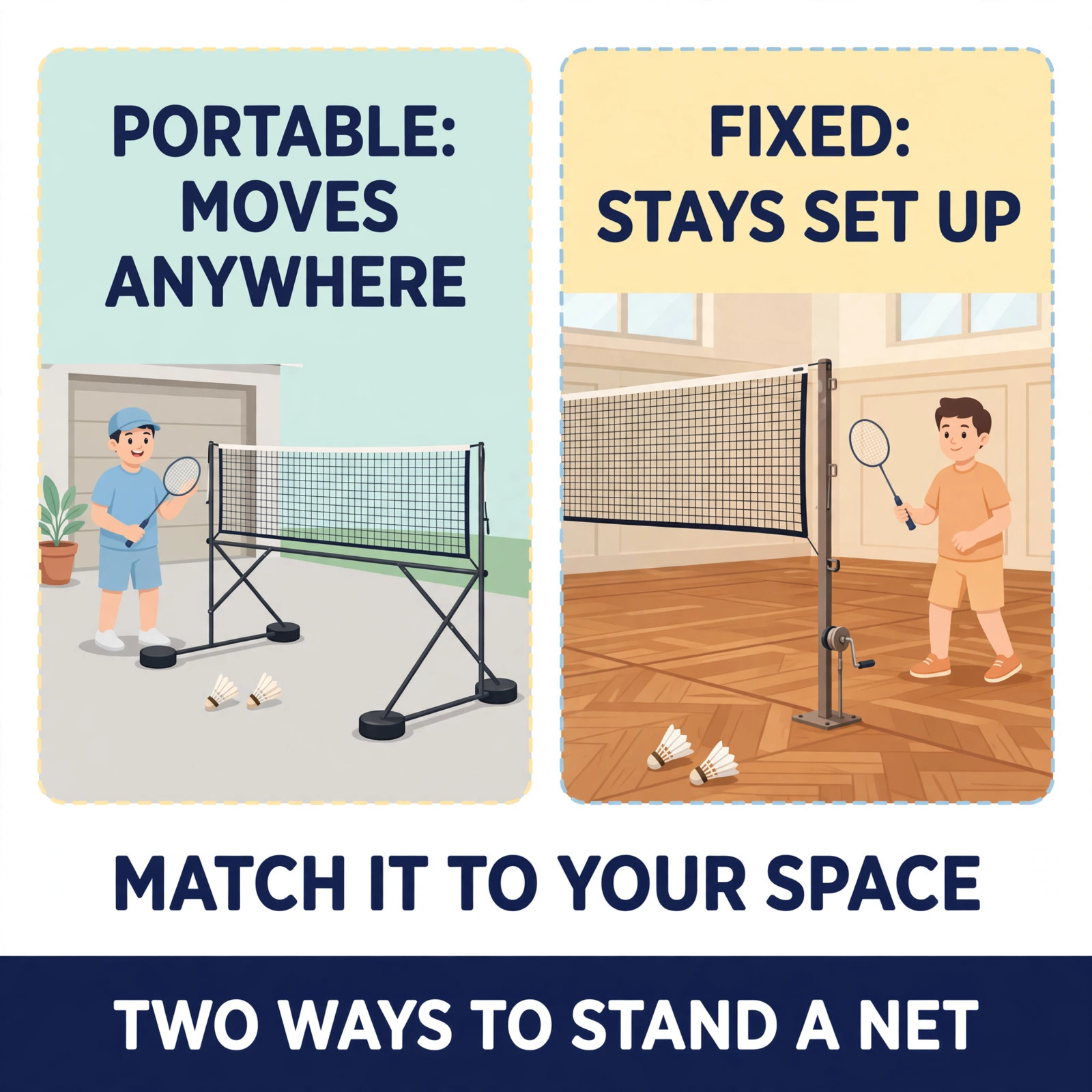
There are two ways to stand a net. The portable frame carries the net on its own folding stand, often with weighted bases or wide feet, and asks for nothing from the building or the ground. It goes up in minutes in a driveway or garden, moves when the space is needed for something else, and stores in a corner. The fixed post is the hall solution: steel posts that drop into floor sockets or stand on heavy bases, with a winch or cleat to tension the top cord, set once and left ready.
Choose by space and habit, not by appearance. A portable frame suits a home because home spaces are shared: the driveway parks a car by day and hosts rallies by evening. Its limits are honest ones: a light frame can wobble in wind and under a hard net cord shot, and its height adjustment may be coarse. Fixed posts suit a hall or a dedicated court because stability and fine height control are their whole design. A family that plays three times a week in one place leans fixed or heavy portable; a family that plays wherever the weekend lands leans portable and light.
Net Check #2
The Height Facts: 1.55 at the Posts, 1.524 in the Middle
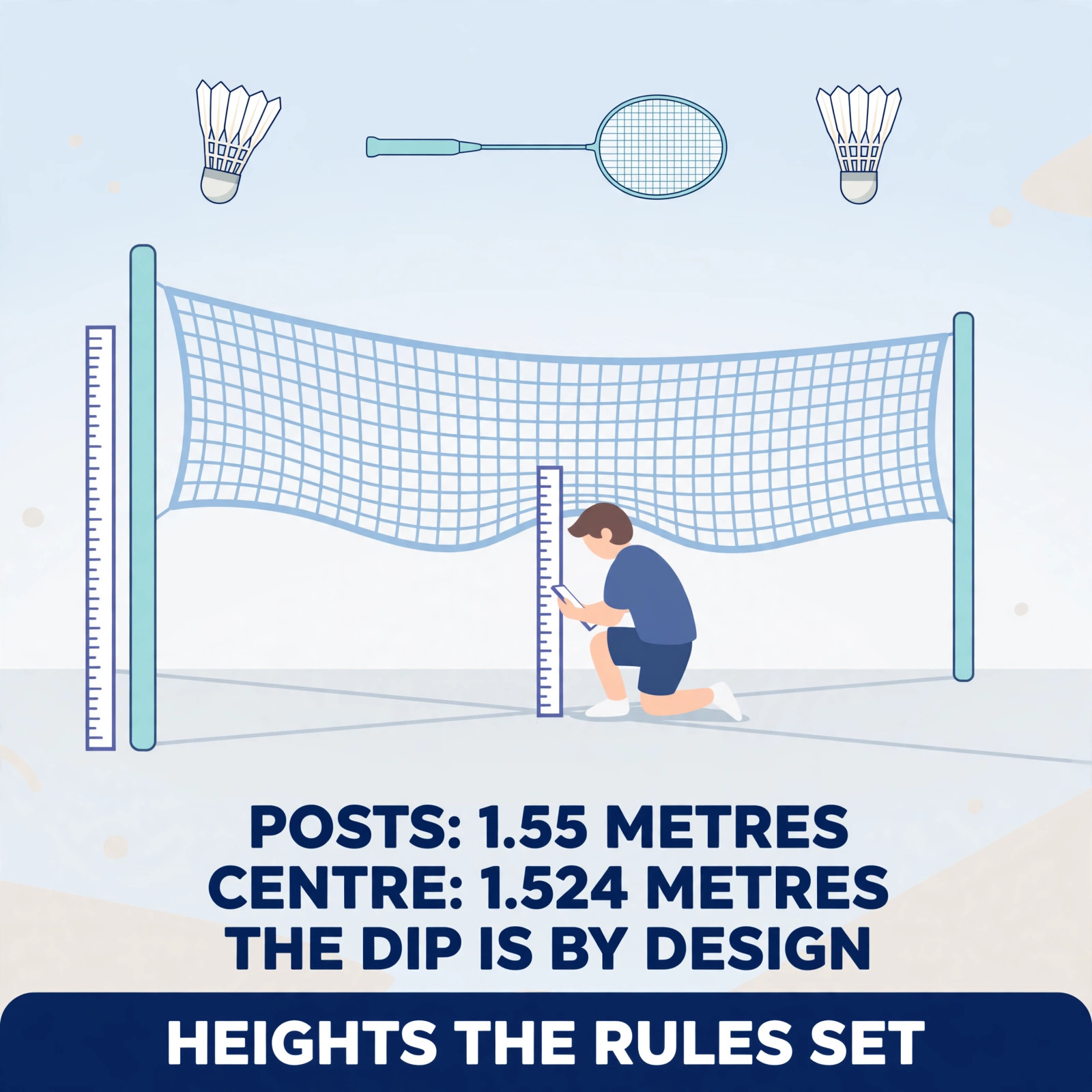
Now the numbers, because home badminton is full of guessed heights. The official net height is 1.55 metres at the posts and 1.524 metres at the centre. Those figures come from the laws of the game and they are the same in a world final and in a Setapak driveway. The tape at the top of the net, not the mesh below it, is what the measure touches. A net strung to these heights gives home practice the same geometry as a hall match: the same lift that just clears at home just clears in competition.
The centre is lower than the posts on purpose, and understanding why stops a common home mistake. A net is a heavy band of mesh hanging from a cord between two posts. Even pulled firm, the cord gives a little in the middle, and the laws allow for that dip by setting the centre height 26 millimetres lower. Players who fight the dip, cranking a home net flat and level at 1.55 metres everywhere, have actually raised the middle above the legal height. Home games on that net teach lifts and net shots to the wrong clearance, and the error shows up in the first hall match.
Height shapes every shot habit a player builds. Net shots are judged against the tape; drives skim it; smashes are angled down from above it. Train for months against a net slung at chest height and the judgement sticks, wrongly. This is why the portable set that cannot reach the official height is a toy for knockabout fun, which is a fine thing to own, as long as nobody mistakes it for training equipment. Check the maximum height before you judge any home set, and check it at the centre, where the truth lives.
Net Check #3
Mesh, Depth and the White Top Tape
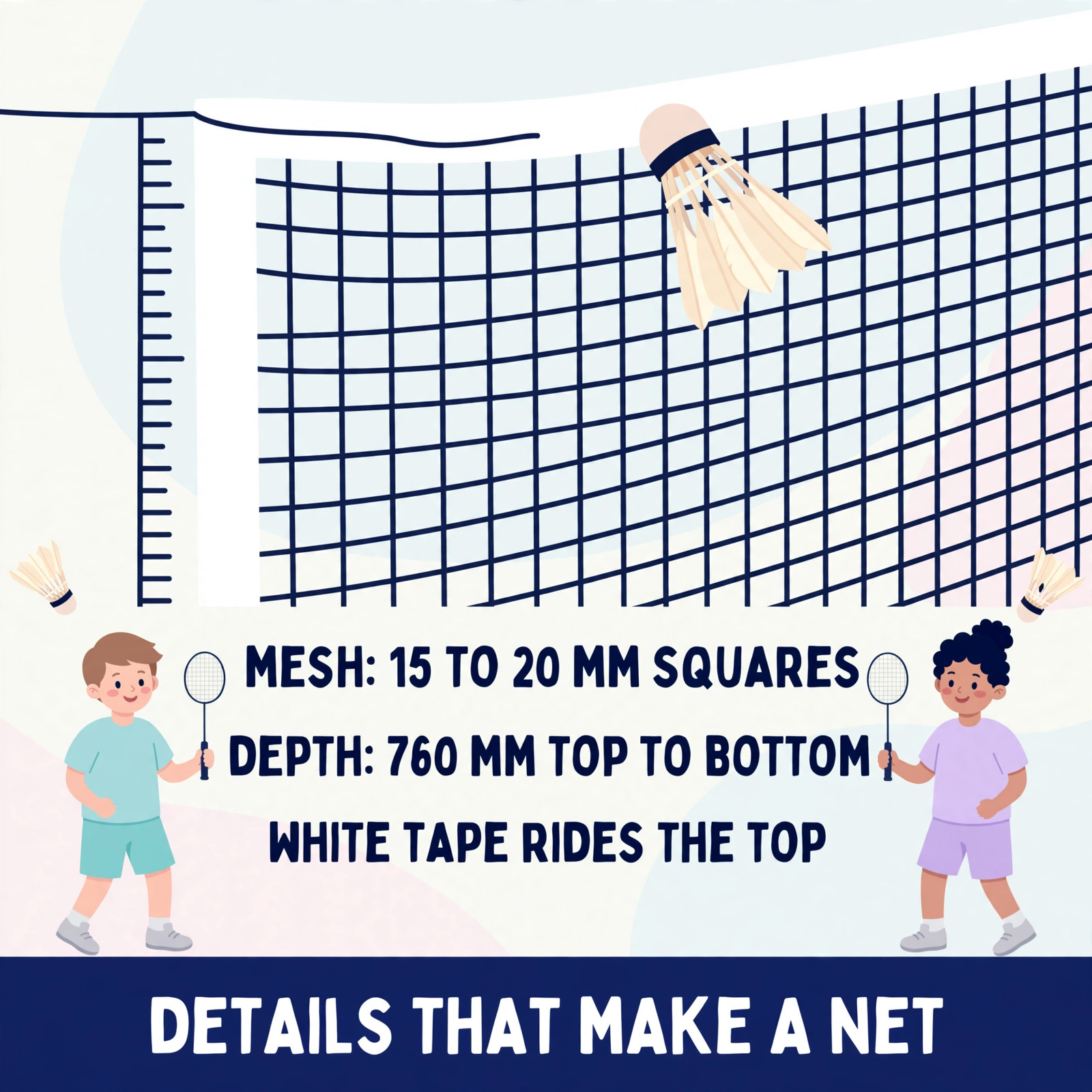
A standard net has its mesh woven in squares of 15 to 20 millimetres. That size is not decoration: the mesh must be fine enough that a shuttlecock cannot pass through it or wedge in it, and open enough to stay light and let the net hang well. Home sets vary here more than anywhere. Cheap garden nets sometimes carry wide, loose mesh that catches shuttle skirts and feathers, turning every net cord into an argument. Run a shuttle against the mesh before you judge a net; it should meet a wall, not a fishing net.
The depth of a standard net, top tape to bottom edge, is 760 millimetres. Depth matters because the net is a visual wall as much as a physical one: a shallow net lets players see and reach under the tape in ways that change net play, and it flaps and lifts in wind. Home sets are often shallower, which is acceptable for family games but worth knowing when a junior’s home net shots keep behaving differently in the hall. Check the depth on the box or with a tape, and know what you are practising against.
The white top tape is the working part of the net. On a standard net the tape is 75 millimetres wide, doubled over a cord or cable that runs the length of the net. The cord carries the tension, the tape presents the clean white edge every player reads their shots against, and net cords, the shuttles that clip the tape and drop, are judged by it. On home sets, check that the tape is stitched firmly along its whole length and that the cord inside can be tensioned. A torn tape or a slack cord makes the height settings in the next section impossible to hold.
Net Check #4
Setting the Height: A Tape Measure and Two Minutes
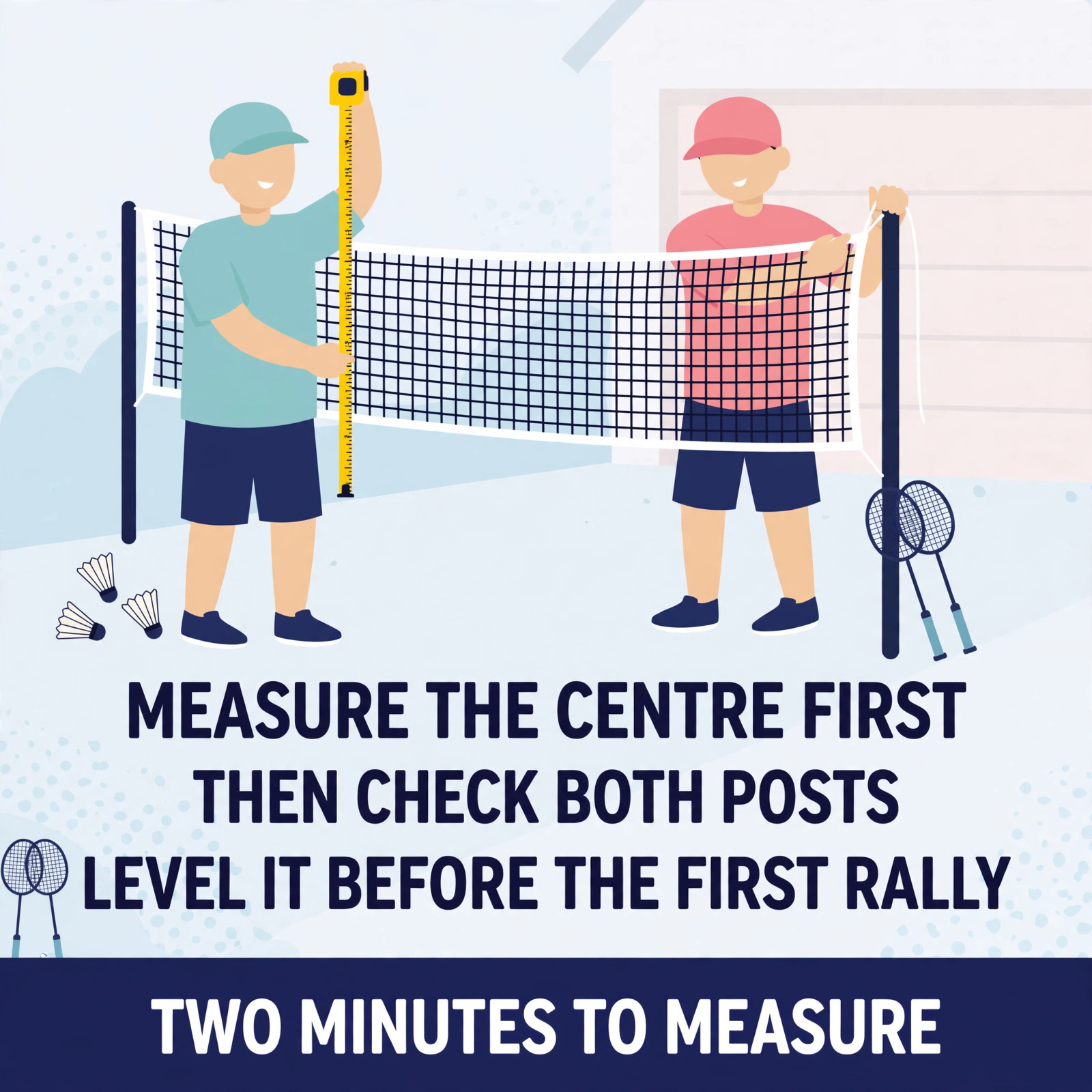
Setting the height takes a tape measure and two minutes, and it starts at the centre. Stand the net up, tension the cord until the top tape sits level and firm, then measure from the playing surface to the top of the tape at the exact middle. The reading should be 1.524 metres. If it reads low, tension or raise before touching anything else; if it reads high, ease the cord or lower the frame. The centre is the match height, the one every shot is judged by, so it is set first and checked last.
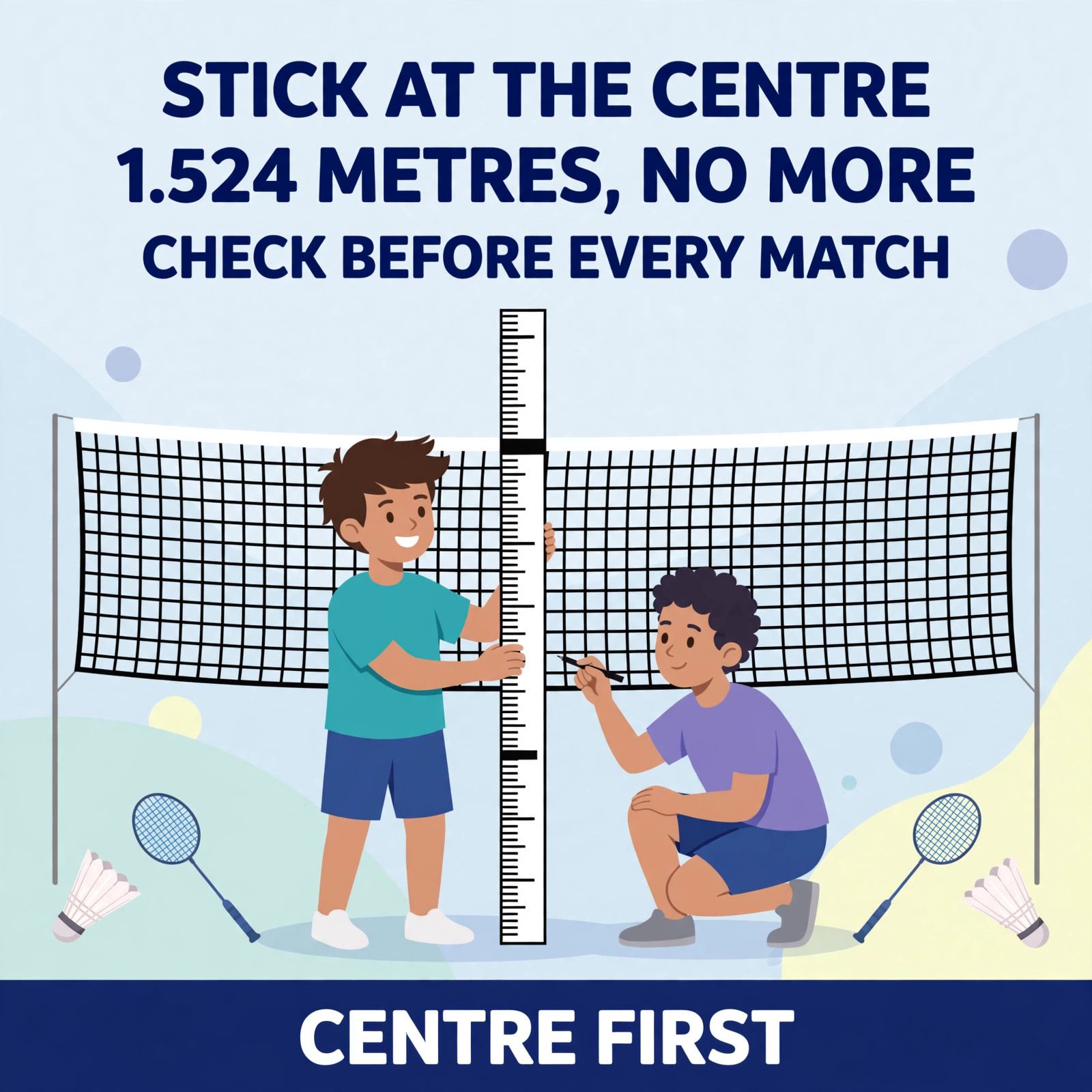
Then check both posts: 1.55 metres at each end, measured to the top of the tape where it meets the post. Portable frames often adjust one side at a time, which is how nets end up level in the middle and tilted overall, a fault players feel but cannot name. A simple trick used in halls works at home too: cut or mark a light stick at 1.524 metres and stand it at the centre as a gauge. It turns every future setup into a thirty second check instead of a measuring session, and juniors can run it themselves.
Outdoors, measure from the ground the players actually stand on. Driveways slope, gardens dip, and a net measured from the higher side will play low on the other. Set the posts on the flattest ground available, keep the playing area swept so feet and frames sit true, and recheck the centre after the first hard game, because fresh cords stretch and frames settle. After wind, after a knock, after moving the set: measure again. Two minutes of measuring buys hours of honest rallies.
Net Check #5
Wind, Sun and Storage: Caring for an Outdoor Net
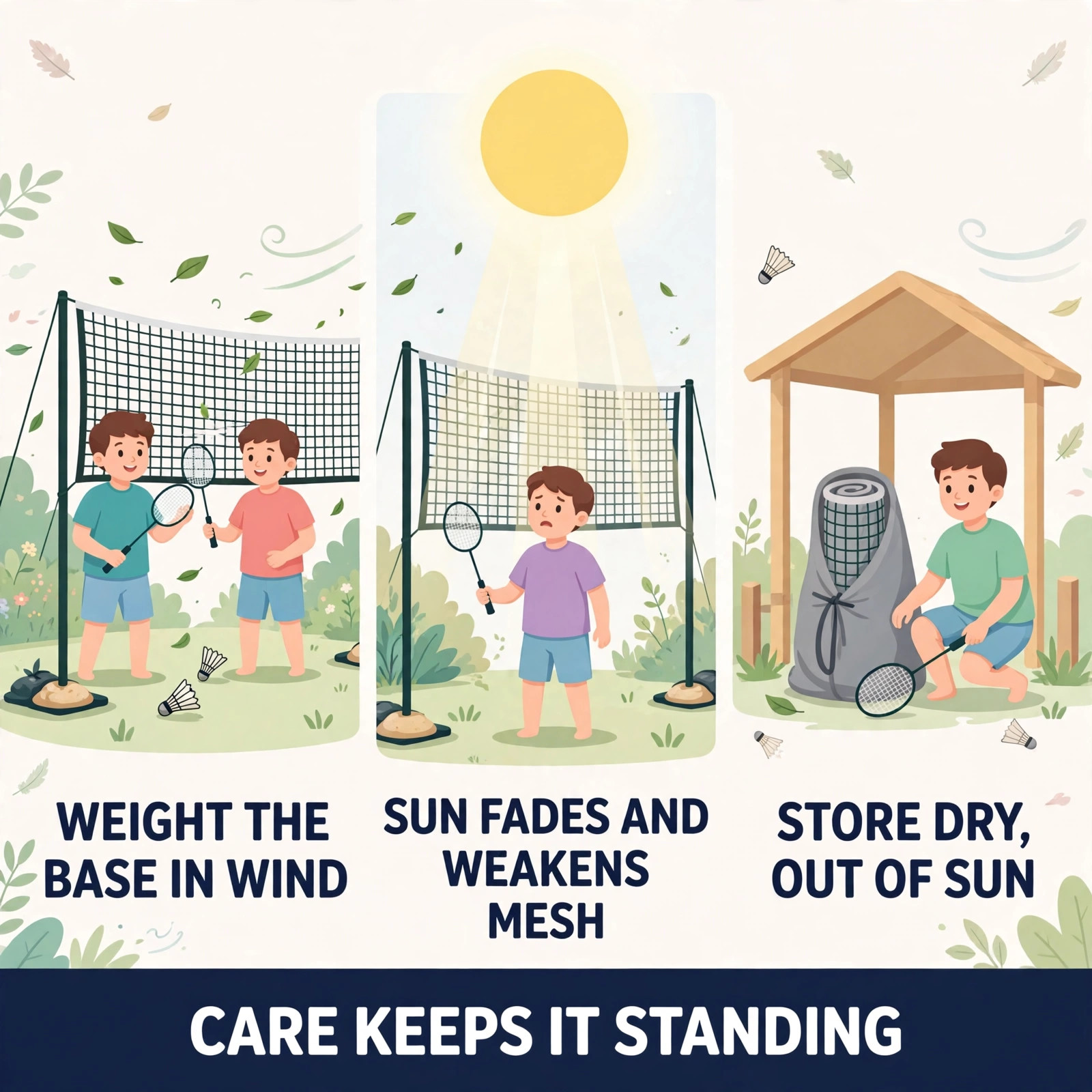
Wind is the first weather problem for a portable net. A net is a sail, and a light frame in a gust will walk, lean or fall, usually onto somebody’s rally. Weight the bases properly, use the ground anchors where the set provides them, and be honest about strong wind: lower the net or take it down rather than watching it crash mid game. Fixed posts shrug at weather that ends a portable session, which is the trade at the heart of the choice in the first section of this guide.
Sun is the slow problem. Ultraviolet light weakens net mesh and tape stitching season by season, and a net left standing outside all year ages several years in one. Rain does similar work when a net is stored wet: mildew stains and weakens the fibres, and cords rot quietly inside the tape. The care routine is short. Dry the net before storing it, roll it loosely rather than balling it, and keep it bagged under cover, out of direct sun. Ten minutes of care after a wet session is what separates a five season net from a one season net.
Inspect as you pack. Look along the top tape for torn stitching, run a hand down the mesh for snags and small tears, and check the cord ends and frame joints for rust or cracks. Small tears in mesh can be tied or patched early; left alone, they grow shuttle by shuttle. A net log helps here too: the date you noticed a tear, the height setting that worked on your sloped driveway, the frame part that loosened. Nets are simple equipment, and simple equipment rewards simple records.
Myth vs Reality
Myths About Badminton Nets
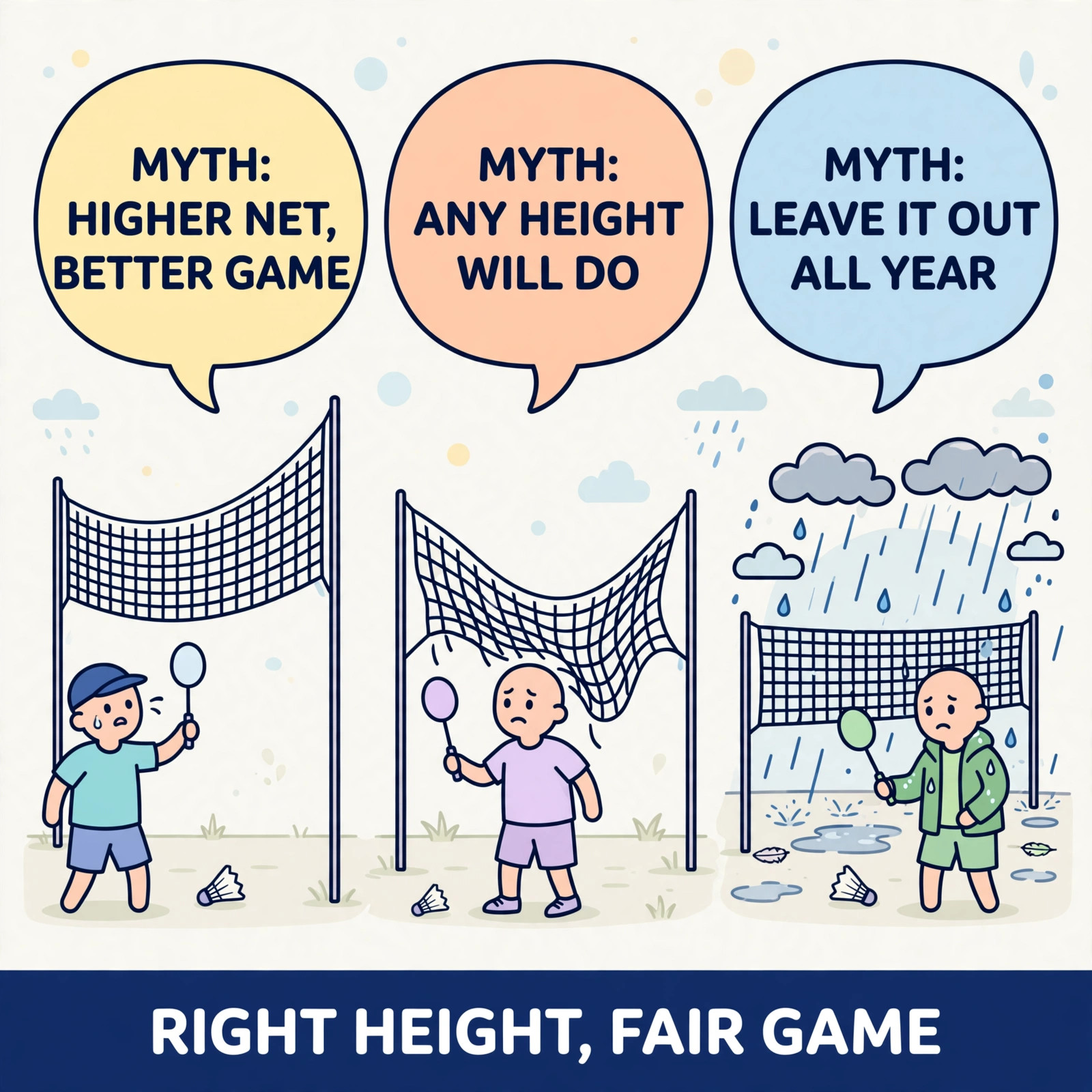
Myth one: a higher net makes a better game. It makes a different game, one that exists nowhere else. Lifts are trained to clear a bar that competition never sets, net shots float higher than they should, and the player’s judgement is calibrated to a fiction. When that player reaches a hall net at the legal height, weeks of home practice argue with every shot. Set the home net to the real numbers and the practice transfers; that transfer is the entire point of owning the net.
Myth two: any height will do for home practice. For pure knockabout fun with small children, a low net and a balloon rally are a joy, and nobody should measure that. But the moment home play is meant to build a player’s game, height stops being a detail. The tape is the reference line for half the shots in badminton. Practising against a wrong reference teaches wrong shots with great consistency, which is worse than no practice at all. Know which game you are playing, and set the net for it.
Myth three: a net can live outside all year. Sun, rain and wind work on mesh, tape and cord every day they are given, and a season of weather does more damage than a season of rallies. Players who leave a set standing through monsoon weeks and hot months meet the result as a sagging, faded net that will not hold its height. Bring it in, dry it, roll it, bag it. The net you store properly in October is the net that still plays true in January.
Why Choose Us
Why Players Choose ST Badminton Academy
On the academy’s courts, nets are set to the official numbers and checked, because our students should never have to relearn a shot their home setup taught them wrongly. Coaches at ST Badminton Academy measure centre height as part of setting up, and juniors in our classes learn to run the check themselves: stick at the centre, eyes level with the tape, read it honestly. With a maximum of four students per group, these small disciplines get taught properly instead of being shouted across a crowded hall.
The academy does not sell nets, and that is deliberate. Advice with nothing to sell can be plain: your garden set reaches the right height, keep it and play; or, this frame stops well short of 1.55 metres, so treat it as a toy and let us fix your child’s net judgement in class. Parents hear the same straight line about home practice: measure the centre, store it dry, and home rallies will support what lessons build instead of undoing it.
Teaching a junior to set and measure a net is teaching them that the game’s standards are not decoration. The player who checks the centre height before a home session is learning the same respect for the rules that shows up in honest line calls and fair play. At the academy we treat setup as part of the sport, not as time before the sport. A net set right disappears from thought, and what remains is the rally, which is exactly where a player’s attention belongs.
FAQs: Badminton Nets, Heights and Home Courts in Malaysia (KL)
Here are the questions players and parents ask us most about badminton nets, heights, home courts and care, and how our coaches advise on home setups in Kuala Lumpur and Setapak.
What net should a family choose for a junior practising at home in Setapak or Gombak?
A portable frame set that adjusts up to the full official height, with a base heavy or wide enough for your driveway. Set it to the real numbers and your junior practises against the same tape as in class. Treat any set that cannot reach the height as a game toy.
What is the correct badminton net height for home games in KL?
One point five five metres at the posts and 1.524 metres at the centre, measured to the top of the white tape. The centre is lower by design because the cord dips slightly under the net’s weight. Measure the centre first when you set up at home.
How much space does a home badminton net need at a steady level?
Allow the net’s full width: a doubles court is 6.1 metres wide, and a standard net spans that. At home, add room to move behind each end if you can. On a short driveway a narrower net still works, but games adapt to the space.
Can a portable home net reach the official height, or is it always lower?
Yes, many portable sets adjust to the full 1.55 metres at the posts. Check the stated maximum height and confirm it with your own tape at the centre before trusting it. Sets that stop short are fine for fun, but they cannot train match judgement.
What should I check before buying a badminton net for home use?
Check how it stands, the maximum height it truly reaches, the mesh size, the net depth, the top tape and cord, and whether it packs into a bag for storage. Then run a shuttle against the mesh: it should meet a wall, not tangle.
Do your coaches check net height for students near Wangsa Maju?
Yes, when classes are set up the centre height is measured, and students learn to run the check themselves with a marked stick. Students near Wangsa Maju and Setapak take the same habit home, so driveway practice matches the hall tape.
Does your academy sell nets or just advise players in Malaysia?
We advise; we do not sell nets. Coaches explain heights, mesh and setup checks, then families buy wherever suits them, or keep a current set if it reaches the numbers. The academy earns its living from coaching, which keeps the advice honest.
How long does a home badminton net last with regular outdoor use?
Stored dry and out of the sun, a home net serves for years of regular play. Left outside through sun and monsoon rain, the same net can fade, sag and tear within a season. Care, not the calendar, decides most of a net’s life.
What makes Mr Eric Chuar a good coach for honest net advice for badminton?
Mr Eric Chuar has coached for over 15 years and treats setup as part of the sport. He measures what others guess, names the fault when a home net teaches wrong shots, and refuses to call a toy a training tool. Players trust advice that stays that straight.
Badminton Nets and Home Courts in Action


One Standard for Every Player and Every Session
The academy's standard for net advice matches its coaching standard: give the real numbers, show the simple check, and let the family decide with facts. Nobody at ST Badminton Academy will tell a parent that any net at any height builds a player's game. We will tell them how to set 1.524 metres at the centre and keep it there.
| Factor | Guessed Setup | Measured Setup NET |
|---|---|---|
| Frequency | 1 or 2 times a week. Mostly for fun and sweat. | Net height measured: 1.55 metres at the posts, 1.524 at the centre. |
| Drills Focus | Basic static feeding. Minimal footwork pressure. | Mesh and top tape checked so shuttles meet a wall, not a tangle. |
| Physical Conditioning | Rarely included. Just playing games on court. | Core, agility, and speed training included in every session to prevent injury and build stamina. |
| Tactical Awareness | "Just hit it over." No real game plan. | Video analysis, point construction, and learning to read the opponent's game. |
| Coach Ratio | Large groups (8-10 kids). Coach barely watches you. | Max 4 students. Mr Eric Chuar personally corrects every stroke and movement detail. |
| Goal Setting | Fun and exercise. | Net dried, rolled and stored out of the sun after play. |
| Long Term Result | Good recreational player. | A home game that plays like a hall game. |
Badminton Coaching and Honest Gear Advice in Kuala Lumpur
A home net set to the real heights, on mesh a shuttle cannot tangle in, stored dry after play, will serve your family's badminton for years. Measure the centre first and the rest follows. If your child trains with us at ST Badminton Academy in Setapak, Kuala Lumpur, ask any coach to show you the centre check. It takes thirty seconds, and your home rallies will play true from that day.






