How Can You Improve Your Badminton Net Shot Technique Through Training (Net Shot Guide)
The net shot looks like the smallest shot in badminton. The shuttle travels a metre, the swing is a few centimetres, and the whole thing is over in a blink. Yet rallies at every level turn on it, because a tight net shot takes the attack away from your opponent and hands it to you. This page trains the shot properly: arrive early on a balanced lunge, let soft hands do the work at the tape, and learn the straight, cross court and tumbling family that lives at the front of the court. No power, no big swing, and no firm grip. Touch is a technique, and techniques can be taught.
Net Shot Check #1
What A Net Shot Really Is
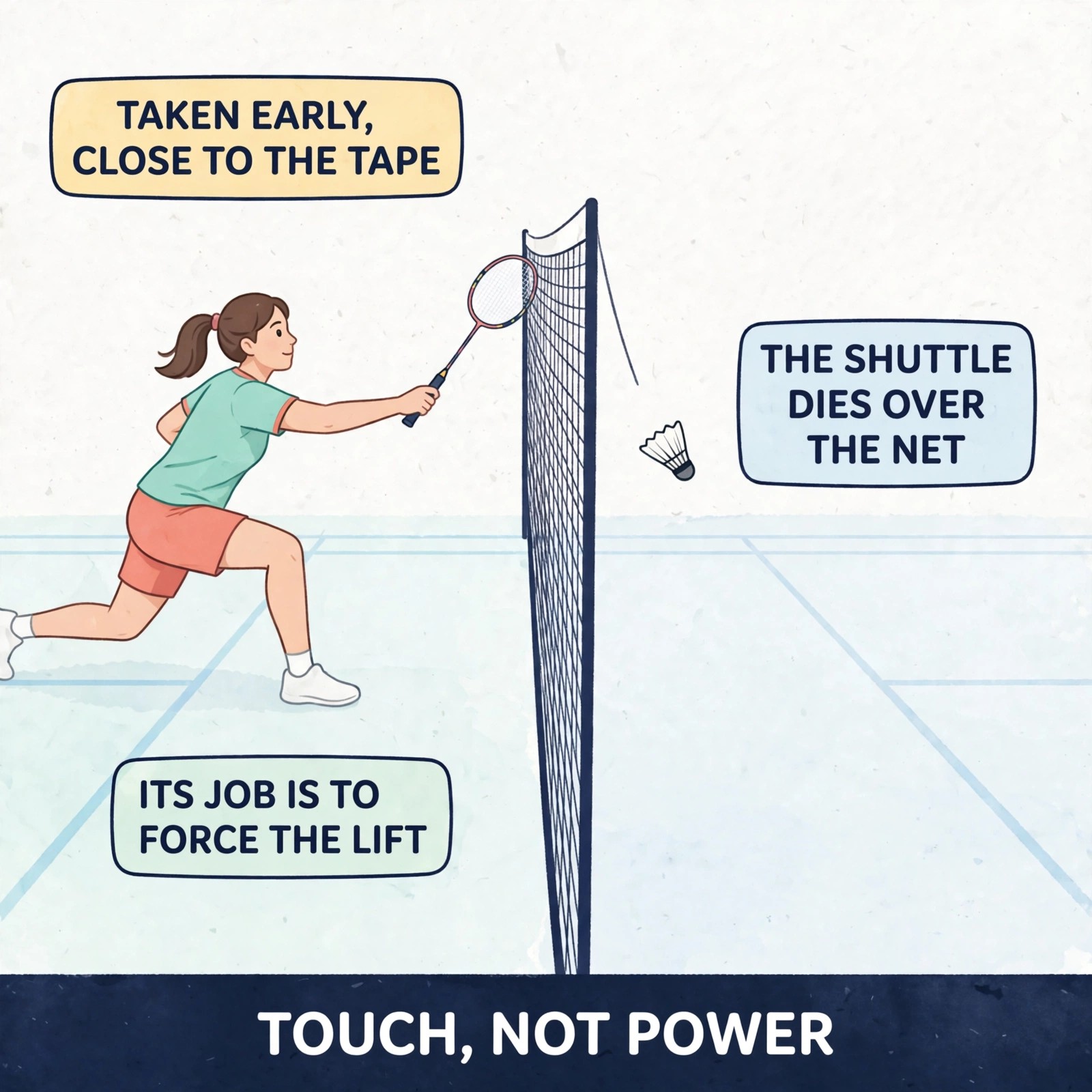
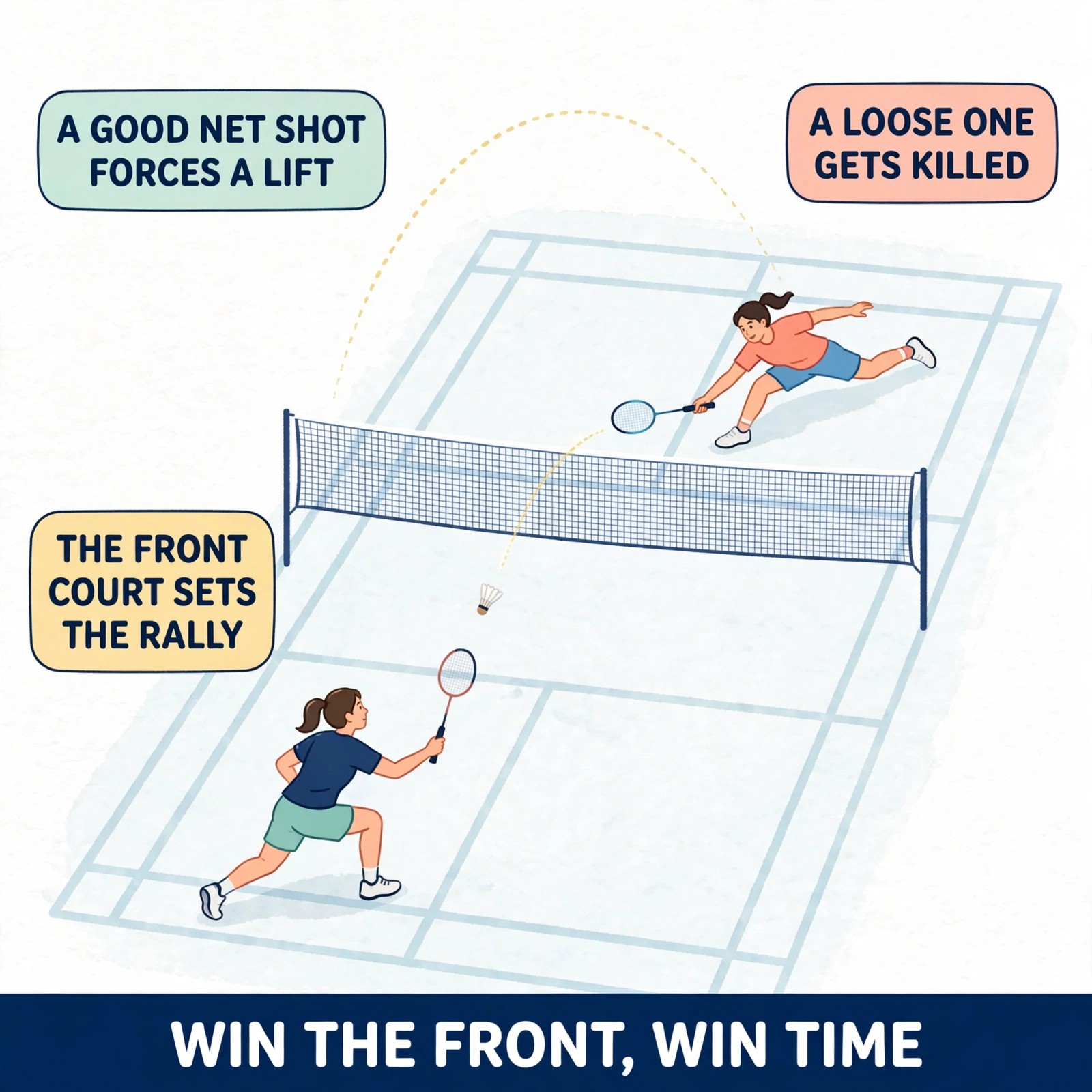
A net shot is a shot played from close to the net, sending the shuttle just over the tape so it falls steeply on the other side, hugging the net as it drops. Played well, it leaves the opponent two poor choices: lift the shuttle high and give you the attack, or attempt a net reply from below the tape with no angle to hurt you. That is the whole job of the shot. It does not win the rally by itself. It wins the next shot, by forcing a lift your side can attack or by drawing a reply that sits up for your partner.
Quality at the net is measured in centimetres and in timing. A shuttle that crosses two centimetres above the tape and tumbles as it falls is a different problem from one that crosses twenty centimetres up in a clean arc. Equally, a net shot taken when the shuttle is still above tape height is a weapon, while the same shot attempted after the shuttle has dropped to your knees is a rescue. Most net errors are not touch errors at all. They are arrival errors: the player reached the shuttle late, low and off balance, and no amount of hand skill repairs that. So this page starts with the feet.
Net Shot Check #2
Arrive Early: Feet, Lunge And Balance
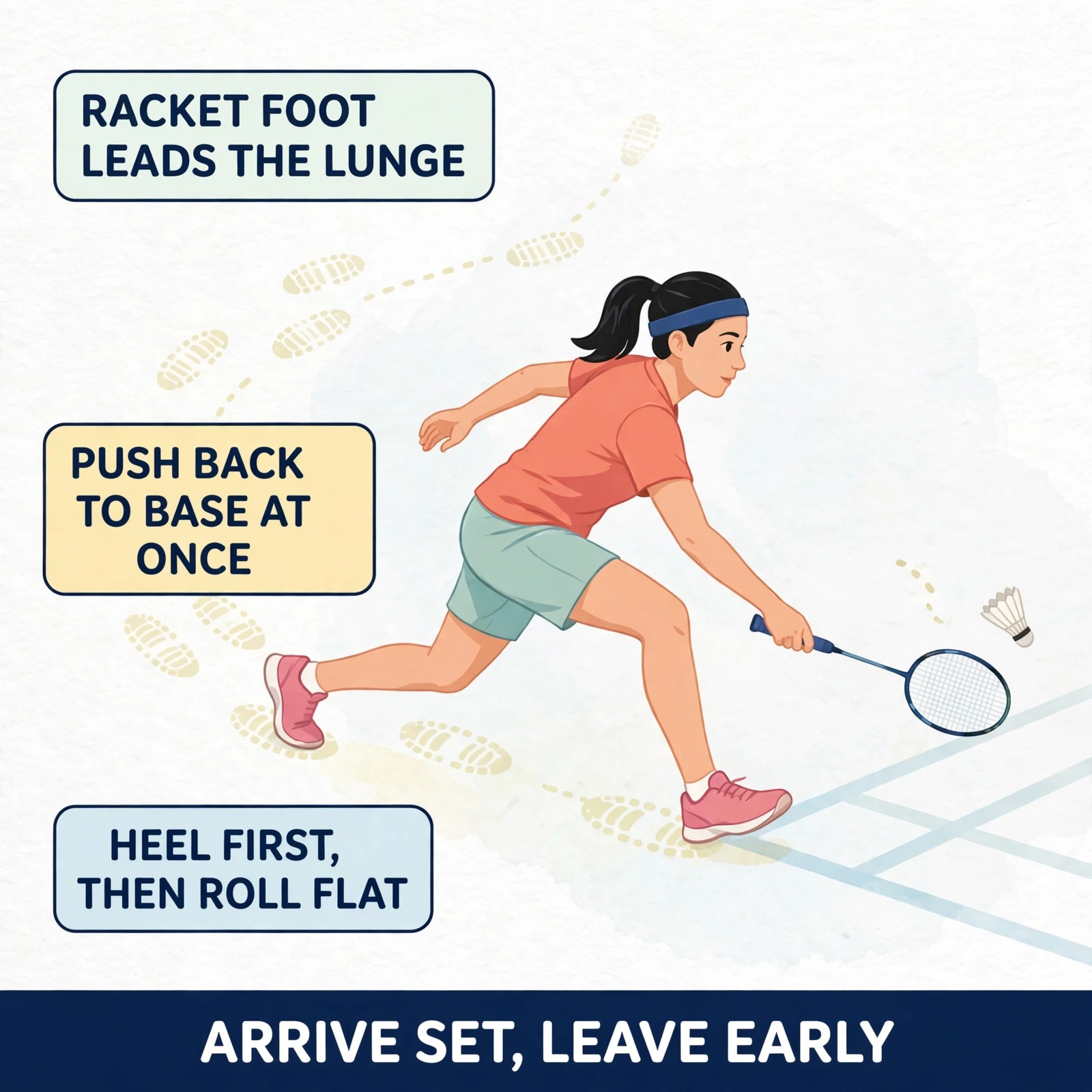
Net shots are won by the player who arrives first and settles best. Move to the front corner with a lunge: a chassé or a quick pair of steps from base, then a long final stride on the racket leg. The heel lands first and the foot rolls flat, the knee tracking over the toes, your weight carried into the corner without falling into it. Your non racket arm reaches back as a counterweight, and your racket arm extends forward so contact happens in front of your body, as close to the net as the laws allow. Arrive like that and the shot plays itself. Arrive upright, late, or on the wrong foot and you are poking at a dropping shuttle.
The lunge must also be a door you can walk back through. Land balanced enough to freeze for a photograph, then push back off the racket leg and return to base in one motion. Players who collapse into the corner after a good net shot watch the reply land where they used to be standing. In training we check the freeze: if you cannot hold the lunge still for a full second, the arrival is not finished, whatever the shuttle did. Singles players recover to base after every net shot. Doubles front players recover to their front position, racket already up for the next exchange.
Timing the arrival matters as much as the stride. Start moving as the opponent strikes the shuttle, not after it crosses the net, and read the shot early enough to choose your corner. A split step as he hits keeps your weight loaded and your first step honest. Many players are beaten at the net before the shuttle arrives, because they watched it travel and moved late with a big, slow stride. Short early steps beat one long late lunge. Practise the movement without a shuttle first, corner to corner from base, until the pattern of steps is quiet and repeatable at full speed.
Net Shot Check #3
Soft Hands: Grip, Contact And Touch
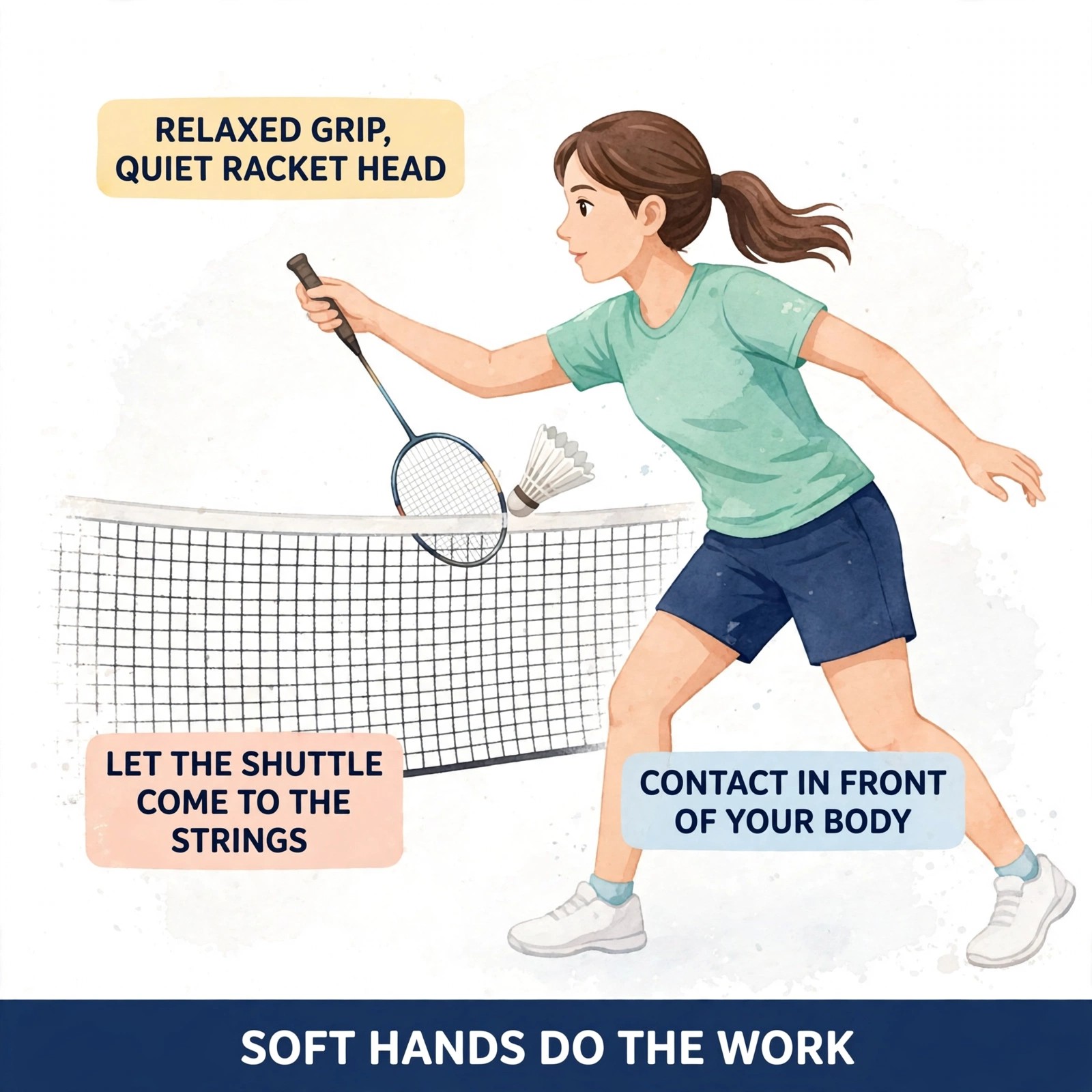
At contact, the net shot asks for the opposite of what most players bring to it. The grip stays relaxed, held in the fingers with the racket head quiet, because tension in the hand travels into the strings and bounces the shuttle off them. There is almost no swing. From a lunge, your racket is already where the shuttle is going; you present the strings, let the shuttle meet them with a small cushioning motion, and guide it over the tape. Think of catching the shuttle softly and placing it, rather than hitting it. The sound tells the truth: a good net shot is nearly silent, while a tense one clicks and pops.
Forehand and backhand net shots share the same soft hands and differ mainly in the thumb. On the forehand side, the basic grip stays, the racket head sits slightly across your body, and the shuttle is played with a gentle push and roll of the fingers. On the backhand side, turn the thumb up onto the back bevel of the handle, which points the racket face correctly without twisting your wrist. Both shots are played in front of the body, never beside it. If you find yourself reaching across your chest or behind your racket shoulder, your feet arrived in the wrong place and the hands are paying for it.
Contact height decides what the shot can do. Met above the tape, the shuttle can be spun, angled, or killed. Met at tape height, it can still tumble over with a brushing contact. Met below the tape, your only honest jobs are to keep it tight and low as it climbs over, or to lift and reset the rally. Good players accept that ladder instead of forcing a winner from knee height. In drills we grade net practice by where contact happened: above, at, or below the tape. The count of above tape contacts is the number that predicts your net game better than any other.
Net Shot Check #4
Straight, Cross And Tumbling: The Net Family
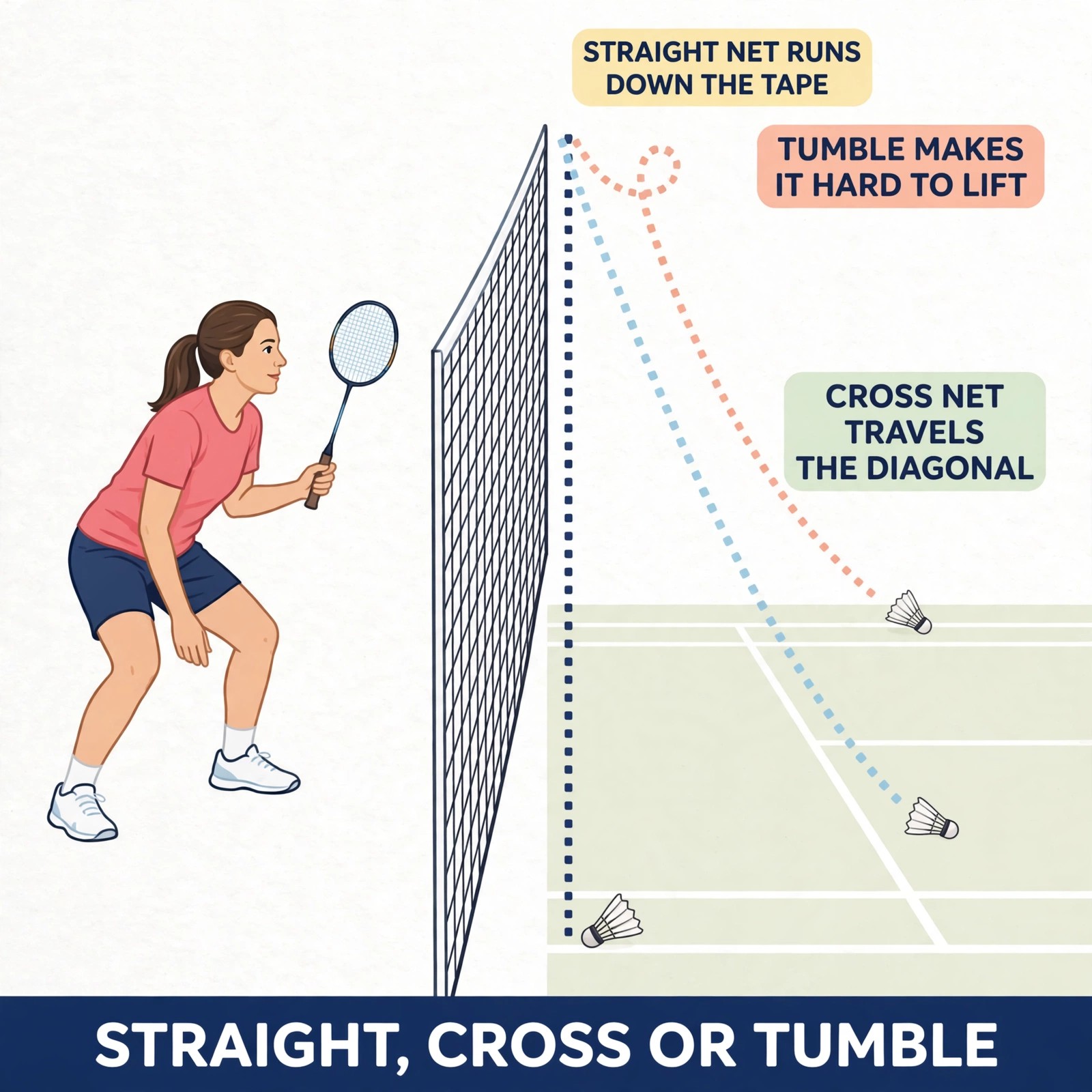
The straight net shot is the base of the family. Played from a front corner, it runs the shuttle down your side of the tape and drops it in the same corner on the other side. It is the safest net shot and the one that asks the narrowest question of the opponent. Keep it as your default: arrive, settle, and roll the shuttle over with the smallest motion that works. A straight net shot played tight from a balanced lunge wins more rallies than any fancy variation, simply because it can be repeated under pressure without thinking.
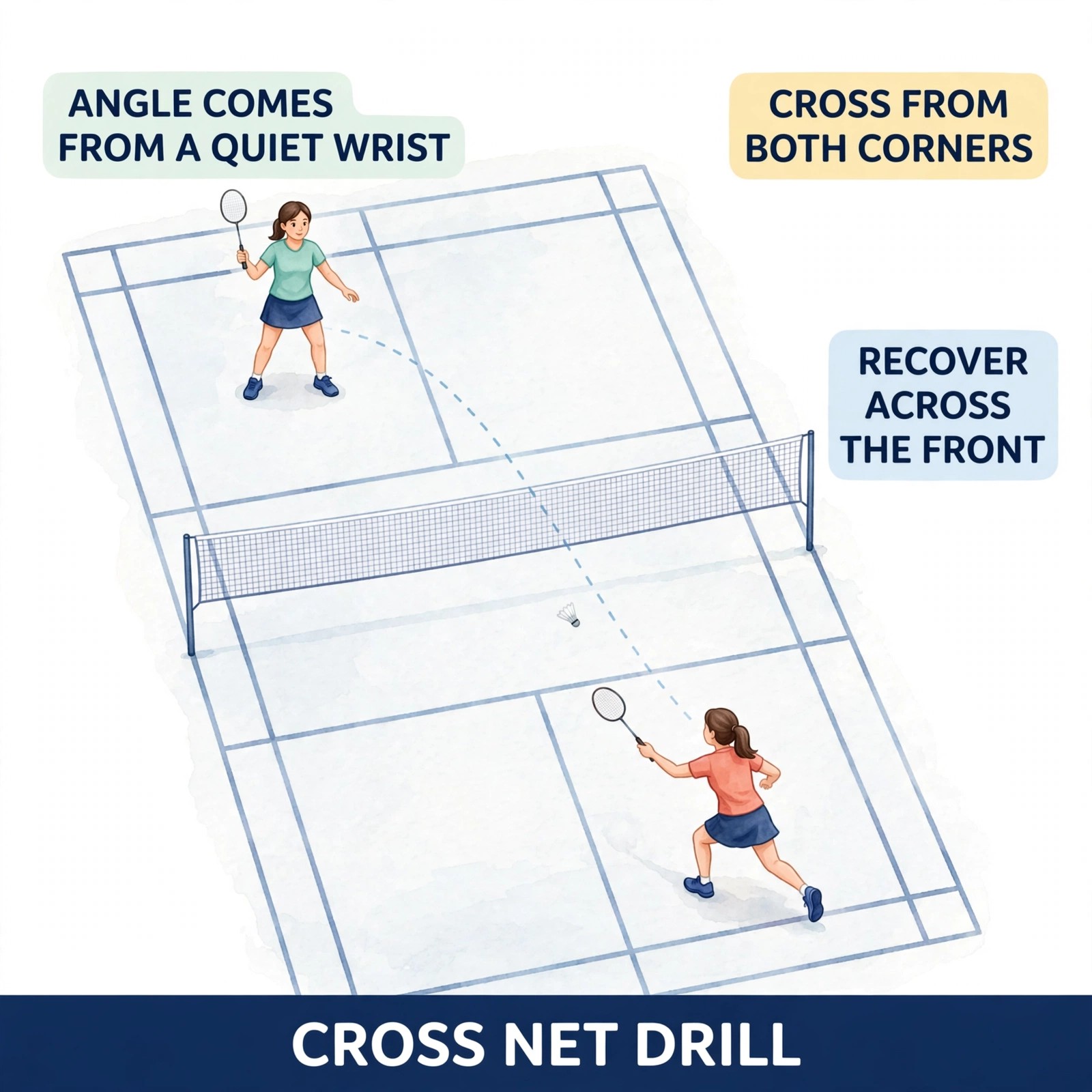
The cross court net shot travels the diagonal, from your forehand corner to the far forehand corner or backhand to backhand. It moves the opponent the full width of the front court and punishes players who lean toward the straight reply. The angle comes from a small change in racket face at contact, not from a swing across the body, and the shuttle must still cross close to the tape, now at the centre. Because it crosses the middle, it is the net shot most likely to be intercepted in doubles, so use it when the front player is drawn wide or sitting deep. Practise it from both corners until the diagonal feels as plain as the straight shot.
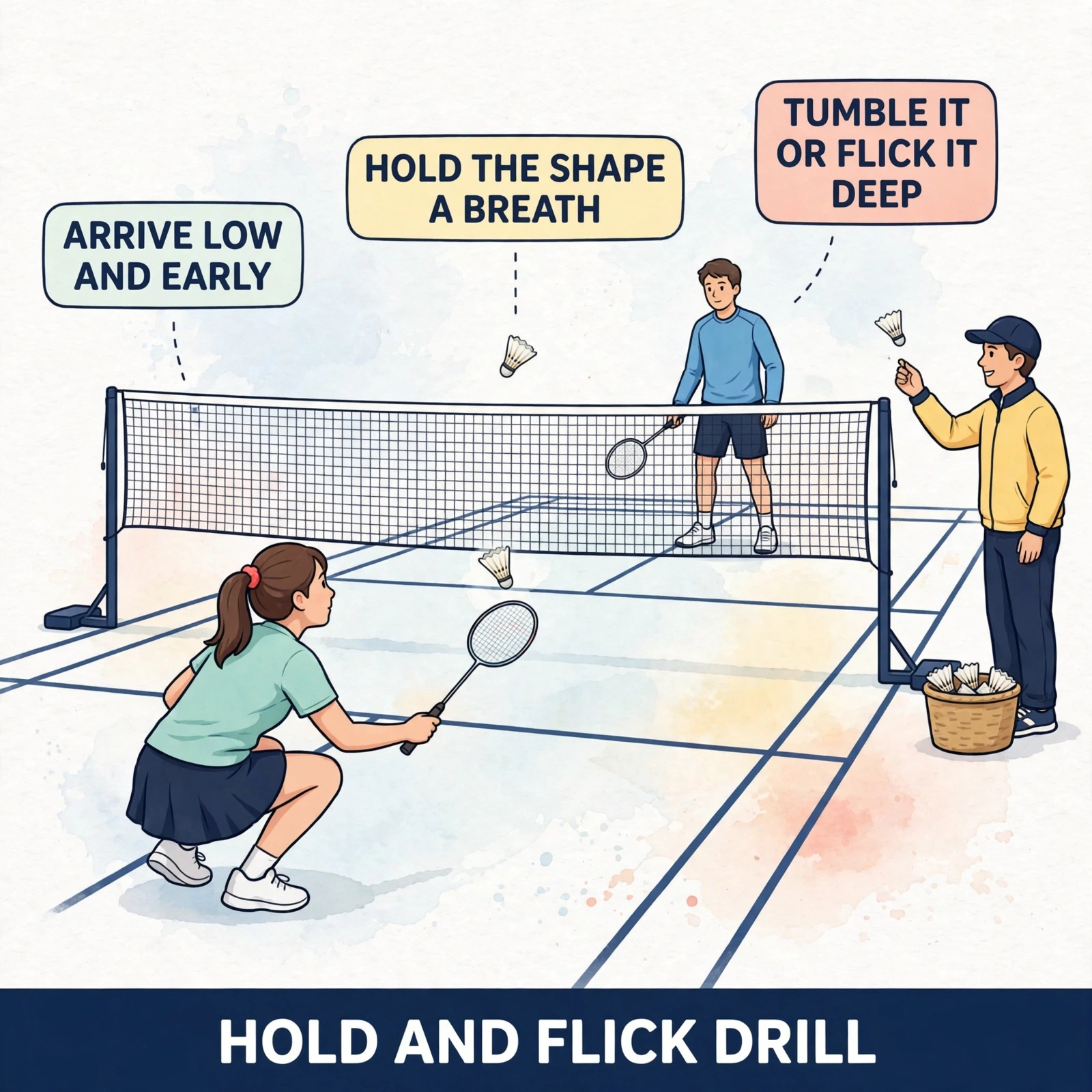
The tumbling net shot is the advanced layer. The shuttle is brushed so it turns over itself in the air, which makes it drop unpredictably and delays the moment the opponent can play it cleanly. It is learned last, after the straight and cross shots hold under feeding, because tumble added to a late arrival is decoration on a fault. Sitting behind all three is the hold and flick: show the net shot shape, hold it a breath while the opponent commits forward, then flick the shuttle deep over his head. The family works as a set. One shape at the front, several endings, and the opponent forced to guess which one is coming.
Net Shot Check #5
Net Shot Drills That Build Touch
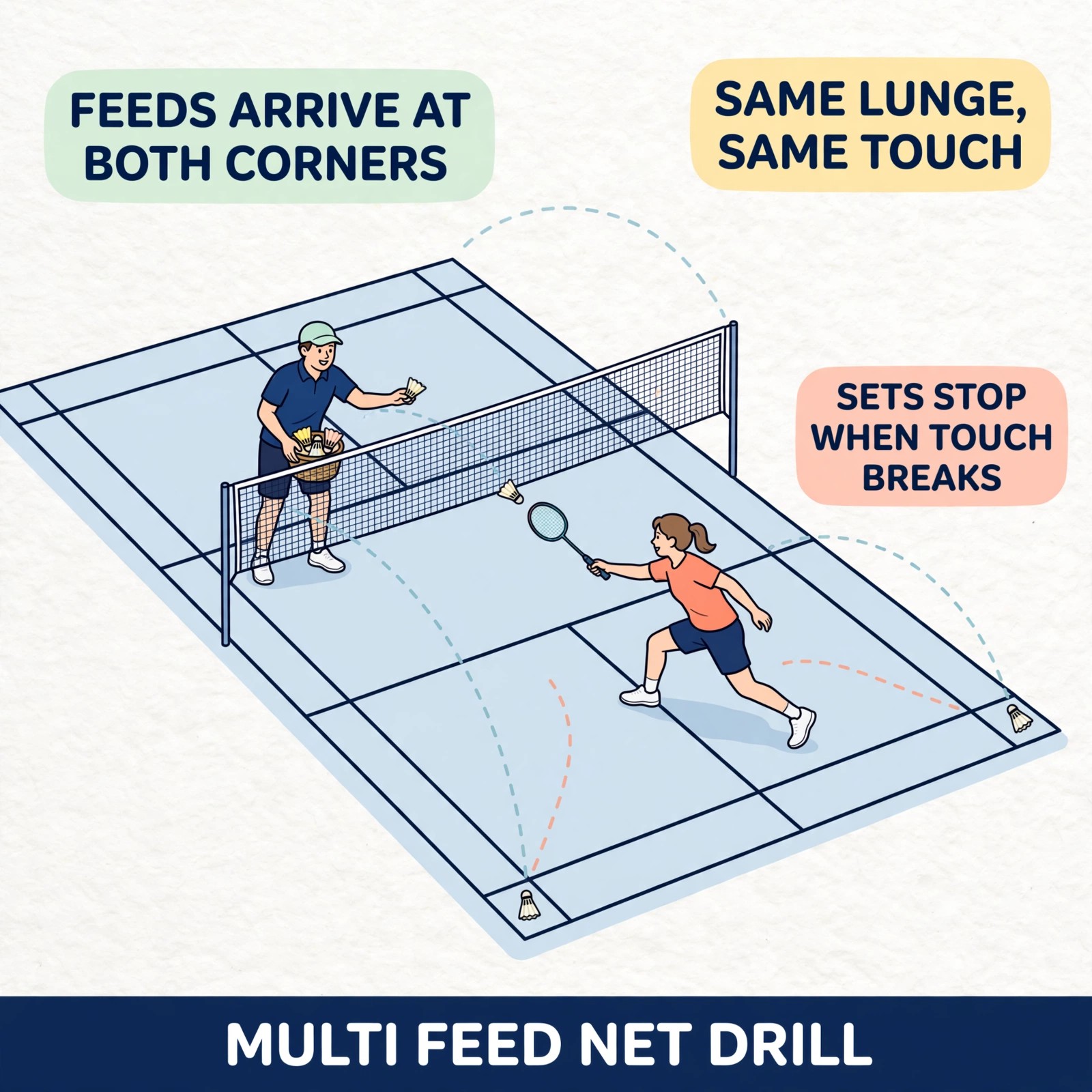
Net training is feeding training, because touch only grows from many honest contacts. The multi feed drill sends shuttles to both front corners in turn while you lunge, play, and recover, with the set ending the moment your contact drops below tape height twice in a row. That stop rule is the drill. Touch breaks quietly as legs tire, and sets that run on regardless teach tired hands to poke. Short sets, full recovery, and a feeder who varies the height slightly once the base pattern holds: that is how the front court gets grooved without getting sloppy.
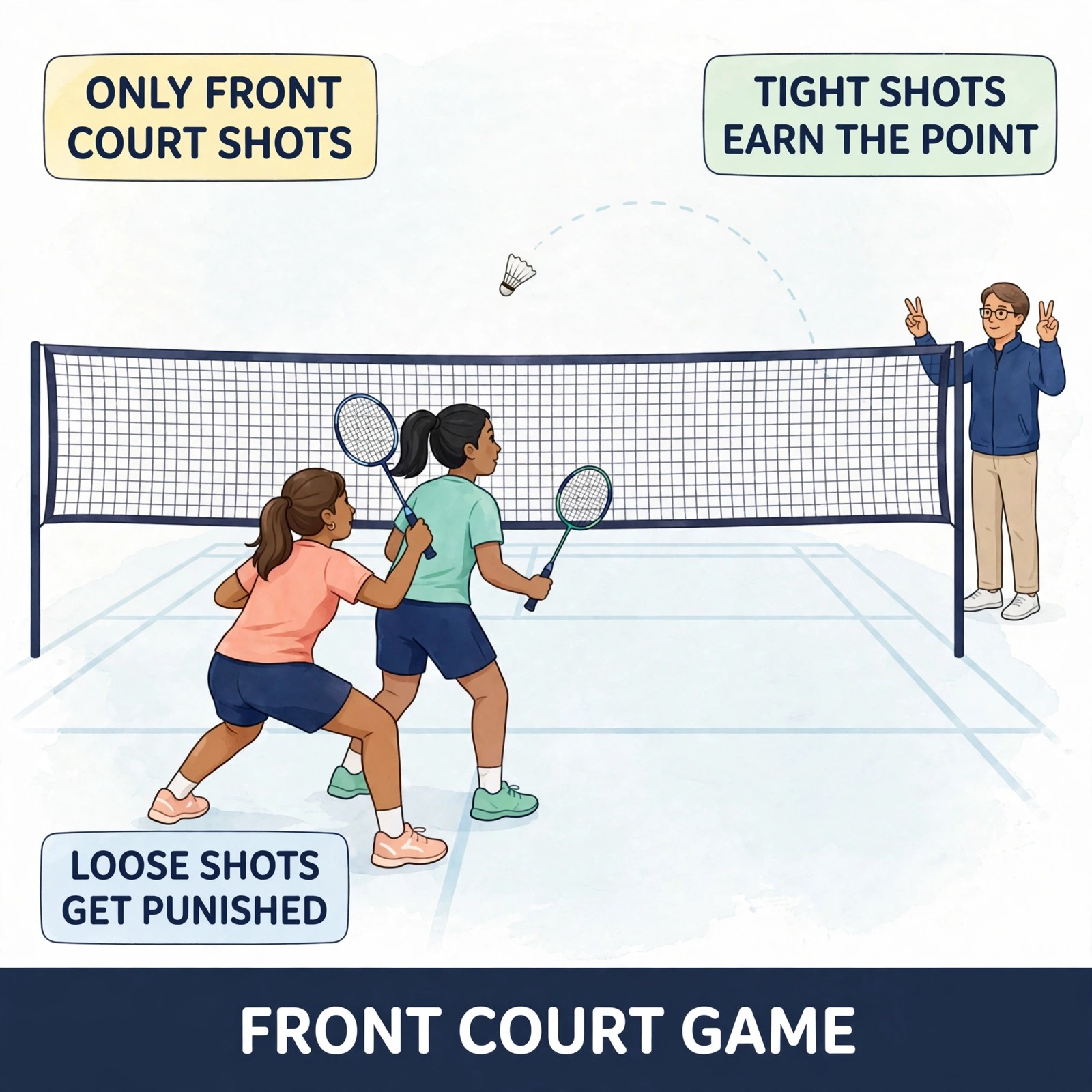
Two drills sharpen the decisions inside the technique. The hold and flick drill freezes your shape at the net for one breath before you choose tumble or flick, training the calm that makes opponents commit first. The cross net drill pairs you with a partner who returns your cross with a straight shot, so the diagonal is practised inside a real exchange rather than into empty space. Finish with the front court game: rallies played only with net shots, tight shots scoring, loose shots punished by your partner killing them. Under that small pressure, you learn which of your net shots are real.
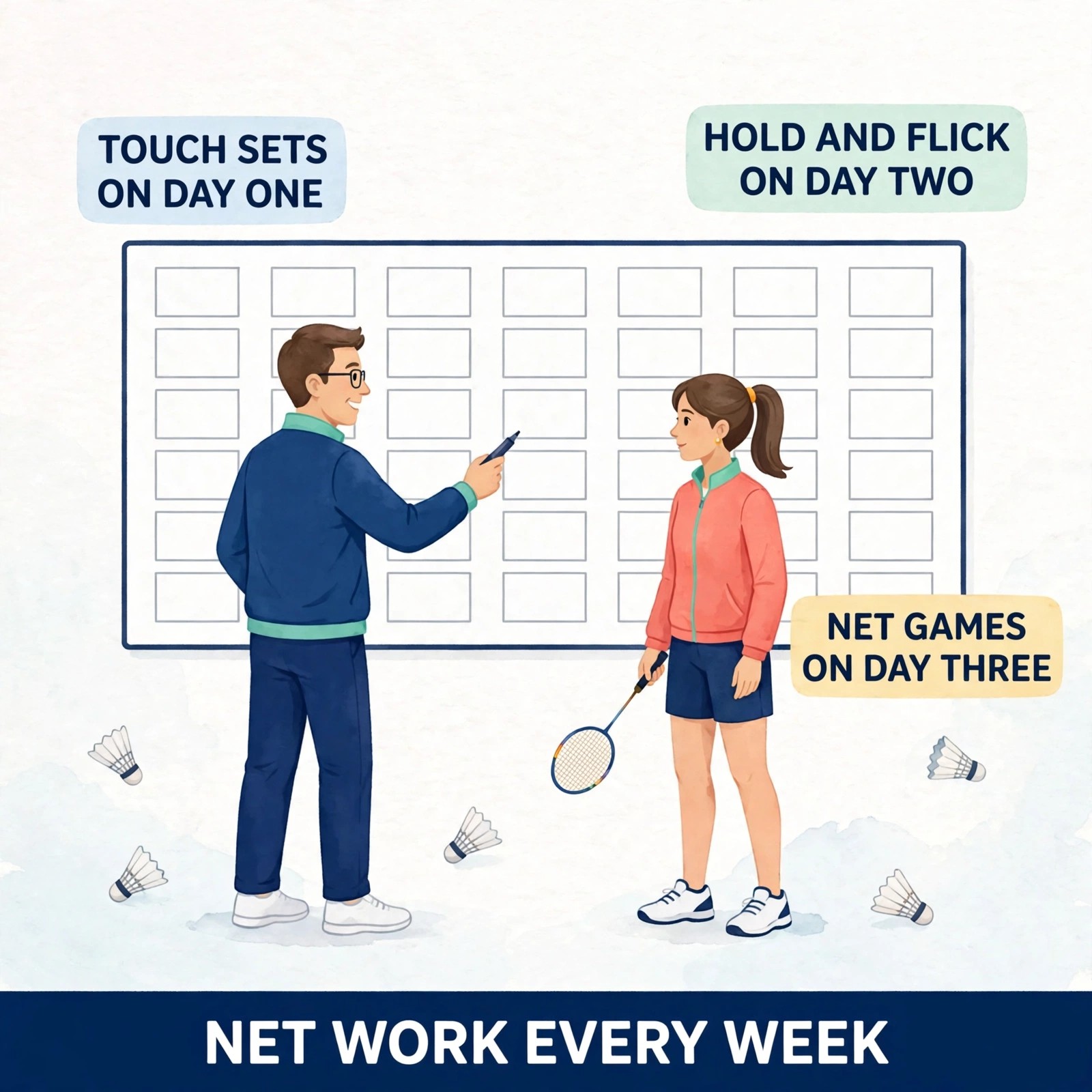
Count what the front court gives you. In each feeding set, note your contacts in three columns: above the tape, at the tape, below it. Across a month, the first column should grow and the third should shrink, and that movement is your net game improving in plain numbers. Note also your tape errors, shuttles clipped into the net from good positions, because those point at tension in the hand rather than late feet. Bring the counts to class. A coach can read them in a minute and know whether your next block is footwork, touch, or decisions.
Myth vs Reality
Myths About Net Shots
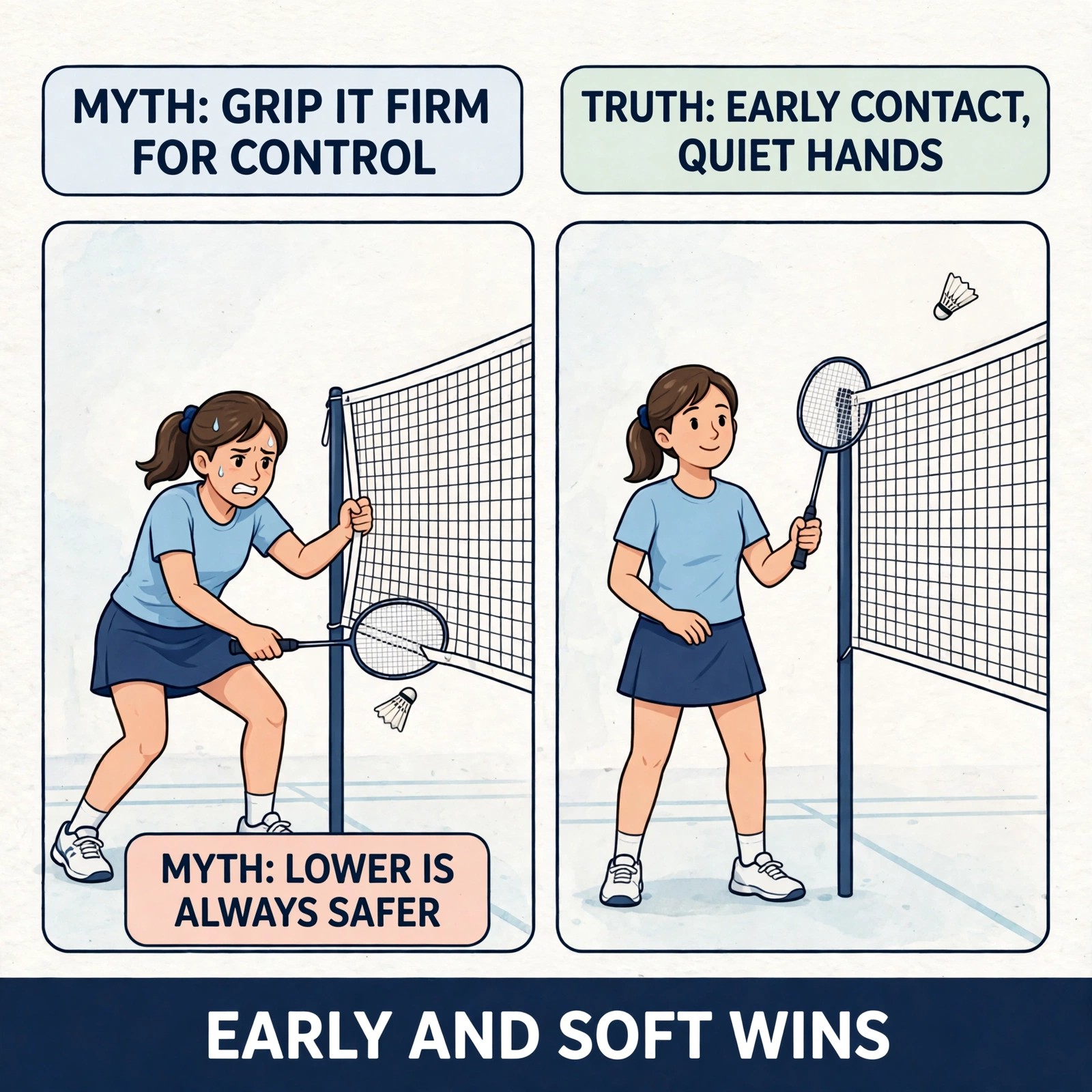
Myth: net shots need a firm grip for control. Reality: a squeezed grip makes the racket head bounce the shuttle away, and control at the net comes from relaxed fingers that can feel the shuttle arrive. Myth: the lower you take the shuttle, the safer the shot. Reality: low contacts are rescues, not choices, and the safest net shots are the early ones met near tape height. Myth: a powerful follow through finishes the shot properly. Reality: the net shot has almost no follow through at all. The racket stays quiet in front of you, ready for the reply that a good net shot forces.
Myth: only tall players or doubles specialists need a net game. Reality: singles rallies are built at the front, and a player who cannot threaten the net gets lifted on all match. Myth: spinning net shots are showing off. Reality: the tumbling shot is a working tool that delays the opponent reply, learned after the plain shots hold. Myth: net errors mean your hands are bad. Reality: most net errors are arrival errors, late feet asking the hands to perform a rescue. Check the freeze in your lunge before you blame your touch.
The deepest myth is that touch is a gift, something soft handed players are born with. Watch a player with a beautiful net game train and you find lunges checked in a mirror, feeding sets stopped early, and a count book of contact heights. Touch is what consistent, honest repetitions feel like from the outside. Your hands learn the weight of the shuttle the same way they learned the weight of a cup: by meeting it many times without drama. Give the front court that patience and the smallest shot in the game becomes one of the most reliable things you own.
Why Choose Us
Why Players Choose ST Badminton Academy
Players choose ST Badminton Academy for net work because we coach the arrival before the shot. Your lunge is checked with a freeze test, your contact height is counted in every feeding set, and your grip is kept honest by coaches who watch your fingers, not just the shuttle. Your straight shot is grooved first, your cross court shot added when the base holds, and tumble only when both survive pressure. Groups stay at no more than four students, so your front court sets are watched rep by rep, and the set stops when your touch does, not when the clock does.
The sessions run the way this page describes. Footwork patterns open the net block, corners visited in order until the lunge freezes cleanly. Feeding follows, both corners, with contact heights called out loud. Hold and flick work adds the decision layer, and every net block ends with the front court game, where loose shots get killed by a partner and tight ones score. Between sessions you shadow the lunge and net shape at home, ten slow shapes a day, so the pattern costs no thought when it matters.
We are based in Setapak, Kuala Lumpur, and our students join us from across the Klang Valley, some travelling in from Wangsa Maju, Gombak and Setiawangsa for evening sessions. Net work sits inside regular badminton training rather than a separate course, because the front court only matters inside rallies. Bring the shot that frustrates you: the net reply that keeps clipping the tape, the cross that gets intercepted, the lunge that will not recover. Each becomes a counted drill, and the counts decide when it is fixed.
FAQs: Net Shot Technique And Badminton Training in Malaysia (KL)
These are the questions players ask us most about net shots, before they book and during their first weeks. The short version runs through all of them: arrive early, freeze balanced, keep the hands soft, and count your contact heights honestly. If your question is not covered here, bring it to a trial session and we will answer it at the net, where a coach can see your lunge and your grip in the same minute.
Can a beginner improve net shot technique in training in Setapak or Gombak?
Yes. Beginners can start net work early, because the shot is built from a lunge and soft hands rather than power. In our Setapak classes we groove the straight net shot in groups of no more than four students, counting contact heights from the first feeding set, so your progress is visible quickly.
What is the first net shot habit a new player should build in KL?
Build the arrival first. Lunge to the front corner, heel first, land balanced, and freeze for a full second with your racket up. Until the arrival is stable, touch work sits on moving ground. Once the freeze holds, we add the soft contact, then the cross court shot, one layer at a time.
Why do my net shots keep sitting up at a serious level?
Because sitting up is usually an arrival problem. When you reach the shuttle late and low, you must lift it upward to clear the tape, and it arrives in the kill zone. Check your contact height honestly: if most contacts happen below the tape, your feet need work before your hands do.
My net shots keep hitting the tape. Should I take them earlier or soften my grip first?
Take them earlier first. Tape errors from early, balanced contacts are grip and tension problems, but most tape errors come from late arrivals poking upward at a dropping shuttle. Fix the lunge and the timing, then soften the grip if the shuttle still bounces off a relaxed, early contact in practice.
How can I practise net shots when I train mostly on my own in between classes?
Shadow the lunge and net shape at home, slowly, in front of a mirror: step, land heel first, freeze, racket presented in front. On court, use any feeding partner or a coach session for contact work, and count your contact heights. Bring the counts to class and we will tell you which layer needs the next block.
Do you coach net shots beside badminton training near Wangsa Maju?
Yes. Our academy is based in Setapak, a short drive from Wangsa Maju, and net shots are coached inside regular sessions there: lunge checks with a freeze test, multi feed sets to both corners, and hold and flick work. Groups stay at no more than four students, so your contacts are watched rep by rep.
Where does ST Badminton Academy teach badminton training in Malaysia?
We teach in Setapak, Kuala Lumpur, and students join us from across the Klang Valley. Net shot training sits inside normal sessions in groups of no more than four: your arrival filmed and frozen, your contact heights counted aloud, and your cross court and tumbling shots added only when the straight shot holds.
How do I book a trial session to test my net shots?
Book a trial session with us in Setapak and bring your racket and court shoes. The coach will feed both front corners, freeze check your lunge, count your contact heights, and show you honestly whether your feet or your fingers are costing you at the net before regular training begins.
What makes Mr Eric Chuar a suitable coach for net shots in badminton?
Mr Eric Chuar coaches the academy sessions himself, with more than 15 years of coaching in Malaysia and Singapore. He teaches net shots the way this page describes: arrival before touch, soft hands before variations, and counts before opinions. No power at the net, just early feet and quiet strings.
Net Shot Training in Action
We benchmark our net shot coaching against World Badminton (BWF) coaching standards and our own academy values: before any player trusts a training plan, they deserve honest checks. You can verify our coaches' credentials through the Badminton Association of Malaysia (BAM) coach education pathway.
One standard governs how we coach the net: the arrival is judged before the outcome. A lucky net shot that dribbled over from a collapsed lunge is marked down, and a clean arrival whose shuttle caught the tape is marked up, because only the second habit survives better opponents. We check the feet first, the contact height second, and the scoreboard last. That order keeps practice honest when results flatter a late arrival, and it keeps players patient while sound habits are still collecting their results.
| Factor | Power Players At The Net | Touch Players NET SHOTS |
|---|---|---|
| Frequency | 1 or 2 times a week. Mostly for fun and sweat. | A touch player arrives early and set, so the shuttle is met in front while options still exist. |
| Drills Focus | Basic static feeding. Minimal footwork pressure. | The grip stays relaxed and the racket head quiet, so the shuttle leaves softly and dies over the tape. |
| Physical Conditioning | Rarely included. Just playing games on court. | Core, agility, and speed training included in every session to prevent injury and build stamina. |
| Tactical Awareness | "Just hit it over." No real game plan. | Video analysis, point construction, and learning to read the opponent's game. |
| Coach Ratio | Large groups (8-10 kids). Coach barely watches you. | Max 4 students. Mr Eric Chuar personally corrects every stroke and movement detail. |
| Goal Setting | Fun and exercise. | Net shots are counted in sets, and the set stops when the touch breaks, not when the basket empties. |
| Long Term Result | Good recreational player. | A touch player: early feet, soft hands, counted sets. |
Badminton Training For Net Shots in Kuala Lumpur
A better net game starts smaller than most players expect: one corner, one lunge that freezes, one shuttle rolled over the tape with quiet hands. Practise the arrival until it bores you, count your contact heights for two honest weeks, and bring the numbers to a trial session in Setapak. We will read them together, find whether your feet or your fingers are costing you, and build from there. The smallest shot in badminton decides a surprising share of rallies. It deserves practice as careful as any smash.




