How Can You Improve Your Badminton Serves Through Targeted Training Drills (Serves Guide)
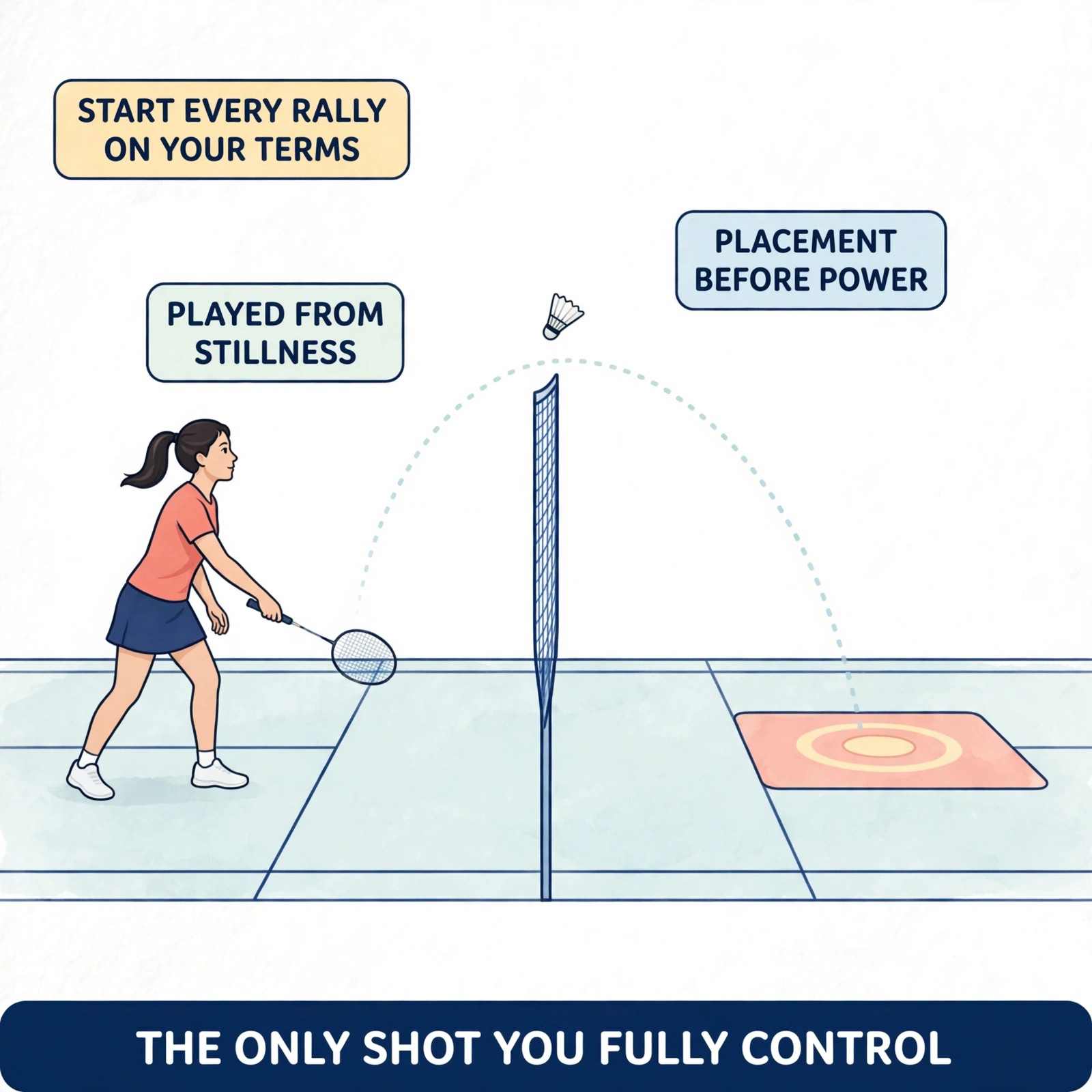
Every rally you will ever play starts with a serve, and yet most club players practise it less than any other shot. Smashes get an hour, footwork gets a morning, and the serve gets the last two minutes while someone collects the shuttles. That is a strange order, because the serve is the only shot in badminton played from stillness, with the shuttle in your own hand and nobody rushing you. This page trains it properly: one legal action you can repeat, a low serve and a flick serve that share that action, honest options for singles and doubles, and targets you count out of ten so progress is a number, not a feeling.
Serve Check #1
What A Good Serve Really Does
A good serve does three jobs at once. It starts the rally on terms you chose, it refuses the receiver any easy attack, and it sets up the shot your side wants next. A tight low serve in doubles forces the receiver to lift or play a soft net reply, which hands the rally shape to your partner at the front. A deep high serve in singles pushes the receiver to the back line and buys you time to set at base. None of this needs power. It needs placement, a calm routine, and a shuttle that crosses the tape with no room under it for a racket to attack.
The other side of the same coin is what a loose serve costs. A low serve that floats half a metre above the tape is an invitation: good receivers drive it, kill it, or rush it before you have settled. A flick serve that lands mid court gives the receiver a comfortable smash. Players often blame their defence for rallies that were actually lost at the serve, three shots earlier. When we film rallies for students, the first thing we check is not the smash that ended the point. It is the height and the landing spot of the serve that started it, because that is where the trouble usually began.

Serve Check #2
One Legal Action: Height, Grip And Contact
Every serve you play in a match must pass the same simple tests, so build one action that passes them all. The whole shuttle must be struck below the fixed height line marked in the laws, which sits at 1.15 metres from the court surface. The racket shaft and head must be pointing downwards at contact. Once you start the forward swing, it must continue forward without a pause, a dummy movement, or a second attempt. And the shuttle must travel upward from your racket, over the net, and land inside the correct service box. One calm action, checked against those points, is legal everywhere you will ever play.
The grip follows the serve. For the backhand serve, used for low and flick serves in doubles and by many singles players too, the thumb rests up the back bevel of the handle and the racket sits in the fingers, not buried in the palm. That finger grip is what lets you change from low to flick with the same start. For the forehand high serve in singles, use a relaxed basic grip and an underarm swing, the shuttle held by the feathers in front of your body. In both serves your stance is side on, weight even, shuttle held still. Nothing moves before it should, and nothing about the start tells the receiver which serve is coming.
Build a routine around the action and never skip it, even in practice. Stand in the same spot, hold the shuttle the same way, take the same breath, look at the same target spot, then serve. A routine is not superstition. It is how you make one action repeatable under pressure, because the body copies what it has done a thousand times in the same order. When a serve goes wrong in a match, players with a routine reset and serve the next one clean. Players without one start inventing, and the second serve is usually worse than the first.

Serve Check #3
Low Serve And Flick Serve: One Action, Two Endings
The low serve and the flick serve are the heart of doubles serving, and they work because they are one action with two endings. The stance, the grip, the shuttle hold and the start of the swing are identical. The low serve brushes the shuttle flat so it skims the tape and drops into the front corner of the service box. The flick serve uses the same start, then the fingers and forearm add speed at the last moment and the shuttle lifts over the receiver and falls toward the back of the box. The receiver who cannot tell them apart must wait, and a waiting receiver is a receiver who attacks late or not at all.
Place the low serve where it is hardest to attack. The front corner near the centre line is the usual target, because a return from there travels the shortest distance and gives the receiver the fewest angles. A wide low serve has its place against a receiver who crowds the centre, but it opens your side of the court, so it is a change, not a habit. Judge every low serve by two things only: how close it crosses to the tape, and where it lands. If you cannot see the tape gap from your serving position, film a set from the side and measure honestly.
The flick serve earns its keep by punishing receivers who lean in. If your low serves are being rushed, the answer is rarely a better low serve. It is a flick serve from the same action, sent over the leaning receiver often enough that he has to respect it. Two warnings travel with it. A flick that is too flat gets smashed from mid court, so give it height and depth, landing it close to the back service line in doubles. And a flick used every third serve stops being a surprise, so ration it. The pair works when both endings are real and neither one is a habit the receiver can read.

Serve Check #4
The High Serve And The Other Options
Singles serving starts from a different question, because there is no partner at the front and the box is longer. The high serve is the base serve: struck underarm, sent high and deep so it falls steeply inside the back line. Its height buys you the time to recover to base, and its depth forces the receiver to play from behind his body. A well struck high serve is hard to smash with any angle, because the shuttle drops almost straight down. Practise it to a target strip along the back line and count how many land inside, because a high serve that falls short is the most expensive mistake in singles serving.
Around the base serves sit the change options. The wide serve pulls a receiver toward the side line and opens the far corner for the next shot. The low serve in singles invites a net reply and starts a front court exchange, useful against a receiver whose net game is weaker than yours. The drive serve, flat and fast at the receiver body, is legal only if it meets the same height and shaft rules, and it works as an occasional surprise rather than a plan. Choose serves by the receiver in front of you: where he stands, which returns he trusts, and which shots he has been avoiding all match.
Serving to order also means serving to the score and to your own partner. In doubles, agree simple signals behind your back so your partner knows whether a low or flick serve is coming and can set for the likely return. At tight scores, serve the serve you trust most, not the clever one you practised twice. When your side is well ahead, that is the time to test the wide serve or the drive. Good serving looks boring from the stands: the same stance, the same quiet start, the shuttle landing where it was meant to land. The excitement is in what the serve does to the rally that follows it.

Serve Check #5
Serve Drills That Build The Habit
The drills on this page share one rule: every serve is counted. Start with the counted target drill. Serve ten low serves at one flat target in the front corner and write down how many land on it or close enough to force a soft reply. Then move the target and go again. The number matters more than the feeling, because feel lies on good days and bad days alike. When eight of ten hold at one spot across two sessions, the spot has earned a smaller target or a longer distance. Progress in serving is a ladder of counted spots, not a sudden breakthrough.
Next, train the pair. Alternate low and flick serves without telling the receiver which is coming, and have the receiver call low or flick out loud as late as he honestly can. If he calls early and right, your action is leaking. Film the pair from the receiver side and compare the two starts frame by frame: stance, grip, shuttle height, first movement. The drill is finished not when the serves land well but when the receiver admits he cannot read them. Add the depth drill for singles players: high serves counted into the back strip, with a partner calling in or out so your depth judgement stays honest.
Finish serve practice under mild pressure, because a serve that only works in drills is a rumour. Play serve and recover games where you serve, then play out the rally, so the serve stays connected to the ready position that must follow it. Keep a simple weekly count in your training notes: low serves landing in the front box area out of ten, flicks reaching the back line out of ten, high serves inside the back strip out of ten. When one number stalls for two weeks, that serve gets the next drill slot. Serving improves slowly and then all at once, and the counts are how you know which part is happening.

Myth vs Reality
Myths About Badminton Serves
Myth: a good serve needs power. Reality: the low serve, the most used serve in the game, is a placement shot played with a short, quiet action. Power serves exist, but they are the garnish, not the meal. Myth: practising serves is wasted time because matches are won in rallies. Reality: every rally starts with a serve, and the side that serves well starts more rallies on its own terms. Myth: a new racket or tighter strings will fix a floating serve. Reality: floating serves come from contact height and action, and both are trained, not bought.
Myth: the spin serve is a clever trick worth learning. Reality: spinning the shuttle off the feathers so it tumbles through the air was banned from the game, and a serve that manipulates the shuttle before contact is a fault. Learn the legal serves well instead. Myth: you should vary your serving action to keep receivers guessing. Reality: receivers read actions, so the action must stay the same while the ending changes. Myth: serving faults are only about the shuttle height. Reality: a pause, a dummy swing, or a shaft pointing up at contact are faults too, and honest practice checks all of them.
One more myth sits underneath the others: that serving is a talent, something players either have or do not. Watch any strong server closely and you find a routine, a target, and a count book, not a gift. Junior players in our sessions often start with low serves that sit up badly, and within a school term of counted target work the same players are skimming the tape. Nothing about their hands changed. Their practice changed. That is the honest summary of this whole page: the serve is the most trainable shot in badminton, because it is the only one nobody interrupts while you learn it.

Why Choose Us
Why Players Choose ST Badminton Academy
Players choose ST Badminton Academy for serving work because we coach the serve the way the rally feels it: as the first shot, not a formality before the rally. Your low serve is filmed from the receiver side, the view that shows the tape gap honestly. Your flick is checked against your low serve frame by frame, so the pair shares one action. Your targets are sized to your current count and shrunk only when the numbers say so. Groups stay at no more than four students, so your serving sets are watched closely, not sampled between other players.
The sessions run the way this page describes. Counted target sets open the serving block, so we know where your serve stands this week. Pair work follows, with receivers calling your serves late and out loud. Singles players add the depth drill to the back strip, and every serving block ends with serve and recover games that join the serve to the rally. Between sessions you keep the count book we set up together, ten serves at a time, so the next session starts from evidence rather than memory.
We are based in Setapak, Kuala Lumpur, and our students join us from across the Klang Valley, some travelling in from Wangsa Maju, Gombak and Setiawangsa for evening sessions. Serving work sits inside regular badminton training rather than a separate course, because the serve only matters inside rallies. Bring your match frustrations with you: the receiver who rushes you, the flick that keeps getting smashed, the high serve that falls short. Each one becomes a drill with a count attached, and the count decides when it is fixed.
FAQs: Badminton Serves And Serving Drills in Malaysia (KL)
These are the questions players ask us most about serving, before they book and during their first weeks. The short version runs through all of them: one legal action, a low serve and a flick serve that share it, targets you can count, and a routine that holds at tight scores. If your question is not covered here, bring it to a trial session and we will test it on court, where serving questions get honest answers.
Can a beginner improve badminton serves in training in Setapak or Gombak?
Yes. Beginners improve serving quickly, because the serve starts from stillness and can be practised slowly from the first session. In our Setapak classes we set one legal action and one target spot in groups of no more than four students, and count your landings out of ten from week one.
What is the first serving habit a new player should build in KL?
Build the routine first. Same stance, same shuttle hold, same breath, same look at the target, then serve. A routine makes one action repeatable before you chase variety. Once the routine holds, we add the low serve target, then the flick serve from the same start, one layer at a time.
Why do my serves keep getting attacked at a serious level?
Because attacked serves are usually loose serves: they cross too high above the tape, land mid court, or come from an action the receiver can read. Serious receivers punish all three. Film your serve from the receiver side, measure the tape gap honestly, and check whether your flick and low serves start the same way.
My low serve keeps floating high. Should I change my grip or make my action smaller first?
Make the action smaller first. A floating low serve usually comes from a pushing action that starts too high or lifts the shuttle on its way. Shorten the swing, hold the shuttle lower, and brush it flat. The grip only needs changing if your thumb position is forcing the racket face open at contact.
How can I practise serving when I train mostly on my own in between classes?
Serve against targets on any court you can book, or shadow the action at home. Set a towel in the front corner, serve ten, count the landings, and write the number down. Shadow the routine slowly in a mirror to check your stance and shuttle hold. Bring your counts to class and we will size the next target.
Do you coach serving beside badminton training near Wangsa Maju?
Yes. Our academy is based in Setapak, a short drive from Wangsa Maju, and serving is coached inside regular sessions there: counted target sets, low and flick pair work with a receiver calling late, and serve and recover games. Groups stay at no more than four students, so your action is watched on every set.
Where does ST Badminton Academy teach badminton training in Malaysia?
We teach in Setapak, Kuala Lumpur, and students join us from across the Klang Valley. Serving training sits inside normal sessions in groups of no more than four: your action checked against the laws, your pair filmed from the receiver side, and your progress counted in landings out of ten, week by week.
How do I book a trial session to test my serves?
Book a trial session with us in Setapak and bring your racket and court shoes. The coach will watch your low serve and flick serve from the receiver side, count your landings on a named target, and show you the first leak in your action before any regular training begins.
What makes Mr Eric Chuar a suitable coach for serving in badminton?
Mr Eric Chuar coaches the academy sessions himself, with more than 15 years of coaching in Malaysia and Singapore. He teaches serving the way this page describes: one legal action, a routine that holds at tight scores, and targets decided by counts. No trick serves, just serves receivers cannot attack.
Badminton Serving Training in Action


We benchmark our serving coaching against World Badminton (BWF) coaching standards and our own academy values: before any player trusts a training plan, they deserve honest checks. You can verify our coaches' credentials through the Badminton Association of Malaysia (BAM) coach education pathway.
One standard governs how we coach serving: the action is judged before the outcome. A lucky serve that floated and still won the point is marked down, and a clean, low serve that was attacked brilliantly is marked up, because only the second habit survives better receivers. We check every serve against the laws first, the target second, and the scoreboard last. That order keeps practice honest when results flatter a loose action, and it keeps players patient when a sound action has an unlucky week.
| Factor | Servers Who Hope | Servers With A Routine SERVES |
|---|---|---|
| Frequency | 1 or 2 times a week. Mostly for fun and sweat. | A server with a routine repeats one legal action, so the low serve and the flick leave from the same shape. |
| Drills Focus | Basic static feeding. Minimal footwork pressure. | Serves are aimed at named spots and counted, so a loose patch shows up in the numbers within a week. |
| Physical Conditioning | Rarely included. Just playing games on court. | Core, agility, and speed training included in every session to prevent injury and build stamina. |
| Tactical Awareness | "Just hit it over." No real game plan. | Video analysis, point construction, and learning to read the opponent's game. |
| Coach Ratio | Large groups (8-10 kids). Coach barely watches you. | Max 4 students. Mr Eric Chuar personally corrects every stroke and movement detail. |
| Goal Setting | Fun and exercise. | The serve starts a planned rally: server and partner both know the likely returns and set for them. |
| Long Term Result | Good recreational player. | A routine server: one action, named targets, counted landings. |
Badminton Training For Better Serves in Kuala Lumpur
Better serving starts smaller than most players expect: one stance, one shuttle hold, one target spot, counted ten at a time. Pick the serve that costs you most, set a flat target where it should land, and keep the count for two honest weeks. Bring your numbers to a trial session in Setapak, and we will read them together, find the leak in your action, and build the pair that hides it. The serve is the one shot you fully control. It deserves more than the last two minutes of practice.


