Badminton And Cross Training: Exercises For Improving Overall Fitness And Performance (Fitness Guide)
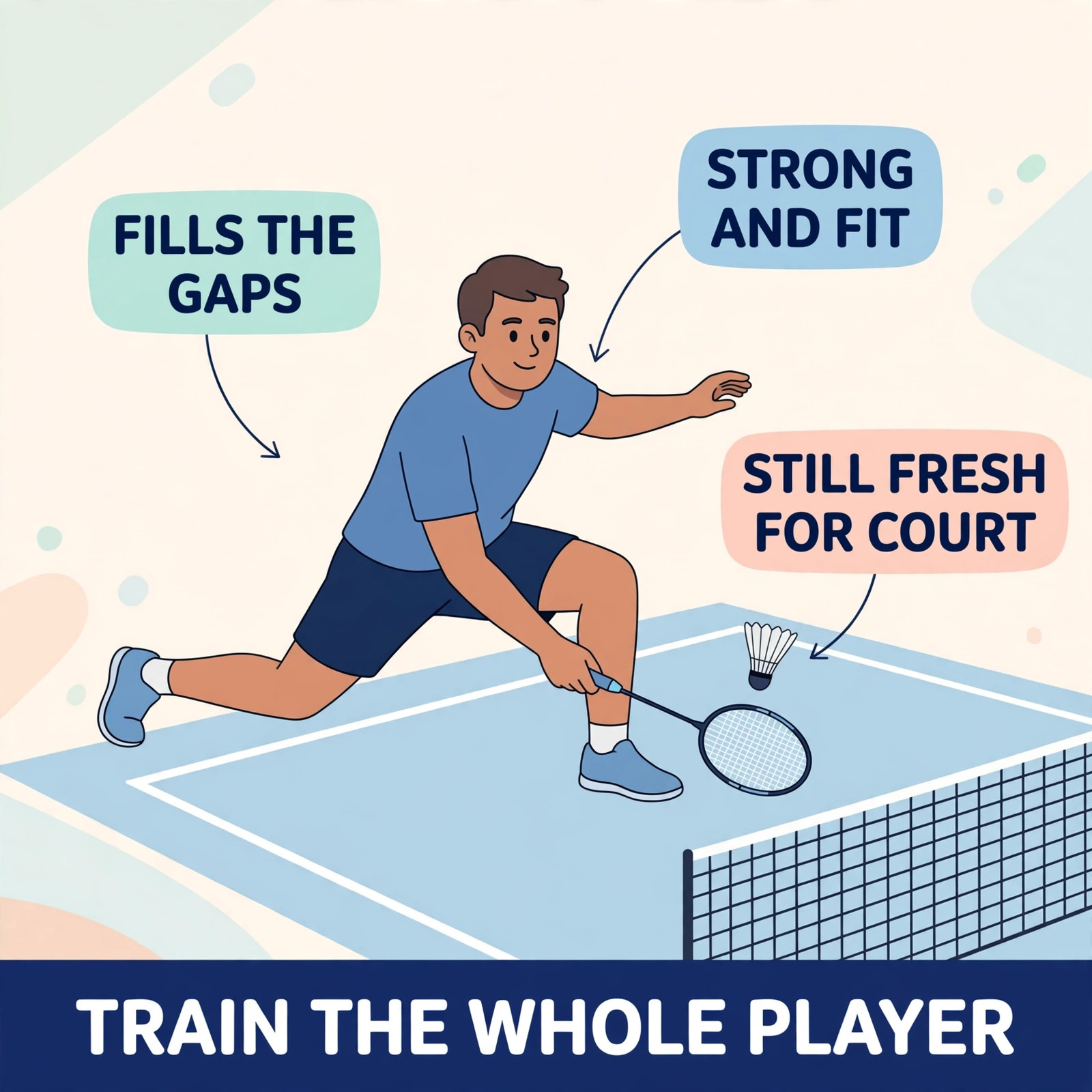
Badminton is a demanding sport, but it is not a complete one. The game trains your lunges, your overhead arm and your reactions brilliantly, and leaves quiet gaps everywhere else: the pulling muscles of the back, the trunk that must resist as much as rotate, the easy fitness underneath the bursts. Cross training is the work that fills those gaps: other exercises, chosen on purpose, that make the badminton body stronger, fitter and harder to injure. This guide covers cross training the way we build it at ST Badminton Academy in Setapak, Kuala Lumpur: the strength that transfers, cardio variety that spares the joints, and a week where everything supports the court instead of competing with it.
Fitness Check #1
What Badminton Alone Leaves Out
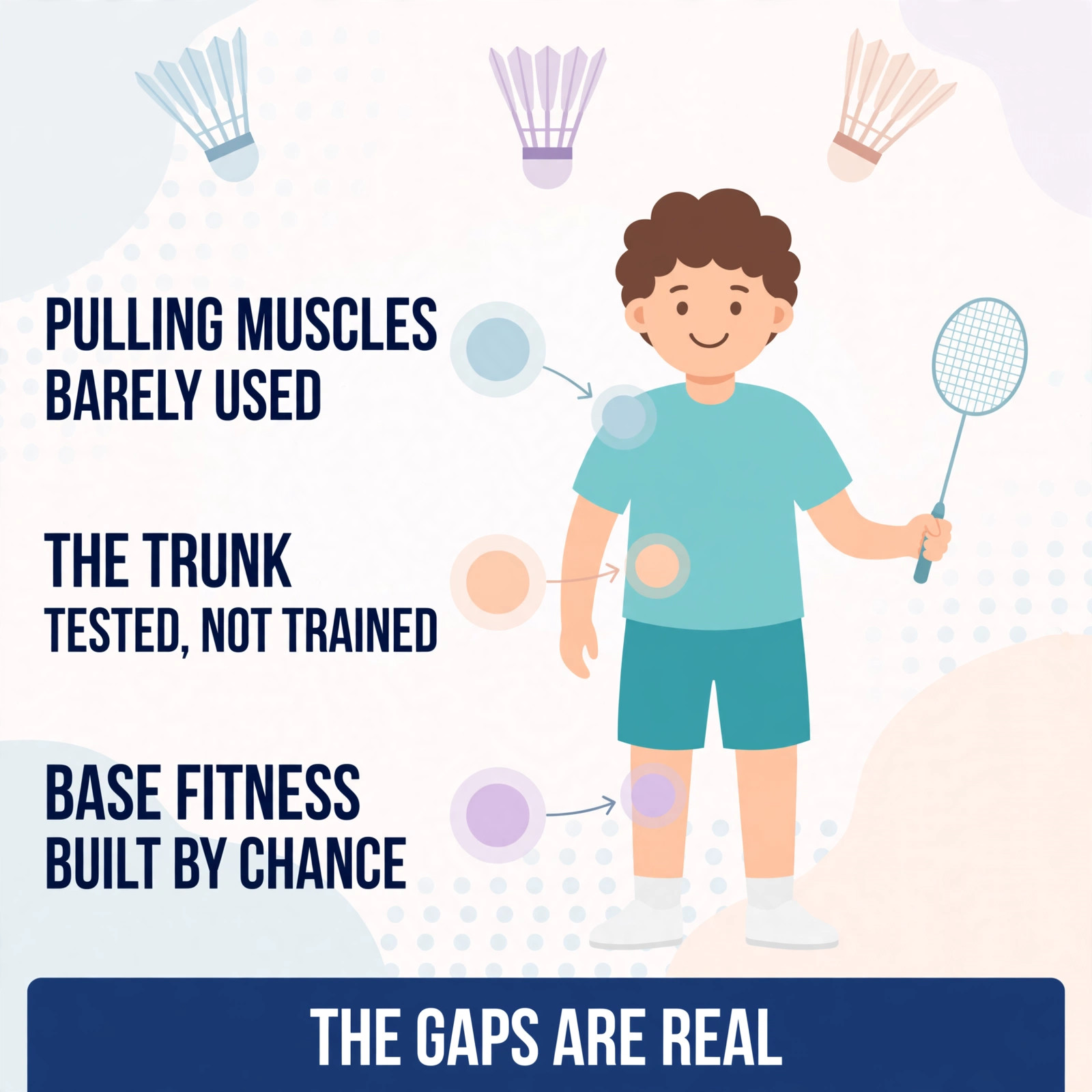
Look at what a rally actually trains. One arm hits almost every shot. The legs lunge in a few repeated shapes. The trunk rotates mostly one way. Thousands of repetitions carve deep strengths, and the same thousands leave the opposite patterns untouched: the back muscles that pull, the other side of the trunk, the slow fitness that easy movement builds. Untouched patterns do not stay neutral. They become the weak link a hard season eventually finds, usually as a sore shoulder, a grumpy lower back or a player who is fit for twenty minutes and ordinary after that.
Cross training answers that imbalance directly. It trains the muscles badminton forgets, builds the base badminton borrows, and gives tired joints a different job while the engine keeps working. Done well, it is not a second sport and it is not a distraction from your game. It is support work with one client: your badminton. Every exercise in this guide earns its place by answering one question: what does this give the player on court. If the honest answer is nothing, the exercise does not make the plan.
Fitness Check #2
Strength Work That Transfers to Court
Legs come first, and the shapes are familiar: squats and lunges, done slowly and under control, with knees tracking over the toes. Badminton legs need strength through a deep range, not just at the top of it, because the lunge lives at the bottom. Calf raises and single leg balance protect the push-off and the landing. Two honest sets, perfect form, twice a week will do more for most club players than an exhausting leg day they dread and skip. Strength work is a deposit. Make it small enough to keep making.
The trunk is the transfer station between legs and racket, and it trains best by resisting movement. Planks and side planks, dead bugs, and loaded carries, walking tall with a weight in each hand, teach the trunk to stay braced while the arms and legs work around it. Crunches have their place, but a badminton player who can only fold is missing the main job. Ten to fifteen minutes of bracing work, a few times a week, quietly changes how solid every overhead shot feels from the ground up.
The upper body needs balance most of all. Hitting is pushing and swinging forward, thousands of times, so the pulling muscles of the back and the rear shoulder get left behind. Rows with a band or a weight, done with the elbows travelling back and the chest open, are the single most valuable upper body exercise most badminton players are not doing. Add gentle pressing for balance, keep the loads honest, and stop well before form breaks. Shoulders that are pulled back into place by their own muscles complain far less about overhead volume.

Fitness Check #3
Cardio Variety That Spares the Joints
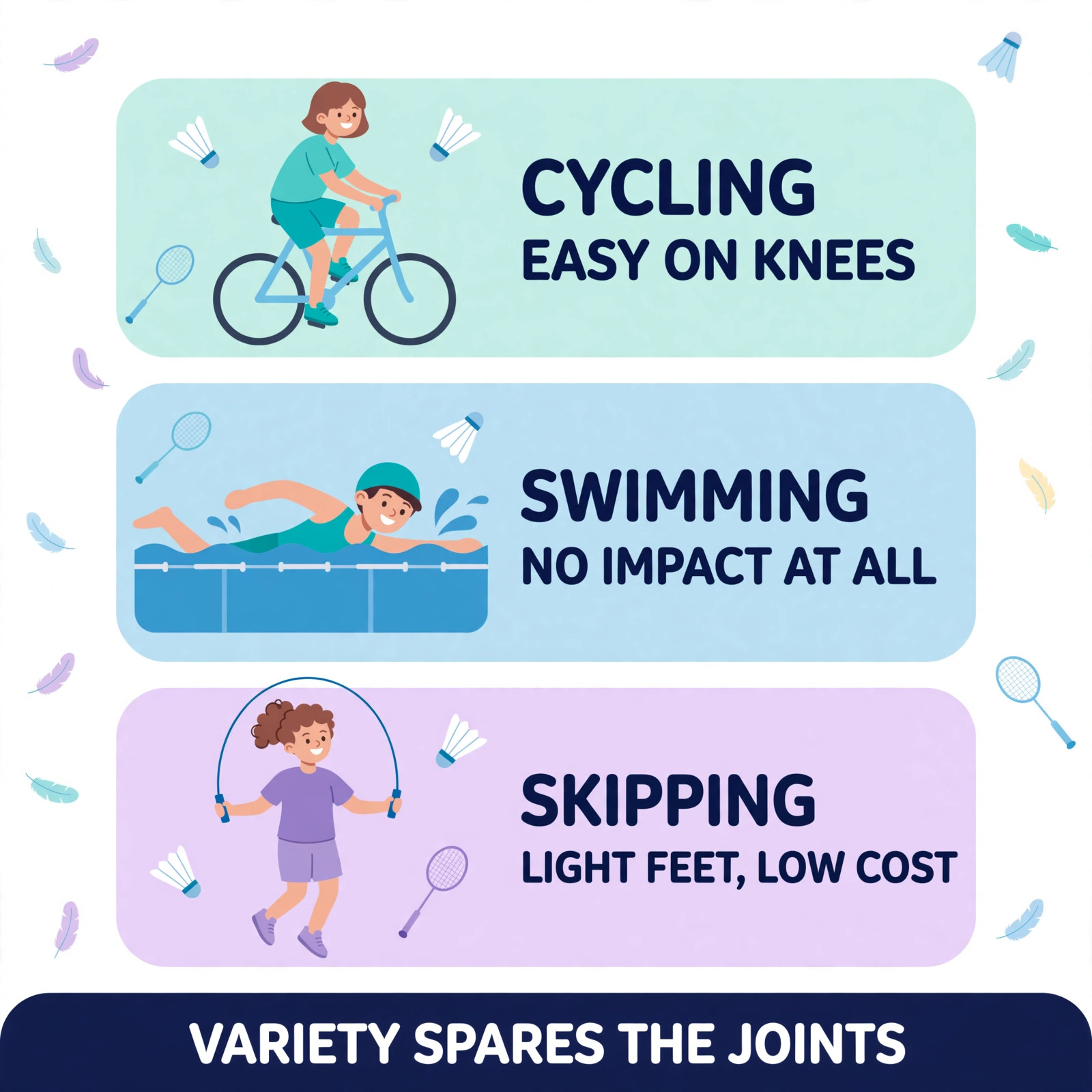
The engine needs variety as much as the muscles do. Cycling, swimming and rowing build the aerobic base at talk test pace while sparing the knees and ankles the impact that court work already supplies. For a badminton player, that trade is the whole point: the heart gets its work, the joints get a day off from lunging. Players training in Malaysia have pools and bikes everywhere, and the rainy season makes indoor options more than a luxury. Rotate what you enjoy. The base does not care which machine built it.
Light skill variety has its own place. Skipping trains the quick, light feet your footwork wants, in sets short enough to stay springy. Agility ladder work, kept playful and fast, rehearses the small steps and direction changes the game loves. Even a different sport played socially, a swim squad session, a weekend hike with the family, feeds coordination and freshness that drills cannot. Cross training that feels like play gets repeated. Cross training that feels like punishment gets quietly dropped by week three.
A useful honesty about variety: new exercises make you sore in new places, and soreness is a cost your court sessions pay. Introduce one new thing at a time, at half the dose you think you need, and let two weeks pass before judging it. The goal of cross training week one is not fitness, it is information: what suits your body, your schedule and your recovery. Players who start greedy end up sore, suspicious of the whole idea, and back to badminton only within a month. Start small enough to still be doing it in June.
Fitness Check #4
Plan the Week, Protect the Court
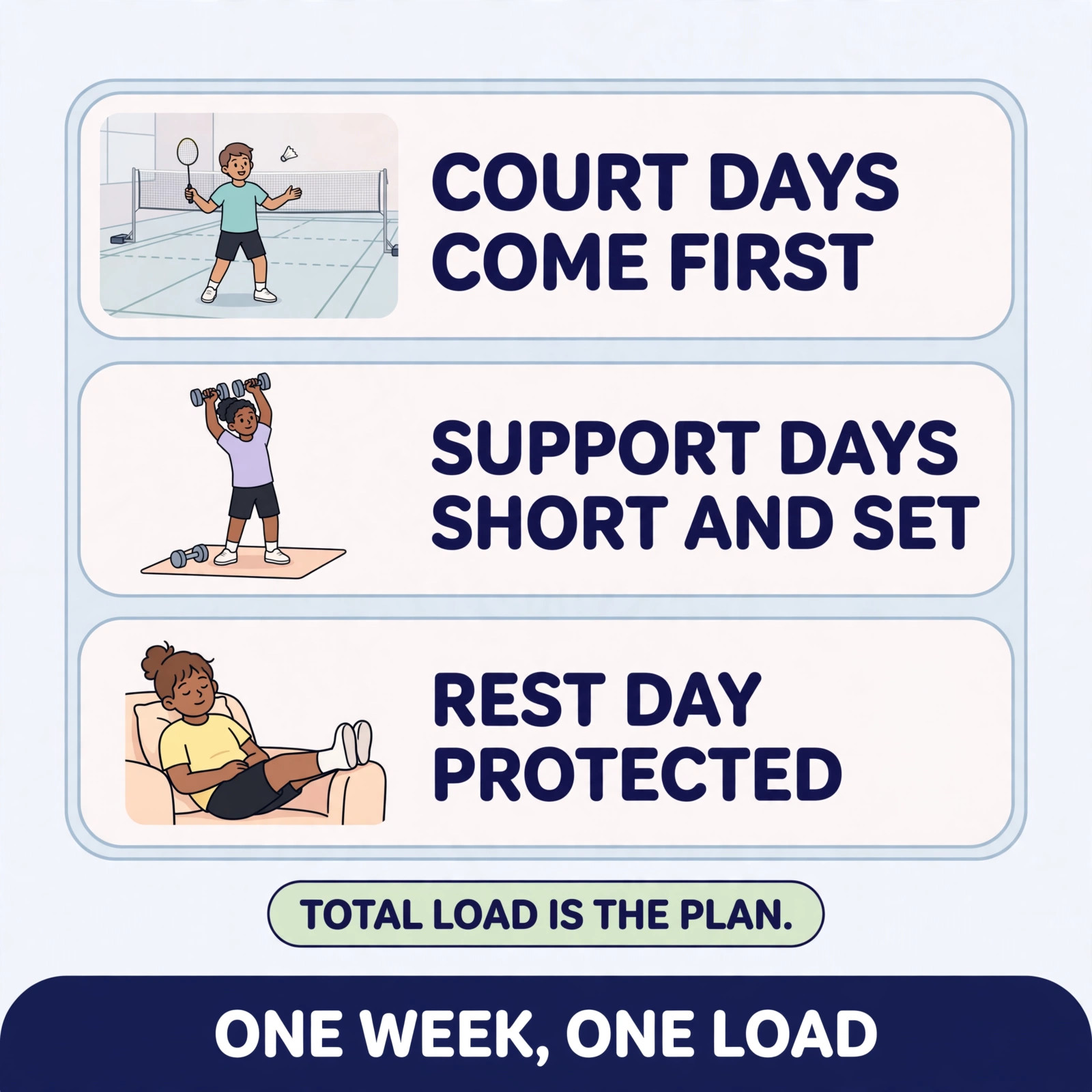
Everything you add competes for the same recovery, so plan the week as one load, not as separate wishes. Court days come first in the diary, because badminton is the sport you are actually training for. Support work slots around them: a short strength set after an easy court day or on its own day, base cardio on the days between, and one full rest day that nothing is allowed to eat. When a week gets busy, cut the support work first and keep the court sessions. The plan serves the game, never the other way round.
Hard and easy must alternate on purpose. A heavy leg session the day before a hard footwork class is not toughness, it is scheduling illiteracy, and both sessions come out worse. Pair hard with hard if you must stack: strength after court work on the same day leaves the next day genuinely easy. And keep the support sessions short. Twenty to forty focused minutes, done completely, beat an abandoned two hour programme every week of the year. The best plan is the one still standing in three months.
Track it simply or it drifts. One line per session in a notebook or a phone note: what you did, how hard it felt, and how the next game went. That humble data answers the only question that matters within a month: is the support work helping your badminton. Set goals the same way, small and dated: ten clean lunges each side, thirty easy minutes on the bike, a plank that holds its shape for a minute. Goals you can see are goals you keep. Everything in cross training follows from that honesty.
The Balance
Warm Up, Cool Down, Every Single Session
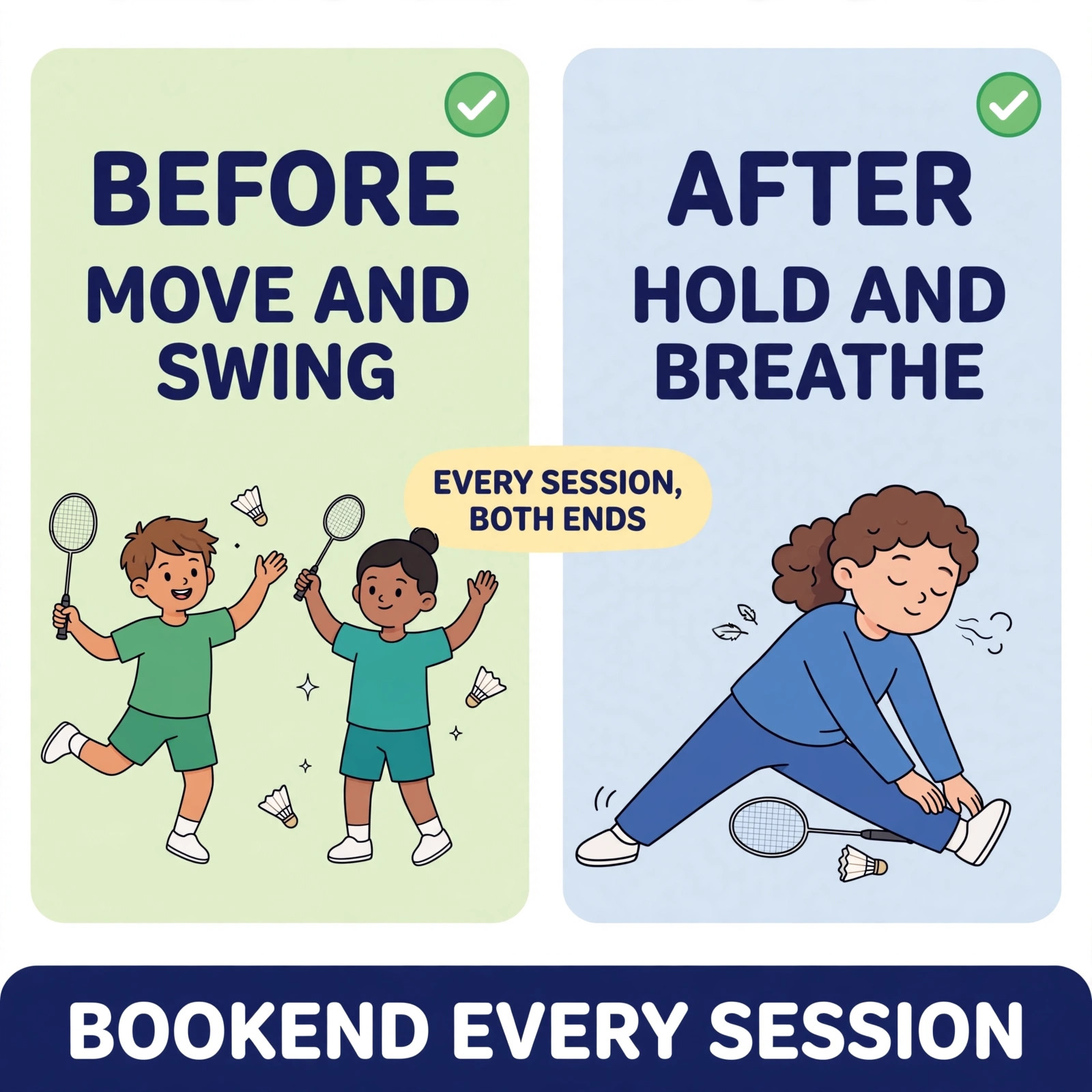
Every session, court or cross training, gets bookends. Before: movement, because cold muscles and stiff joints do their worst work in the first ten minutes. Jog, circle the joints, swing the legs and arms, and shadow the shapes of the day. After: slow the breathing down, then hold gentle stretches while the muscles are warm, twenty to thirty seconds each, covering the legs, hips, trunk and shoulders. The bookends are not decoration. They are where preparation and recovery actually live, and skipping them taxes everything between.
Shoes are the piece of equipment that matters most, and the honest news is that they are specific. Badminton asks for grip and sideways support on a hard court, so proper court shoes protect the ankles and knees in a way running shoes, built to travel in a straight line, simply do not. Your racket should feel comfortable and familiar rather than impressive: a balanced setup you can swing all evening beats a head heavy one that tires the shoulder. A spare grip, a towel and a change of shirt complete a kit that supports training instead of interrupting it.
Safety in cross training is mostly patience wearing a watch. Build loads gradually, ten percent thinking rather than double it thinking. Drink water before, during and after sessions in Malaysian halls and gyms, where sweat outruns thirst. Stop and get advice when pain is sharp, sits in a joint, or changes how you move; training through that kind of pain is how small problems get promoted. None of this is complicated. All of it is the difference between cross training that builds a player and cross training that borrows from one.
Myth vs Reality
Myths About Cross Training
Myth: “Cross training means taking up another sport seriously.” Reality: cross training is support work chosen for your badminton: strength for the gaps, base for the engine, variety for the joints. It serves one master, and it knows it.
Myth: “If some exercise is good, more is always better.” Reality: everything competes for the same recovery. A plan that eats your rest day eats your progress with it. Myth: “Expensive gear makes you fit.” Reality: shoes that suit the court matter. After that, consistency does the work that shopping cannot.
Myth: “Cross training can replace court practice.” Reality: nothing rehearses badminton like badminton. Support work makes your court hours count for more; it never makes them optional. Myth: “Soreness proves a session worked.” Reality: soreness mostly proves a session was new. Progress is measured on court, in the third game, not in the stairs the next morning.

Why Choose Us
Cross Training Coaching for Badminton Players
At ST Badminton Academy KL, cross training is planned inside small group classes capped at max 4 students, alongside the court work it supports. In groups that small, the coach sees the whole athlete: the shoulder that needs pulling work, the base that needs building, the week that needs a rest day, and sets the support plan inside the badminton plan.
Mr Eric Chuar has over 15 years of coaching experience in Singapore and Malaysia. His cross training rule is plain: support, never replace, and judge everything by the third game. He builds strength and base work around the court diary, keeps doses small enough to repeat, and asks one question of every new exercise: what does this give the player on court.
Our academy is based in Setapak, Kuala Lumpur, convenient for players from Wangsa Maju, Melati Utama, Danau Kota and Gombak. If your game feels strong in parts and strangely unfinished in others, bring that pattern to a session. We will find the gaps your badminton leaves and build the support plan that fills them.
FAQs: Cross Training in Malaysia (KL)
These are the questions players ask us most about cross training for badminton in Malaysia. If your question is not here, message us, tell us what your current week looks like, and we will give you a straight answer about where support work fits.
How can I add cross training to my badminton if I live in Setapak or Gombak?
Start small: one short strength set and one easy cardio session a week around your court days. Squats, lunges, planks and rows cover most gaps; cycling or swimming builds the base. In our Setapak classes the support plan is set per player inside small groups of max 4 students.
What matters most in cross training for badminton players in KL?
Fit and honesty about load. Court days come first, support work fills the gaps badminton leaves, and the whole week shares one recovery budget. Start at half the dose you think you need. In our training the plan is judged by how your third game feels, not by how tired Tuesday was.
How many cross training sessions a week should I plan at club level?
For most club players, one or two short support sessions a week is enough: strength once, easy cardio once or twice, fitted around court days with a rest day protected. More helps only if recovery keeps up. In our classes the week is planned as one load, per player.
I only play social games twice a week. Is cross training still worth it?
Yes, and social players often gain the most, because the gaps are biggest where training is least structured. One strength set a week steadies the shoulder and legs; one easy cardio session keeps the third game friendly. Keep it small and enjoyable. Bring your current week to a session and we will place it.
What should I do right after a hard session to help my body recover?
Slow down in order: easy movement until breathing settles, water, then gentle held stretches for legs, hips, trunk and shoulders, twenty to thirty seconds each. Eat a real meal inside the next couple of hours and protect your sleep that night. In our classes the cool-down is coached, never rushed.
Do you coach cross training and conditioning in classes near Wangsa Maju?
Yes. Cross training is planned inside regular group classes at our Setapak base, a short trip from Wangsa Maju, and as homework between them. Strength, base and mobility work are set per player in small groups of max 4 students, always around the court diary, never instead of it.
Can the academy help me build overall fitness for competitions in Malaysia?
Yes. We build overall fitness for the events players enter: strength for the gaps, base for long matches, and routines rehearsed until they run themselves. Start early, because fitness grows over weeks. Our small groups mean the plan is matched to your current level and your competition calendar.
Where is ST Badminton Academy KL located for fitness training?
We are based in Setapak, Kuala Lumpur, close to Wangsa Maju, Melati Utama, Danau Kota and Gombak. Sessions run in small groups of max 4 students, with cross training planned inside the badminton week. Message us for the current class schedule and we will place you in a group at your level.
What does Mr Eric Chuar teach about cross training in badminton?
Fifteen years of coaching in Singapore and Malaysia, and a cross training philosophy of support, never replacement: fill the gaps, build the base, protect the rest day. Eric asks one question of every exercise, what it gives the player on court, and plans support work inside small groups.
Cross Training in Action


What It Takes to Be Fit for the Whole Game
A player meets our fitness standard when five habits hold: strength work covers the gaps twice a week, base cardio happens at talk test pace, court days stay first in the diary, one rest day a week is protected, and every session is written down in one honest line. When those five hold, fitness stops being a project and becomes a background.
| Factor | Plays Badminton Only | Trains the Whole Body FITNESS |
|---|---|---|
| Frequency | 1 or 2 times a week. Mostly for fun and sweat. | Off court strength work covers the pushing, pulling and trunk work the game itself skips. |
| Drills Focus | Basic static feeding. Minimal footwork pressure. | Low impact cardio builds the base on bikes and in pools while the knees and ankles rest. |
| Physical Conditioning | Rarely included. Just playing games on court. | Core, agility, and speed training included in every session to prevent injury and build stamina. |
| Tactical Awareness | "Just hit it over." No real game plan. | Video analysis, point construction, and learning to read the opponent's game. |
| Coach Ratio | Large groups (8-10 kids). Coach barely watches you. | Max 4 students. Mr Eric Chuar personally corrects every stroke and movement detail. |
| Goal Setting | Fun and exercise. | Hard days and easy days are planned together, so court sessions stay sharp all season. |
| Long Term Result | Good recreational player. | A player who is strong, fit and still fresh enough to enjoy the third game. |
Cross Training and Fitness Training in Kuala Lumpur
This page covered cross training for badminton in full: the gaps the game leaves in pulling muscles, trunk and base, the strength work that transfers, cardio variety that spares the joints, a week planned as one load, and the bookends and shoes that keep it all safe. Bring your current week to a session in Setapak and let us build the support plan your game is missing.




