Badminton And Power: Exercises For Increasing Strength And Explosiveness (Power Guide)
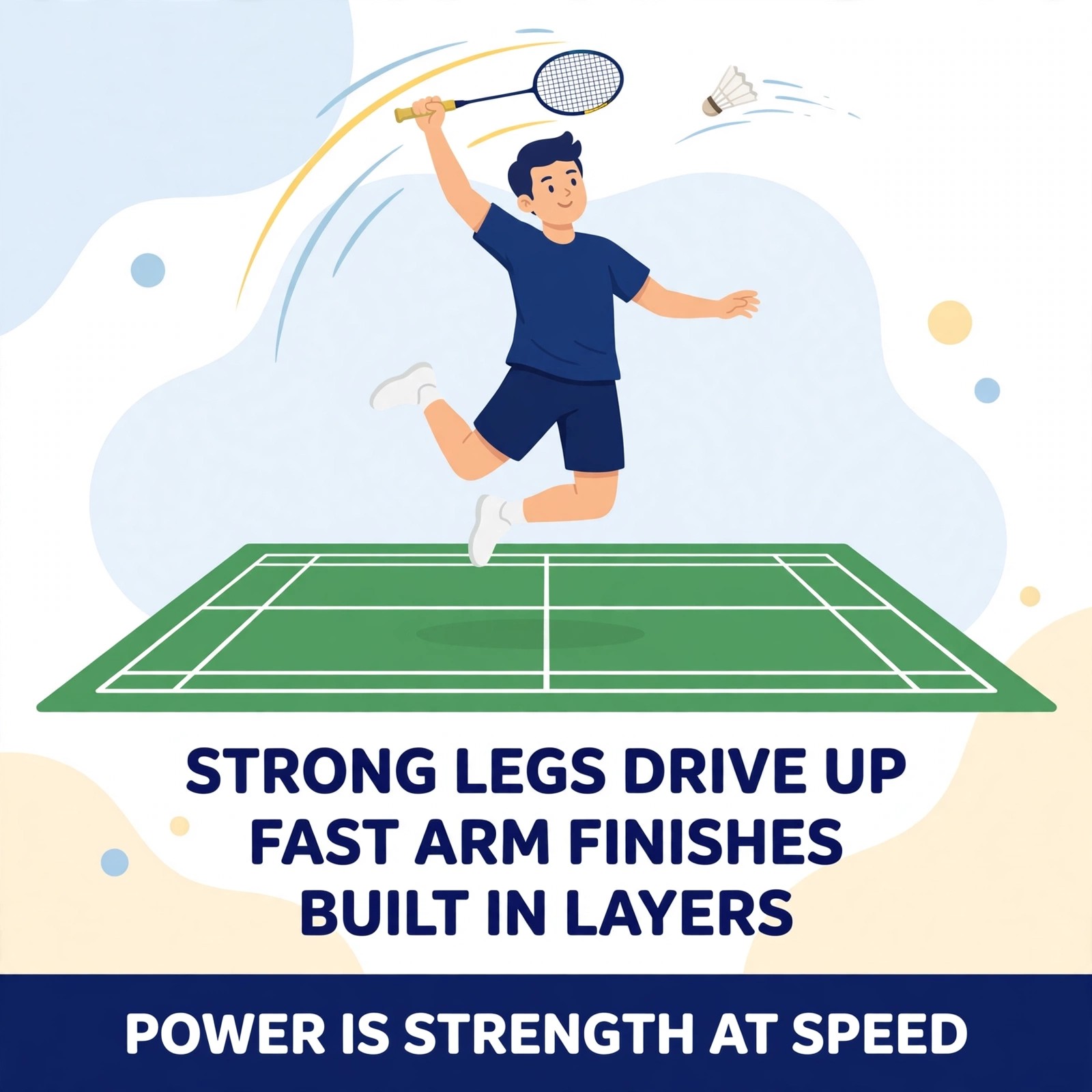
Watch a strong junior and a strong gym member play the same smash and you will see the difference this page is about. The gym member may lift far more weight, yet the junior’s shuttle travels faster, because badminton power is not raw strength. It is strength used at speed, in the split second of a jump smash, a deep clear or a driving lunge. This guide explains how that power is built in layers: a strength base first, then throws, jumps and fast lifts, held together by balance and control. At ST Badminton Academy in Setapak, Kuala Lumpur, this is the order we teach it in.
Power Check #1
What Power Really Means on a Badminton Court
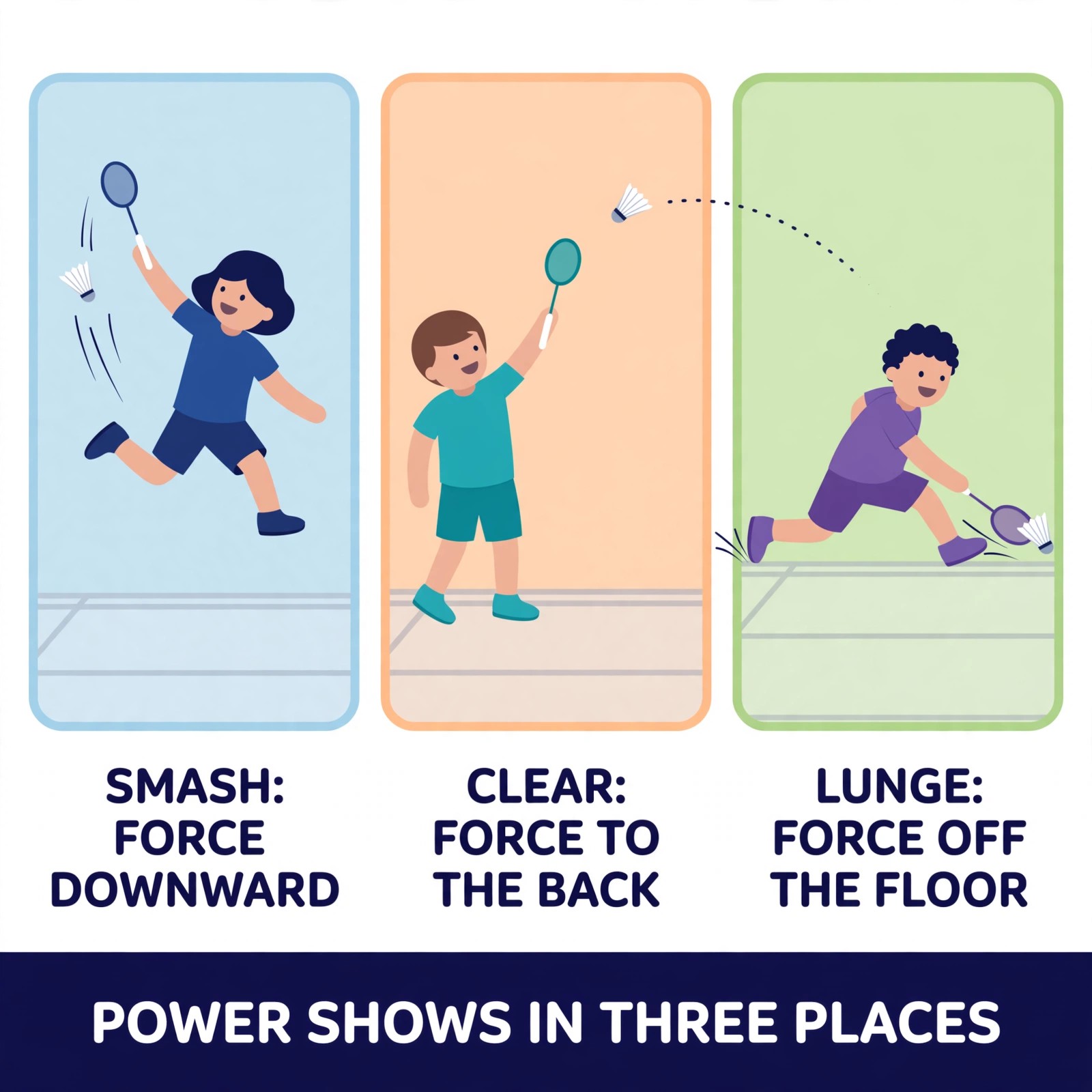
On court, power shows itself in three places. It is the smash that travels down before the defender settles. It is the clear that still reaches the back line in the third game, when tired arms start dropping it short. And it is the lunge that drives you off the floor and back to base, instead of leaving you stranded at the net. None of these are arm tricks. Each one runs through the whole body: legs drive, hips turn, trunk transfers, arm and racket finish. Power training works when it trains that whole chain, in that order.
This is why the biggest muscles in the gym are not automatically the most powerful players on court. A slow, grinding lift and a smash ask for opposite qualities: one rewards force with time to build it, the other gives you a fraction of a second. The good news is that speed of force can be trained like anything else. You build the strength first, because fast work needs something to be fast with. Then you teach the body to use that strength quickly, with throws, jumps and light fast lifts. Skip the base and the fast work has nothing behind it.
Power Check #2
Layer One: The Strength Base Comes First
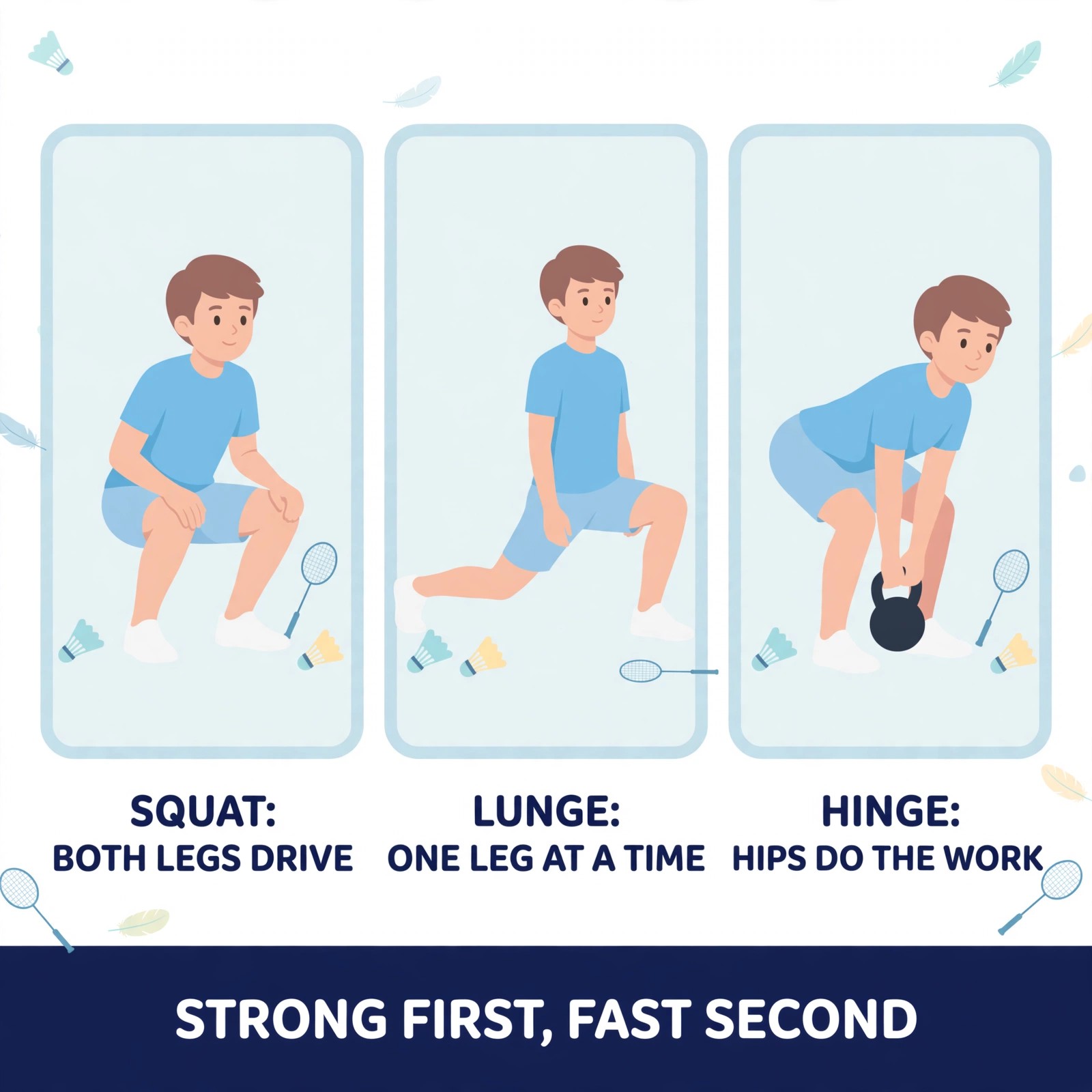
Layer one is plain strength, built on the big patterns badminton uses. The squat trains both legs driving together, the pattern behind jumping and recovering from deep lunges. The lunge trains one leg at a time, which is the shape badminton actually happens in: almost every shot at the net or in defence is played off one leg. The hinge, hips back with a flat back, builds the back of the body that pulls you upright out of low positions and powers the turn in overhead shots. Master these three shapes with bodyweight first, then with load.
The upper body half of the base is push and pull in balance. Pressing work covers the pushing side used in drives and smashes. Rowing and pulling work builds the upper back that keeps your posture tall and your shoulder healthy while the hitting side works hard. Players who only train the hitting side end up rounded and sore; players who pull as much as they push stay upright in long matches. Trunk work ties the halves together: bracing drills that teach the middle to stay firm while arms and legs move fast around it.
Keep the loading honest and simple. Main lifts usually live in sets of about four to eight controlled reps, where the last rep is hard but still clean. Support work such as rows, carries and trunk drills often sits around eight to twelve reps. Rest long enough between sets that your shape resets fully, usually a few minutes on the big lifts. The moment your shape breaks, the set is over, whatever the plan said. Strength built with tidy reps transfers to court. Strength built with bent, rushed reps mostly transfers to the physio.
Power Check #3
Layer Two: Throws, Jumps and Fast Lifts
Layer two teaches the base to move fast, and the medicine ball is its best teacher. A throw is a smash without a racket: squat or step, drive through the legs, turn the hips, and let the ball leave overhead or into a wall at full effort. Because you release the ball, nothing slows you down at the end, which is exactly what a hitting action needs. Throws stay few and honest: sets of three to five, every one at full intent, with a walk back and a breath between reps. Throwing tired and lazy teaches lazy, and the body learns whatever you repeat.
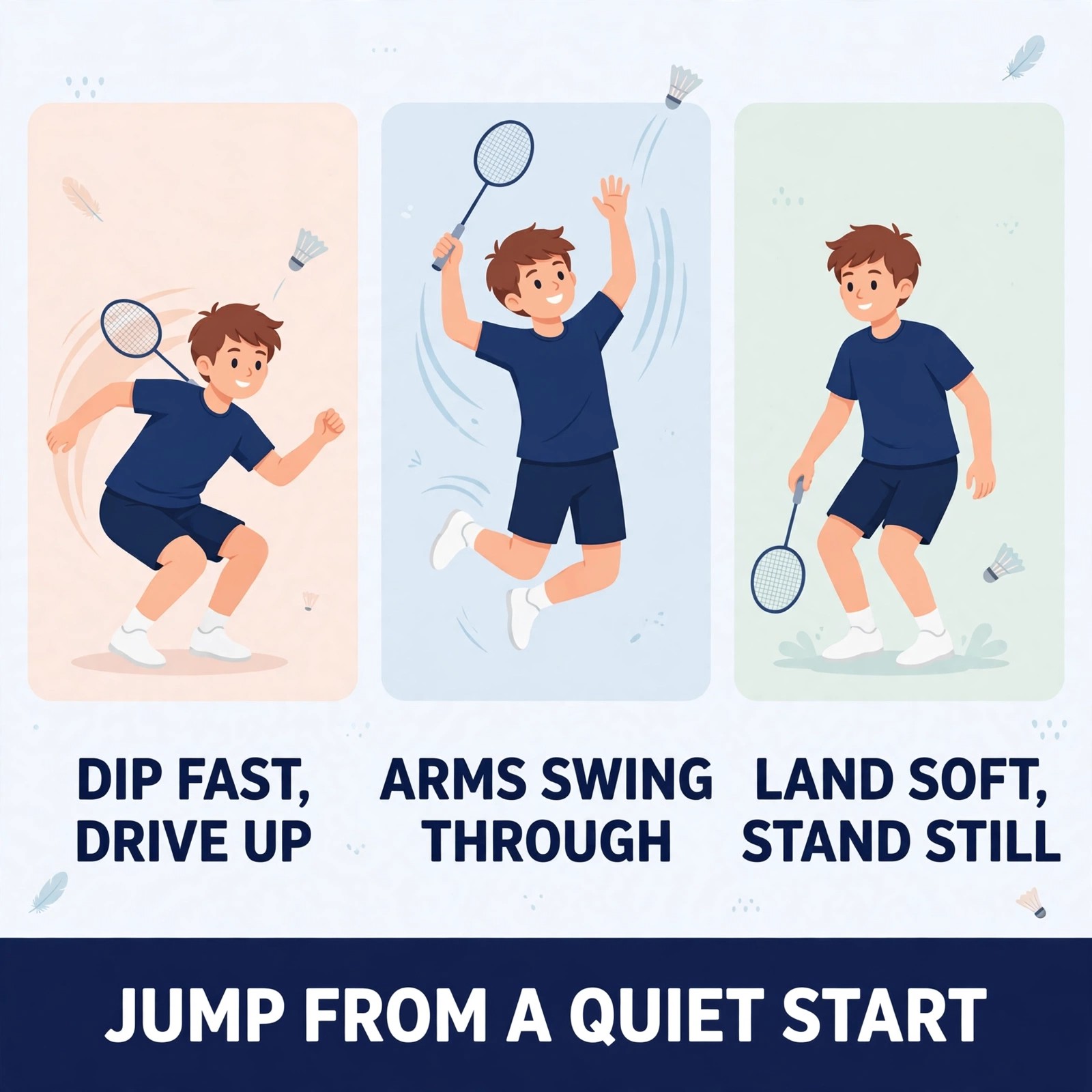
Jumps belong in this layer too, in the same small, sharp doses. A countermovement jump, dip fast and drive up with the arms swinging, trains the legs to produce force in the short time a jump smash allows. Keep jump sets short, land soft and still, and rest until the next set can match the first. Jumping is a wide topic with its own safety rules about landings and surfaces, and it deserves care rather than volume. For power purposes, the rule is simple: a few jumps done at full quality beat a long session of tired hopping, every time.
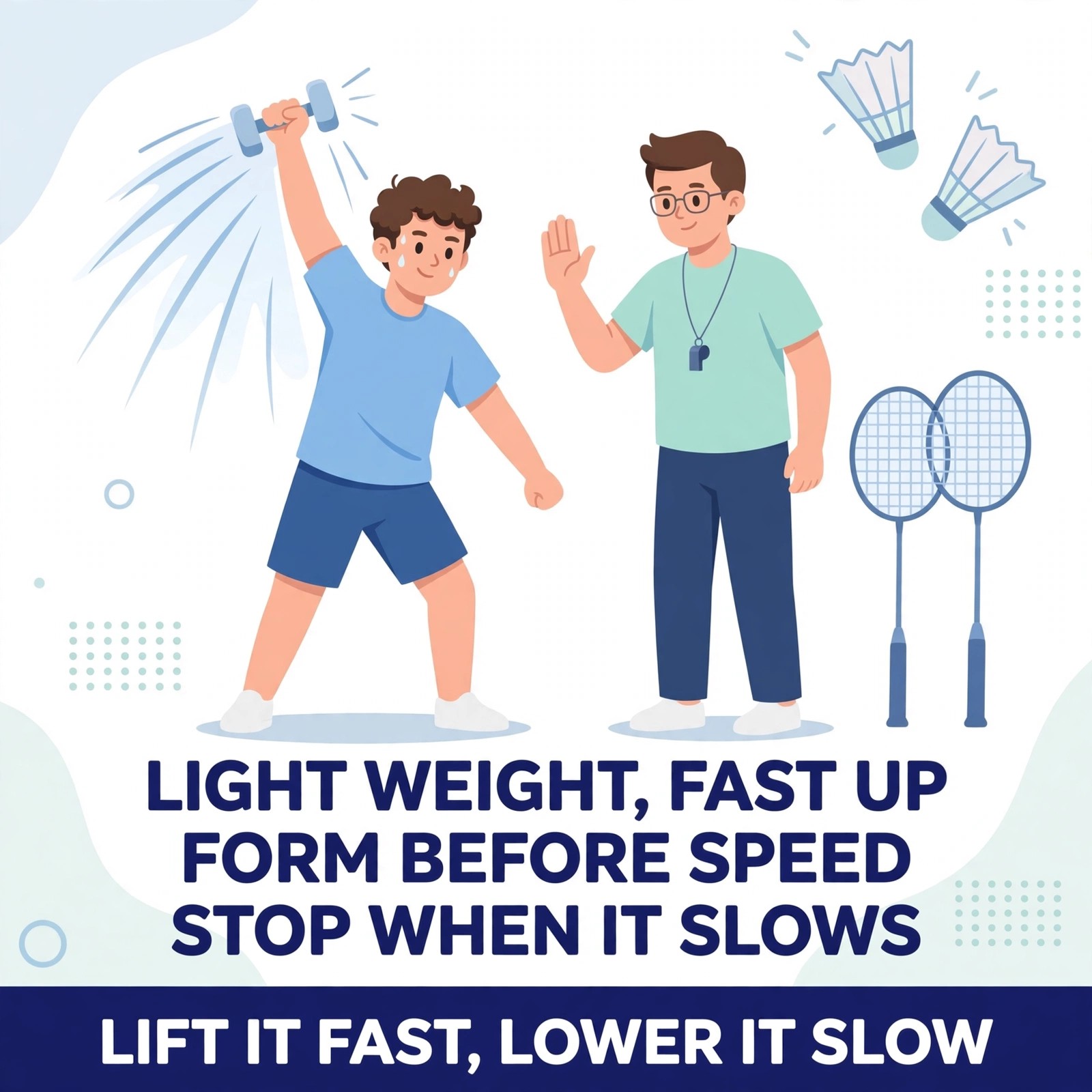
Fast lifts complete the layer. Take a lift you already own with good shape, cut the load to something light, and move it as fast as clean form allows: a quick push press, a fast high pull, a speedy split squat. The weight is not the point; the speed of the drive is. Stop the set the moment the movement slows, because slow reps train the opposite quality. Done well, fast lifts teach strong muscles to switch on quickly, which is the exact moment a rally asks for when the shuttle drops short and the smash window opens.

Power Check #4
Balance and Body Control for Powerful Shots
Power leaks without control, and the first leak is balance. So much of badminton is played on one leg: the lunge at the net, the reach in defence, the landing from a jump smash. If that leg wobbles, force escapes sideways instead of driving you back to base, and the next shot starts from a stumble. Single leg work, slow reaches, holds and controlled step downs, builds the steadiness that lets your strength actually leave the floor. It is quiet training, and players underrate it until they feel a lunge hold still for the first time.
The trunk is the second leak. Between the legs that drive and the arm that finishes sits the middle of the body, and if it folds, the chain breaks. Bracing drills, planks with reaches, carries and controlled rotations, teach the trunk to stay firm while everything around it moves at speed. A firm trunk does not make the smash by itself. It stops the legs’ work being wasted on the way up, so the force your legs produced actually arrives at the racket. That is why power programmes always include unglamorous middle work.
Landing is where control gets tested hardest. Every jump smash ends on the floor, every deep lunge ends in a stop, and the player who lands quietly and stays balanced owns the next shot. Train landings the way you train lifts: land on the front of the foot, knees tracking over the toes, hips sitting back, then freeze for two seconds to prove the position is yours. Power that cannot land is power you can only use once per rally. Power that lands well gets used again and again, which is what winning rallies actually looks like.

Power Check #5
How Power Work Fits the Training Week
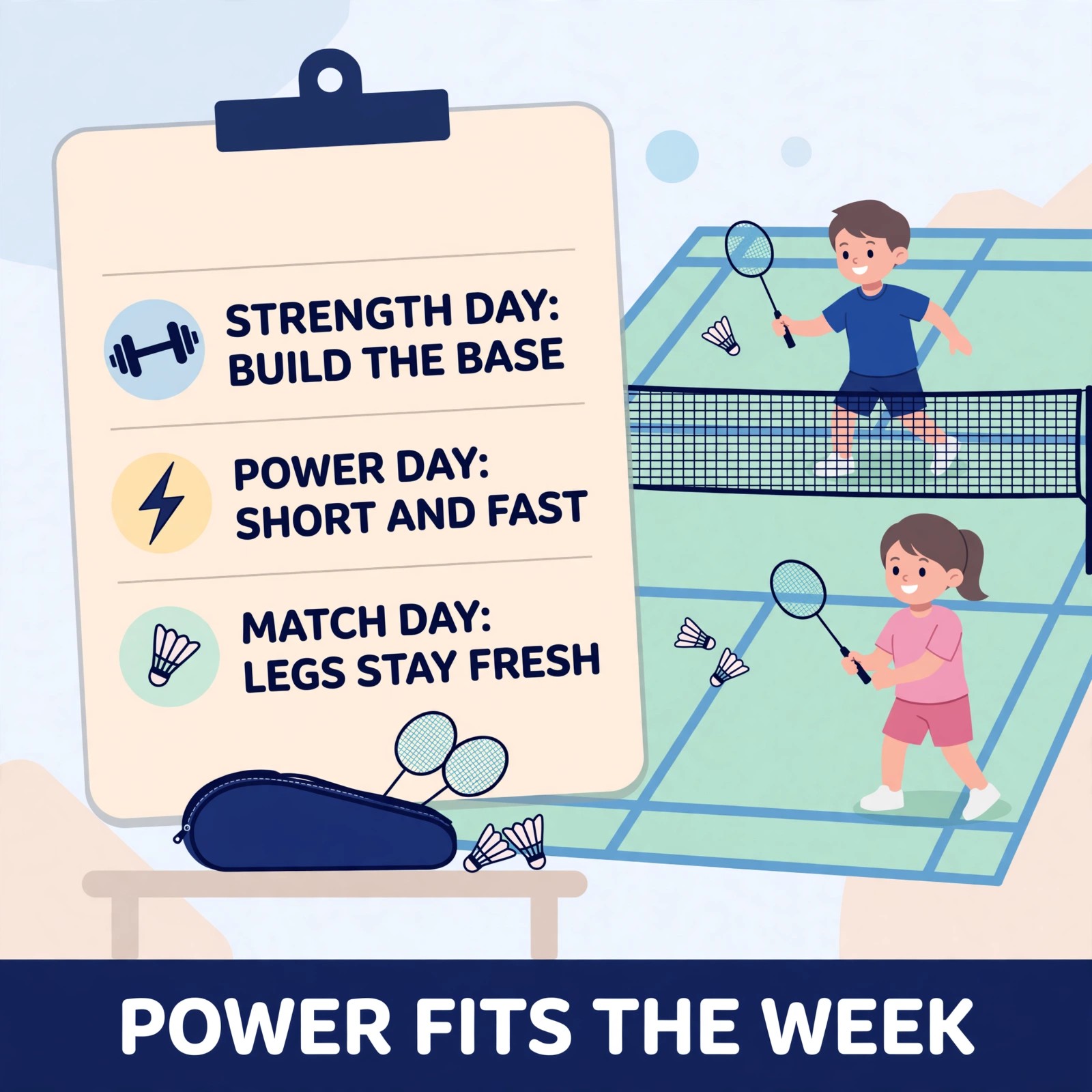
Power work has a strict address in the training week: early, while you are fresh. Fast muscles need a fresh nervous system, so throws, jumps and fast lifts belong at the start of a session or in their own short block, never as a finisher after exhausting match play. A common shape that works well is two power blocks a week: one paired with a strength day, one standing alone or before a lighter court session. Keep at least a day between them, and keep both away from the day before an important match. Fresh legs are not a luxury in power training; they are the entry ticket.
Progress one dial at a time. Add a little load to the base lifts, or a slightly heavier ball, or one more clean throw per set, then hold the change for two weeks and watch what your court game says. The tests are simple and honest: how far the medicine ball travels from a standing throw, how high and how quietly you jump, whether your clear still reaches the back line late in practice matches. Write the numbers down. Power grows slowly and quietly, and the notebook is how you know it is growing at all.
Recovery is the silent half of power. Fast work asks a lot of muscles, tendons and joints, and it only pays out when the days between sessions rebuild you. Sleep, regular meals and at least one full rest day are part of the programme, not rewards for finishing it. The warning signs of too much are plain: jumps getting lower across a week, a clear that keeps shrinking, enthusiasm draining out of sessions you used to enjoy. The fix is an easier week, not a harder one. Players get powerful by repeating good fast work across a season, and only recovered players can repeat anything.
Myth vs Reality
Myths About Building Power
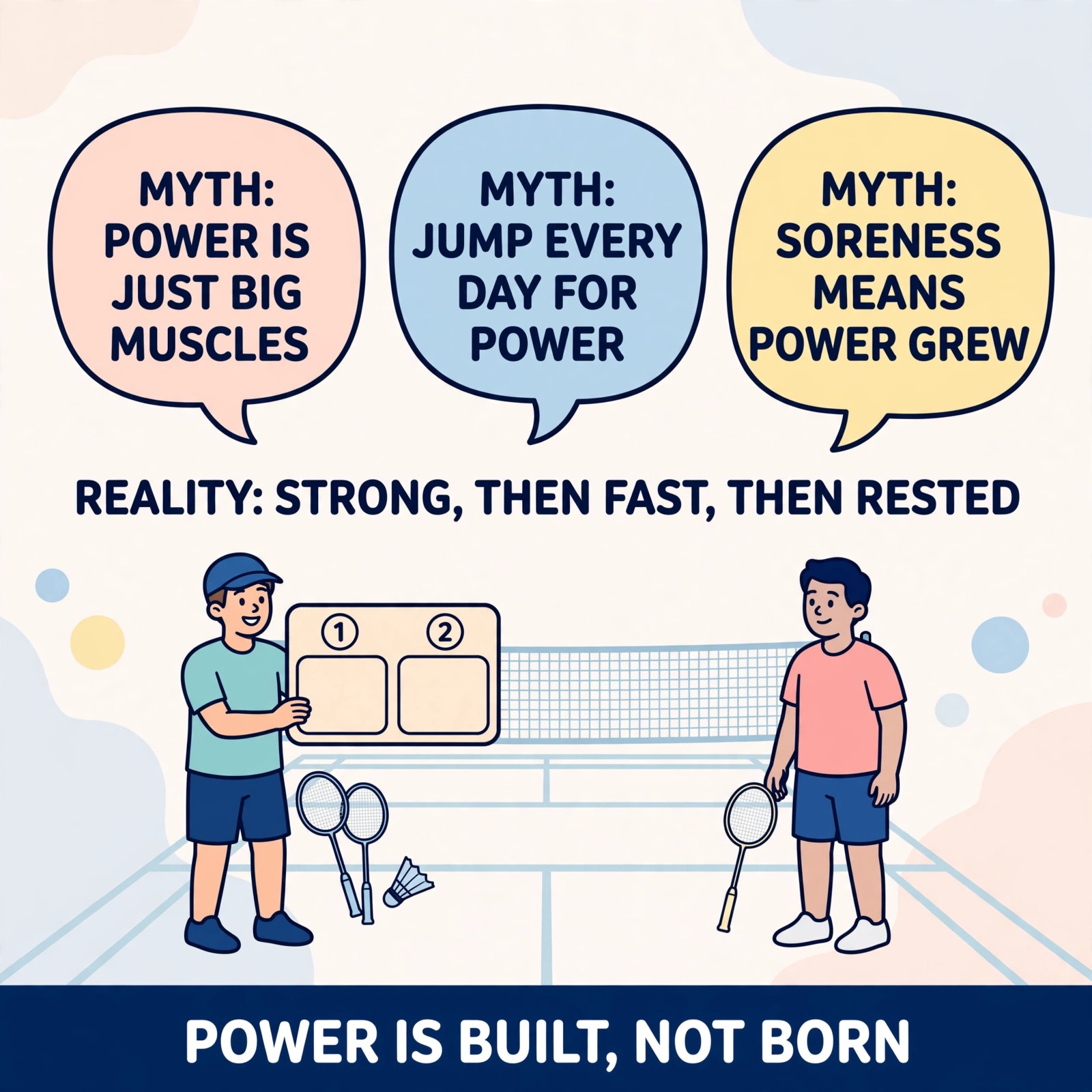
Myth one: power is just big muscles, so bodybuilding is power training. Size and power are cousins, not twins. A muscle can be large and slow, and a smaller muscle can fire extremely fast. Badminton rewards the fast one. Strength training matters because it raises the ceiling of what you can produce, but the power work in layer two is what teaches you to reach that ceiling quickly. Players who only chase size often feel heavier on court; players who build strength and then speed feel sharper. The order is the whole secret.
Myth two: soreness proves the power session worked. Soreness mostly proves the session was new or sloppy. A well built power session can leave you feeling almost fresh, because the sets are short and the rests are long, yet do more for your smash than a workout that wrecks you for three days. Judge power work by its tests: throw distance, jump quality, and what happens to your shots in the third game. If you train for soreness, you will get very good at being sore. It is not the same skill.
The honest summary is that power is a skill with a strength base, not a gift and not a mystery. Legs and hips supply the force, the trunk passes it on, the arm delivers it, and control keeps it from leaking. Build the base, teach it speed with throws, jumps and fast lifts, protect it with balance work and rest, and measure it with simple tests. Do that for a season and your smash, your clear and your first steps all change together. No shortcuts are involved, which is exactly why it works for ordinary players who stay consistent.
Why Choose Us
Why Players Choose ST Badminton Academy
At ST Badminton Academy, power training is built into our sessions in exactly these layers. Groups stay at four students or fewer, so a coach watches your squat, your throw and your landing, not just your rally. The strength base is taught before the fast work starts, loads and ball weights are matched to the player, and test days are written into the programme so progress is measured rather than guessed. Badminton stays the main sport in every session; the power work exists to serve your game on court.
Head coach Eric Chuar leads the programme, with over 15 years of coaching experience across Singapore and Malaysia. Eric’s rule for power work is simple: strong first, fast second, fresh always. He will stop a throw set the moment intent drops and a lift set the moment shape breaks, because he is coaching the quality that transfers, not the tiredness that photographs well. His players test their throws and jumps on a schedule, so a stronger month is a fact in a notebook, not a feeling.
You will find us in Setapak, Kuala Lumpur, easy to reach from Wangsa Maju, Melati Utama, Danau Kota and Gombak. If your smash feels capped, your clear fades late in matches, or your legs feel strong in the gym but slow on court, come and try a session with us. We will look at your base movements first, because that is where power problems usually start, and build your layers from there at a pace your game can absorb.
FAQs: Badminton Power Training in Malaysia (KL)
Power training raises fair questions, especially about gyms, soreness and where fast work belongs. Here are the answers we give most often.
Where can I train badminton power and explosiveness if I live in Setapak or Gombak?
With us, in Setapak. ST Badminton Academy is based in Setapak, Kuala Lumpur, and players travel in from Gombak, Wangsa Maju, Melati Utama and Danau Kota. Power work is taught inside our small group sessions, so your strength base, throws and landings are coached on the same court where you play, not in a separate gym membership.
What matters most for badminton power in KL?
Three things, in order. First, a real strength base in the squat, lunge and hinge patterns, because fast work needs strength to draw on. Second, fast practice itself: throws, jumps and light lifts moved at full intent. Third, freshness, because power only shows when legs are rested. Chase those three and power follows.
How often should I train power work to improve at a steady level?
Two short power blocks a week is the rhythm that works for most players, each built around a handful of throws, jumps and fast lifts done fresh. One block can sit with a strength day, the other before a lighter court session. More than two usually steals recovery from court training, and power grows from repeated quality, not from volume.
Can I build badminton power at home with no gym or partner?
Yes, the base travels well. Squats, lunges, hinges and trunk work need no equipment, and throws can be done with any heavy ball in an open space. Jumps need a kind surface and care with landings. What home cannot give you is a coach checking your shapes, so learn the patterns in a session first, then practise them at home.
Should power exercises come early in a session or at the end?
Early, while you are fresh. Power work asks for full intent and clean shape, and both disappear when you are tired. Put throws, jumps and fast lifts at the start of a session, or in their own short block on a separate day. The end of a session is for steady work and stretching instead.
Do you offer power and explosiveness coaching near Wangsa Maju?
Yes. Our base is in Setapak, a short drive from Wangsa Maju, and power coaching runs inside our regular small group sessions rather than as a separate course. Groups stay at four students or fewer, so your lifts, throws and landings are watched closely from your first session.
Does your academy teach medicine ball and jump training in Malaysia?
Yes. Medicine ball throws and jump work are regular parts of our training in Setapak, taught after the strength base is in place and always in small, fresh sets. A coach matches the ball weight and the jump height to the player in front of them, and every set stops while quality is still high.
Where does ST Badminton Academy coach badminton power?
At our home base in Setapak, Kuala Lumpur. Power work happens inside regular badminton training in the same hall, with no more than four students in a group. Players come in from Wangsa Maju, Gombak and across the Klang Valley, and trial sessions can be arranged through the academy.
What makes Mr Eric Chuar a suitable coach for power training in badminton?
Eric builds power in layers and refuses to skip them. He checks the base first: squat, lunge, hinge and trunk control. Then he adds throws, jumps and fast lifts in small sets, stops work the moment shape or intent drops, and tests progress on a schedule. Over 15 years of coaching have taught him that patient layers beat flashy programmes.
Badminton Power Training in Action


One Standard for Every Player and Every Session
Hold your power training to five standards. Strength before speed, always. Every fast set done fresh, at full intent. Shape decides when a set ends, not the clock or your pride. Landings as tidy as take offs. And every test written down, so progress is proven. Standards like these sound plain because they are. Plain standards, kept for a season, are what turn gym strength into court power that opponents can feel.
| Factor | Playing Only | Layered Power Training POWER |
|---|---|---|
| Frequency | 1 or 2 times a week. Mostly for fun and sweat. | Two short power blocks a week, placed fresh and away from big matches. |
| Drills Focus | Basic static feeding. Minimal footwork pressure. | Squats, lunges, throws and fast lifts that copy the actions of the game. |
| Physical Conditioning | Rarely included. Just playing games on court. | Core, agility, and speed training included in every session to prevent injury and build stamina. |
| Tactical Awareness | "Just hit it over." No real game plan. | Video analysis, point construction, and learning to read the opponent's game. |
| Coach Ratio | Large groups (8-10 kids). Coach barely watches you. | Max 4 students. Mr Eric Chuar personally corrects every stroke and movement detail. |
| Goal Setting | Fun and exercise. | Power tested with standing throws and quiet jumps, written down monthly. |
| Long Term Result | Good recreational player. | A player whose smash, clear and first steps keep their force in the third game. |
Badminton Power Coaching in Kuala Lumpur
Power is strength at speed, and it is built, not born. Build the base with squats, lunges, hinges and honest trunk work. Teach it speed with throws, jumps and fast lifts. Protect it with balance, landings and rest. If you would like those layers coached rather than guessed, train with us in Setapak. Bring your racket and your questions. We will check your base movements first and build from there.




