Badminton And Core Strength | Exercises For Improving Stability And Power (Core Guide)
Ask any coach where badminton power really comes from and the answer surprises many players: the middle of the body. Core strength is the link between your legs and your racket arm, and it decides whether the power you generate in a lunge or a jump actually reaches the shuttle. This guide walks through the core exercises that matter most for badminton, from planks and bird dogs to medicine ball throws and standing work, and shows how to fit them beside court training at ST Badminton Academy in Setapak, Kuala Lumpur, without turning fitness work into a second full time job.
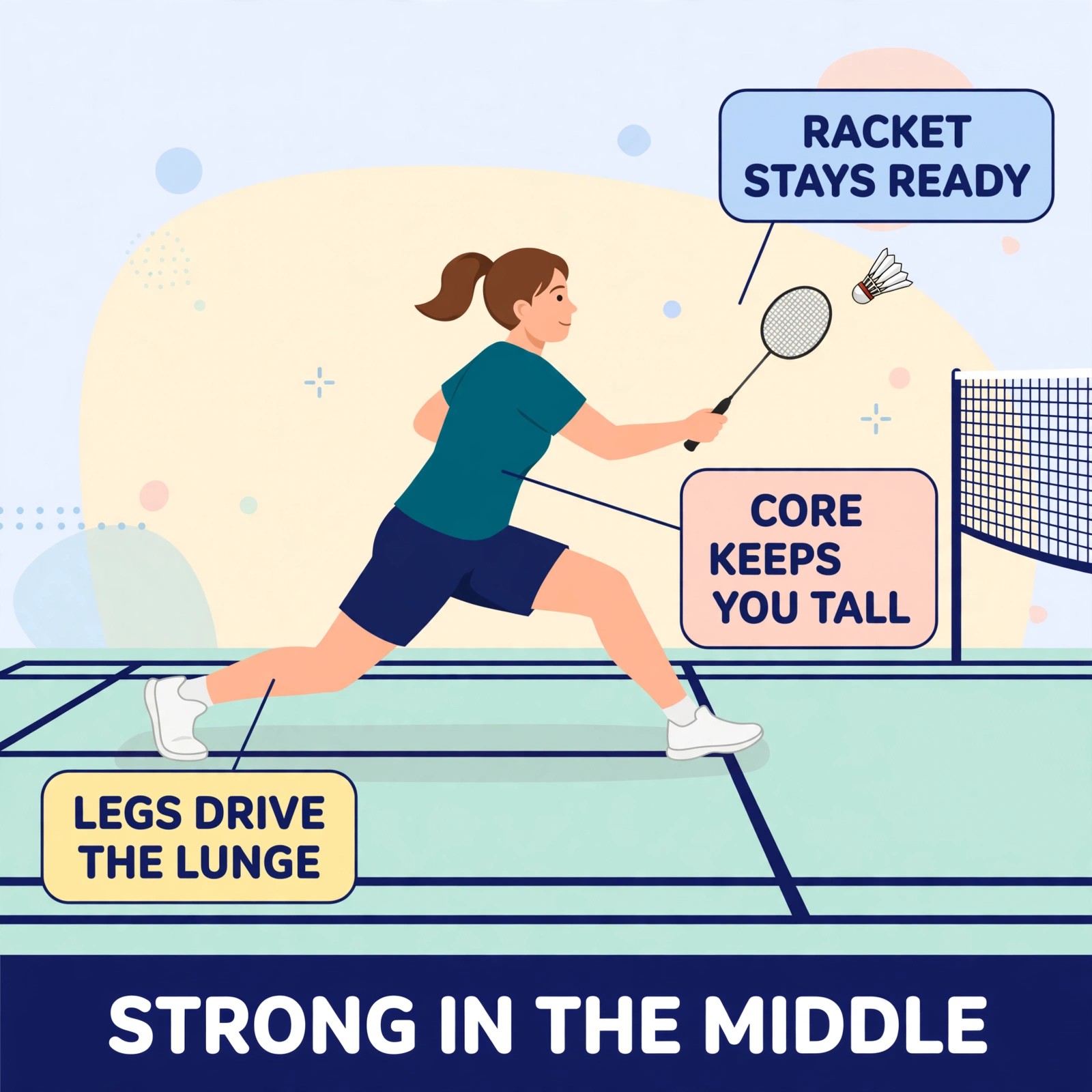
Core Check #1
Why the Core Decides Your Power
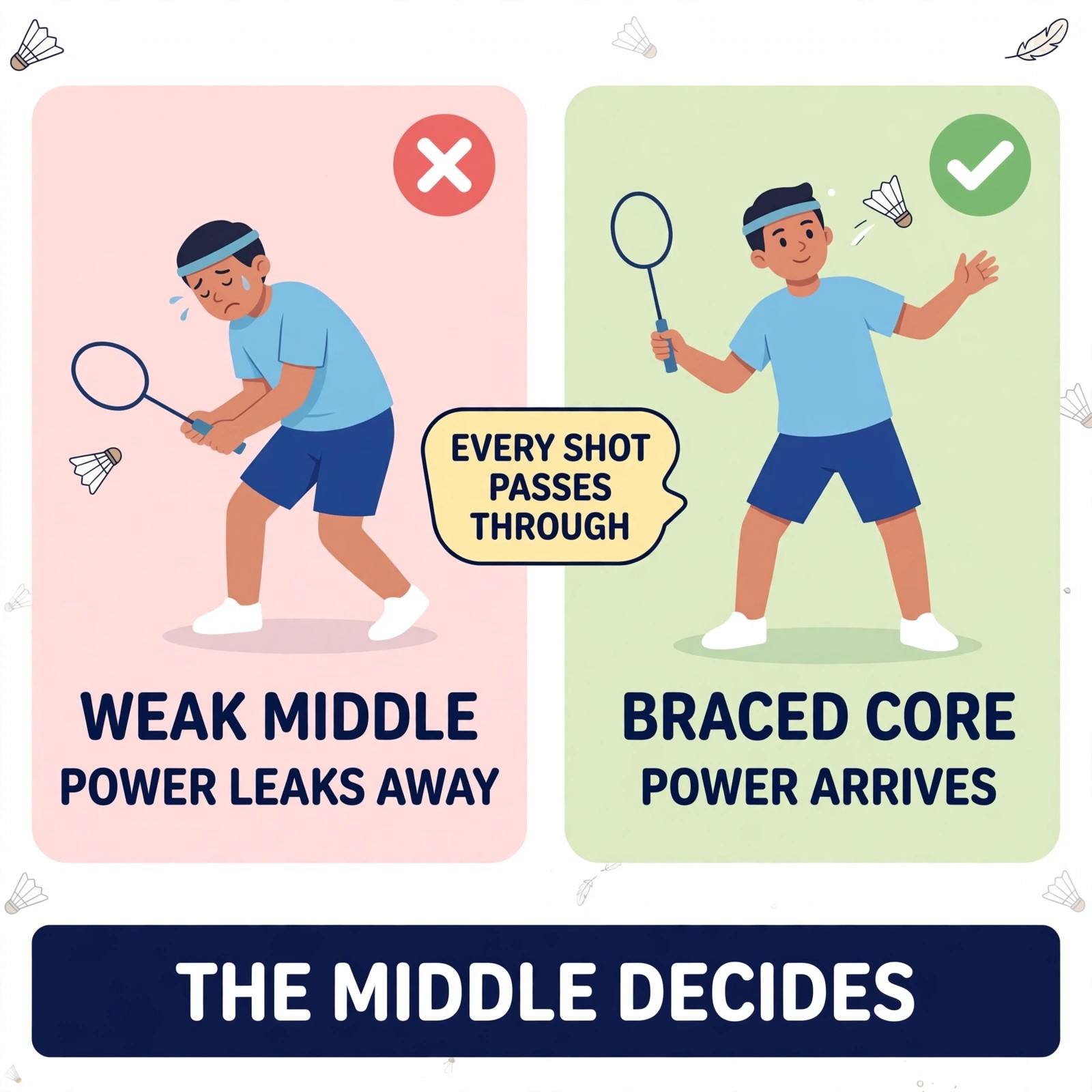
Every hard shot in badminton starts on the floor. Your legs drive you into the lunge or up into the jump, your trunk turns, and only then does the arm swing. The muscles of your core, the deep abdominals, the obliques and the muscles along your back, are the bridge in that chain. When the bridge is strong, force passes through cleanly and the shuttle leaves the racket fast. When it is weak, force leaks away at the trunk: the body folds, the shoulder does extra work, and a shot that should have been a winner floats harmlessly back.
Stability is the other half of the story. Badminton is a game of hard stops: big lunges at the net, landings after jump smashes, sudden changes of direction at the back of the court. A braced core keeps your pelvis and ribs stacked so those stops stay controlled instead of wobbly. That control protects your lower back and knees, steadies your racket head at contact, and lets you recover to base a fraction faster. Players rarely notice a strong core directly. They notice what it removes: the wobble, the late recovery, the shots that fade late in the third game.
Core Check #2
The Plank Family: Holds That Hold You
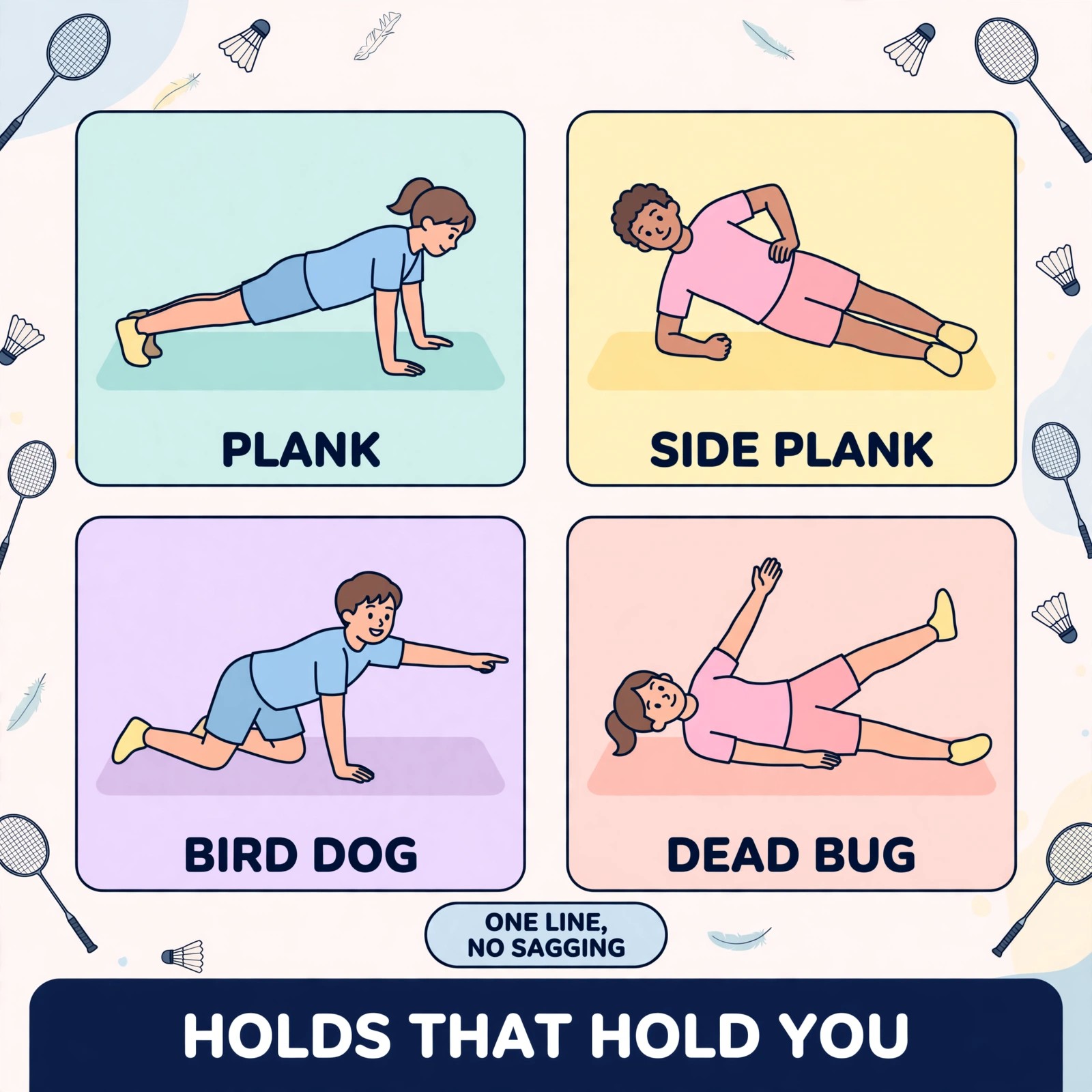
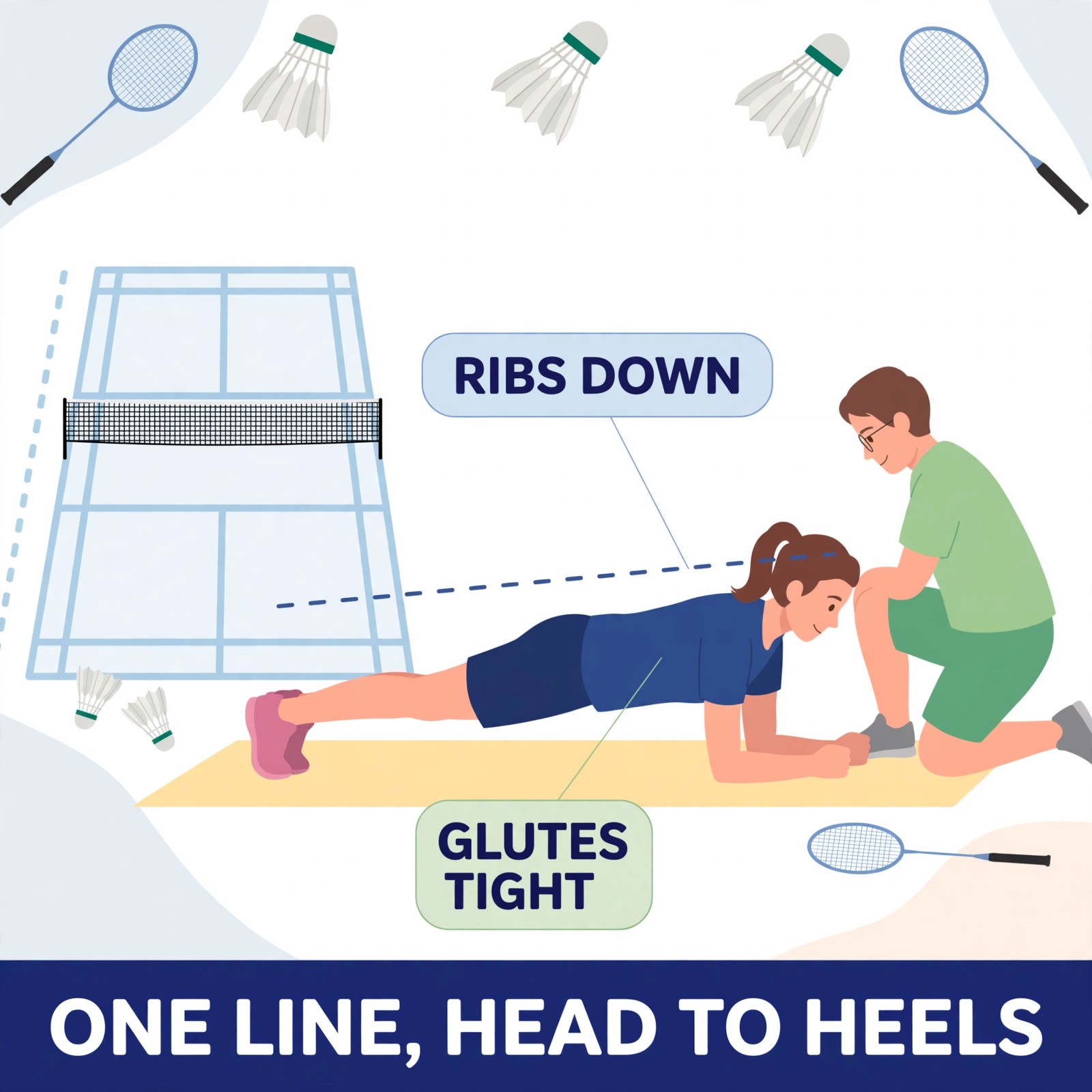
The plank family is where core training for badminton should start, because it teaches the skill underneath everything else: holding one straight line while you breathe. In a basic plank, forearms or hands under shoulders, ribs pulled down, glutes tight, you are practising the exact brace you need in a ready position. Start with holds you can keep clean, twenty to forty seconds, and stop the set the moment your hips sag or your lower back arches. Short, perfect holds build far more useful stability than one long, ugly hold at the end.
The side plank trains the obliques and the side of the hip, the muscles that stop you tipping over in wide defensive lunges. Stack your feet or stagger them, elbow under shoulder, and lift until your body forms one line from head to heels. If the full version is too much at first, drop the lower knee and build from there. Both sides matter equally. Many players find one side clearly weaker, and that gap often matches the side they struggle to defend on court, which makes the side plank a useful test as well as a training tool.
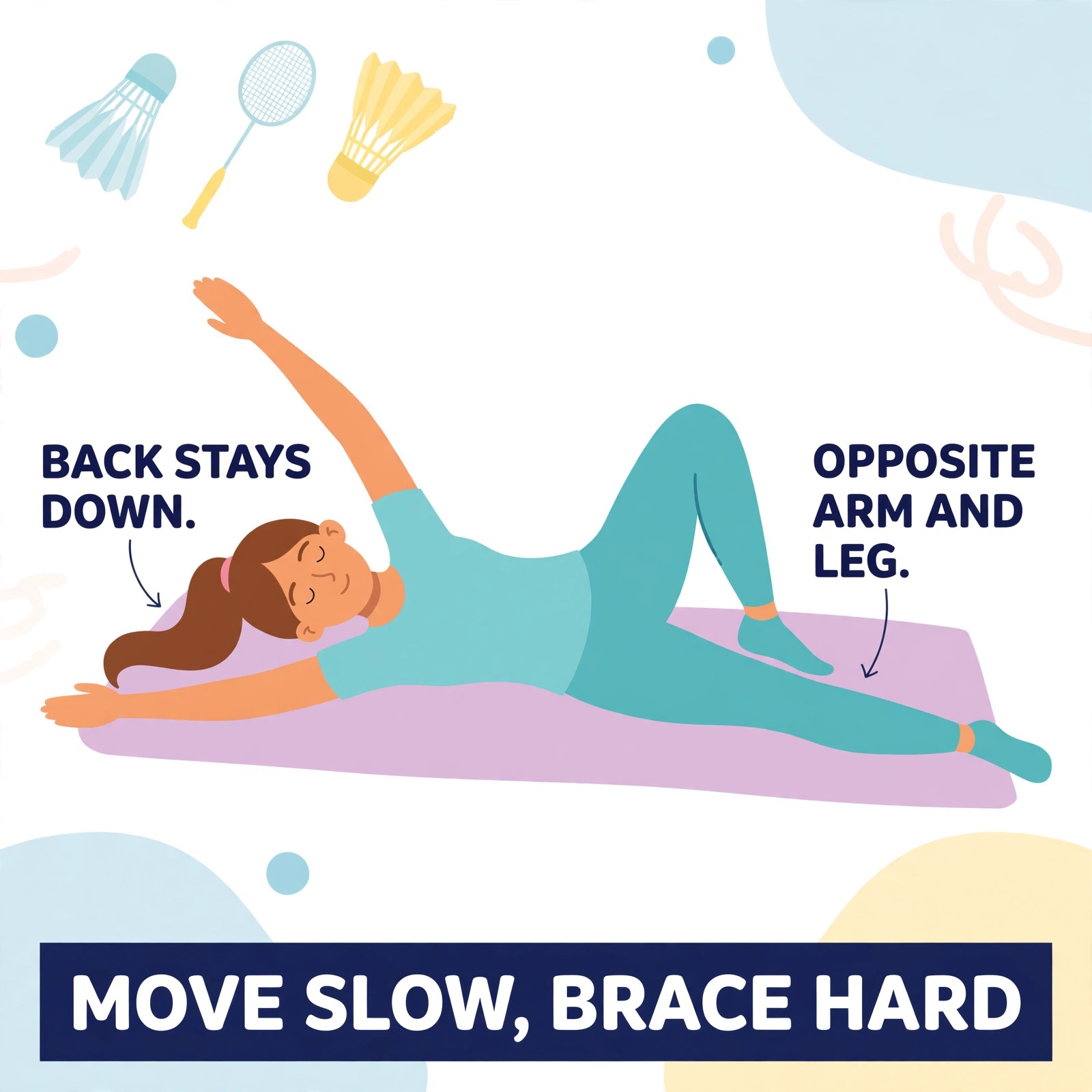
Bird dogs and dead bugs add movement to the brace. In a bird dog, on all fours, you reach one arm forward and the opposite leg back while your hips stay square and level, as if balancing a cup of water on your lower back. In a dead bug, lying on your back, you lower the opposite arm and leg slowly while your lower back stays pressed into the floor. Both drills teach the trunk to stay quiet while the limbs move, which is precisely what happens every time you lunge, reach and play a shot.
Core Check #3
Rotation Work: Twist With Control
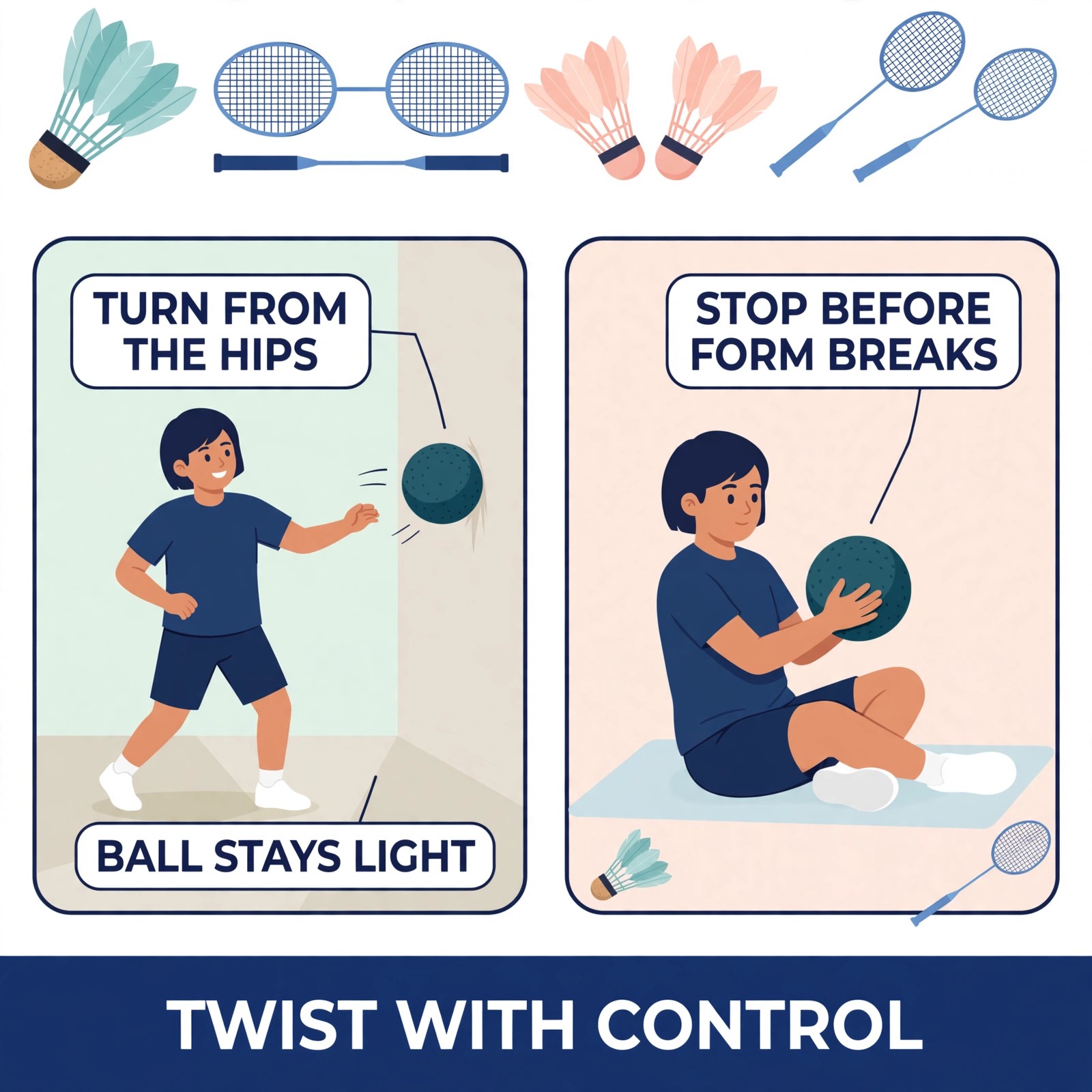
Badminton power is rotational. A backhand drive, a cross court clear and above all the smash all turn the trunk quickly and then stop it cleanly. Medicine ball throws are the most direct way to train that turn. Stand side on to a solid wall, hold a light ball at your hip, and throw by turning your hips and trunk together, finishing tall. The ball should stay light enough that speed, not strain, does the work. If you have no wall, a partner catch or a throw into open space at the park works the same way.
Russian twists build the same muscles in a slower, controlled way. Sit tall with knees bent, lean back slightly with a straight back, and rotate your ribs from side to side, moving the ball or your clasped hands with control. The common mistake is rushing: fast, sloppy twists train momentum, not muscle. Keep the movement smooth enough that you could pause at each side. Plank hip drops and standing oblique crunches complete the set, training the sides of the trunk through a full range while you stay tall and balanced on your feet.
Two safety rules govern all rotation work. First, the turn should come from the ribs and hips moving together, not from twisting hard through the lower back alone. Second, light and clean beats heavy and wild every time: if the load makes you hold your breath and heave, it is too heavy for this purpose. Done well, rotational work shows up on court as a smash that stays steep late in the match and a trunk that still turns fully when tired legs start asking the upper body to do everything.
Core Check #4
Standing Core: Power on Your Feet
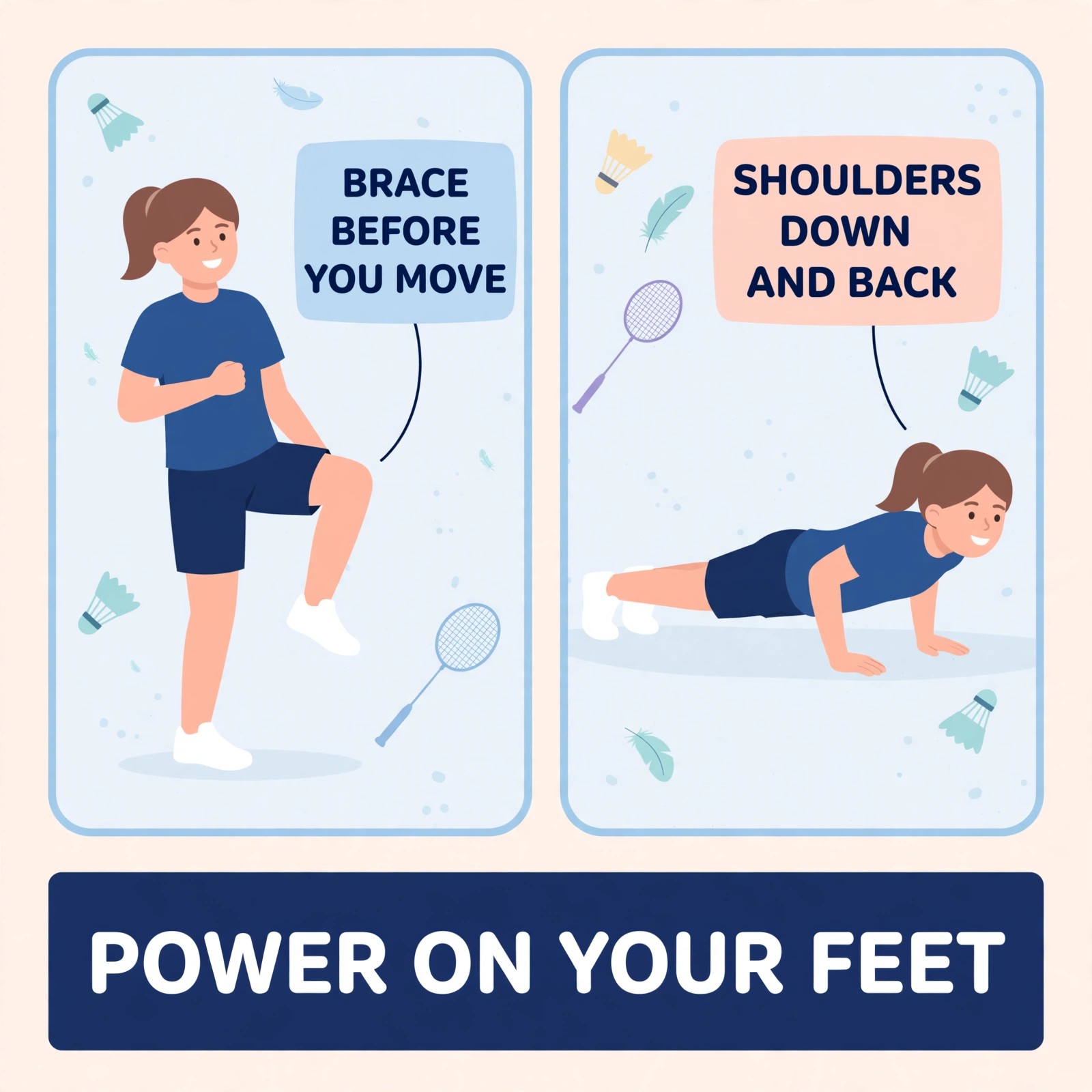
Most badminton is played standing up, so some of your core work should be too. Standing oblique crunches, driving one knee up toward the elbow on the same side while staying tall, train the brace in the posture you actually compete in. They also double as a balance drill: the slower you move, the more your stabilisers have to work. Add plank hip drops for the sides and push up variations for the front of the body, and you have a standing friendly set that needs no equipment and fits in a hallway or beside the court.
Push ups deserve their place in a core programme because a good push up is a moving plank. Hands under shoulders, body in one line, glutes tight: the trunk works the whole time while the chest, shoulders and arms do the pushing. Variations change the demand. Staggered hands shift more load to one side, decline push ups with feet raised raise the difficulty, and slow eccentrics, lowering for a count of three, build control. Keep the line honest; if your hips sag, the core has stopped doing its share and the set should end.
Squats and lunges complete the picture because they connect the core to the legs it serves. A split squat or walking lunge asks your trunk to stay tall while your legs work hard, which is exactly the demand of a deep net lunge followed by a push back to base. Train them with bodyweight first, slow and balanced, before adding any load. When your legs and trunk work as one unit, you stop thinking about your core on court at all, and that is the point: stability you never have to think about.
The Routine
A Core Week That Fits Training
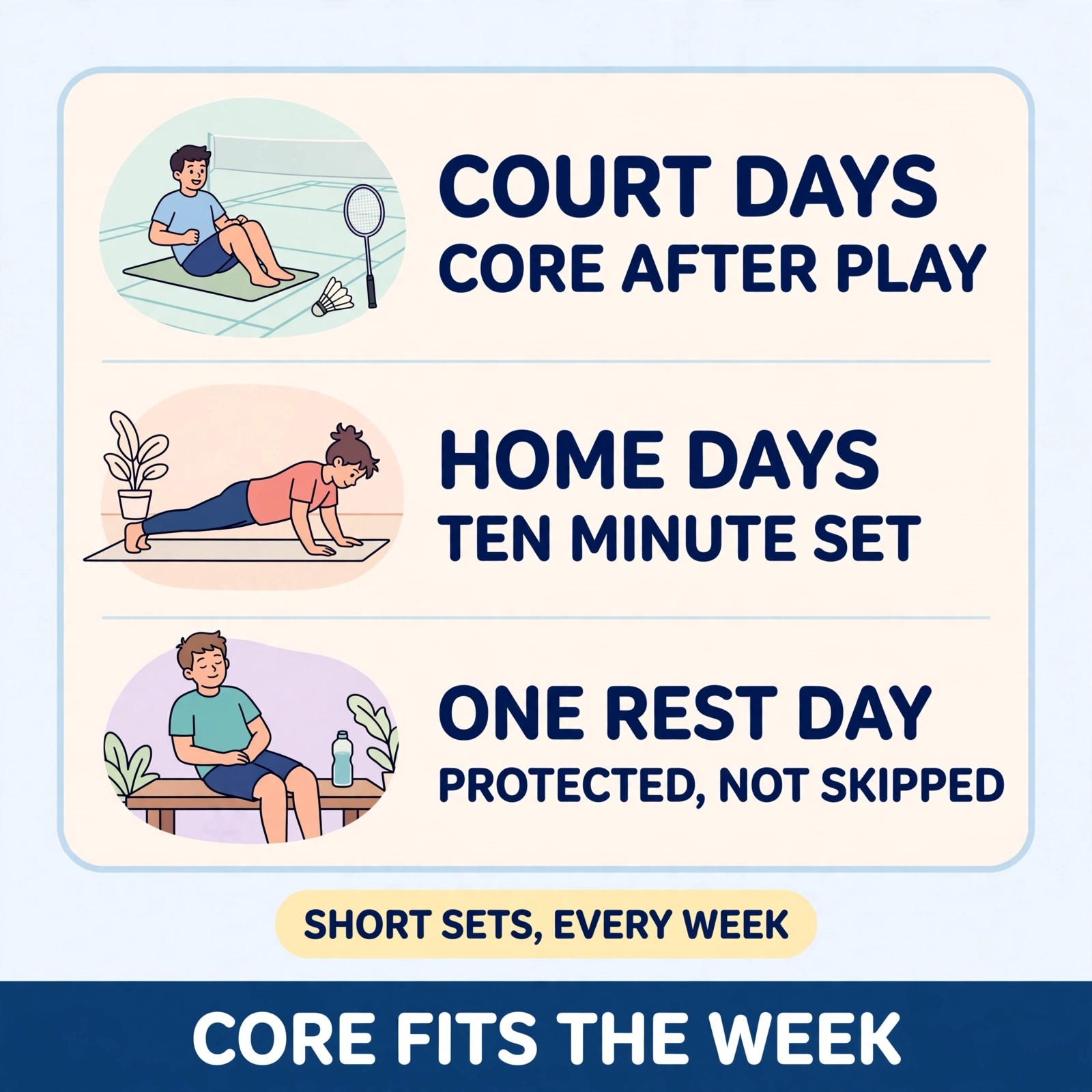
Fitting core work into a badminton week is simpler than most players fear. Two or three short sessions a week is enough for real progress, and short means ten to fifteen minutes, not an hour in the gym. Attach the work to sessions you already have: after court training while you are warm, or as a small home set on the days between. A sample shape: day one, the plank family; day two, rotation work; day three, standing core and push ups. The exercises rotate, the habit stays the same.
Warm up before the work, always. Two or three minutes of dynamic movement, leg swings, arm circles, easy lunges and a few jumping jacks or high knees, prepares the muscles and joints far better than sitting into long static stretches while cold. Inside the session, rest enough between sets to keep every rep clean; core training is quality work, not a race. Finish while your form is still good. Walking away with two perfect sets in the bank beats collapsing through a fourth set with a sagging back.
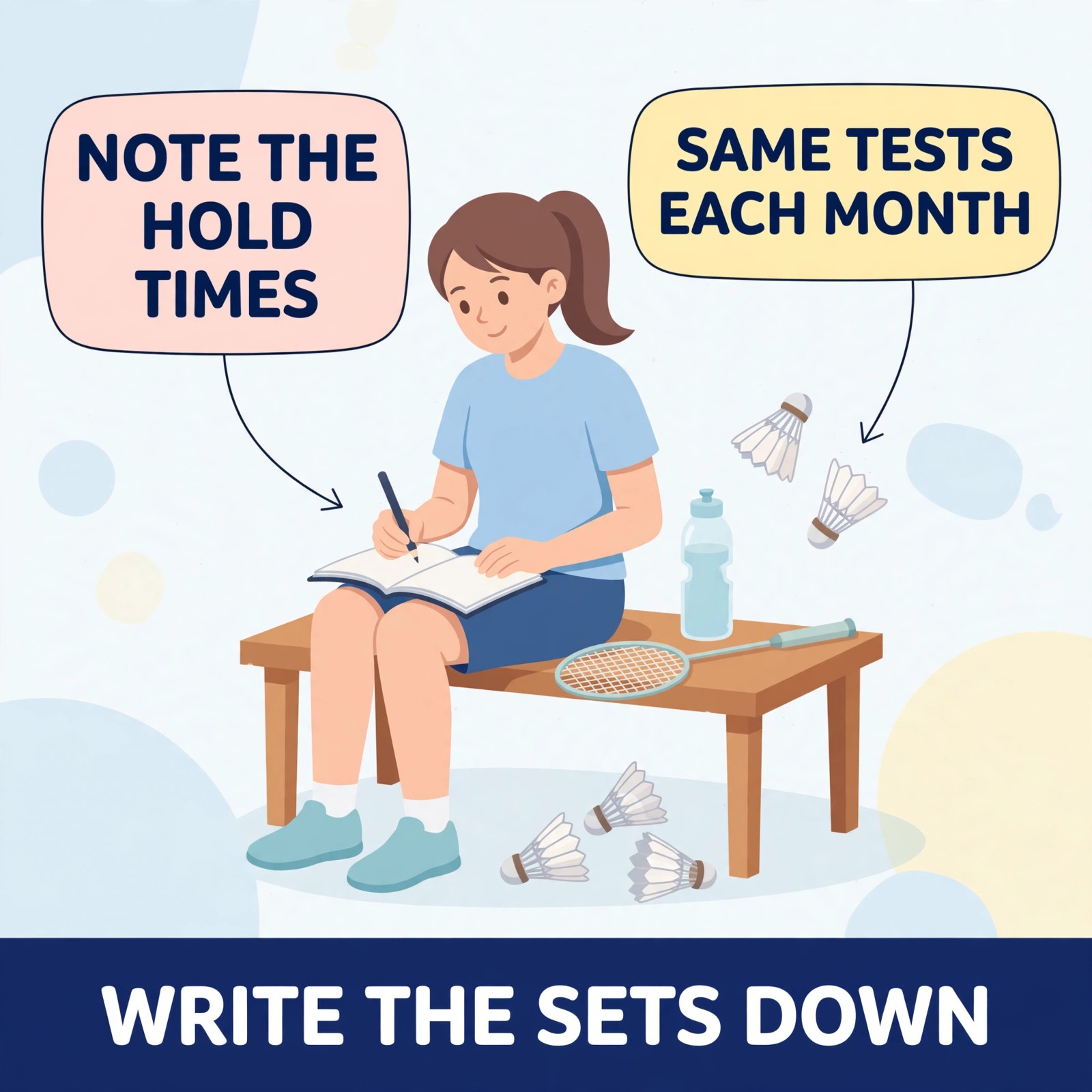
Track the work the simple way, in a notebook or phone note: exercise, sets, hold times or reps, and one line on how it felt. Retest monthly with the same small tests, your best clean plank hold, side plank each side, and a set of dead bugs with no back lift, so progress is visible rather than guessed. Expect change in weeks, not days: first your holds feel steadier, then lunges land quieter, then late match shots stop fading. Steady records make that quiet progress impossible to miss.
Myth vs Reality
Myths About Core Training
Myth one: core training means chasing a six pack. Visible abs are mostly about body fat, not function. Plenty of players with flat stomachs fold under a smash, and plenty of strong cores hide under an ordinary looking middle. Train what the core does, brace, rotate, resist rotation, not how it photographs. Myth two follows from it: that crunches alone are enough. Crunches train one bend. Badminton asks the trunk to hold still, turn, and stop turning, so a programme built only on crunches leaves most of the job undone.
Myth three: soreness proves the session worked. Soreness mostly proves the work was new. Chasing it leads players to pile on volume until form collapses, which trains exactly the sloppy patterns core work exists to remove. Judge a session by clean reps and steady progress on your tests, not by how hard it is to sit down tomorrow. Myth four is the opposite trap: the idea that core work is only for injured players or gym people. Every lunge you play is core work done badly or well. Training it on purpose just chooses well.
One honest limit should be stated plainly: no exercise programme can promise you will never get injured, and this guide will not pretend otherwise. What good core training can do is lower the risk by improving how forces pass through your body, and support the back, hips and knees that badminton loads hardest. That is a meaningful claim, and it is enough. Strong claims need no decoration. Build the brace, train the turn, repeat the habit, and let your third game shots make the argument for you.

Why Choose Us
Core Coaching for Badminton Players
At ST Badminton Academy, core work is not a separate fitness class bolted onto badminton. It is woven into the court sessions themselves: bracing cues inside footwork drills, balance checks inside lunge practice, and short mat sets to finish a session while players are warm. Groups are capped at four students, so a coach can watch your plank line, your landing and your recovery as closely as your grip. The goal is simple: the strong, stable base your strokes need, built inside the training you were already coming to.
The programme is led by head coach Eric Chuar, who brings over 15 years of coaching experience across Singapore and Malaysia. Eric teaches core work the way he teaches footwork: by position, by feel, and by honest correction. He will spot the hip drop in your side plank, the fold in your landing, and the brace you lose when the rally gets long, then fix the habit at its root. Players improve fastest when someone who knows the game watches the details, and that watching is the core of his coaching.
You will find us in Setapak, Kuala Lumpur, an easy trip from Wangsa Maju, Melati Utama, Danau Kota and Gombak. Most of our players are local students, working adults and parents who train with us around school and office hours. If your smashes fade late, your landings feel wobbly, or your back complains after long sessions, come and let us look at the base those problems start from. A strong middle is trainable at any age and any level, and it starts with one honest assessment on court.
FAQs: Core Strength Training in Malaysia (KL)
Parents, students and adult players ask us about core training often, so here are the answers we give most, in plain words.
How can I build core strength for badminton if I live in Setapak or Gombak?
Start with two or three short sessions a week built on planks, side planks, bird dogs and dead bugs, added after court play or at home. No gym is needed, just a mat and honest form. At ST Badminton Academy in Setapak, we build the same work into court sessions, so local players get coached core training without extra trips.
What matters most in core training for badminton in KL?
Form matters more than load, every time. A clean twenty second plank with ribs down and glutes tight teaches your body more than a two minute plank with a sagging back. After form comes variety: holds, rotations and standing work. Your core responds to short, weekly sessions far better than one heroic workout followed by a fortnight of nothing.
How many core sessions a week should I plan alongside court level?
Two or three sessions a week is the range we recommend for most players, and each one needs only ten to fifteen minutes. Put them after court training while you are warm, or on the days between sessions. One session can focus on holds, another on rotation, another on standing work. Rest days still count as training.
My core feels weak late in matches. Where do I start?
Start with the plank family, because late match weakness is usually a bracing problem before it is a strength problem. Practise planks, side planks and dead bugs twice a week with perfect form, and add one habit to your matches: brace before every serve receive and every big lunge. Most players feel steadier landings within a few weeks.
Which core exercises help my smash and footwork most?
For the smash, rotational work leads: medicine ball throws and controlled Russian twists train the trunk turn that feeds the arm. For footwork, the holds lead: side planks and bird dogs keep you balanced through lunges and landings. Dead bugs help both, because they teach your trunk to stay quiet while your limbs move fast.
Do you train core strength in classes near Wangsa Maju?
Yes. Core work is built into our regular sessions rather than sold as a separate class: bracing cues inside footwork drills, balance checks inside lunge practice, and short mat sets to finish. Groups stay at four students or fewer, so the coach sees every rep and fixes form on the spot. Setapak is a short trip from Wangsa Maju.
Can the academy help me build core strength for tournaments in Malaysia?
Yes, and this is where planned core work pays off fastest. Tournament days stack matches back to back, so the players who hold their brace in the third match of the day keep their smashes steep and their landings safe. We build core blocks into preparation, test holds monthly, and taper the heavy work before competition so you arrive fresh.
Where is ST Badminton Academy KL located for core training?
We are in Setapak, Kuala Lumpur. The hall is easy to reach from Wangsa Maju, Melati Utama, Danau Kota and Gombak, and most players come by car or ride hailing after school or work. Core training happens inside the same hall as our court sessions, so you need one trip for both.
What does Mr Eric Chuar teach about core training in badminton?
Eric teaches that the core is a skill before it is a strength. His first lesson is the brace: ribs down, glutes tight, one straight line, practised in planks until it becomes automatic. Then come rotation for power and standing work for balance, taught inside badminton movements, not in isolation. His rule is simple: when form goes, the set ends.
Core Strength Training in Action

What It Takes to Own Your Core
Hold yourself to five standards and your core will look after your game. Every hold finishes in one clean line, never a sagging one. Every rotation stays smooth enough to pause. Every session is written down. Every week keeps its rest day. And every exercise serves a shot you actually play: a lunge that lands quietly, a smash that stays steep, a recovery that gets you home. Standards like these sound plain, but plain standards, kept weekly, are what separate players who train from players who improve.
| Factor | Arms Only | Builds the Core CORE |
|---|---|---|
| Frequency | 1 or 2 times a week. Mostly for fun and sweat. | Two or three short core sessions a week sit beside court training, every week. |
| Drills Focus | Basic static feeding. Minimal footwork pressure. | Bracing is practised as a skill: plank, side plank, dead bug and controlled twists. |
| Physical Conditioning | Rarely included. Just playing games on court. | Core, agility, and speed training included in every session to prevent injury and build stamina. |
| Tactical Awareness | "Just hit it over." No real game plan. | Video analysis, point construction, and learning to read the opponent's game. |
| Coach Ratio | Large groups (8-10 kids). Coach barely watches you. | Max 4 students. Mr Eric Chuar personally corrects every stroke and movement detail. |
| Goal Setting | Fun and exercise. | Power is tested on court: smashes, lunges and recoveries late in the third game. |
| Long Term Result | Good recreational player. | A player who stays tall and balanced when tired, and lands every lunge under control. |
Core Strength Training in Kuala Lumpur
Your core is the quiet centre of every shot you play. Build it with holds that teach the brace, rotation work that feeds your power, and standing exercises that balance you on your feet, two or three short sessions a week, tracked honestly and rested properly. Do that for a season and the change shows up where it matters: in the third game. If you would like that work coached rather than guessed, you are welcome to train with us in Setapak. Bring your questions, bring your notebook, and let us build your base together.




