The Importance Of Proper Warm-Up And Cool-Down In Badminton (Warm-Up Guide)
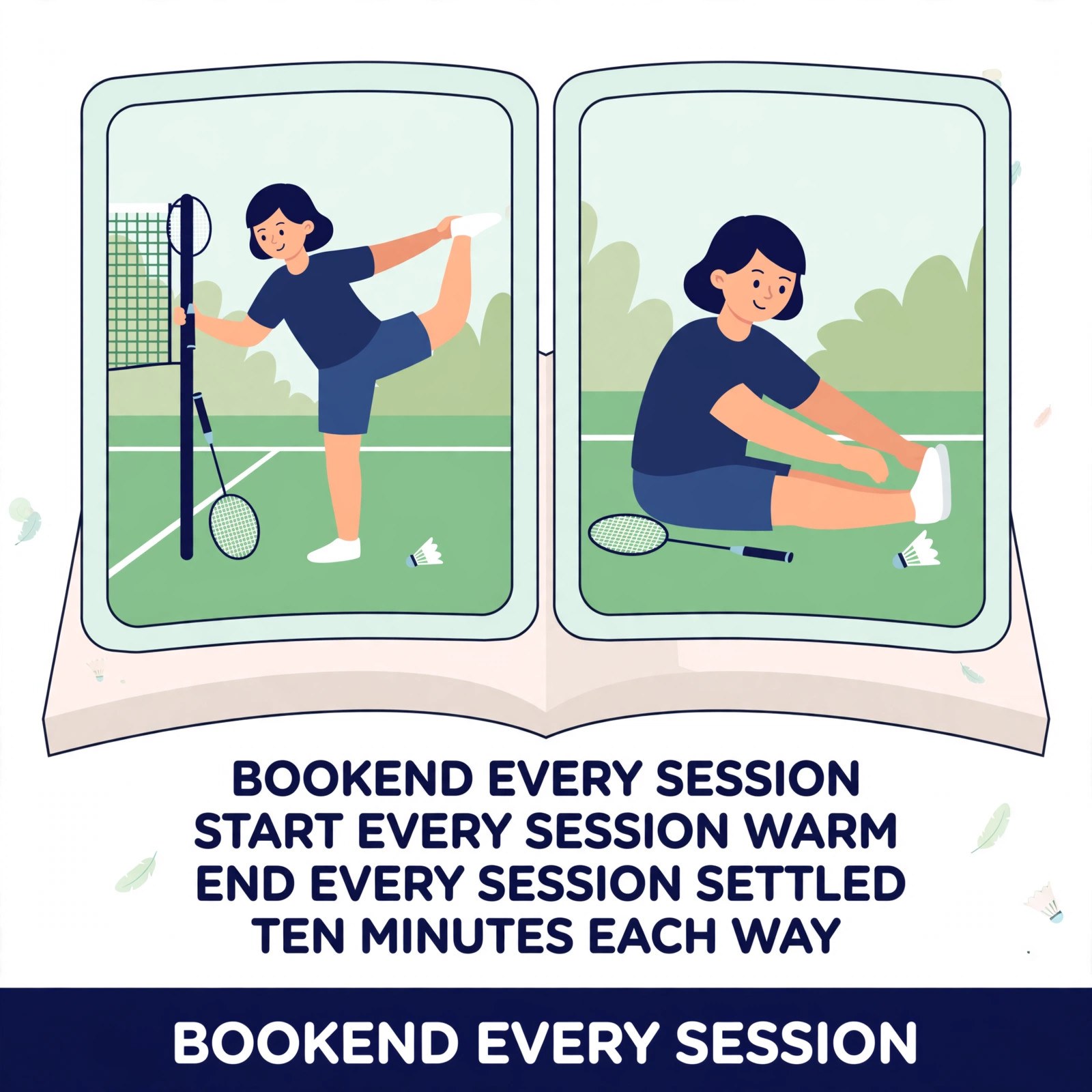
Every badminton session has two ends, and most players only respect the middle. They arrive, play hard from the first rally, and walk off the moment the games end. The ten minutes before and the ten minutes after are treated as extras. This guide explains why those bookends matter: what a warm up actually changes inside your body, what a cool down actually does, and how to run both in a simple order that fits training, matches and tournament days. It is the standard routine we teach at ST Badminton Academy in Setapak, Kuala Lumpur.
Session Check #1
Why the Warm-Up Comes First: What Changes Inside the Body
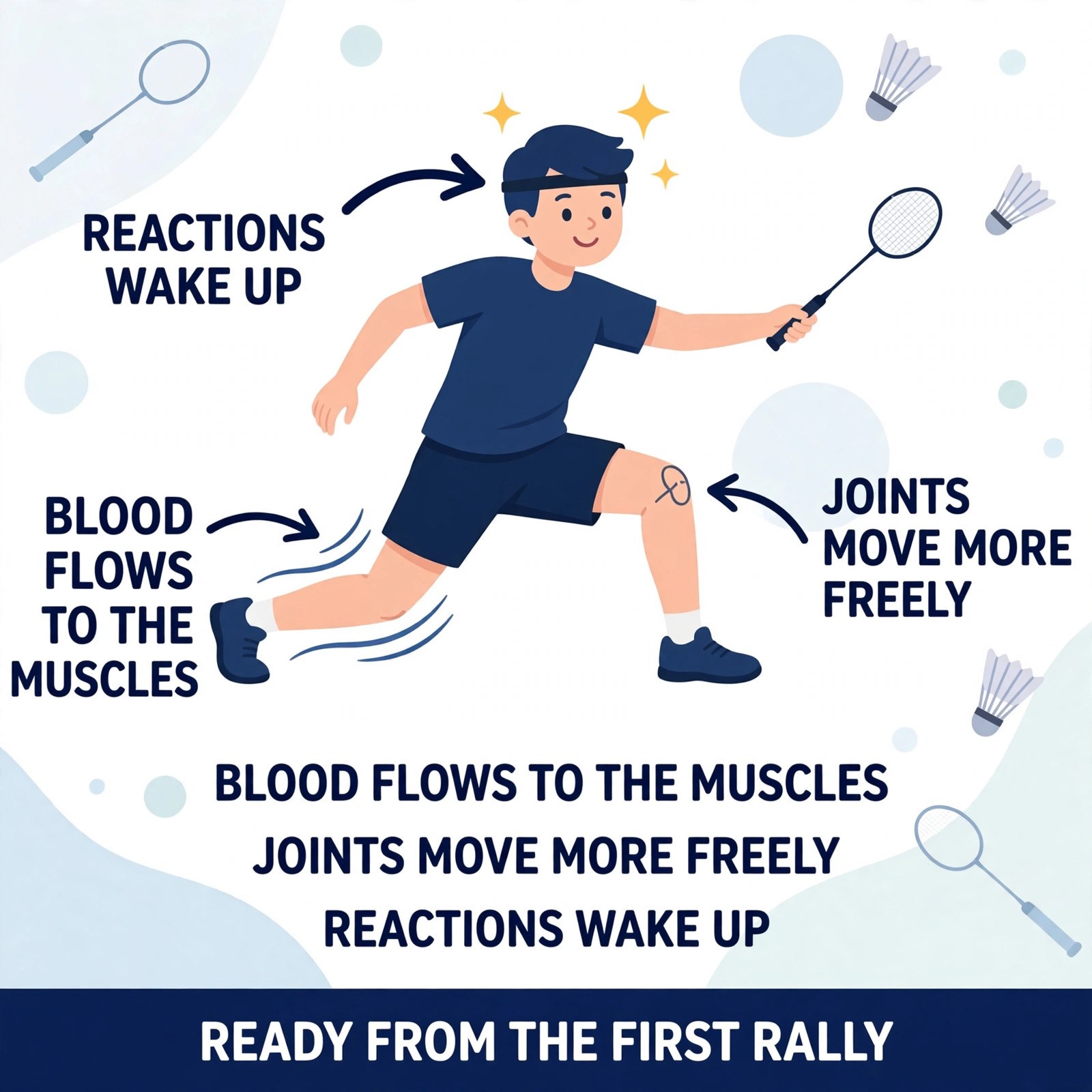
A warm up is not a ritual or a superstition. It is a set of plain physical changes. Your heart rate climbs, so more blood reaches the muscles that are about to work. Your body temperature rises a little, and warmer muscles contract and relax more smoothly. The fluid inside your joints spreads and thins as you move, so knees, ankles and shoulders travel through their ranges with less stiffness. None of this is guesswork; you can feel each change arrive inside ten minutes of moving.
The second change is in your reactions. A cold player is a late player: the first lunge is stiff, the first change of direction is heavy, and the first hard rally arrives before the body is ready for it. Warming up wakes the system up in the right order, coordination first, then speed. It also lowers the risk of the classic cold start injuries, the pulled calf and the tweaked ankle, though no routine can remove risk completely, and we will not pretend otherwise in this guide.
Session Check #2
What a Good Warm-Up Looks Like, Step by Step
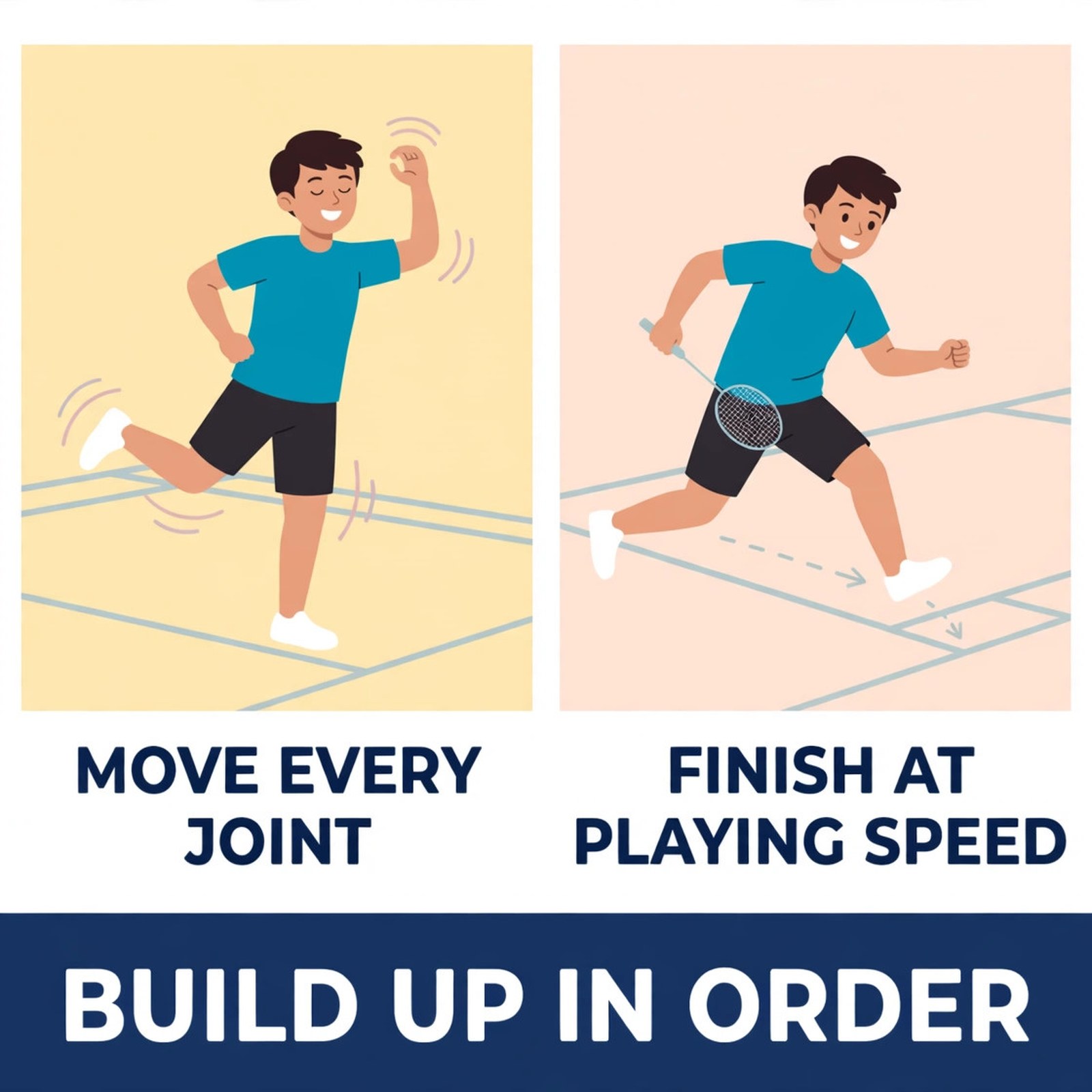
A good warm up follows the same order every time: raise, move, shadow, rally. Start by raising the pulse with two or three minutes of easy jogging, side steps and skipping around the court. Nothing heroic; you should still be able to talk. This is the part that starts the blood flow and the temperature change described in the last section, and it is why gentle jogging beats standing stretches as an opener.
Next, move every joint the game uses. Circle the ankles, knees, hips and shoulders. Swing each leg forward and back, then side to side, holding the net post if you need balance. Circle the arms small, then big, and add gentle trunk turns. Then shadow the game itself: footwork to the four corners without a shuttle, building from easy to brisk. By the end of this stage your body has already visited every shape the match is about to ask for.
Finish with rallies that build. Knock up easy at first, clears at half pace, then drives and drops at rising speed, until the last minute feels like the match itself. The whole warm up takes around ten minutes for most players. Static stretching, the long held kind, does not belong anywhere in it: held stretches on cold muscles are the wrong tool at the wrong time, and their proper home is the cool down at the other end of the session.
Session Check #3
Why the Cool-Down Comes Last: Settling the System
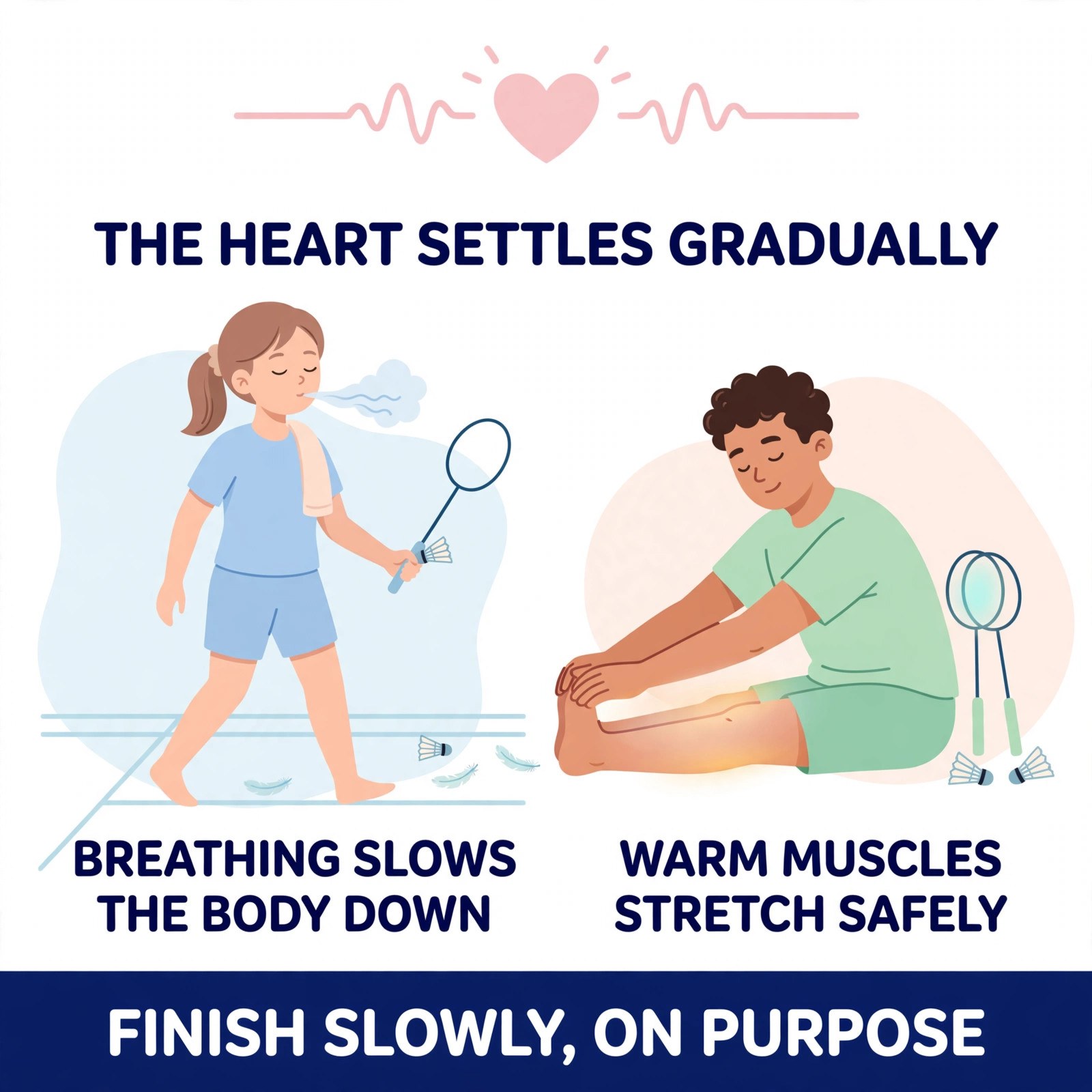
If the warm up switches the body on, the cool down switches it off properly. After a hard session your heart is still beating fast and your muscles are still full of working blood. Stopping dead and sitting in the car is a sudden order your system handles badly: blood pools, the head can feel light, and everything stiffens as it cools in a heap. A gradual finish gives the heart and breathing time to settle at their own pace.
The cool down is also the one moment when held stretching is the right tool. Muscles are warm, ranges are open, and gentle pulls on the calves, thighs, hips, chest and shoulders help you keep that range across a season. This is about comfort and maintenance: feeling looser tomorrow, and keeping the movements badminton needs available year after year. Be honest about the limit, though: a cool down cannot cancel a session that was far too hard, and skipping it is not what causes next day soreness on its own. New and harder work does that.
There is a calmer benefit too. The slow minutes at the end let breathing settle, and a settled body starts its recovery sooner: eating, drinking and sleeping all work better after a proper finish than after a sudden stop. Players who cool down also tend to notice their niggles earlier, in the quiet minutes when a tight calf or a sore shoulder can still be heard over the noise of the day. Noticing early is how small problems stay small.
Session Check #4
What a Good Cool-Down Looks Like, Step by Step
The cool down mirrors the warm up: down in order. Begin with easy movement, a slow walk around the court or a few gentle rallies at social pace, for two or three minutes while the breathing settles. Do not sit down yet. Movement is what walks the heart rate down smoothly, and it keeps the muscles gently working while they are still warm.
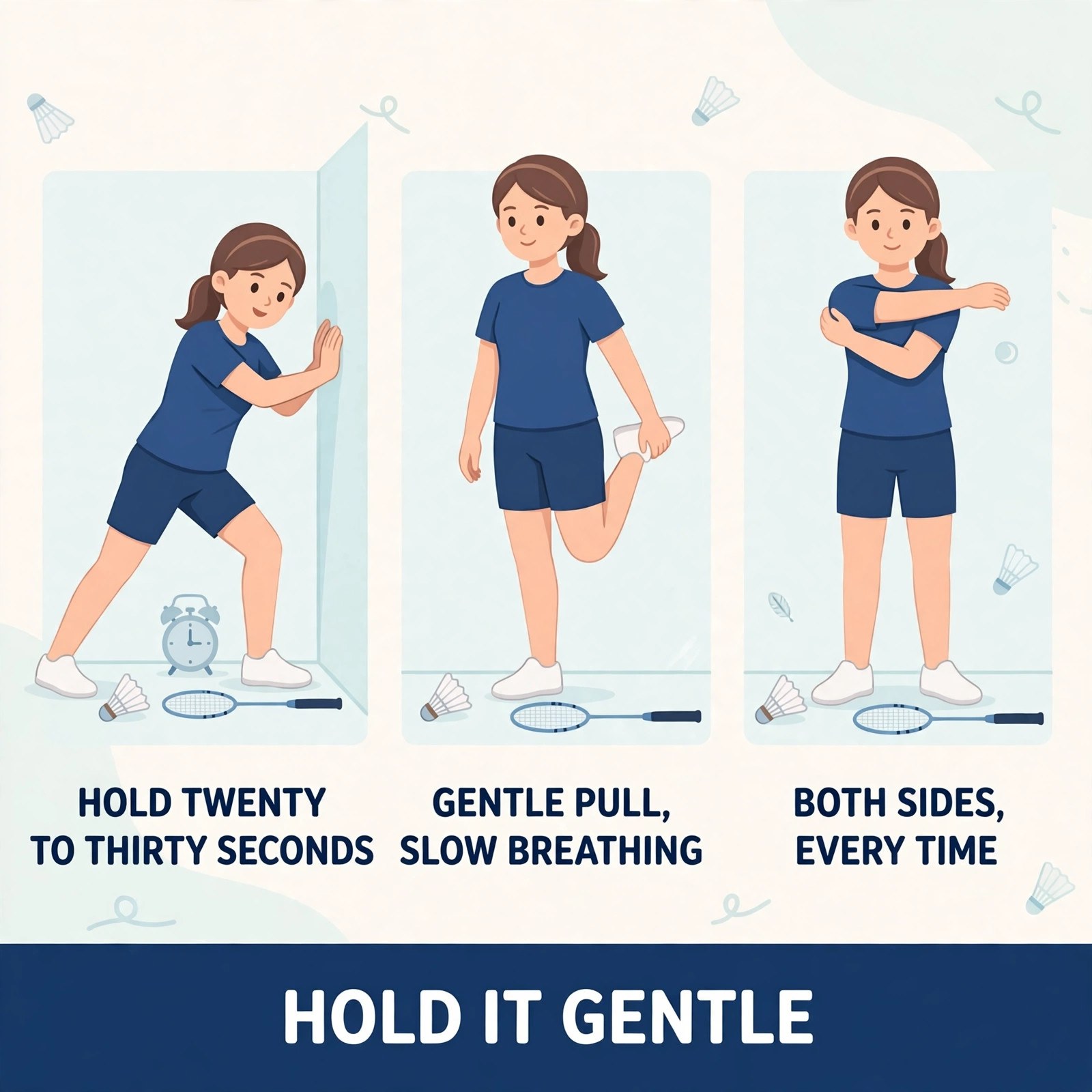
Then stretch, gently and in a fixed order: calves, the front and back of the thighs, hips and glutes, chest, and the back of the shoulder. Ease into each stretch until you feel a mild pull, hold it for twenty to thirty seconds while breathing slowly, and do both sides. A light foam roll on the calves and thighs can follow if you enjoy it; treat it as comfort, not treatment. Finish with a minute or two of slow breathing, then water and food.
Keep the whole cool down to around ten minutes, and protect it the way you protect the warm up. The common failure is social: the games end, friends are leaving, and the cool down gets traded for the car park conversation. Have the conversation while you stretch. The routine is short on purpose, so that it survives real life: school runs, work dinners and the last train home.

Session Check #5
Bookends Across the Week: Sessions and Tournaments
Bookends only work if they happen every session, and that includes the sessions players take least seriously. Social games with friends are still full speed badminton for your calves and shoulders, even if nobody is keeping score. School training, club nights and academy sessions all count. If a session is worth playing, it is worth starting warm and finishing settled.
Tournament days add one twist: the bookends repeat between matches. After a game, cool down gently, eat and drink, and keep the body loose with easy movement rather than an hour of sitting. Before the next match, run a shorter warm up, five minutes or so, since the body is already part warm from the day. Players who manage the gaps between matches usually look fresher in the last match of the day than players who only manage the matches themselves.
At the academy we treat the two routines as one habit with two halves, taught from the first session and repeated until they run themselves. Juniors learn the order the way they learn the grip: by doing it, every time, with a coach watching. Adults sometimes need convincing, because the bookends feel like they steal playing time. Ten minutes each way is the honest price, and it buys the first rally and the next morning, which is a trade most players accept once they have felt both versions.

Myth vs Reality
Myths About Warm-Ups and Cool-Downs
Myth one: stretching is a warm up. It is not. Standing still and pulling on cold muscles raises neither your temperature nor your heart rate, and it wakes up none of your reactions. Stretching has a real job, after play, on warm muscles. Before play, the job is movement: jogging, swings, circles and shadow footwork. Players who swap the two are doing the right exercises in the wrong order.
Myth two: cool downs are only for professionals. Watch what happens to players who skip them for a season: ranges quietly shrink, calves stay tight, and warm ups take longer and longer to feel ready. Nothing dramatic goes wrong on any single day, which is exactly why the habit is easy to drop. The cost is paid slowly, in stiffness, and it is paid by club players exactly as much as by professionals.
The reality is unglamorous: the bookends are part of playing, not a bonus for the keen. A warm up prepares the body you are about to use; a cool down looks after the body you have just used. Together they can help lower injury risk, protect your movement range and make back to back sessions feel manageable. No magic is claimed for them in this guide. Their power is that they are simple enough to do every single session.

Why Choose Us
Why Players Choose ST Badminton Academy
At ST Badminton Academy, warm up and cool down are coached, not suggested. Sessions run in small groups with a maximum of four students per coach, so the routines are watched closely: the coach sees the half hearted leg swings, the skipped cool down, the junior trying to stretch cold in the corner. Habits form under watching, and these two habits are worth forming properly.
New students learn the full order in their first weeks: raise, move, shadow, rally at the start; walk, stretch, breathe at the end. We teach the reasons alongside the moves, in plain words, because players keep routines they understand. Once the order is yours, it travels with you to every hall, school team and club night you will ever play in, no coach required.
One more academy habit belongs here: listening. The cool down is where we ask how bodies feel, and players learn to report tightness and niggles while they are small. We can adjust a session around a sore calf; we cannot adjust around a secret. Sharp or lasting pain leaves our court and goes to a doctor or physiotherapist first, the same rule as every other part of training.
FAQs: Badminton Warm-Ups and Cool-Downs in Malaysia (KL)
These are the questions players and parents ask us most about warming up and cooling down. The short answer running through all of them: around ten minutes at each end, movement before play, held stretches after play, and the same order every session.
How long should a badminton warm-up and cool-down be if I play in Setapak or Gombak?
Around ten minutes at each end works for most players at our Setapak base. The warm up runs jogging, joint movement, shadow footwork and building rallies. The cool down runs easy walking, gentle held stretches and slow breathing. Shorter sessions can trim both a little; the order matters more than the clock.
What actually happens inside the body during a warm-up in KL?
Your heart rate climbs and more blood reaches the working muscles. Your temperature rises a little, so muscles contract and relax more smoothly, and the fluid in your joints spreads as you move, so they feel looser. Your reactions wake up last of all, which is why the first rally should never be the hardest one.
Is stretching before a match the same thing as warming up in level?
No, and the difference matters. Stretching on its own raises neither your temperature nor your heart rate, and long held stretches on cold muscles are the wrong tool before play. Warming up means moving: jogging, swings, circles and shadow work. Save the held stretches for after the match, when muscles are warm.
Should I warm up and cool down for short social games, or only for matches?
For both. Your calves and shoulders cannot tell a friendly game from a final; the lunges, jumps and stops load them exactly the same way. Social games are also where most adults play hardest with the least preparation. Ten minutes at each end is a small price for the way you feel tomorrow.
What should I do between matches on a tournament day to stay ready?
Cool down gently after each match instead of sitting straight down, then eat something simple and keep drinking water. Between matches, move a little every so often rather than staying seated for an hour. Before the next match, run a shorter warm up of about five minutes, because the day has kept you part warm.
Do you teach warm-up and cool-down routines near Wangsa Maju?
Yes. Our base is in Setapak, a short drive from Wangsa Maju, and both routines are taught inside normal sessions from the first week. You learn the order with a coach watching your shapes, then keep the same routine wherever else you play, at school, at club nights or in your own games.
Do juniors at your academy learn warm-up habits from their first class in Malaysia?
Yes. Juniors learn the bookends as a fixed habit from their first classes: the same warm up order before play and the same cool down order after it, every session. Because groups are small, a coach watches the routine itself, not just the badminton, until the habit runs without reminders.
Where does ST Badminton Academy coach badminton in Setapak?
Our home base is Setapak in Kuala Lumpur, and the full programme runs there, including the warm up and cool down coaching in this guide. Players join us from Wangsa Maju, Gombak and across the city. Tell us your area when you book a trial and we will confirm the session times that suit you.
What makes Mr Eric Chuar strict about warm-ups and cool-downs in badminton?
Mr Eric Chuar has coached in Singapore and Malaysia for over fifteen years, and he has seen the same pattern the whole time: players who bookend their sessions stay on court longer across a season. So the routines are not optional extras in his sessions. They are coached, watched and repeated like any technique.
Badminton Warm-Up and Cool-Down Coaching in Action



One Standard for Every Player and Every Session
One standard runs through both routines in this guide: the same order, every session, watched until it is habit. At ST Badminton Academy the warm up and the cool down are timetabled parts of training, not time fillers at the edges. Players log their niggles in the cool down minutes and report them early. Bodies looked after at both ends of every session tend to stay available for the next one, and availability, week after week, is what improvement is actually built on.
| Factor | Straight Into Games | Bookended Sessions SESSION |
|---|---|---|
| Frequency | 1 or 2 times a week. Mostly for fun and sweat. | Ten minutes up, ten minutes down, every single session. |
| Drills Focus | Basic static feeding. Minimal footwork pressure. | Moving warm up work before play, gentle held stretches after. |
| Physical Conditioning | Rarely included. Just playing games on court. | Core, agility, and speed training included in every session to prevent injury and build stamina. |
| Tactical Awareness | "Just hit it over." No real game plan. | Video analysis, point construction, and learning to read the opponent's game. |
| Coach Ratio | Large groups (8-10 kids). Coach barely watches you. | Max 4 students. Mr Eric Chuar personally corrects every stroke and movement detail. |
| Goal Setting | Fun and exercise. | Routines learned young and repeated until they run themselves. |
| Long Term Result | Good recreational player. | A player who starts sharp, finishes loose, and backs up next session. |
Badminton Warm-Up Coaching in Kuala Lumpur
This guide gives you the full picture: raise, move, shadow and rally to start; walk, stretch and breathe to finish; ten minutes at each end of every session you play. The routines are plain, and that is their strength, because plain routines get done. If you want them taught and watched rather than guessed, come and try a session with us in Setapak, Kuala Lumpur. Arrive a little early, and we will run the first warm up together.






