Badminton And Interval Training: Workouts For Building Cardiovascular Endurance (Intervals Guide)
Badminton is not run at one steady speed. A rally is a burst: a few seconds of sprinting, lunging and jumping, then a short pause while the shuttle is picked up and the next serve is set. Interval training copies that shape on purpose. You work hard for a short block, rest for a set time, and repeat, so your heart, lungs and legs learn to recover quickly and go again. This guide explains how to build interval sessions on court with shuttles and footwork, off court with a bike, a rope or a quiet road, and how hard each block should feel. It also covers the safety rules, because hard training done carelessly helps nobody. At ST Badminton Academy in Setapak, Kuala Lumpur, intervals are one part of our conditioning, used with care.

Interval Check #1
What Interval Training Really Means
The idea is older than the fashion for it. Interval training simply means splitting hard work into pieces with planned rest between the pieces. The rest is not quitting; the rest is what lets the next piece stay fast and clean. A steady jog asks your body to hold one moderate effort for a long time. An interval session asks for repeated short efforts that look much more like rallies. Both have value, and a complete player uses both, but they train different things and should not be confused.
Why does the rally shape matter? Because the third game is usually lost by the player who recovers slowest between rallies, not the player with the weakest shots. When your breathing settles quickly, your feet are ready for the next split step and your head stays clear enough to choose the right shot. Interval training targets exactly that recovery speed. It will not replace steady base work, skill training or sleep, and honest coaches will not claim it does everything. Used once or twice a week, it sharpens the engine you already have.

Interval Check #2
On Court Intervals: Shuttle and Footwork Sets
On court, the classic interval is the multi shuttle set. A feeder sends shuttles to the corners in quick order, and you move, strike and return to base for a block of about twenty to thirty seconds, roughly the length of a long, hard rally. Then you walk, breathe and let your heart rate come down while your partner takes a turn. Six to ten blocks with honest rest is a real session. The footwork must stay clean: split step, lunge, recover. When the steps turn sloppy, the set is over, whatever the plan said.
Footwork intervals without shuttles work well too. The six point pattern sends you from base to each corner of the court in turn, at match speed, for a set block, then rest. Shadow swings keep the racket skills honest while the legs do the conditioning work. A simple version many players start with: twenty seconds of fast six point footwork, forty seconds of walking recovery, repeated six times. As fitness grows, the work block can stretch toward thirty seconds, or the rest can shrink a little. Change one thing at a time, and write down what you changed.
Conditioned games turn intervals into badminton. Play rallies where one player must hit every shuttle to the back, or where the rally restarts the moment it ends, for two minute blocks with a minute of rest. The score keeps players honest in a way a stopwatch cannot. Keep the technical goal visible: even in the last block, the clear should still reach the back line and the lunge should still be balanced. Conditioning that destroys technique teaches the wrong lesson, so a coach ends the block when form goes, not when the clock does.

Interval Check #3
Off Court Intervals: Bike, Rope and Road
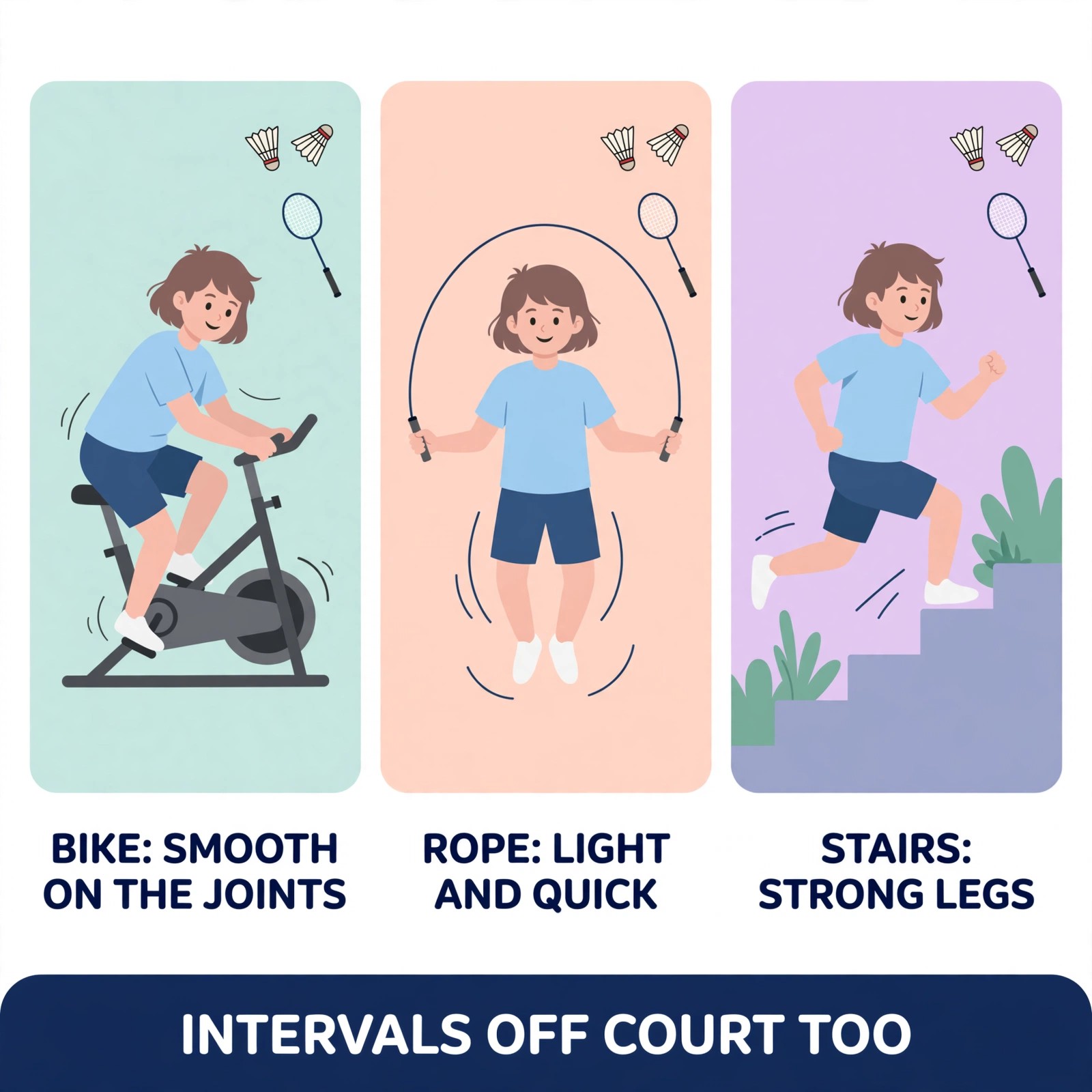
Off court intervals give the joints a break while the heart and lungs still work. A stationary bike is the friendliest tool: set the seat so your knee keeps a slight bend at the bottom of the stroke, pedal hard for thirty seconds, then easy for a minute or more, and repeat. The legs burn, the breathing races, and the knees take none of the pounding that court sprints bring. Rowing machines and similar trainers follow the same pattern for players who have access to them.
A skipping rope is the cheapest interval tool in sport. Skip fast for twenty to thirty seconds with light, quick feet, then walk and shake the legs out for double that time. On a quiet road or a track, short gentle hill repeats or relaxed fast runs work too, but keep them on soft, even ground and never sprint cold. Stairs suit some players in small doses. Whatever the tool, the pattern is the same: hard block, easy block, repeat, and stop while the quality is still there.
Home intervals need almost nothing: a rope, a mat and a timer on your phone. Star jumps, mountain climbers and fast shadow footwork in a clear space can all carry a work block, as long as the neighbours below and the ceiling above allow. Keep the floor dry and the space empty of furniture corners. Home sessions are the backup that keeps a training week alive when work, rain or travel steals your court time, and a short honest session at home beats a perfect session that never happens.
Interval Check #4
How Hard, and How Much Rest
How hard should a work block feel? Use the talk test. In a proper work block you can say only a few words at a time; full sentences are gone. In the rest block, your breathing should settle enough that you could hold a short conversation again before the next block starts. If you cannot, the rest was too short or the work was too hard, and the next block will be slow and scruffy. Intervals train speed of recovery, and recovery cannot be trained by never recovering.
Hold one rule above all others: quality first. A session of six clean blocks beats ten blocks of stumbling. Beginners start smaller than they think: four to six work blocks, generous rests, one session in the week, and a lighter week every month or so. Add a block, or trim a little rest, only when the current load feels repeatable two sessions in a row. Young players grow into interval work gradually, with a coach watching the movement, not chasing exhaustion.
Safety lines are plain. Warm up properly first: easy movement, then dynamic stretches, then a few gentle rallies or skips before any hard block. Never start intervals on a body that is ill, injured or running on almost no sleep; move the session a day instead. Stop the session at once for chest pain, dizziness, feeling faint, or pain that changes how you move, and get checked if it happens again. Hard training should leave you tired and satisfied, not worried. When in doubt, ask a coach or a doctor, not a video.

Interval Check #5
How Intervals Fit the Training Week
Place intervals in the week like you place matches: with space around them. One or two interval sessions a week is the right range for most club and academy players. Put them on days away from your hardest skill sessions and never the day before an important match. A common shape: intervals early in the week, skills and games later, steady easy movement at the weekend. The hard days make you fitter; the easy days let the fitness arrive. Crowding three hard days together usually produces one tired player and no progress.
Steady training keeps its place. The long, easy work, a relaxed run, an easy cycle, a long social game, builds the base that intervals then sharpen. Players who drop all steady work often find their recovery between hard blocks gets worse, not better. Think of it as the difference between the size of the engine and how fast it responds. Base work builds the engine. Intervals teach it to answer quickly. Badminton needs both, in that order.
Write the session down. Sets, seconds, rest and one line about how the last block felt. Four weeks of notes will tell you more than any gadget: work blocks that once emptied you now feel repeatable, rests can shrink a little, and the third game at training starts to feel different. Progress in conditioning is quiet and gradual. The notebook is how you hear it. If four honest weeks show no change at all, the problem is usually sleep, food or total load, and those get fixed first.

Myth vs Reality
Myths About Interval Training
Myth one: real interval training means training to exhaustion, every time. Exhaustion is easy to reach and mostly useless. When every block is a survival test, footwork falls apart, landings get heavy and the body learns sloppy movement at exactly the speed matches demand clean movement. Good intervals finish with you tired but still able to do one more decent block. You stop because the plan says stop, not because you cannot continue.
Myth two: more sessions always means more fitness, so do intervals daily. The body gets fitter during recovery, not during the session itself. Daily hard intervals give the body no time to rebuild, and the usual result is flat legs, poor sleep and a growing dislike of training. Two honest sessions a week, kept up for a season, will beat a heroic daily month that ends in a layoff. Myth three follows: intervals do not replace steady work, skill work or rest. They sharpen; they do not substitute.
The reality: interval training is a simple, powerful tool with a clear job. Short hard efforts, honest rests, repeated with clean technique, once or twice a week, inside a week that also has skills, steady work and sleep. It asks for a timer, a plan and the discipline to stop on time. Players who use it that way feel the difference where it counts: in the last rallies of the third game, when the legs still answer.

Why Choose Us
Why Players Choose ST Badminton Academy
Conditioning at ST Badminton Academy is planned, not improvised. Groups are capped at four students, so when we run interval sets the coach watches every player’s footwork and breathing, and stops a set when form goes, not when a stopwatch says so. Juniors, club players and adults each get loads matched to their level. Nobody is trained to collapse; everybody is trained to recover.
We also place conditioning honestly inside the whole week. Intervals sit beside technique sessions, match play, steady movement and rest days, because fitness that costs you your skills is a bad trade. Players keep simple training notes, and we review them together, so progress is visible and plateaus get explained instead of ignored. No gadget is required and no miracle is promised. The work is ordinary, repeated well.
Our base is Setapak in Kuala Lumpur, with players coming from Wangsa Maju, Gombak and across the city. Sessions run for kids, teens and adults, from first timers to league players. Whatever your level, conditioning follows the same standard: build the base, sharpen it with intervals, rest on purpose, and keep the technique clean while you do it.
FAQs: Badminton Interval Training in Malaysia (KL)
These are the questions we hear most from players starting interval training. The theme running through the answers is simple: hard blocks, honest rests, clean technique and patience. If you have a heart condition, asthma or any health worry, talk to your doctor before starting hard interval work. That conversation comes first, always.
Where can I learn interval training for badminton if I live in Setapak or Gombak?
You can train with us at ST Badminton Academy in Setapak, where interval conditioning is built into normal sessions at the right dose for your level. Groups stay at four students or fewer, so a coach watches your footwork during every set. Players from Gombak train here too, and home interval plans cover the days you cannot travel.
How do intervals build badminton endurance faster across a season in KL?
Intervals work across a season because they target recovery speed, the thing the third game tests. Short hard blocks with honest rests teach your heart and legs to settle quickly between rallies. In Kuala Lumpur heat you sweat more, so drink steadily and keep some sessions indoors or early. Week by week, the same sets start to feel repeatable.
How many interval sessions a week should a beginner start with at a safe level?
A beginner should start with one interval session a week, four to six short work blocks, and rests at least twice as long as the work. Keep the technique simple: shadow footwork, skipping, or a bike. Add a second session only after three or four weeks. If your form falls apart, the session is finished, whatever remains on the plan.
How long should each work block be, and how do I know the rest is enough?
For most badminton players, work blocks of twenty to thirty seconds match rally lengths well, with rests of forty seconds to a minute at first. You know the rest was enough when your breathing settles, you can speak in short sentences again, and the next block starts at full speed. If each block gets slower, rest longer next time.
Can I do interval training at home with no court, and what should I use instead?
Yes. A skipping rope, a clear floor space and a phone timer are enough. Use fast skipping, shadow footwork or mountain climbers for the work blocks, and walk around the room during rests. Keep the floor dry, move furniture out of the way, and keep the jumps low and quiet if neighbours live below you.
Do you run interval conditioning for badminton players near Wangsa Maju?
Yes. Conditioning is part of normal training at our Setapak base, a short drive from Wangsa Maju. Interval sets are coached in small groups, with loads matched to each player and technique watched throughout. Adults and juniors both do them, at doses that fit their level. Nobody is pushed to exhaustion for show.
Does your academy use interval training with young players in Malaysia?
Yes, with care and smaller doses. Young players do short, game like interval sets with long rests, always supervised, and the focus stays on clean footwork rather than exhaustion. Sessions stop the moment form drops. As players grow and their training age builds, the loads grow slowly with them. Fun stays in the session, or the habit will not last.
Where does ST Badminton Academy coach badminton in Setapak?
We coach at our base in Setapak, Kuala Lumpur, in groups of no more than four students, which keeps conditioning sets closely watched. Sessions run across the week for children, teenagers and adults. Setapak is easy to reach from Wangsa Maju, Gombak and the city centre, and trial sessions can be arranged through WhatsApp.
What makes Mr Eric Chuar a suitable coach for conditioning work in badminton?
Mr Eric Chuar has coached badminton in Malaysia for more than fifteen years and builds conditioning the way he builds technique: progressively, with form first. He matches interval loads to each player, watches movement during every set, and stops work when quality drops. Players get fitter without being broken, and the notebook shows the progress honestly.
Badminton Interval Training in Action


One Standard for Every Player and Every Session
Our standard for conditioning is simple: hard work must stay clean work. Every interval set at this academy is planned, watched and written down, and every set ends when technique ends, not a second later. Players learn why each session sits where it does in the week. Fitness built with understanding lasts; fitness built on fear does not.
| Factor | Steady Only | Steady Plus Intervals INTERVALS |
|---|---|---|
| Frequency | 1 or 2 times a week. Mostly for fun and sweat. | One or two interval sessions a week, placed away from the biggest matches. |
| Drills Focus | Basic static feeding. Minimal footwork pressure. | Rally length work blocks with honest rest, on court and off court. |
| Physical Conditioning | Rarely included. Just playing games on court. | Core, agility, and speed training included in every session to prevent injury and build stamina. |
| Tactical Awareness | "Just hit it over." No real game plan. | Video analysis, point construction, and learning to read the opponent's game. |
| Coach Ratio | Large groups (8-10 kids). Coach barely watches you. | Max 4 students. Mr Eric Chuar personally corrects every stroke and movement detail. |
| Goal Setting | Fun and exercise. | Sets counted and written down, so next week can be a touch harder. |
| Long Term Result | Good recreational player. | A player whose legs and lungs still answer in the third game. |
Badminton Interval Coaching in Kuala Lumpur
Your third game does not need a new racket or a secret drill. It needs a heart and legs that recover while the shuttle is being picked up. Start with one honest interval session a week, rest on purpose, keep your notes, and give it a season. Train with us in Setapak and we will build that engine with you, set by set.






