What Are The Best Drills For Enhancing Your Badminton Smash Recovery (Smash Recovery Guide)
The smash is only half a shot. The other half is what you do in the two seconds after it: land in balance, get the racket back up, and take the first step back towards base before your opponent’s reply arrives. Players with strong smashes and weak recovery win the highlight and lose the rally, because a good defender blocks the smash back while the smasher is still admiring it or still tangled in the landing. This page works through the drills that build smash recovery properly: the landing shape first, then the first step and the split that follows it, then feeding sets that pair every smash with a reply, transition work between forehand and backhand, and pressure sets where you recover tired. Nothing here asks you to smash harder. It asks you to be ready sooner.
Recovery Check #1
Smash Recovery: The Shot After The Shot
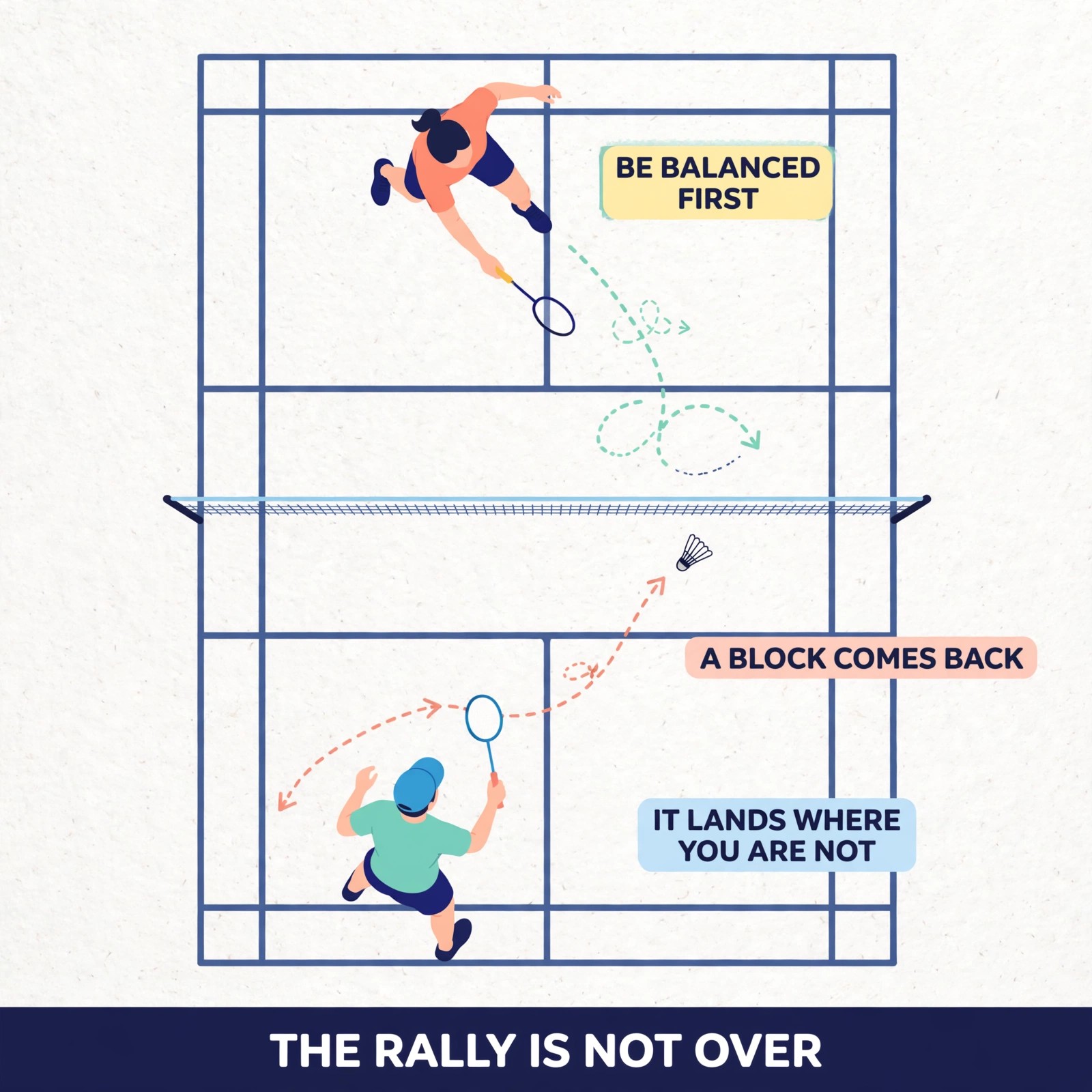
Before the drills, it helps to see why recovery decides whether the smash is a weapon or a gamble. A smash commits you. You leave the floor or stretch deep into the rear corner, your weight travels forward with the shot, and for a moment you are the furthest from base you will be in the whole rally. A defender who survives the smash knows this, and the block goes exactly where you are not: soft to the net, or driven past your shoulder as you turn. Every smash you play buys your opponent one free question: are you balanced yet? Recovery work is how the answer becomes yes, quickly, every time. Train it and the same smash that used to start your problems starts ending rallies.
Coaches can read a player’s smash by watching only the landing. Does the player land on the racket leg with the body tall and the racket already recovering? Or does the chest drop, the racket fall to the hip, and the feet take three small steps to find balance? The first landing turns the smash into pressure. The second turns it into a pause the opponent can use. That is why this page treats recovery as a skill with its own drills rather than a footnote to smash technique. The smash itself gets the coaching hours in most clubs, while the two seconds after it get none, and then players wonder why their best attacking shot keeps coming back at their feet.
Recovery Check #2
The Recovery Shape: Land, Push And Split On Time
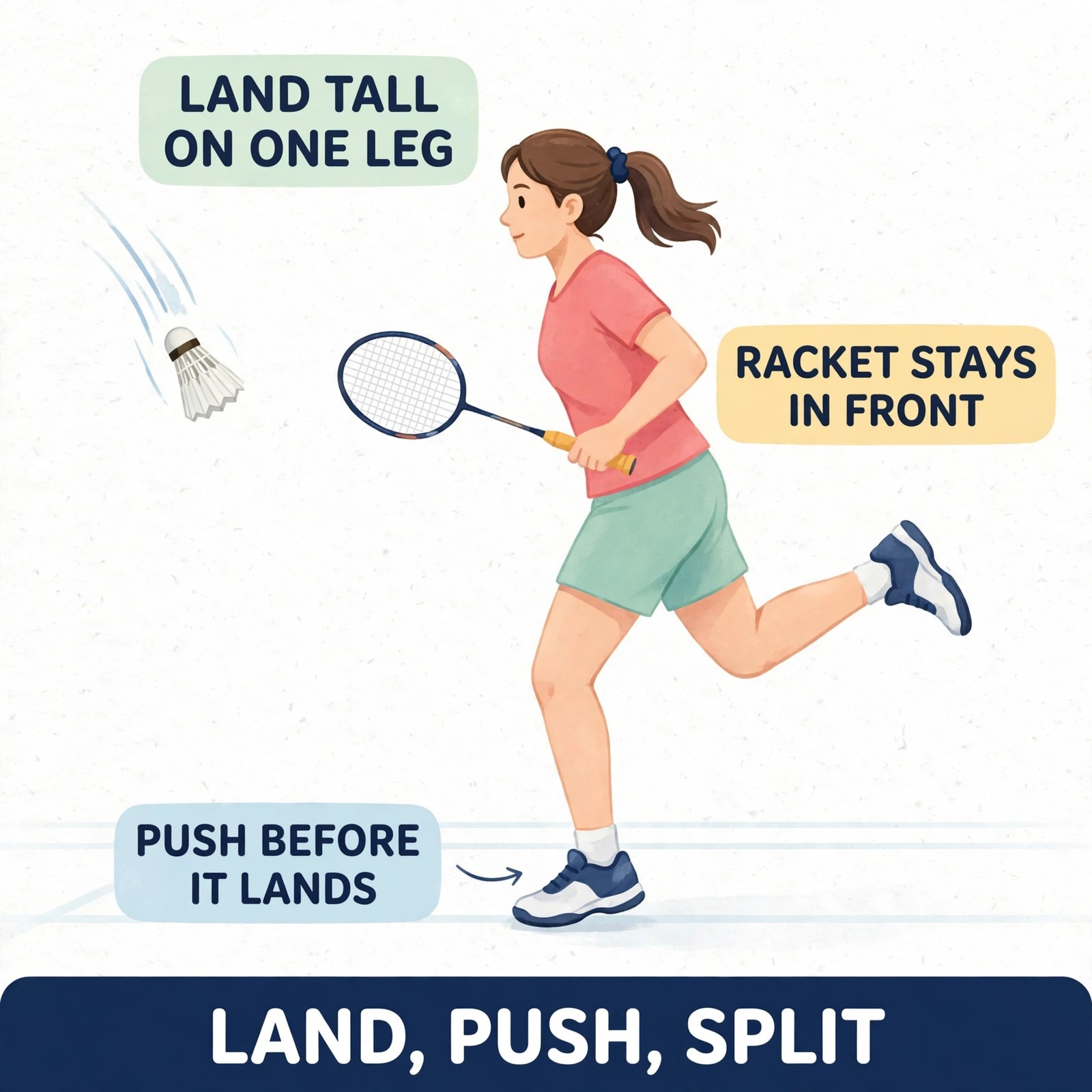
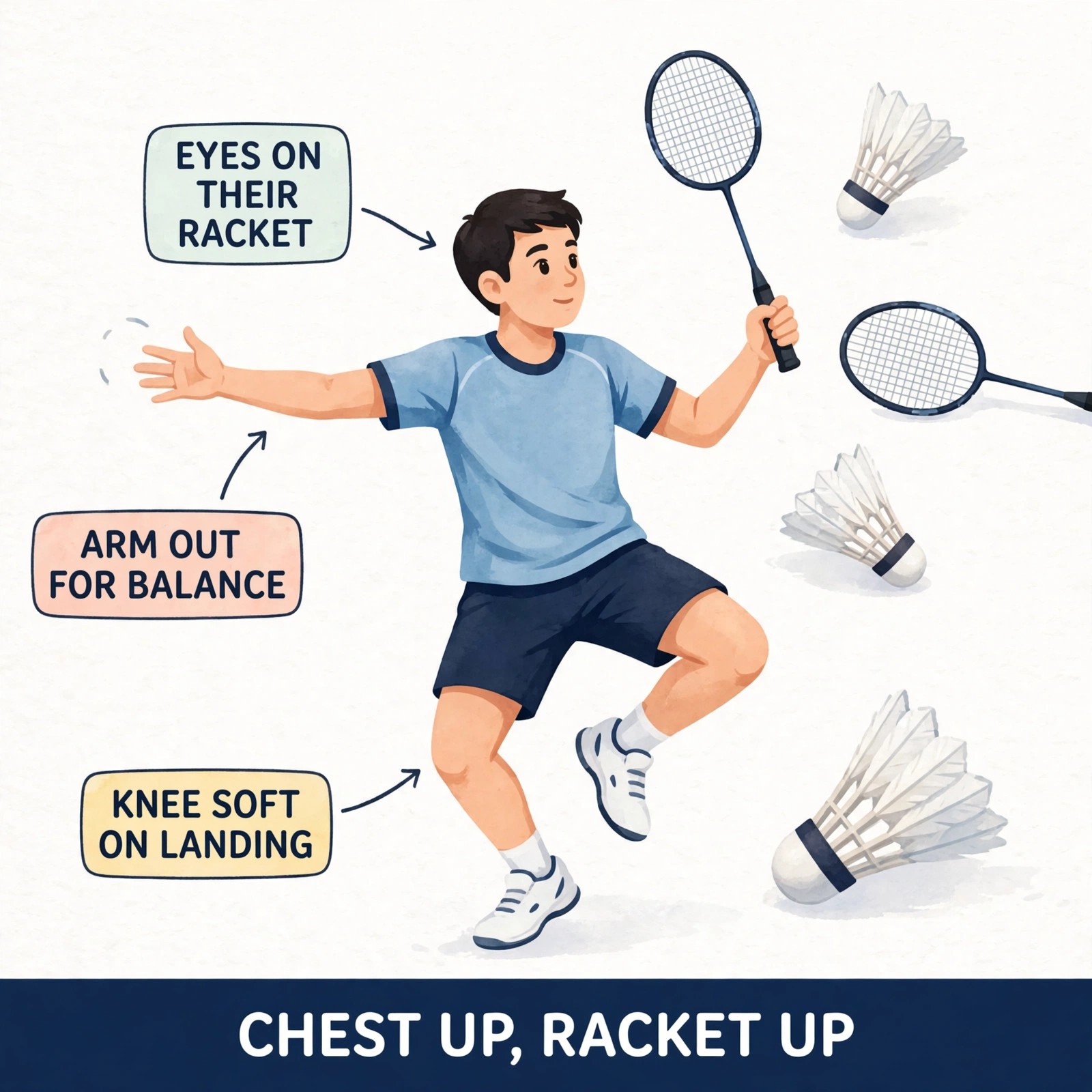
The recovery starts at the landing, so the landing is coached first. On a rear court smash played with a scissor style jump or a strong rotation, land on the racket leg with the knee soft, the chest up, and the non racket arm out for balance. The racket does not finish down by your shoe; the follow through ends across the body with the racket head still in front of you, ready to be lifted into the next preparation. From that landing, the first step back towards base is a push, not a walk: drive off the landed leg while the shuttle is still travelling. Players are often surprised how much of recovery is decided before the shuttle lands. If the landing is balanced and the push starts early, the rest is easy. If the landing is a stumble, no split step afterwards can buy the time back.
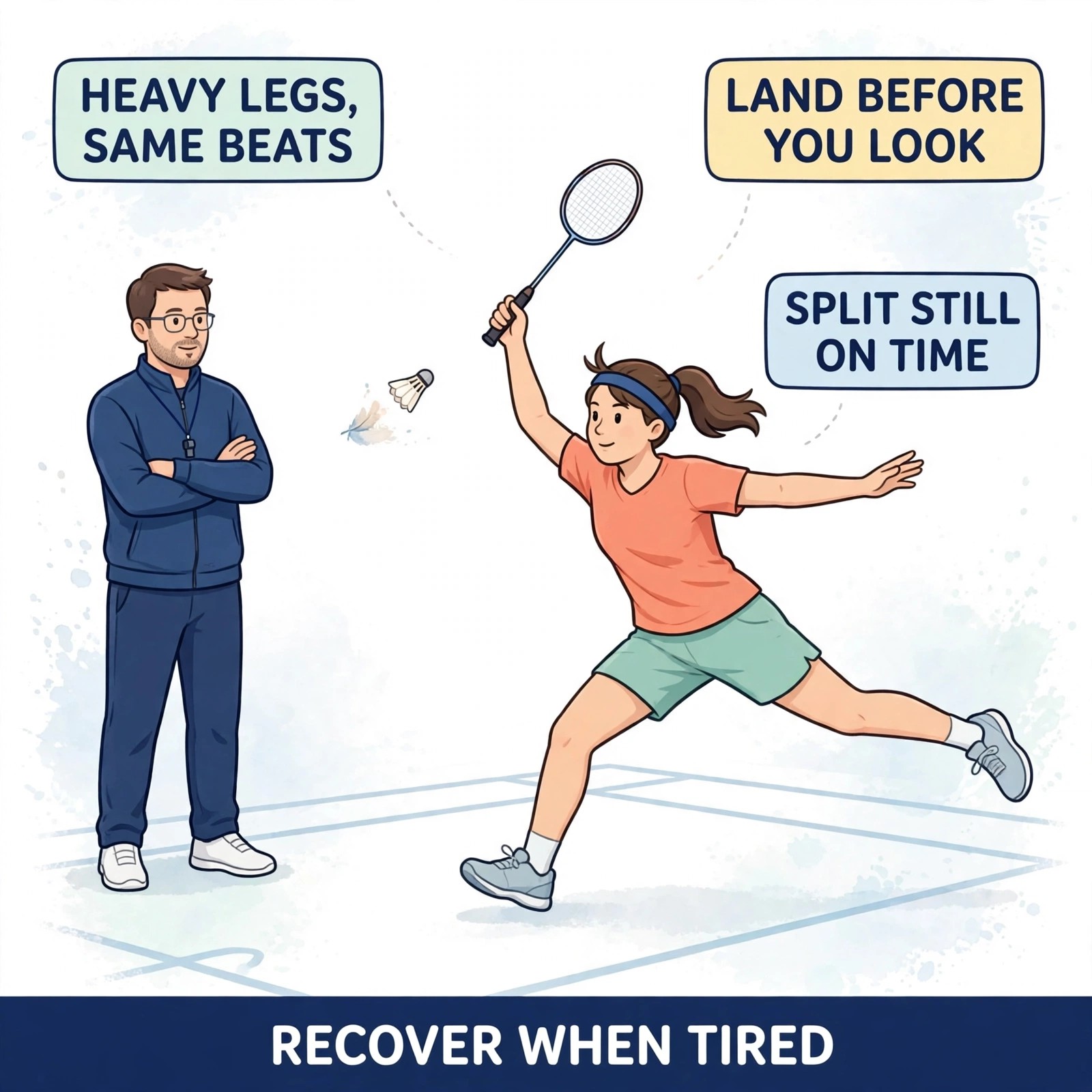
The head and body play their part too. After the smash, your eyes should find the defender’s racket, not your own shuttle. Watching your smash land is the most common recovery fault at club level: the head stays turned, the feet stay planted, and the block is already past you before you react. Train the gaze to switch at contact. The body also has to come back to a shape it can move from: hips turned back towards the net, weight centred, racket up in front of the chest. Between the landing and that ready shape there should be no standing tall, no racket drop, no breath of admiration. In drills we coach it as one joined action with a simple count: land, push, split. Three beats, every smash, until the beats run themselves.
The split step after a smash is shorter than the split after a clear, because the reply comes sooner. Land from your push back a step behind your base position, knees soft, and split as the defender’s racket meets the shuttle. From there the likely replies are few enough to prepare for: the soft block to the net asks for a forward lunge on the racket leg; the drive past your shoulder asks for a quick turn and a backhand side step; the high lift gives you time to move back fully. Recovery training names these replies and drills each one as the second half of the smash. A smash that is only ever practised alone, with no reply fed back, teaches the body that the rally ends at the smash. Matches disagree.
Recovery Check #3
Paired Feeding: Every Smash Earns A Reply
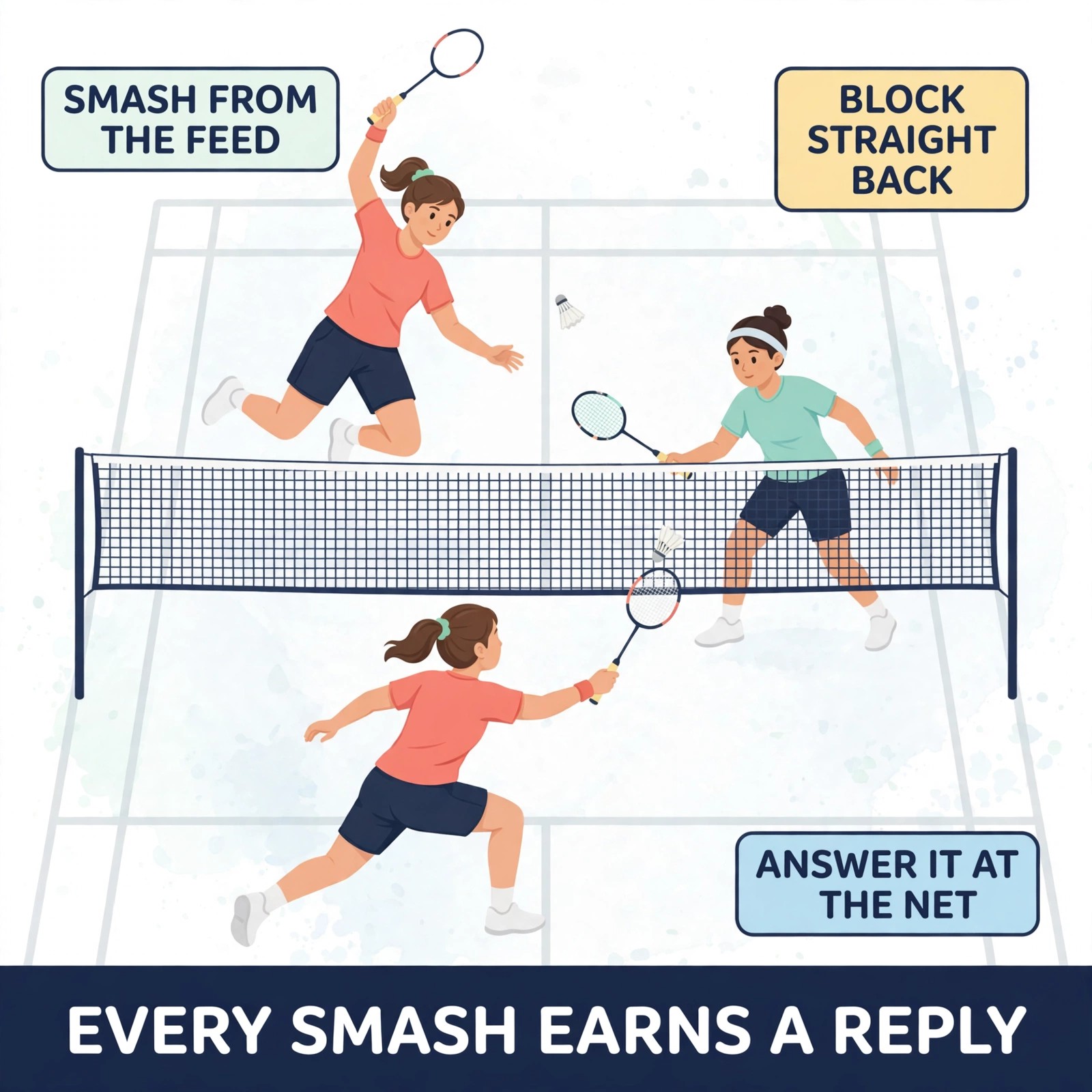
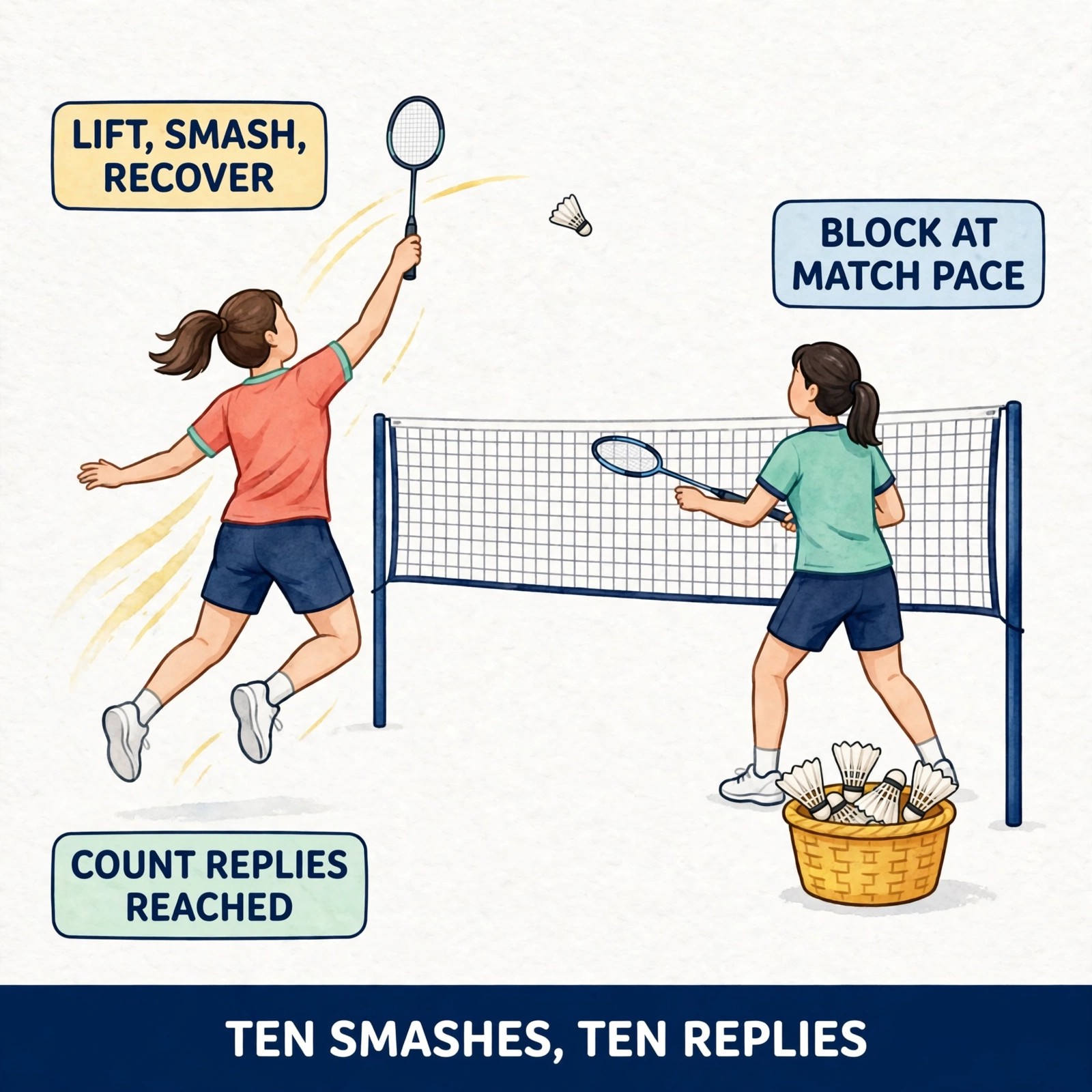
The first drill family pairs every smash with a reply. Your partner feeds a lift to the rear court; you smash, recover, and your partner immediately plays the block to the net, which you must reach and answer with a net shot. Ten smashes per set, each one followed by the same demand: land, push, split, lunge. The feeder’s job is honesty: the block arrives at match pace, not floated kindly to your racket. At first the block can be played to a named front corner so the pattern settles. After a week or two the block goes to either corner, and the recovery has to read as well as move. The count that matters is replies reached in balance out of ten, written down after every set.
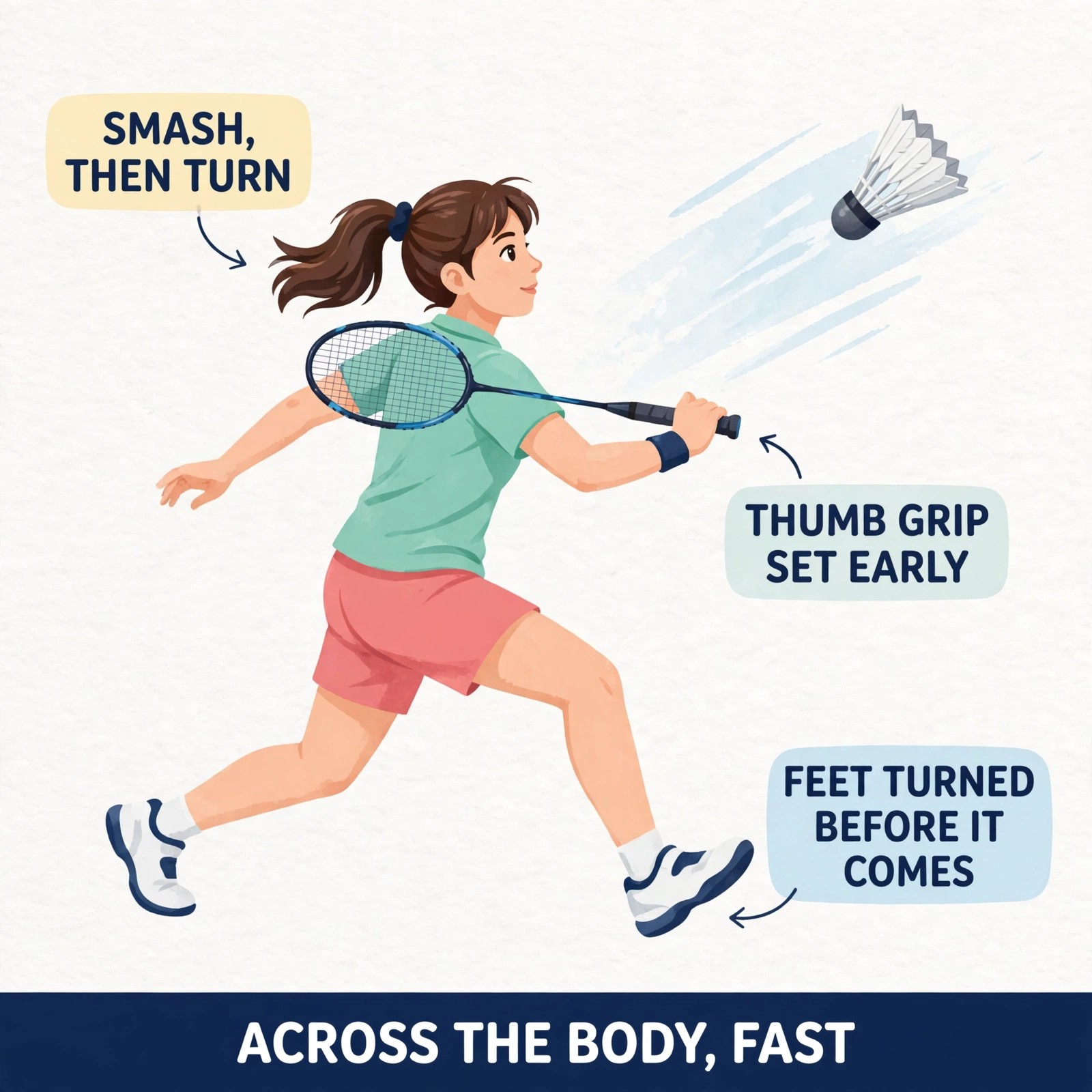
The forehand to backhand transition drill answers the reply that beats many smashers: the drive or block played wide to the backhand side while you are still turning. One feeder lifts, you smash from the forehand rear corner, and the return comes flat to your backhand mid court, where you play a backhand drive or block and recover to base. The transition is the skill: racket across the body early, thumb grip set while you move, feet turned before the shuttle arrives. Start the return at a pace you can handle with shape, then raise it. Most players find the first sessions clumsy, because the drill exposes a truth the smash alone hides: attacking from one corner means defending the opposite side a second later.
Multi shuttle smash sets build recovery under rhythm. The feeder sends lift after lift with only a short gap, and every smash must be followed by a full recovery to base and a split before the next lift arrives. Six smashes per set is a good start; the set ends when the recovery shape breaks, not when the arm tires. A useful variation mixes the feeds: two lifts to smash, then one short feed to the net, so the player must smash, recover, and then travel forward in the same sequence. That mix is close to real rallies, where the shot after your smash is as likely to be a sprint to the net as another jump at the back. Keep the feeds honest and the rests full; this is quality work, not conditioning in disguise.
Recovery Check #4
Second Shot Work: Loops, Cross Court And Follow Ups
The second drill family adds the shot after the reply. Smash, block fed back, you play the net shot, partner lifts, and you smash again from the new position. The rally is now a loop of three shots, and your recovery has to serve two different next movements: forward after the block, backward after the net shot. Players who only drill smash and block often recover beautifully towards the net and then watch the lift sail over them. The loop fixes that. Run it in sets of six loops per side, and swap roles so both players feed and recover. The coach watches one thing above all: whether the split step appears before every shot in the loop, or quietly vanishes by the third round when attention fades.
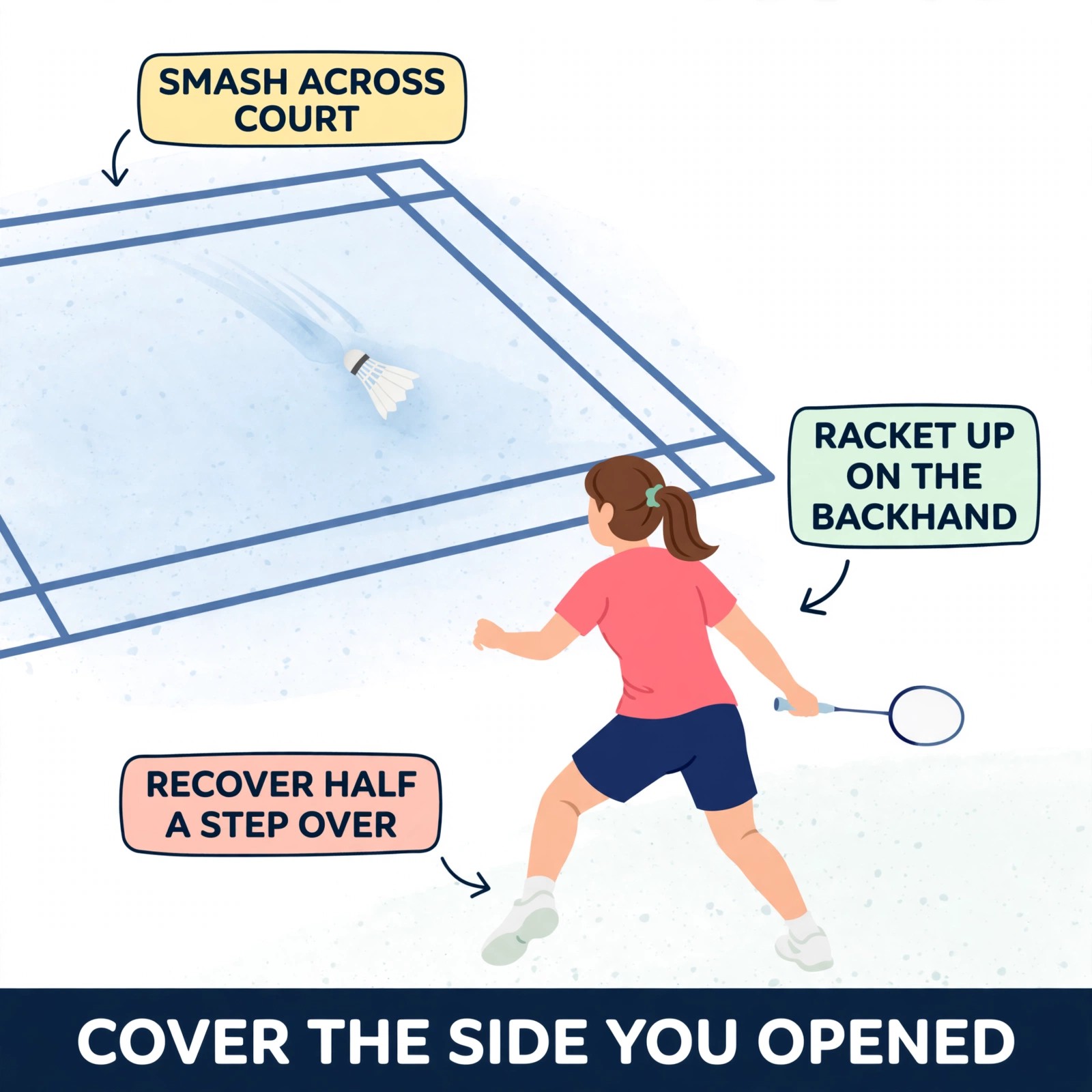
Cross court recovery work covers the smash played diagonally. A cross court smash opens the far side of your own court, so the recovery path is longer and slightly turned towards the open side. Feed lifts to the forehand corner, smash cross court, and the block comes back straight, into the side you have just left open. The drill teaches the recovery angle: push back not to the centre but a half step towards the danger side, racket up early on the backhand. Alternate sets of straight and cross court smashes with the same block reply, so the body learns two recovery paths from one hitting position. In matches this is the difference between a cross court smash that pressures and one that invites the winning reply.
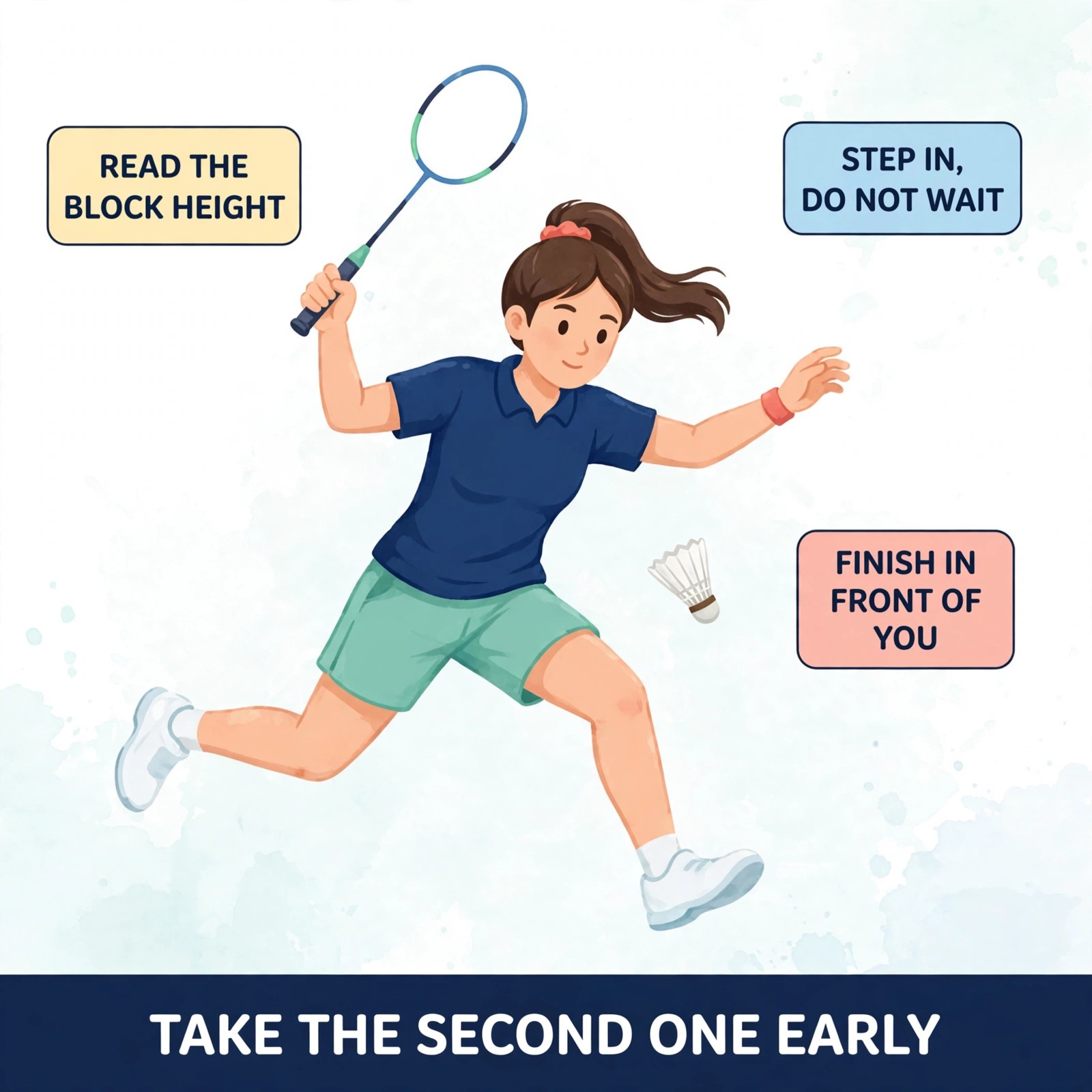
The follow up smash set trains the most satisfying version of recovery: the second smash. Feed a lift, the player smashes, the block comes back short and high enough to attack again, and the player must already be moving forward to take it early. The skill is reading the block’s height while recovering: a weak block is an invitation to step in, not a moment to relax. Sets of eight, scored by how many second smashes are taken in front of the body rather than reached for late. This drill also disciplines the first smash. Players quickly learn that a smash placed with some margin brings a weaker block than a smash aimed at the line and clipped, so recovery training ends up improving shot choice as a side effect.
Recovery Check #5
Recovery Under Pressure: Same Beats, Heavy Legs
Pressure work trains recovery in the state matches demand it: tired, late, and after a stretch. One honest set: the feeder works the player around the rear court with clears for twenty seconds, then lifts for the smash with the block fed straight back. The smash now comes off heavy legs, and the recovery must run on habit. Another set starts the smash from a defensive position: the player retrieves a drive at the side, then the lift comes, and the smash and recovery follow from a body that is already turning. None of this is about suffering. It is about proving that land, push and split survive fatigue, because a recovery that only works fresh is a rally plan for the first game only.
Diving and stretching smashes need their own small drill, because the recovery is different. When you have stretched wide or left the floor fully, the first job is getting one foot under you and the racket up; the split step comes later. Practise it in a controlled way: feeder plays a wide lift, you stretch smash, land, regain the feet, and answer a gentle block. Never drill full dives on a hard floor without mats and a coach present, and stop at once if the shoulder or elbow complains sharply. Repeated smash volume loads the shoulder, so build the sets gradually across weeks. A sharp or growing pain is a stop signal; have it checked by a doctor or physiotherapist rather than smashing through it.
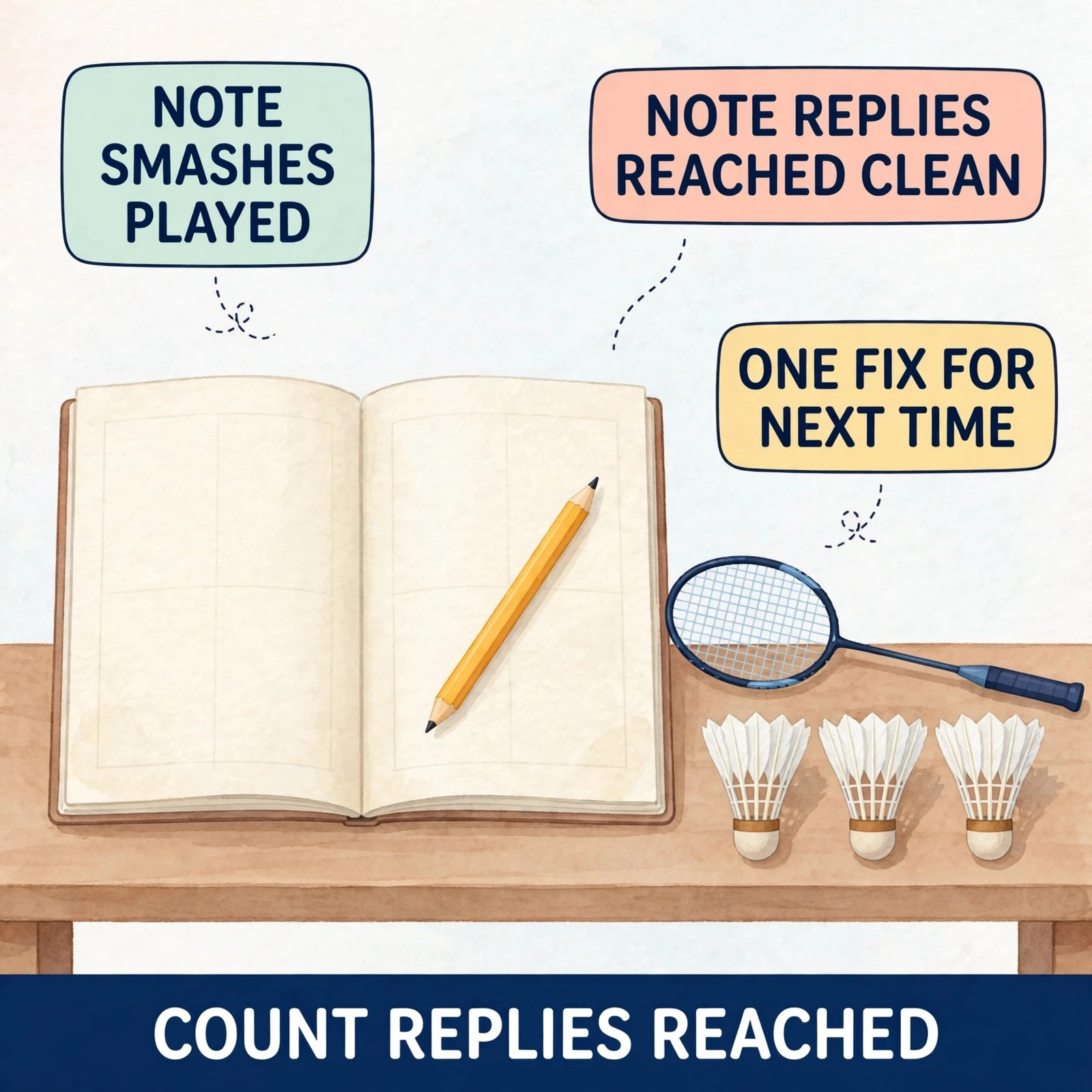
How do you know recovery is improving? Keep three numbers. Replies reached in balance out of ten in the smash and block set. How often the wide backhand reply beats you in the transition drill, out of ten. And second smashes taken early out of eight in the follow up set. When the first number climbs, the second falls, and the third grows, your smash has become a rally weapon instead of a single swing. Your training partners will report it before the log does: the block that used to win the point starts coming back, and defenders stop looking comfortable against your best shot.
Myth vs Reality
Myths About Smash Recovery
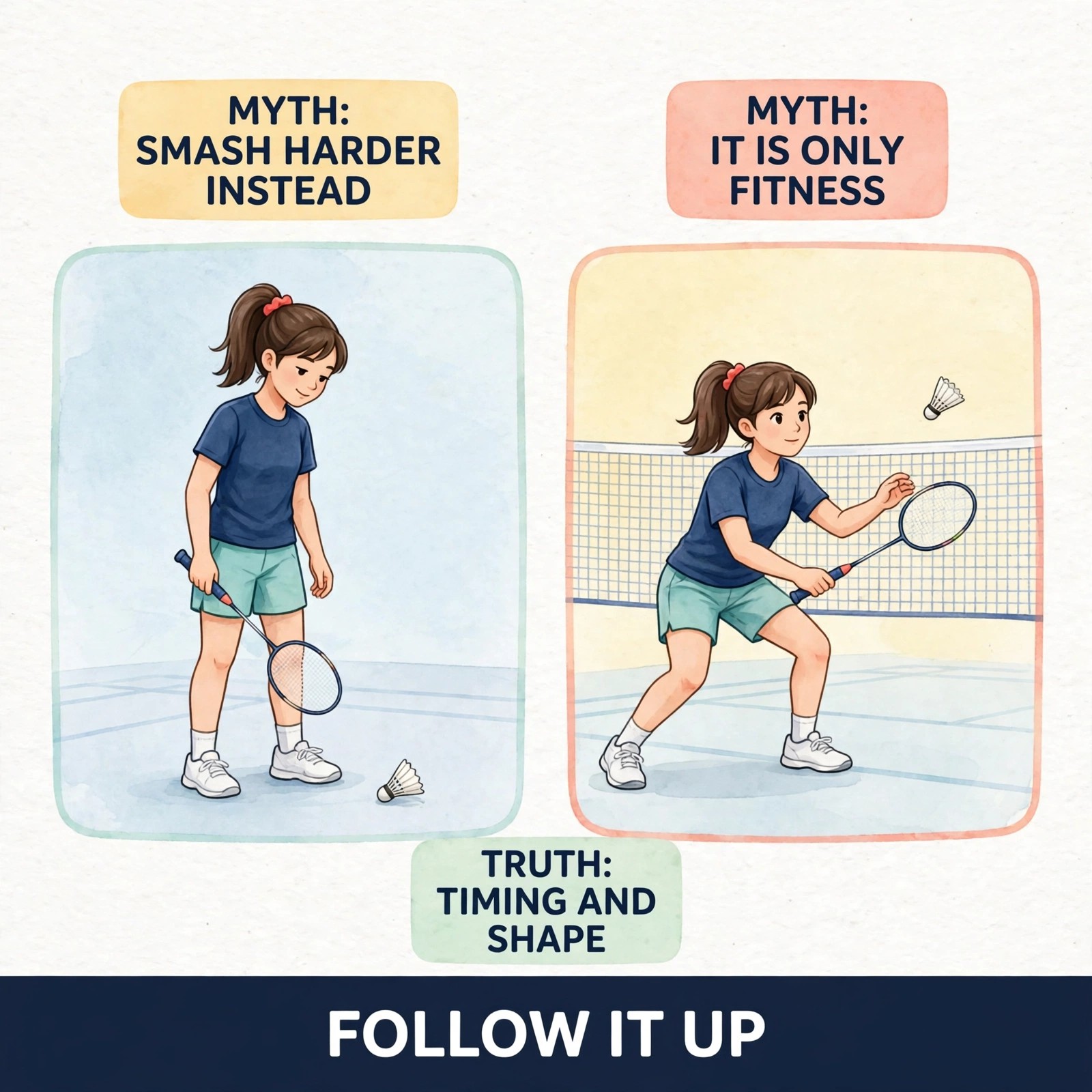
The first myth says the answer to blocks is a harder smash: hit it well enough and there is nothing to recover from. Harder smashes do end some rallies, but they also come back faster when they are defended, and the smasher who has bet everything on pace has the least time of anyone to recover. Watch strong players instead: their smashes are placed as much as powered, many are played at eighty percent with the body already recovering, and the rally is won on the second or third attack. The smash that cannot be followed up is a loan taken against the next shot. Recovery is what lets you smash at sensible pace, keep the pressure on, and still be standing in the rally three shots later.
The second myth says recovery is just fitness, and fitter players recover automatically. Fitness sets the ceiling, but recovery is mostly timing and shape: a fit player who lands off balance and watches the shuttle still gets beaten by the block, while a less fit player with a clean landing, an early push and an honest split answers the same block comfortably. This is why our sets are scored by replies reached in balance rather than by how breathless the player gets. Conditioning supports the work, and we build it gradually, but no amount of running drills teaches the feet to push before the shuttle lands. That is a habit, and habits are trained on court, one counted set at a time.
The honest picture is that smash recovery is a small chain of coachable habits: land on the racket leg with the chest up, racket finishing in front, eyes switching to the defender’s racket, push starting while the shuttle still travels, base regained a step behind centre, and a short split timed to the defender’s contact. None of it is a talent, and none of it needs a bigger smash. All of it responds to paired feeding and counted sets within weeks of honest work. Players who build the chain stop fearing their own best shot. They smash knowing the rally continues, and that knowledge quietly changes which smashes they choose and how calmly they play the shots that follow.
Why Choose Us
Why Players Choose ST Badminton Academy
At ST Badminton Academy, smash recovery training follows the order on this page: landing shape first, land push split as one joined action, feeding sets that pair every smash with a reply, transition work to the backhand side, and pressure sets at the end. Groups are capped at four students, so the coach sees the landing and the first step on nearly every smash, and feeds at a pace matched to the student rather than the group average. Each student keeps the three counts from this page in a training log, reviewed every week, so the smash is judged by the whole rally it creates, not by the sound it makes.
Students join us from across Setapak and the wider Klang Valley, from juniors whose smashes keep coming back at their feet to adult club players who win the attack and lose the point. The work is scaled to the player: beginners start with the landing and the block reply at gentle pace, stronger players move quickly to transition sets and follow up smashes. Smash volume is built up gradually for every student, because shoulders earn load over weeks, not in one heroic session. The order is the coaching: landing first, joined recovery next, replies after that, and pressure only when the chain holds at feeding pace.
If you are not sure where your recovery stands, a trial session answers it in one set. The coach feeds lifts, you smash, and the block comes back at honest pace while the coach counts the replies you reach in balance out of ten. Most players discover the leak is specific: the landing drops the racket, or the eyes stay on the shuttle, or the backhand transition is a full second slow. That leak becomes the first month of work. You leave knowing your real starting number and the exact drills that will move it, which beats being told simply to smash harder and hope.
FAQs: Smash Recovery Drills And Landing in Malaysia (KL)
Smash recovery questions usually start with a block that landed at your feet. Here are the answers we give on the bench.
Can a beginner learn smash recovery drills in training in Setapak or Gombak?
Yes, because recovery starts with the landing, and landings can be coached from day one. In our Setapak groups of no more than four, beginners land tall with the racket up, learn the land, push, split count, and answer gentle fed blocks, so the smash grows with its second half attached.
What is the first recovery habit a new player should build in KL?
Land balanced, racket up. Finish the smash on the racket leg with your chest tall and the racket still in front of you, then push back while the shuttle still travels. KL players who build that one habit stop losing the point after their best shot, because the pause was the landing.
Why does the block keep landing at my feet after I smash at club level?
Almost always your eyes and your landing, not the defender. Watching your own smash keeps your feet planted while the block travels. Land tall, switch your gaze to the defender’s racket at contact, and push before the shuttle lands. Bring it to a session and we will count replies reached out of ten.
My smash is strong but my recovery is slow. Should I smash harder or fix my landing?
Fix the landing first. A harder smash comes back faster when defended, and a committed landing gives you even less time. Land tall, push early, split on the defender’s contact, and your current smash becomes a rally weapon. Extra pace is worth adding only after the recovery chain holds at feeding pace.
How can I practise smash recovery drills with a partner in training?
Use paired feeding. Your partner lifts from the front, you smash and recover, and the partner blocks straight back to the net for you to answer. Ten smashes a set, each with its reply, and count replies reached in balance. In training with us the block arrives at honest pace, never floated kindly.
Do you coach smash recovery drills near Wangsa Maju?
Yes. Our academy is based in Setapak, a short drive from Wangsa Maju, and smash recovery is coached inside normal sessions there: landing first, paired feeding counted by replies reached, transition sets and pressure work. Groups stay at no more than four students, so the coach sees the landing on nearly every smash.
Where does ST Badminton Academy teach smash recovery drills in Malaysia?
We teach in Setapak, Kuala Lumpur, and smash recovery is coached as the second half of the smash rather than left to fitness: landing, first push, split, and one drilled answer for each likely reply. Students join us from across the Klang Valley, and their three counts are logged and reviewed weekly.
How do I book a trial session to test my smash recovery?
Book a trial session with us in Setapak and bring your playing racket. Train in a group of no more than four, and the coach will feed lifts, block back at honest pace, and count the replies you reach in balance out of ten. You will leave with your biggest recovery leak named.
What makes Mr Eric Chuar a suitable coach for smash recovery and badminton?
Mr Eric Chuar coaches the academy sessions himself, with more than 15 years of coaching in Malaysia and Singapore. He coaches the landing as part of the smash, pairs every training smash with a fed reply, and counts replies reached in balance, so students build attacks that survive good defence.
Badminton Smash Recovery Training in Action
We benchmark our smash recovery coaching against World Badminton (BWF) coaching standards and our own academy values: before any player trusts a training plan, they deserve honest checks. You can verify our coaches' credentials through the Badminton Association of Malaysia (BAM) coach education pathway.
Our standards for smash recovery coaching are plain. The landing is coached as part of the smash, every smash in training is followed by a fed reply, and sets are counted by replies reached in balance. We make no promises about turning any smash into a winner; solid recovery is built from landings and first steps repeated at the right pace over weeks. When recovery improves here, the student's log shows the count, and their partners feel it first, because the comfortable block stops being comfortable. We would rather a student smash at eighty percent and recover fully than at full pace and watch the reply pass.
| Factor | One Swing Wonders | Rally Smashers RECOVERY |
|---|---|---|
| Frequency | 1 or 2 times a week. Mostly for fun and sweat. | Recovery is coached as part of the smash: land tall, push early, split on their contact. |
| Drills Focus | Basic static feeding. Minimal footwork pressure. | Every training smash earns a fed reply, so the second shot is practised as often as the first. |
| Physical Conditioning | Rarely included. Just playing games on court. | Core, agility, and speed training included in every session to prevent injury and build stamina. |
| Tactical Awareness | "Just hit it over." No real game plan. | Video analysis, point construction, and learning to read the opponent's game. |
| Coach Ratio | Large groups (8-10 kids). Coach barely watches you. | Max 4 students. Mr Eric Chuar personally corrects every stroke and movement detail. |
| Goal Setting | Fun and exercise. | Smash pace stays sensible, placed with margin, so pressure builds across the rally instead of ending in a gamble. |
| Long Term Result | Good recreational player. | A recovering smasher: lands balanced, answers the block, and is ready to attack again three shots later. |
Badminton Training With Recovery Coaching in Kuala Lumpur
Come and give your smash its second half. Book a trial session in Kuala Lumpur, train in a group of no more than four, and leave with your landing checked, a smash and block set counted honestly out of ten, and your biggest recovery leak named as your first fix. Bring your playing racket and think of the defender who keeps blocking you. We will feed the first set together, count the replies you reach in balance, and show you exactly where the work goes next.




