Chinese Men’s Singles Badminton Star
Wang Zi Jun

China
Player Event: Men’s singles
China national team · Born 7 January 2006 · Right-handed
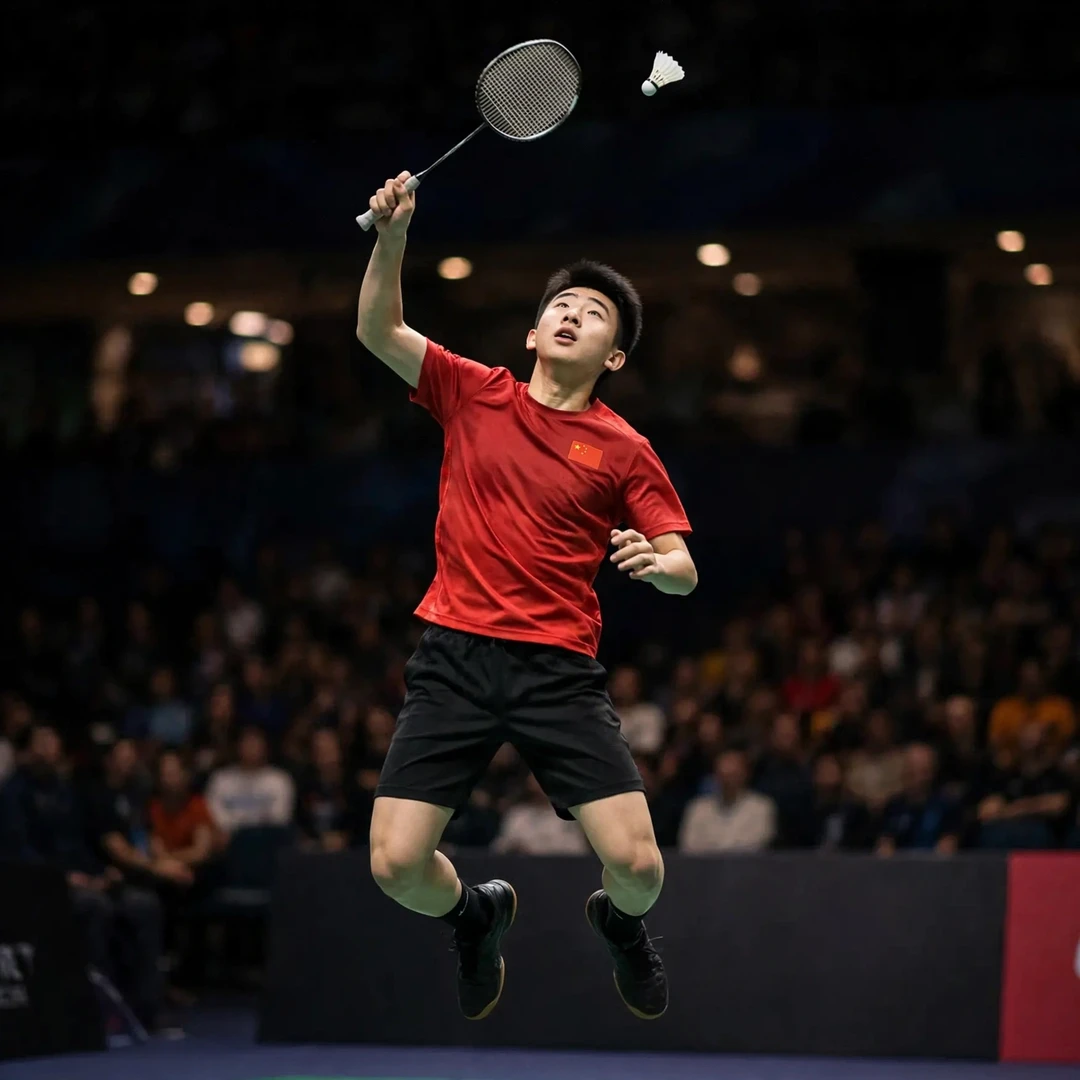
Playing Style: Right-handed attacking all-rounder who changes the pace suddenly, strikes precisely from the back court and turns defence into instant counterattack
Known For: Winning the Malaysia Super 100 2026 from the qualifying rounds — seven wins, all in straight games — for his first senior title, a year after taking World Junior singles silver
Journey: China junior national team · Asian Junior singles bronze 2023 · World Junior team gold 2023 · World Junior singles silver 2024 · Malaysia Super 100 champion 2026 · World No. 150
Understanding Wang Zi Jun (Chinese Badminton Star)
Wang Zi Jun is a Chinese men’s singles badminton player who stands at world No. 150 in the BWF rankings (Week 43, 20 October 2026) with 13,270 points. One week earlier he was ranked No. 210. The reason for the 60-place leap is one of the stories of the 2026 season: at the Malaysia Super 100 in Johor Bahru, Wang entered through the qualifying rounds and won the title, beating the fourth seed in an all-China final without dropping a single game all week. It was the first senior title of his career — and it announced a player whose junior medals, including World Junior singles silver, had long marked him as one of China’s next wave.
Early Life and the Chinese Junior Pathway
Wang Zi Jun was born on 7 January 2006 in China and developed inside the Chinese badminton system, the deepest and most demanding production line in the sport. In China, a talented child is scouted into a sports school, then a provincial team, and only the very best reach the national junior squads in Beijing — at every step, hundreds of equally hungry players are competing for the same few shirts. To emerge from that system with junior world medals, as Wang did, a player needs far more than talent: he needs a complete game and the patience to wait for his chance.
Forged in the World’s Deepest Junior System
His junior generation is a golden one. Wang grew up in the same Chinese age group as Hu Zhe An and Zhu Xuan Chen — players he would meet again and again in junior finals and, later, in senior ones. Training and competing against that level every week is a double-edged sword: medals are brutally hard to win, but a junior who survives the internal competition arrives on the senior circuit already hardened. Wang’s junior record shows exactly that pattern — he was rarely the only star, but he was almost always still standing in the final rounds.
A Medal-Filled 2023: Team Gold, Singles Bronze and Silver
Life inside that system is famously intense. China’s junior internationals train full-time: morning sessions on footwork and physical conditioning, afternoons of multi-shuttle drills and match play, and constant internal selection tournaments that decide who travels abroad and who stays home. A player’s place is never safe — it is re-earned every few months against the same compatriots he will later meet in finals. Wang’s steady harvest of junior medals between 2023 and 2024 is the visible result of surviving that invisible pressure, week after week, year after year.
World Junior Silver in Nanchang 2024
His international breakthrough came in 2023. At the Asian Junior Championships in Yogyakarta in July 2023, Wang reached the boys’ singles semi-finals before losing to Japan’s Yudai Okimoto, and took home the bronze medal. The photograph on this page shows that podium: gold medallist Hu Zhe An, silver medallist Okimoto, Indonesia’s Alwi Farhan, and Wang in the red China jacket holding his bronze. For a 17-year-old in the world’s strongest junior field, a continental singles medal was a serious statement.

Career Milestone #1
Senior Breakthrough: Qualifier to Champion in Malaysia
The medals kept coming that year. At the World Junior Championships in Spokane, Wang was part of the Chinese squad that won the mixed team gold medal — the Suhandinata Cup — the first team title of his career. Weeks earlier, at the East Asian Youth Games in Ulaanbaatar, he had taken boys’ singles silver: he beat Korea’s Cho Hyeon Woo 21-13, 21-12 in the semi-finals before losing a tight final to his own compatriot Hu Zhe An, 18-21, 15-21. Team gold, continental bronze, regional silver — 2023 made Wang a fixture of China’s junior podium photos.
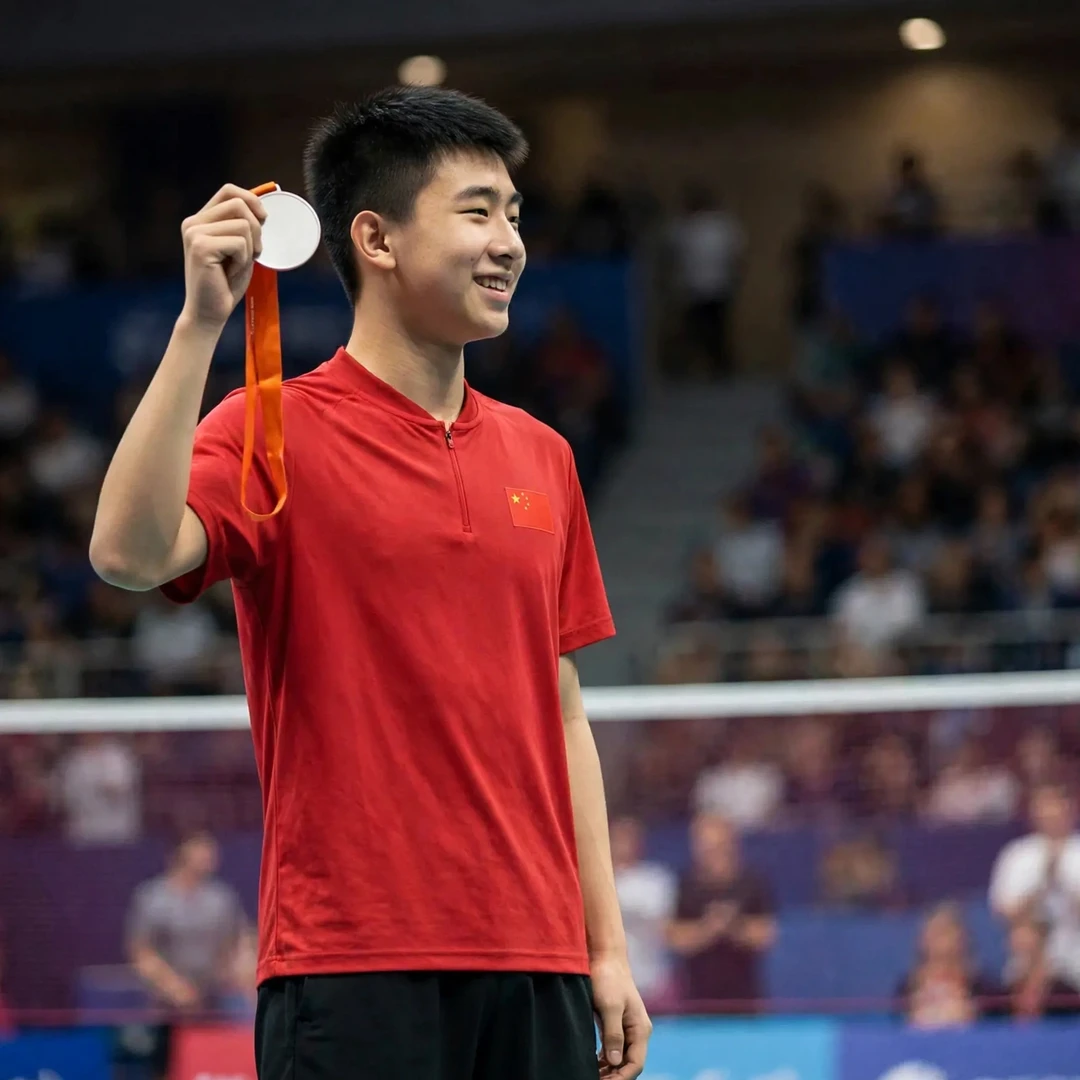
His biggest junior singles medal arrived a year later. At the World Junior Championships 2024 in Nanchang, on home soil, Wang reached the boys’ singles final — and once again it was Hu Zhe An who stood across the net and took the gold. A world junior silver medal is no consolation prize; it marked Wang as the second-best junior on the planet that week. The same year he added another team gold at the Asian Junior Championships in Yogyakarta, where his semi-final win over Malaysia’s Razeeq Roslie, 21-17, 21-9, helped China into the final. When he graduated from junior badminton at the end of 2024, his medal collection already read like a career: world junior team gold, world junior singles silver, two Asian junior medals and an East Asian Youth Games silver.

Career Milestone #2
Learning the Senior Circuit the Hard Way
The senior circuit, though, does not care about junior medals. In 2025 Wang began the long apprenticeship every Chinese youngster serves, playing Super 100 and tour events far from the television courts. At the Vietnam Open 2025 he fought into the quarter-finals and took the first game 21-16 off home favourite Nguyen Hai Dang before the Vietnamese, roared on by the crowd, came back to win in three games. It was a classic young-player lesson: good enough to trouble established tour players, not yet steady enough to close them out.
Through 2026 the near misses kept stacking up — and kept teaching. At the Ruichang China Masters in March he reached the quarter-finals, sweeping past Thailand’s Korakrit Laotrakul 21-9, 21-10 before losing to Korea’s Park Sang Yong, 18-21, 18-21. At the Baoji China Masters he won the first game against Malaysia’s experienced Cheam June Wei before falling in three. Twice he ran into Japan’s Shogo Ogawa — at the Korea Masters in August, and again at the Indonesia Masters in Pontianak in September, where this time he pushed Ogawa all the way before losing 18-21, 21-9, 21-23. Each defeat was close; each one was data.
By the Vietnam Open in September 2026, the breakthrough was visibly close. Wang beat Singapore’s Jia Wei Joel Koh in the round of 16 — losing the first game 21-23, then storming back 21-9, 21-8 — and then took top seed Jason Teh Jia Heng of Singapore to the edge: Wang won the first game 21-16, lost the second 22-24 in setting, and only then faded, 12-21. Match reports noted his aggressive baseline play and sharp net attacks. A player ranked around No. 210 was going toe-to-toe with the tournament’s top seed. Something was about to break open.
Career Milestone #3
Seven Matches, Seven Straight-Game Wins
It broke open in Johor Bahru. Wang arrived at the ALLIANZ Malaysia Super 100 (13–18 October 2026) still ranked around world No. 210, which meant starting in the qualifying rounds on the Monday, when the hall is almost empty. He beat Sri Lanka’s Rasindu Hendahewa 21-9, 21-19 to qualify, then marched through the main draw without dropping a game: Ong Zhen Yi in the round of 64, then Malaysia’s Kok Jing Hong in the round of 32. Qualifying is where young players’ weeks usually end. Wang was only getting started.
The second half of the week was flawless. Dong Tian Yao fell in the round of 16, Wu Zhe Ying in the quarter-finals, and in the semi-finals Wang beat Korea’s Jeon Hyeok Jin — a former top-20 player with years of World Tour experience — in straight games. Seven matches into the week, Wang had still not lost a single game. For a 20-year-old qualifier, the composure was as impressive as the badminton: no drama, no collapses, just one controlled performance after another.
The final, on Sunday 18 October, was an all-China affair against fourth seed Zhu Xuan Chen — a familiar face from the junior years. Wang never let it become a contest. Chinese match reports described a player attacking with constant changes of pace, his touch at the net red-hot, his back-court smashes precise and his counterattacking defence razor sharp; Zhu managed only 11 points in the first game and 15 in the second. Wang won 21-11, 21-15 to lift his first senior title, and Chinese media noted the wider significance: the win ended a 32-month wait for a Chinese men’s singles title at Super 100 level. From the qualifying rounds to the trophy, without dropping a game.
Career Milestone #4
World No. 150 — and a 60-Place Leap in One Week
The rankings made the story official. In the Week 43 BWF rankings published on 20 October 2026, Wang Zi Jun climbed from No. 210 to No. 150 — a career-high — with 13,270 points earned from just seven counting tournaments. Most players above him have built their totals across ten or more events; Wang’s points are concentrated and fresh, which means every good week from here can move him quickly. The Malaysia title also changes his tournament life: direct entry into Super 100 main draws, and a realistic path toward the Super 300 and Super 500 events where his game has already troubled top seeds.
What makes Wang’s rise especially interesting for coaches is that it is built on a complete game rather than one spectacular shot. The reports from his Malaysia title run return to the same four ingredients: sudden changes of pace in attack, a confident and delicate touch at the net, accurate — rather than merely powerful — back-court smashes, and a defence that does not just retrieve but counterattacks. Remove any one of the four and the Malaysia week does not happen; together, they are a template any ambitious junior can work towards.

Playing Style
The Pace-Changing Attacker: Net Touch, Precision and Counters
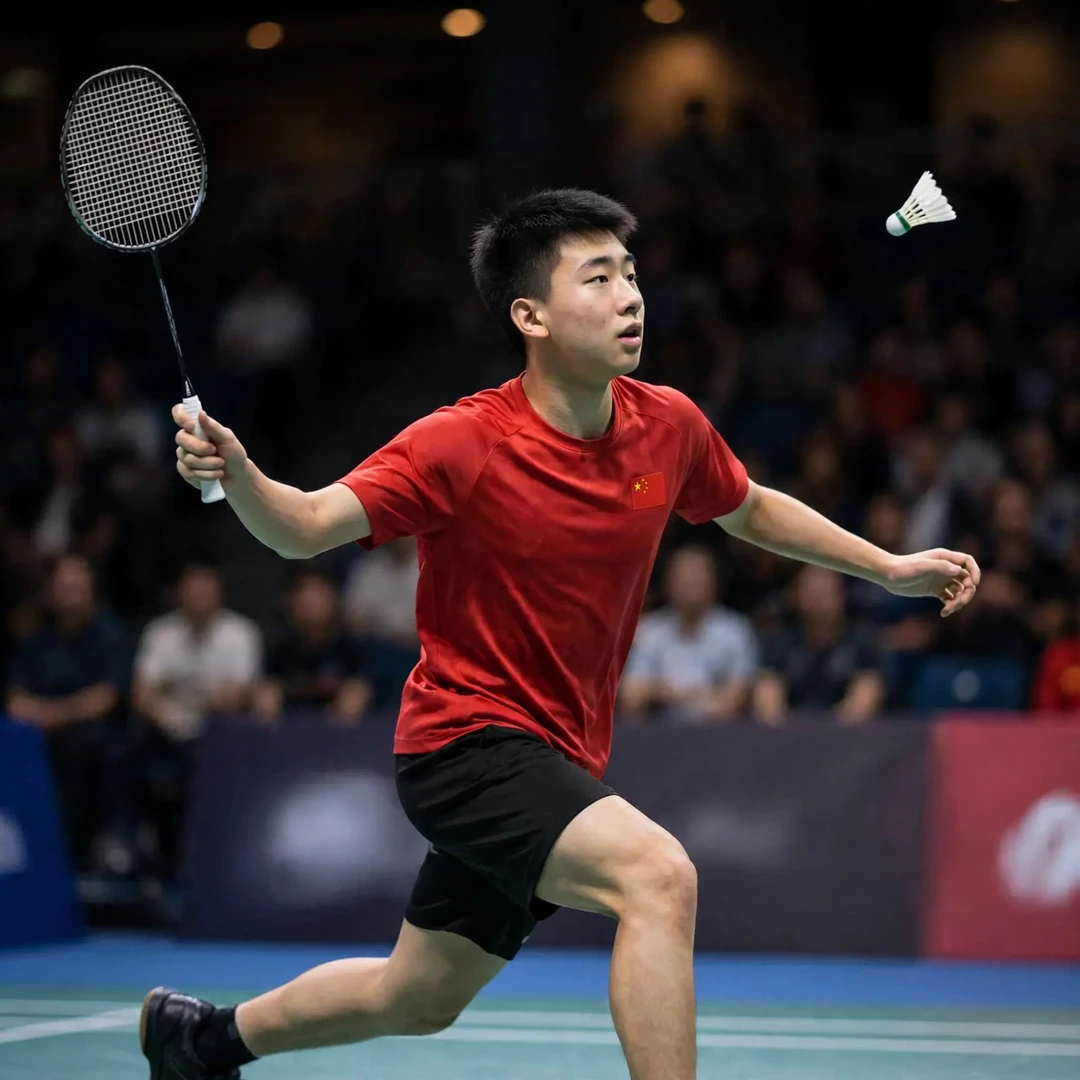
The pace change is his signature weapon. Wang does not attack at one speed: he builds rallies with patient clears and lifts, holds the shuttle a fraction longer to freeze his opponent, then accelerates without warning — a stick smash, a sudden flat drive, a late flick from the net. Against Zhu Xuan Chen in the final, that rhythm-breaking turned a meeting of equals into a one-sided match: the fourth seed could never settle, because he could never predict when the speed was coming. Changing pace is not a gift; it is trained, rally by rally, with a coach feeding shuttles at deliberately varied tempos.
His net play deserves equal attention. Young attacking players often treat the net as an afterthought — a place to dump the shuttle before the next smash. Wang uses it as a weapon: tight spinning net shots that force weak lifts, and the confidence to take the shuttle early and high, which is exactly what match reports praised in Vietnam and again in Malaysia. Combined with his counterattacking defence — the ability to turn a defensive scramble into an attacking drive in one shot — it means opponents cannot relax in any corner of the court. Study his matches and count how many rallies he wins without ever hitting a full-power smash.
Underpinning all of it is his footwork. The pace-change game only works if a player arrives at the shuttle early and balanced — late, scrambling players cannot hold a shot or disguise its speed. Watch Wang’s movement in the back court: a quick scissor-kick rotation that lets him strike from behind his body without losing position, and an explosive first step into the net that makes his early takes possible. It is unglamorous, repetitive, trainable work — and it is the engine that allows the touch and the tactics to function at full speed in the seventh match of a week, not just the first.

Mental Strength
Fearlessness, Patience and the Qualifier’s Mindset
Wang’s mindset through the Malaysia week is a case study in the qualifier’s mentality. A seeded player protects a ranking; a qualifier has nothing to protect. Seven matches in six days, starting in an empty hall on Monday, is a physical and mental marathon — and Wang played it like a veteran: straight games in every round, conserving energy, never chasing points emotionally after errors. The junior years had prepared him: a player who has stood in World Junior finals does not panic in a Super 100 semi-final.
His response to defeats tells the same story. Twice in 2026 Shogo Ogawa beat him — the second time 21-23 in a deciding game. Park Sang Yong edged him 21-18, 21-18. Jason Teh survived him in three games. A month after the last of those losses, Wang produced the most complete week of his life. For young players the sequence is the lesson: at this level almost everyone loses most weeks; the ones who rise are the ones who convert close defeats into information — about opponents, about their own patterns under pressure, about fitness — and arrive at the next tournament slightly better.
The practical lessons from Wang’s journey are repeatable anywhere. Enter the qualifying rounds without ego when your ranking demands it — points and titles are won there, not wished for. Win the early rounds economically: his straight-game wins left him fresh for the semi-final and final. Build the complete game before the spectacular one, so that no opponent finds a free weakness. And treat team events and junior medals as foundations, not ceilings: Wang’s World Junior silver was not the peak of his story, it was the platform for Malaysia.

Learning Reference
ST Badminton Academy Connection
ST Badminton Academy has no official partnership or endorsement from Wang Zi Jun. He is not connected with our academy, and this profile is published purely as an educational case study for parents and junior players who want to understand how a world junior medallist converts junior promise into a first senior title.
Many of our students from Malaysia saw his Malaysia Super 100 run at close range — the tournament was played in Johor Bahru — and it is already a favourite case study in our academy discussions: how a qualifier manages a seven-match week, how pace changes dismantle a higher seed, and how a player who lost three close matches in the previous two months responded by winning a title without dropping a game.
We encourage our students to watch how Wang constructs points: the patient rally, the sudden injection of pace, the early take at the net and the counterattack out of defence. His game rewards study because none of it is magic — it is footwork, timing, touch and nerve, all of them trainable. Champions are not only the players with the biggest smashes; sometimes they are the qualifiers who refuse to lose a single game all week.
FAQs: Wang Zi Jun Chinese Badminton Player
Here are answers to common questions about Wang Zi Jun’s career, achievements and what young players in Malaysia can learn from the Chinese youngster’s breakthrough.
Who is Wang Zi Jun and which country does he represent in badminton?
Wang Zi Jun is a Chinese professional badminton player competing in men’s singles. Born on 7 January 2006, he is a right-handed player who came through China’s national junior system, won World Junior singles silver in 2024 and the mixed team gold in 2023, and in October 2026 won his first senior title at the Malaysia Super 100 — rising to a career-high world No. 150.
What are Wang Zi Jun’s biggest badminton achievements?
Wang’s major achievements are the Malaysia Super 100 title in 2026 — his first senior title, won from the qualifying rounds without dropping a game — World Junior Championships boys’ singles silver (Nanchang 2024) and mixed team gold (Spokane 2023), Asian Junior Championships mixed team gold (2024) and boys’ singles bronze (2023), and boys’ singles silver at the East Asian Youth Games 2023. He reached his career-high world ranking of No. 150 in October 2026.
What is Wang Zi Jun’s playing style?
Wang plays a right-handed attacking all-court game built on variety. His signature is the sudden change of pace — patient rallying broken by sharp acceleration — supported by delicate net touch, precise back-court smashes and a counterattacking defence that turns pressure into attack. Match reports from both the Vietnam Open and his Malaysia Super 100 title run singled out his aggressive baseline play and sharp net attacks.
How did Wang Zi Jun perform at the World Junior Championships?
Wang reached the boys’ singles final at the World Junior Championships 2024 in Nanchang, taking the silver medal after losing the final to his compatriot Hu Zhe An, and a year earlier he was part of the Chinese squad that won the mixed team title at the World Junior Championships 2023 in Spokane. Few juniors leave the world junior stage with both an individual silver and a team gold.
How can my child learn from Wang Zi Jun’s training approach?
Young players can study Wang’s approach by copying the habits behind his complete game: drill net shots until taking the shuttle early feels automatic, practise pace-change combinations — slow, slow, fast — rather than attacking every ball, train defence as an attacking skill by driving out of the crouch, and build the fitness to survive long tournament weeks. At ST Badminton Academy we use his Malaysia Super 100 final as a video lesson in rhythm-breaking, then train the same patterns in multi-shuttle and rally-building drills.
Did Wang Zi Jun win any junior titles?
Yes — an exceptional set of them. Wang won mixed team gold at the World Junior Championships 2023 and the Asian Junior Championships 2024, boys’ singles silver at the World Junior Championships 2024, boys’ singles bronze at the Asian Junior Championships 2023, and boys’ singles silver at the East Asian Youth Games 2023. His junior medals are the foundation on which his 2026 senior breakthrough was built.
What are Wang Zi Jun’s best World Tour results?
Wang’s best World Tour result is his title at the Malaysia Super 100 in October 2026, where he came through qualifying and won seven matches in straight games, beating fourth seed Zhu Xuan Chen 21-11, 21-15 in the final. He also reached the quarter-finals of the Ruichang China Masters Super 100 in 2026 and of the Vietnam Open in 2025, and the round of 16 at the Vietnam Open 2026, where he pushed top seed Jason Teh Jia Heng to three games.
What playing style should young players learn from Wang Zi Jun?
Young players should study Wang’s variety rather than one shot: the patience to build a rally, the nerve to change its pace without warning, the net touch that earns weak lifts, and the defence that counterattacks instead of merely surviving. His game is a reminder that at the highest level, the player with the most complete toolbox — not the single biggest weapon — is the one still standing on Sunday.
Does ST Badminton Academy have any connection with Wang Zi Jun?
No, Wang Zi Jun is not a student, coach or ambassador of ST Badminton Academy. He represents China and developed through the Chinese national system. However, coaches at our academy in Kuala Lumpur regularly use his matches as teaching material, because his journey from world junior medallist to qualifier-to-champion shows young players exactly how junior foundations convert into senior success.
Wang Zi Jun Career Highlights


Career Statistics and Rankings
Wang Zi Jun, born 7 January 2006 in China, has built one of the most instructive young careers in badminton: Asian Junior bronze and World Junior team gold in 2023, World Junior singles silver in 2024, a hard senior apprenticeship of close defeats in 2025 and 2026 — and then, in one October week in Johor Bahru, a first senior title won from the qualifying rounds without dropping a game, and a leap from world No. 210 to No. 150.
| Development Area | Common Misconception | What Wang Zi Jun's Career Shows REALITY |
|---|---|---|
| Junior Foundation | Talent alone decides who becomes a champion. | Wang Zi Jun came through China's national junior system and collected World Junior team gold in 2023 and singles silver in 2024 — a structured junior base came first. |
| Playing Style Priority | Kids should copy the flashiest attacking shots. | Wang built a complete game first; his precise back-court smashes are the finishing touch on sharp net play, sudden pace changes and counterattacking defence. |
| Fitness Importance | Juniors can out-train everyone without rest. | Wang played seven matches in six days to win the Malaysia Super 100 from qualifying — managing energy across a long week is what turns qualifiers into champions. |
| Mental Approach | Top players never get nervous or upset. | Wang lost twice to Shogo Ogawa in 2026, the second time 21-23 in a deciding game, and won his first senior title a month later — mental skills are trained, not inherited. |
| Attacking Training | Smashing harder is always the answer. | His Malaysia Super 100 final win over Zhu Xuan Chen (21-11, 21-15) came from pace changes and net control, not raw power. |
| National Milestones | Only world titles matter. | Wang's Asian Junior bronze (2023), World Junior singles silver (2024) and two junior team golds made him a name in China — junior and continental milestones build a career step by step. |
| Career Timeline | Champions peak once and fade fast. | From World Junior singles silver in 2024 to a World Tour title and world No. 150 in 2026, Wang proves sustained development beats a short peak. |
Study Wang Zi Jun's Work Ethic and Professional Approach
This profile explains who Wang Zi Jun is, his major achievements, and what developing players can learn from his journey. Whether you are a parent in Kuala Lumpur, Cheras or anywhere in Malaysia whose child dreams of following a junior pathway like Wang's, his story carries the answer: build the complete game, respect the early rounds, and be ready when your week comes — book a trial class with ST Badminton Academy on WhatsApp at +60 17-684 2136 and let your child begin a development journey built to last.