Swedish Men’s Singles Badminton Player
Gustav Bjorkler

Sweden
Player Event: Men’s singles
Date of Birth: 29 March 2002, Gothenburg, Sweden · Right-handed
Playing Style: Tall right-handed all-court player who uses a 190 cm frame and long reach to cover the court, builds rallies patiently and defends from deep, difficult positions
Known For: One of the great comeback stories in modern badminton — diagnosed with myelodysplastic syndrome, a form of blood cancer, in 2018, he rebuilt his body after chemotherapy and a stem-cell transplant to become Swedish champion and break into the world top 100
Journey: Swedish junior singles titles U15 (2017) and U17 (2018) · MDS diagnosis 2018 · Declared healthy 2019 · Swedish mixed doubles title 2021 · European Championships debut 2024 · Swedish singles champion 2025 · Dutch Open finalist 2025 · Career-high world No. 94 · Thomas Cup and World Championships player 2026
Understanding Gustav Bjorkler (Swedish Badminton Player)
Gustav Bjorkler is Sweden’s No. 1 men’s singles player — and the owner of a story that reaches far beyond badminton. In the official BWF world rankings for Week 43, published on 20 October 2026, Gustav Bjorkler stands at world No. 149 with 13,274 ranking points. He is a Swedish national champion, a Dutch Open finalist and a career-high world No. 94. He is also a cancer survivor: diagnosed with myelodysplastic syndrome, a form of blood cancer, in 2018, he came through chemotherapy and a stem-cell transplant, was declared healthy in 2019, and then rebuilt a body that had lost almost all of its muscle. This profile explains who Gustav Bjorkler is, how illness interrupted one of Sweden’s brightest junior careers, how he fought his way back to the top 100, and what young players can learn from the patience and perspective his journey demands.
Early Life in Gothenburg and Junior Career
Gustav Fredrik Olof Bjorkler was born on 29 March 2002 and grew up in Gothenburg, Sweden’s second city. He started playing badminton at the age of ten at Västra Frölunda Badmintonklubb, the Gothenburg club that remains his home club today. Sweden is not a badminton superpower — football and ice hockey dominate its sporting life, a reality Bjorkler himself talks about openly — but its club system has produced European-class players for decades, and Västra Frölunda gave the tall youngster from Gothenburg exactly what a developing singles player needs: structured coaching, senior league badminton and a pathway from junior titles to the national team. At 190 cm, he would grow into one of the tallest players on the European circuit.
A Gothenburg Club With a Champion’s Pathway
His junior record marked him out early. Bjorkler won the Swedish junior championships singles titles in the under-15 class in 2017 and the under-17 class in 2018, and his junior medal collection ran across all three disciplines: under-15 doubles golds in 2016 and 2017 alongside Tom Söderström, an under-13 doubles gold in 2015, and under-15 mixed doubles golds with Alice Lindhé in 2016 and Edith Urell in 2017. In Swedish terms, this was the profile of a future senior international — a singles champion who could also play doubles, winning national titles year after year through the age groups. By 2018, the year of his under-17 singles crown, everything pointed one way: upwards.
The Diagnosis That Changed Everything
Then 2018 brought the news that stopped everything. Bjorkler was diagnosed with myelodysplastic syndrome — MDS, a form of blood cancer in which the bone marrow fails to produce healthy blood cells. The treatment that followed was as serious as the disease: chemotherapy and a stem-cell transplant, with the long protective isolation that transplant recovery demands. Swedish reporting on his story runs under headlines like “From blood disease and isolation to an Olympic campaign” and “He beat cancer — dominant in the badminton final”, and they are accurate summaries of both halves of his life. In 2019, he was declared healthy. The badminton player, however, had to be rebuilt from zero.
Rebuilding a Body, Rebuilding a Career
“I didn’t have any muscle on my body at all. I was the same height, but almost 15 to 17 kilos less. So I didn’t have any physicality at all,” Bjorkler told PTI, describing what the illness left behind. “It took some time to get these things back.” Rebuilding took years, not months: strength first, then stamina, then the explosiveness elite singles demands, rebuilt session by session while his peers were banking ranking points. What carried him, he says, was belief — the conviction, held throughout the sickness, that he would overcome it and return to the highest level he could reach. “That was something that helped me quite a lot when I went through the sickness. It really helped me to really push and just make the best out of it.”

Career Milestone #1
Swedish Champion: The 2025 Season
The comeback announced itself in stages. He entered the BWF senior world ranking in January 2020 at No. 1824 — a number that belongs in his story, because it is where a former junior champion had to start again. In August 2021, at the Swedish Championships in Borås, he won senior national gold in mixed doubles alongside Sanne Ekberg. In 2022 he took silver in the men’s singles at the Swedish Championships, beaten in the final by Felix Burestedt. Each season the body held more and the results climbed further, and in April 2024 he made his European Championships debut in Saarbrücken, losing his first-round match to Finland’s Kalle Koljonen in straight games. The results were modest; the trajectory was not. A player who had been declared healthy in 2019 was, five years on, playing European Championship badminton.
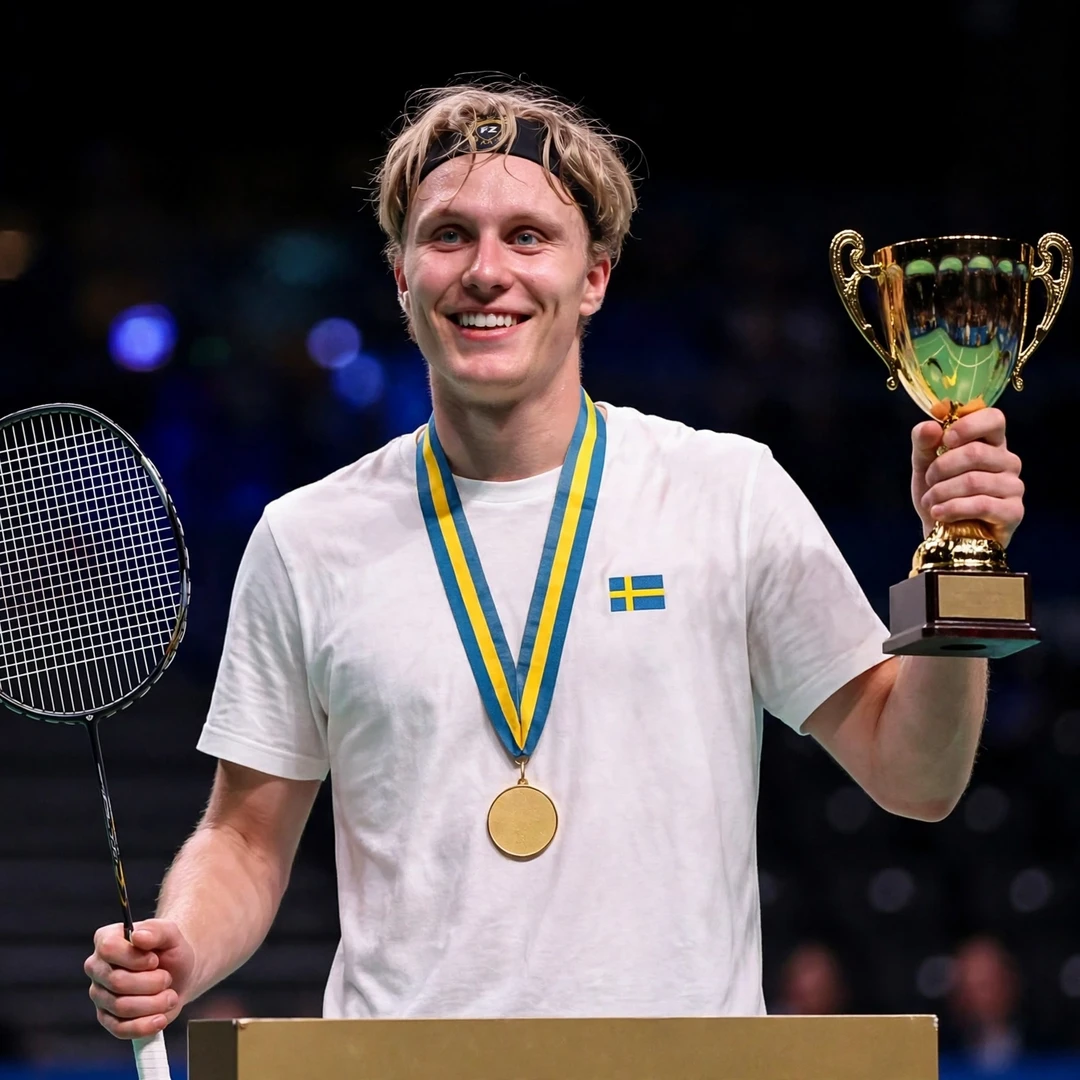
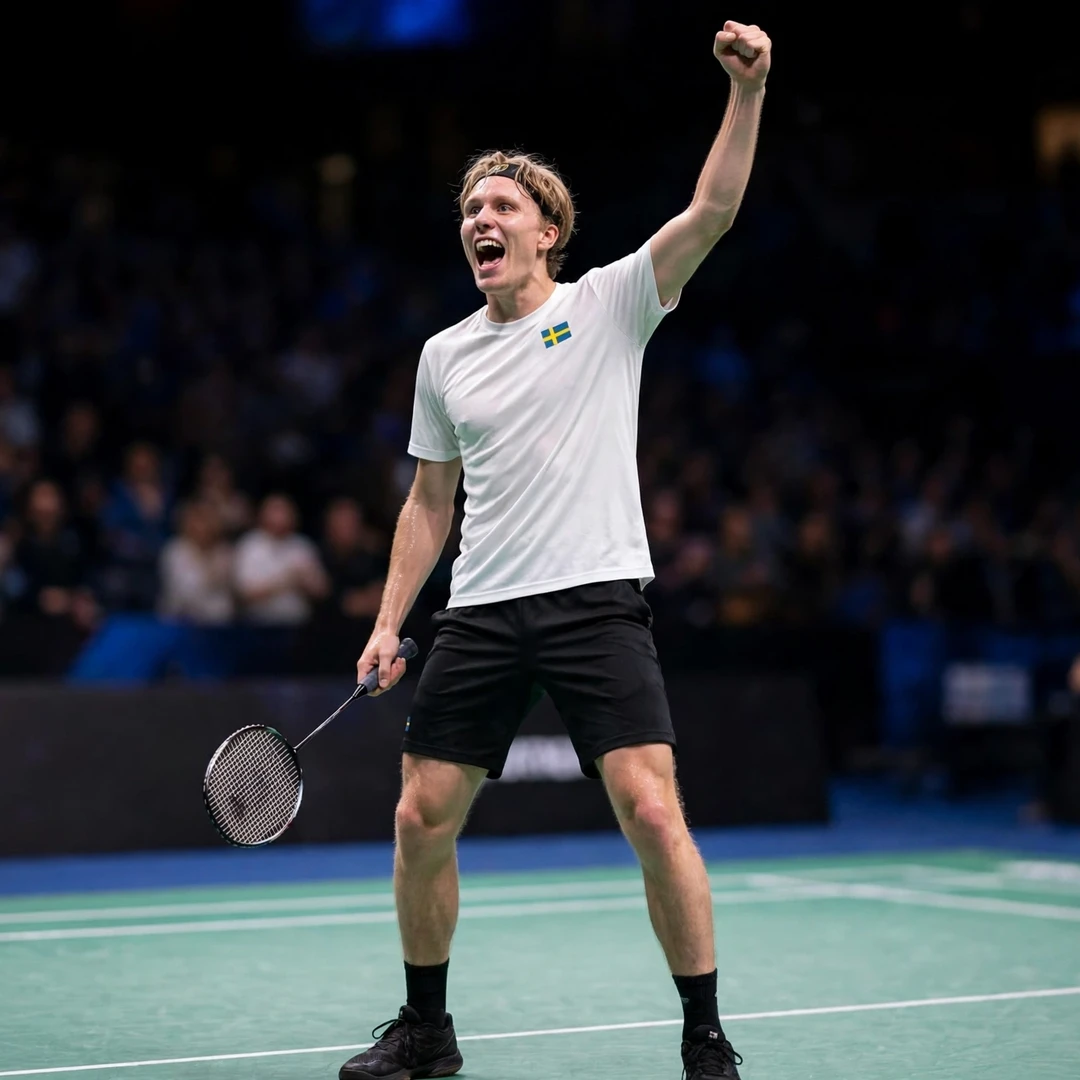
The 2025 season turned the comeback into a coronation at home. In February 2025, in Borås, Bjorkler won the Swedish national singles title, beating Kim Linell in the final — Sweden’s public broadcaster SVT marked it with the headline “Gustav Bjorkler beat cancer — dominant in the badminton final”. In May he added a second gold of the year, winning the Swedish team championships with Västra Frölunda, who edged Påvelunds TBK 4–3 in a golden set. Gothenburg’s newspaper GP summarised the season in one line: “Gustav Bjorkler is the best in Sweden — and can play badminton full-time.” Three Swedish Championship gold medals now stand on his record — singles and team in 2025, mixed doubles in 2021 — and the singles crown, seven years after his diagnosis, is the one that defines the comeback.
Career Milestone #2
A European Championships Run in Horsens
The same season brought his biggest senior international result. At the Dutch Open in ‘s-Hertogenbosch in October 2025 — an International Challenge event — Bjorkler strung together the best week of his senior career: he beat England’s Cholan Kayan in three games, defeated Belgium’s Julien Carraggi 21–19, 21–18, and swept France’s Enogat Roy 21–9, 21–13 to reach the final. The title itself escaped him on finals day, but a runner-up finish worth 3,400 ranking points — the largest single points haul of his career — confirmed that the Swedish champion’s level travelled. For a player whose ranking had begun at No. 1824, a European International Challenge final was another border crossed.
His European Championships story deepened that same spring. After his 2024 debut in Saarbrücken, Bjorkler returned at the 2025 European Championships in Horsens, Denmark, and produced the best championship run of his career. He opened by beating Poland’s Mateusz Golas 21–19, 19–21, 21–10, then defeated Azerbaijan’s Ade Resky Dwicahyo 15–21, 21–14, 21–12 — a comeback win over a higher-ranked opponent — to reach the round of 16. There he took the first game off France’s Toma Junior Popov before the Frenchman turned the match around, 19–21, 21–17, 21–14 from Popov’s side of the scorecard. A last-16 finish at the Europeans, with two three-game wins banked, was the level his career-high ranking was built on: that same month, April 2025, he reached world No. 94.
In April 2026 came the biggest team stage in men’s badminton: the Thomas Cup Finals, again in Horsens. Bjorkler led Sweden’s singles line in a brutal Group C, and his three matches were a measuring stick against the elite. Against Chinese Taipei he faced Chou Tien Chen, the world No. 6, and produced one of the performances of his life — after losing the first game 11–21, he won the second 21–18 and pushed the decider all the way before falling 19–21. Against Denmark he lost to Anders Antonsen 18–21, 11–21, and against Korea he went down 11–21, 14–21 to Yoo Tae Bin. Sweden exited in the group stage, but their No. 1 had taken a game off a top-six player on the sport’s biggest team stage — the clearest proof yet that his level, on the right day, troubles the very best.
Career Milestone #3
Thomas Cup Tests Against the World’s Best
Put the three Horsens matches together and they sketch his exact address in world badminton. Against the world No. 6 he was a late run of points from a famous win; against Denmark’s Anders Antonsen and Korea’s Yoo Tae Bin, established top-level professionals, he competed without ever looking out of his depth. That is the profile of a player whose ceiling sits above his ranking whenever the biggest stages arrive — which is precisely what makes his stated target credible. The top 100 is not a dream for Bjorkler; it is a place he has already lived, at world No. 94, and his Thomas Cup week showed a game capable of going back there and staying.
World Championships badminton has given him a rivalry to measure himself against. Bjorkler made his World Championships debut in Paris in August 2025, losing in the first round to Hong Kong’s Lee Cheuk Yiu. A year later, at the 2026 World Championships in New Delhi, he drew Ade Resky Dwicahyo — the same Azerbaijani he had beaten at the European Championships — and the rematch went the other way: Bjorkler won the first game 21–14, then lost 17–21, 18–21 in a 55-minute battle, afterwards blaming his own impatience in the closing stages. Two meetings, two three-game matches, one win each: it is the kind of rivalry that tells a player exactly where he stands, and exactly what the next step costs.
Around the headline events, his 2026 season has been the honest grind of the European circuit. In December 2025 he helped Sweden win their European Men’s Team Championships qualifying group in Portugal and then beat Azerbaijan in the play-off tie — Badminton Sweden’s annual report singled out Bjorkler’s win over an opponent ranked around fifty places above him as one of the key performances — sending Sweden to the finals in Istanbul in February 2026. In October 2026, at the Czech Open in Prague, a Super 100 event, he beat Ukraine’s Oleksii Titov 21–13, 19–21, 21–7 before losing the round of 16 to Denmark’s William Bogebjerg 16–21, 10–21. He also beat India’s Sankar Muthusamy Subramanian at the Denmark Challenge, and lost twice to Israel’s Daniil Dubovenko, at the Valence Alpes International and the Belgian International — the weekly reality of building a ranking outside the sport’s rich federations.

Career Milestone #4
Career-High No. 94 and the Road Back
The ranking tells the comeback in numbers. Bjorkler’s first senior listing, in January 2020, was world No. 1824. Five years of rebuilding carried him to a career-high of world No. 94 on 15 April 2025, in the weeks of his European Championships run. Points expire, draws harden, and by the autumn of 2026 the number reads No. 149 — but it is rising again: the Week 43 rankings of 20 October 2026 lift him three places from No. 152, with 13,274 points gathered across 16 tournaments. For Bjorkler, the target is stated in his own words, and it is not complicated by sentiment: “My target is to go back to the top 100 and just develop myself and be a better player and play the bigger tournaments.”
Context makes the climb harder than the numbers suggest. “Badminton is of course not that big in Sweden,” Bjorkler says. “Not so many youngsters play badminton. They play football, ice hockey — these kinds of things. We have to find solutions to get the right sparring and the right training.” His solution was drastic: he moved to Copenhagen, Denmark, to live and train inside one of the strongest badminton environments in Europe. “I made a move to Denmark. I live in Copenhagen, I practice there.” It is the decision of a player who knows precisely what his development needs and refuses to let geography ration it — the same refusal, in a different form, that carried him through 2018 and 2019.

Playing Style
The Tall All-Court Competitor Style
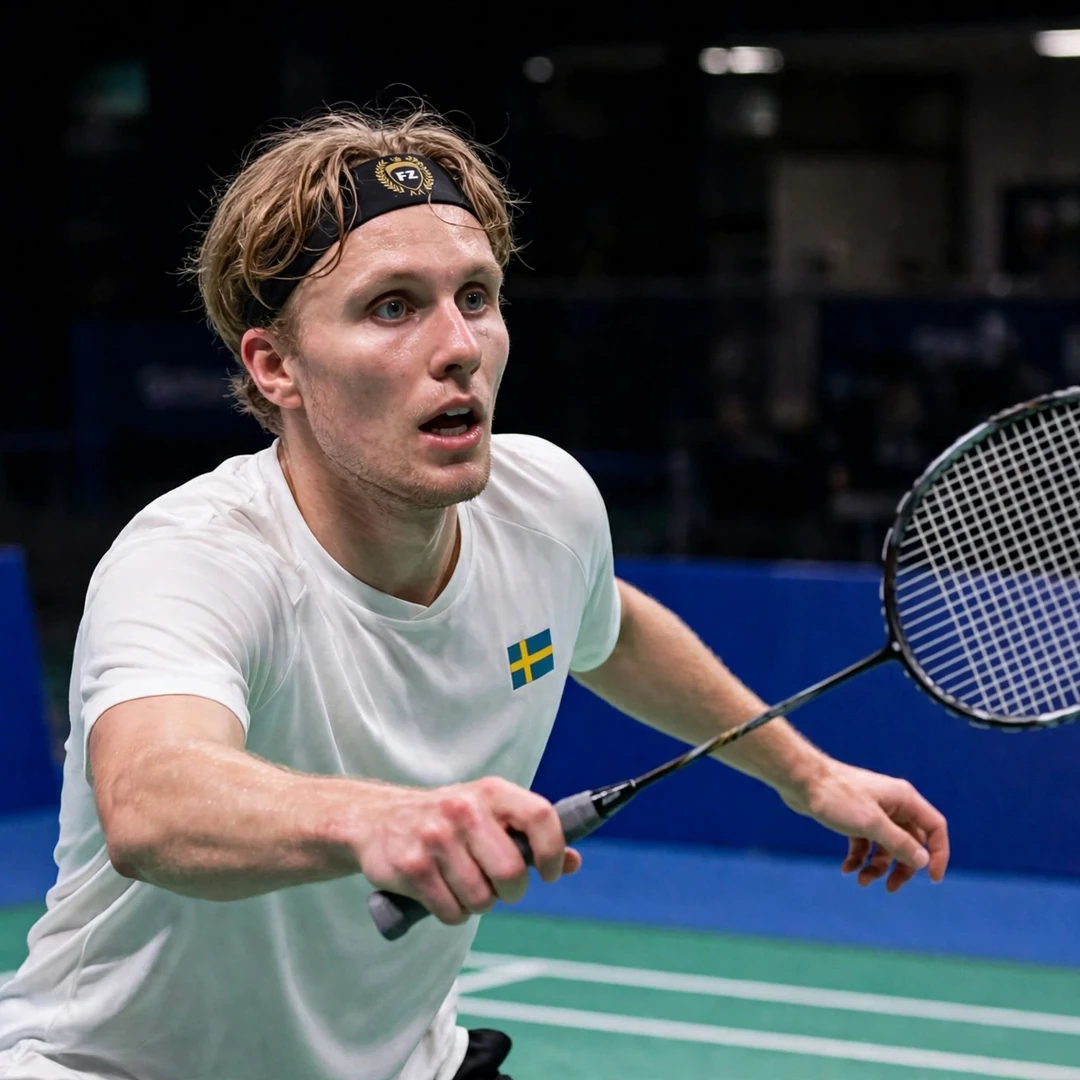
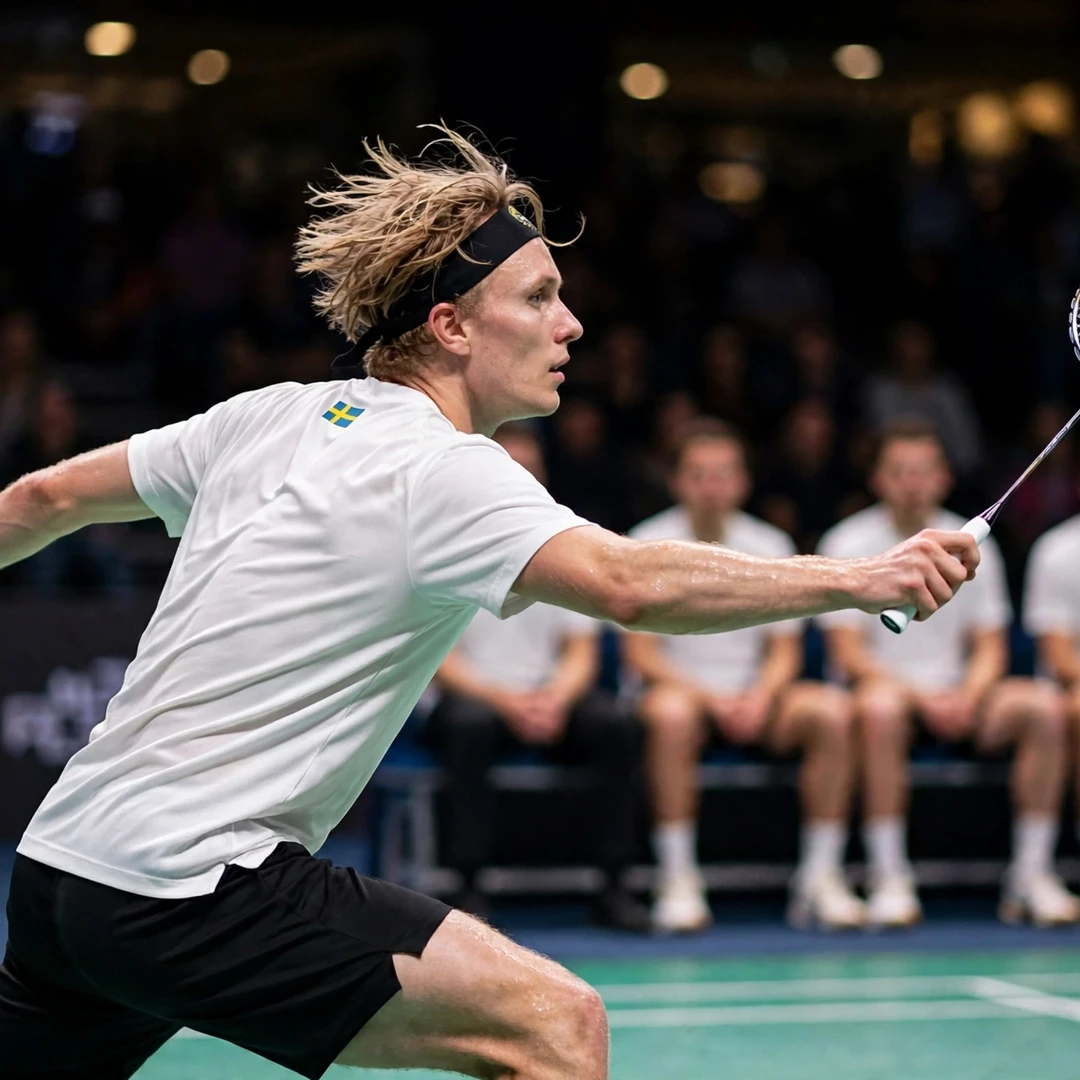
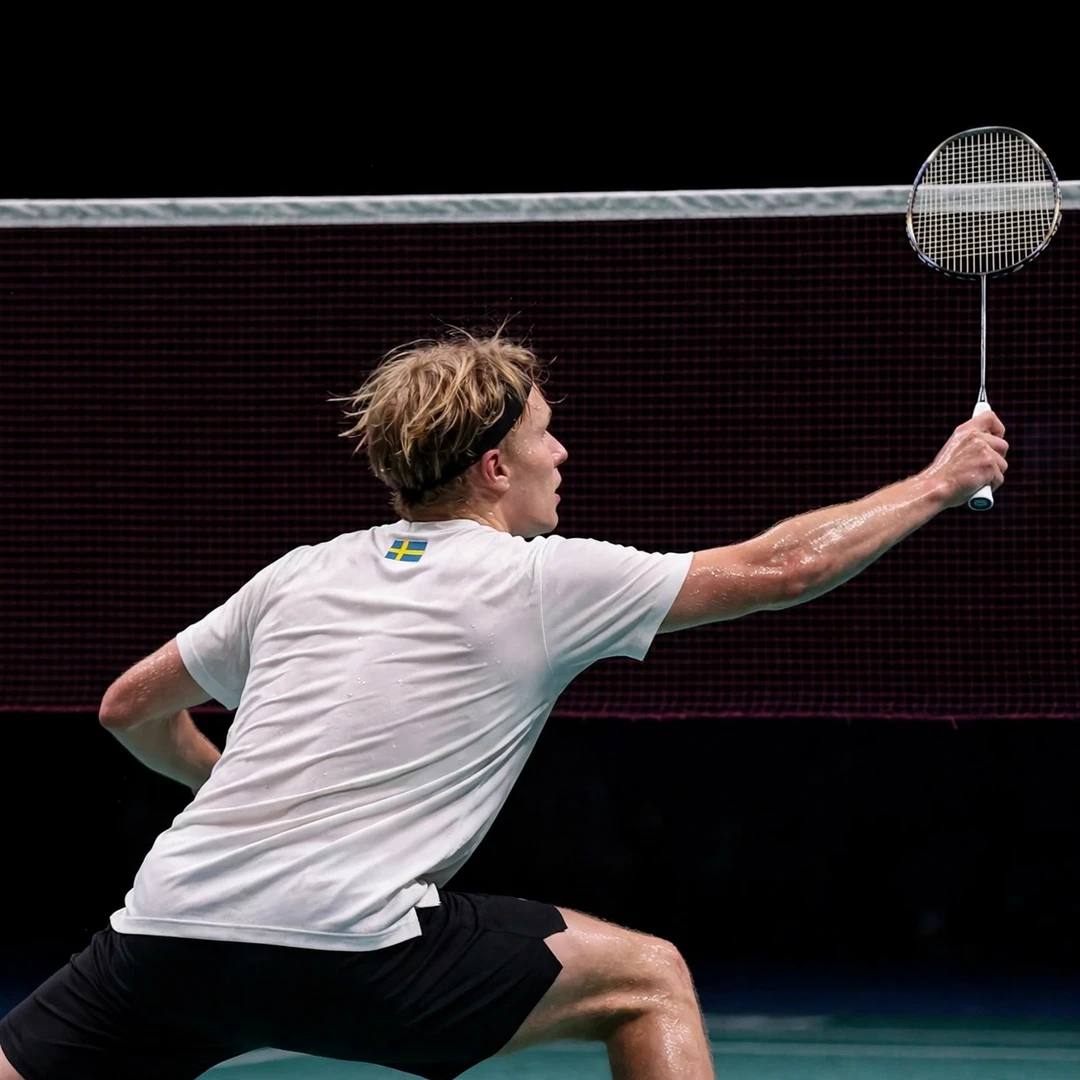
Gustav Bjorkler plays right-handed, and at 190 cm his game starts from geometry most opponents cannot change. The long reach lets him hold his ground in defence: lunges that leave other players stretched still arrive balanced, deep clears are cut off a fraction earlier, and the net area he controls is bigger than the man across from him wants it to be. Watch his ready position — low, wide, racket up, patient — and you see a player in no hurry to finish rallies. His base game is construction: accurate lifts and clears to the back corners, drops that force the opponent to lift, and defence that keeps returning the shuttle from positions where most rallies end. He makes the court feel small for the other man, one accurate shot at a time.
His attack grows out of that patience. Bjorkler is not a one-shot smasher; he strikes when the rally has been built and the opening is real, and his results show what the method produces in deciding games. At the 2025 European Championships he won two consecutive three-game matches, against Golas and Dwicahyo, coming from a game down in the second of them. At the 2026 Thomas Cup he took a game off the world No. 6 and nearly the match. At the 2026 World Championships he won the first game against Dwicahyo before the match turned. A body rebuilt from zero has become an engine for the longest matches on his schedule — stamina, in his case, is not a physical footnote but the whole story of the career.
Young players should study three things in Bjorkler’s game and conduct. First, how he uses reach as patience rather than as a shortcut: the tall frame buys him time, and he spends that time constructing rallies instead of forcing winners. Second, his between-points calm — this is a player who has faced something far more frightening than a deciding game, and it shows in how little a scoreline can rattle him. Third, his team value: Swedish champion with his club in the team event, a key singles point in Sweden’s European team qualifying win over Azerbaijan, and Sweden’s first singles at the Thomas Cup. Coaches trust him with ties, not just matches — and trust like that is earned in training rooms long before it is announced in team sheets.

Mental Strength
Perspective, Patience and the Long Way Back
Consider the timeline his career asks a young player to accept. Swedish junior champion in 2017 and 2018. A blood cancer diagnosis that same year. Declared healthy in 2019, with 15 to 17 kilos of muscle gone. A first senior ranking of No. 1824 in 2020. A first senior national gold, in mixed doubles, in 2021. A European Championships debut in 2024. Swedish singles champion and world No. 94 in 2025. Thomas Cup and World Championships stages in 2026. Between the diagnosis and the Swedish singles title stand seven years — most of them invisible, spent in gyms and small halls, rebuilding a body one session at a time. Elite careers are usually described as rises. Bjorkler’s is better described as a return, completed in full view of everyone who had watched him disappear.
His ranking arc teaches the modern ranking lesson with unusual force. The same player has been world No. 1824, No. 94 and No. 149 within one career — numbers that describe his points, his draws and his health at different moments, never his worth. Young players often treat a ranking as a verdict; professionals treat it as arithmetic with a twelve-month memory. Bjorkler’s response to every number has been the professional one: keep training, keep entering, keep the level climbing, and let the arithmetic follow. The three-place rise in the Week 43 list, earned through a Super 100 win in Prague, is what that response looks like in practice.
The deepest lesson, though, is perspective — and Bjorkler states it better than any coach could. “Of course, it affects you mostly mentally, I think, and it gives you another perspective on life as a whole,” he says of the illness. “You think of life in another way and you’re quite happy just to be healthy and to be able to live a normal life.” Asked what he wants people to know about him beyond the cancer story, he kept it simple: “I’m just a guy that likes to play badminton and enjoying badminton life at the moment. I’m really, really blessed that I’m healthy now.” He does not want the illness to define him — and the respectful way to honour that wish is to take his badminton as seriously as his story. The Swedish champion, Dutch Open finalist and world top-100 player is not a footnote to the survivor. He is the point of him.

Learning Reference
ST Badminton Academy Connection
ST Badminton Academy has no partnership or commercial connection with Gustav Bjorkler; this profile was written by our coaching team for education, so students and parents can study how a Swedish champion rebuilt an elite career after serious illness.
Our students study Gustav Bjorkler because his career isolates the qualities junior badminton most needs and least likes to practise: patience, long-term physical rebuilding, and gratitude for the chance to compete at all. The junior titles, the diagnosis, the No. 1824 restart, the national golds, the Dutch Open final, the game taken off Chou Tien Chen and the move to Copenhagen are all stages our advanced juniors can map onto their own development — especially any young player whose progress has been interrupted by injury or illness and who needs proof that an interrupted career is not a finished one.
Most of all, we point developing players to his order of priorities: health first, gratitude always, and ambition that survives being told to start again from the bottom of the ranking list. If your child is willing to build a game that patiently, Gustav Bjorkler’s story carries the answer: book a trial class with ST Badminton Academy on WhatsApp at +60 17-684 2136, and start building the game that will still be standing when the hard years come.
FAQs: Gustav Bjorkler Swedish Badminton Player
Parents and students often ask our coaches the same questions about Gustav Bjorkler, so we collected the ones we hear most, with honest answers drawn from his record.
Who is Gustav Bjorkler and which country does he represent in badminton?
Gustav Bjorkler is a Swedish men’s singles badminton player, born on 29 March 2002 and raised in Gothenburg. He is a tall, right-handed all-court player, Sweden’s No. 1, and the Swedish national singles champion of 2025. In the Week 43 rankings of 20 October 2026 he stands at world No. 149 with 13,274 points, and his career-high is world No. 94, reached in April 2025.
What are Gustav Bjorkler’s biggest badminton achievements?
His biggest achievements are the Swedish national singles title of 2025 — won seven years after his cancer diagnosis — together with Swedish golds in mixed doubles (2021) and the team event (2025), a runner-up finish at the Dutch Open in 2025, a round-of-16 run at the 2025 European Championships built on wins over Mateusz Golas and Ade Resky Dwicahyo, a career-high world ranking of No. 94, and singles duty for Sweden at the 2026 Thomas Cup, where he took a game off world No. 6 Chou Tien Chen.
What is Gustav Bjorkler’s playing style?
Gustav Bjorkler plays a right-handed all-court game built on his 190 cm reach: a low, patient defensive base, accurate rally construction with clears, drops and lifts, and attacking shots played when the rally has been properly built rather than forced. His outstanding trait is deciding-game durability — three-game wins at the European Championships and three-game fights against the world No. 6 and his World Championships rival show a player whose structure holds when matches get long.
What illness did Gustav Bjorkler overcome to return to badminton?
In 2018 Bjorkler was diagnosed with myelodysplastic syndrome (MDS), a form of blood cancer. He underwent chemotherapy and a stem-cell transplant and was declared healthy in 2019 — but the treatment cost him 15 to 17 kilos and, in his own words, left him with no muscle at all. He rebuilt his body and his game over several years, won a Swedish mixed doubles title in 2021, became Swedish singles champion in 2025 and reached world No. 94 — one of the most remarkable comebacks in modern badminton.
How can my child learn from Gustav Bjorkler’s training approach?
A child can learn that an interrupted path is not a finished one: Bjorkler lost years to illness and still reached the top 100, because he rebuilt fundamentals patiently and never treated a setback as a verdict. His career teaches physical rebuilding done gradually, gratitude for ordinary training days, and the discipline to move countries for better sparring when development demands it.
Did Gustav Bjorkler win any junior titles?
Yes. Bjorkler was one of Sweden’s dominant juniors: national junior singles champion in the under-15 class in 2017 and the under-17 class in 2018, with further junior golds in doubles — under-13 in 2015 and under-15 in 2016 and 2017 with Tom Söderström — and in under-15 mixed doubles in 2016 and 2017. His senior Swedish titles followed the same pattern: mixed doubles gold in 2021, then singles and team golds in 2025.
What are Gustav Bjorkler’s best World Championships results?
Bjorkler has played two World Championships. On his debut in Paris in 2025 he lost in the first round to Hong Kong’s Lee Cheuk Yiu. At the 2026 World Championships in New Delhi he faced Ade Resky Dwicahyo — whom he had beaten at the 2025 European Championships — won the first game 21–14, and lost 17–21, 18–21 in 55 minutes. He is still chasing his first World Championships match win, and this profile reports that honestly: the level is close, the breakthrough has not arrived yet.
What playing style should young players learn from Gustav Bjorkler?
Young players can learn his patience and his reach management: defend from a low, balanced base, construct rallies with accurate clears and drops, and strike only when the opening is real. His career also teaches the habits around the court — rebuilding patiently after setbacks, keeping perspective under pressure, and doing whatever development requires, even moving abroad for better training partners.
Does ST Badminton Academy have any connection with Gustav Bjorkler?
No. Gustav Bjorkler has no connection with ST Badminton Academy. We feature him purely as an educational example for our students, a Swedish champion whose return from serious illness to the world top 100 shows what patience, perspective and long-term rebuilding can do.
Gustav Bjorkler Career Highlights


Career Statistics and Rankings
Gustav Bjorkler, born 29 March 2002 and raised in Gothenburg, has travelled one of the longest roads in modern badminton: Swedish junior champion, cancer patient, a first senior ranking of No. 1824, and then — step by rebuilt step — Swedish singles champion, Dutch Open finalist, European Championships round-of-16 player and world No. 94. He stands at world No. 149 with 13,274 points in the Week 43 list of 20 October 2026, trains in Copenhagen, and leads Sweden's singles line at the Thomas Cup and World Championships.
| Development Area | Common Misconception | What Gustav Bjorkler's Career Shows REALITY |
|---|---|---|
| Junior Foundation | Talent alone decides who becomes a champion. | Bjorkler started at Västra Frölunda Badmintonklubb in Gothenburg at age ten and won Swedish junior singles titles in the under-15s (2017) and under-17s (2018) — a structured junior base came first. |
| Playing Style Priority | Kids should copy the flashiest attacking shots. | Bjorkler built a complete game first; at 190 cm his reach and defensive coverage are the finishing touch on reliable footwork, rally patience and net play. |
| Fitness Importance | Juniors can out-train everyone without rest. | Bjorkler was diagnosed with myelodysplastic syndrome, a form of blood cancer, in 2018, lost 15 to 17 kilos through chemotherapy and a stem-cell transplant, and rebuilt his body over years — his Swedish singles title came from smarter rebuilding, not more hours. |
| Mental Approach | Top players never get nervous or upset. | Bjorkler has publicly said he does not want his illness to define him and calls himself just a guy that likes to play badminton, yet he keeps reaching finals — mental skills are trained, not inherited. |
| Attacking Training | Smashing harder is always the answer. | His 2025 European Championships wins over Mateusz Golas and Ade Resky Dwicahyo and the game he took off Chou Tien Chen at the 2026 Thomas Cup came from controlled placement and composure, not raw power. |
| National Milestones | Only world titles matter. | Bjorkler's Swedish singles title (2025), mixed doubles title (2021) and team title (2025), plus a Dutch Open final in 2025, made him Sweden's No. 1 — national milestones build a career step by step. |
| Career Timeline | Champions peak once and fade fast. | From a first senior ranking of No. 1824 in 2020 to a career-high world No. 94 in April 2025, Bjorkler proves sustained development beats a short peak. |
Study Gustav Bjorkler's Work Ethic and Professional Approach
This profile explains who Gustav Bjorkler is and why our coaches use him as an example of perspective: a complete all-court game, a body rebuilt from zero, and the calm of a player who knows the difference between a bad match and a bad year. Young players do not need an untroubled path before their big moments arrive; they need Bjorkler's patience, so train like Gustav Bjorkler.