The Best Badminton Training Equipment For Home Workouts (Home Training Guide)
Home practice is where badminton quietly improves between classes. Ten or twenty minutes of shadow footwork in the living room, a few band exercises after school, some skipping while dinner cooks: small sessions stack up over a season. But home training only works if the space is safe and the gear earns its place. This guide walks through the home kit we recommend at ST Badminton Academy, item by item, in the order a player should buy it: a sound racket and the right shuttles first, then a mat, resistance bands, a skipping rope and cones. It also names the gear to skip, because every home has a corner of sports equipment that was bought with hope and used twice. There are no brand names and no prices here. Home kit is chosen by simple criteria any player can check: Is it safe in my space? Will I use it three times a week? Does it support what my coach is teaching on court? If an item fails those questions, it stays in the shop. Read the sections in order and build the corner slowly. A small kit that gets used beats a big kit that gathers dust, every single week.
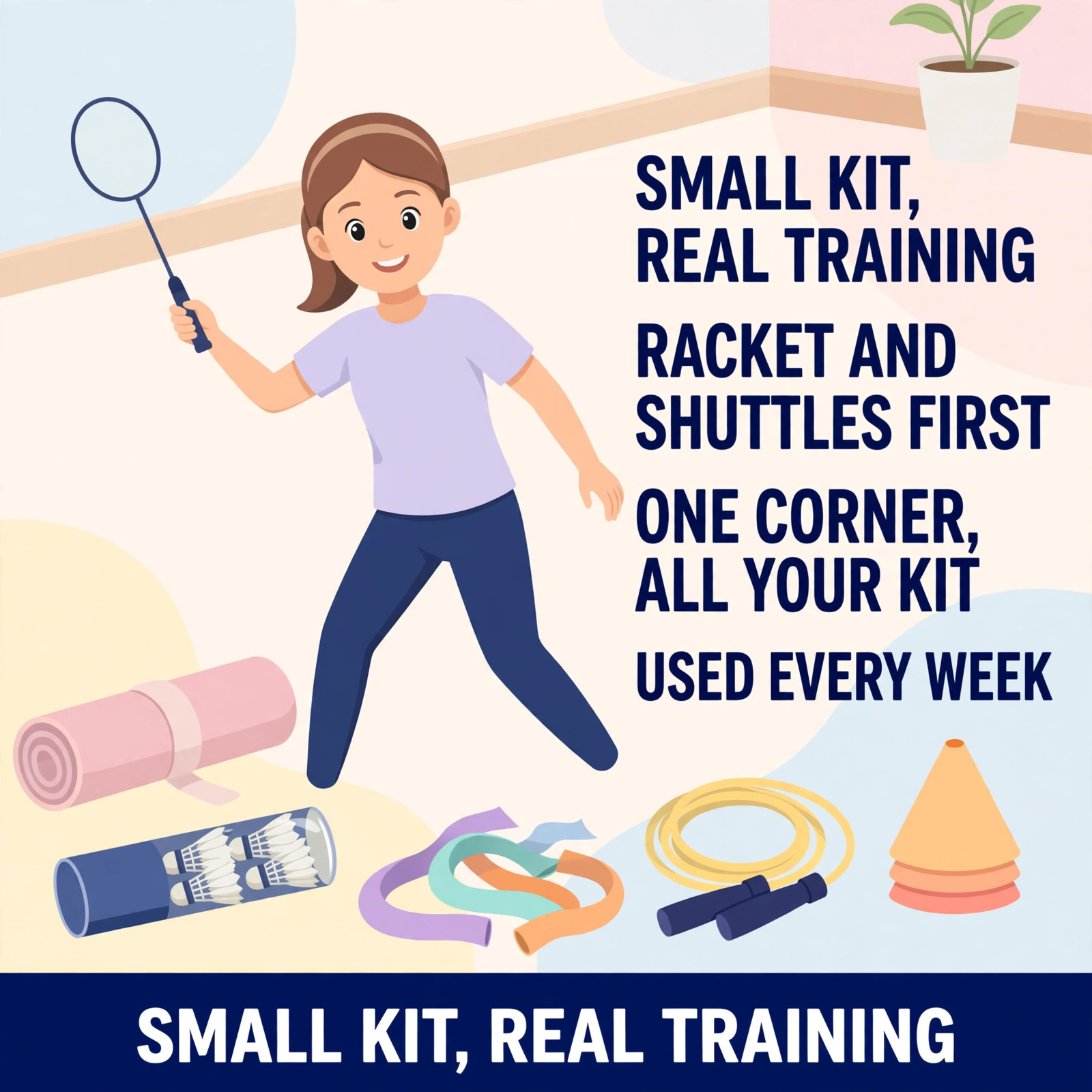
Home Kit Check #1
Start With the Basics: Racket, Shuttles and a Safe Space
Start with the racket, and keep it simple: the racket you already own is the home racket for most players. A second, sound spare is useful for juniors who play at school too, because a broken string then stops nothing. Check three things. The grip should be fresh enough to hold without squeezing hard. The string bed should feel alive, not dull and dead. The weight should suit the player: most adults play with 3U rackets at 85 to 89 grams or 4U at 80 to 84 grams, and growing juniors often handle 4U or 5U at 75 to 79 grams more easily. On strings, thin gauges feel livelier and thicker gauges last longer; for home practice, durability usually wins.
Shuttles split by surface and budget. Nylon shuttles are the home workhorse: they survive hitting furniture, walls and tiled floors, and one lasts many sessions. Feather shuttles fly truer and belong in the hall, where they are the match standard. Speed grades run from 75 to 78, and warm Malaysian rooms suit the middle of that range for most players. Store shuttles upright in their tube, away from heat. Then check the space itself before any drill: enough ceiling height for clears, lights and fans out of the swing path, furniture pushed back, and a floor that is dry and not slippery. More home sessions end because of a low ceiling fan than because of any missing gadget.
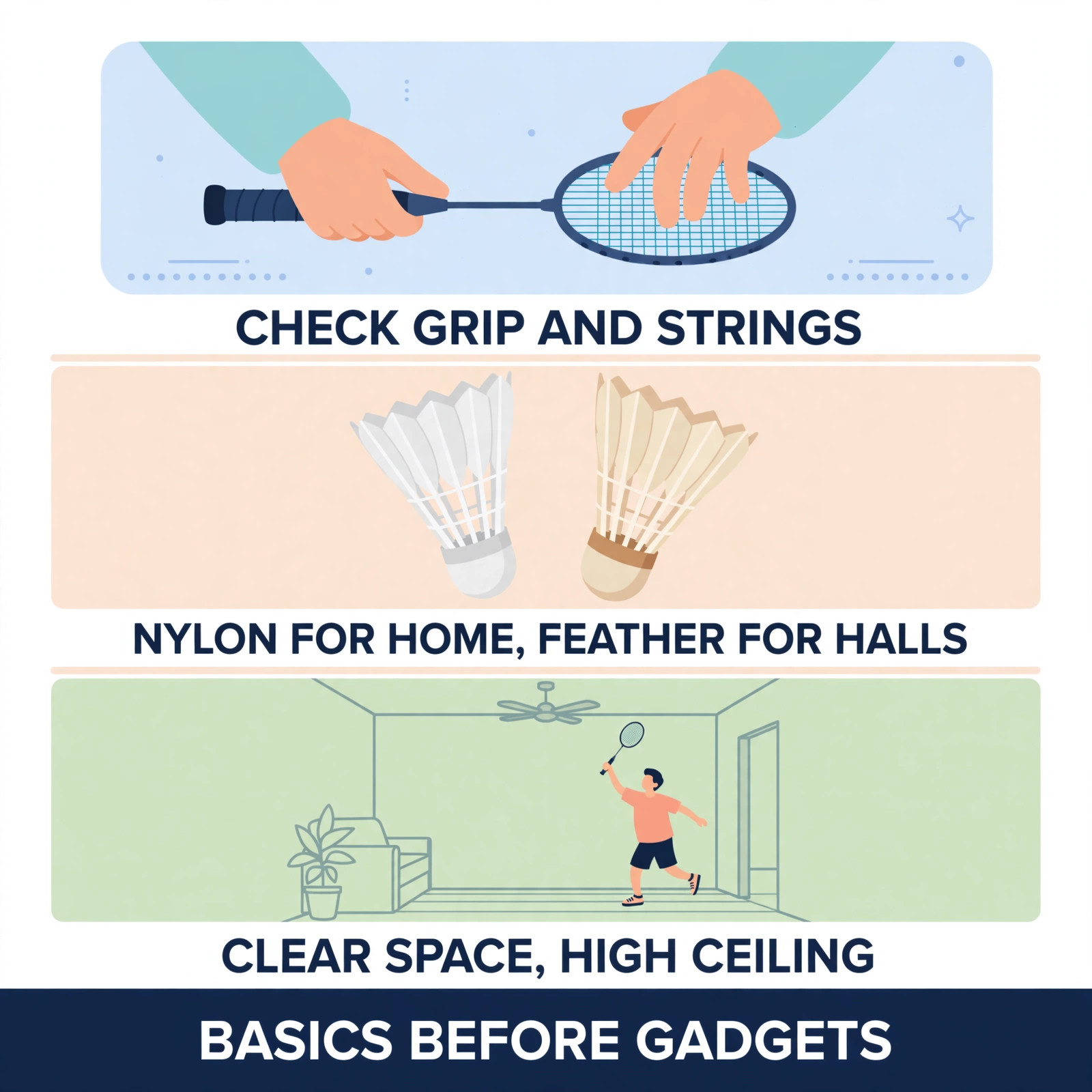
Home Kit Check #2
The Training Mat and Floor: Where Home Sessions Happen
A training mat turns any corner into a practice spot. It protects knees during floor exercises, gives lunges and jumps a surface with some give, and marks a clear zone where training happens and the rest of the home does not. Look for a mat that stays flat at the edges, grips the floor instead of sliding on it, and is thick enough for planks and core work without feeling like a mattress. A mat that slides is worse than no mat at all, so test the backing on your own floor. Roll it or fold it after sessions so it keeps its shape.
The floor under the mat matters too. Tiles and polished concrete are hard and can be slippery in socks, so home footwork should be done in clean court shoes or trainers with grip, never in socks alone. Wooden floors forgive landings a little more but still punish a bare heel over weeks. Keep the area dry: a small towel at the side for sweat keeps the mat safe during band work and core sets. If the only space is a balcony, check the railing height and keep every drill low and controlled. Home training should lower the risk of a silly injury, never raise it.
The training corner itself needs one habit to survive: everything lives in one place. Racket against the wall, tube of shuttles standing in the corner, mat rolled beside them, bands and rope in one small box. When setting up takes two minutes, sessions happen. When it takes fifteen minutes of hunting, they do not. A portable net is the one optional extra, and only for homes with real space and ceiling height: a proper net stands 1.55 metres at the posts and 1.524 metres at the centre, and a low garage copy teaches low habits. If the height is not there, shadow drills do the same job safely.
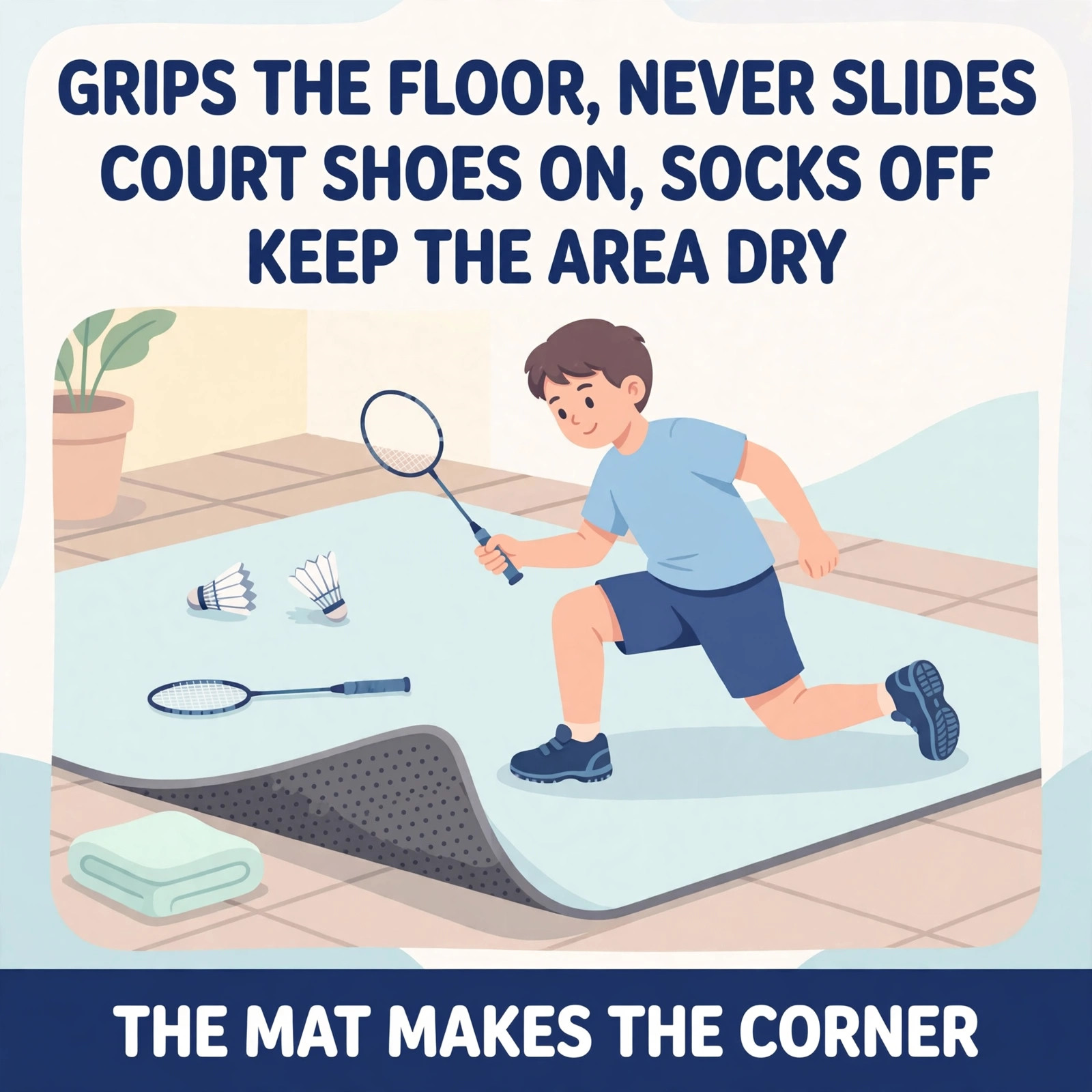
Home Kit Check #3
Resistance Bands: Strength Work Without a Gym
Resistance bands are the strength corner of the home kit. Badminton legs, shoulders and core all respond well to band work, and a band asks for no rack, no bench and no spare room. Start with light to medium resistance. The movements that matter most are simple: band pull aparts and external rotations for the shoulder, lateral walks and slow squats for the legs, and rows for the back that balances all the hitting in front of the body. A player who can do twenty clean repetitions needs a stronger band or a slower tempo, not a heavier story about the workout.
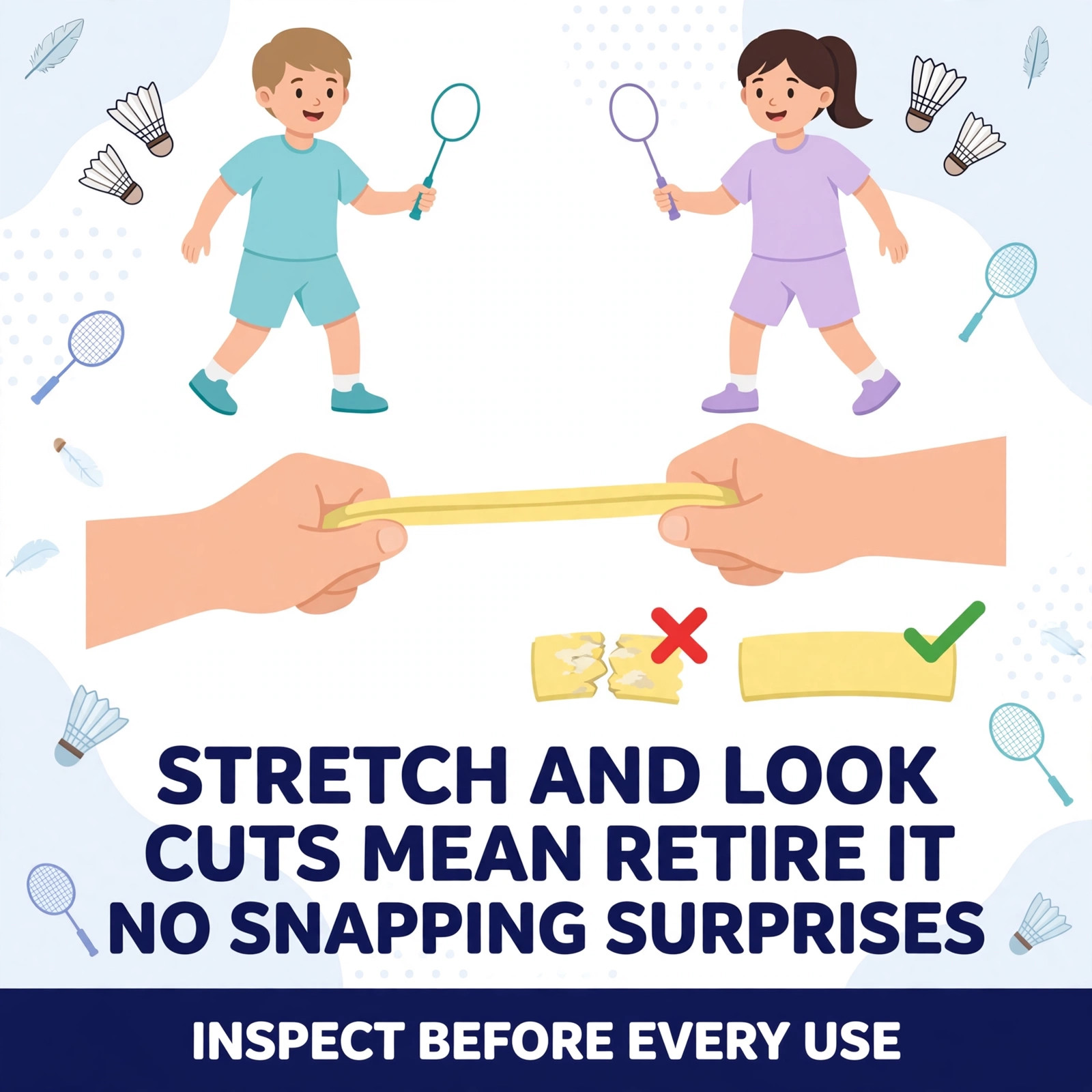
Choosing bands is a two minute check. Loop bands suit legs and warm ups. Tube bands with handles suit rows and presses. Fabric covered bands feel kinder on skin and do not roll as much. Whatever the type, inspect it before every use: small cuts, pale stretched patches and cracks near the handles are warnings, and a band that snaps mid exercise can whip an eye or a cheek. Anchor bands only to things that cannot move: a closed door with the band through the hinge side, a heavy table leg, never a door handle that can turn. Replace bands at the first signs of damage, not after the snap.
Use bands the badminton way. Add a light band to shadow swings so the shoulder learns to stay strong through the hitting path. Step sideways against a loop band before footwork drills so the hips wake up. Keep every repetition clean: slow out, steady back, no bouncing at the ends. The moment form breaks, the set is over, however many repetitions were planned. Bands also travel well: a junior going to a tournament can run the whole warm up routine in a hotel room. That portability is the real reason bands sit near the top of this list, ahead of any single purpose machine.
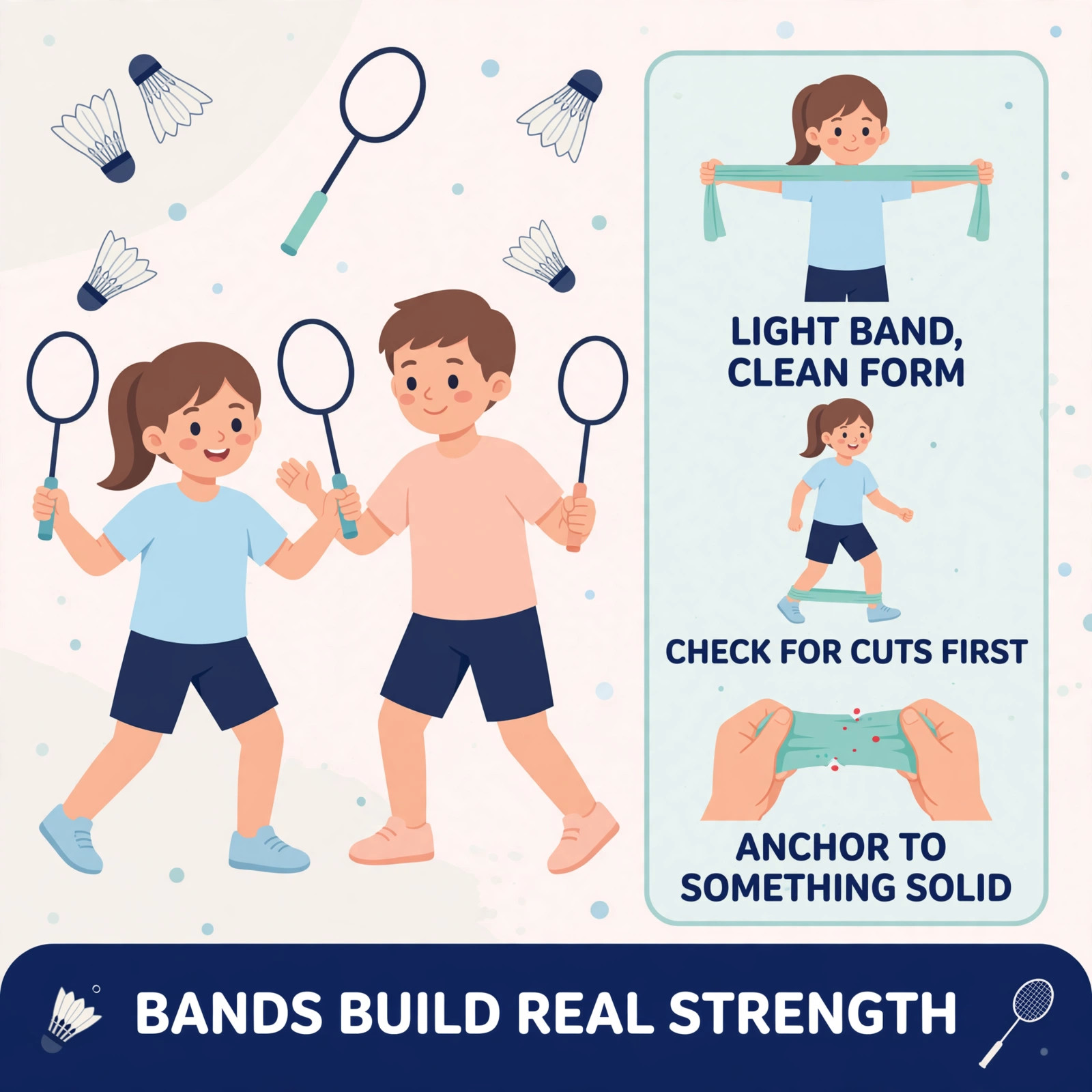
Home Kit Check #4
Skipping Rope and Cones: Footwork in a Small Space
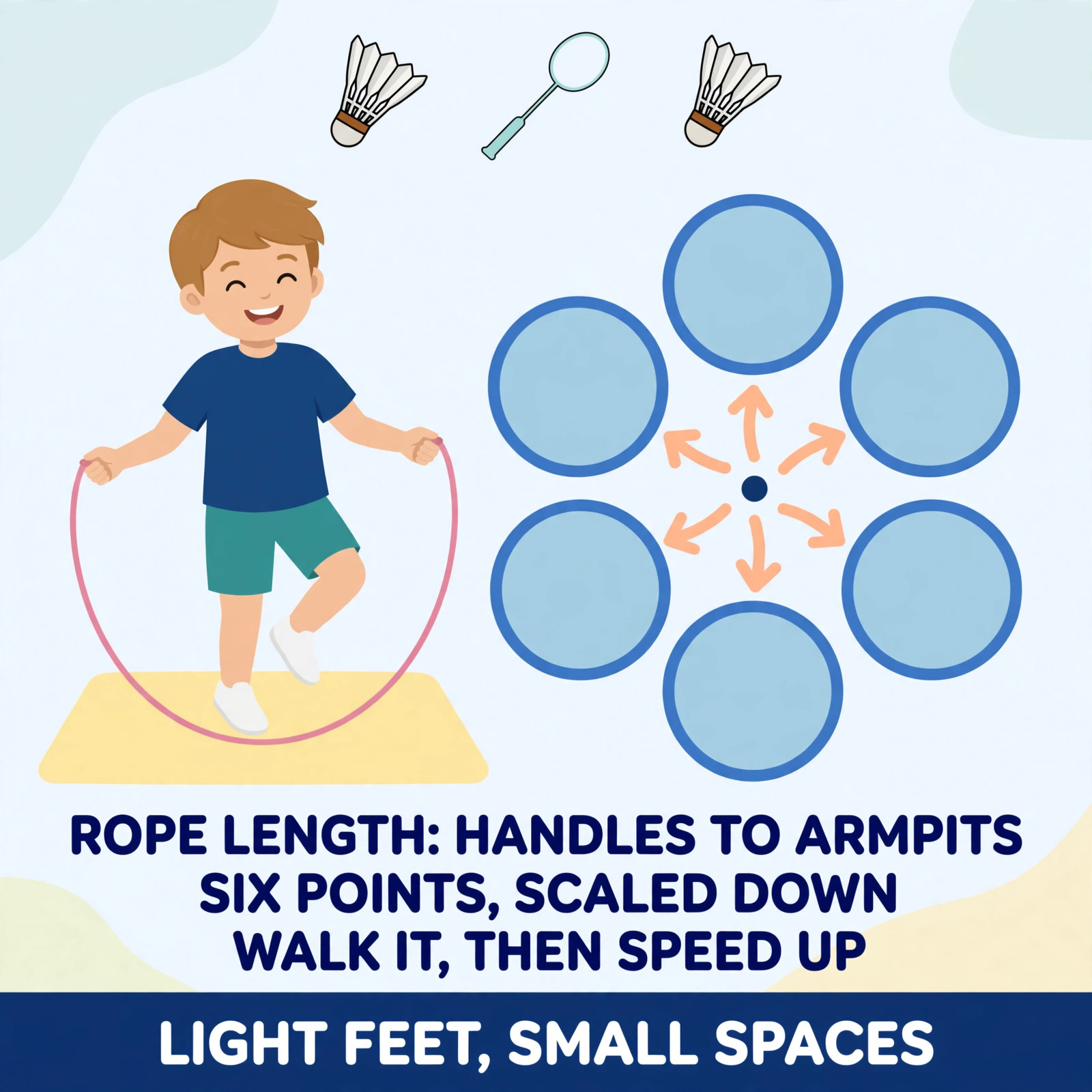
A skipping rope is the oldest footwork tool in sport, and still one of the best for badminton. Skipping builds calf spring, rhythm and light feet, and it teaches a player to land quietly on the front of the foot, which is exactly how good court movement sounds. Check the length first: stand on the middle of the rope and the handles should reach about armpit height. Too long and it slaps the floor; too short and it clips the toes. Skip on the mat or another giving surface, in short sets with rest between, and stop when the landings get loud and heavy, because tired skipping teaches tired footwork.
Cones and flat markers turn a small space into a footwork course. Six flat discs can mark the six points of the court scaled down to a living room: front corners, sides and back corners around a centre base. Flat markers beat tall cones indoors because a stepped on disc slides less and hurts less. Use them for patterns first, speed second: walk the pattern, jog it, then move at training pace. A player who knows exactly where the feet go at home arrives at class ready to add the racket and the shuttle. Wash markers now and then; dusty discs on tile are skates, not markers.
The rope and cones combine into a short session any junior can run without a screen or an app. Warm up with easy skipping, run three footwork patterns to the markers, skip again, then finish with shadow swings. Fifteen honest minutes, three times a week, does more for court movement than a monthly hour of random gadgets. Write the sessions on a simple card on the wall if that helps them happen. Home training succeeds on routine, not on variety: the same few drills, done well, on the same days, until the feet remember them without thinking.
Home Kit Check #5
What to Skip: Gear That Gathers Dust at Home
Now the skip list, which saves more money than any other section. Skip heavy gym machines for juniors: a single station machine trains one movement, takes a room, and is outgrown or ignored within months. Skip big free weights for young players whose technique is still forming; bodyweight and bands cover home strength at that stage, under a coach’s eye. Skip anything sold with an app subscription for basic drills a card on the wall can run. And skip bulk buying: a home that buys ten items at once uses two and stores eight.
Skip the expensive extras that solve problems home players do not have. Feather shuttles by the dozen for daily home use burn money; nylon flies well enough for drills and lasts. A string tension meter is a nice tool in a stringer’s hands, but tension is set at restringing, and your restringer handles it; a home player gains nothing from measuring it weekly. Single purpose gadgets, one for the wrist, one for the forearm, one for a finger, almost always lose to a band and a plan. If a product promises professional results from ten minutes a day with no coaching, the promise is the product. Leave it on the shelf.
The buying order finishes the guide. Basics first: racket checked, shuttles stocked, space made safe. Mat second, because it makes the corner real. Bands third, rope and cones fourth. Then stop for a month and train. Add nothing until a coach names a gap the current kit cannot fill: that rule alone protects most wallets. Store everything dry and out of direct sun, air the mat after sweaty sessions, and check bands and grips monthly. Home equipment looked after this way lasts for seasons, and the corner stays inviting instead of becoming a pile nobody wants to tidy.

Myth vs Reality
Myths About Home Training Gear
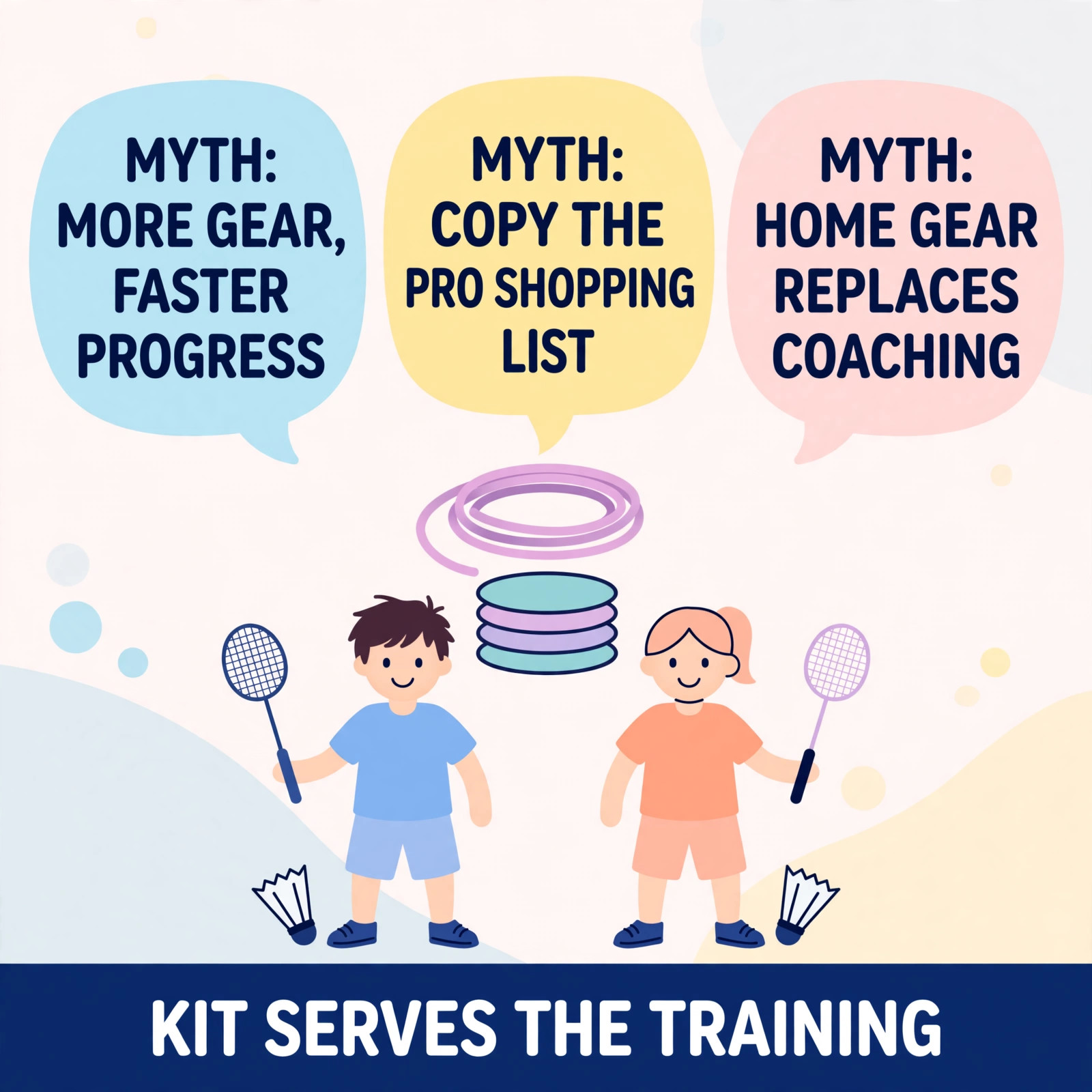
Myth one: more equipment means faster improvement. It does not. Improvement comes from repetitions done well, and repetitions come from short sessions that actually happen. We have seen juniors transform their footwork with a rope, six discs and a mat, and others stall completely in rooms full of machines. The kit list in this guide is short on purpose. Every item has a weekly job. If a new item cannot name its job in one sentence, it is decoration, and decoration is not training.
Myth two: home gear must match what the professionals use. Home kit has a different job from hall kit. Professionals play with feather shuttles because matches demand that flight; home drills demand survival against walls and floors, so nylon wins. Professionals train in gyms because their strength work is heavy and supervised; home strength for a junior is bands and bodyweight, done with clean form. Copying a professional’s shopping list copies their costs without their support team. Choose for your space, your stage and your week.
Myth three: enough home equipment replaces coaching and court time. Home training supports coaching; it cannot replace the eye of a coach or the truth of a real rally. A shadow swing can groove a wrong grip for months if nobody checks it, and no cone pattern teaches reading an opponent. The healthy split is simple: home sessions build fitness, footwork and habits between classes, and classes correct technique and test everything against real shuttles and real opponents. Players who keep that split improve steadily. Players who swap the hall for the living room plateau politely.
Why Choose Us
Why Players Choose ST Badminton Academy
At ST Badminton Academy, home practice is set by the same coaches who run the classes, so the two halves match. With a maximum of four students per group, a coach knows each junior’s home setup: the ceiling height, the floor, the kit they actually own. Home tasks are then set to fit that reality: shadow patterns for the small flat, band routines for the player with a corner, skipping sets for the one with a mat. No student is told to buy a room of equipment. They are told to use a corner of it well.
The academy advises on gear the same way this guide does: criteria first, brands never. Coaches will tell a parent when a junior needs court shoes before anything else, when a spare racket can wait, and when a requested gadget would gather dust. That honesty is deliberate. Advice that sometimes says do not buy is advice a family can trust when it says buy. Parents also get the safety checks: space, floor, ceiling, band condition. Home training set up safely is training that keeps happening.
Finally, home habits build the discipline tournaments demand. A junior who packs a bag, airs a mat, checks a band and logs a short session is rehearsing the same orderliness that later means arriving fed, hydrated and on time with working equipment. Coaches notice these players early. Champions are not built only on court; they are built in small, boring, well run corners of ordinary homes. Our job is to help families build those corners with the right few items, honestly chosen.
FAQs: Badminton Home Training Equipment in Malaysia (KL)
Here are the questions parents and players ask us most about badminton training equipment for home workouts, what to buy first, and how our coaches set home practice in Kuala Lumpur and Setapak.
What basic gear does a junior need for home practice if they live in Setapak or Gombak?
Start with a sound racket, a tube of nylon shuttles, court shoes and a mat to mark the training corner. Add resistance bands, a skipping rope and flat markers once the first sessions are running. That order covers footwork, strength and shadow drills without wasting money on gadgets a junior will not use.
What is the first piece of home training equipment to buy for badminton in KL?
Buy the racket and shuttles first, because every home drill hangs off them. A racket that fits the player’s hand and strength, with a fresh grip and a live string bed, plus durable nylon shuttles for home use, opens up shadow swings, footwork patterns and wall practice from day one.
How much space does a player need at home to train at a steady level?
Very little, if it is safe. A clear patch about the size of a large rug suits mat work, bands and shadow swings, and markers can scale the six footwork points down to that patch. Ceiling height for clears matters more than floor size. Move furniture, check lights and fans, keep the floor dry.
Can home equipment replace court training for a junior, or only support court work?
No. Home equipment supports court training by building fitness, footwork and habits between classes. It cannot correct technique or teach a player to read real rallies. Coaches check grips, correct patterns and test everything on court. The two work together: home volume, court correction, steady progress.
What should I check before setting up a training corner at home?
Check five things: ceiling height for a full swing, lights and fans clear of the racket path, furniture moved back, a dry non slip floor, and a mat that grips instead of sliding. Add a band safety check if bands are used: solid anchor, no cuts in the rubber, room to step back.
Do your coaches suggest home practice drills for students near Wangsa Maju?
Yes. Coaches set short home tasks that match what the class is learning: shadow patterns, skipping sets and band routines scaled to the space each student actually has. Students near Wangsa Maju and Setapak get the same approach: honest tasks, simple kit, no shopping lists full of gadgets.
Does your academy lend equipment or tell students what to buy in Malaysia?
We advise; we do not lend kit or push products. Coaches explain what each item must do and how to check it, then families buy wherever suits them. For rackets and strings, coaches can point to what suits the player’s level. The advice is free of brands, because the academy sells coaching, not equipment.
How long does home training equipment last with regular home training?
Looked after, the core kit lasts for seasons: a mat for years, bands until the rubber shows cuts or pale patches, a rope until it frays, markers almost forever. Grips and strings are the consumables. Store everything dry, out of direct sun, and check bands monthly, and home gear gives long, honest service.
What makes Mr Eric Chuar a good coach for honest home gear advice for badminton?
Mr Eric Chuar has coached for over 15 years and treats home equipment as practice support, not as a shopping hobby. He names what each item must do, sets tasks that fit the student’s real space, and refuses to let a gadget stand in for coaching. Players trust advice that stays honest about limits.
Badminton Home Training Equipment in Action



One Standard for Every Player and Every Session
The academy's standard for home kit is the same as its standard for coaching: say what the item does, say what it does not do, and let the player decide with clear criteria. Nobody at ST Badminton Academy will tell a family that a machine or a gadget will fix a junior's game. We will tell them how to choose a few items well, use them weekly, and keep them safe.
| Factor | Gadget Pile | Simple Home Kit HOME KIT |
|---|---|---|
| Frequency | 1 or 2 times a week. Mostly for fun and sweat. | Five useful items, each with a clear job in weekly home practice. |
| Drills Focus | Basic static feeding. Minimal footwork pressure. | A mat, bands and a rope that support footwork, strength and shadow drills. |
| Physical Conditioning | Rarely included. Just playing games on court. | Core, agility, and speed training included in every session to prevent injury and build stamina. |
| Tactical Awareness | "Just hit it over." No real game plan. | Video analysis, point construction, and learning to read the opponent's game. |
| Coach Ratio | Large groups (8-10 kids). Coach barely watches you. | Max 4 students. Mr Eric Chuar personally corrects every stroke and movement detail. |
| Goal Setting | Fun and exercise. | Gear stored in one corner, clean, dry and ready inside two minutes. |
| Long Term Result | Good recreational player. | A player who trains at home often and arrives at class sharper. |
Badminton Coaching and Home Practice in Kuala Lumpur
A home training corner does not need to be big, new or expensive. It needs a sound racket, shuttles that survive the walls, a mat, bands, a rope and markers, all used a few times a week. Start with the basics, add slowly, and let a month of real sessions judge every purchase. If your child trains with us at ST Badminton Academy in Setapak, Kuala Lumpur, ask any coach to look at your home setup list. We will sort the home kit simply, so practice at home and coaching on court pull in the same direction.




