The Best Badminton Thigh Sleeves For Support And Compression (Thigh Sleeve Guide)
Thigh sleeves are everywhere in badminton halls now: juniors copy them from older players, adults wear them under shorts, and the packaging promises a lot. This guide gives the honest version of what a thigh sleeve does. It keeps the thigh warm, it gives a gentle squeeze, and many players like the feeling of support when they lunge, jump and change direction. That is the real offer, and for some players it is enough to justify wearing one. What a sleeve is not proven to do is prevent injuries, heal strains or speed up recovery in any strong, settled way. The evidence for big compression claims is thin and mixed, and any guide that tells you otherwise is selling, not informing. We will cover what the sleeve does, the materials it comes in, how the fit should feel, when players choose to wear one, and how to wash and replace it. There are no brand names and no prices. If your thigh hurts, this guide will also tell you plainly: a sleeve is not the answer to pain, and getting checked is.

Sleeve Check #1
What a Thigh Sleeve Really Does: Warmth and Gentle Support
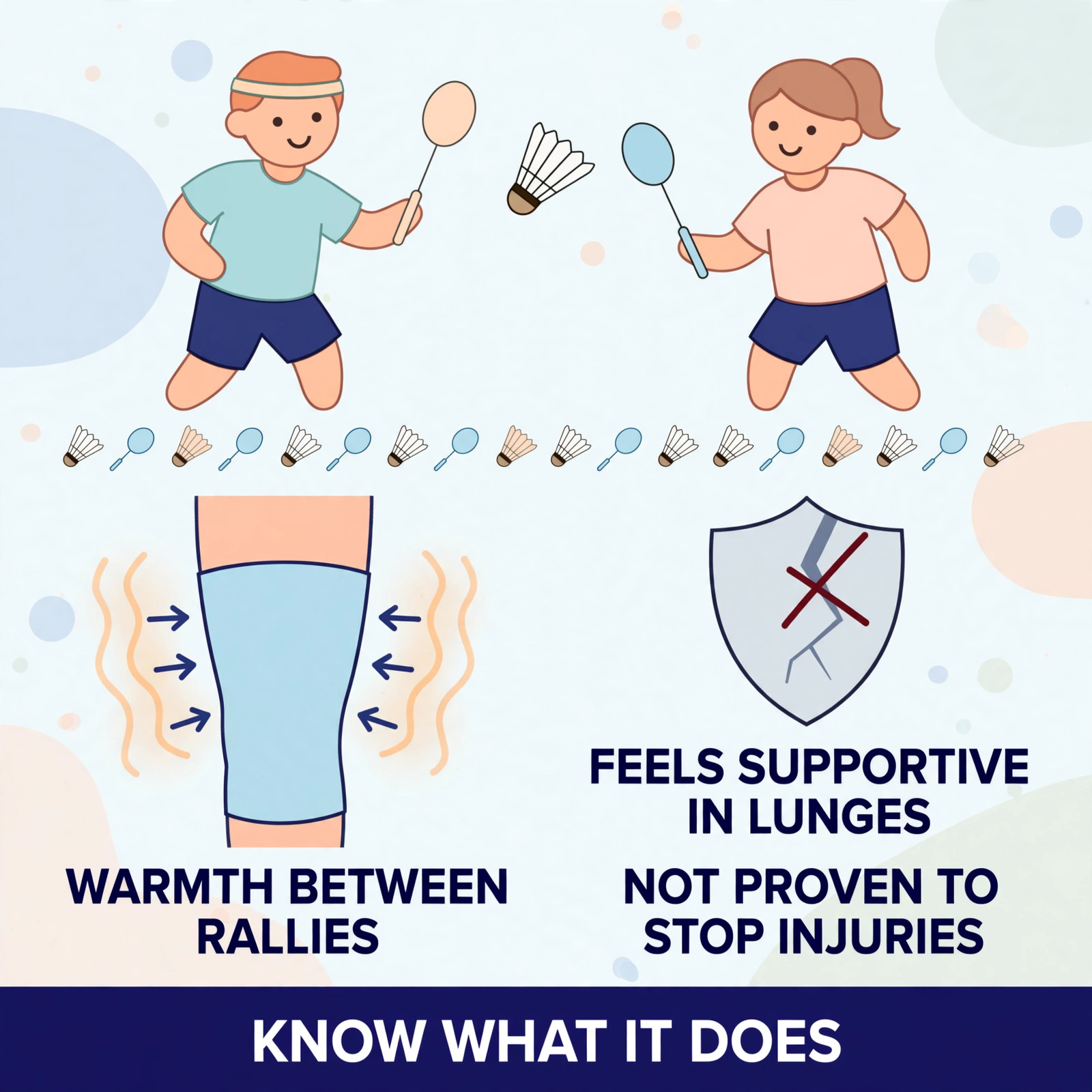
The sleeve’s first honest job is warmth. A covered thigh stays warmer during warm ups, between games and in cold halls, and a warm muscle simply feels readier to work. Players notice this most at early morning sessions and in air conditioned halls, where uncovered legs cool down during every break. The second job is the gentle, even squeeze players call support. It does not hold the leg together. It gives the skin and muscle a constant light pressure, and many players say that pressure helps them feel where the leg is during a deep lunge or a jump landing.
Now the limits, stated plainly. No sleeve has been shown to stop hamstring tears or thigh strains from happening, and no sleeve repairs a strain once it happens. Recovery claims on packaging, faster this and improved that, run ahead of what careful studies can support. Treat the sleeve as comfort gear: it can help a player feel warm and supported, rally to rally. If a thigh is painful, tight in a bad way, or weak after a pull, the sleeve is not treatment. Rest, get the leg checked, and follow the plan you are given. Gear never outranks a diagnosis.
Sleeve Check #2
Materials: Stretch Knit, Neoprene and Breathability
Most thigh sleeves are stretch knit blends: polyester or nylon knitted with elastane for the squeeze. They are light, breathe reasonably well, and suit everyday training in warm halls. A good knit sleeve feels smooth, stretches in every direction, and springs back flat when you let go. For Malaysian conditions, breathability matters more than thickness: a sleeve that traps heat and sweat will be pulled off by the second game however supportive it felt at the start. Try to handle the fabric before buying, stretch it, and hold it to the light; thin, uneven patches show a sleeve that will not last.
Neoprene sleeves are the thick, rubbery option. They hold heat well, which is why some players wear one for the warm up and the first game, then take it off. In a hot hall neoprene can feel like a sauna on one leg, and sweat collects inside it fast. Some players still prefer that deep warmth, especially on a thigh that stiffens in cold air conditioning. Neither material is the winner. Knit is the everyday choice for most players in Malaysia; neoprene is a personal taste for short, warm spells. If your skin reacts to rubber with itching or a rash, knit is the safer road.
Construction decides whether a sleeve stays up. Look for a grip strip or silicone dots inside the top band, flat seams that do not rub, and edges that lie flat instead of rolling. The bottom edge matters less; the top edge does the holding. Stretch the sleeve and watch the knit: it should spread evenly, not ladder or shine in streaks. A two way stretch that only pulls one direction will twist as you play. None of this needs a laboratory: pull it, roll the edges, rub a seam with a thumb. Two minutes of honest checking beats any label.

Sleeve Check #3
Fit and Sizing: Snug Around the Thigh, Never Numb
Sizing starts with a tape measure around the middle of the thigh, over the muscle, standing relaxed. Sleeves are sold by that measurement, so take it honestly: not pulled tight, not guessed from shorts size. Between two sizes, comfort decides. A sleeve you forget about is the right size; a sleeve you think about every rally is not, in either direction. Juniors grow, so their fit expires faster than the sleeve does. Recheck a junior’s sleeve each season, because last year’s gentle squeeze can become this year’s tight band on a bigger leg.
The fit test happens on court, not in the shop. Pull the sleeve on and do the movements badminton asks for: a deep lunge each side, a few jumps, some side steps. The sleeve should stay in place without being dragged up every rally. Now the safety half of the test: your lower leg should feel completely normal. No numbness, no tingling, no pins and needles, no colour change in the foot. Any of those signs means the sleeve is too tight, whatever the size chart said. Too tight is not extra support; it is a problem worn on purpose.
Ignore compression grades and pressure numbers as a buying guide. Those figures are measured on still legs in laboratories, and they tell a player little about how a sleeve feels in the third game of a real match. Comfort, warmth and staying in place are the honest criteria, and all three can be tested before money changes hands. A sleeve with a modest claim and a kind fit will serve a player better than a medical sounding one that numbs the calf. If a player needs true medical compression, that is a conversation for a clinic, not a sports shop.

Sleeve Check #4
When Players Wear One: Matches, Training and Recovery Days
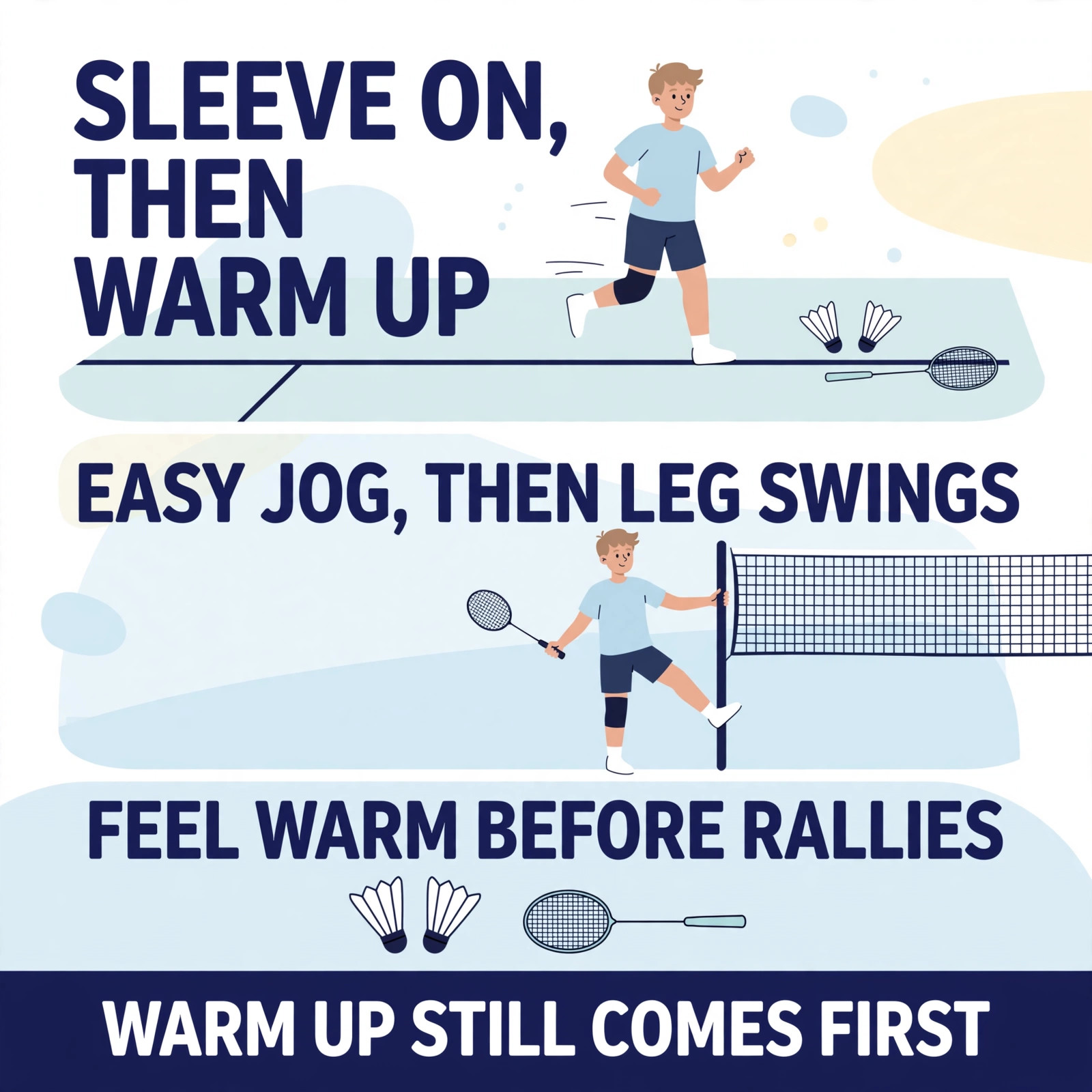
Players wear thigh sleeves for three common reasons. Some put one on before the warm up because a covered thigh warms faster and stays warm through breaks. Some wear one for matches only, because the feeling of support settles their mind in big rallies. Some wear one on easy days after a heavy week, when the legs feel tired and the warmth feels kind. All three are comfort choices, and comfort is a fair reason. What is not on the list: wearing a sleeve to protect a thigh you know is injured so you can play through it. That use turns comfort gear into a gamble.
Daily wear is not needed and not wise. Skin under a sleeve all day sweats, softens and can break into rashes, especially in our weather. A sleeve is session gear: on for the warm up and the games, off and aired afterwards. Juniors especially should not live in one. If a young player believes the leg only works with the sleeve on, that belief is worth a coach’s conversation, because confidence should be built on training and warm up habits, not on one piece of elastic. The sleeve is a helper, not a crutch the mind leans on.
Returning players ask about sleeves often, so here is the careful answer. After a thigh strain, the order is: get checked, follow the rehabilitation plan you are given, rebuild strength and flexibility step by step, and return in stages. A sleeve can ride along on those easy return sessions if it feels good, and many physios are content with that. But the sleeve is the passenger, not the driver. Pain that returns, weakness that stays, or a leg that gives a sharp warning in a lunge means stop and report back, sleeve or no sleeve.

Sleeve Check #5
Washing, Rotating and Knowing When to Replace
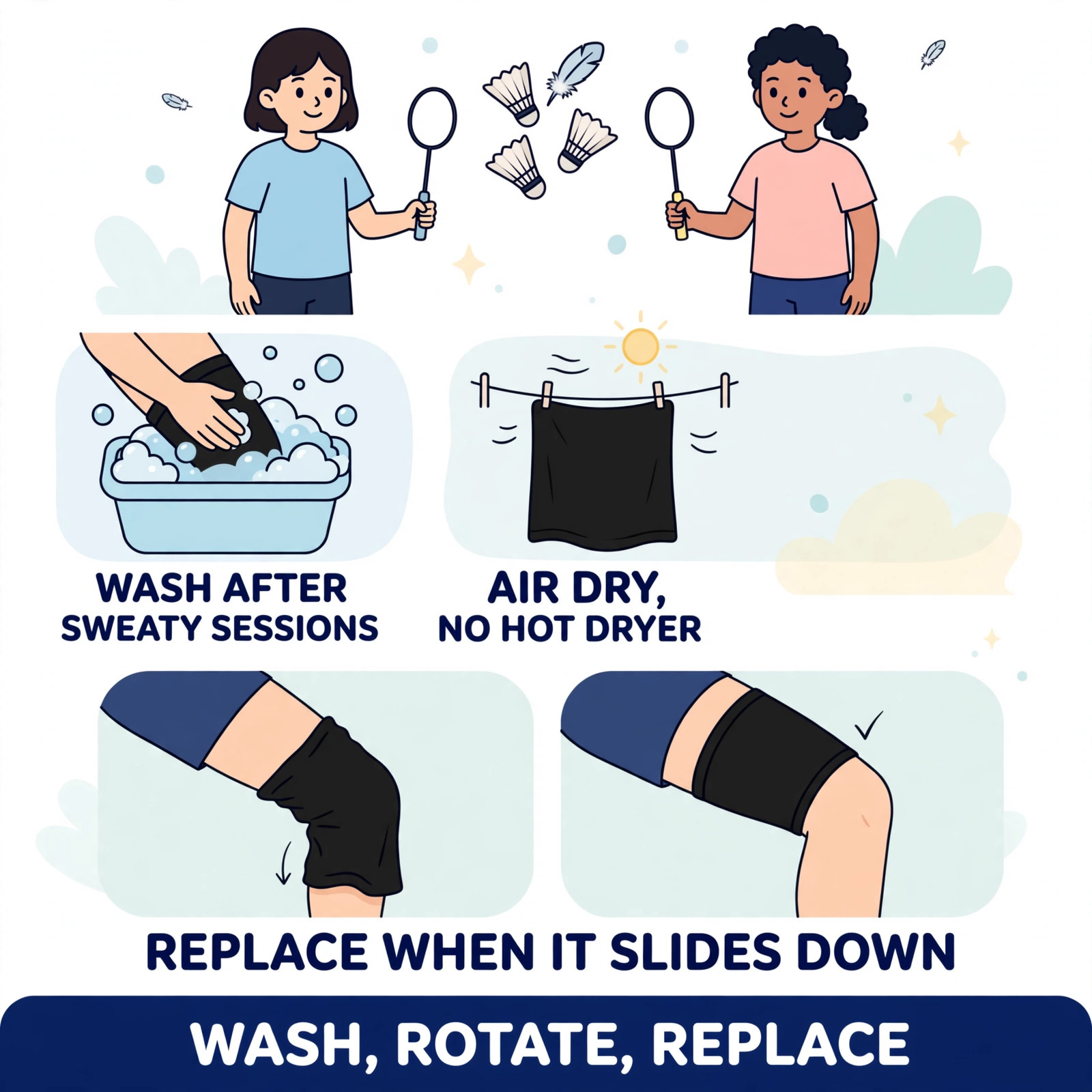
Washing is simple and not optional. Sweat left in a sleeve breeds the same kit bag smell as an unwashed wristband, only bigger. Rinse or wash the sleeve after sweaty sessions with mild soap, and wash it inside out so the grip strip gets clean too. Most knit sleeves handle a gentle machine wash in a mesh bag. Neoprene prefers hand washing. Keep both away from dryers and strong heat, which age elastic faster than play does. A sleeve washed little and often keeps its stretch and its dignity; a sleeve washed rarely smells like it.
Rotation extends life, the same system players use for grips and bands. One sleeve in play, one clean spare in the bag, and the first gets aired properly instead of worn damp the next day. Store sleeves dry and loose, not rolled tight inside a shoe or sealed in plastic while damp. Sunlight on a balcony rail for a short airing is fine; leaving elastic baking there all week is not. Two mid priced sleeves rotated will outlast one expensive sleeve worn daily, and there is always a dry one ready for the next session.
Replace a sleeve by feel and behaviour, not by the calendar. It is done when it slides down during lunges and needs dragging up, when the top band no longer springs back after a stretch, when the knit has gone thin and shiny, or when the smell survives a proper wash. For a player training several times a week, that day comes after months of honest work. Do not retire a sleeve for faded colour; retire it when it stops doing its two jobs: staying in place and keeping the thigh warm with a gentle, kind squeeze.
Myth vs Reality
Myths About Thigh Sleeves
Myth one: a thigh sleeve prevents hamstring and thigh injuries. It does not, and believing it can do real harm, because a player who feels protected may skip the work that actually lowers the risk: a proper warm up, progressive strength training, and honest rest between hard days. Sleeves sit on top of those habits as comfort. They never stand in for them. If you want fewer thigh injuries, train the legs, warm them up, and respect fatigue. The sleeve is the last item on that list, not the first.
Myth two: tighter means more support and better play. A sleeve can be too tight, and too tight is easy to spot once you know the signs: numbness, tingling, a foot that changes colour, a player pulling at the band between rallies. Past snug, extra squeeze adds discomfort, not support, and a distracted player plays worse, not better. The best sleeve is the one forgotten by the second rally. If you are aware of yours in the third game, the fit is wrong in one direction or the other.
Myth three: wearing the sleeve all day speeds up recovery. Recovery is built from sleep, food, rest days and the graded exercises a physio sets after an injury. A sleeve worn at a desk does none of that work, and all day wear can irritate skin and make the leg feel dependent. Wear it for sessions, air it after, and let recovery be done by the things that truly drive it. Players who chase recovery in products usually underdo it in sleep and patience, which are free.

Why Choose Us
Why Players Choose ST Badminton Academy
Small support gear comes up in our classes often, and coaches at ST Badminton Academy answer the same way this guide does: what it does, what it does not do, and how the fit should feel. With a maximum of four students per group, a coach sees the details: the sleeve that slides every rally, the junior tugging a too tight band, the player whose warm up is too short for cold legs. That closeness turns gear talk from guesswork into observation. Most thigh questions end with warm up advice, not a shopping trip.
The academy does not sell sleeves, and that is deliberate. A coach with nothing to sell can say the sentence players most need to hear: you might not need one at all. Some juniors are told a sleeve would suit their cold hall mornings. Others are told their legs are warm, their fit is fine, and their money should stay in their pocket. Advice that sometimes says do not buy is the only advice worth trusting when it says buy. Our coaches would rather be trusted than sell a single sleeve.
Honest gear thinking is part of the player education we want juniors to carry for life. A young player who can say this sleeve keeps my thigh warm and feels supportive, and no, it will not stop an injury, has learned to read the sports shop with clear eyes. That skill protects wallets and legs for decades, across every product category the industry invents next. At the academy, that is worth more than the sleeve itself, and it is why we answer small gear questions seriously.
FAQs: Badminton Thigh Sleeves, Support and Comfort in Malaysia (KL)
Here are the questions players and parents ask us most about badminton thigh sleeves, warmth, fit, and how our coaches advise on support gear in Kuala Lumpur and Setapak.
How does your academy advise juniors on support gear in Setapak or Gombak?
Honestly: it keeps the thigh warm and gives a gentle feeling of support, and coaches can show the player the fit test in a normal session. If the real problem is a short warm up or a sore thigh, the coach will say so and point to the fix, which may be a routine change or a clinic visit.
Does a thigh sleeve really help a player during a match in KL?
It can help the thigh feel warm and supported during a match, and some players settle better with that feeling in long rallies. It is not proven to prevent injuries or add power or speed. Think of it as comfort gear: pleasant for some players, pointless for others, and worth trying only with honest expectations.
How tight should a thigh sleeve feel when worn at a steady level?
Snug, and forgettable. The sleeve should stay in place through lunges and jumps without being dragged up, and the lower leg must feel completely normal: no numbness, no tingling, no colour change. Two signs decide it: if you forget it by the second rally it fits; if you keep touching it, it does not.
Should a junior wear a thigh sleeve for every session, or only on hard days?
Only if there is a reason: cold halls, early sessions, or a player who simply likes the warm, supported feeling. For most juniors, session by session choice is fine, and skin needs sleeve free days. A junior who feels unable to play without one should talk it through with a coach.
What should I check before buying a thigh sleeve for my child?
Check the material for breathability, the top band for a grip strip, seams that lie flat, and the size against a measured thigh, not a guess. Then run the court test in the shop if you can: lunge, jump, side step. Finish with the safety check: no numbness or tingling while it is on.
Do your coaches check how support gear fits during classes near Wangsa Maju?
Yes, when a coach can see the gear in action. Fit problems show themselves in play: sliding, tugging, a player adjusting the band between rallies. Coaches near Wangsa Maju and Setapak give the same honest checks as in this guide and will say plainly when a sleeve is too tight, too loose, or simply not needed.
Does your academy sell thigh sleeves or just advise players in Malaysia?
We advise; we do not sell sleeves. Coaches explain what a sleeve can and cannot do and how to test fit, then players buy wherever suits them, or decide not to buy at all. The academy earns its living from coaching, which keeps its gear advice free of sales pressure and brand favourites.
How long does a thigh sleeve keep its stretch with regular training?
Knit sleeves washed gently and rotated usually keep their stretch for months of regular training. The end shows itself: sliding down in lunges, a top band that no longer springs back, thin shiny knit. Heat is the fast killer, so air drying instead of the dryer is the habit that stretches a sleeve’s life.
What makes Mr Eric Chuar a good coach for honest support gear advice in badminton?
Mr Eric Chuar has coached for over 15 years and answers small gear questions with the same honesty as big technique ones. He starts with what the item truly does, names the checks anyone can run, and refuses to dress comfort gear up as injury protection. Players trust advice that stays straight about limits.
Badminton Thigh Sleeves and Leg Care in Action



One Standard for Every Player and Every Session
The academy's standard for support gear advice matches its coaching standard: say what the item does, say what it does not do, and let the player decide with clear checks. Nobody at ST Badminton Academy will tell a junior that a sleeve prevents injuries or speeds recovery. We will tell them how to choose a kind fit, wear it for sessions, and care for it well.
| Factor | Magic Thinking | Honest Support SLEEVE |
|---|---|---|
| Frequency | 1 or 2 times a week. Mostly for fun and sweat. | A sleeve that keeps the thigh warm and feels gently supportive in play. |
| Drills Focus | Basic static feeding. Minimal footwork pressure. | A fit checked by feel: snug, no numbness, no slipping at full stretch. |
| Physical Conditioning | Rarely included. Just playing games on court. | Core, agility, and speed training included in every session to prevent injury and build stamina. |
| Tactical Awareness | "Just hit it over." No real game plan. | Video analysis, point construction, and learning to read the opponent's game. |
| Coach Ratio | Large groups (8-10 kids). Coach barely watches you. | Max 4 students. Mr Eric Chuar personally corrects every stroke and movement detail. |
| Goal Setting | Fun and exercise. | Washed, aired and replaced when the stretch fades, like other kit. |
| Long Term Result | Good recreational player. | A player who knows what the sleeve can and cannot do. |
Badminton Coaching and Honest Gear Advice in Kuala Lumpur
A thigh sleeve is a small, honest piece of kit when it is understood properly: warmth, gentle support, comfort. Buy it for those reasons, fit it kindly, wash it, rotate it, and replace it when the stretch gives up. Skip it happily if your legs warm up well and feel fine without one. If your child trains with us at ST Badminton Academy in Setapak, Kuala Lumpur, ask any coach about the support gear in the bag. We will give you the straight answer, even when the straight answer is that you need nothing new.




