Indian Men’s Singles Badminton Star
Tharun Mannepalli

India
Player Event: Men’s singles
Born on 24 August 2001 in Khammam, Telangana
Right-handed all-court grinder · National Games champion and Asian Games team bronze medallist whose breakthrough was built on a rebuilt body
Understanding Tharun Mannepalli (Indian Badminton Star)
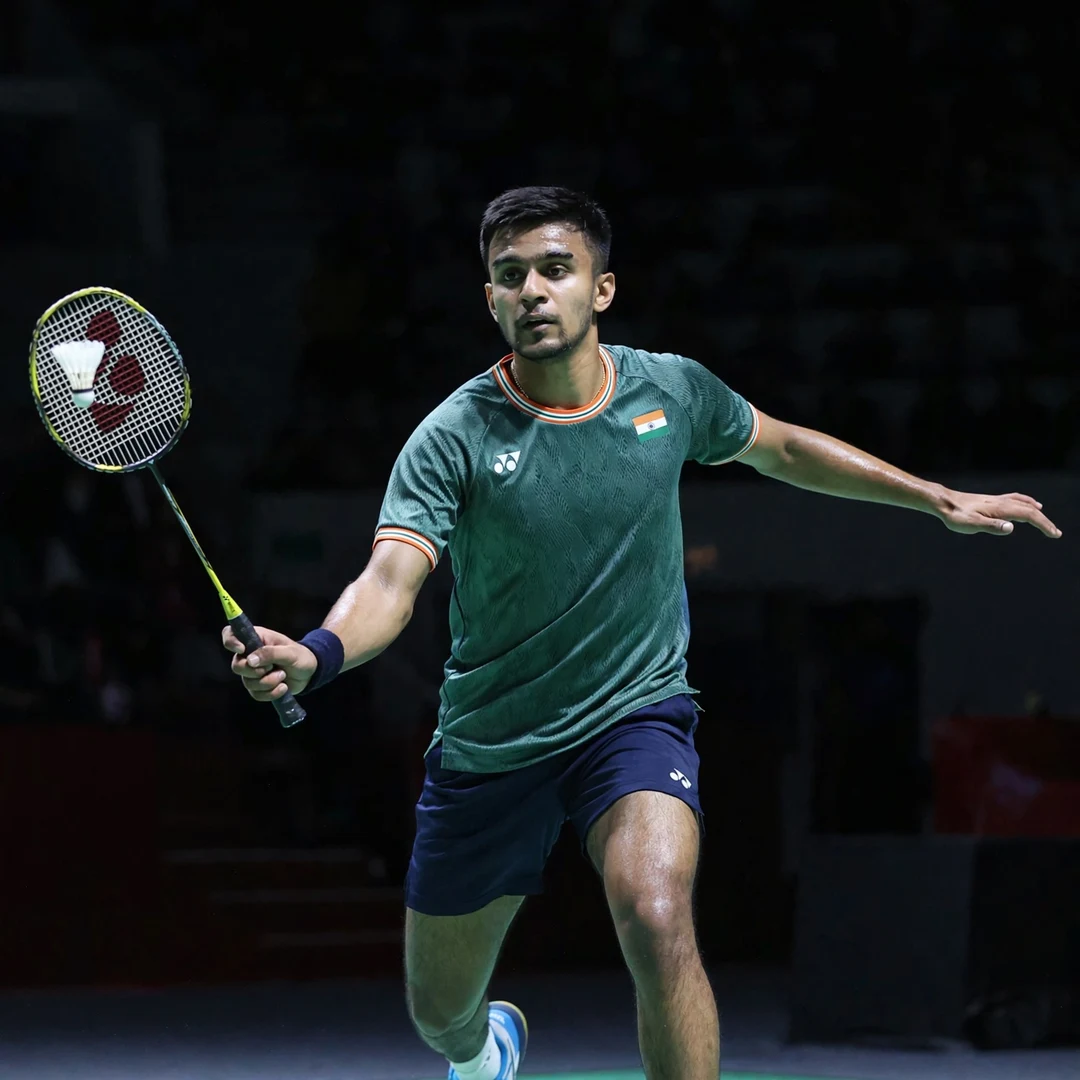
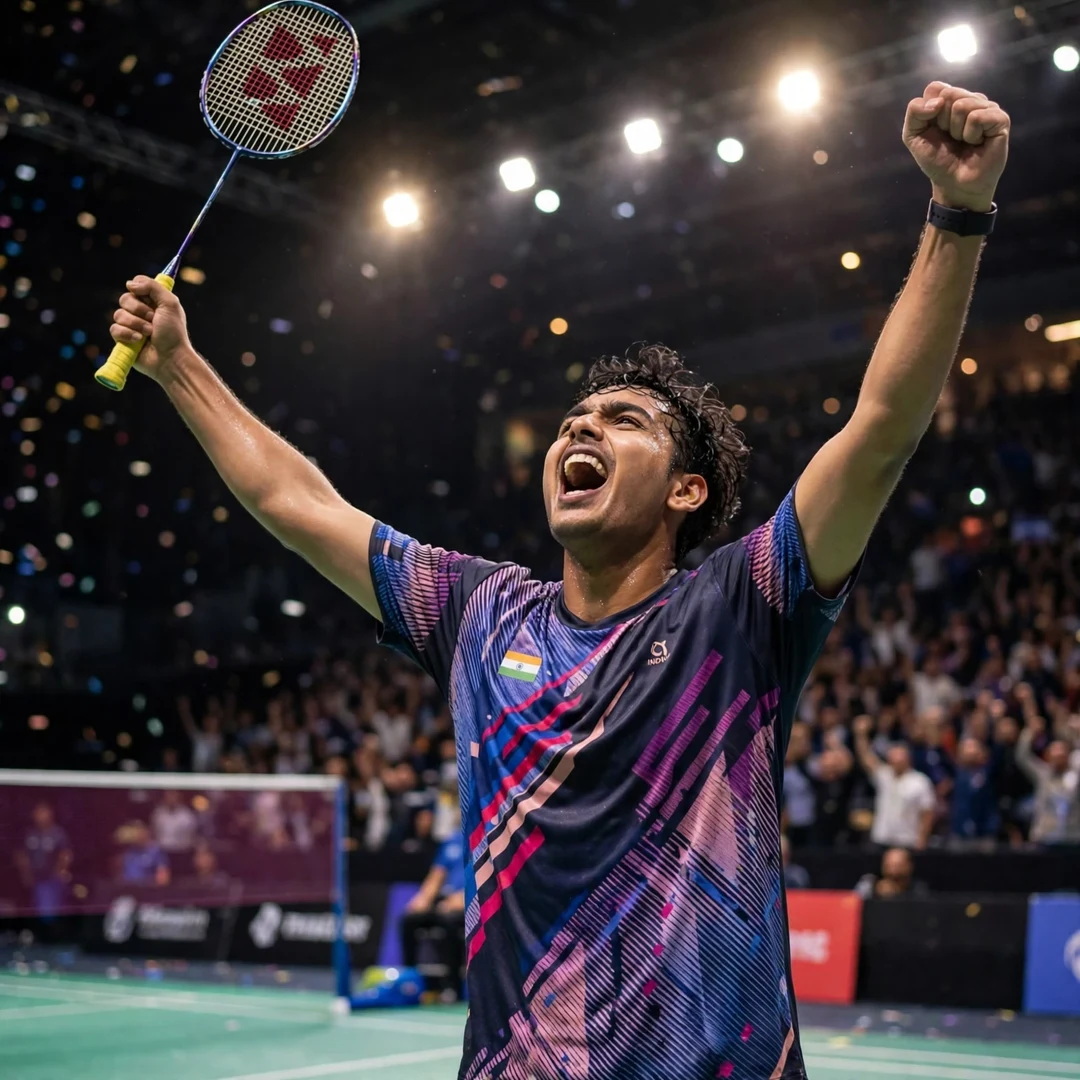
Tharun Mannepalli is an Indian men’s singles player whose rise has been anything but fast — and that is exactly what makes it instructive. From Khammam in Telangana, with no sponsors and no junior headlines, he ground his way through India’s domestic circuit, won the National Games title, collected two BWF International Challenge trophies, and then, at 23, produced the breakthrough week of his life at the Macau Open: top seed beaten, junior world champion beaten, a first Super 300 semi-final. Two months later he saved four match points to beat a world No. 14 at a Super 500. In 2026 he reached a career-high world No. 41 and stood on the Asian Games podium with India’s men’s team. In the BWF Week 43 rankings of 20 October 2026 he stands at No. 51 with 31,656 points — a late bloomer still climbing.
Khammam Roots: The Boy Who Picked Up a Racket at Eight
Mannepalli was born on 24 August 2001 in Khammam, a town in Telangana, and picked up a badminton racket at the age of eight. There was no famous academy and no early national buzz; there was a boy with a solid, heavy-set build who liked the game enough to reorganise his life around it. After Class X he moved to Hyderabad — Telangana’s capital and the beating heart of Indian badminton — to pursue the sport seriously alongside his studies. Around 2021 he enrolled at the Pullela Gopichand Badminton Academy, the programme that produced India’s Olympic medallists, and began the long process of turning domestic promise into an international game. As he later admitted, he started playing senior international events only after he came out of the under-19 age group, partly because the sponsorship to travel simply was not there.
National Games Gold and a Senior Nationals Final in 2023
Hyderabad changed his environment completely. At the Gopichand Academy he trained inside a system built on discipline: sparring with India’s best singles players, courtside guidance from coaches such as Guru Sai Dutt and former India international Parupalli Kashyap, and Pullela Gopichand himself helping him secure OGQ sponsorship support so that international entries became possible. The results at home came first. Playing as M. Tharun on the Indian circuit, he announced himself in the autumn of 2023 — and within three months he had a National Games gold medal, a Senior Nationals silver medal and a national team title, the domestic hat-trick that told Indian badminton a new name had arrived from Telangana.
First International Titles in Kazakhstan and Réunion
The first of those came at the 37th National Games in Goa in October 2023. Mannepalli, the fourth seed, upset national champion Mithun Manjunath in the semi-finals, then beat the experienced Sourabh Varma 21-15, 16-21, 21-15 in a 70-minute final, sticking to an aggressive, smash-heavy plan even after Varma dragged him into long rallies in the second game. Two months later in Guwahati, at the 85th Senior National Championships, he reached the final again before losing to Chirag Sen — Lakshya Sen’s elder brother — 14-21, 21-13, 9-21. The same week he led the Airport Authority of India team to the Senior National Team Championships title, winning his opening singles against Karnataka’s Bhargav Somasundara 21-18, 21-18 in the final. Domestic badminton had been conquered; the international circuit was next.
A First World Tour Final at the Odisha Masters
His first senior international title arrived in April 2024 in Uralsk, at the Kazakhstan International Challenge. Mannepalli beat compatriot Gagan Balyan, 2022 World Junior Championships silver medallist S. Sankar Muthusamy, fourth seed Dmitriy Panarin of Kazakhstan and seventh seed Le Duc Phat of Vietnam on the way to the final, where he defeated Malaysia’s Soong Joo Ven 21-10, 21-19 — a maiden title won the way his whole career has been won, match by match against the draw in front of him. Three months later he struck again at the Saint-Denis Réunion Open, another International Challenge, beating Japan’s Yudai Okimoto 21-15, 21-15 in the final. Two international titles in a single season established him as a player who converts finals — and gave him the ranking base to attack the World Tour.
Career Milestone #1
The German Open Quarter-Final and the World Tour Apprenticeship
December 2024 brought his first taste of a BWF World Tour final. At the Odisha Masters in Cuttack, a Super 100 event on home soil, Mannepalli fought through to the championship match before losing to compatriot Rithvik Sanjeevi Satish Kumar 18-21, 16-21. A runner-up finish was still a landmark: proof that the International Challenge winner could live with World Tour fields. The same season carried quarter-finals at the Vietnam Open and the Guwahati Masters, and by the end of 2024 the boy from Khammam was a full-time World Tour player with a ranking climbing towards the world’s top sixty.
The 2025 season opened with another step. At the German Open in Mülheim in February, Mannepalli reached the quarter-finals of a Super 300, taking the first game off world No. 18 and third seed Toma Junior Popov of France before the Frenchman escaped 16-21, 21-17, 21-8. The rest of the spring and summer was a true World Tour apprenticeship: round-of-16 finishes at the Thailand Open, the Australian Open, the Taipei Open and the US Open, early exits at the biggest events, and lessons banked at every stop. Remember the name Popov, though — Mannepalli would meet him again in October, in Finland, with a very different ending.
Career Milestone #2
Leaner, Meaner, Stronger: The Fitness Transformation
Behind the results, a harder project was under way: rebuilding the athlete himself. Guru Sai Dutt, who has coached him through this period, describes the starting point honestly — for his body type and strokes, Mannepalli was limited; he was heavy-set, not a naturally fluent stroke player, and much of his early game depended on the physical battle, waiting for opponents’ errors rather than creating openings himself. So for two years the work was unglamorous: cutting weight, building agility, freeing up his court movement with trainers and coaches, session after session. The change showed up first in training consistency, then in shot-making that improved visibly from tournament to tournament. By the time he arrived in Macau in late July 2025, everything had converged — a leaner, meaner, stronger body, sponsorship secured, international entries regular, and a game that had added creation to its old patience. Mannepalli was ranked 47th in the world, unseeded, and drawn into the hardest part of the field at the Macau Open, a Super 300. What followed was the finest week of his career — three three-game battles in four days, each one a small career of its own, and a breakthrough that Indian badminton media called the moment a new face arrived.
The statement win came in the round of 16 against top seed Lee Cheuk Yiu of Hong Kong, the world No. 15 and a former India Open finalist. Mannepalli lost the first game 19-21, then changed the match on his own terms — slowing the pace, extending the rallies, dragging the attacker into defensive positions he did not want — and took the second game 21-14. The decider went to 20-20 before the Indian seized the last two points for a 22-20 win he later called the biggest of his career. In the quarter-finals he faced China’s Hu Zhe An, the reigning junior world champion, and won another epic: 21-12, 13-21, 21-18 in 75 minutes, racing to 5-0 in the decider, surviving a late wobble at 19-15, and closing the match with a body smash and a precise push to Hu’s backhand corner.
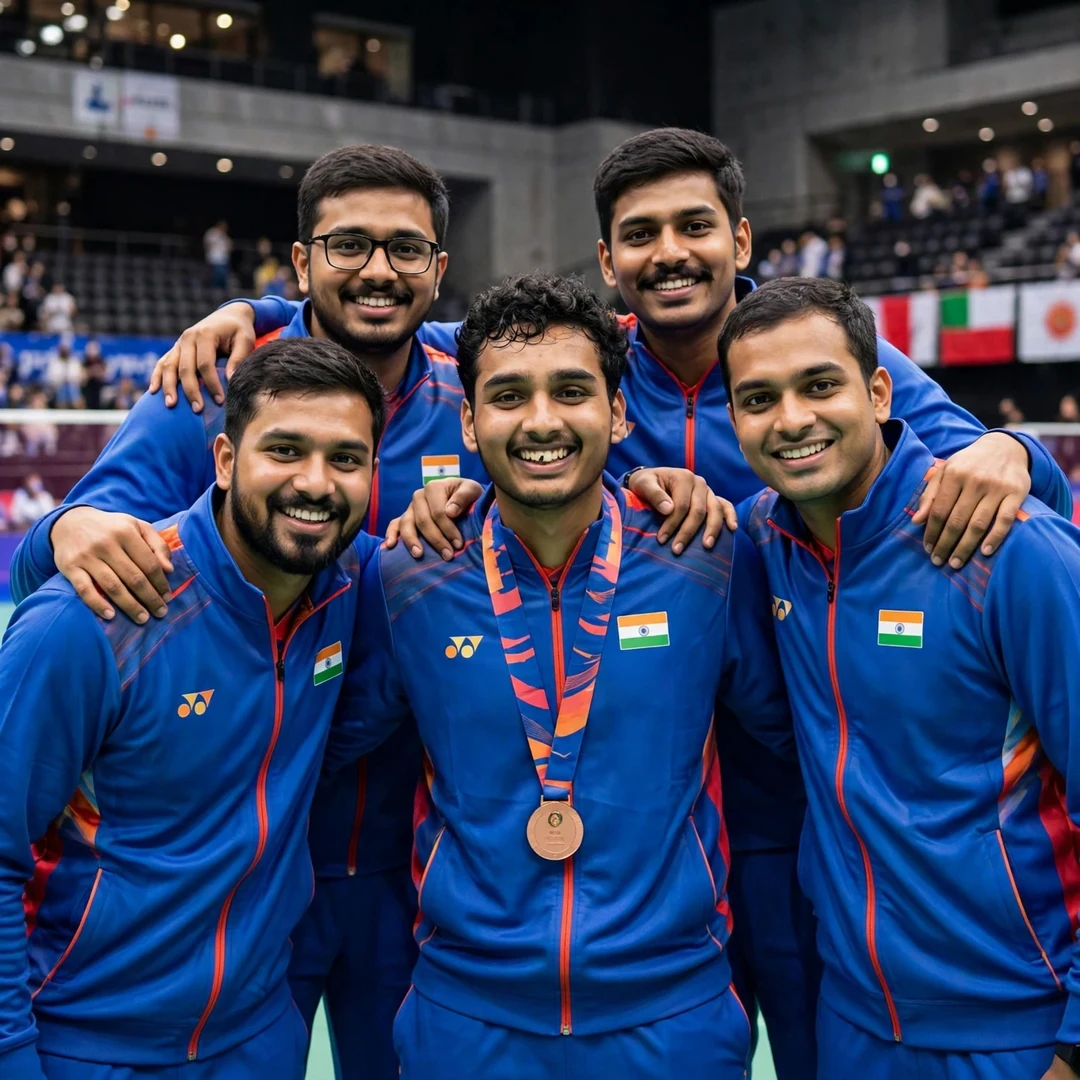
The semi-final against Malaysia’s Justin Hoh was one match too far — but only just. Mannepalli led 11-6 in the opener and took it 21-19; Hoh levelled from 16-17 in the second, winning it 21-16; and in the decider the Indian struggled with the drift, slipping from 9-9 to 9-16 on a seven-point run before falling 16-21 after 81 minutes on court. It was his maiden BWF Super 300 semi-final and, by every account, the best result of his career — achieved the same week his compatriot Lakshya Sen also reached the last four. A player who two years earlier could not afford a full international calendar had stood one match from a Super 300 final.
Career Milestone #3
Macau 2025: The Week He Beat the Top Seed
If Macau announced him, the Arctic Open in October 2025 proved it was no fluke. In Vantaa, Finland, world No. 46 Mannepalli met Toma Junior Popov again — the seventh seed, ranked world No. 14, the man who had beaten him in the German Open quarter-finals eight months earlier. Popov took the first game 21-11 and reached 20-16 in the decider: four match points. Mannepalli saved all four, reeled off six consecutive points and won 11-21, 21-11, 22-20 in 68 minutes — the heist of the tournament, on a day when Lakshya Sen fell in the first round and Mannepalli kept India’s hopes alive alone. His run ended in the round of 16 against Japan’s Koki Watanabe, but the Popov win — four match points saved against a top-15 player at a Super 500 — is the result his whole career will be introduced with.
The new year kept the level high. At the Thailand Masters, a Super 300 in Bangkok in January 2026, Mannepalli outlasted Chinese Taipei’s Ting Yen-Chen 21-17, 14-21, 24-22 in a 78-minute quarter-final run — as world No. 43 he was the lone Indian men’s singles player to reach the last eight. In March he progressed at the Swiss Open, winning his opening match, and he played his home India Open in New Delhi. Across 2026 the ranking told the story of the climb: from 47th in the summer of 2025 to a career-high world No. 41, a number built entirely from results like these — quarter-finals and giant-killings banked one week at a time.
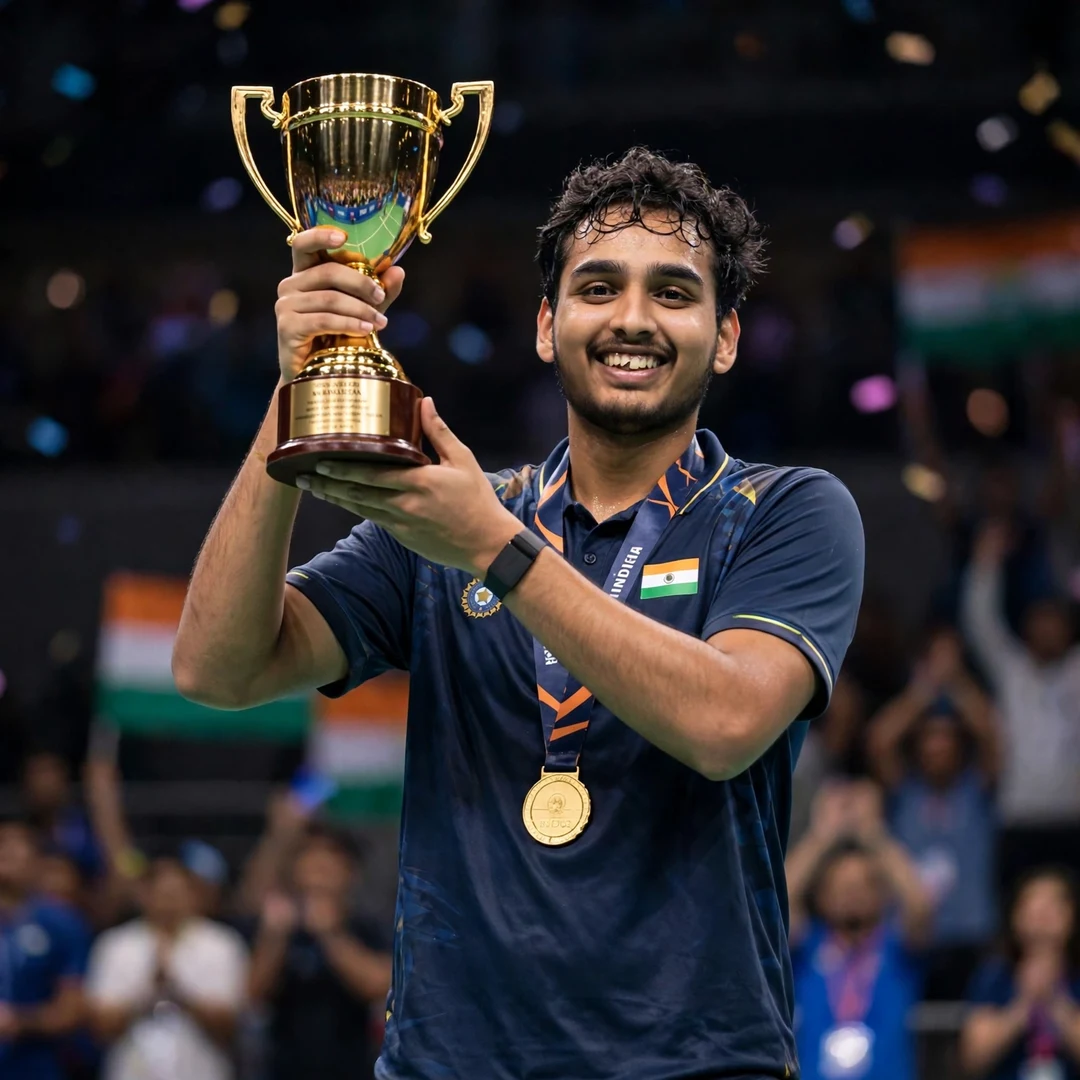
Then came the medal he will keep forever. At the 2026 Asian Games in Aichi-Nagoya, Japan, Mannepalli was part of the Indian men’s team that won the bronze medal. India swept Bangladesh 3-0 in the group stage and fought into the semi-finals, where China — the same team that had beaten India in the 2023 final — won 3-1 despite Satwiksairaj Rankireddy and Chirag Shetty defeating the world champion pair Liang Wei Keng and Wang Chang. The bronze gave India back-to-back Asian Games men’s team medals, matching feats from four decades earlier, and Mannepalli’s reaction said everything about what team badminton means to him: ‘Winning a medal for India as a team means a lot. We stand together as a team, and we fought together.’
Career Milestone #4
Four Match Points Saved in Finland, and an Asian Games Bronze
Holding a top-fifty ranking is its own discipline, and the autumn of 2026 has been the grind that follows a career year. At the Arctic Open in October he came through qualifying — beating Belgium’s Julien Carraggi 21-12, 19-21, 21-13 — then defeated Denmark’s Magnus Johannesen 21-16, 21-14 before France’s Christo Popov, the world No. 3’s younger brother and a top-five player himself, stopped him in the round of 16; a week earlier he had reached the Vietnam Open round of 16. When the Week 43 rankings were published on 20 October 2026, Mannepalli stood at No. 51 with 31,656 points — a figure that reflects the 2025 Macau points cycling out as much as his current level, which by every recent result belongs well inside the world’s top fifty.
Strip the story back and its shape is what young players should study. A boy from Khammam who started at eight and moved cities for the game at sixteen; a prospect with no sponsors who played senior internationals late because the money was not there; a National Games champion and Senior Nationals finalist at 22; an International Challenge winner twice over at 22 and 23; a World Tour finalist; a heavy-set grinder who rebuilt his own body for two years; a Super 300 semi-finalist who beat a top seed and a junior world champion in the same week; a man who saved four match points against a world No. 14; and an Asian Games medallist at 25 with a career-high ranking of No. 41. Every stage of Tharun Mannepalli’s career was earned the slow way. That patience, compounded, is the real curriculum of his career.

Playing Style
The Relentless All-Court Grinding Style
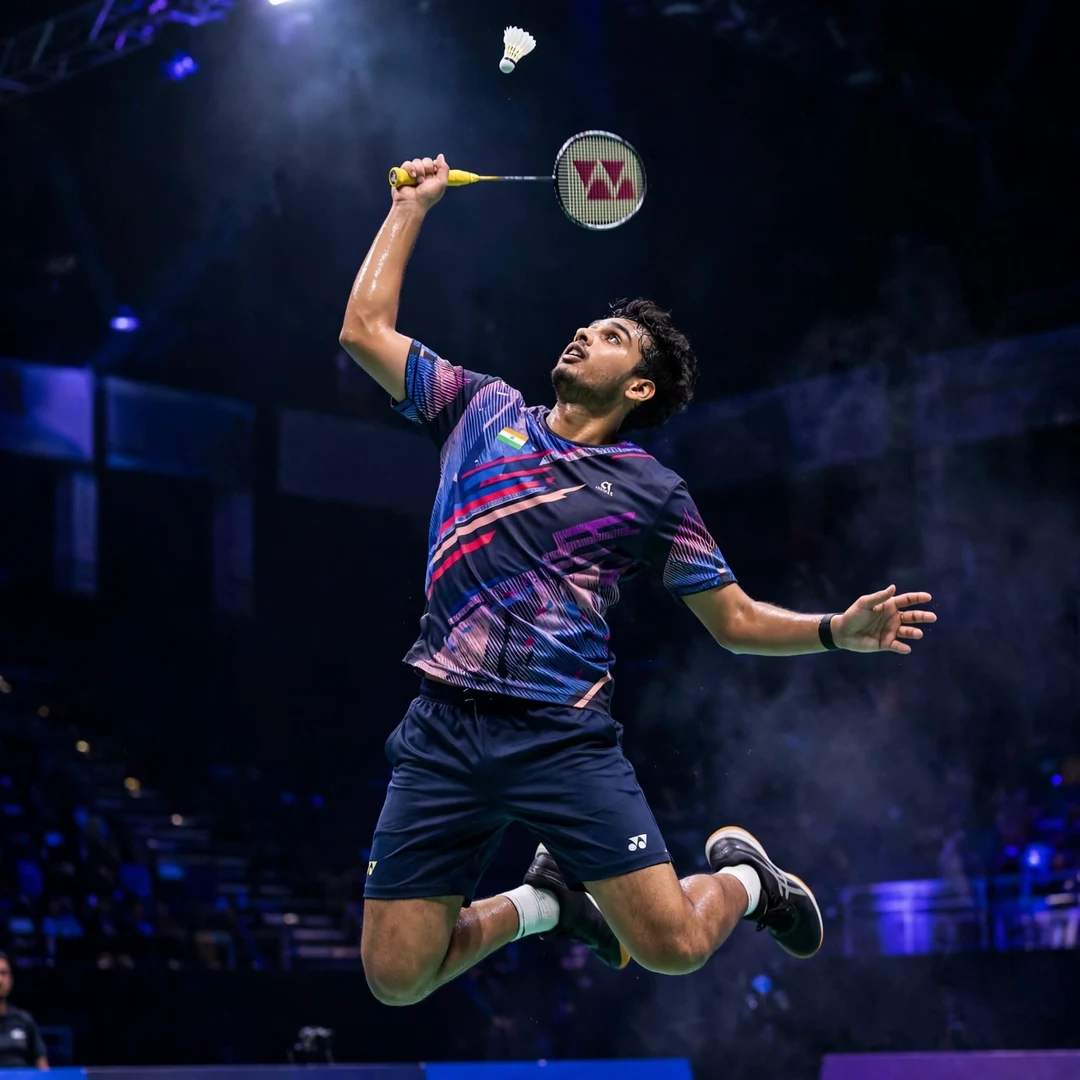
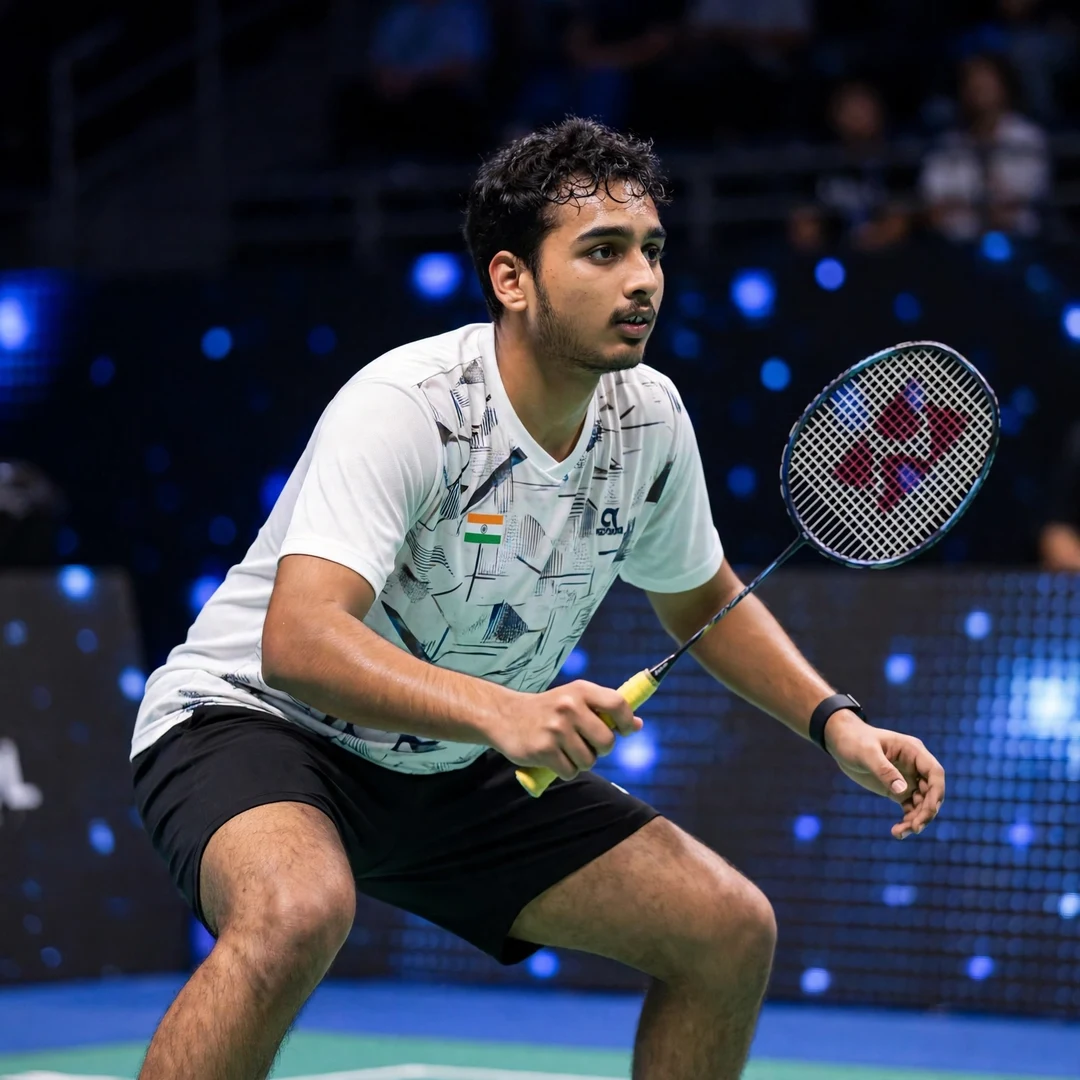
On court, Mannepalli is a grinder with a growing sting. The foundation is physical: rebuilt fitness and agility that let him extend rallies until opponents crack, flat and fast exchanges that deny them time to set up, and a defence organised enough to keep returning one more shuttle. The old version of his game waited for errors; the 2025 version creates openings — steep body smashes like the one that earned him match points against Hu Zhe An, tumbling net shots, and sudden injections of pace after long patient rallies. The racket stays in his right hand throughout; the left hand is the server’s hand, holding the shuttlecock for his backhand serve, and the counterbalance in his lunges. Speed and a versatile shot selection, the qualities PTI noted in Macau, are now layered on top of the engine — not instead of it.
The evidence is in the scorelines of his biggest wins, and none of them are power results. Beating Lee Cheuk Yiu 19-21, 21-14, 22-20 is a tactical result — pace slowed, rallies lengthened, a favourite dragged somewhere uncomfortable. Beating Ting Yen-Chen 24-22 in a 78-minute decider in Bangkok is an endurance result. And beating Toma Junior Popov after trailing 16-20 in the third game, with four match points saved, is a nerve result: six straight points played clean, one decision at a time, against a player ranked more than thirty places above him. Guru Sai Dutt warned opponents years ago that this is a player who puts in the work every single day in training; the deciders of 2025 and 2026 are simply that consistency, arriving under pressure.
His next frontier is turning deep runs into finals and a first World Tour title. He has the proof of concept — a Super 100 final in Cuttack, a Super 300 semi-final in Macau, quarter-finals in Germany and Bangkok, a Super 500 giant-killing in Vantaa — and at 25 the task is repetition and altitude: climbing back from No. 51 towards the top 32, where direct entries into the biggest draws and the Los Angeles 2028 Olympic qualification race will be decided. The body that once limited him is now his weapon, the sponsors and structure are finally in place, and the calendar is his to attack. Few players ranked around fifty carry a story half as instructive — or a slope still pointing this clearly upwards.
Mental Strength
Patience, Fitness and Refusing to Rush
The first lesson of Mannepalli’s career is that the base is built before anyone is watching. Eight years old in Khammam, a move to Hyderabad after Class X, years inside the Gopichand Academy system — the footwork, defence and rally tolerance winning his matches at 25 were installed long before the Macau breakthrough. Young players who want his completeness should copy the order: movement and rally skills first, inside a structured programme; the spectacular winners are only the visible tip of a decade of basics.
The second lesson is that a limiting body is information, not a life sentence. Mannepalli was heavy-set and error-waiting, and his coaches said so plainly; his response was two years of weight management, agility and movement work that raised his ceiling more than any new shot could have. A young player whose build or fitness is holding back their technique should copy the response, not the frustration: rebuild the physical base honestly, keep training consistently while it happens, and trust that shot-making improves fastest once the movement underneath it is free.
The third lesson is patience with levels — and with yourself. Mannepalli’s rise was sequenced honestly: domestic titles first (National Games gold, a Senior Nationals final), International Challenge titles next (Kazakhstan, Réunion), then World Tour quarter-finals, a final and a semi-final as the ranking climbed from the sixties to 41. Sponsors followed results, not the other way round, and his own verdict on the timeline is the one juniors should borrow: ‘And 23 is not late, I think.’ Pick the level you can win this season, bank the titles and the confidence, and let the ranking follow the results.
Learning Reference
ST Badminton Academy Connection
Tharun Mannepalli is an Indian professional player in the Pullela Gopichand Academy set-up in Hyderabad and does not coach for, teach at or endorse ST Badminton Academy, and there is no official connection between him and the academy. Students may occasionally see his name in academy discussions of the professional game because his rise — unsponsored, late-starting and built on a rebuilt body — is such a clear case study in patience — but he has no coaching role, sponsorship or teaching relationship with the academy, and nothing on this page should be read as his endorsement.
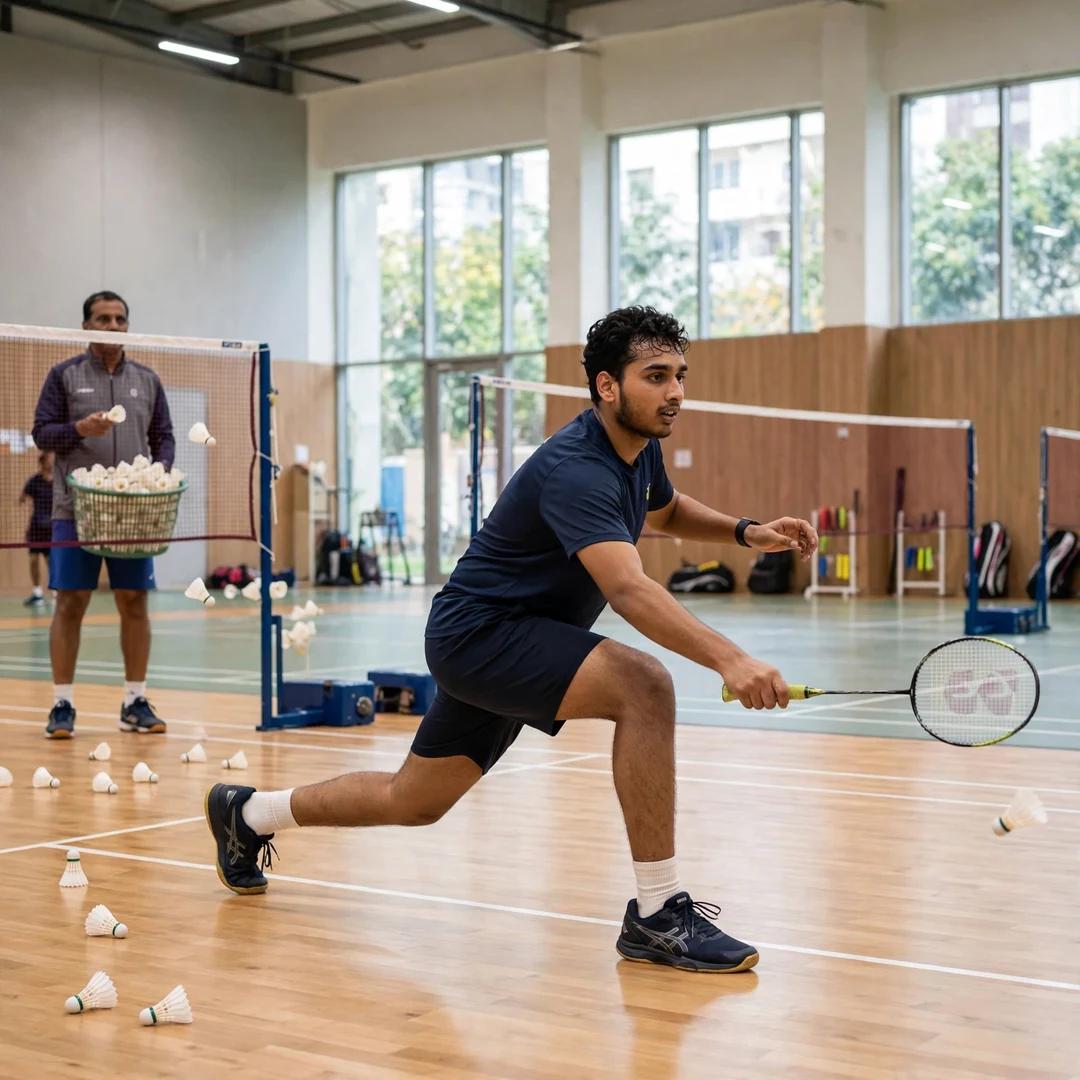
Coaches can use Mannepalli’s 2025 Arctic Open match against Toma Junior Popov as a teaching film for decider-game nerve. Freeze the rally at 16-20 down in the third game and count the next six points: no wild winners, no panic — flat exchanges, early taking of the shuttle, and one clean decision after another until the scoreboard turned. Then rebuild the base that makes it possible in training: multi-shuttle defence and movement blocks, long-rally games with a no-error rule, and fitness work treated as a technical session, because Mannepalli’s career is the proof that the third game is won in the gym months before it is won on court.
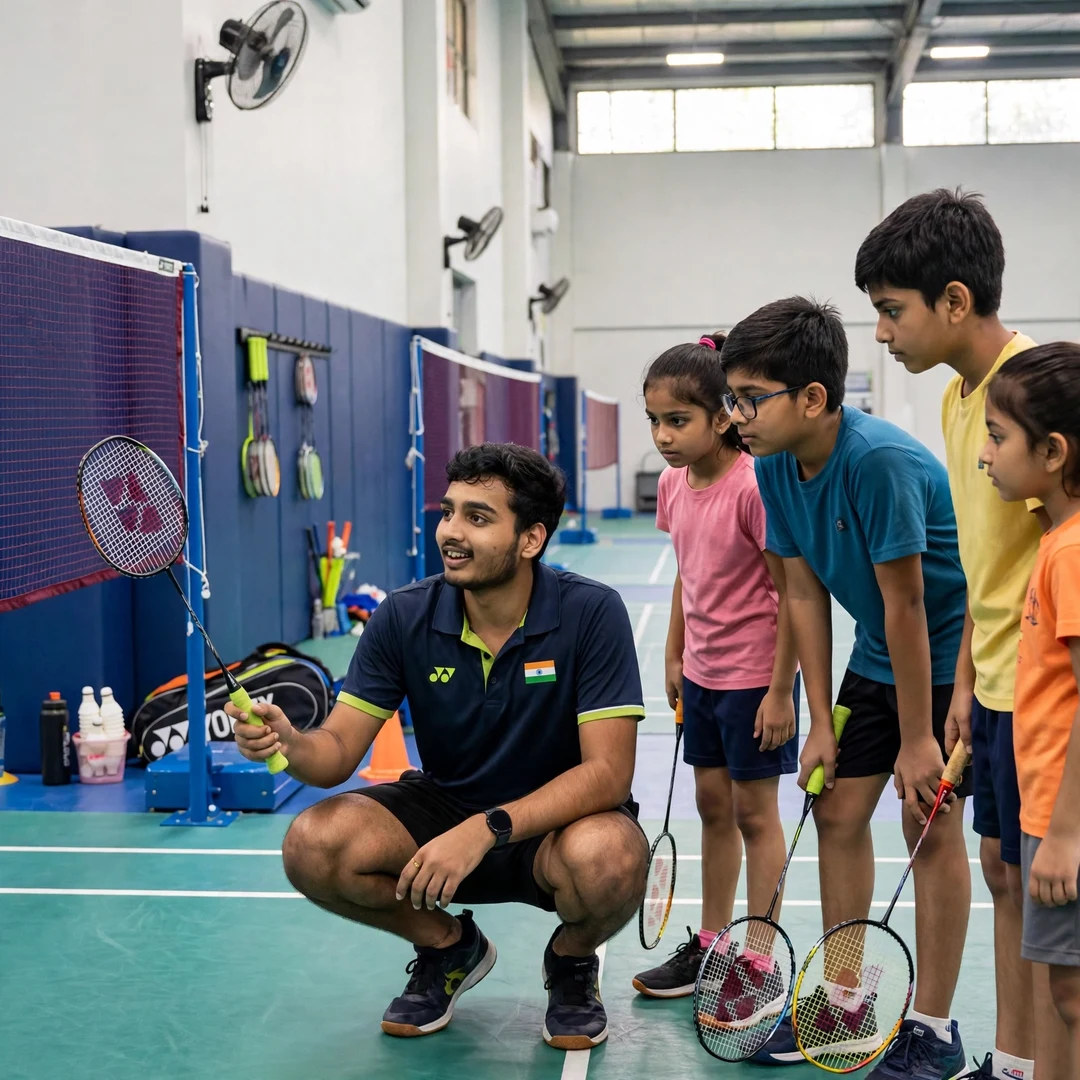
For parents, Mannepalli’s timeline is a healthy reality check. He started at eight but played senior international badminton late — sponsorship, not talent, was the bottleneck — won his first senior international title at 22, broke through at 23 and 24, and reached a career-high ranking and an Asian Games podium at 25. Progress measured in years, not weekends; and beneath the timeline sits the practical lesson his family lived: when the support finally matched the work — an academy place, sponsorship, regular entries — the results that had been promised for years arrived within two seasons. Back the process, fund the levels in order, and do not mistake a late breakthrough for a failed one.
FAQs: Tharun Mannepalli Indian Badminton Player
Here are the questions badminton fans in India, Malaysia, Singapore and beyond ask most about Tharun Mannepalli — his Khammam roots, his two International Challenge titles, the Macau breakthrough and the four match points he saved in Finland, and what young players can learn from his patient, fitness-first, right-handed style.
Who is Tharun Mannepalli and which country does he represent in badminton?
Tharun Mannepalli is an Indian men’s singles badminton player. Born on 24 August 2001 in Khammam, Telangana, he is right-handed and trains at the Pullela Gopichand Badminton Academy in Hyderabad. In the Week 43 rankings of 20 October 2026 he sits at world No. 51 with 31,656 points, having reached a career-high of No. 41 in 2026.
What are Tharun Mannepalli’s biggest badminton achievements?
His biggest achievements are a bronze medal with the Indian men’s team at the 2026 Asian Games in Aichi-Nagoya, the men’s singles gold medal at the 37th National Games in Goa in 2023, two BWF International Challenge titles — the Kazakhstan International Challenge and the Saint-Denis Réunion Open, both in 2024 — a semi-final at the Macau Open Super 300 in 2025, a runner-up finish at the Odisha Masters Super 100 in 2024, and silver at India’s Senior National Championships in 2023.
What is Tharun Mannepalli’s playing style?
Mannepalli plays a fitness-first, all-court grinding game. Rebuilt agility and movement let him extend rallies and play fast, flat exchanges that rush opponents, while his shot-making has grown sharper season by season: body smashes, tumbling net shots and sudden changes of pace now sit on top of the rally tolerance that made his name. He is right-handed, with the racket in his right hand and the shuttlecock served from his left.
How did Tharun Mannepalli transform his body, and why did his breakthrough take time?
Mannepalli was heavy-set and, by his coaches’ assessment, limited by his body — an error-waiting player rather than a creator. Two years of weight, agility and movement work at the Gopichand Academy changed that, and his breakthrough still took time because senior international badminton started late for him: without sponsors, he played senior events only after the under-19s, until OGQ support and regular entries unlocked the calendar. As he puts it himself: ‘And 23 is not late, I think.’
How can my child learn from Tharun Mannepalli’s development path?
Children can learn from the order of his career: a structured academy base before any title, domestic medals before international ones, International Challenge trophies before World Tour runs. On court they can copy his rally construction — at the Arctic Open he beat Toma Junior Popov with the racket in his right hand by refusing to concede at 16-20 down in the decider — and his habit of treating every limitation, from a heavy build to a missing sponsor, as a problem to work on rather than a verdict.
Did Tharun Mannepalli win titles on the BWF International Challenge circuit?
Yes. Mannepalli won two BWF International Challenge titles in 2024: the Kazakhstan International Challenge in Uralsk, where he beat Malaysia’s Soong Joo Ven 21-10, 21-19 in the final, and the Saint-Denis Réunion Open, where he beat Japan’s Yudai Okimoto 21-15, 21-15. The Kazakhstan title was the first senior international trophy of his career.
What is Tharun Mannepalli’s best result on the BWF World Tour?
His best World Tour result is the semi-final of the Macau Open 2025, a Super 300, where he beat top seed Lee Cheuk Yiu and junior world champion Hu Zhe An before losing to Justin Hoh in three games. He also reached the final of the Odisha Masters 2024, a Super 100, losing to Rithvik Sanjeevi Satish Kumar, and the quarter-finals of the German Open 2025 and the Thailand Masters 2026.
What playing style should young players copy from Tharun Mannepalli?
Young players should copy his rally patience and construction: extend the rally on your terms, play flat and fast to deny the opponent time, and earn the smash rather than forcing it — then finish with the body smash and the net tumble, as he did against Hu Zhe An in Macau. Above all, copy the physical honesty underneath it: build the fitness and movement first, because his whole career shows that technique only survives the third game when the body does.
Does ST Badminton Academy have any connection with Tharun Mannepalli?
No. Tharun Mannepalli is an Indian professional player based at the Pullela Gopichand Academy in Hyderabad and has no official connection to ST Badminton Academy. He does not work with the academy as a coach or ambassador, and the academy follows his career only as followers of professional badminton and as a case study in patience, physical rebuilding and step-by-step player development.
Tharun Mannepalli Career Highlights



Career Statistics and Rankings
The next chapter is already being written. Mannepalli defends the points of his breakthrough season through the autumn of 2026 from a Week 43 ranking of No. 51, with the targets in plain sight: a second World Tour final and a first World Tour title, a climb back through the forties towards the top 32, and a place in India's plans as the qualification race for the Los Angeles 2028 Olympic Games takes shape. The Asian Games bronze is banked; the best individual results of his career, on his own evidence, are still in front of him.
| Development Area | Common Misconception | What Tharun Mannepalli's Career Shows REALITY |
|---|---|---|
| Junior Foundation | Talent alone decides who becomes a champion. | Mannepalli started badminton at eight in Khammam, moved to Hyderabad after Class X and joined the Pullela Gopichand Badminton Academy — a structured junior base came first. |
| Playing Style Priority | Kids should copy the flashiest attacking shots. | Mannepalli built a complete game first; his big smashes are the finishing touch on rebuilt fitness, reliable footwork, stubborn defence and net craft. |
| Fitness Importance | Juniors can out-train everyone without rest. | Mannepalli was a heavy-set player who waited for errors; two years of weight, agility and movement work at the Gopichand Academy turned him into the athlete who broke through in 2025 — physical rebuilding, not more hours. |
| Mental Approach | Top players never get nervous or upset. | Mannepalli saved four match points from 16-20 down in the deciding game against Toma Junior Popov at the 2025 Arctic Open and still won the match — mental skills are trained, not inherited. |
| Attacking Training | Smashing harder is always the answer. | His 2025 Macau Open wins over top seed Lee Cheuk Yiu (19-21, 21-14, 22-20) and junior world champion Hu Zhe An came from rally patience and controlled placement, not raw power. |
| National Milestones | Only world titles matter. | Mannepalli's National Games gold in 2023 and his Asian Games men's team bronze with India in 2026 bookend his rise — domestic and team milestones build a career step by step. |
| Career Timeline | Champions peak once and fade fast. | From Senior Nationals runner-up in 2023 to a career-high world No. 41 and an Asian Games medal in 2026, Mannepalli proves sustained development beats a short peak. |
Study Tharun Mannepalli's Grinding Game and Patient Rise
Whether you are an Indian supporter who watched him save four match points in Finland, a young heavy-set player learning how far a rebuilt body can carry a grinding game, or a junior still waiting for the sponsorship that lets you travel, Tharun Mannepalli's matches reward close study. Watch how long he makes the rallies last and how calmly he plays the points everyone else has already lost — then bring that patience, and his refusal to call 23 late, into your own training week.