
 All languages
 Chinese (Simplified)
 Chinese (Traditional)
 English
 Indonesian
 Japanese
 Korean
 Malay
 Thai
 Vietnamese


Badminton Training Load for Juniors: Rest Days, Sleep, and School Balance
Parents ask us the same question in different words every term: how much badminton is the right amount for my child? Too little and the skills stay shaky. Too much and the child arrives tired, homework piles up, and the love of the game fades. The answer is not a fixed number of sessions. It is a balance between training, rest days, sleep, and school, and that balance changes as a junior player grows in skill and readiness. This guide explains badminton training rest days for juniors in plain words: what training load means, how rest days work, why sleep matters for junior badminton recovery, and how to fit training around school without turning every week into a rush. Head coach Mr Eric Chuar shares how we plan load at ST Badminton Academy in Setapak, so parents can spot overload early and keep training steady for the long term.

Part 1
What Training Load Means for a Junior Player
Training load is not just the hours on court. It is everything a junior player carries in a week: coaching sessions, school games, practice with friends, homework, and the travel between them. A week with three sessions plus a school match is heavier than a week with three sessions and nothing else, even when the court time looks the same. Coaches who plan well count the whole week, not just the lessons they teach. That is why the first question at ST Badminton Academy is never how many sessions a child can take. It is what the rest of the week already looks like.
Load also changes with skill and readiness. A junior who is still learning grip and footwork uses a lot of energy just to stay balanced and reach the shuttle. A junior with clean basics moves with less effort and can handle a fuller week. Readiness is not a number. It shows in how a player recovers between sessions, how steady the footwork stays late in a rally, and how keen the player is to come back. When a coach plans by readiness instead of by a fixed schedule, training stays hard enough to build skill and light enough to keep the player fresh.

Part 2
Rest Days: The Part of Training Most Families Skip
A rest day is a day with no badminton training, no school match, and no extra practice. It is not a wasted day. On a rest day, the body catches up on the work of the week, and the mind gets a break from drills and scores. Juniors who train without rest days often look busy and driven, but their footwork gets slower, their shots lose shape, and small mistakes creep in. Rest is the part of the plan that lets the training show up as skill.
Most junior players do well with two rest days in a week, placed between training days rather than bunched at the end. A simple pattern is train, rest, train, rest, train, then two days off, or train on alternate days with a full rest day after a hard session. The exact pattern matters less than the habit: hard days are always followed by lighter days or full rest. Parents can help by guarding those rest days the way they guard training days, and by saying no to extra games that land on a rest day.
A rest day does not have to mean sitting still all day. Light play with friends, a walk, stretching at home, or a fun game that is not badminton can all fit on a rest day, as long as the body is not pushed hard and the evening stays calm. What a rest day should not include is extra coaching, a long match, or late night practice that eats into sleep. If a junior wakes on a training day still tired from the day before, the rest day did not do its job, and the week needs a lighter plan.
Part 3
Sleep: The Quiet Part of Junior Recovery
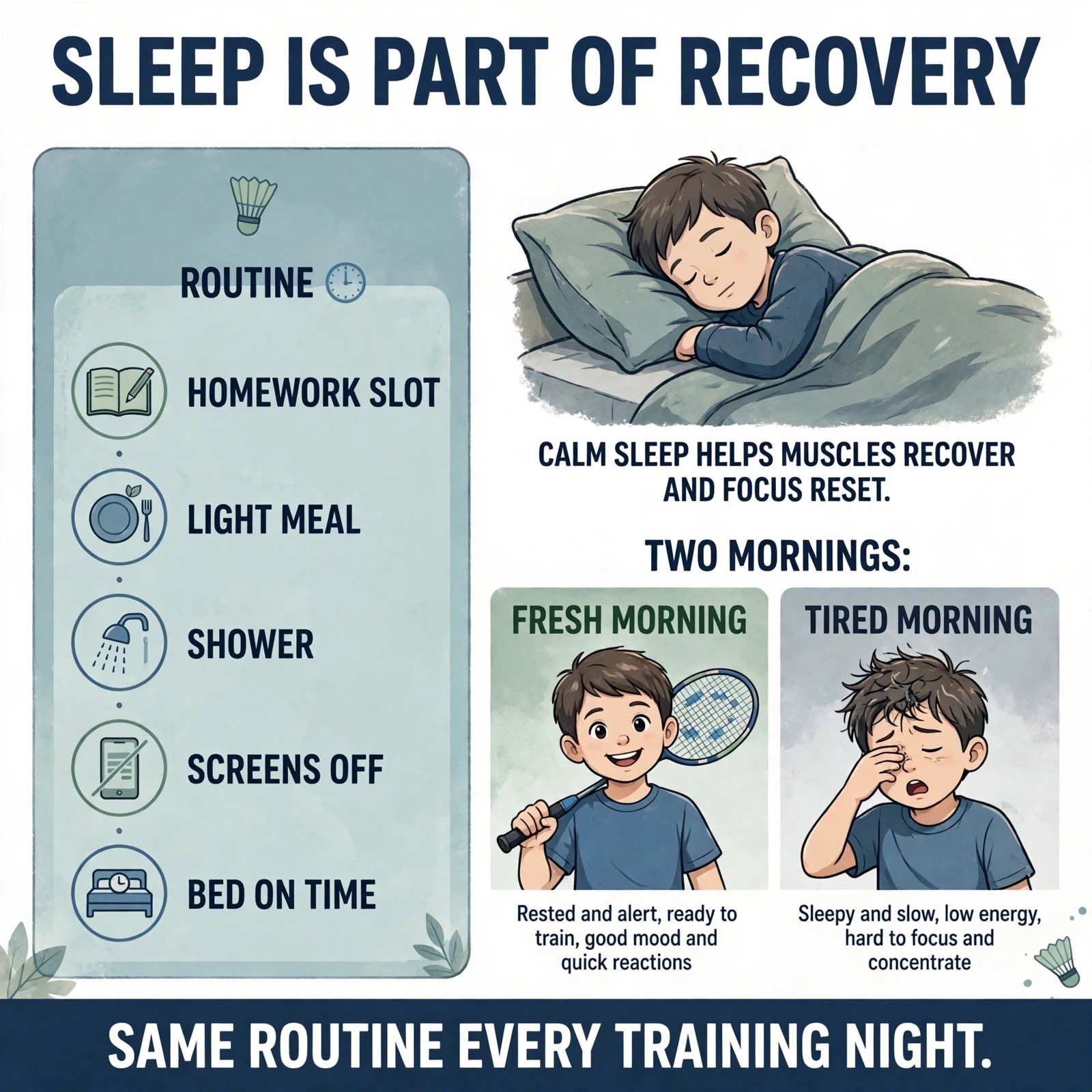
Sleep is where junior badminton recovery really happens. During sleep, the body settles after training, and the skills practised on court get a chance to settle too. A junior who sleeps well moves better the next day, listens better in class, and keeps a steadier mood. A junior who sleeps badly arrives at training with heavy legs and a short temper, and no amount of extra drilling fixes that. Coaches can see the difference in the first ten minutes of a session.
School nights set the limit. A late training session that ends close to bedtime makes it hard to wind down, finish homework, and sleep on time. That is why evening sessions for juniors should end with time to spare, not run right up to bedtime. A simple routine helps: homework first or a set homework slot after training, a light meal, a shower, and screens off well before bed. When the routine stays the same each training night, sleep stops being a nightly fight and becomes part of the plan.
Parents sometimes ask whether a junior can catch up on sleep at the weekend. A long sleep on a free morning helps, but it does not undo a week of late nights. Steady sleep across the week beats a big weekend catch up. If a junior needs a very long sleep every weekend just to feel normal, the weekday load is too heavy. The fix is usually a lighter training week or an earlier session, not a later bedtime on school nights.

Part 4
School First: Fitting Badminton Around Homework and Exams
School comes first, and a good training plan admits it. Juniors carry homework, tests, projects, and exam terms, and those demands rise and fall across the school year. A training load that fits in a quiet school month may be too much in an exam term. Parents and coaches should look at the school calendar together at the start of each term and mark the heavy weeks, then plan training around them. A junior who can train three times a week in a normal month may train once or twice in an exam term, and that is a sensible plan, not a step back.
Homework needs a fixed slot, not whatever time is left after training. The easiest way is to decide the homework time before the training time. If training ends late, homework goes before training, or the session moves to a day with less homework. Juniors who do homework in a rush after a long session learn little and sleep late. A short, honest talk with the coach about the school timetable usually finds a slot that works. Coaches would rather move a session than watch a student fall behind at school.
Travel time counts too. A session that looks short on paper becomes long when travel, waiting, and the trip home are added. Families in Setapak, Wangsa Maju, Gombak, Kepong, and nearby areas often pick a training base close to home for this reason. At ST Badminton Academy in Setapak, sessions are planned so juniors can get home, eat, and settle homework without a late night. If the trip to training eats the evening, the load is heavier than the session itself suggests.

Part 5
Signs of Overload Parents Can Spot Early
Overload rarely arrives with a single loud warning. It builds slowly, and parents usually see it at home before a coach sees it on court. The first signs are small: a junior who used to look forward to training starts to drag their feet, complains about going, or finds reasons to stay home. Mood changes too. A player who was cheerful becomes flat or easily upset, and small setbacks in a rally feel bigger than they should. When the love of the game fades, load is the first thing to check.
Schoolwork is the next place overload shows. Homework takes longer, marks slip, or the junior stops talking about school with any interest. Sleep changes as well: trouble falling asleep, waking tired, or needing far more sleep than usual on free days. On court, the signs are tired legs, footwork that breaks down early in a session, shots that lose height and length, and rallies that end sooner than they used to. One tired day means little. A pattern across two or three weeks means the load needs a change.
Parents should also watch for a player who stops improving even while training more. Extra sessions do not fix tiredness; they add to it. When a junior trains harder and plays worse, the answer is usually rest, not more drills. Keep a simple note of mood, sleep, school, and training across a few weeks, and share it with the coach. A coach who sees the whole picture can cut the load early, before a small dip turns into a long break from the game.

Part 6
How a Coach Plans Load Across a Week and a Term
A coach plans load the way a teacher plans lessons: easy weeks and hard weeks, with breaks built in. A typical training week mixes skill work, footwork, rallies, and games, and no single day carries the whole load. Hard sessions are followed by lighter ones, and the week ends with rest. Across a term, the load rises slowly as skills settle, then eases before exams or a school break. This rise and fall is normal. A flat plan that pushes the same hard load every week for months is not a plan; it is a grind.
At ST Badminton Academy, head coach Mr Eric Chuar plans each junior group around readiness, not a fixed timetable. Groups are capped at four students, so the coach can see who is fresh and who is tired, and can change a session on the spot. A player who arrives tired gets lighter drills and more rest between rallies. A player who is fresh gets a harder set. The paid Initial Assessment at the start helps the coach set the right starting load, and regular feedback after each block of sessions keeps the plan honest.
Breaks are part of the plan, not a failure of it. A week off after a hard term, a lighter week during exams, or a short break when a junior feels flat all help the player come back stronger. Juniors who never take a break often lose interest by the end of the year. Juniors who rest on purpose keep their love of the game and their skills. Parents should treat a planned break as training, not as lost time, and should not fill it with extra sessions somewhere else.

Part 7
When the Load Needs to Change: Cut Back, Then Build Again
When the load needs to change, change it early and change it clearly. The simplest cut is to drop one session a week for a few weeks and keep the rest days firm. Keep the session the junior enjoys most, and drop the one that lands on the busiest school day. Tell the coach what changed and why, so the plan can be rebuilt around the new week. A quiet cut that nobody talks about leads to confusion; a clear talk leads to a better plan.
If a junior has been overloaded for a while, the return should be slow. Start with one or two lighter sessions a week, with rest days between them, and build back only when mood, sleep, and schoolwork look steady again. Do not rush back to the old load in the first week. A player who returns slowly keeps the skills and the love of the game. A player who returns at full load straight away often feels tired again within days, and the cycle repeats.
The goal is not to train the most. The goal is to train in a way a junior can keep for years. A balanced week with rest days, steady sleep, and school in order builds a player who still loves badminton after many terms. That is what good coaching protects. If you are unsure about your child’s load, talk to the coach, look at the whole week together, and make one small change at a time. Small changes, made early, keep training on track.
Why Eric Chuar Stands Out
A coach can sound good on paper and still teach badly. The difference shows in the details: how a lesson is planned, how mistakes get corrected, and whether a student actually improves week after week. Eric Chuar has spent over 17 years coaching in Malaysia and Singapore, and his teaching is built on proper training, not guesswork. His certificates are listed below, and parents can ask to see them before signing up.
Coaching licences: National Coaching License Lesen C, SLKK Tahap I, issued by Akademi Kejurulatihan Kebangsaan (AKK). This is the licence that confirms legal coaching status in Malaysia, and it can be checked on the Malaysia Sports Coach Registry (MSCR). He is also a Certified National Level 1 Badminton Coach under SPKK, issued by AKK and Institut Sukan Negara, and a Certified Badminton Coach under BAM Level 1.
Sport science: Sport Science Course Level 1 (AKK), covering basic anatomy and physiology, youth training principles, injury prevention, fitness components, training planning, testing and monitoring, and sport psychology basics.
Data and analytics: Sports Performance Analysis, Sports Performance Analytics Specialization, Prediction Models with Sports Data, Data Collection and Processing with Python, Wearable Technologies and Sports Analytics, Machine Learning in Sports Analytics, and a Test on Moneyball and Beyond.
Athlete development and safety: The Science of Training Young Athletes, Motivating Gen Z Learners, Safe Sport Core, Safe Sport (Coach), and Doping in Sports.
He codes, too. The Python and machine learning certificates are real, and he uses them. He builds his own systems for tracking students and planning lessons, so decisions come from records and data, not just feel. A coach who can read the numbers and read the court is hard to find.
Small groups, close attention. Classes stay at a maximum of four students, so every grip, every footwork step and every swing gets corrected properly. With over 17 years of coaching behind him, he has seen the same beginner mistakes hundreds of times, and he knows how to fix them before they become habits.
Sixteen certificates in total, plus registration on the Malaysia Sports Coach Registry. That is the part other coaches cannot match by talking about it.
FAQs: Junior Badminton Training Load, Rest Days and Sleep
Here are answers to common questions from parents in Kuala Lumpur about junior badminton training load, rest days, sleep, and school balance.
How many rest days should a junior badminton player have each week?
Most junior players do well with at least two full rest days in a week. A rest day means no badminton training, no school match, and no extra practice. Place the rest days between training days rather than bunched at the end, so hard days are always followed by lighter days or full rest. Guard rest days the way you guard training days. If a junior wakes on a training day still tired from the day before, the week needs a lighter plan.
How often should juniors train each week?
Two to three times a week, with sessions of about 45 to 60 minutes, is a good shape for most junior players who are still building basics. That rhythm leaves room for rest days, homework, and school. A junior with clean basics and steady recovery may handle a fuller week, while a junior in a heavy school term may train once or twice. The right number depends on the whole week, including school games and travel, not on training alone.
How much sleep does a junior need for badminton recovery?
There is no single number that fits every junior, but the pattern matters more than any one night. A steady bedtime and a steady wake time across the week, with a calm wind down after evening training, help a junior arrive fresh at the next session. A junior who wakes fresh, stays steady in mood, and moves well in the first ten minutes of training is sleeping well enough. A junior who needs a very long sleep every weekend just to feel normal is carrying too much weekday load.
What are the signs of overload in junior badminton players?
Watch four places: mood, school, sleep, and legs. A junior who used to love training starts to drag their feet or finds reasons to stay home. Homework takes longer and marks slip. Sleep turns restless, or the junior wakes tired. On court, the legs feel heavy, footwork breaks down early, shots lose height and length, and rallies end sooner. One tired day means little. A pattern across two or three weeks means the load needs a change, and the coach should hear about it early.
Can a junior train every day?
No, daily training without rest days is a poor plan for a junior. Rest days are when the body catches up on the work of the week and skills settle. Juniors who train every day often look busy but play worse over time: footwork slows, shots lose shape, and the love of the game fades. A week with two to three sessions and at least two rest days builds skill faster than a week packed with daily sessions and no recovery.
What should a junior do on a rest day?
A rest day should feel restful. Light play with friends, a walk, stretching at home, or a fun game that is not badminton all fit, as long as the body is not pushed hard and the evening stays calm. What a rest day should not include is extra coaching, a long match, or late night practice that eats into sleep. Keep the routine simple and keep the evening free, so the next training day starts fresh.
How do I balance badminton with school and exams?
Look at the school calendar with the coach at the start of each term and mark the heavy weeks. In an exam term, cut training to once or twice a week and keep the homework slot fixed. Decide the homework time before the training time, so homework never becomes whatever time is left after a long session. Tell the coach about the school timetable early. A good coach would rather move a session than watch a student fall behind at school.
How long until a junior shows improvement?
Many families see visible change in about 8 to 12 weeks of steady training: a cleaner grip, steadier footwork, a clear that reaches the back line more often, and rallies that last longer. Basics take longer to settle, often three to six months of regular practice. Improvement is rarely a straight line. Some weeks look flat, then a skill clicks. Keep the load balanced, keep the rest days, and judge progress across a term, not across a single week.
What makes Mr Eric Chuar a suitable coach for juniors?
Mr Eric Chuar has coached for more than 15 years in Singapore and Malaysia, and he still teaches the small groups himself at ST Badminton Academy in Setapak. He holds a valid National Coaching License, Lesen C (SLKK Tahap I), issued by the National Coaching Academy (AKK), plus a National Level 1 Badminton Coaching Certificate under SPKK, a Sport Science Level 1 qualification, and a BAM Level 1 coaching qualification. His groups are capped at four students, so he can see who is fresh and who is tired and change a session on the spot. He plans junior load around readiness, with rest days and school balance built in, and he tracks progress with regular feedback after each block of sessions.
Rest, Sleep, and School in Balance




Balanced Training at ST Badminton Academy
A balanced week is not a soft week. It is a planned week. These are the standards we hold ourselves to in every junior session at ST Badminton Academy in Setapak.
| Factor | Overloaded Week | Balanced Week STBA |
|---|---|---|
| Training Days | Sessions on most days, with school matches squeezed in between. | Two to three sessions a week, with rest days between them. |
| Rest Days | No real rest day, or rest days filled with extra games. | At least two full rest days, guarded like training days. |
| Sleep | Late nights after training, homework rushed, waking tired. | A steady routine each training night, with time to wind down. |
| School | Homework squeezed into whatever time is left. | A fixed homework slot, planned before the training time. |
| Mood | Flat, easily upset, and keen to skip training. | Keen to train, steady in mood, and happy to play. |
| On Court | Tired legs, footwork breaks down early, rallies end sooner. | Fresh legs, steady footwork, and rallies that last longer. |
| Long Term | Skills stall, love of the game fades, and breaks get longer. | Steady gains, lasting love of the game, and training that lasts for years. |
Rest Is Part of Good Training
Start with one small change this week. Guard two rest days, fix a steady bedtime routine on training nights, and look at the school calendar with your child's coach. If the week already feels full, cut one session and see how mood, sleep, and schoolwork respond. Training load is not about doing the most. It is about doing the right amount, week after week, so a junior player keeps improving and keeps loving badminton. ST Badminton Academy in Setapak welcomes parents who want a training plan that fits school, rest, and sleep, not one that fights them.


