
 All languages
 Chinese (Simplified)
 Chinese (Traditional)
 English
 Indonesian
 Japanese
 Korean
 Malay
 Thai
 Vietnamese


Badminton Academies in Singapore Compared (Kids vs Adults)
If you search for a badminton academy in Singapore, you will find plenty of names, plenty of claims, and very little that helps you compare them. This guide compares Singapore badminton academies by type and by the things that shape your learning, not by naming one business better than another. Names change, coaches move, and timetables move with them. What stays useful is a clear way to judge any academy: its type, its group size, how its coaches teach, how it starts new students, and how it tracks progress. The guide also covers the difference between classes for younger players and classes for adults, so parents and adult beginners can both use it. Head coach Mr Eric Chuar has coached for more than 15 years in Singapore and Malaysia, and the checks below are the same checks we use at ST Badminton Academy, founded in 2007, with our base in Setapak, Kuala Lumpur and small groups capped at four students.

Start Here
What a Singapore Badminton Academy Really Is
A badminton academy in Singapore is a school for the game, not just a hall with courts. It should have a head coach who sets the teaching plan, coaches who follow that plan, groups sorted by level, and a clear path from a first lesson to steady play. Some academies are large, with many students and many coaches across several halls. Some are small, with one head coach and a handful of groups. Some coaches work alone, one student at a time. All three can be good, and all three can be poor. The type tells you what to expect, and the checks in this guide tell you whether the academy lives up to it.
This guide does not rank named academies, and it does not list prices. A ranking of names goes out of date fast, and it tells you nothing about how a coach teaches your child or how a coach fixes your backhand. Prices change too, and they mean little without knowing the group size, the session length, and what is included. Instead, you get the same comparison we would use ourselves: type, group size, coach attention, trial and assessment, progression, and how the academy treats younger players compared with adults. Use the checks on any academy in Singapore, and the best fit will show itself.
Three Types
Large Academy, Small Academy, or Private Coaching?
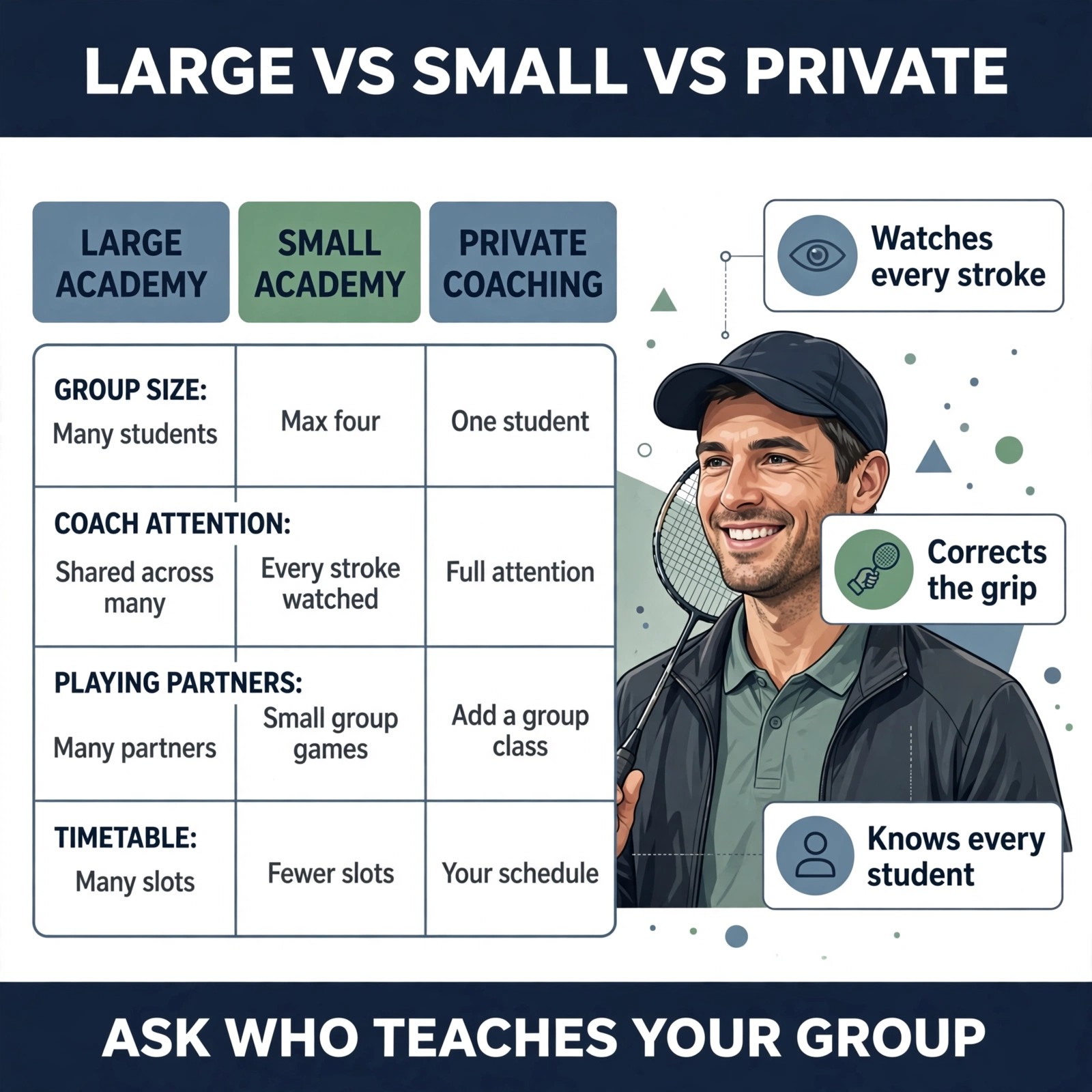
A large academy runs many groups at once, often across more than one hall, with several coaches on the floor. The upside is choice: more time slots, more levels, and a bigger pool of playing partners. A child can find friends at the same level, and an adult can find a group that matches a busy work week. The risk is distance from the head coach. In a large academy, the person whose name is on the website may rarely coach your group. Ask who actually teaches the group you would join, and watch that coach, not the brochure. If the coach on the floor cannot explain a simple grip, the size of the academy does not help you.
A small academy runs fewer groups, and the head coach often teaches them. The upside is closeness: the coach knows every student by name, knows every weak shot, and can change the plan when a student improves or stalls. The group size is usually smaller too, which means more correction per student. At ST Badminton Academy, for example, groups are capped at four students per coach, and head coach Mr Eric Chuar still teaches the small groups himself. The risk with a small academy is fewer time slots, so check that the timetable fits your week before you fall in love with the coaching. A great coach at a time you cannot attend is no use to you.
Private coaching is one coach and one student, or sometimes one coach and two students who train together. The upside is full attention: every drill is yours, every correction is aimed at your game, and the pace moves as fast as you do. Private coaching suits a player with one stubborn problem, such as a grip that will not change or a backhand that keeps failing, and it suits a player whose schedule fits no group. The trade off is that you lose playing partners and games, which is where rallies, tactics, and confidence are built. Many players mix both: a weekly group class for rallies and games, plus a private session when one shot needs fixing.
Group Size
Group Size and Coach Attention: The Number That Matters Most
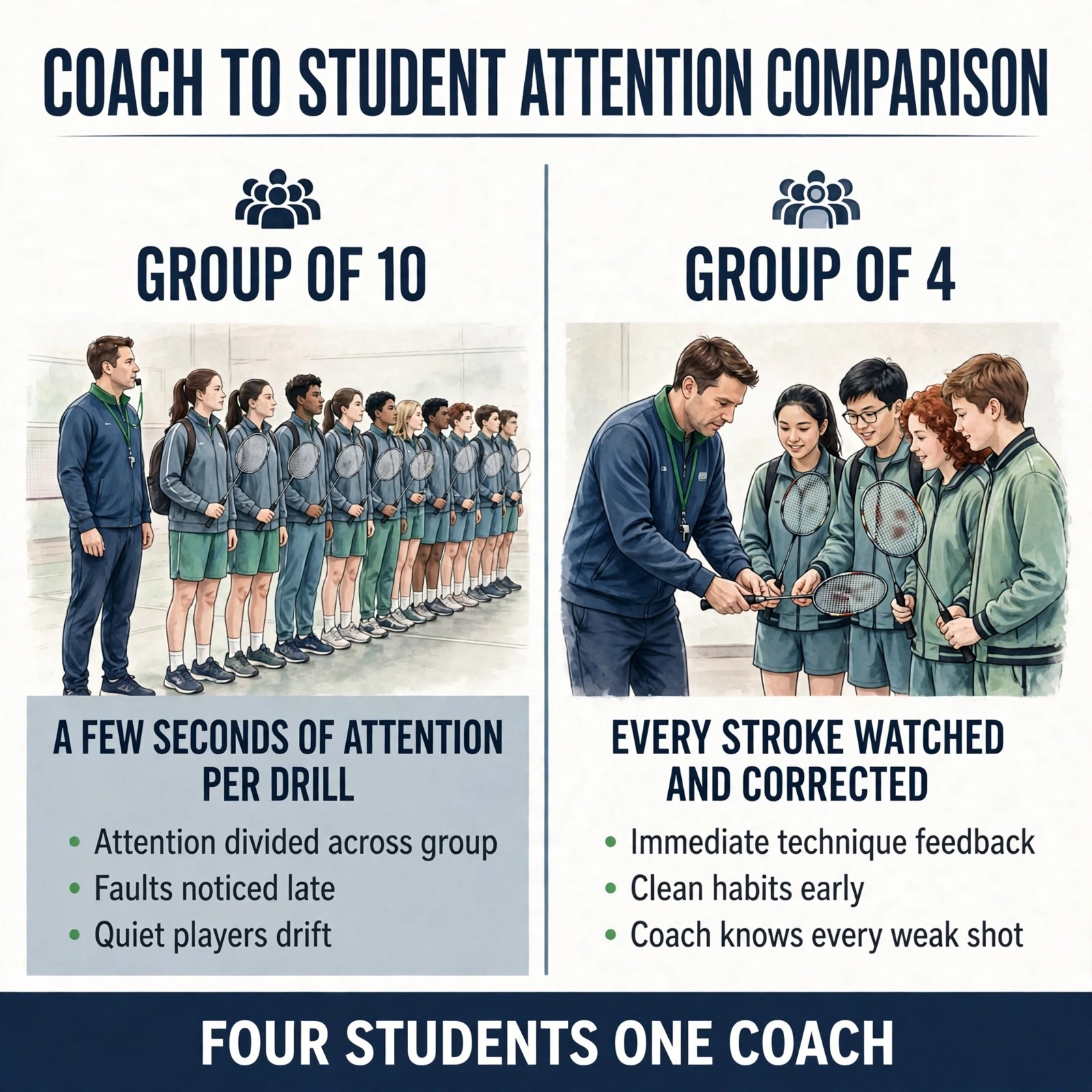
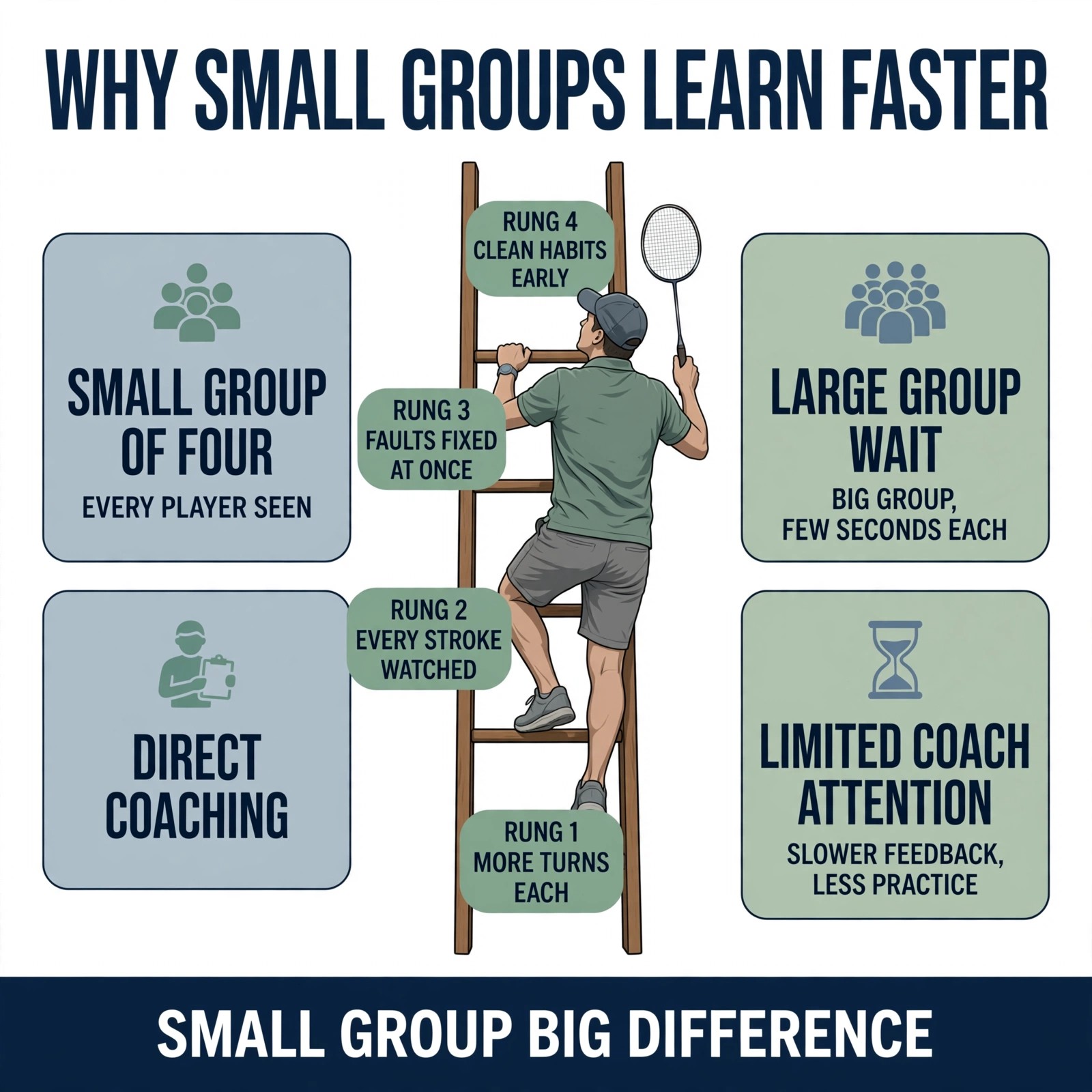
Group size decides how much coaching you actually get, whatever the academy type. In a group of ten, a coach can watch each student for a few seconds per drill. In a group of four, the coach can watch every stroke, fix the grip, adjust the feet, and check the result. The difference shows up in weeks, not years. A player in a small group learns clean habits early. A player in a big group often practises the same fault for months before anyone notices, and then the fix takes longer than the fault took to form. When you compare academies in Singapore, ask for the group size before you ask about anything else.
Ask for the real maximum, not the usual size. Some academies say small group but run eight or ten when the class is full. Ask what happens when new students join a full group, and whether the academy opens a new group or squeezes them in. A serious academy will give you a plain number and stick to it. At ST Badminton Academy, the maximum is four students per coach, and that number does not change when the class is busy. Whatever academy you choose, visit once and count: if the coach cannot name every student’s weak shot, the group is too big for real coaching.
Small groups also change the feel of the lesson. Students get more turns, more rallies, and more chances to ask questions. They learn to watch each other and to wait their turn without losing focus. Parents can see the difference in one visit. In a small group, the coach knows every student’s name and every student’s weak shot, and the students move most of the time instead of standing in a long line. In a big group, the coach knows the loudest student, and the quiet ones drift. That is true for younger players and for adults alike, and it is the simplest check in this whole guide.
Kids vs Adults
Kids Classes vs Adult Classes: What Changes, What Stays the Same
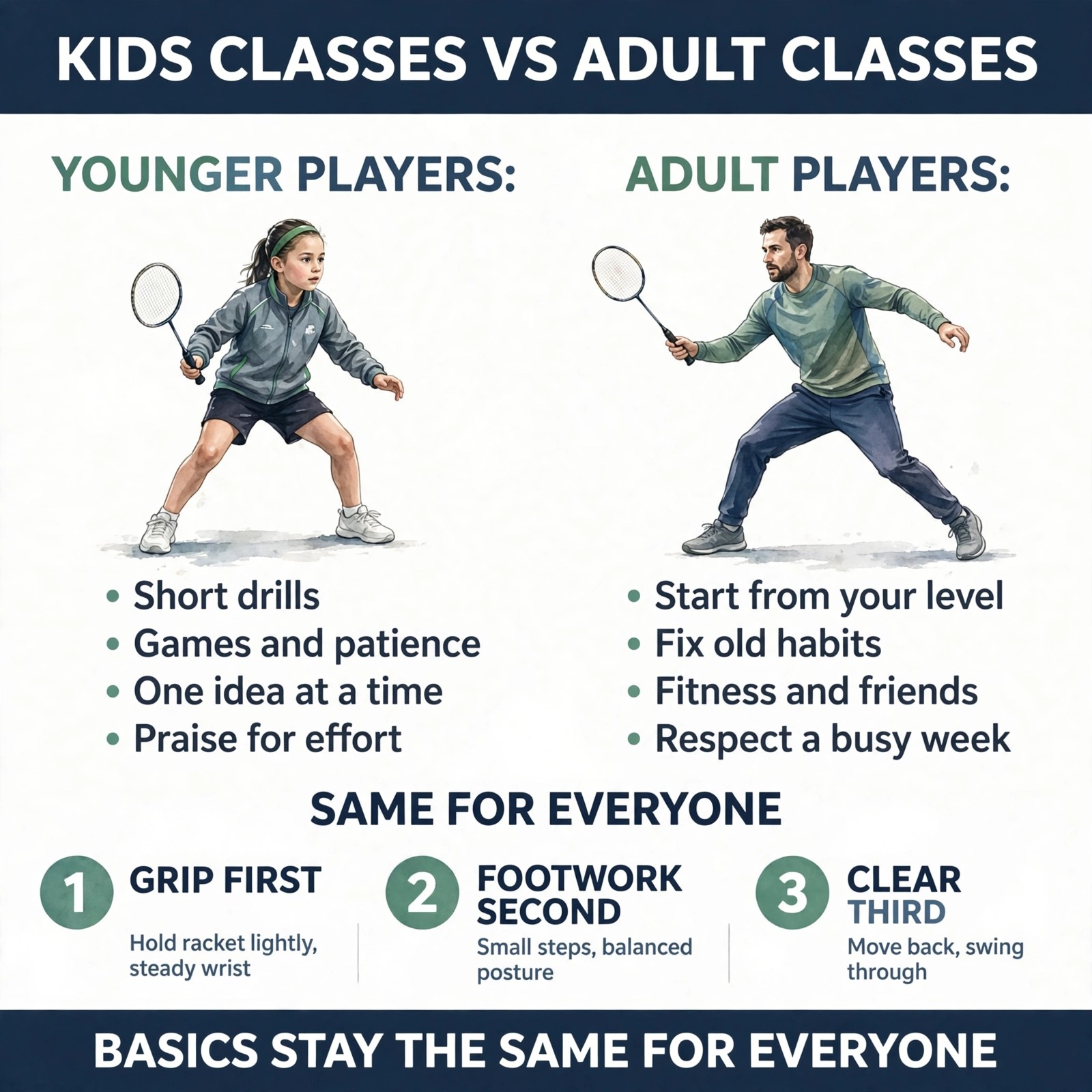
Classes for younger players and classes for adults look different on court, because the players are different. A class for younger players should be built around short drills, games, and patience, with plenty of movement and praise for effort. The coach should keep instructions short, one idea at a time, and should know how to hold the attention of a child who is tired after school. A class for adults should be built around the adult’s starting point: some adults played at school and want to return, some never held a racket, and some want fitness and friends more than competition. The coach should ask about that starting point before prescribing a plan, and should respect the fact that an adult’s week is full of work and family.
What stays the same matters more than what changes. Grip comes first for every beginner, whatever the age, because a wrong grip limits every shot that follows. Footwork comes next, because a player who cannot reach the shuttle on balance cannot play a clean shot. The clear comes after that, because it teaches height, timing, and court coverage in one stroke. A class that starts a beginner on smashes in the first week is skipping the base, whether the beginner is a child or an adult. Small groups, a clear first month plan, and regular feedback are not child things or adult things. They are good coaching, and they belong in every class.
When you compare academies, ask how they separate younger players from adults, and how they group within each side. A class that mixes complete beginners with players who have trained for two years will leave one side bored and the other side lost. Ask how the academy moves a student up when the student improves, on both sides of the divide. A good academy has a clear answer for younger players and for adults: beginners together, improvers together, and a path between the two. If the academy puts every player in the same group whatever the level, it is selling places, not coaching, and neither a child nor an adult will get what they came for.
Trial and Progress
Trial, Assessment, and Progression: How an Academy Should Start You
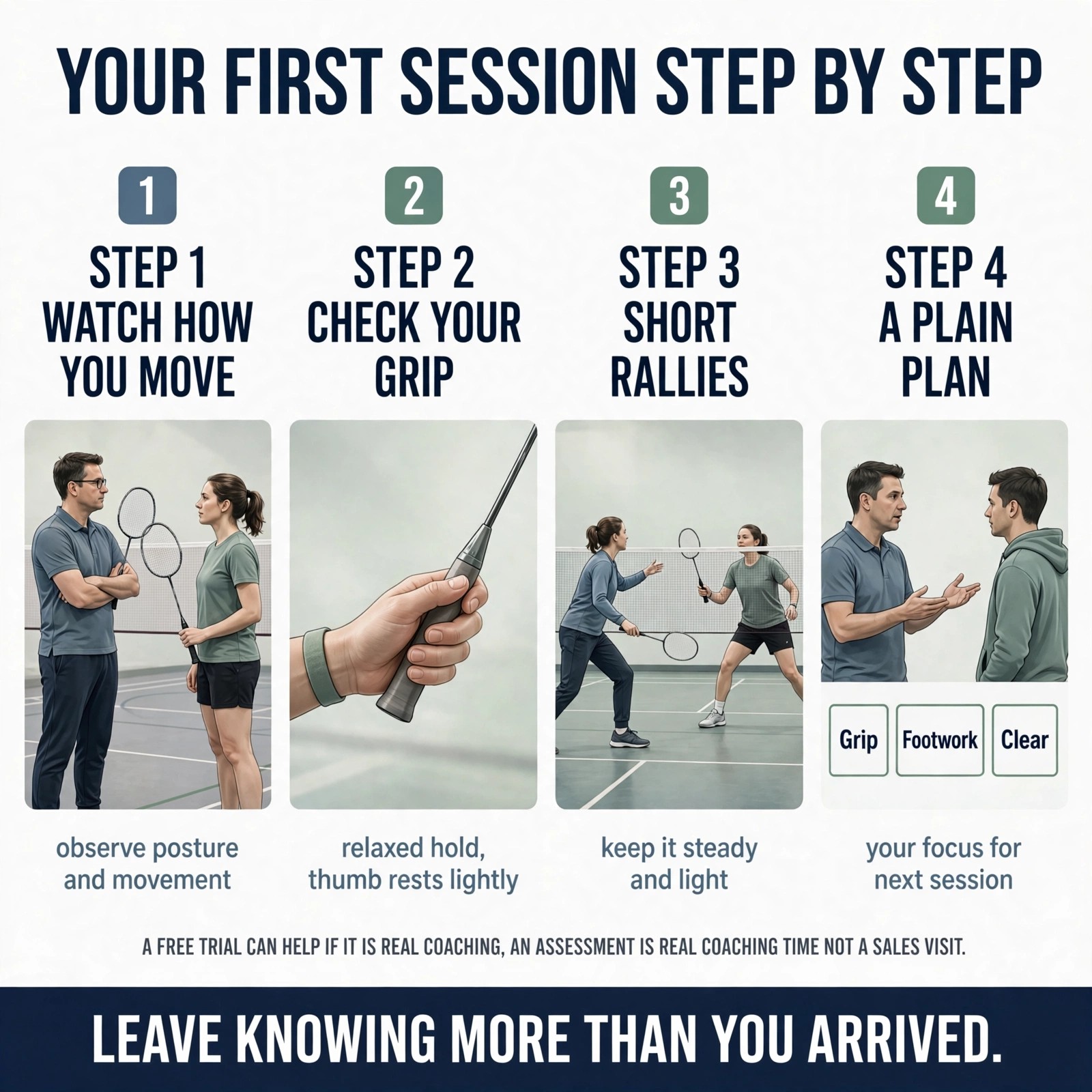
Never commit to a long programme before you have seen a single session. A trial or assessment lesson is the honest way to check the fit. In a good assessment, the coach watches how you move, how you hold the racket, and how you react to simple instructions. Then the coach tells you plainly what needs work and what the next steps look like. You should leave knowing more about your game than when you arrived. That is true for a child and for an adult, and it is true in Singapore just as it is in Kuala Lumpur. Any academy that asks you to pay for a long term before you have watched one session is asking for trust it has not earned.
Academies handle the first session in different ways, and you should know which way you are getting. Some run a free trial class, which can be useful if it is a real session with real coaching. Ask what the trial actually includes before you book one, and watch whether the coach teaches or spends the time talking about payment. At ST Badminton Academy, there is no free trial class. New students start with a paid Initial Assessment instead, because an assessment is real coaching time, not a sales visit. The coach spends the session on your game, not on persuading you to sign up. Either way, judge the first session by the teaching, not by the price tag on it.
Progression is where a good academy earns its keep over months, not weeks. Ask how the academy moves students between groups when they improve, and how often the coach reviews progress. A good coach keeps a record, even a simple one: grip fixed, footwork steadier, clear reaching the back line, rally length up from five shots to ten. Feedback should be regular, specific, and honest. Saying good job every week is not feedback. A useful comment names one thing that improved and one thing to work on next. If an academy cannot tell you how it tracks progress, it probably does not track it, and that is a fair reason to look elsewhere, in Singapore or anywhere else.
How to Start
How to Start: Visit, Ask, Then Decide
Start with a visit, not a payment. Go to the hall at the time you or your child would train, watch a full session, and talk to the coach after. Take your child along if the class is for them, so you can see how the coach speaks to them. Check the trip at that same time of day, because the trip to a hall in Singapore can look short on a map and feel long in evening traffic. A class that is hard to reach every week will not last, whatever the coaching is like. If an academy will not let you watch a session before you enrol, ask why. A class that is proud of its coaching has nothing to hide behind a closed door.
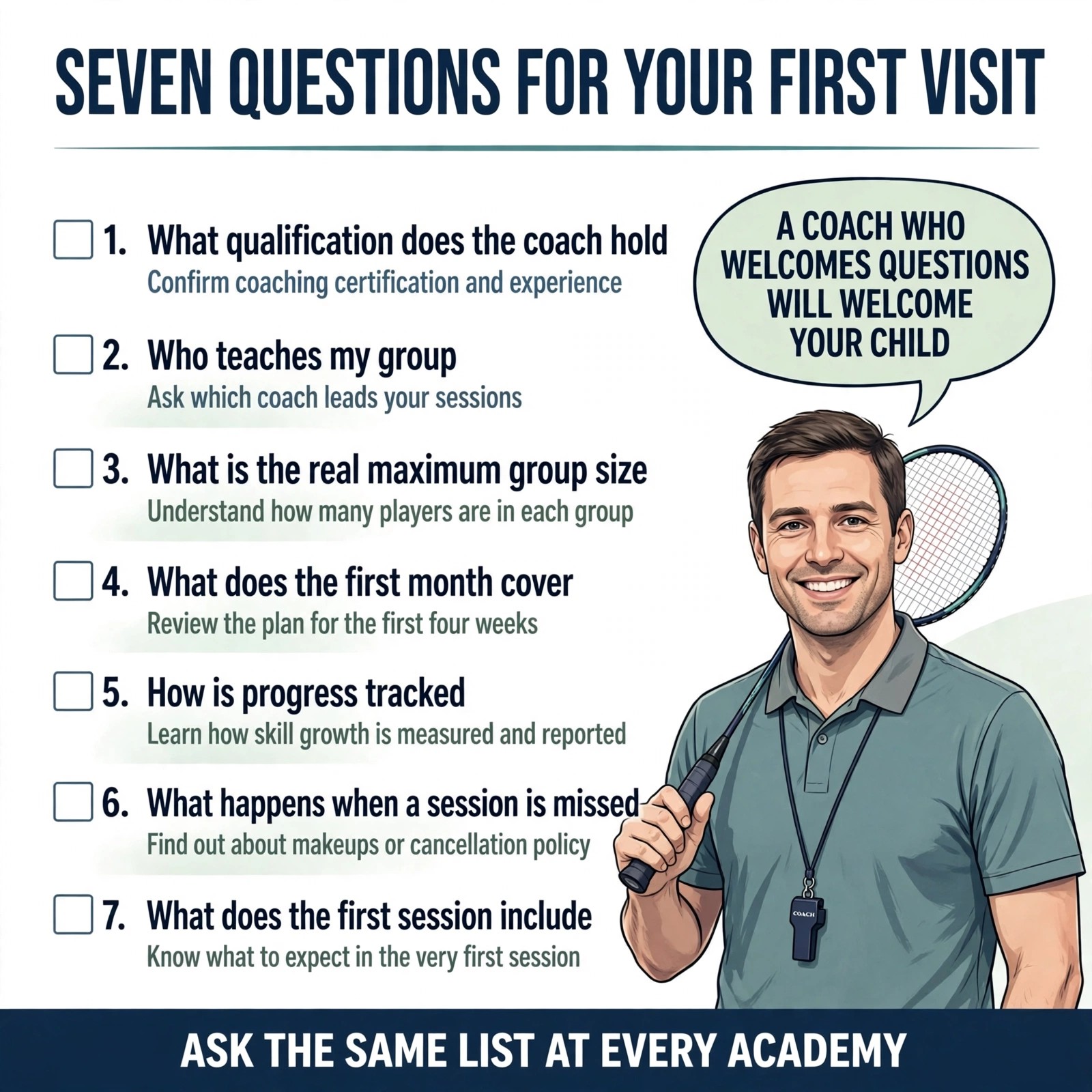
Ask the same short list of questions at every academy you visit, so you can compare the answers fairly. What coaching qualification does the coach hold? Who actually teaches the group I would join? What is the real maximum group size? What does the first month cover, and in what order? How is progress tracked, and how often will I hear from the coach? What happens when a student misses a session, or when the coach is away? What does the first session include, and is there an assessment before we commit? The answers matter, but so does the manner. A coach who welcomes questions will welcome your child. A coach who rushes you, or who answers with sales talk, is showing you how the relationship will go.
Bring a racket if you have one, and court shoes with non marking soles, plus a water bottle and a small towel. A light racket with a flexible or medium shaft suits most beginners, and the academy can advise on racket size and grip size at the first visit, so do not buy an expensive racket before the coach has seen you play. A first lesson should start with a short assessment, then teach the grip, show basic footwork, and practise the clear in short rallies. There should be time to ask questions, and you should leave with a simple plan for the next few weeks. Decide after the visit and the assessment, not before, and let your child have a say in the final choice if the class is theirs.
Red Flags
Red Flags: When to Walk Away
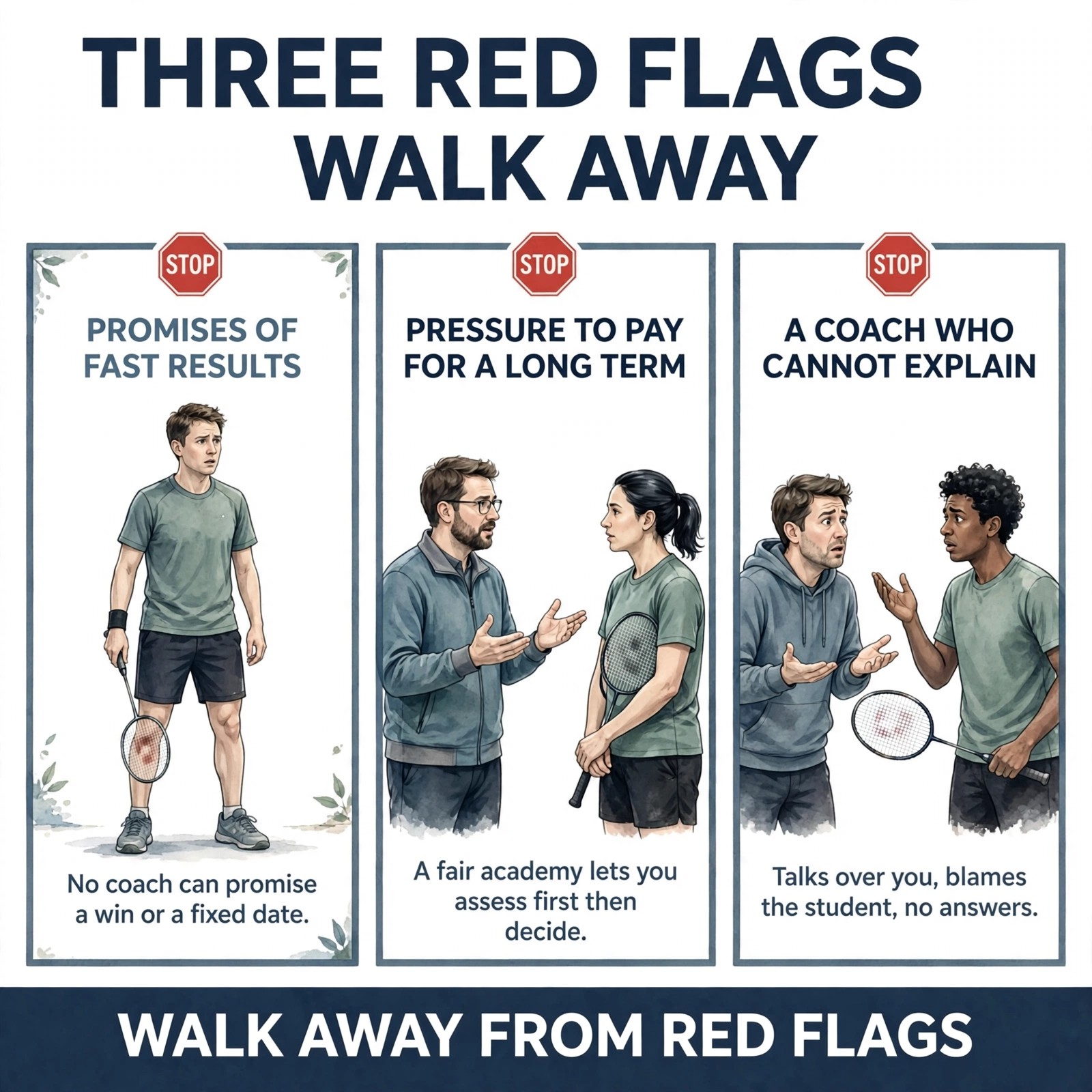
The first red flag is a promise of fast results. No coach can promise a tournament win, a team place, or a fixed timeline for improvement. Badminton rewards steady work over months, and any coach who guarantees an outcome in weeks is selling hope, not coaching. A good coach talks about the work, the plan, and the signs of progress, and leaves the results to the player. If a flyer or a coach promises that a student will reach a certain level by a certain date, keep that promise in mind when you judge everything else they say. It tells you how that academy thinks about its students.
The second red flag is pressure to pay for a long term before you have seen a single session. A fair academy lets you assess first, then decide. Watch for contracts that lock you in for many months, extra charges that appear only after you sign, and answers that dodge direct questions about terms. Clear terms, given in writing before you commit, are a sign of a serious academy. The same applies to any badminton academy in Singapore that asks for a long commitment on the first phone call. You are choosing a coach for your child or for yourself, not buying a product in a hurry, and a good academy will give you time to decide.
The third red flag is a coach who cannot explain, cannot correct, or will not answer questions. If the coach talks over you, blames the student for every fault, or keeps the group so big that no one gets attention, walk away. There are many good coaches and academies in Singapore. The right one will welcome your questions, show you a plan, and let the coaching speak for itself. Use the STBA standard as your yardstick: a qualified coach, a maximum of four students, a clear first month plan, regular feedback, and an assessment before you commit. Any academy in Singapore that meets that standard is worth a serious look, and any academy that fails it is not.
Why Eric Chuar Stands Out
A coach can sound good on paper and still teach badly. The difference shows in the details: how a lesson is planned, how mistakes get corrected, and whether a student actually improves week after week. Eric Chuar has spent over 17 years coaching in Malaysia and Singapore, and his teaching is built on proper training, not guesswork. His certificates are listed below, and parents can ask to see them before signing up.
Coaching licences: National Coaching License Lesen C, SLKK Tahap I, issued by Akademi Kejurulatihan Kebangsaan (AKK). This is the licence that confirms legal coaching status in Malaysia, and it can be checked on the Malaysia Sports Coach Registry (MSCR). He is also a Certified National Level 1 Badminton Coach under SPKK, issued by AKK and Institut Sukan Negara, and a Certified Badminton Coach under BAM Level 1.
Sport science: Sport Science Course Level 1 (AKK), covering basic anatomy and physiology, youth training principles, injury prevention, fitness components, training planning, testing and monitoring, and sport psychology basics.
Data and analytics: Sports Performance Analysis, Sports Performance Analytics Specialization, Prediction Models with Sports Data, Data Collection and Processing with Python, Wearable Technologies and Sports Analytics, Machine Learning in Sports Analytics, and a Test on Moneyball and Beyond.
Athlete development and safety: The Science of Training Young Athletes, Motivating Gen Z Learners, Safe Sport Core, Safe Sport (Coach), and Doping in Sports.
He codes, too. The Python and machine learning certificates are real, and he uses them. He builds his own systems for tracking students and planning lessons, so decisions come from records and data, not just feel. A coach who can read the numbers and read the court is hard to find.
Small groups, close attention. Classes stay at a maximum of four students, so every grip, every footwork step and every swing gets corrected properly. With over 17 years of coaching behind him, he has seen the same beginner mistakes hundreds of times, and he knows how to fix them before they become habits.
Sixteen certificates in total, plus registration on the Malaysia Sports Coach Registry. That is the part other coaches cannot match by talking about it.
FAQs: Badminton Academies in Singapore
Here are answers to common questions from parents and adult beginners in Singapore about choosing a badminton academy.
How do I choose a badminton academy in Singapore?
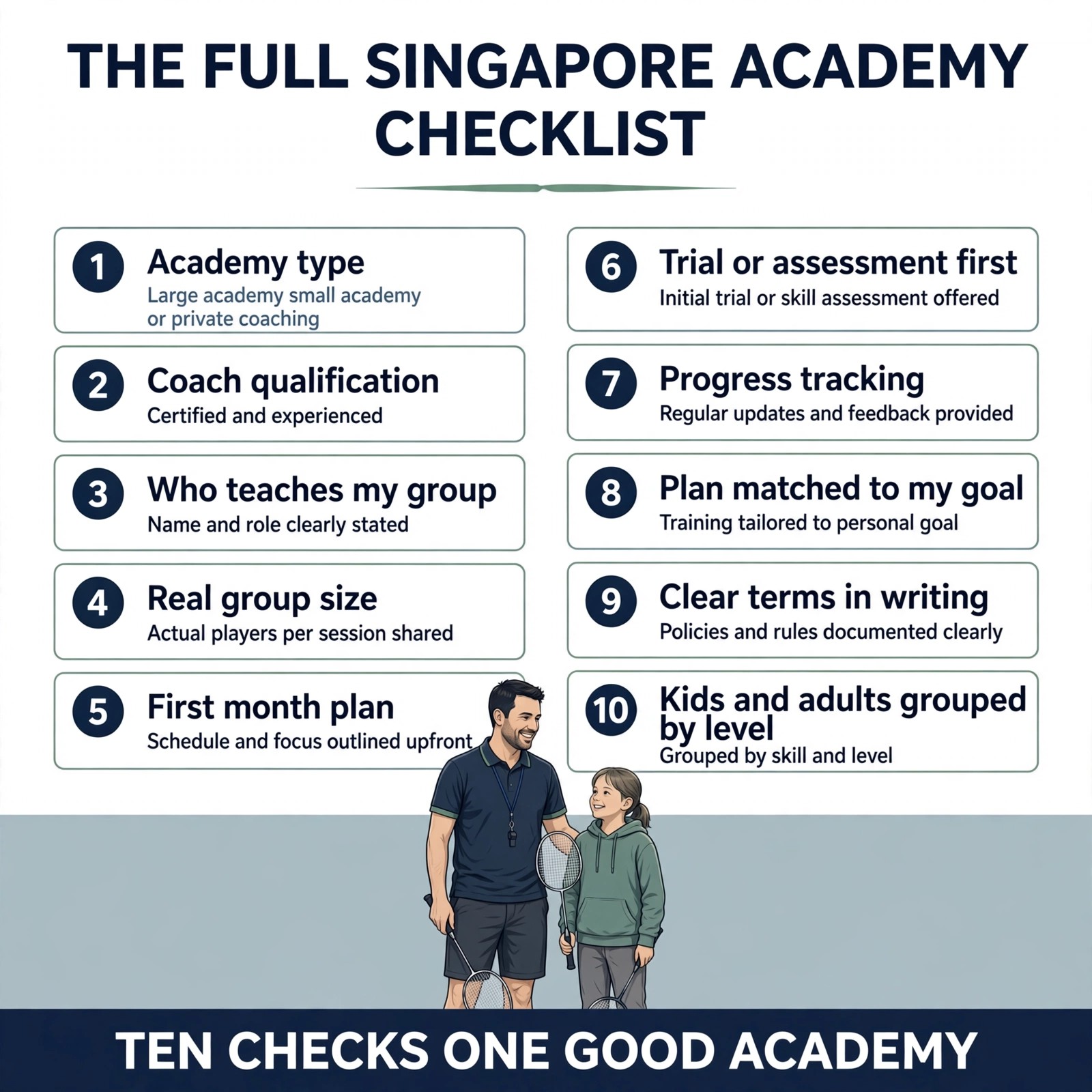
Compare by type and by the things that shape learning, not by names on a list. First, work out which type fits you: a large academy with many groups, a small academy where the head coach teaches, or private coaching for one stubborn problem. Then check the group size, who actually teaches your group, what the first month covers, and how progress is tracked. Visit once at the real class time and watch a full session. The checklist in this guide covers every point, and it works on any academy in Singapore.
Who is the best badminton coach in Singapore?
There is no official ranking for the best badminton coach in Singapore, so be careful of any list that claims there is. The best coach for you is the one who fits your goal, your level, and your schedule. Judge a coach by the teaching: a real coaching qualification, a clear plan for the first month, small groups where every student gets corrected, and students who improve steadily. Watch one session before you decide, and ask how long the coach has taught beginners at your level.
How much do badminton lessons cost in Singapore?
We do not publish prices in this guide, because prices change and they depend on group size, session length, venue, and what is included. Ask each academy directly for its full terms in writing, and compare like with like: how many students per coach, how long each session runs, what happens when a session is missed, and whether there is an assessment before you commit. A cheaper class with ten students and no feedback is not the same as a small group class with a plan. Judge value by the coaching you actually get, not by the lowest figure on a flyer.
When can a child start badminton?
A child can start when they can follow simple instructions, hold a light racket, and enjoy moving around a court for a full session. There is no single starting point that fits every child, and a good coach will tell you honestly whether your child is ready after watching them in an assessment. Look for readiness in plain signs: your child can listen to the coach, wait for a turn, and keep going when a drill is hard. If a coach pushes a very young child into hard drills before the child is ready, that is a warning sign.
Should my child take private or group lessons?
It depends on the goal. Group lessons give partners, games, and a social setting, and most children learn best with other children around them. Private lessons give full attention to one stubborn problem, such as a grip that will not change or a backhand that keeps failing. Many families mix both: a weekly group class for rallies and games, plus a private session when one shot needs fixing. At ST Badminton Academy, group classes are capped at four students, which sits between a big group and a private lesson.
How often should beginners practise badminton each week?
Two to three times a week is a sound rhythm for most beginners, with rest days between sessions. One session a week is enough to start, but progress will be slow. Every day is too much for a beginner, and tired players learn bad habits. Between lessons, short practice at home helps: grip checks, footwork steps, and short rallies when there is space. The coach should tell you what to practise between sessions, and the practice should be short enough that the player still enjoys it.
How long until improvement at badminton?
Most beginners show visible change within the first few months when they train two to three times a week: a cleaner grip, steadier footwork, a clear that reaches further back, and rallies that last longer. The first month sets the pattern, and the next few months build on it. Progress is not a straight line, and some weeks will feel flat. A good coach will point out the small gains, and will tell you honestly when a player needs more time on one skill before moving on. Be careful of any coach who promises a fixed result by a fixed date.
Do badminton academies in Singapore offer trial classes?
Some academies in Singapore run free trial classes, and some run a paid assessment first. A free trial can be useful if it is a real session with real coaching. Ask what the trial actually includes before you book one, and watch whether the coach teaches or spends the time talking about payment. ST Badminton Academy does not offer free trial classes. New students start with a paid Initial Assessment instead, where the coach watches how the student moves and holds the racket, then gives a plain plan for the next steps.
What makes Mr Eric Chuar a suitable coach for beginners?
Mr Eric Chuar has coached for more than 15 years in Singapore and Malaysia, and he still teaches the small groups himself at ST Badminton Academy in Setapak, Kuala Lumpur. He holds a valid National Coaching License, Lesen C (SLKK Tahap I), issued by the National Coaching Academy (AKK), plus a National Level 1 Badminton Coaching Certificate under SPKK, a Sport Science Level 1 qualification, and a BAM Level 1 coaching qualification. His groups are capped at four students, so every student gets individual correction. He teaches basics first, grip, footwork, then clear, and he tracks progress with regular feedback. Parents and adult beginners in Singapore can use the same standard to judge any badminton academy near them.
Good Coaching in Action in Singapore


What Good Coaching Looks Like at ST Badminton Academy
ST Badminton Academy is based in Setapak, Kuala Lumpur, and this guide uses our own standards as the yardstick for comparing any badminton academy in Singapore. These are the standards we hold ourselves to in every session, and the same standards parents and adult beginners can use to judge any academy.
| Factor | A Large Academy | Small Group Standard STBA |
|---|---|---|
| Coach Background | Many coaches on the floor. The head coach may rarely teach your group. | A qualified coach with a clear teaching record and 15+ years in Singapore and Malaysia. |
| First Session | Turn up and play games. No assessment, no plan for the first month. | An Initial Assessment first, then grip, footwork, and clear in a set order. |
| Group Size | Large groups. The coach barely watches each student. | Max 4 students. Coach Eric Chuar personally corrects every stroke and movement detail. |
| Progress Tracking | No record. You are told you are doing fine every week. | Regular feedback and a clear record of what improved and what to work on next. |
| Communication | Short answers. Parents hear little about how the student is doing. | Clear explanations after sessions, and video feedback that stays private. |
| Training Plan | Same drills every week for everyone, whatever the goal. | A plan matched to your goal: fun games, school team, or competitive training. |
| Long Term Result | A player who plays the same way year after year. | A player with clean basics, a clear next step, and steady gains over time. |
Compare Well, Then Train With Confidence
Before you commit to any badminton academy in Singapore, run three last checks. First, does the location and the trip fit your week at the real class time, without long travel or late nights? Second, can the coach explain things in words you and your child both understand? Third, are the terms clear in writing, with no pressure to pay for a long term before you have seen a single session? If an academy passes all the checks in this guide, it is worth a serious look. ST Badminton Academy in Setapak, Kuala Lumpur, welcomes parents and adult beginners who want to see good coaching before they commit, and the same standard will serve you well wherever in Singapore you train.


