How to Play Badminton With Quickness and Reflexes: Techniques and Drills (Reflexes Guide)
Some rallies are lost before your brain even joins in. A smash comes straight at your chest, a drive whistles past your hip, and by the time you have decided what to do, the shuttlecock is already on the floor. Players call that being slow, but it is rarely about slow legs. It is about reflexes, the answers your body gives before your mind has time to speak. The good news is that reflexes are not a gift you are born with or without. They are patterns your body has stored through practice, and patterns can be trained. This guide explains how reflexes really work on a badminton court, and the drills that build them.
Reflex Check #1
No Time to Think: What Reflexes Really Do on Court
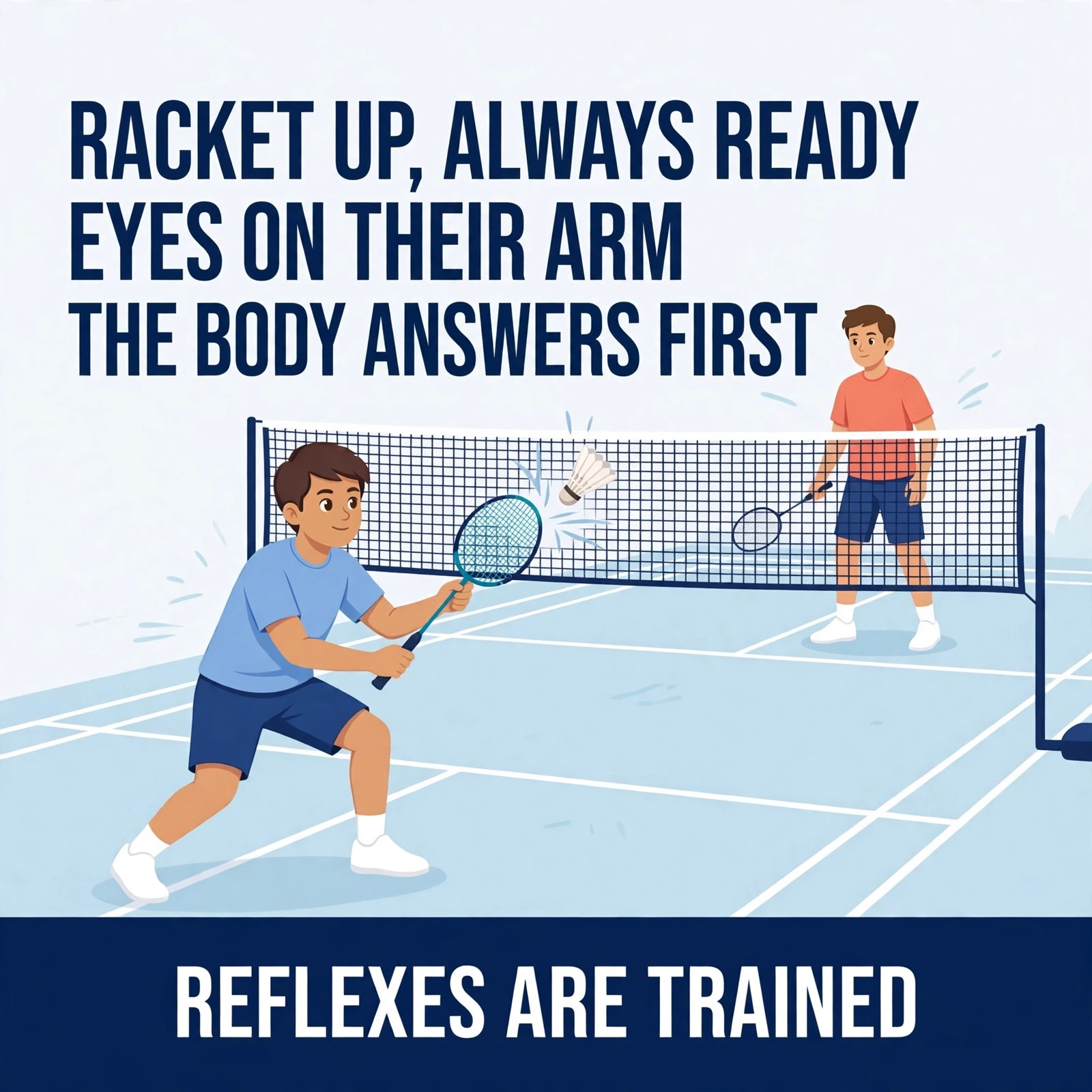
A reflex shot is a reply your body makes on its own. Your eyes pick up the shuttle, your brain matches it to a pattern it has seen before, and your arm moves, all before you have formed a single clear thought. Watch a strong defender and you will see how little thinking is involved. The racket is simply there, in front of the body, at the right angle, again and again. That is not magic. It is a stored pattern firing on its own, the same way you catch a falling cup without planning the catch. On court, these patterns cover the shots that arrive too fast for decisions: smashes at the body, drives at the hip, and quick pushes at the net.
Thinking is a fine tool, but it is a slow one. Every clear decision costs steps: see the shot, name the shot, choose a reply, then move. Against a hard smash from the back court, the shuttlecock reaches you in a fraction of a second, and those steps simply do not fit. This is why two players with the same leg speed can look worlds apart in defence. The calmer one is not thinking faster. Their body has stopped asking permission. Position helps more than people expect. A defender standing in the right place, racket up, gives the pattern an easy job. A defender caught leaning the wrong way has no pattern that can save the rally.

Reflex Check #2
Train Your Eyes First: Seeing the Shot Earlier
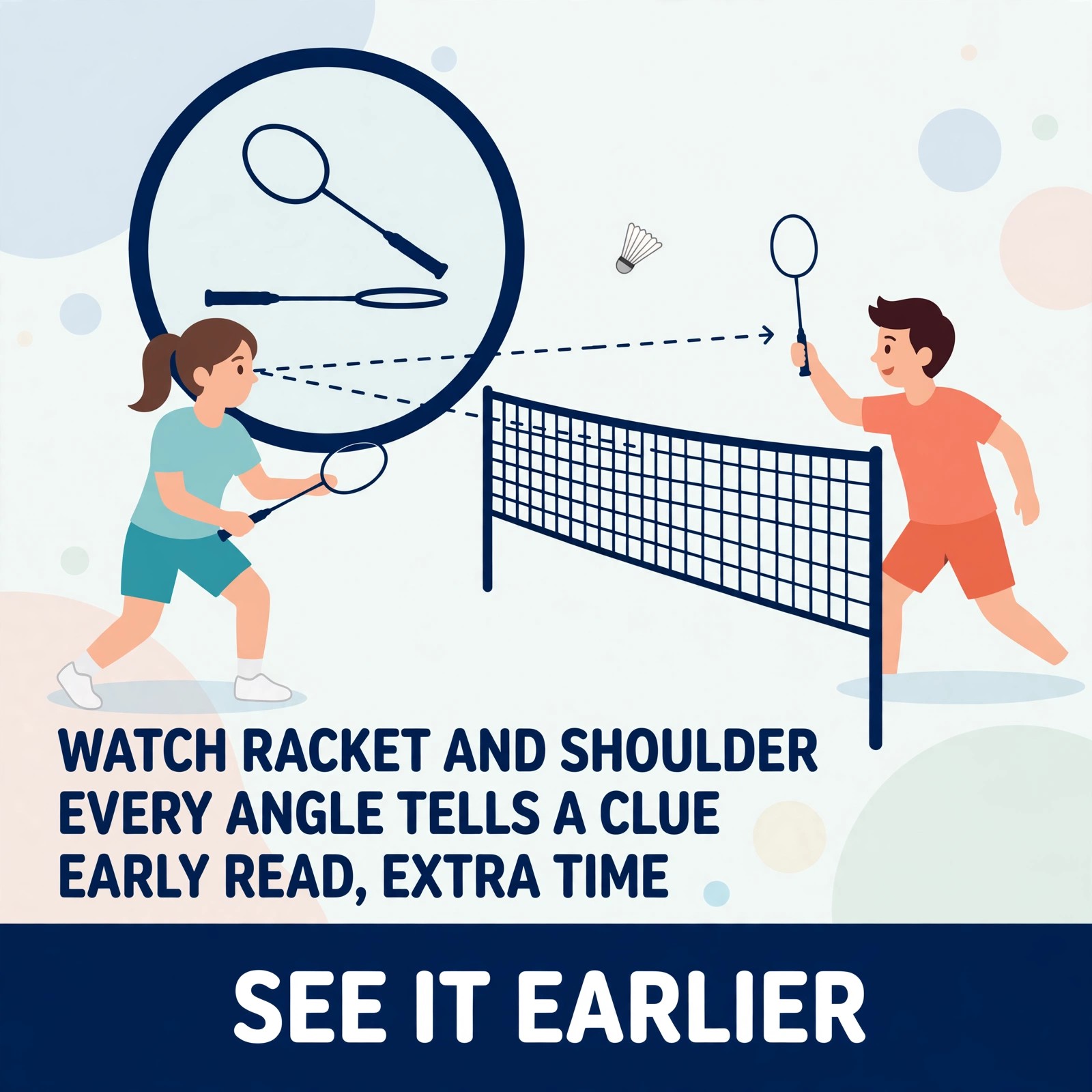
Every reflex starts with the eyes, and the eyes can be trained like anything else. Most club players watch only the shuttlecock, which means their information arrives late, at the moment of contact. Better defenders watch the opponent: the racket arm, the shoulder turn, the shape of the swing. A steep racket angle held high usually means a smash or a clear is coming. A flat, level swing at the front usually means a drive or a push. Reading those clues buys you the one thing reflexes need most, a head start. You are not reacting faster. You are reacting earlier, which feels exactly the same from the inside.
The simplest eye drill is shadowing. A partner hits shots around the court while you stand in your ready position and watch, without moving at all. Your only job is to call each shot early: smash, drop, clear, drive. At first the calls come late. Within a few sessions you will notice the calls arriving before the shuttle crosses the net, because your eyes have learned where to look. A step up from shadowing is tracing, where you copy the movement of each shot as it is played, still without a racket battle. Both drills feel almost too easy, but they build the reading skill that every fast reaction stands on.
Reading is also about habits. Every opponent has favourite shots: the cross court drop they trust, the backhand they avoid, the smash they hit only when the lift is short. The first few rallies of a match are free information. Spend them watching. Note which corner your opponent attacks when they are rushed, and which shot they play when the rally gets long. Later, your body can lean on those notes without any fresh thinking. When players say a defender seemed to know where the shuttle was going, this is usually why. The defender was not guessing. They had done their homework in the early rallies, and their patterns were ready.
Reflex Check #3
Block Defence: Turning Smashes Back Without a Swing
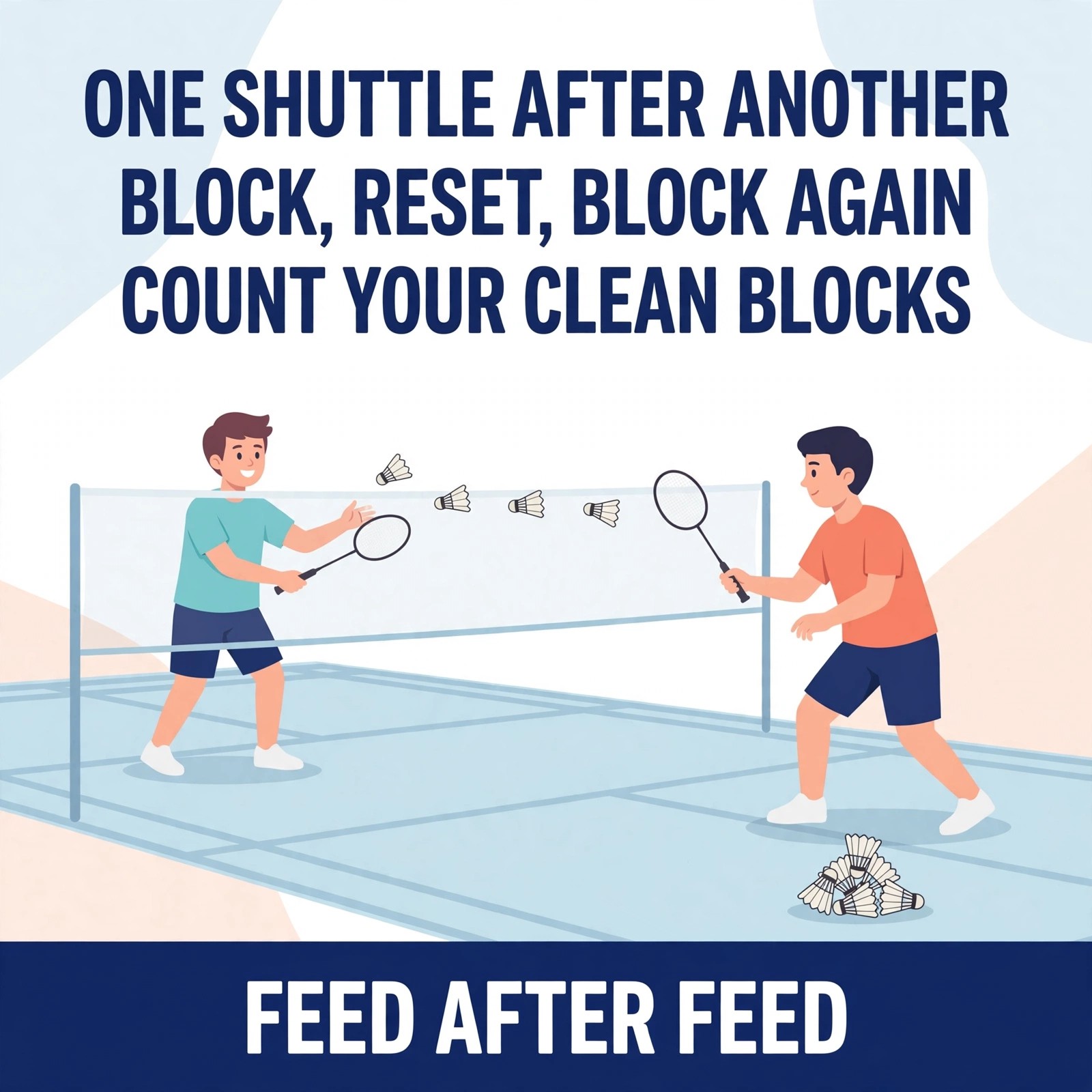
Block defence is the clearest reflex skill in badminton, and the most misunderstood. When a smash comes at you, the correct reply is usually not a swing at all. Hold the racket up in front of your body, keep it almost still, and let the pace of the smash do the work. The shuttle hits your strings and rebounds. Your job is only the angle: tip the racket face slightly down and the block drops softly over the net; flatten it and the block pushes back into mid court. A big swing ruins both options. It arrives late, it sprays the shuttle wide, and it leaves you in no shape for the next shot.
Your grip decides how the block behaves. Squeeze hard and the shuttle bounces off like a ball off a wall, flying long or floating up for an easy kill. Keep the grip soft and the strings absorb some of the pace, so the block dies gently near the net. This is why good defenders look so relaxed. Their hand is loose, their arm is quiet, and the racket face does the talking. Practise the feeling against gentle feeds first: partner taps smashes at half pace, you block with a still racket and a soft hand. When the blocks start dropping tight to the net, the grip pressure is right.
Where you stand matters as much as how you block. Defend from a balanced base around the middle of your half, low enough to move either way, with the racket in front rather than down by your side. Shots at the body are the hardest to read, so give yourself a small step of room and keep your non racket arm out for balance. After the block, the rally is not finished. A good attacker expects the block and moves in for the next shot, so your recovery starts the moment the shuttle leaves your strings. Block, reset, watch again. The defenders who survive long rallies are the ones whose second and third blocks are as tidy as their first.

Reflex Check #4
Drive Battles: Winning the Fast Flat Exchange
Drive battles are reflex rallies in their purest form. The shuttle travels flat and fast between two players standing close, at chest or hip height, and there is no time for swings, steps or plans. Winners of these exchanges share the same habits. They stand low with the racket held out in front, they use tiny movements of the forearm and fingers, and they switch between forehand and backhand without dragging the racket across their body. The moment a player takes a big back swing, the next drive is already past them. In a drive battle, the smallest swing wins, because it is the only swing that is ready twice in a row.
Aim gives you the edge once your hands are quick enough. Drives hit straight at the hip or the racket shoulder rush your opponent, because the shuttle arrives where their racket is not. A drive to the open side is easier to answer, since the racket is already travelling that way. Mix the two: one drive at the body to jam them, then the next into the space they lean away from. Keep the shuttle flat. A drive that climbs gives your opponent time and height, and time is the one thing a drive battle is supposed to remove. Flat, low and at the body is the recipe that makes opponents feel hurried even when they are not moving much.
You can practise drive battles in a small space with one partner. Stand on opposite sides of the net, around the service lines, and trade drives at a pace you can both handle. Count your clean returns in a row, then try to beat the count. Keep your feet under you and your racket in front, and stop the set the moment your swings start growing, because big swings practised here will follow you into matches. Two or three short sets in a session is plenty. Drive work is sharp work, and like all reflex training it belongs early in the session, while your eyes and hands are still fresh.

Reflex Check #5
Reflex Drills That Work: Feeds, Games and Pressure
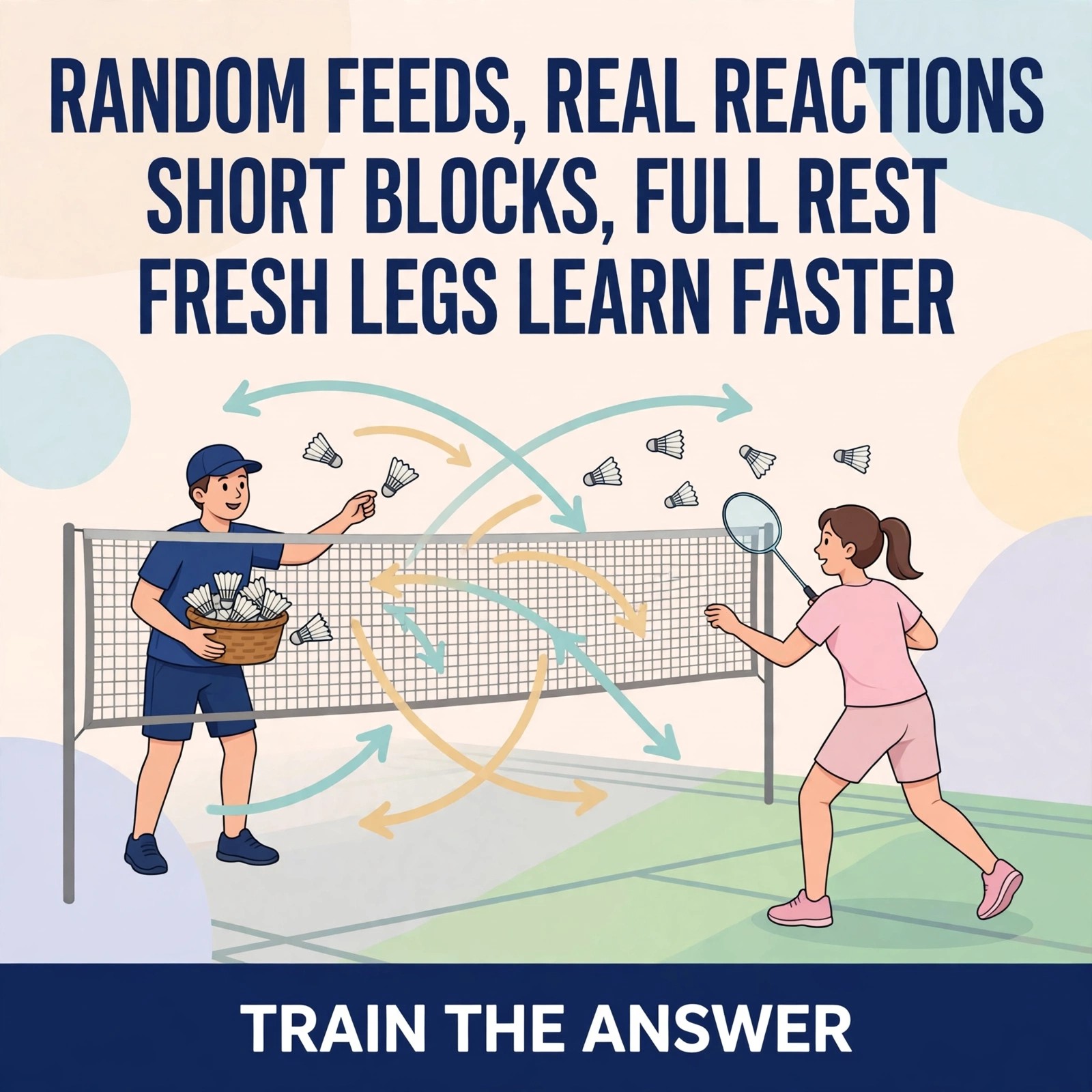
Reflexes grow when the body cannot guess what is coming. That is why random feeds are the heart of reflex training. A feeder at the net sends shuttlecocks to different spots in no fixed order: at the body, to the backhand hip, out to the forehand side, sometimes a soft one at the net. The defender does not know which is next, so the body must answer honestly. Fixed patterns have their place for technique, but a pattern you already know trains memory, not reaction. Keep the feeds honest and the speed fair. A feed you can sometimes reach builds reflexes. A feed nobody could reach just builds frustration.
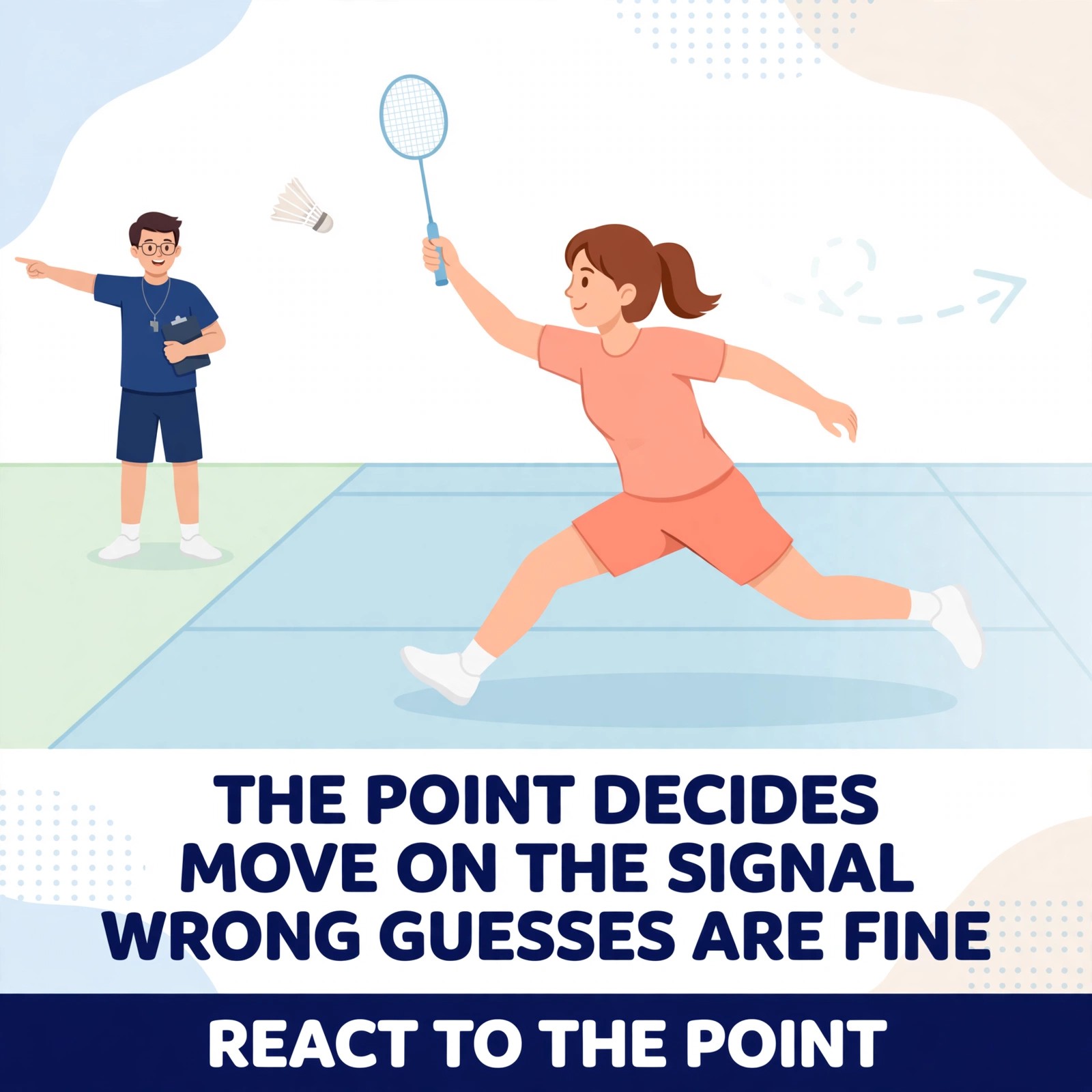
Games make the same work feel lighter, and for younger players they work better than formal drills. The pointing game is a favourite: a coach or partner suddenly points left or right, and the player lunges that way with the racket up. Wrong guesses are fine; the laugh is part of the learning. The back to back game from old footwork practice works too: stand in the middle, and on a call, turn fast to face the other way and get set. Side to side shuffles between two markers, done on a whistle, sharpen the first step that follows a reaction. Short, playful and competitive beats long and solemn for this kind of training.
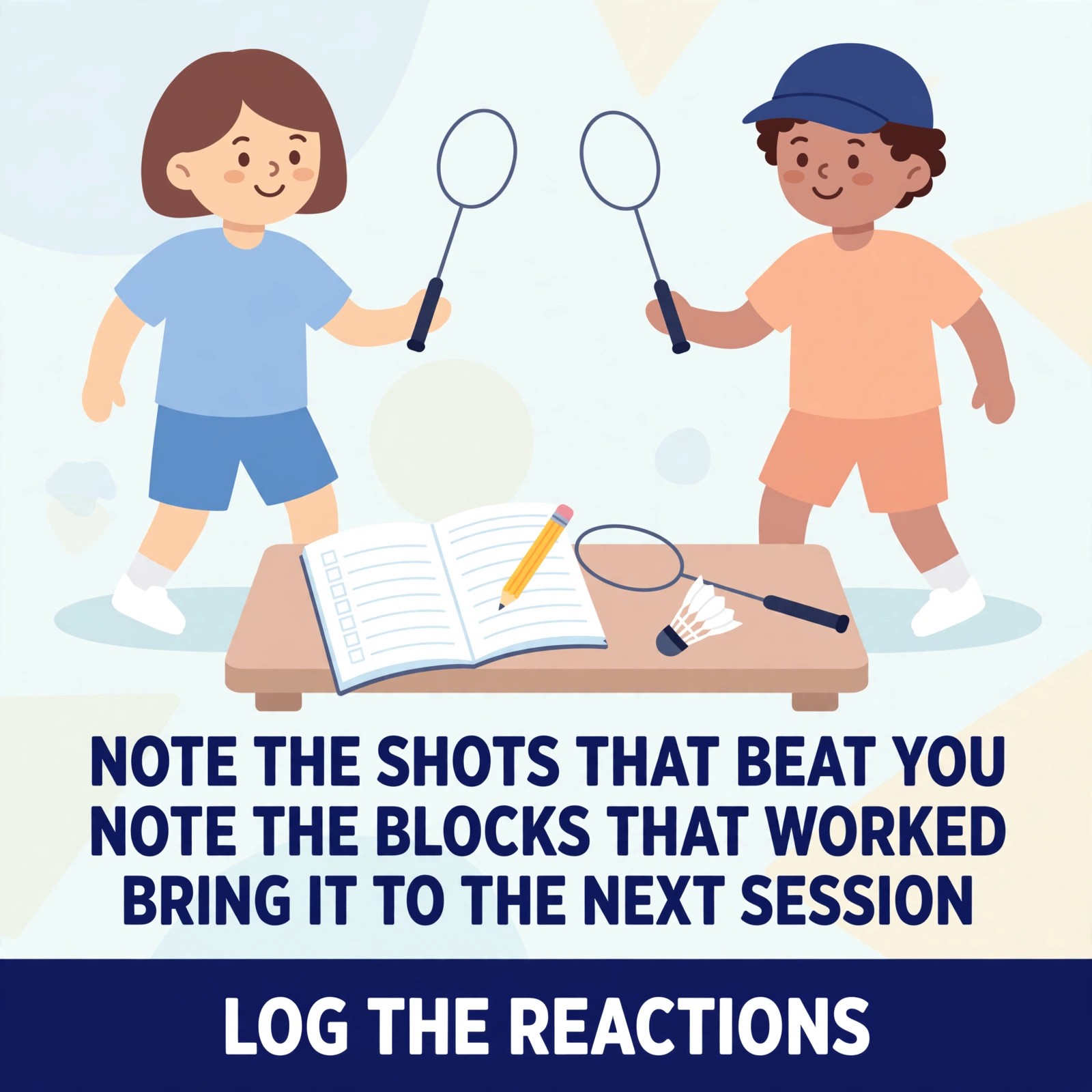
Be honest about how reflexes improve. They do not change in a day, and they do not change in a tired hour at the end of a hard session. The nervous system learns fastest when you are fresh, so reflex blocks belong near the start of training, in short sets of a few minutes with full rest between them. Measure progress simply: count clean blocks out of twenty feeds, or clean drive returns in a row, and write the number down. When the count climbs over the weeks, your reflexes are climbing with it. Slow, measurable and repeatable is not a boring promise. It is how reactions are actually built.
Myth vs Reality
Myths About Quickness and Reflexes
The most common myth says fast players are born fast, and the rest of us just have to accept it. It survives because professionals make reactions look natural, as if they arrived in the world that way. Watch the same professionals train and the truth shows: thousands of feeds, blocks and drive exchanges, repeated for years. What looks like a gift is a pattern library built the slow way. A club player will never need a library that size, but the first shelves are open to everyone. A few months of honest reflex work will not make you a professional. It will make smashes that used to beat you start coming back.
The second myth says the fastest hands always win. Raw hand speed matters, but it loses to position more often than players admit. A still racket held in the right place will return a smash that a fast racket, swung from the wrong place, never touches. This is why calm defenders beat frantic ones. They stand where the shuttle is likely to come, racket up, and let the game arrive at their strings. If your defence feels slow, check your starting position and your reading before you blame your hands. Very often the hands are fine. They were just asked to start from the wrong postcode.
The third myth says reflexes should be trained when you are tired, because matches are tiring. It sounds tough and sensible, and it teaches the wrong lessons. A tired body answers late, swings big and guesses early, and whatever the body practises is what it keeps. Tired reflex practice builds tired reflexes. Matches do get long, and fitness matters for the third game, but that is conditioning work, a separate job with separate drills. Keep reflex training short and fresh, and let the patterns you store be your best ones, not the sloppy versions you produce when your legs have gone.

Why Choose Us
Why Players Choose ST Badminton Academy
At ST Badminton Academy, reflex work is built into normal coaching rather than sold as a special talent programme. Classes are kept small, with a maximum of 4 students, so the coach can feed at the level each player can honestly handle: gentle feeds for a beginner learning the block, faster and wider feeds for the player whose defence is growing. Reaction games suit our junior classes, where the work feels like play. Adult players get the same drills with the pace set to challenge without swamping. Nobody is asked to keep up with feeds they cannot reach, because unreachable feeds teach nothing.
We are honest about what coaching can do here. No coach can give you the reactions of a world class defender, and we will not promise that. What we can do is build your patterns in the right order: eyes first, then the block, then drives, then random feeds that test everything together. Progress is measured on court, in clean blocks and calmer defence, not in speeches. Players usually feel the change first in one place: the smash that used to end the rally against them starts coming back, and the rally continues. That small change wins more club matches than any trick shot.
Sessions run in Kuala Lumpur, with our original base in Setapak and players joining us from around the Klang Valley. Reflex and defence work suits players of every level, from the beginner who freezes when a smash comes at them to the league player who wants a steadier backhand block. If you are not sure where your defence stands, a trial session is the easiest way to find out. The coach will feed, watch and tell you plainly what to build first. Bring your racket, court shoes and a bit of patience. Reflexes reward the players who keep showing up for the short, sharp work.
FAQs: Badminton Quickness, Reflexes and Reaction Training in Malaysia (KL)
Below are the questions players ask us most about quickness, reflexes and reaction training at ST Badminton Academy. If your question is not answered here, bring it to a trial session and ask the coach on court.
Are fast reflexes something you are born with, or can they be trained in Setapak or Gombak?
Partly both, but training matters far more than most players think. A few people do react naturally faster, yet almost everyone can sharpen their reactions a lot with the right drills. Reading the opponent earlier, holding the racket ready and practising blocks against honest feeds will make your defence feel quicker within weeks, whatever your starting point.
How do I train my eyes to pick up shots earlier in KL?
Watch the opponent, not only the shuttlecock. In training, use shadowing: a partner hits shots around the court while you stand ready and call each shot early, without moving. Your eyes learn to read the racket arm and shoulder shape. After a few sessions, your calls start arriving before the shuttle crosses the net.
Can older adults improve their reactions if they start at a beginner level?
Yes. Reactions slow a little with age, but reading and positioning improve with experience, and those two skills do most of the work in defence. Adult beginners at our classes start with gentle feeds and the basic block, then build speed gradually. Many find their defence becomes steadier than it was in their younger, wilder playing days.
My reactions feel slow against smashes. Should I train defence or footwork?
Start with the block. Defence against the smash is a position and a still racket before it is anything else, and it gives you clean returns straight away. Footwork matters next, because a good block from a bad position still leaves you stranded. Once your block is tidy, footwork drills will make the whole defence quicker and calmer.
How many minutes of reflex work should I add to normal classes?
A little goes a long way. Ten to fifteen minutes of focused reflex work inside a normal session is plenty for most players, as long as it is done fresh and with full rest between sets. Short blocks of random feeds, drive exchanges or reaction games, two or three times a week, will move your reactions forward steadily.
Do I need a training partner for reflex drills near Wangsa Maju?
A partner helps for feeds and drive battles, but plenty of reflex work is solo. Shadowing, wall returns at close range and the block shape practice in this guide need nobody else. At our classes near Wangsa Maju, coaches feed for you anyway, so you can train reactions properly even if you arrive on your own.
Where does ST Badminton Academy run reflex and reaction training in Malaysia?
Reflex and reaction work is part of our regular badminton coaching in Kuala Lumpur, based in Setapak, where ST Badminton Academy first started. Defence feeds, drive games and reaction drills are built into group and private sessions at the right level for each player. You do not need a separate special class to train your reflexes with us.
How do I book a trial session to test my reflexes?
The simple way is to book a trial session through our website or WhatsApp and tell us you want your defence tested. The coach will run some honest feeds at your level, watch your block and your reading, and tell you plainly what to work on first. No special gear is needed beyond your usual racket and court shoes.
What should I bring to my first reflex session for badminton?
Just your normal playing kit: your racket, proper court shoes with non marking soles, a change of shirt if you sweat a lot, and a water bottle. Everything else, including the shuttlecocks and the feeding, is provided at the session. If you wear glasses for sport, bring them; clear eyes are half of reaction training, after all.
Quickness and Reflexes Training in Action

One Standard for Every Session and Every Player
Every reflex session at ST Badminton Academy follows the same coaching standards. Feeds are matched to the player in front of the coach, never copied from a video of professionals. Sets stay short, rest is given in full, and no player is pushed through feeds they cannot reach just to look busy. When a drill stops producing clean reactions, we stop the drill and reset it. Coaches explain what each drill is building, in plain words, and they measure progress by what changes on court. These standards sound simple. Holding them every session is what makes the training work.
| Factor | Frozen Defence | Trained Reflexes REFLEX |
|---|---|---|
| Frequency | 1 or 2 times a week. Mostly for fun and sweat. | Racket up and still, eyes on the opponent, so the block is already waiting when the smash comes. |
| Drills Focus | Basic static feeding. Minimal footwork pressure. | Short random feeds and drive games that teach the body to answer before the mind catches up. |
| Physical Conditioning | Rarely included. Just playing games on court. | Core, agility, and speed training included in every session to prevent injury and build stamina. |
| Tactical Awareness | "Just hit it over." No real game plan. | Video analysis, point construction, and learning to read the opponent's game. |
| Coach Ratio | Large groups (8-10 kids). Coach barely watches you. | Max 4 students. Mr Eric Chuar personally corrects every stroke and movement detail. |
| Goal Setting | Fun and exercise. | Eyes trained to read the arm and racket early, buying the fraction of a second that matters. |
| Long Term Result | Good recreational player. | A defender who turns smashes into replies and stays calm when the rally speeds up. |
Badminton Reflex Coaching in Kuala Lumpur
Your defence does not need more panic. It needs better patterns. Come to ST Badminton Academy in Kuala Lumpur and train your eyes, your block and your drives in small classes where the feeds are set at your level. The smashes will still come. The difference is that more of them will start coming back.






