Badminton Vs. Tennis: Which Sport Is Right For You? (Comparison Guide)
Badminton and tennis sit in the same family and feel completely different to play. One is fought over a feather that cannot touch the floor, on a compact indoor court. The other uses a bouncing ball on a court more than twice as long, usually under the sky. If you are choosing where to spend your evenings and your energy, the honest answer is not that one sport is better. It is that one of them fits your body, your schedule and your idea of fun more closely. This guide compares them fairly, court by court and cost by cost, so you can choose with your eyes open.

Choice Check #1
Court and Space: The First Difference You Feel
Start with space. A badminton court is 13.4 metres long and 6.1 metres wide for doubles, and the whole game fits inside that rectangle, usually indoors in a hall. A tennis court is much bigger: nearly twice as long, and wider again, with run back space needed behind the baselines on top of that. That size difference decides a lot. Badminton halls are everywhere in Malaysian towns and cities, bookable by the hour, and a game is never rained off. Tennis needs a dedicated court, which usually means a club, a condo facility or a public court you travel to.
The smaller court changes the feel of the sport. In badminton you are always close to the action: every rally happens within a few steps, the net is right there, and doubles especially becomes a game of reactions at close range. In tennis the distances stretch out, rallies breathe more, and there is time to watch the ball travel before you commit. Neither is more athletic. They ask the same legs for different patterns, short and sharp in one, long and ranging in the other.

Choice Check #2
Equipment: Light and Fast, or Heavy and Solid
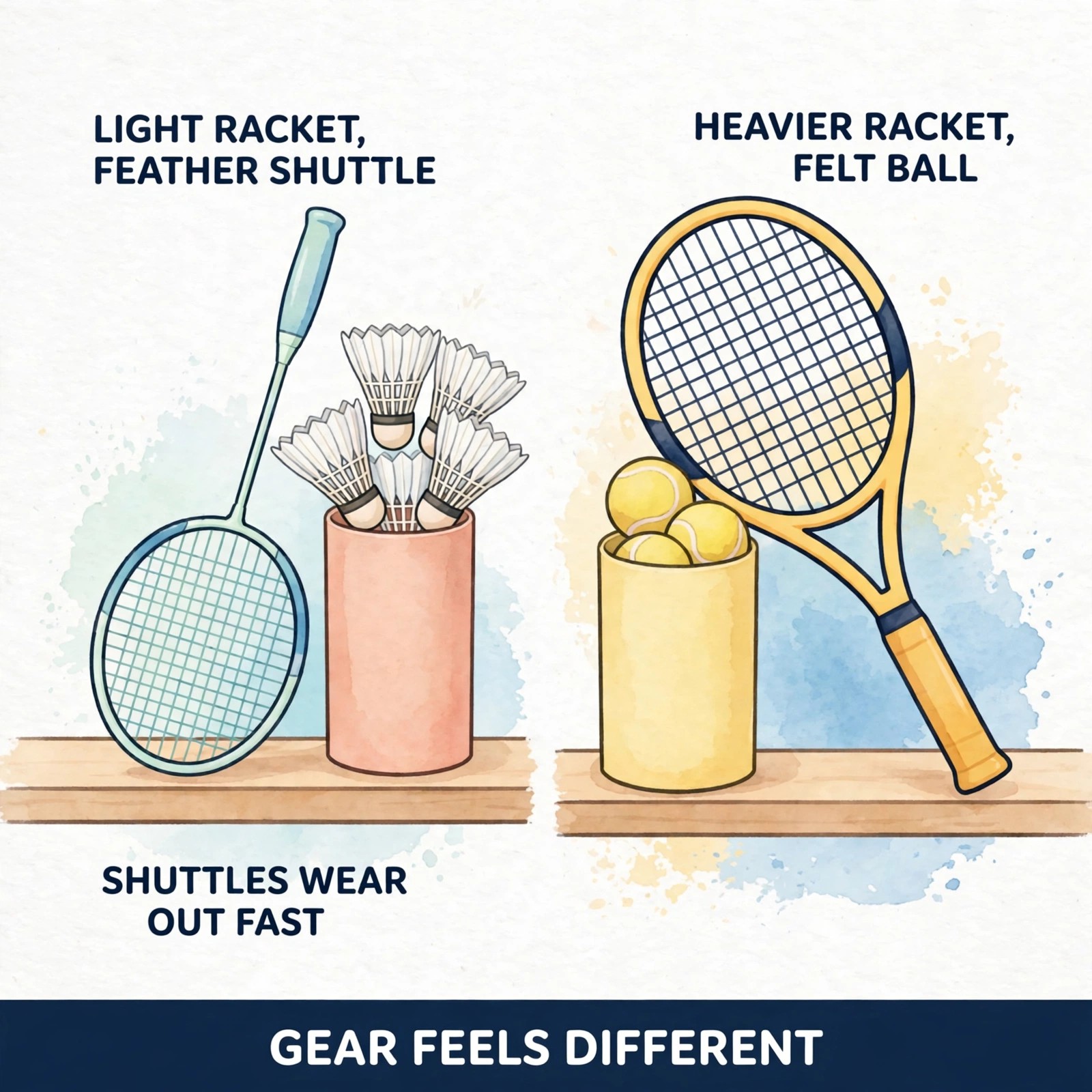
The gear looks similar from a distance and diverges fast up close. A badminton racket is a light tool, usually in the 75 to 89 gram classes, strung tight and swung mostly with the wrist and fingers. Its partner is the shuttlecock: sixteen feathers on a cork base for match play, which flies true and slows beautifully, but wears out as feathers break. A tennis racket is a far heavier frame built to drive a felt covered rubber ball, and the strings and frame ask for a fuller arm and shoulder swing.
That feather shuttle shapes badminton ongoing costs honestly. Feather shuttles are a consumable: a hard session can finish one or more, and regular players treat tubes of shuttles as a running cost of the sport, like petrol for a car. Nylon shuttles last far longer and soften that cost for training. Tennis balls are consumables too: they lose their bounce and felt over time and are replaced in cans, but a set of balls generally survives more sessions than a feather shuttle does. In both sports, court shoes matter, and in both, borrowing gear first is a perfectly sensible start.
Neither sport needs expensive gear to begin. A basic racket, court shoes and borrowed or shared consumables will carry your first months in either game, and both sports have a second hand market for rackets. Spend more only when you know you are staying, and spend it on the things you feel: shoes first, then the racket. Players in both sports waste money the same way, buying the famous model before they own the basic strokes it was built for.
Choice Check #3
Movement: Lunges and Bursts, or Long Running Lines
Badminton movement is a game of lunges, jumps and split second direction changes on a small floor. The furthest you ever run is a few metres, but you change direction constantly, brake hard, and explode out of deep lunges hundreds of times a night. Ankles, knees and the Achilles tendon do heavy work, and the shoulder repeats one of the fastest swings in sport. It feels like sprint intervals and fencing combined: short, sharp and very intense in bursts.
Tennis movement covers far more ground per rally. You run longer lines, chase balls into the corners, slide or brake on the surface, and reset over bigger distances, with points usually giving you a little more breathing room between them. The swing is heavier through the shoulder and trunk, and the one bounce rule gives you a fraction more time to arrive. Both sports reward fast feet and punish players who only run in straight lines. They simply draw different maps on the floor.
For fitness, both sports build strong legs, good lungs and quick reactions, and both can be played gently or ferociously depending on the group you join. Badminton doubles at social level can be surprisingly kind to a beginner body, because the court is small and partners share it. Tennis singles on a full court is a bigger early ask of the legs. Be honest about your current joints and fitness, and remember both sports let you start soft: social doubles, short sessions, and coaching that teaches movement before intensity.

Choice Check #4
Learning Curve: Quick First Rallies, Deep Mastery
Badminton usually gives a new player rallies sooner. The shuttle slows down as it flies, it cannot bounce away from you, and a gentle clear or net shot keeps the rally alive while you learn. Many first time players are having real rallies inside their first session, which is a powerful hook. The catch comes later: because the shuttle is so light, touch and timing decide everything at higher levels, and the softest shots in the game take the longest to master.
Tennis asks for more patience at the start. The ball bounces, so your timing has to meet it after the bounce, on the move, with a heavier racket, and the tennis serve, a tossed overhead action, is famously the hardest first skill in either sport. Early sessions can feel like fetching practice. Then the curve turns: once the basic groundstrokes hold, tennis opens into a deep game of spin, placement and construction. Both sports are easy to start at some level and take a lifetime to finish. They just front load the difficulty differently.
Coaching speeds up either choice. A few early lessons in badminton fix the grip and footwork habits that are painful to change later. In tennis, early lessons on the serve and groundstroke shape save the same trouble. If budget forces a choice between gear and lessons at the start, most coaches in both sports will quietly tell you lessons win. You can borrow a racket. You cannot borrow good habits.

Choice Check #5
Cost, Access and Social Fit: The Practical Choice
Cost honesty means counting the repeat costs, not the shop window. In badminton: hall hire shared by the group, feather shuttles eaten by hard sessions, and restringing now and then. In tennis: court hire, balls replaced as they die, and the same restringing story. Which total is smaller depends on your hall, your club and how often you play, and any guide giving you a universal winner is guessing. What can be said: badminton group sessions in shared halls are a well worn, budget friendly format in Malaysia, and tennis costs fall sharply if your condo or club court comes with your residence.
Access often decides before preference does. Badminton is played indoors, so Malaysian rain never cancels it, evening sessions are easy, and groups for every level run in halls across the Klang Valley. Tennis offers fresh air and space, and in return asks you to plan around weather, daylight or floodlights, and court availability. Social format matters too: badminton doubles is the default social game and mixes levels kindly, while tennis social play often needs four players of closer level to keep rallies alive. Pick the sport your week can actually hold.
The last test is the simplest: play both. Borrow a racket for each, join a social session of each, and notice which one you are still thinking about the next day. Notice also the people: a sport you play with a good group beats a theoretically better sport you play alone and irregularly. Many players keep both, one as the main sport and one as the occasional change. There is no rule that you must swear loyalty to a single court for life.

Myth vs Reality
Myths About Picking a Racket Sport
Myth: badminton is the easy option, a gentle garden game. Reality: at the top level, badminton smashes are among the fastest shots in any racket sport, and club badminton played properly is fast, physical and technical. It is beginner friendly at the door and demanding for a lifetime after that, which is exactly what a good sport should be.
Myth: tennis is always the harder and better sport. Reality: tennis front loads its difficulty into the serve and the bounce, while badminton hides its difficulty in touch, timing and speed of reaction. Harder depends on where you are standing. Both sports have humbled plenty of confident converts from the other side.
Myth: you must choose one racket sport for life. Reality: the footwork, hand and eye timing and court sense you build in one sport transfer to the other, and many social players keep both going for years. Choosing your main sport for this season is a practical decision, not a marriage.

Why Choose Us
Why Players Choose ST Badminton Academy
We don’t just feed shuttles; we help new players make an honest start. At ST Badminton Academy we are a badminton academy, so our answer has a home team, but we would rather you choose badminton because it fits you than because a sales pitch pushed you. Try a session and judge the sport on your own feet.
Our small group policy, with a maximum of four students, means a trial session shows you the real sport: proper rallies, coached footwork and honest feedback on how your body handles the lunges and bursts. That is a fair test no brochure can give you.
We focus on long term development, and that starts with the right sport for the right person. If badminton is your fit, we will coach you properly for years. If tennis turns out to be your fit, we will shake your hand and wish you good rallies.
FAQs: Badminton or Tennis, Courts, Gear and Starting Out in Malaysia (KL)
Here are the questions new players ask us most when they are choosing between badminton and tennis.
Can a complete beginner start either sport in Setapak or Gombak?
Yes, both are genuinely beginner friendly, in different ways. Badminton usually gives you rallies in your first session because the shuttle floats and cannot bounce away. Tennis asks more patience with the bounce and the serve. Start with social groups in either sport, borrow gear, and let coaching set your first habits.
What is the first thing to try when choosing in KL?
Try one real session of each, with the same honest effort, and notice three things: how your body feels the next day, which game you keep thinking about, and which group of people you would happily see every week. The sport that wins those three tests is your sport for now.
Why do my tennis friends say badminton looks easy at club level?
Because the shuttle slows down in flight and waits for you, while a tennis ball keeps coming after the bounce. Badminton first rallies are kind. Your friends may change their tune after a proper session though: at full pace, badminton is one of the fastest and most physical racket sports there is.
I can only play once a week. Should I pick by the game itself or by the group I play with?
Pick the one your week can hold and your friends actually play. A sport played once a week with a regular group beats a perfect sport you reach once a month. If both are equal on access, choose the game itself: badminton for fast indoor rallies, tennis for space and open air.
How can I try both sports before buying any gear?
Borrow first. Most clubs and academies can lend or rent a racket for a trial, friends often have a spare, and court shoes you already own for indoor sport will do for a first badminton session. Play a few sessions in each sport before any real money leaves your pocket.
Do you coach racket sport beginners near Wangsa Maju?
Yes. The academy runs coaching across Kuala Lumpur, with our original base in Setapak and sessions serving players from Wangsa Maju and the wider Klang Valley. First sessions are coached kindly: grip, footwork and real rallies in regular sessions in groups of four, so you can judge the sport fairly.
Where does ST Badminton Academy coach badminton in Malaysia?
The academy coaches in Kuala Lumpur, with our original base in Setapak and players joining from across the Klang Valley. Sessions run for kids, teens and adults in groups capped at four students, and beginners are welcome to test the sport properly before committing to regular training.
How do I book a trial session to test badminton in training?
Send us a message and tell us you are choosing between the two sports. We will arrange a trial in a group of no more than four students, and a coach will give you real rallies, honest footwork and a fair feel of badminton at proper pace. No hard sell. You play, we coach, then you decide.
What makes Mr Eric Chuar a suitable coach for new racket sport players in badminton?
Mr Eric Chuar coaches the academy sessions himself and gives new players the honest comparison this guide sets out. He works with juniors and adults in Kuala Lumpur, keeps groups at four students or fewer, and will tell you plainly if your body or your schedule suits a different sport better.
Badminton Coaching and First Sessions in Action


One Standard for Every Session and Every Player
These standards hold for every session and every player: honest comparison instead of sales talk, real rallies in trial sessions, and coaching in groups of no more than four students. If badminton is not the right fit for you, we will say so plainly and point you the other way.
| Factor | Choosing by Hype | Choosing by Fit CHOICE |
|---|---|---|
| Frequency | 1 or 2 times a week. Mostly for fun and sweat. | Both sports are tried for a real session each, so the body reports on the movement, not the advert. |
| Drills Focus | Basic static feeding. Minimal footwork pressure. | Gear starts simple and borrowed where possible, and money is spent only after the choice settles. |
| Physical Conditioning | Rarely included. Just playing games on court. | Core, agility, and speed training included in every session to prevent injury and build stamina. |
| Tactical Awareness | "Just hit it over." No real game plan. | Video analysis, point construction, and learning to read the opponent's game. |
| Coach Ratio | Large groups (8-10 kids). Coach barely watches you. | Max 4 students. Mr Eric Chuar personally corrects every stroke and movement detail. |
| Goal Setting | Fun and exercise. | Access is counted honestly: hall or court distance, weather, session times and the friends who will actually play. |
| Long Term Result | Good recreational player. | A player who chooses by fit: still playing happily a year later, in the sport that suits their body and their week. |
Badminton Coaching in Kuala Lumpur
This comparison gives you the honest order of the choice: the courts and the space, the gear and its repeat costs, the movement your body will do, the learning curve you will climb, and the access your week allows. If badminton sounds like your fit, bring that curiosity to a trial session and we will give you the real sport to judge, rallies and all.