How To Play Badminton With Power And Precision: Techniques And Drills (Drills Guide)
Ask players what they want and most give the same answer: a harder smash and shots that land where they aim. Ask how they practise and the answer gets vague: some hitting, some games, maybe a few smashes at the end. Power and precision do not grow from vague practice. They grow from drills: short, repeated exercises where one skill is isolated, fed properly, aimed at something visible, and counted honestly. This guide is the practice side of playing with power and precision. It covers the feeding drills that build real smash power, the target work that makes placement measurable, a circuit that trains both skills together, feeds that add footwork, and a weekly structure that keeps the whole thing progressing. The drills are simple. What makes them work is how they are run: one clear job per drill, quality before quantity, and a stop point that protects your shape.

Drill Check #1
Feed and Finish: Smash Feeding That Builds Real Power
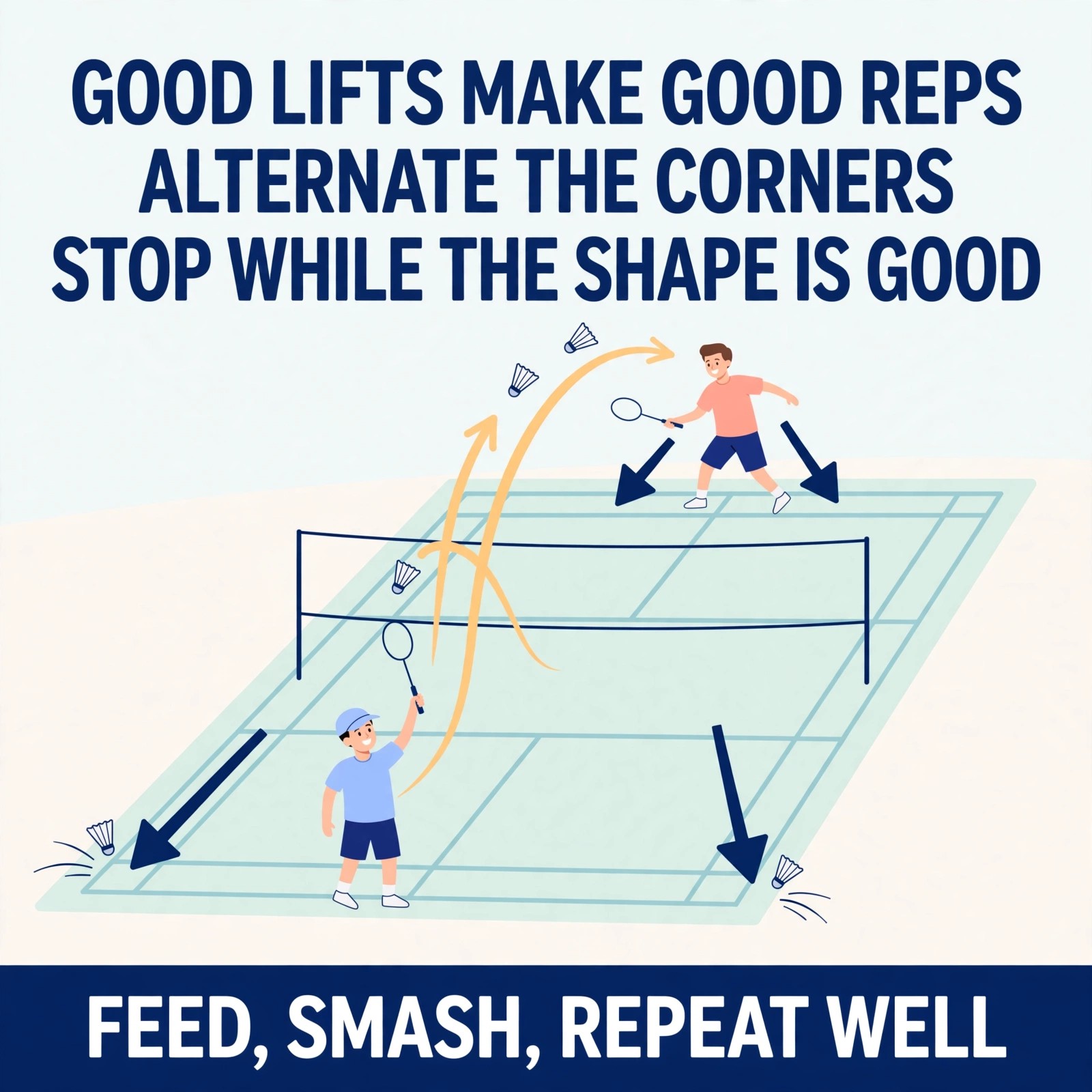
Smash feeding is the oldest power drill in badminton, and it still works because it matches how power is really built: repetition of a correct shape under gradually rising demand. The feeder stands near the net and lifts shuttlecocks high to the back court, one after another, at a pace the hitter can handle. The hitter smashes each lift and recovers. Two things decide whether the drill teaches power or teaches sloppiness. The first is feed quality: lifts that are too low, too fast or drifting wide force the hitter to reach and twist, and every bad lift practises a bad shape. A good feeder is doing skilled work, not just tossing shuttles. The second is honesty about pace. Feeds should arrive just fast enough to keep the hitter sharp, never so fast that the swing falls apart.
Run smash feeding in short sets with a shape rule. A set might be a small basket of lifts, hit to alternating corners: one smash straight, one cross court, so the feet and the aim both work. Between sets, rest properly. Power is a fresh muscle skill; the nervous system learns the fast, clean pattern when you are rested, and learns a slow, forced pattern when you are tired. The stop rule matters most: when the contact point drops, the body stops turning, or the landing starts to stagger, the set is over, whatever the plan said. Finishing a set with five ugly smashes teaches your body that ugly is acceptable. Stopping with shape intact teaches it to chase the good one. Over weeks, the feeder can lift a little deeper and the hitter can swing a little harder, and the power arrives as a by product of all those clean repetitions.
Drill Check #2
Targets on the Floor: Precision Feeding Circuits
Precision cannot be practised in the abstract. You need something on the floor that tells the truth. Targets turn placement from a feeling into a fact: the shuttle either landed in the ring or it did not. Use what the hall offers. Tape makes squares and lines on the floor. Shuttle tubes stand as posts to hit past or land beside. Flat rings and hoops mark landing zones in corners. Set the target before the drill starts, feed at a kind pace, and let the player place shot after shot while someone counts the hits out loud. The count is the magic ingredient. Players who would drift through twenty loose feeds suddenly concentrate when every landing is scored, and concentration is exactly the state in which precision grows.
Good target work progresses in three directions. First, shrink the target: a big square in the back corner becomes a smaller one as the hits climb. Second, move the target: corners first, then the tramlines, then the awkward patches just behind the front service line where drop shots live. Third, raise the feed quality against the hitter: slower feeds at first, then feeds that arrive from different heights and speeds, closer to a real rally. Change one direction at a time. A drill where the target shrinks, moves and speeds up all at once collapses into frustration, and frustration practises nothing. Keep a simple tally for each target size, written down after the session. When last month target becomes this month warm up, you are looking at precision you can prove.
Every shot family deserves its own target work. Serves are the easiest to start: targets inside the service box, low feeds from your own hand, instant feedback on every attempt. Net shots use a target hugging the tape on the far side, fed softly from close range, with the emphasis on the shuttle tumbling and dropping rather than floating. Clears and drops use the back corners, where depth is the whole game and the back line judges you kindly or cruelly. Even smashes benefit: a target deep in the corner teaches the hitter that the fastest smash is worthless if it sails wide, and that a slightly slower one placed at the hip or into the gap wins the same point with margin to spare. Precision is not one skill. It is the same habit of aiming, practised inside every shot you own.

Drill Check #3
Power Plus Placement: The Two Shuttle Circuit
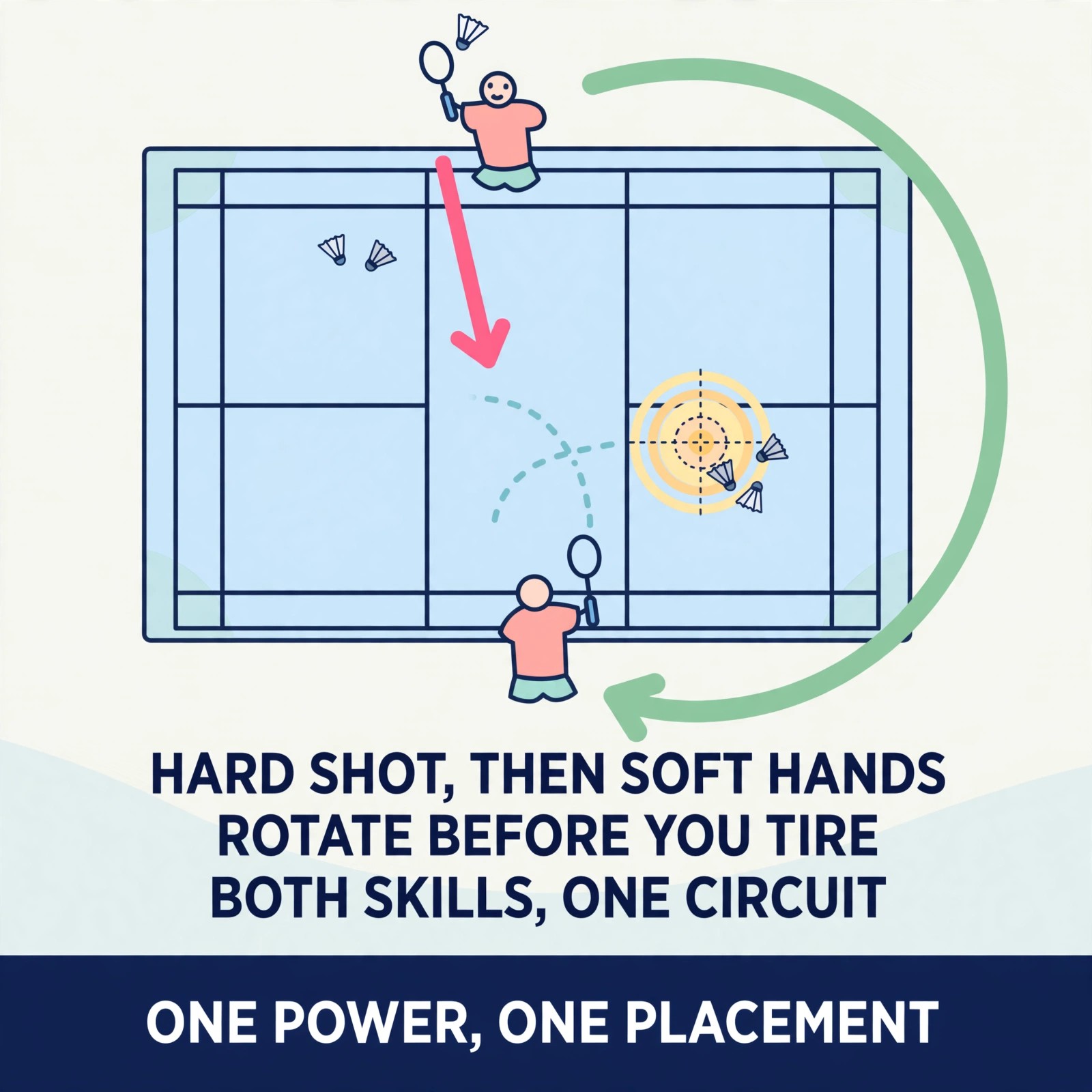
Power and placement are usually trained apart: a feeding block for smashes, a target block for soft shots. Matches do not respect that separation. In a rally, a full blooded smash is followed two shots later by a delicate net shot, and the player whose hands stay soft after swinging hard has a real edge. The two shuttle circuit trains exactly that switch. The setup is simple. At one end of the court, a feeder lifts for smashes at the back. At the other end, or in the next rotation, a second feed arrives soft at the net for a placement shot at a floor target. The player alternates: power rep, placement rep, power rep, placement rep, moving between the two stations with a short rest built into the walk.
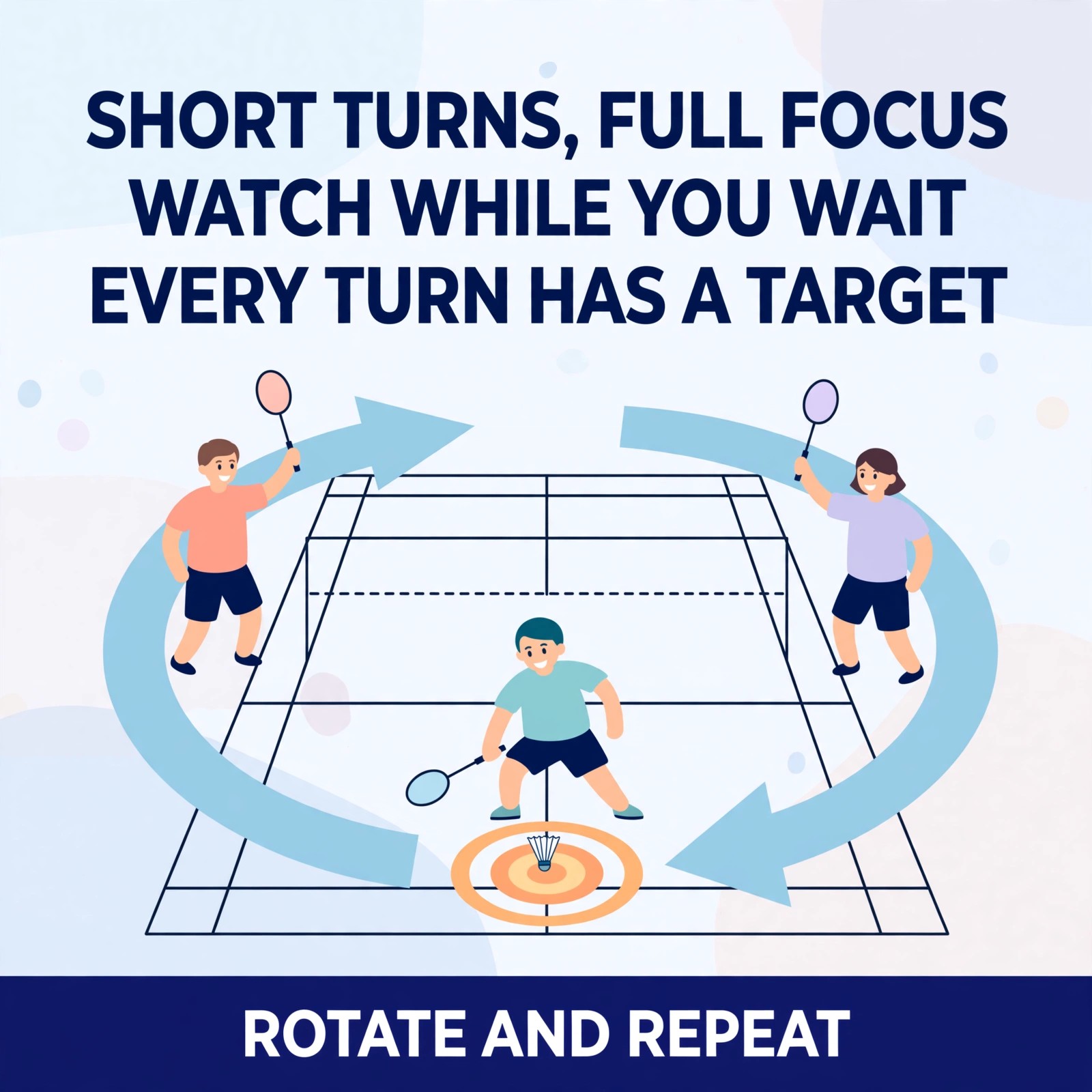
Rotation is what makes the circuit sustainable. With three or four players, one feeds high, one feeds soft, one or two hit, and everyone rotates every few minutes. Nobody feeds for half an hour, nobody hits until their shoulder begs, and the watching players get something underrated: a coach eye view of other people shapes, which quietly teaches them what their own good and bad reps look like. Keep the hitting turns short. The circuit fails when it becomes an endurance event, because tired arms cannot switch to soft hands; they can only swing slower, which is a different and worse skill. Fresh, alert rotations are the design. If players leave the circuit breathing hard but swinging clean, it is set up right.
What the circuit teaches shows up in matches within weeks. The smash stops being a full stop. Players recover from it expecting a block, because in the circuit a placement shot always followed. The net shot stops being a panic poke after a hard rally, because soft hands after hard swings have been rehearsed a hundred times. And shot selection sharpens on its own: a player who alternates power and placement every thirty seconds starts doing it naturally in rallies, mixing pace without being told. That mixing is what opponents describe as unpredictable, and it was not talent. It was a circuit, run patiently, with two feeders, some targets, and a stopwatch nobody worshipped.
Drill Check #4
Footwork Feeds: Power From a Balanced Base
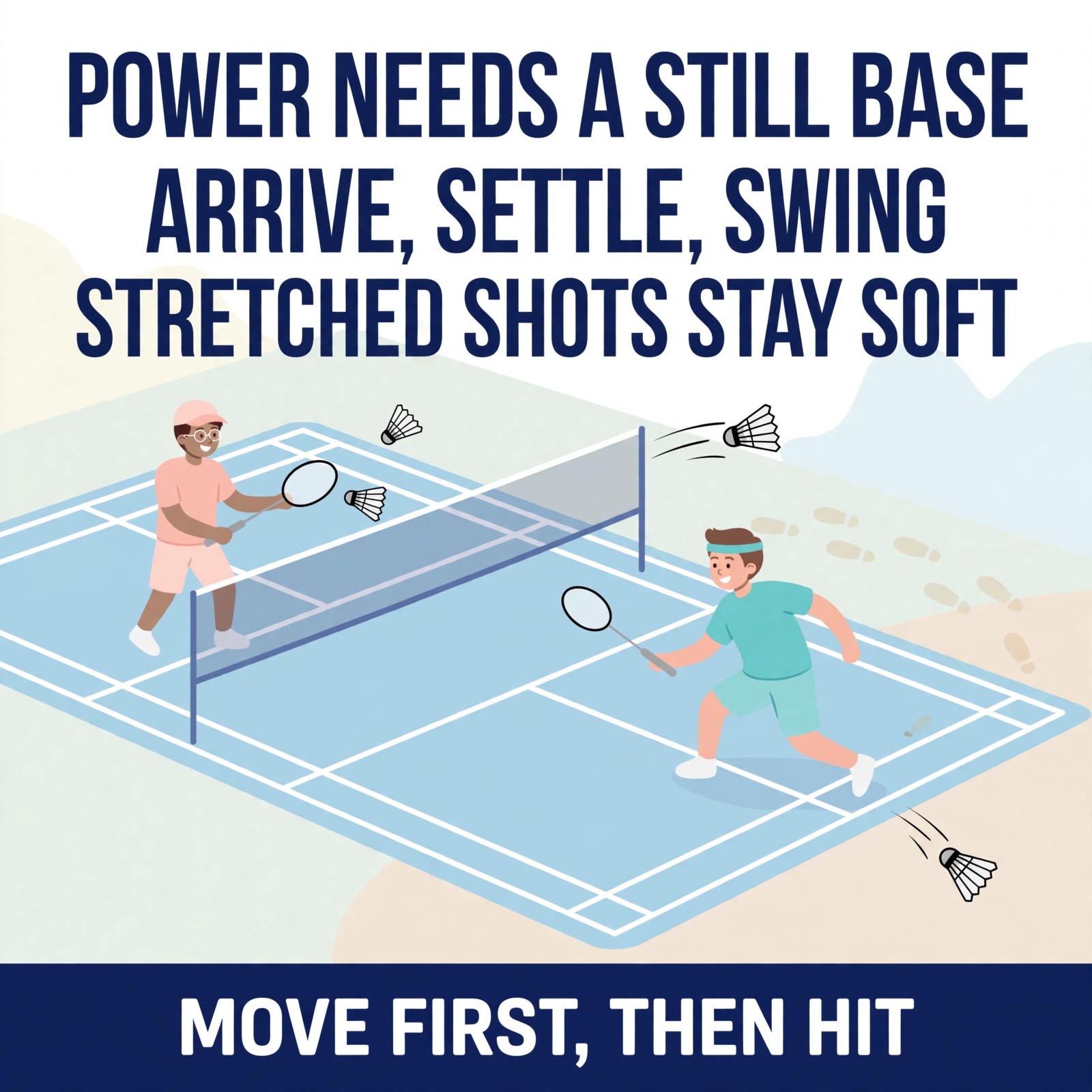
Standing still while someone feeds you perfect lifts is a fine way to learn a swing, and a poor way to prepare for a match. In matches, every powerful shot starts with travel: you arrive at the back court moving, often backwards, and the quality of the smash depends on what your feet did in the second before contact. Footwork feeds add that travel back in. The feeder sends shuttlecocks to alternating areas: deep to the forehand corner, deep to the backhand side, then perhaps a shorter one that pulls the hitter forward. The hitter must move, arrive, and only then swing. Early on, the feeds are kind and the corners predictable. Later, the order shuffles, and the hitter has to read as well as move.
The lesson these feeds teach is physical honesty. Power comes from a balanced base: feet planted, knees soft, body turned, weight able to drive through the shot. When a feed forces a player to arrive stretched, leaning, or still travelling, the correct answer is not a heroic smash. It is a placement shot: a clear with height, a drop that buys recovery time. Footwork feeds train that decision with the body, not the brain. Players feel in their legs why the smash was wrong, and the memory sticks in a way lectures never achieve. Coaches watch the arrival more than the hit. A player who arrives balanced nine times out of ten is ready for faster feeds. A player who arrives in a tangle needs the pace dropped, whatever their arm can do.
The recovery is part of the repetition, and good feeds insist on it. After every shot, the hitter returns toward base before the next feed comes. This feels slow at first and players beg to skip it, especially when the feed is flowing and the hitting feels good. Resist that. A drill where the hitter camps at the back smashing feed after feed is training a player to admire their own shots. Matches punish admiration instantly. Build the recovery into the count: a repetition only scores if the shot was played from a balanced arrival and the player was back near base when the next feed arrived. It is a stricter drill, a slower drill, and the one that transfers. When players complain it feels like a real rally, the drill is finally doing its job.
Drill Check #5
A Weekly Plan: Progressions That Keep Power Honest
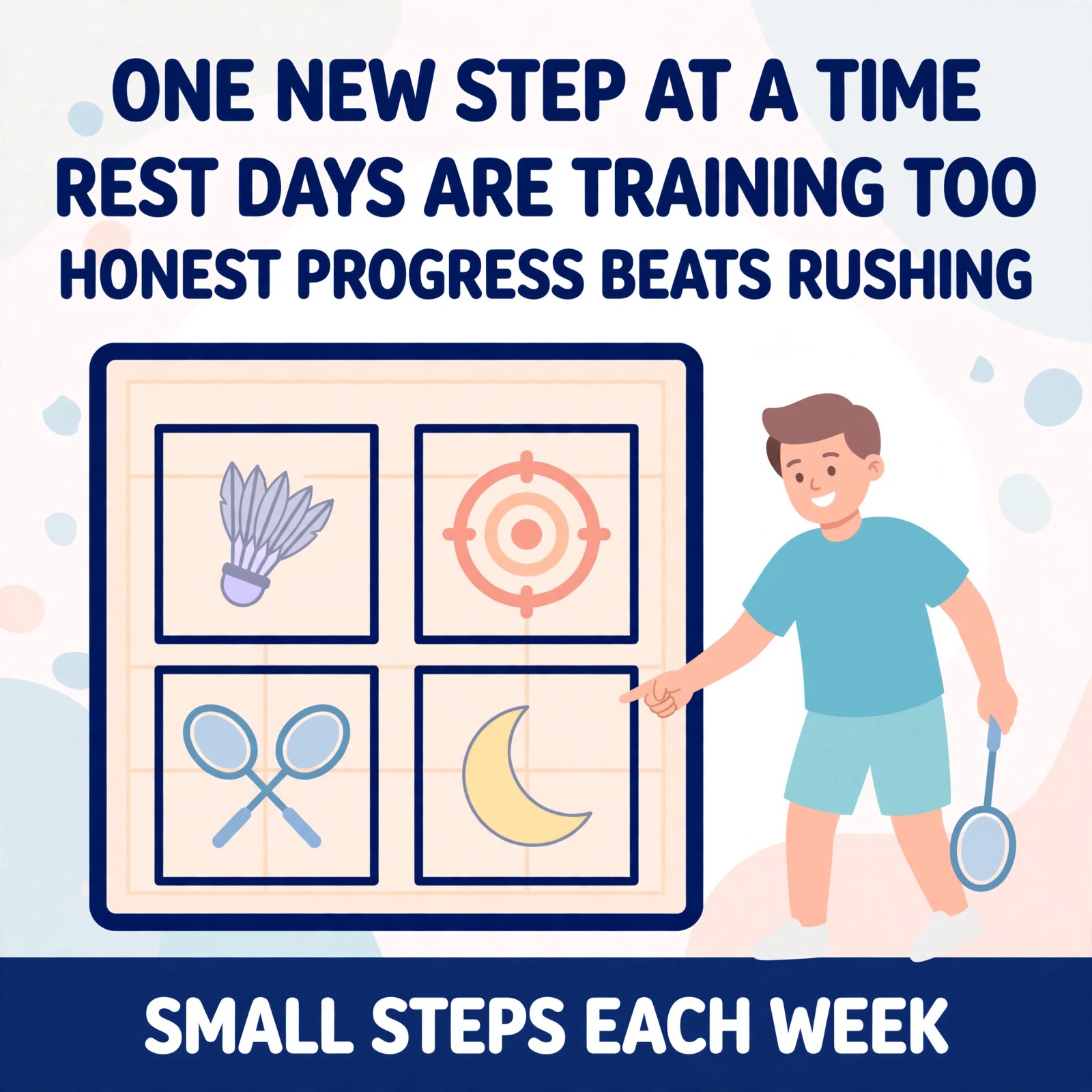
A workable week for a club player balances three ingredients: drill sessions, games, and rest. Two drill sessions give the skills their repetitions. Games, whether social or competitive, test whether the drilled patterns survive contact with an opponent who did not read the plan. Rest days are when the learning physically settles; muscles repair, and timing patterns consolidate. A week with no rest is not dedication, it is debt. Inside a drill session, order matters too. Start with placement while the mind is fresh and the hands are calm, because precision is a concentration skill. Move to power feeding next, while the legs are still springy. Finish with the circuit or conditioned games, and stop the session while some quality remains rather than draining the last tired minutes.
Progression is the art of making this week slightly harder than last week in exactly one way. Raise the feed pace, or deepen the lifts, or shrink a target, or add a corner to the footwork feed, or lengthen a set by a few reps. One change, held for a week or two, lets the body adapt and the counts prove whether the step was earned. The classic mistake is stacking changes: new drill, faster feed, smaller target, longer sets, all on the same brave Monday. Everything collapses together, the player cannot tell which change hurt, and confidence takes the blame that planning deserved. Slow progression feels almost too easy week to week. Then a month passes, the old warm up drill is now the main set, and the player realises the staircase was moving the whole time.
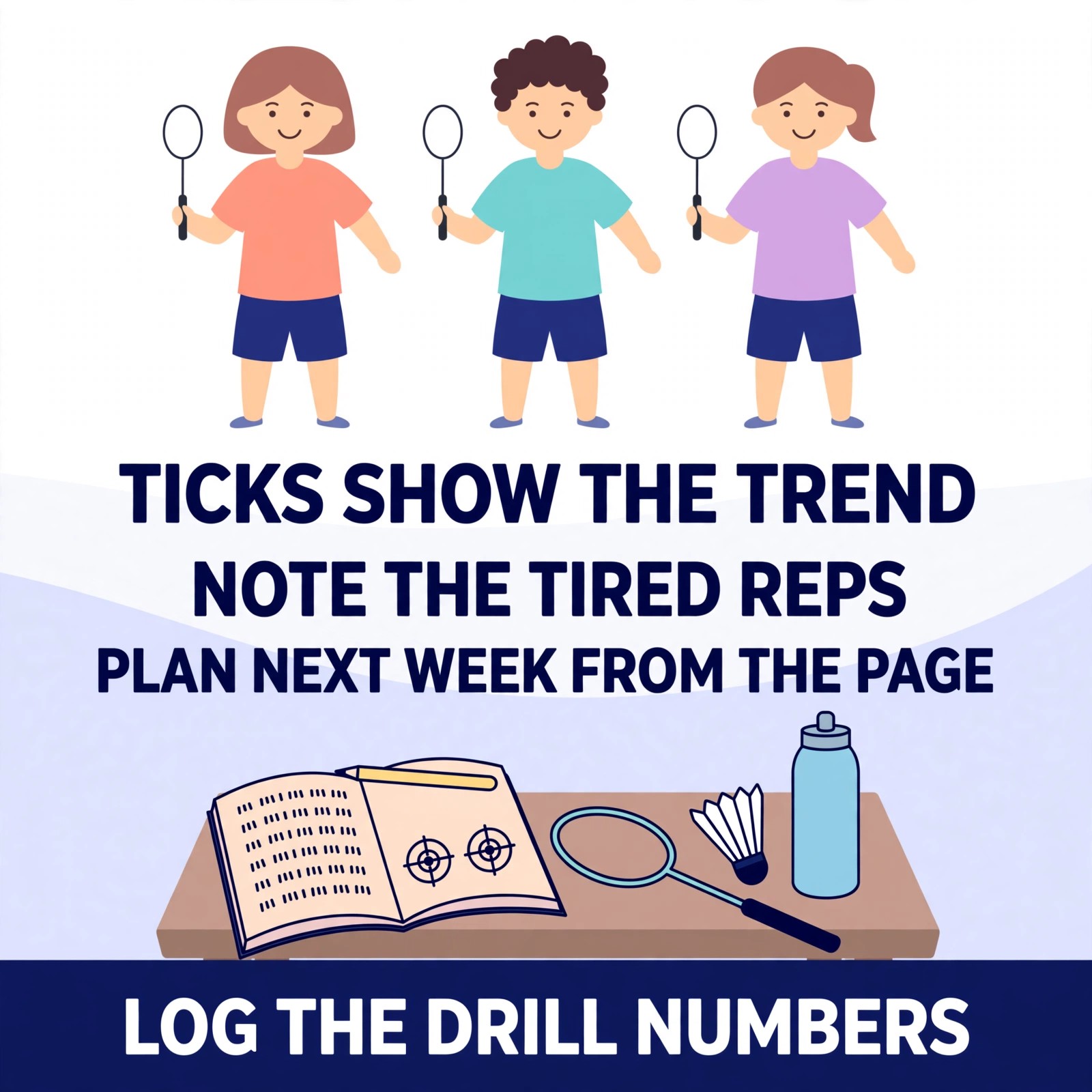
Keep a drill log, and keep it plain. Date, drill, target size or feed type, hits out of attempts, and one honest line about shape: what broke down first when you tired. The log does three jobs. It proves progress on the flat weeks when improvement is real but invisible. It catches problems early, like accuracy that falls off a cliff in the third set, which is a fitness note, not a technique note. And it plans the next week for you: the numbers say which progression step is ready and which needs another week of patience. None of this requires an app or a spreadsheet, though both work. A notebook in the kit bag, filled in before the shoes come off, has guided more real improvement than any gadget a player can buy.
Myth vs Reality
Myths About Power and Precision Drills
The first myth of drill work says every repetition should be at full power, because matches are played hard. The logic sounds brave and falls apart on contact with the body. Full power swings degrade fastest: the shoulder tires, the trunk stops turning, the grip strangles the handle, and by the middle of a long set the player is rehearsing a tired, arm only swing with total commitment. They leave the session having practised the exact shape that fails in third games. Most power reps belong at a strong but controlled effort, the pace where the full body chain still works. Full power is a spice, used for a few reps at the end of a good set, not the main ingredient of the whole session.
The second myth says more repetitions are always better: the biggest basket, the longest set, the most exhausted player wins. Repetitions are only useful while they resemble the skill. A placement drill where the last fifteen feeds are slapped anywhere because the player stopped aiming has not added fifteen reps of precision. It has added fifteen reps of slapping. The count that matters is quality reps: feeds met with the right shape, the right decision and the right recovery. Two focused sets of clean work will out teach an hour of volume every week of the year. If you track one number in your log, track that one: how many reps were actually good. Watch it climb, and let the sloppy volume go without mourning it.
The third myth says drills replace matches, or its mirror image, that matches make drills unnecessary. Both halves are wrong in the same way: they treat practice and play as rivals. Drills build the parts. Matches test the assembly. A player who only drills often owns beautiful shots that vanish against an opponent who moves the shuttle somewhere unexpected, because the drills never included a thinking opponent. A player who only plays matches keeps their favourite habits and never isolates the weak part long enough to fix it, because matches reward using your best shots, not repairing your worst. The healthy pattern is a loop: matches reveal, drills repair, matches verify. Power and precision live on that loop, not on either side of it.

Why Choose Us
Why Players Choose ST Badminton Academy
At ST Badminton Academy, drill work is not filler between games. It is the core of how power and precision get built. Groups are capped at a maximum of 4 students, which keeps feeding honest: the coach can watch every repetition, adjust the feed to the player, and call a set finished the moment shape breaks down rather than when the basket empties. Targets come out in most sessions, counts are called out loud, and players learn to judge their own reps, which is the skill that keeps them improving in their own practice time between sessions with us.
Sessions follow the same order this guide describes. Placement first, while hands are fresh. Power feeding next, in short sets with real rest. Then circuits and conditioned games, so the drilled skills are tested against movement and opponents before the session ends. Progressions are set week by week and explained to the player: you will always know what step you are on, what the next step is, and what your counts need to show before you take it. Players in Setapak and across Kuala Lumpur tell us this structure is what changed their practice from hitting around into training with direction.
We are honest about what drills can and cannot do. They cannot hand you a professional smash in a month, and they will not rescue a player who never plays matches. What they do, reliably, is convert vague wishes into measurable work: this target, this feed, this count, better than last week. Players who stay with that process see their hardest shots start landing in and their soft shots start landing closer, not because of a secret technique, but because hundreds of honest repetitions quietly rewired what their hands do under pressure. That is the only promise drill work has ever needed to make.
FAQs: Badminton Power and Precision Drills in Malaysia (KL)
Below are the questions players ask us most about power and precision drills at ST Badminton Academy. If yours is not here, ask at a trial session and we will happily talk feeding patterns while the shuttlecocks are flying.
Can beginners join power and precision drill sessions in Setapak or Gombak?
Yes. Drill sessions are set by level, so beginners feed and hit at a pace they can control. You start with slow lifts, targets close to you, and short sets with plenty of rest. The drills look like the advanced versions, just kinder. Good shape is the entry ticket, and speed only arrives after the shape holds.
How many drill sessions a week build power and precision in KL?
Two focused drill sessions a week is a strong start for most club players, with social games on top if you enjoy them. What matters is the gap between sessions: muscles and timing both learn during rest. One honest session where every drill has a job will beat four tired sessions of random hitting every time.
How hard should I hit during power drills at club level?
Hit at the hardest pace where your shape still looks correct. For most players that is around eighty percent effort on power reps, slower on placement reps. The moment your swing shortens, your feet stop, or your contact point drops, the set has gone past useful. Stop, rest, and start again while the good shape is still available.
My accuracy falls apart when drills get faster. Should I slow down or push through?
Slow down, on purpose. Accuracy that only exists at one speed is a stage, not a problem: your placement has not yet caught up with your pace. Drop the feed speed, rebuild the target hits, then raise the pace in small steps over the following weeks. Pushing through at full speed teaches rushed swings and wild landings.
What should I check before adding jump smashes to my drills in training?
Check three things first. Your normal smash should be consistent from a set position, your landing should be balanced on one leg without a stagger, and your shoulder should finish normal sessions without complaint. Jump smashes add load to all three. If any check fails, keep building the flat smash and the legs that carry it.
Do you run feeding drills for power and accuracy near Wangsa Maju?
Yes. Feeding drills run at our Setapak base and serve players from nearby areas including Wangsa Maju. A coach or trained partner feeds lifts, drives and net shots in set patterns while you work on power, placement, or both together. Group sizes stay small, so feeding speed and difficulty are adjusted to the player in front of the coach.
Where does ST Badminton Academy run power and precision drills in Malaysia?
Drills run inside our regular training in Setapak, Kuala Lumpur, with players joining from across the city and from Singapore. Every session mixes feeding work, target practice and conditioned games, so the power and placement you drill in the first hour is tested in rallies in the second. Bring your own racket; we supply the shuttlecocks and the plan.
How do I book a trial drill session for power and precision training?
Message us on WhatsApp or through the website, tell us your level, and say you want to try the drill sessions. We will place you in a small group at the right pace, run you through the basic feeding and target drills, and show you your counts at the end so you can see the starting point clearly.
How does Mr Eric Chuar structure feeding drills for badminton?
He builds drills the way matches flow: feed, shot, recovery, next feed. Every drill has one clear job, a visible target or count, and a stop point when form breaks. Because his groups are capped at four students, he watches each player closely and adjusts the feed, the target or the rest before bad habits get a chance to settle.
Power and Precision Drills in Action


One Standard for Every Session and Every Player
Every drill session at ST Badminton Academy follows the same coaching standards. Each drill has one clear job, feeds are matched to the player level, and sets stop when form breaks down rather than when a basket runs out. Loads rise one step at a time, joint pain is treated as a stop sign, and counts are recorded honestly, including the bad days. Coaches explain what each drill is for, because a player who understands the job of a drill can run it well in their own practice, long after the session ends.
| Factor | Random Hitting | Planned Drills DRILL |
|---|---|---|
| Frequency | 1 or 2 times a week. Mostly for fun and sweat. | Every drill has one job: a feed, a target and a count, so progress can be seen week to week. |
| Drills Focus | Basic static feeding. Minimal footwork pressure. | Power reps stop while form is still good, because tired swings teach the wrong shape. |
| Physical Conditioning | Rarely included. Just playing games on court. | Core, agility, and speed training included in every session to prevent injury and build stamina. |
| Tactical Awareness | "Just hit it over." No real game plan. | Video analysis, point construction, and learning to read the opponent's game. |
| Coach Ratio | Large groups (8-10 kids). Coach barely watches you. | Max 4 students. Mr Eric Chuar personally corrects every stroke and movement detail. |
| Goal Setting | Fun and exercise. | Targets sit inside the lines and shrink slowly, so precision grows without panic. |
| Long Term Result | Good recreational player. | A player whose practice transfers: harder smashes that land in, and soft shots placed on purpose. |
Badminton Drill Coaching in Kuala Lumpur
Bring your racket and a little patience. The power and the precision are already in your hands; they just need the right repetitions to come out. Come to ST Badminton Academy in Kuala Lumpur, drill with a plan, count what lands, and watch your hardest shots start landing in.





