How Can You Use Shadow Training To Enhance Your Badminton Skills (Shadow Training Guide)
There is a drill with no shuttle, no partner and no scoreboard that top players have used for as long as the game has been coached. Shadow training, often called ghosting, means moving through badminton’s shots and footwork on an empty court, racket in hand, playing rallies that exist only in the player’s head. It sounds like a warm up act, and it is far more than that. Ghosting is where footwork patterns are built cleanly, where the recovery step stops being forgotten, and where a player can repeat the exact movement a hundred times without waiting for a feed. This page explains how to shadow train with purpose.
Shadow Check #1
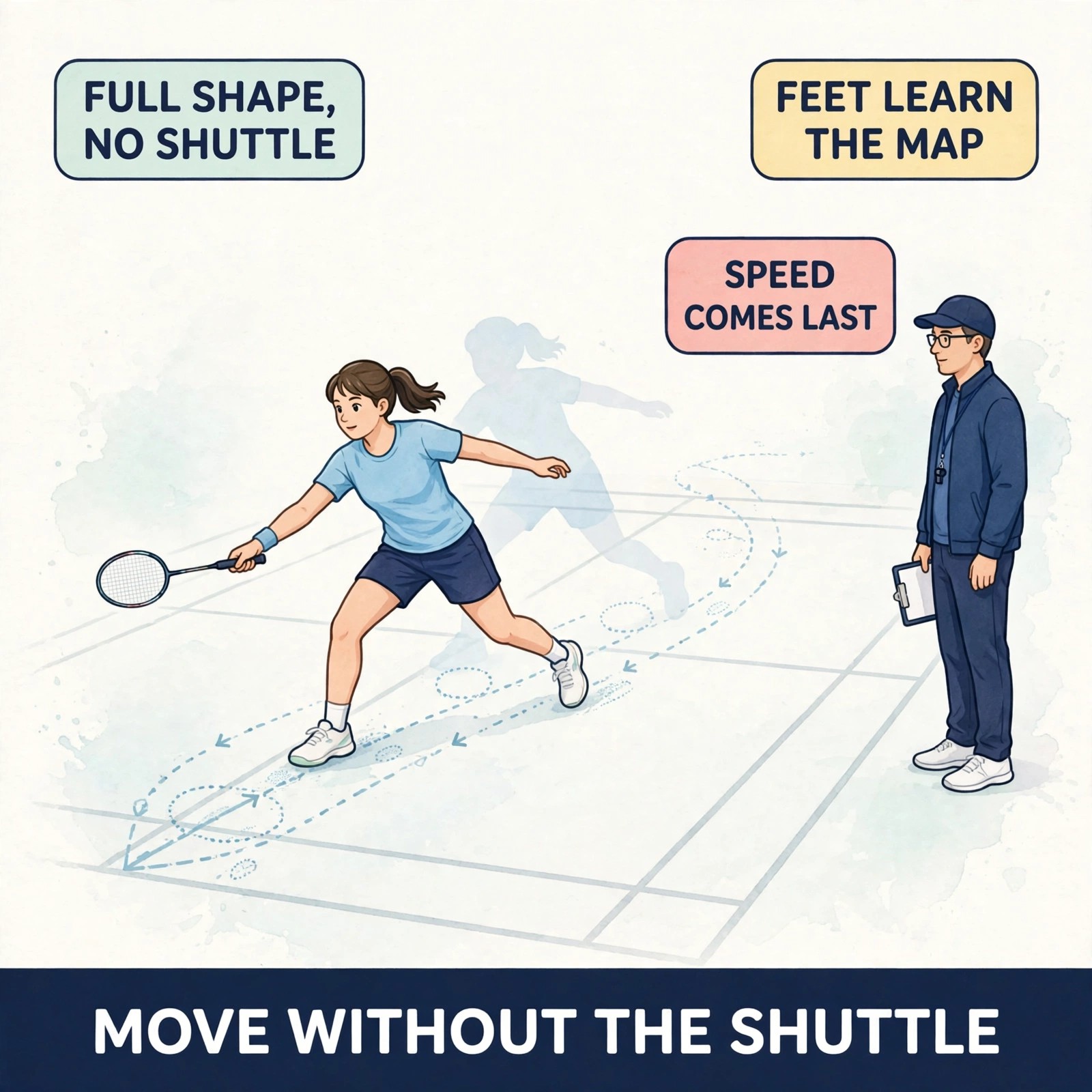
Ghosting With A Purpose: Movement Without A Shuttle
The absence of the shuttle is the point, not a compromise. When a shuttle is flying, almost all of a player’s attention rides on it: its speed, its height, the split second of contact. The feet get whatever attention is left, which is why faults hide inside rallies for years. Remove the shuttle and the attention has nowhere to go except the movement itself. The player feels the split step land, the first push, the lunge shape, the recovery that was supposed to follow. Shadow training is the one setting where movement can be practised with full honesty, slowly enough to be exact and often enough to become habit.
Ghosting also removes the two limits that shape every other drill: the feeder and the rally. A feeding drill ends when the basket empties or the partner tires. A rally drill ends at the first mistake. Shadow rounds end only when the set ends, so the player controls the volume precisely: six corners, four rounds, rest, repeat. That control makes ghosting the easiest work to dose honestly, and the easiest to do anywhere. A hall is best, but the footwork patterns can be walked in any clear space, which is why players who travel or lose hall time for a week lean on shadow work to keep their movement map fresh.
Shadow Check #2
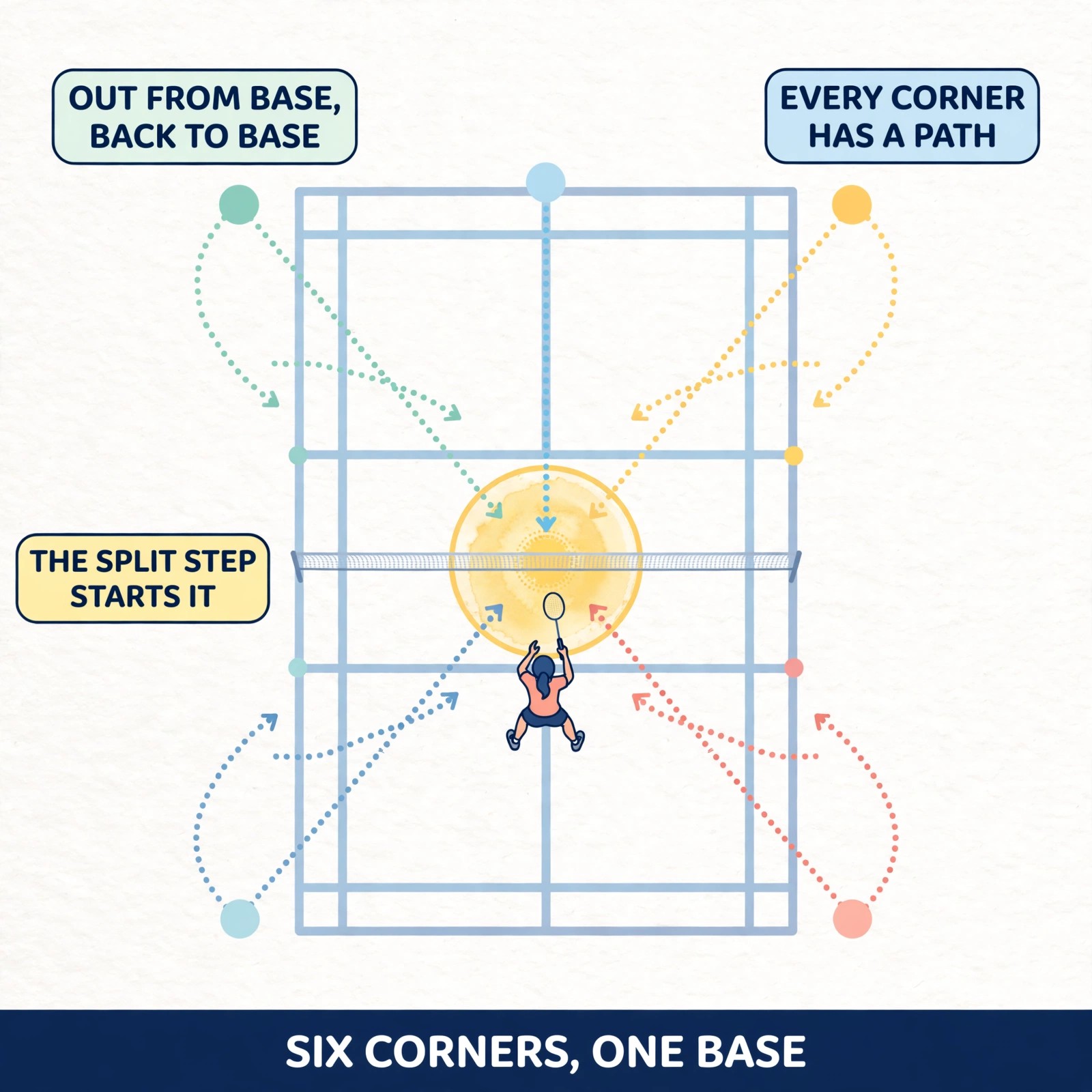
The Six Corners: One Base, Every Path Home
Every ghosting pattern hangs on one piece of geography: the base. Base is the ready position near the centre of the court, low, balanced, racket up, from which every corner is reachable. Shadow rounds always leave base and always return to it, because that return is the habit real rallies punish when it is missing. The split step lives at base too, the small hop that loads the legs as the imaginary opponent strikes. A round that starts without the split step and drifts back late to base is rehearsing the two faults that lose the most rallies, so the map is drawn strictly: out from base, play the shape, straight back home.
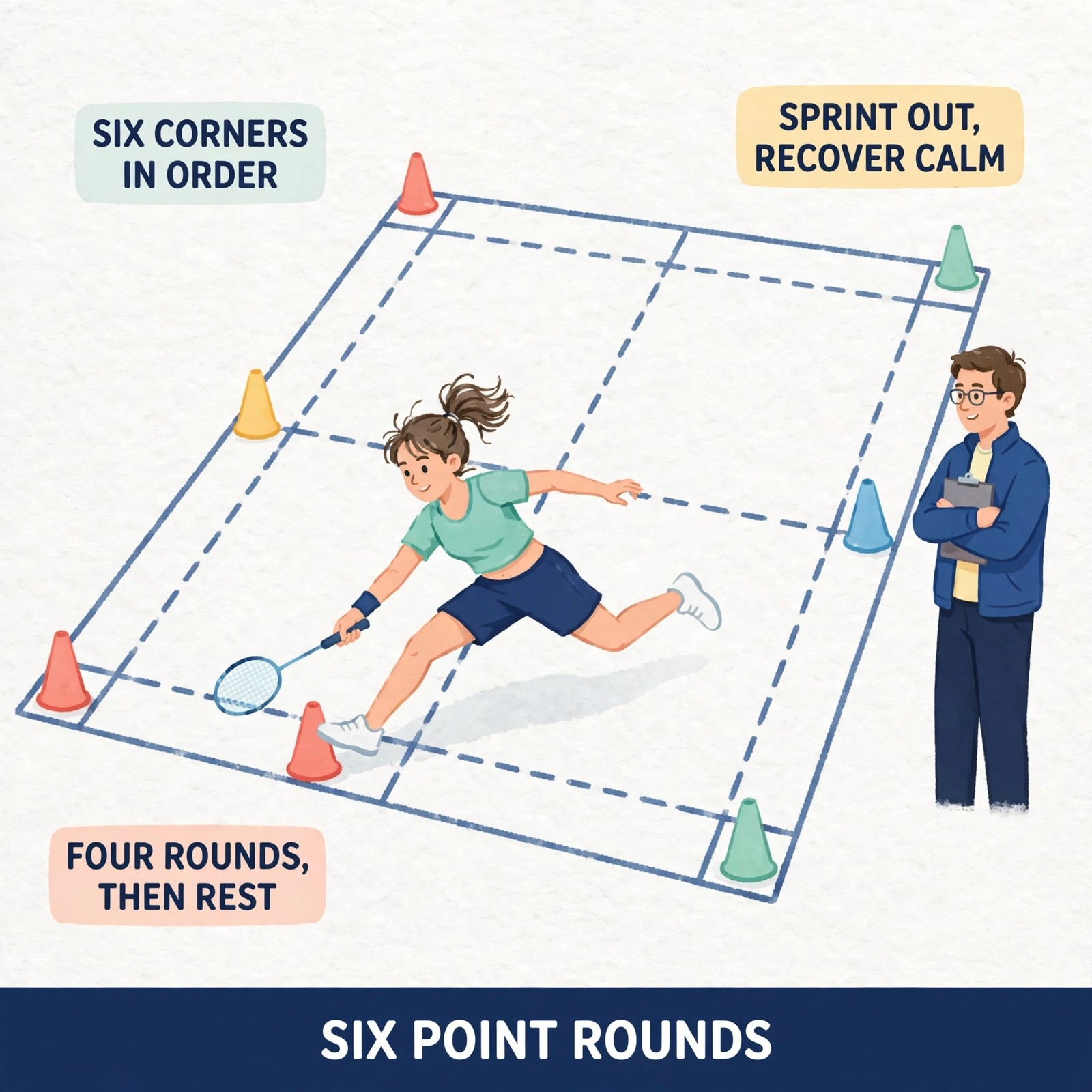
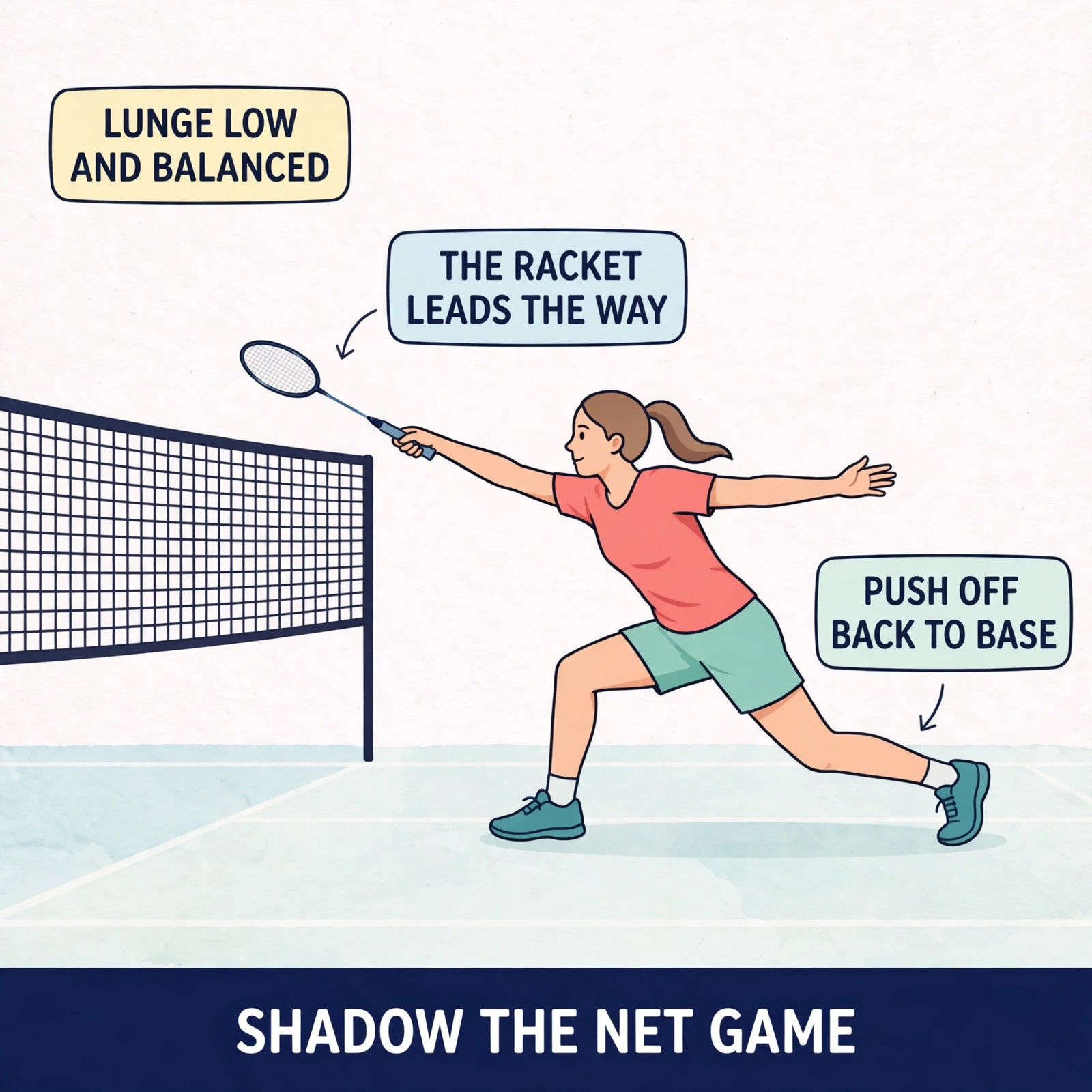
From base, the court opens into six corners: two at the net, two in the mid court sides, two deep at the rear. Each has its own path and its own final shape. The front corners ask for a lunge, low and balanced, racket reaching forward. The rear corners ask for steps that turn the shoulders, a scissor style recovery for overhead shapes, and a fast first stride because the distance is longest. The mid court asks for a short push step and a compact swing shape. Ghosting teaches the feet that these are six different trips, not one generic run, and teaches them in an order the player can feel building into a map.
The order inside a round matters. Early rounds visit the corners one at a time from base, always returning, so the map is laid down cleanly. Later rounds chain corners the way rallies do: front forehand to rear backhand, a net answer followed by a deep recovery, the patterns that real opponents use to stretch a player. Chaining too early turns the round into rushing; the player cuts corners, skips the return to base, and practises a map with the middle missing. The coach’s eye watches for exactly that shortcut. A shadow round done slowly with every return home teaches more than a frantic round that visits more corners on paper.
Shadow Check #3
Shape Before Speed: Build The Pattern Slowly
Speed is the last ingredient, added only when the shape can hold it. New patterns are walked first, at teaching pace, with the player naming the parts quietly: split step, push, lunge, recover. Walking a pattern feels almost too easy, and that ease is where exactness lives: the feet learn the order without the noise of effort. Then the pace rises in layers, a brisk walk, a playing jog, short bursts at rally speed, always returning to walking pace the moment the shape bends. This patience is the same rule as every good drill: practise the right thing slowly until it survives being done quickly.
Technique details get named one at a time inside the rounds. The racket stays up and ready between corners, never dropped to the thigh, because a dropped racket in ghosting becomes a dropped racket in rallies. The free arm works for balance, reaching back on lunges instead of hanging stiff. On rear court shapes the shoulders turn early, so the imaginary contact happens in front with the body behind it. The lunge lands heel first with the knee tracking over the toes, and the push off comes from the lunged leg, not from a hop of both feet. One detail per session is enough; ghosting gives it hundreds of clean repetitions.
Breathing belongs in the technique list too. Players hold their breath through hard rounds without noticing, and a held breath tightens everything the drill is trying to loosen. Coaches set a simple pattern: breathe out on the effort, the lunge or the swing shape, and breathe in on the recovery steps. The rhythm also paces the round honestly. A player who cannot keep the breathing pattern is moving faster than their current shape allows, whatever the stopwatch says. Shadow work is unusually good at revealing this, because with no shuttle to blame, the body’s signals are the whole report.

Shadow Check #4
Routines And Reactions: Sets, Rests And Pointed Calls
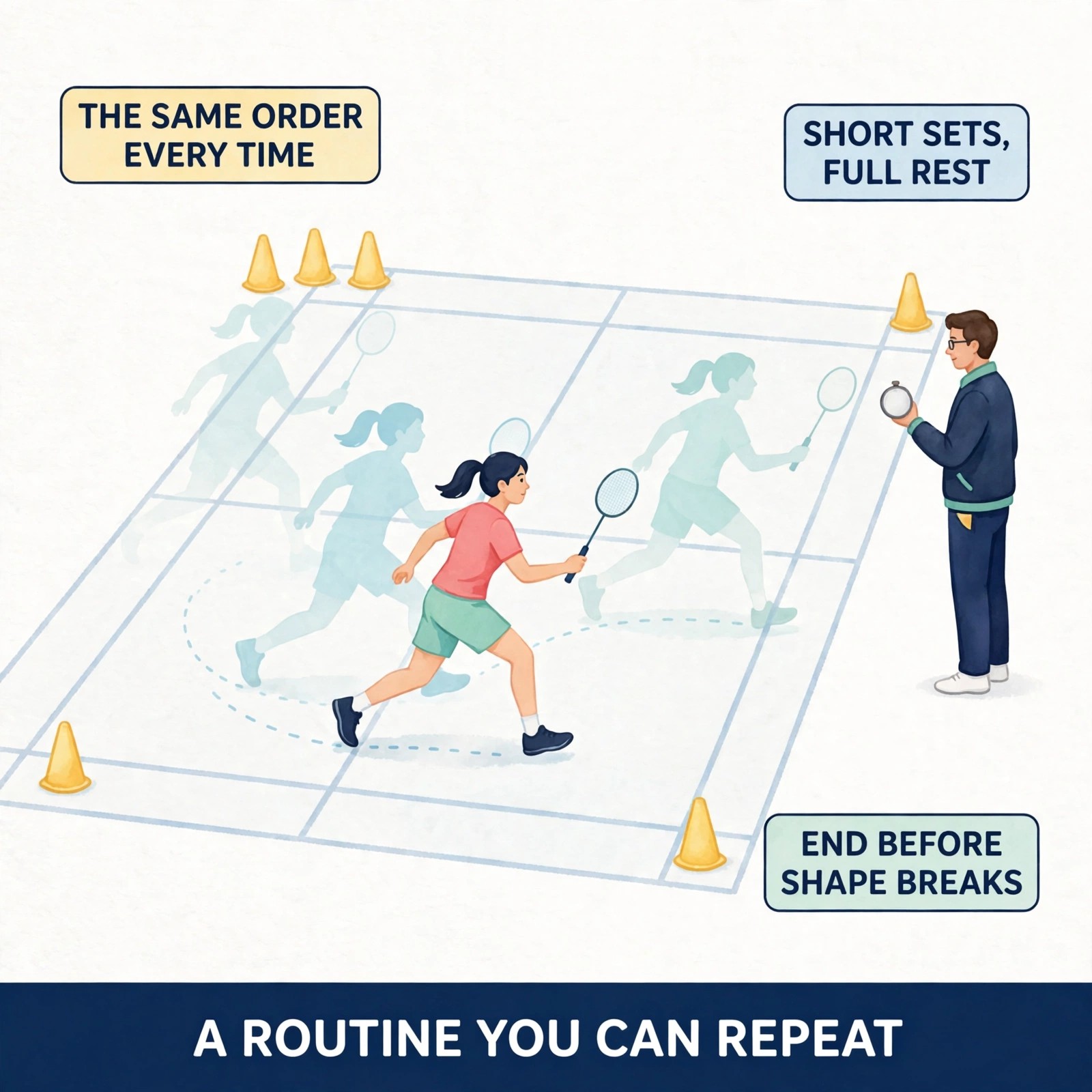
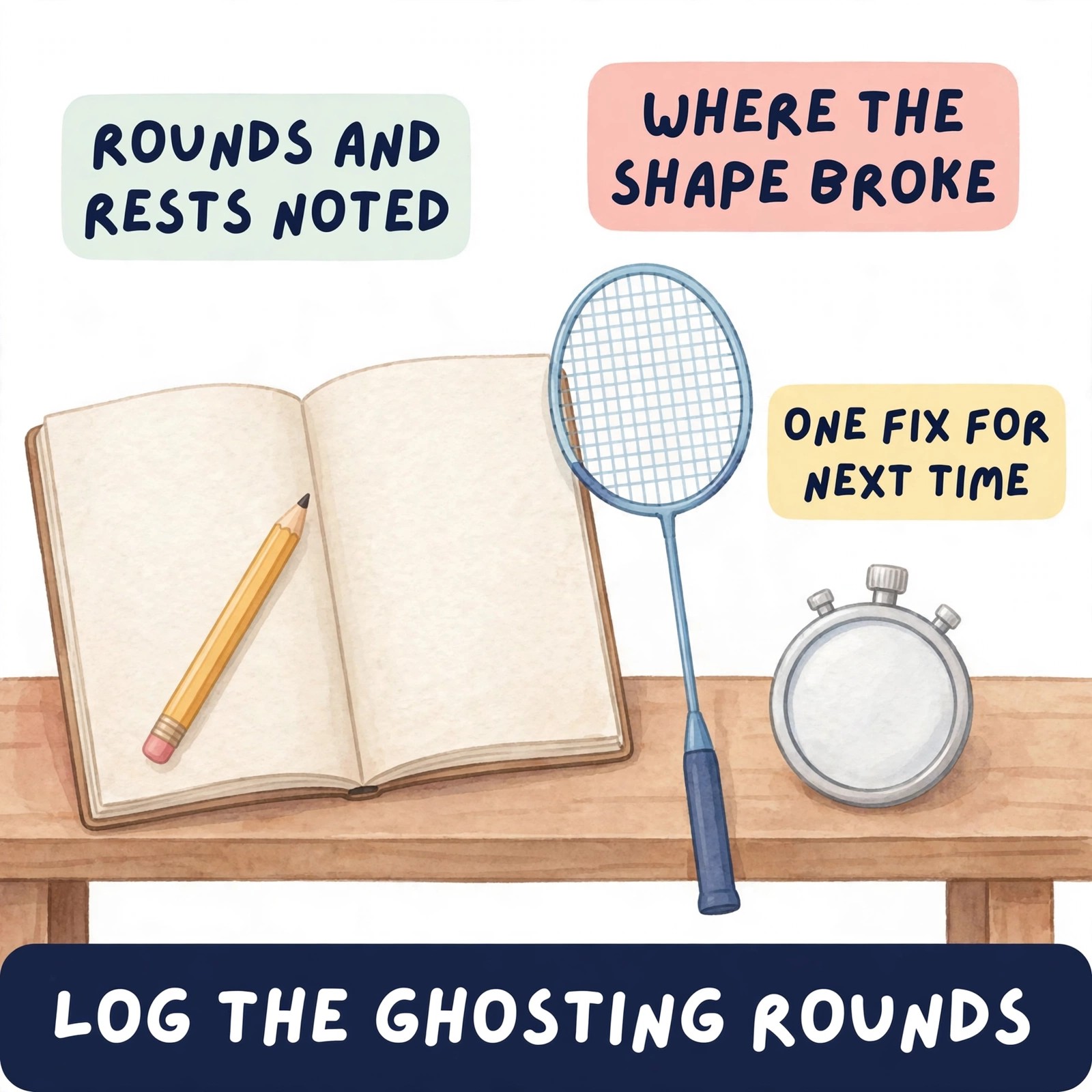
A shadow routine that works looks ordinary on paper: a warm up walk of the six corners, then sets with set rests, then one harder element to finish. Four rounds of six corners with a full minute of rest between rounds is a proper working dose for most players. The rest is part of the drill, not a pause in it, because ghosting quality collapses quietly when legs tire: the lunge shortens, the return to base slows, and the player starts practising the tired version of the pattern. Short sets finished fresh beat long sets finished ragged, and the log records rounds completed cleanly, not rounds survived.
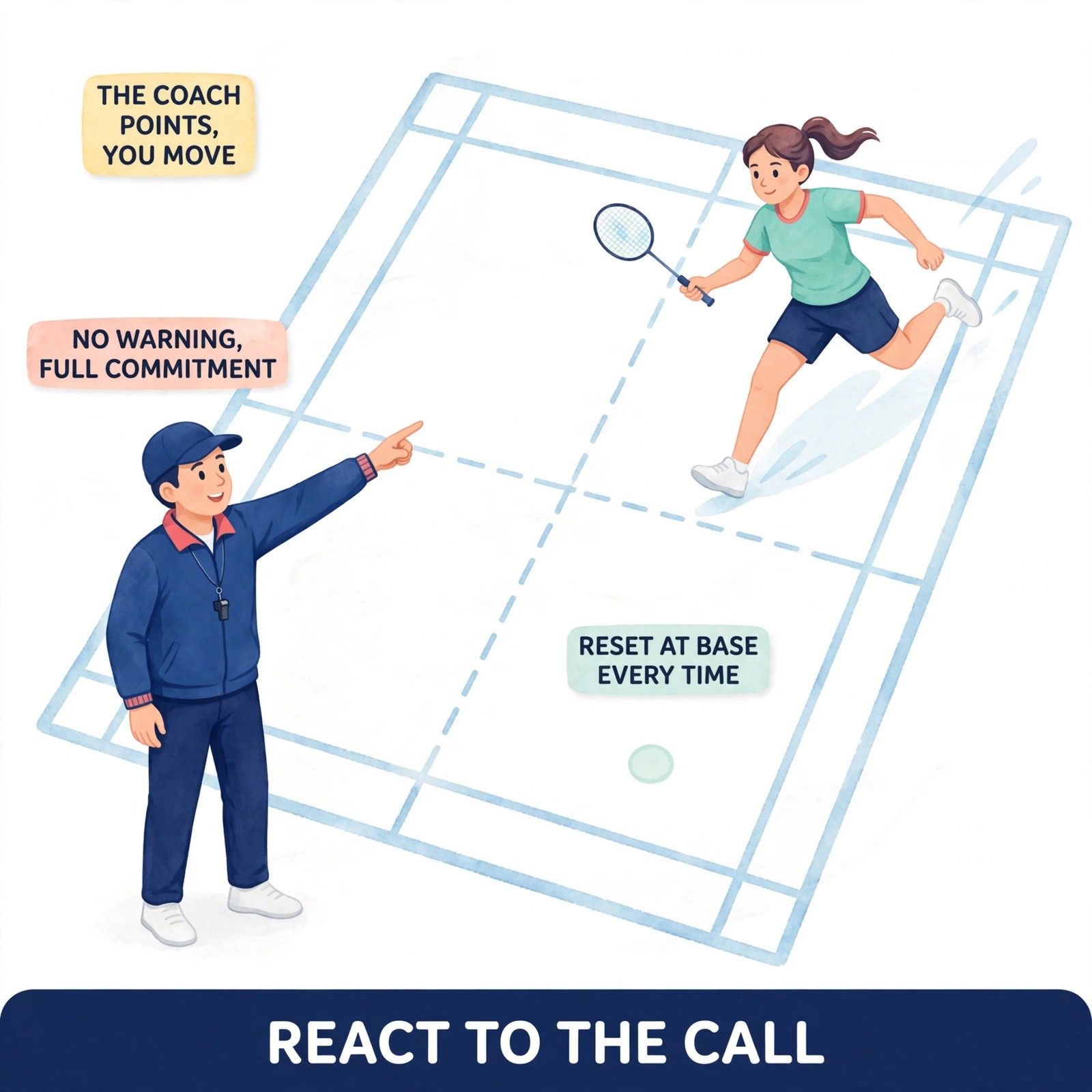
Reaction work layers onto the routine once the map is clean. The coach, or a partner, stands at the side and points or calls a corner without warning, and the player explodes from base to that corner and back. This is the closest ghosting comes to a rally’s demand, because the movement is no longer chosen in advance: the first step must react, not remember. Keep reaction rounds shorter than pattern rounds, four to six calls per set, because honest reactions tire the mind as much as the legs. A player whose first step starts choosing the easy corners is telling the coach the set has gone on long enough.
The final layer joins the corners into rally pictures. The coach calls a short pattern, net then deep then net, and the player ghosts the whole sequence as one flowing rally, imagining the shots the opponent’s replies would force. This is where shadow training starts paying match rent: the recoveries between unlike corners, the discipline of returning to base when the rally would rather keep you stranded, the racket staying ready through changes of direction. Rally pictures are kept short, three to five shots, and walked before they are run. A pattern the feet cannot walk, the feet will not suddenly run.
Shadow Check #5
Legs And Pictures: Fitness And Imagined Rallies
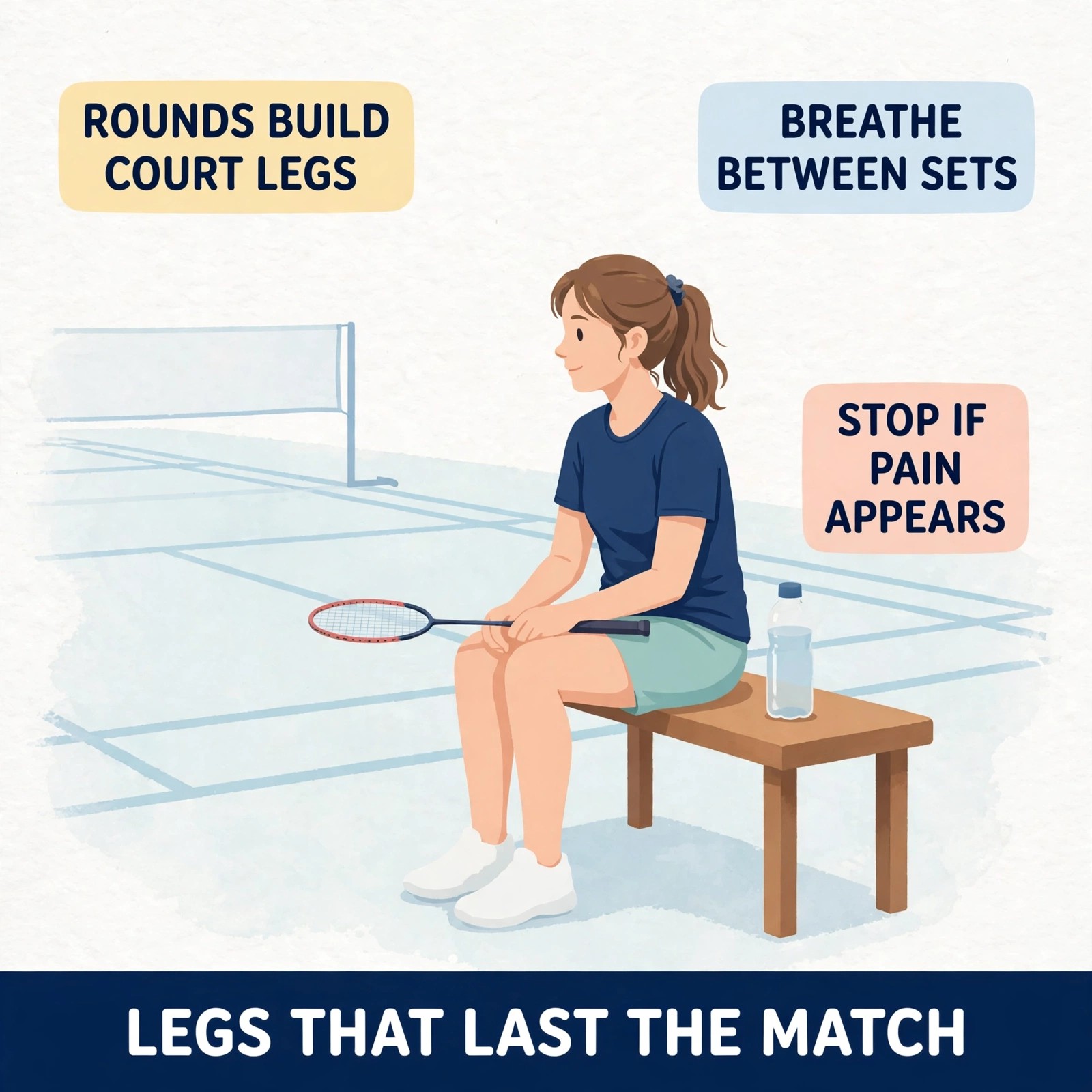
Ghosting loads the legs in a way players respect quickly. Repeated lunges, pushes and recoveries build the specific strength and stamina the court asks for, using the exact shapes the game uses. The load is honest and it is also easy to overshoot: knees and calves complain when rounds multiply too fast, and pain is a stop signal, not a milestone. Players with knee trouble should clear this work with a doctor first, and every player builds rounds gradually across weeks. Used with that respect, shadow sets are the rare fitness work that improves technique at the same time, because every repetition is also a rehearsal of a real court shape.
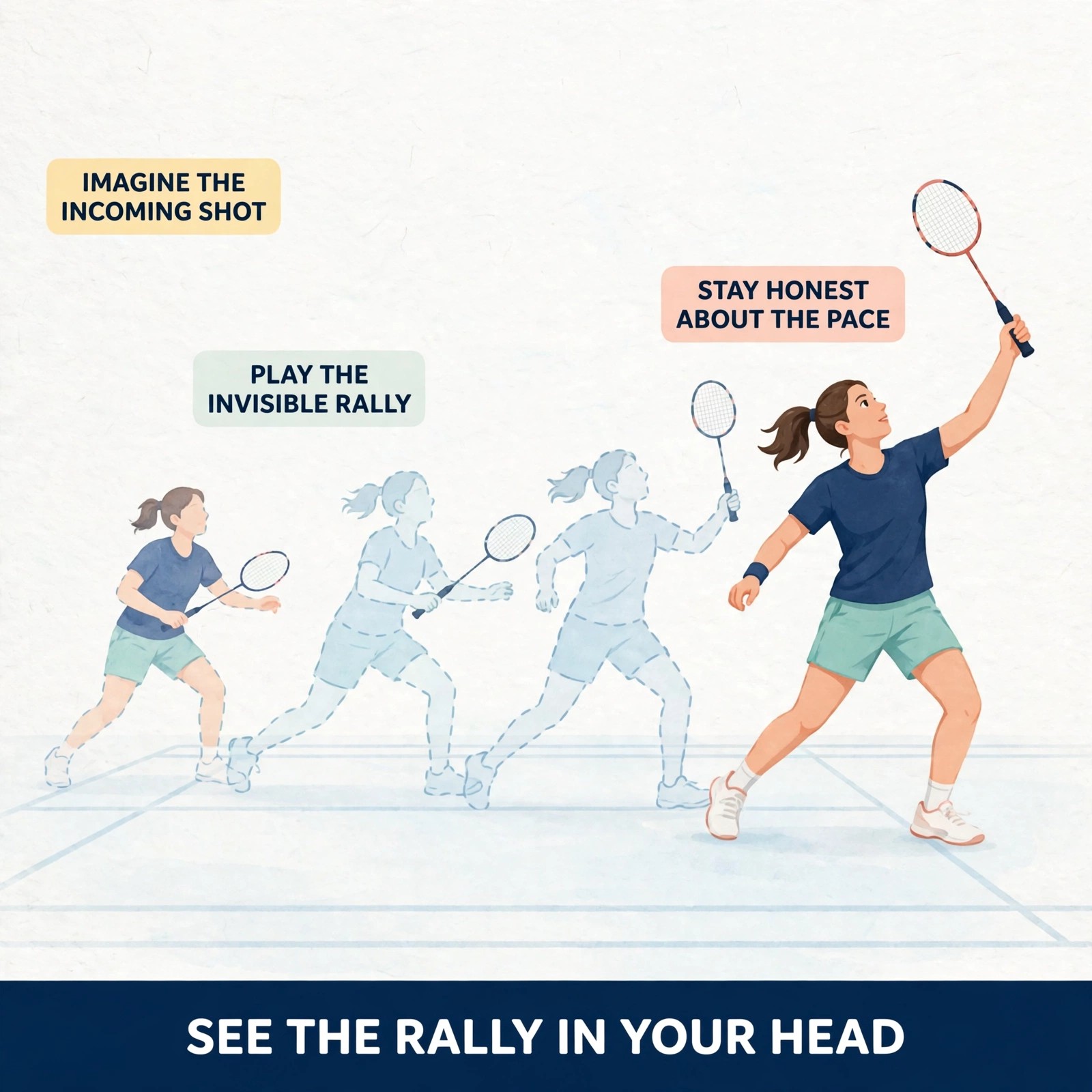
The imagination is the other muscle ghosting trains. A good shadow round is not daydreaming with a racket; it is a rally pictured in detail. The player sees the opponent’s clear floating deep, feels the turn and the strike, pictures the reply coming back to the net and is already moving. Picturing rallies this way builds the library the mind reads during real games, so patterns feel familiar when they arrive at full speed. Coaches help by calling the imagined shots during rounds, which keeps the picture tied to the feet. The drill ends up training decisions as well as steps, at walking cost.
The limits deserve the same plain speech. Shadow training cannot teach timing against a real shuttle, because there is none: the contact point, the judgement of pace and flight, the adjustment to a deceptive flick, all need a flying shuttle and a live opponent. A player who only ghosts will move beautifully to where the shuttle is not. So ghosting lives inside a mixed week, never instead of one: shadow rounds to build the movement map, fed drills to attach the shots, games to test the whole picture under pressure. Coaches who respect that balance get the best of the drill without believing its brochure.
Myth vs Reality
Myths About Shadow Training
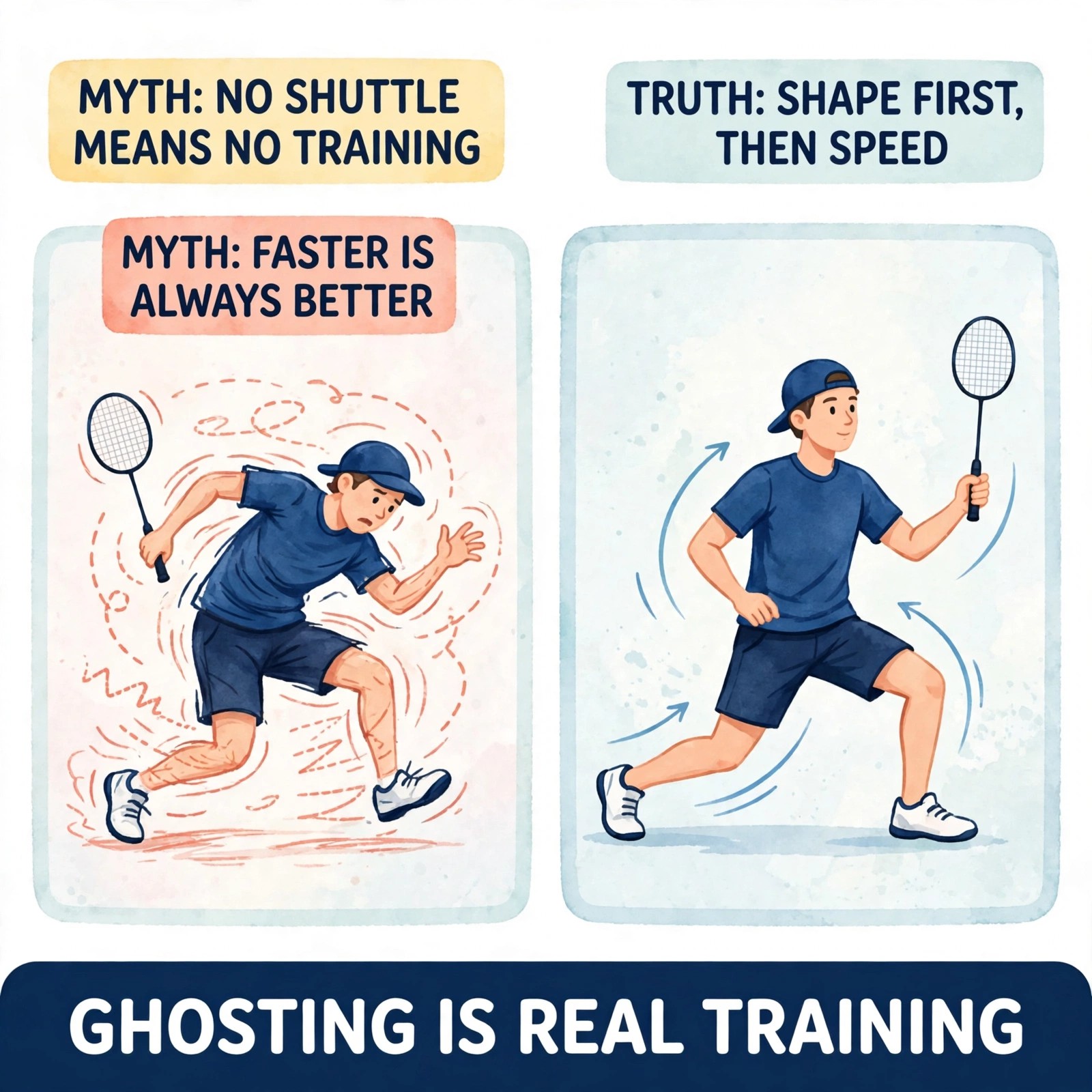
The first myth says no shuttle means no training, that ghosting is what players do while waiting for the real work to start. The stopwatch disagrees politely: four honest rounds of six corners load the legs, groove the recovery step and rehearse every lunge shape the game owns, with an exactness feeding drills cannot match because no feed interrupts the pattern. The second myth says faster is always better, that a shadow round only counts at full sprint. Speed added to a bent shape just rehearses the bent shape at higher velocity. Every coach who uses this drill well walks new patterns first and earns the speed later.
The third myth places ghosting at one end of the game only, either a beginner’s toy too simple for serious players or an elite secret too hard for club players. It is neither. Beginners use it to learn the map at walking pace; advanced players use the same drill at rally pace for reaction rounds and rally pictures. The drill scales because the court map is the same for everyone. The fourth myth says shadow work can replace matches for fitness and sharpness. It cannot, for the reason already given: timing lives in real rallies. Ghosting prepares the feet for the match. It is not the match.
The last myth is about equipment and setting: that shadow training needs a marked court, special gear or a personal coach calling every round. The walking patterns need a few square metres and a racket. Reaction rounds need one partner willing to point. Marked courts and coaching make the work sharper, and hall sessions are where we set the shapes properly, but a player who waits for perfect conditions before ghosting has misunderstood the drill’s greatest strength. It is the most portable serious training in the sport, and the players who use it on ordinary days are the ones whose feet arrive first when the hall days come.
Why Choose Us
Why Players Choose ST Badminton Academy
At ST Badminton Academy, shadow training is built into coached sessions as the movement block, not handed out as homework and hoped for. Groups are capped at four students, so the coach can watch every student’s base position, lunge shape and recovery across the rounds, and stop a set the moment shapes start bending. New students walk the six corner map in their first sessions, with the coach naming each path, before any pace is added. Reaction rounds come later, with the coach pointing corners, and rally pictures after that. The order is protected because it is the order that makes the drill work.
Our base is Setapak, Kuala Lumpur, and students join us from across the Klang Valley. Shadow work there follows the shape of this page: patterns walked, then run; sets kept short with full rest; reactions layered in; rounds written into the student’s log like any other drill, with the corner or shape that broke noted honestly. Students who lose hall time in a busy week are given a walking version of their current pattern for home, at teaching pace, so the map stays warm without the load. When they return, the coach checks the shape before the pace goes back on.
We are honest about what ghosting cannot do at our sessions either. It will not fix timing against deceptive shots, it will not judge a real shuttle’s flight, and it will not replace the games and fed drills the rest of the session carries. We also dose it carefully for knees and calves, and a student who reports joint pain is rested from lunging rounds and sent to a doctor if it returns, because no drill outranks a joint. What we promise is the drill used properly: clean maps, shapes before speed, reactions when the base work holds, and rounds counted in the log like real training, because they are.
FAQs: Shadow Training And Badminton Skills in Malaysia (KL)
Questions about shadow training usually come from players who have ghosted once in a warm up and never learned what the drill is really for. Here are the answers we give on the bench.
Can a beginner use shadow training to improve badminton skills in Setapak or Gombak?
Yes, and beginners take to it well. In our Setapak sessions new students walk the six corner map at teaching pace before any speed is added: base, split step, one corner, straight back home. Groups stay at no more than four students, so the coach checks every lunge and recovery shape personally.
What should a player ghost first when starting shadow training in KL?
Ghost the front corners first. From base, split step, lunge to the forehand net corner with the racket reaching forward, push back to base, then the backhand side. Walk it until the shape feels tidy. Front corners teach the lunge and the recovery, the two habits every other corner borrows from later.
Why does shadow training feel easy but leave my legs so tired?level?
Because ghosting removes everything except the movement, and the movement is harder work than it looks. Repeated lunges, pushes and recoveries at full shape load the legs exactly the way rallies do, with no pauses while a partner picks up shuttles. Tired legs after clean rounds mean the drill did its job. Rest fully.
I have no court on some days. Can shadow training at home replace court sessions completely?
Partly, and honestly only partly. Walking patterns at home keeps the court map fresh and the shapes clean, and we give students a home version for busy weeks. But shadow work cannot teach timing against a real shuttle, so it supports court sessions rather than replacing them. The mix is what works.
How can I practise shadow training at home in between classes?
Walk your current pattern in any clear space at teaching pace: six corners from base, racket up, every return home. Keep rounds short, rest fully, and stop when the shape bends. Note the rounds in your log like any drill, and bring it to the next session so the coach can check the shapes.
Do you use shadow training in badminton coaching near Wangsa Maju?
Yes. Our academy is based in Setapak, a short drive from Wangsa Maju, and shadow training is the movement block inside regular coaching there: patterns walked then run, reaction rounds with the coach pointing, and every round logged. Groups stay at no more than four students, so shapes are corrected early.
Where does ST Badminton Academy coach badminton in Kuala Lumpur?Malaysia?
We teach in Setapak, Kuala Lumpur, and students join us from across the Klang Valley. Ghosting sits inside normal sessions in groups of no more than four: the six corner map taught at walking pace, sets kept short with full rest, and reaction work layered in only when the base patterns hold cleanly.
How do I book a trial session to start shadow training?
Book a trial session with us in Setapak and bring your playing racket and comfortable court shoes. The coach will walk you through the six corners from base in a group of no more than four, check your lunge shape, and set your first shadow rounds at a dose your legs finish cleanly.
What makes Mr Eric Chuar a suitable coach for shadow training and badminton skills?badminton?
Mr Eric Chuar coaches the academy sessions himself, with more than 15 years of coaching in Malaysia and Singapore. He teaches shadow work the way it works: map first, shape before speed, sets stopped the moment shapes bend, and knee or calf pain rested and referred on rather than trained through.
Shadow Training in Action
We benchmark our shadow training coaching against World Badminton (BWF) coaching standards and our own academy values: before any player trusts a training plan, they deserve honest checks. You can verify our coaches' credentials through the Badminton Association of Malaysia (BAM) coach education pathway.
Our standards for shadow work are plain. Base first and base last in every round. Patterns walked until the shape is clean, speed added in layers only. Racket up and ready between corners, breathing kept in rhythm. Sets short, rests full, rounds stopped when the shape breaks. Reactions and rally pictures layered on only when the map holds, and every round logged like any other drill.
| Factor | Players Who Just Wave The Racket | Players Who Ghost With A Plan SHADOW |
|---|---|---|
| Frequency | 1 or 2 times a week. Mostly for fun and sweat. | A planned ghoster walks the pattern slowly first, so speed is added to a clean shape. |
| Drills Focus | Basic static feeding. Minimal footwork pressure. | Sets stay short with full rest between rounds, so the last round looks like the first. |
| Physical Conditioning | Rarely included. Just playing games on court. | Core, agility, and speed training included in every session to prevent injury and build stamina. |
| Tactical Awareness | "Just hit it over." No real game plan. | Video analysis, point construction, and learning to read the opponent's game. |
| Coach Ratio | Large groups (8-10 kids). Coach barely watches you. | Max 4 students. Mr Eric Chuar personally corrects every stroke and movement detail. |
| Goal Setting | Fun and exercise. | Reactions and rally patterns are layered in, and the rounds are logged like any drill. |
| Long Term Result | Good recreational player. | A planned ghoster: shapes first, speeds later, and treats no shuttle work as real work. |
Badminton Shadow Training in Kuala Lumpur
Start by walking the map. Book a trial session in Setapak, train in a group of no more than four, and the coach will walk you through the six corners from base, check your lunge and recovery shapes at teaching pace, and set your first shadow rounds at the dose your legs can finish cleanly. Bring your playing racket and comfortable court shoes. The court map, and the patience to build it properly, are already here.




