
 All languages
 Chinese (Simplified)
 Chinese (Traditional)
 English
 Indonesian
 Japanese
 Korean
 Malay
 Thai
 Vietnamese


How Can You Improve Your Badminton Net Play Skills Through Training (Net Play Guide)
Watch a strong doubles pair and your eyes keep landing on the player who seems to do the least: the one at the front, standing still, racket up, while the rally rages behind and in front of her. Then a loose shot floats, and she ends the rally in half a second. That is net play. It is wider than the net shot itself: it is the whole front court job of positioning, reading, finishing and softening, in doubles and in singles alike. This page trains that job in order: where to stand, how to carry the racket, how to read before you react, and how the kill and the block share one ready position.

Net Play Check #1
What Net Play Really Covers
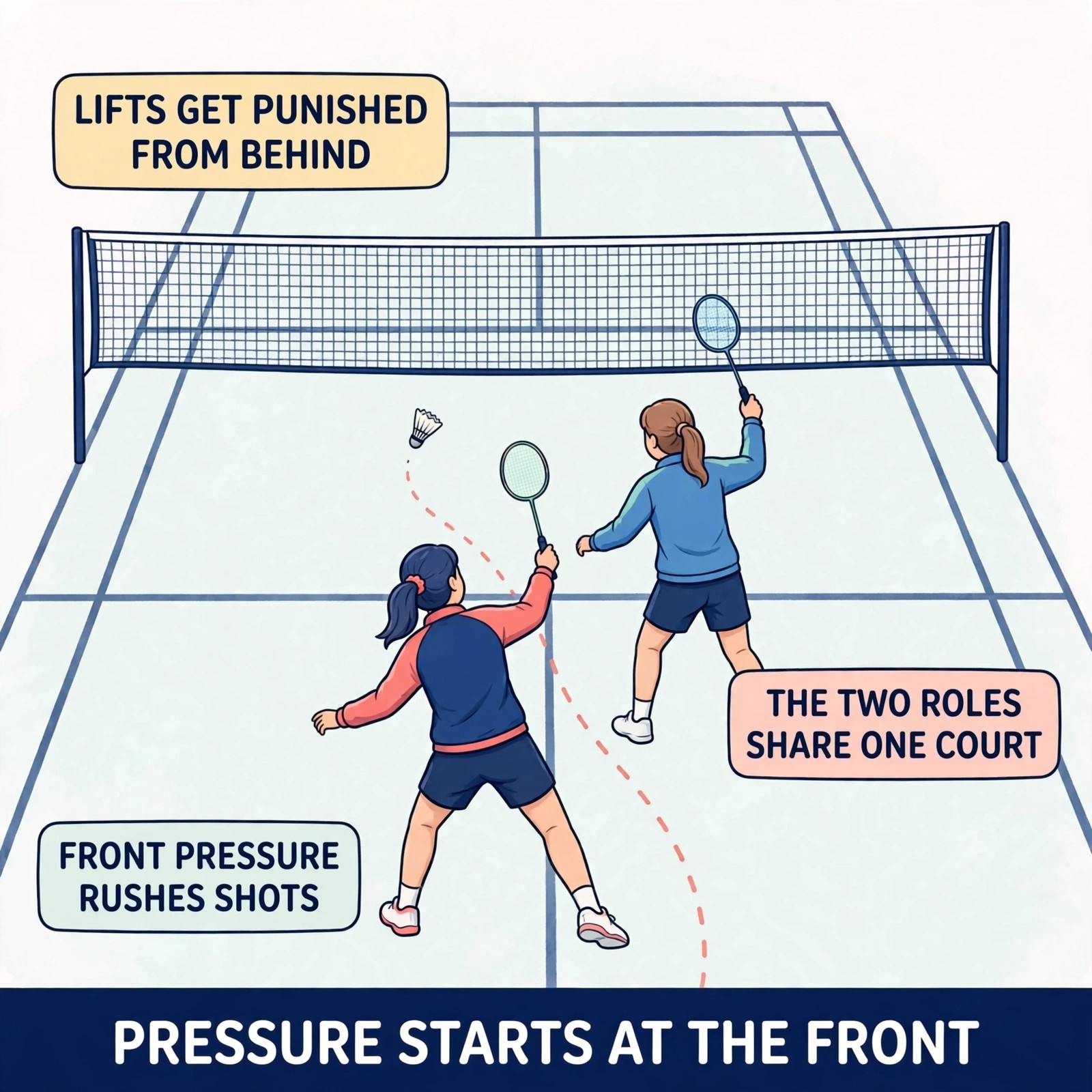
Net play covers everything that happens in the front third of the court. In doubles, the front player owns that ground: she cuts off cross court shots, finishes anything that floats above the tape, and forces lifts that her partner attacks from behind. In singles, net play is the art of arriving at the front early enough to choose, playing the tight shot or the kill when it is offered, and recovering before the reply. The net shot technique from our other page lives inside this bigger job, the way one tool lives inside a trade. Skills first, then the situations that ask for them.
Front court pressure changes how opponents play the whole court. A pair that fears the front player stops driving flat, because drives get cut off. They lift more, which feeds the back player. They hesitate on cross courts, which gives the front player time. None of that shows in her personal score, and all of it is her work. Players who only practise shots wonder why their front court feels quiet in drills and chaotic in matches. The difference is that matches test position and reading, not strokes. Net play is the skill of being a problem before the shuttle even arrives.
Net Play Check #2
Own The Front: Position And Racket Carriage
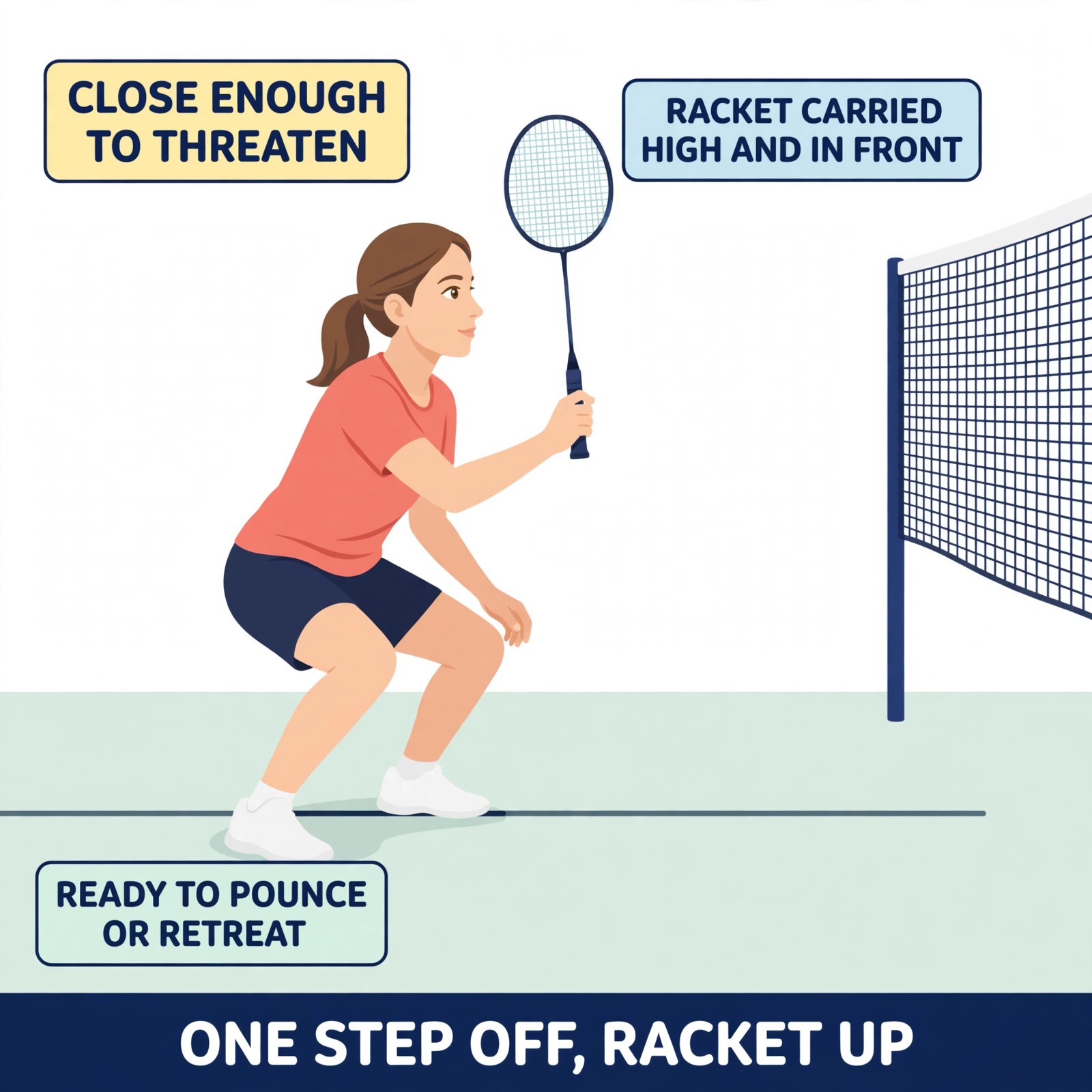
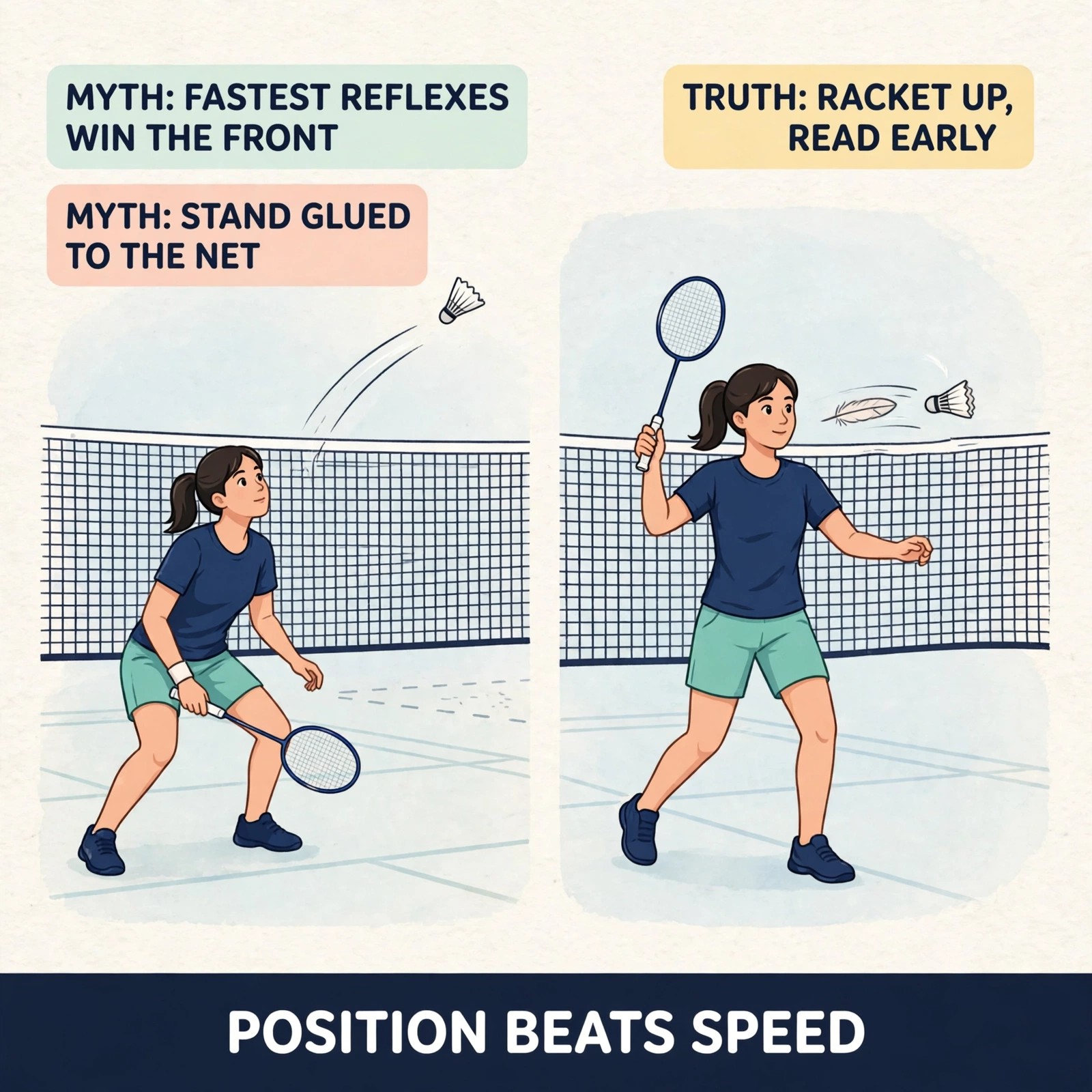
The front player stands close enough to threaten and far enough to survive. In doubles that home is around a step behind the front service line, adjusted for the rally: a half step in when your side is attacking, a half step back when the opponents lift with quality. Stand on the net itself and flick serves and deep drives pass over your head all evening. Stand at mid court and nothing at the front is yours. From home, your racket is carried up in front of your chest, head high, because a racket that starts high reaches loose shuttles in one small movement, while a racket carried at your hip arrives after the moment has gone.
Your stance at the front is a loaded spring, not a statue. Feet a little wider than your shoulders, knees soft, weight on the front of your feet, racket foot ready to step either way. The first step is small: a push toward the shuttle, then the lunge or the intercept stride. Big first steps are slow first steps, because the body must travel before the racket can. Watch strong front players and notice how little they move on most rallies: a rock forward, a rock back, the racket doing the travelling. Economy is the visible sign of good position. If you are sprinting at the front, the rally started while you were somewhere else.
Racket carriage deserves its own honesty check, because it drifts. Under pressure, players let the racket drop to waist height, turn side on to chat with a partner, or rest the racket head on the tape between rallies in training. In matches those habits cost the half second that the front court never refunds. Film yourself for one game and count how often the racket head is below your waist while the rally is live. Most players are shocked by the number. The fix is dull and total: racket up becomes part of the ready position you reset to after every shot, like returning to base with your feet.
Net Play Check #3
Read And React: Eyes, Split Step And First Move
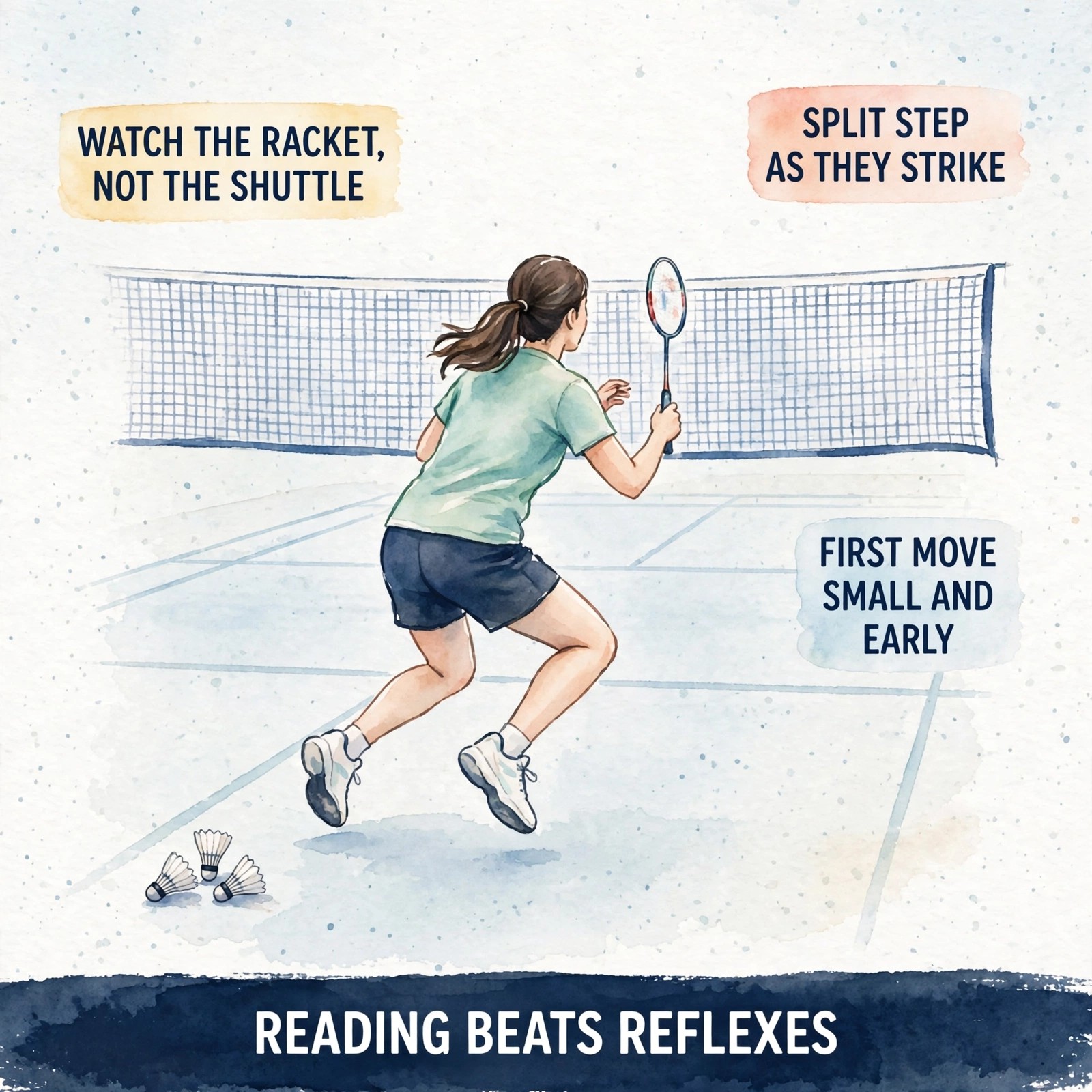
Reaction time at the net is mostly reading done early. The information is in the opponent racket and body before the shuttle is struck: the shape of his backswing, the angle of the racket face, whether his weight is falling forward or sitting back. A front player who watches the racket starts moving as the shot is chosen. A front player who watches the shuttle starts when the shuttle crosses the net, which is half a rally late. Train your eyes to live on the opponent side: his racket, his shoulder, his contact point. The shuttle will arrive in your picture soon enough.
The split step ties your reading to your feet. As the opponent strikes the shuttle, land from a small hop with both feet together on the ground, knees loaded, so your first step can go in any direction at full commitment. Land early and you stand watching; land late and you are in the air while the shuttle passes you. The timing is a rhythm you can drill: hop as his racket swings, land as it meets the shuttle, move as the shuttle leaves. In feeding practice we call the contact out loud until the rhythm settles, because a split step that needs thinking about arrives one rally too late.
Reading also means knowing what not to chase. A front player who lunges at every drive leaves the soft block dropping behind her. A front player who guards only the tape gets beaten by the first flat push. Your position is a bet placed on the most likely next shot, adjusted by the score, the opponent habits, and where your partner is covering. Shrink the bet as you learn an opponent: some players cross under pressure, some always push straight when rushed. The notebook you keep on opponents, even a mental one, is net play equipment, as real as your racket.
Net Play Check #4
The Net Kill And The Soft Block
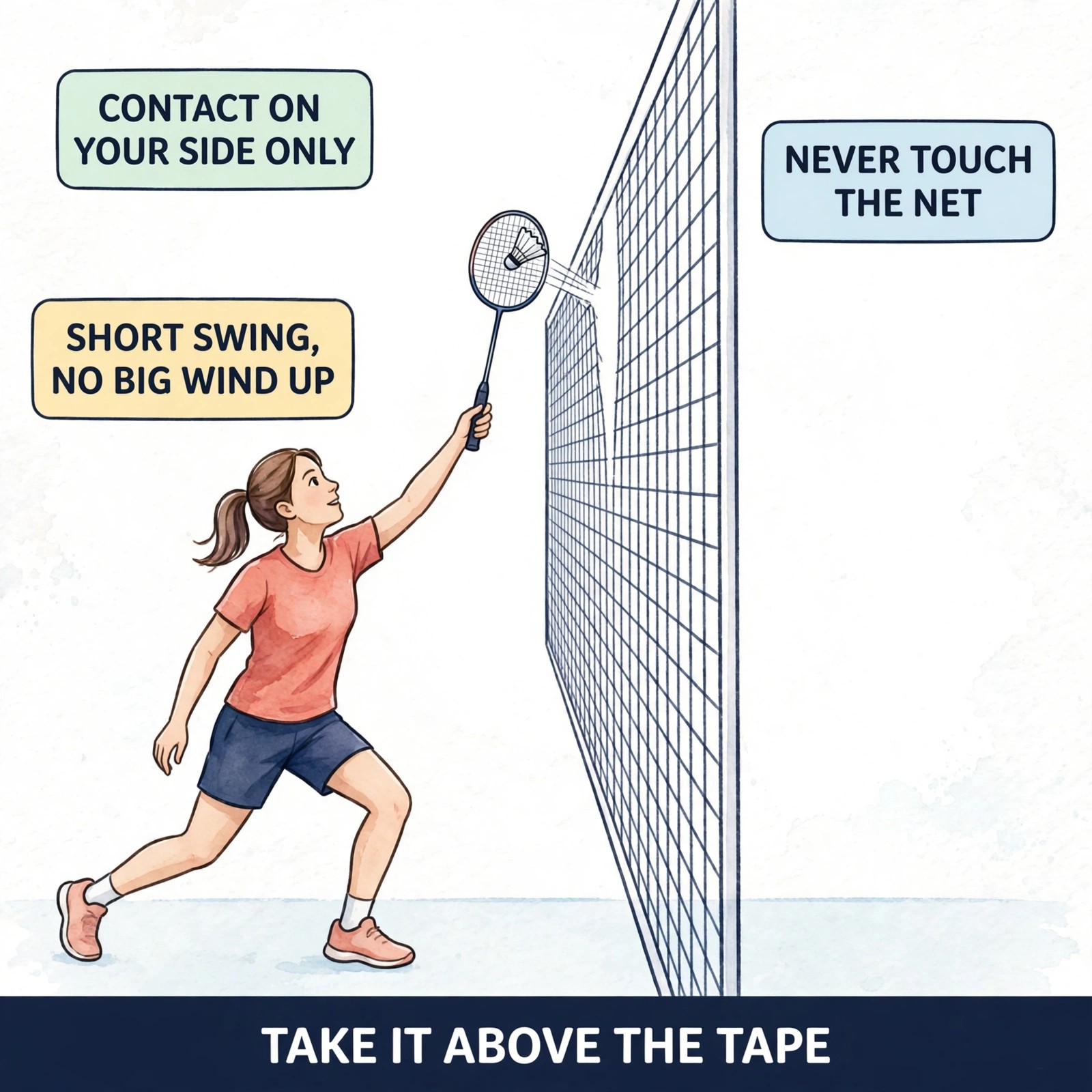
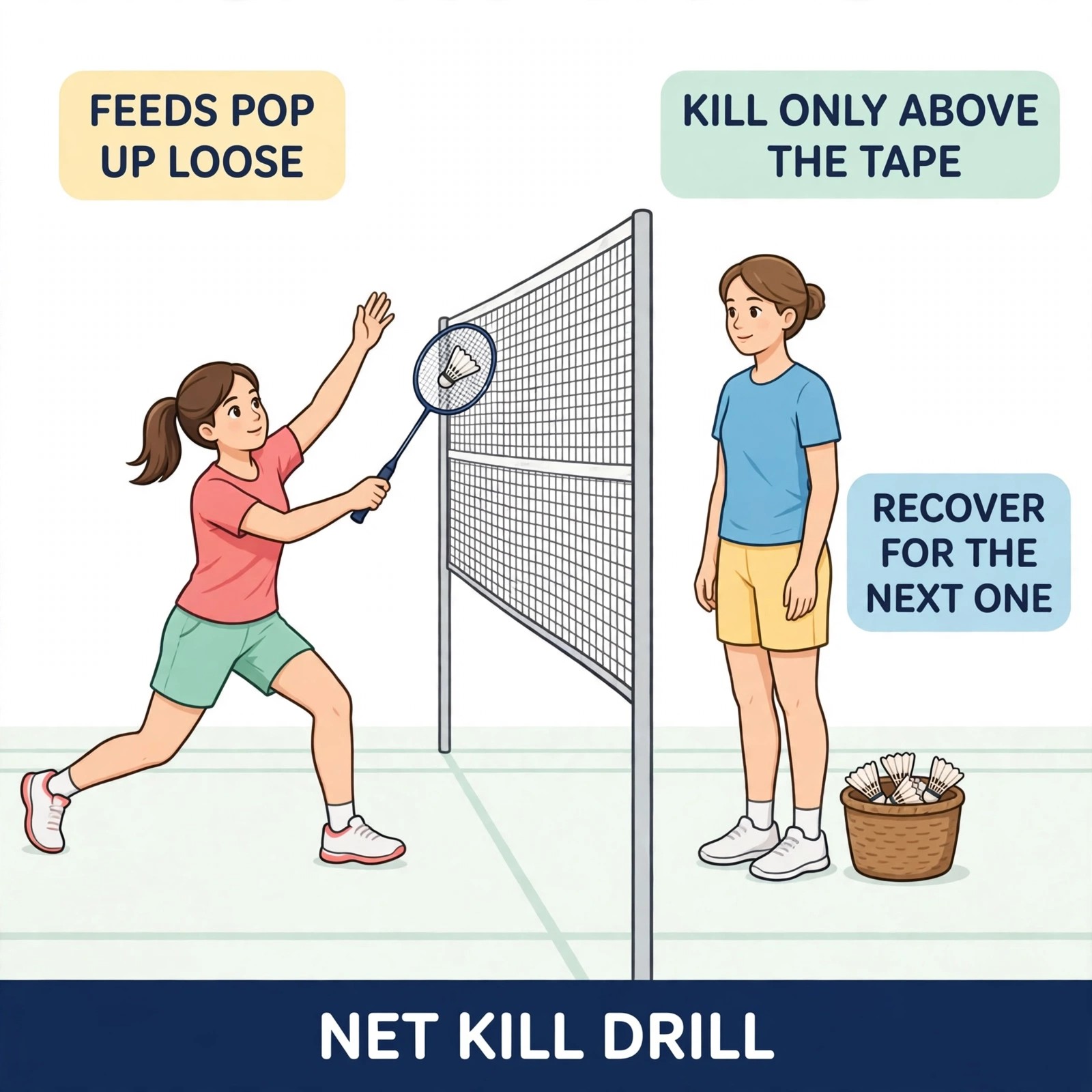
The net kill is the front court finish. When a shuttle floats above tape height on your side, step in and strike it downward with a short, firm action: racket already up, a small forearm movement, contact in front of your body and always on your own side of the net. Your racket may follow through over the net, but the shuttle must be met on your side, and neither you nor your racket may touch the net. Big wind ups miss the moment and hit the tape. The kill is a door closing, not a hammer swinging: short, early, and done before the opponents reset.
Not every loose shot should be killed. A shuttle that floats high but deep belongs to your partner or to a drive reply, and a shuttle met below the tape is not a kill at all, whatever your enthusiasm says. Reaching for it anyway is how front players hit nets, foul, and open their own court. Judgement is part of the skill: kill what is above the tape and close, drive what is flat and at your body, block or lift what arrives fast and low. In drills we grade the choice before the execution, because a well struck wrong shot still loses the rally.
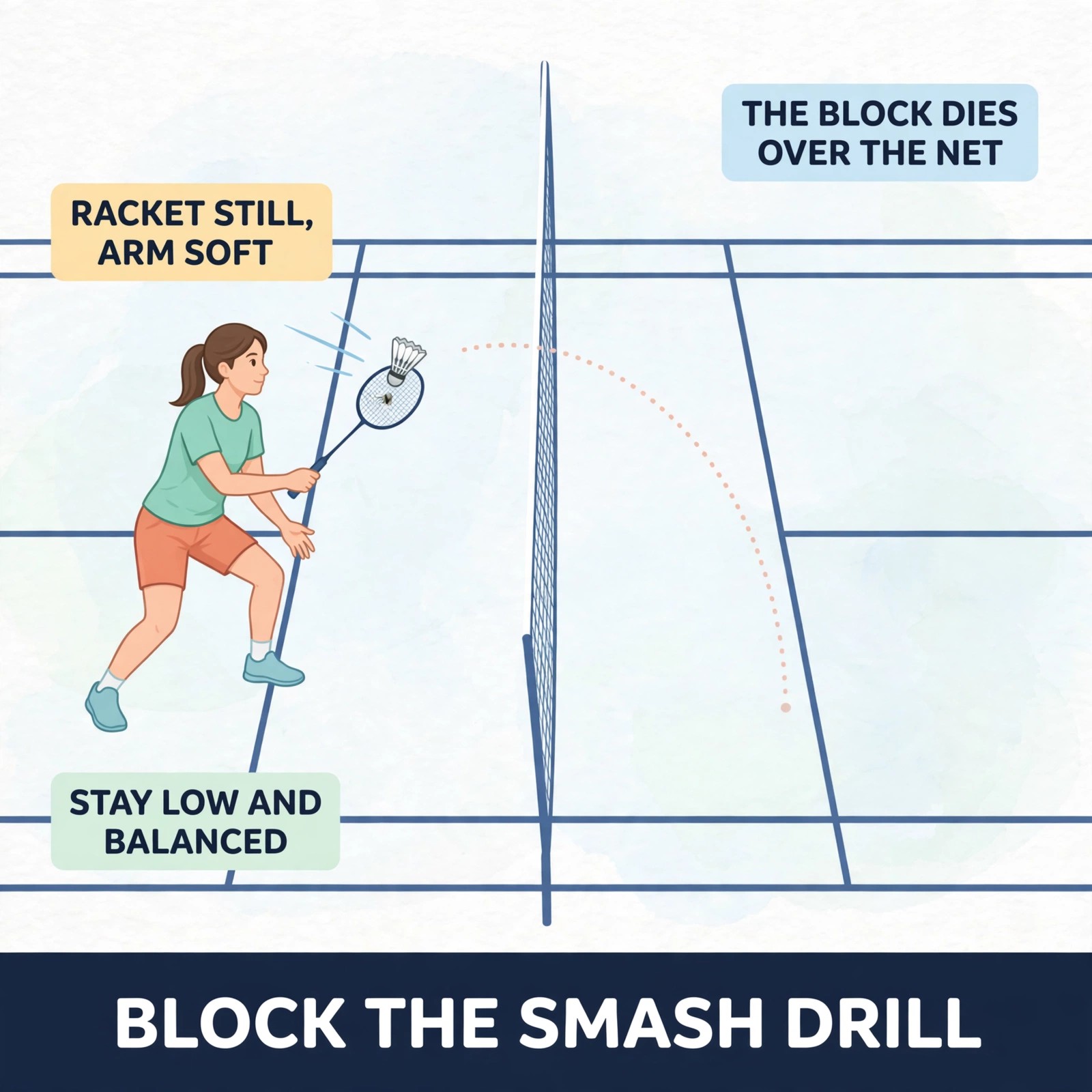
The block is the kill opposite number, the soft answer played against speed. Against a smash or a hard drive aimed at your body, do not swing at all. Present a still racket in front of you, arm soft, strings angled so the pace of the incoming shot does the work and the shuttle drops just over the net on the other side. A good block turns the hardest shot in the rally into the softest reply, and it forces the smasher to sprint the full length of the court to answer. In doubles defence, the block is how a side under attack buys back the front court, one quiet racket at a time.
Net Play Check #5
Net Play Drills That Build The Front Game
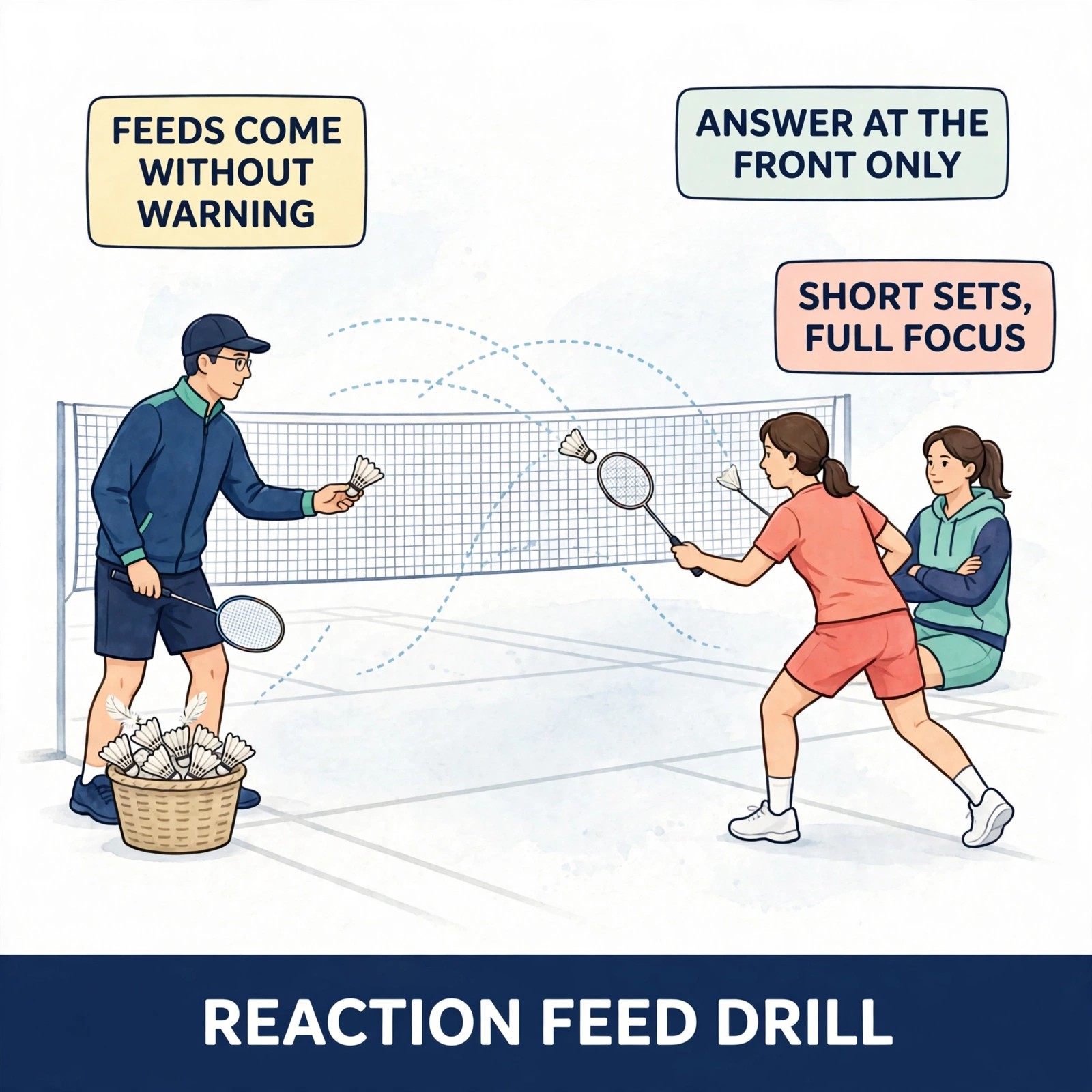
Front court training runs on feeds with no warning. The reaction feed drill has a coach hand feeding fast, flat shuttles at a front player in random order, left, right, and at the body, while she answers with blocks and drives only. Sets are short, because focus is the muscle being trained and it tires faster than legs. When the answers start arriving late, the set ends, the player breathes, and the next set begins clean. Randomness is the point: a front player who knows what is coming is practising a dance, not net play.
The kill drill feeds shuttles that pop up loose above the tape, and the front player steps in, kills, and recovers to home before the next feed. Her choice is graded too: a feed that arrives low must be blocked or driven, and killing it anyway ends the set with a discussion, not a point. The block drill pairs a smasher at the back with a defender at the front third, counting blocks that die over the net. Together the three drills cover the front court answers: finish what floats, soften what flies, and choose correctly between them at match speed.
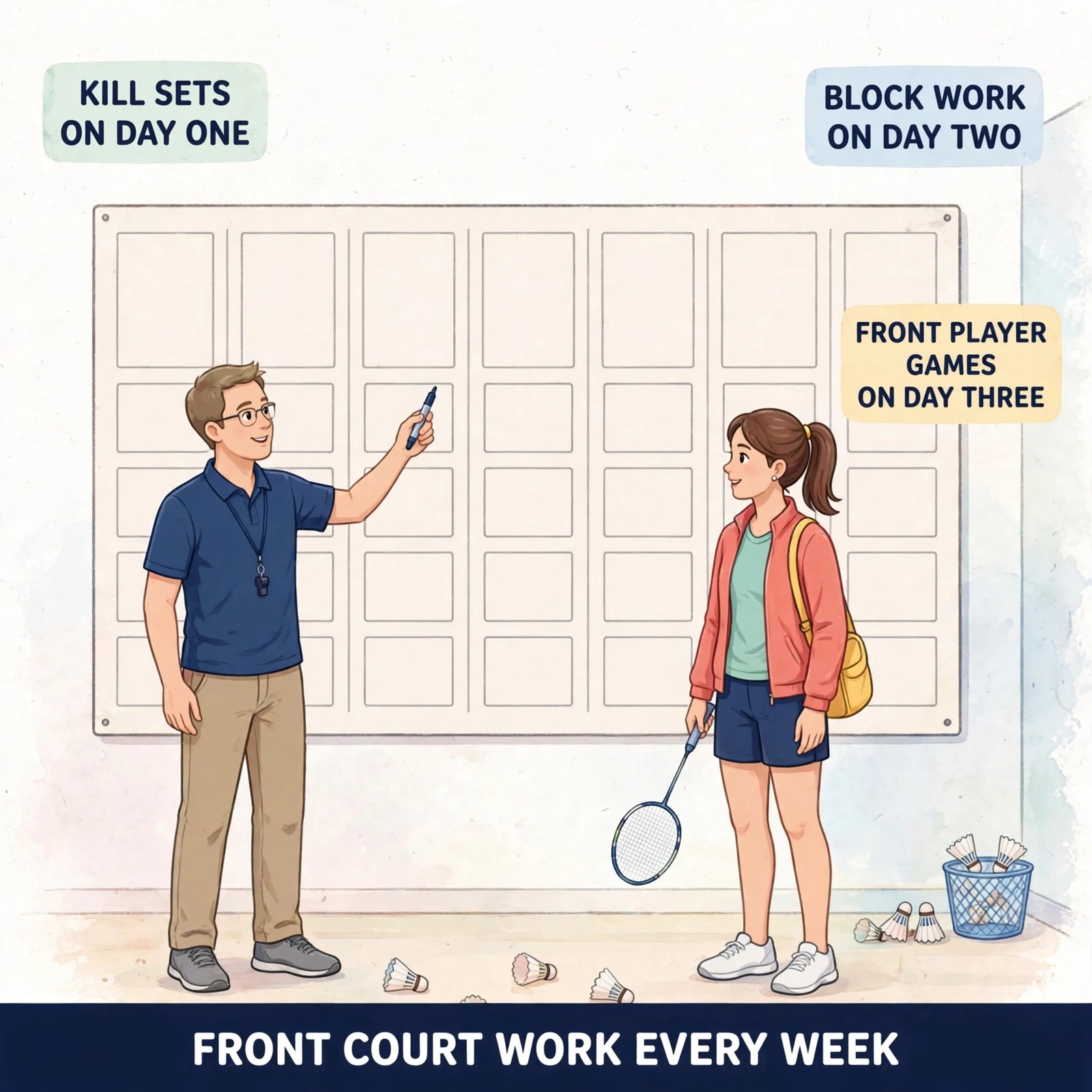
Finish net training inside a game, because position only proves itself against people trying to beat it. The front player game scores points only for front court winners and forced lifts, with roles rotating every game so every player lives at the front and behind it. Singles players play the same idea as a front court ladder: points for net shots that force a lift, points lost for kills attempted from below the tape. Keep a small count across weeks: interceptions made, kills finished, blocks landed. Net play grows quietly, and the counts are how you hear it growing.
Myth vs Reality
Myths About Net Play
Myth: the fastest reflexes win the front court. Reality: reading wins it, because a player who starts as the opponent strikes beats a faster player who starts when the shuttle crosses. Reflexes are the small change left over after position and reading have done their work. Myth: the front player should stand glued to the net to look dangerous. Reality: that player is beaten by every flick and deep drive, and the dangerous home is a step off, racket up, able to move both ways. Presence comes from where you stand and what you have finished lately, not from hugging the tape.
Myth: the net kill needs a big swing to be safe. Reality: big swings arrive late, strike downward into the tape, and foul nets. The kill is a short action from a racket that was already up. Myth: blocking is a passive, defensive shot for weaker players. Reality: the block is how strong sides steal the attack back, turning a smash into a net shot the smasher must chase. Myth: front players in doubles just wait for easy finishes. Reality: their position and interceptions shape every choice the opponents make, including the shots never hit toward them.
One more myth: net play cannot be practised without a full match. Reality: every piece of it breaks into drills with counts, feeds with no warning, kill sets with graded choices, block sets against a real smasher, and conditioned games that pay for front court work. What cannot be practised is the hope that matches will teach it to you under pressure. Matches test net play; training builds it. Bring the building into your week, in short honest sets, and the front court slowly changes from the place rallies scare you into the place you go to finish them.
Why Choose Us
Why Players Choose ST Badminton Academy
Players choose ST Badminton Academy for net play because we coach the front court as a job with a home position, a reading habit, and graded choices, not as a talent for standing near the net. Your split step is timed against the feeder contact until the rhythm holds. Your kill choices are graded before your kill swings, and your block is trained against real smashes at honest speed. Groups stay at no more than four students, so your front court sets are watched closely and your racket carriage is corrected the rally it drops, not the week after.
The sessions run the way this page describes. Position and carriage checks open the front court block. Reaction feeds follow, short sets with no warning, then kill and block work graded on choice first. Every block ends in the front player game, roles rotating, points paid for interceptions and forced lifts. Between sessions you keep two small habits: racket up shadow checks in a mirror, and one page of notes on the opponents you faced, what they played under pressure, and what you will read for next time.
We are based in Setapak, Kuala Lumpur, and our students join us from across the Klang Valley, some travelling in from Wangsa Maju, Gombak and Setiawangsa for evening sessions. Net play sits inside regular badminton training rather than a separate course, because the front court only exists inside rallies and partnerships. Bring your front court frustrations: the drives that pass you, the kills that find the tape, the flicks that sail over your head. Each one becomes a counted drill or a graded choice, and the counts decide when it is fixed.
FAQs: Net Play Skills And Badminton Training in Malaysia (KL)
These are the questions players ask us most about net play, before they book and during their first weeks. The short version runs through all of them: stand a step off with the racket up, read the racket across the net, split step on their contact, and grade your choices honestly. If your question is not covered here, bring it to a trial session and we will test it in the front player game, where net play questions get honest answers.
Can a beginner improve net play skills in training in Setapak or Gombak?
Yes. Beginners can learn net play from the start, because its base is a position and a habit, not a gift: stand a step off the net, carry the racket up, and reset after every shot. In our Setapak classes those habits are coached in groups of no more than four students from the first month.
What is the first net play habit a new player should build in KL?
Build the home position first. One step behind the front service line in doubles, racket carried up in front of your chest, weight forward, resetting after every shot. Most front court improvement is that position held for a whole game. Reading, kills and blocks are all built on top of it afterwards.
Why do I keep getting beaten at the front at a serious level?
Because serious opponents read slow starts. If your racket is down, your split step lands late, or your eyes follow the shuttle instead of the racket across the net, the front court is decided before you move. Film one game and count your late starts honestly; the fix is position and reading, not speed.
I keep arriving late at the net. Should I stand closer or read the shot earlier first?
Read earlier first. Standing closer feels safer but gets you flicked and driven past, and it does not fix a late start. Keep the home position, time your split step to the opponent contact, and train your eyes on his racket shape. A small early step from the right home beats a lunge from the tape.
How can I practise net play when I train mostly on my own in between classes?
Shadow the front court habits at home: ready position with the racket up, split step rhythm, one small step each way and back to home, slowly in a mirror. Keep a short notebook on opponents you face, what they play under pressure and what you will read for. Bring both habits to class and we will test them in feeds.
Do you coach net play beside badminton training near Wangsa Maju?
Yes. Our academy is based in Setapak, a short drive from Wangsa Maju, and net play is coached inside regular sessions there: reaction feeds with no warning, kill and block work graded on choice, and the front player game. Groups stay at no more than four students, so your position is corrected the rally it drifts.
Where does ST Badminton Academy teach badminton training in Malaysia?
We teach in Setapak, Kuala Lumpur, and students join us from across the Klang Valley. Net play training sits inside normal sessions in groups of no more than four: your home position and carriage checked, your split step timed to the feeder, and your choices graded before your swings in every set.
How do I book a trial session to test my net play?
Book a trial session with us in Setapak and bring your racket and court shoes. The coach will run reaction feeds at you, watch your home position and split step, grade a few kill and block choices, and map your first front court fix before any regular training begins.
What makes Mr Eric Chuar a suitable coach for net play in badminton?
Mr Eric Chuar coaches the academy sessions himself, with more than 15 years of coaching in Malaysia and Singapore. He teaches net play the way this page describes: position first, reading before reflexes, and choices graded before outcomes. No standing and hoping at the net, just a front court job done properly.
Net Play Training in Action

We benchmark our net play coaching against World Badminton (BWF) coaching standards and our own academy values: before any player trusts a training plan, they deserve honest checks. You can verify our coaches' credentials through the Badminton Association of Malaysia (BAM) coach education pathway.
One standard governs how we coach net play: the choice is judged before the outcome. A correct block that a lucky opponent still killed is marked up, and a wild kill that won the point from below the tape is marked down, because only the first habit survives better opponents. We check position first, reading second, choice third, and the scoreboard last. That order keeps front court practice honest, and it teaches players to trust a process that pays over a season rather than a single evening.
| Factor | Front Court Visitors | Front Court Owners NET PLAY |
|---|---|---|
| Frequency | 1 or 2 times a week. Mostly for fun and sweat. | An owner stands a step off the net with the racket carried up, close enough to threaten every loose shot. |
| Drills Focus | Basic static feeding. Minimal footwork pressure. | The eyes read the racket across the net before the shuttle moves, so the first step starts on time. |
| Physical Conditioning | Rarely included. Just playing games on court. | Core, agility, and speed training included in every session to prevent injury and build stamina. |
| Tactical Awareness | "Just hit it over." No real game plan. | Video analysis, point construction, and learning to read the opponent's game. |
| Coach Ratio | Large groups (8-10 kids). Coach barely watches you. | Max 4 students. Mr Eric Chuar personally corrects every stroke and movement detail. |
| Goal Setting | Fun and exercise. | Kills and blocks are trained as a pair: finish what floats, soften what arrives fast. |
| Long Term Result | Good recreational player. | A front court owner: position first, reading early, racket already up. |
Badminton Training For Net Play in Kuala Lumpur
Better net play starts smaller than most players expect: one home position, one racket carried up, one split step landed on time. Stand in your home for a week of rallies and count how many loose shots suddenly become yours. Bring the count to a trial session in Setapak, and we will watch your front court game together, grade your choices, and build the next layer. The front of the court is where rallies are finished and opponents are rushed. It is worth learning to live there.


