How Can You Develop Your Badminton Forehand Drive Technique Through Training (Forehand Drive Guide)
The forehand drive is the flat, fast shot that rushes opponents before they are set: played from the front and middle court, travelling just over the tape, arriving at the body before a full swing can answer it. It is the engine of the doubles mid court and an honest pressure shot in singles, and it is built from small things done early: racket carried up, contact met in front, a short push of a swing instead of a big one. Players who try to hit drives like small smashes arrive late and loop them. This page builds the drive in order: the carriage, the short shape, and the flat flight that makes it a weapon.

Drive Check #1
What A Forehand Drive Really Is
A forehand drive, in the way this page uses the term, is a flat forehand played from the front or middle court at around tape height or above, sent fast and flat toward the middle and back areas of the other court so it falls late rather than climbing. Its job is pressure: to take time away from the receiving side, refuse them the comfortable lift and smash pattern, and force the loose reply your side attacks next. In doubles it is the mid court’s main exchange, drive answering drive. In singles it is the answer to a lift that falls short or a block that sits up. The drive is graded by the reply it forces, not by its own speed.
The cost of a weak drive is paid in the exchange itself. A drive that loops, climbing after contact, is a smash invitation struck from the exact distance smashers practise from. A drive met late, beside the body, catches the tape or pops up short, donating the front court it was meant to defend. And a player with no drive at all loses every flat exchange by default: pushed back by opponents who drive freely, lifting from positions she never chose, defending rallies that were decided in the mid court before they reached her. Count a doubles match honestly and the side that loops first loses most of the flat rallies, and with them the right to attack.

Drive Check #2
Carriage And Grip: Ready Before It Arrives
The carriage comes before the shot, and the carriage is a racket held up and in front with the elbow carried away from the ribs. From there the drive is a short reach forward; from a racket dropped at the side, every drive begins with lifting the arm, and that small delay is exactly what a flat exchange is designed to punish. The grip is the basic grip held in the fingers, loose enough to adjust the face a fraction between straight and crosscourt, firming only at contact. The feet complete the carriage: loaded and low in the middle court, so the step that meets the shuttle goes forward to it rather than reaching from standing still.
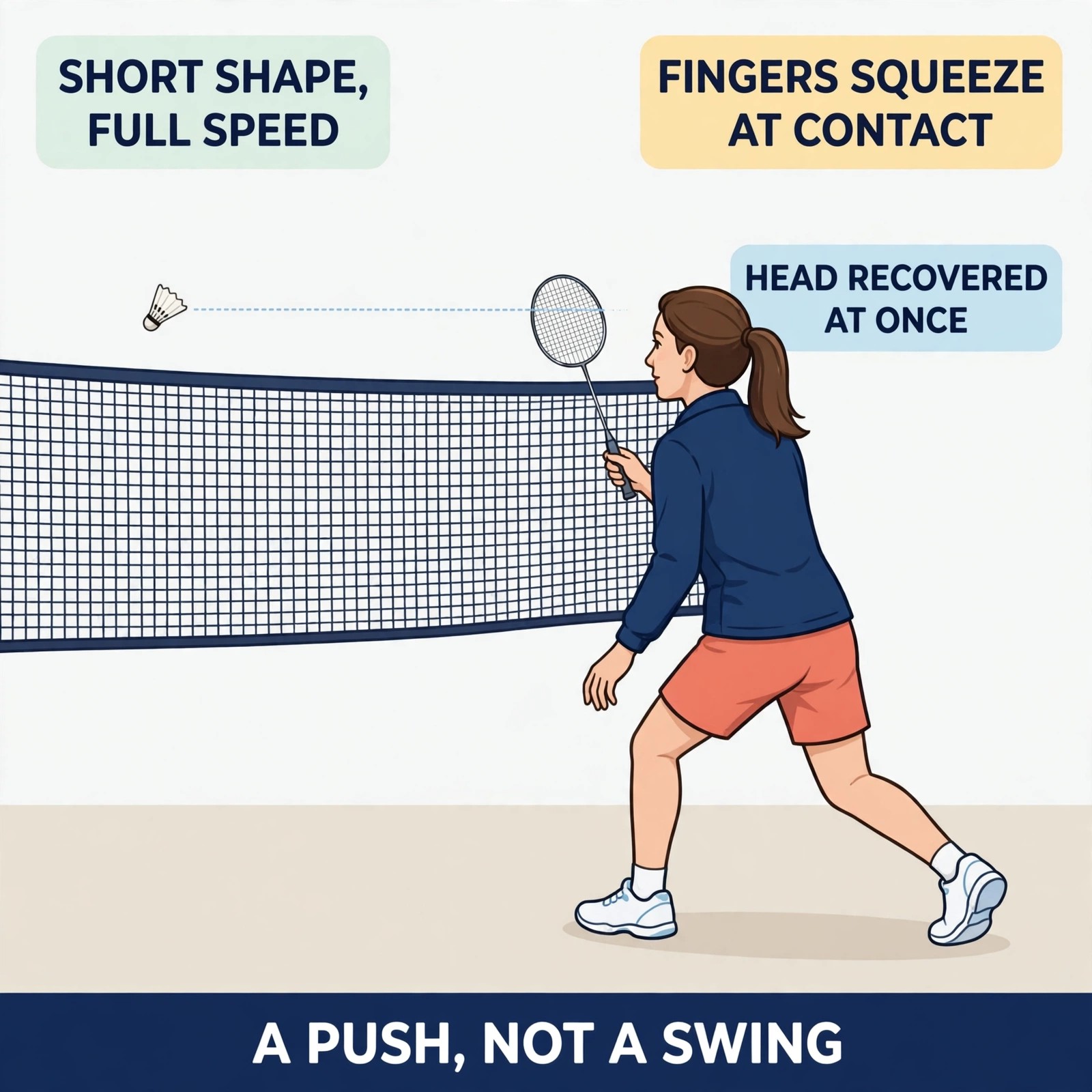
The swing is a push, not a swing. The backswing is a few centimetres: the head comes slightly back as the elbow sets, then the forearm turns and the fingers squeeze through a short contact in front of the body, and the head is recovered upward at once for the next shot. Compare the smash, where the same muscles work over a full arc: in a drive the arc would still be travelling when the return arrives. Flat exchanges are won by the player whose racket is ready again first, and readiness is a short shape plus an instant recovery. Players who feel their drives are slow usually have a long shape, not slow hands.
Drive faults repeat so faithfully that opponents scout for them. The first is the big backswing, borrowed from the smash, which makes the contact late and shows the shot early. The second is the jam: the elbow tucked into the ribs, so drives played at the body are met beside it with the face half closed, popping up or catching tape. The third is the open face, drifting upward through contact, which turns a drive into a lift one centimetre at a time until the smash arrives. The fourth is the dropped racket between shots, resetting the carriage to zero after every contact. Each fault has a training answer in this page’s order: carriage first, shape second, flight last.
Drive Check #3
The Flat Flight: Tape Height And The Body Line
The flight is the drive’s whole argument, and it is judged in centimetres above the tape. A good drive crosses flat and close, still travelling level or just starting to fall as it passes the receiver, and lands in the middle or back area without ever offering height to hit down on. A drive that crosses a hand above the tape has given the receiver a shuttle she can step into and drive back harder; a drive that climbs after contact is not a drive at all, whatever the player intended. This is why height control is coached before line: the straight drive, the crosscourt drive and the drive at the body are all the same flat flight wearing different addresses.
Where the drive goes matters, and the honest order starts with the body. A drive at the receiver’s racket side hip rushes the reply most, because it jams the swing at its shortest. A drive into the middle area between partners creates the hesitation doubles players know well, each waiting for the other. The change to the open side comes last, played off the same shape when the receiver has started leaning toward the body line. What the order avoids is the sideline as a first address: drives aimed at lines donate wides without rushing anyone, and the mid court is won by pressure placed where replies are weakest, not by paint shaved where errors live.
A flat exchange is a duel with a simple rule: the side that loops first loses it. Drives answer drives, each reply a fraction earlier and flatter than the last, until one side meets the shuttle late and has to lift. That lift, played from below the exchange’s height under time pressure, is the point of the whole argument: it is the smash chance the drives were building. This is why patience inside the exchange is a skill rather than a mood. The player who gets bored and tries to finish a drive rally with a smash swing loops the shot herself and donates the very lift she was waiting for. The exchange rewards the last player still playing drives.

Drive Check #4
The Duel: Winning The Flat Exchange
Position for the drive is the middle court held honestly: close enough to meet drives in front, far enough back that a lift over the top is still reachable, racket carriage high and feet loaded. In doubles this is the front and middle player’s working address, shared with a partner whose drives from the back are flatter and rarer. In singles the drive is played from wherever the rally offers it, usually answering a short lift or a loose block from the front and middle. The common fault is drifting: creeping toward the net until lifts sail overhead, or sagging toward the back until drives land at the feet. The address is a discipline remade after every shot, not a place a player stands once.
The change of line is the drive’s second weapon, and it is played from the same carriage and the same short shape. Straight drives hold the receiver in place; the crosscourt drive, turned by a fraction of face angle at the same contact point, sends her across the court and opens the straight side for the next shot. Because the shape does not change, the receiver cannot read the line from the swing: she has to read the shuttle, by its line and speed off the face, which is a slower read than any tell. Players who wind up differently for the crosscourt give the read away free, the same error as a separate smash swing, and it is coached out the same way, with counted sets where the line is called late.
Under pressure the drive fails in two honest ways, and each points at its own repair. Drives that climb late in games are usually grown swings: the player, chasing a finish, lengthens the shape rally by rally until the loop appears and the smash answers it. Drives that catch the tape late are usually dropped carriages: the racket sinks between shots as legs tire, contacts drift back beside the body, and the flat shot becomes a jammed one. Neither is fixed by deciding to concentrate, because both are physical drifts with physical repairs: shape shortened back to the push, carriage rebuilt in counted flat sets with scores announced, until the exchange at 19 all looks like the one from the warm up.

Drive Check #5
Drive Drills That Groove The Exchange
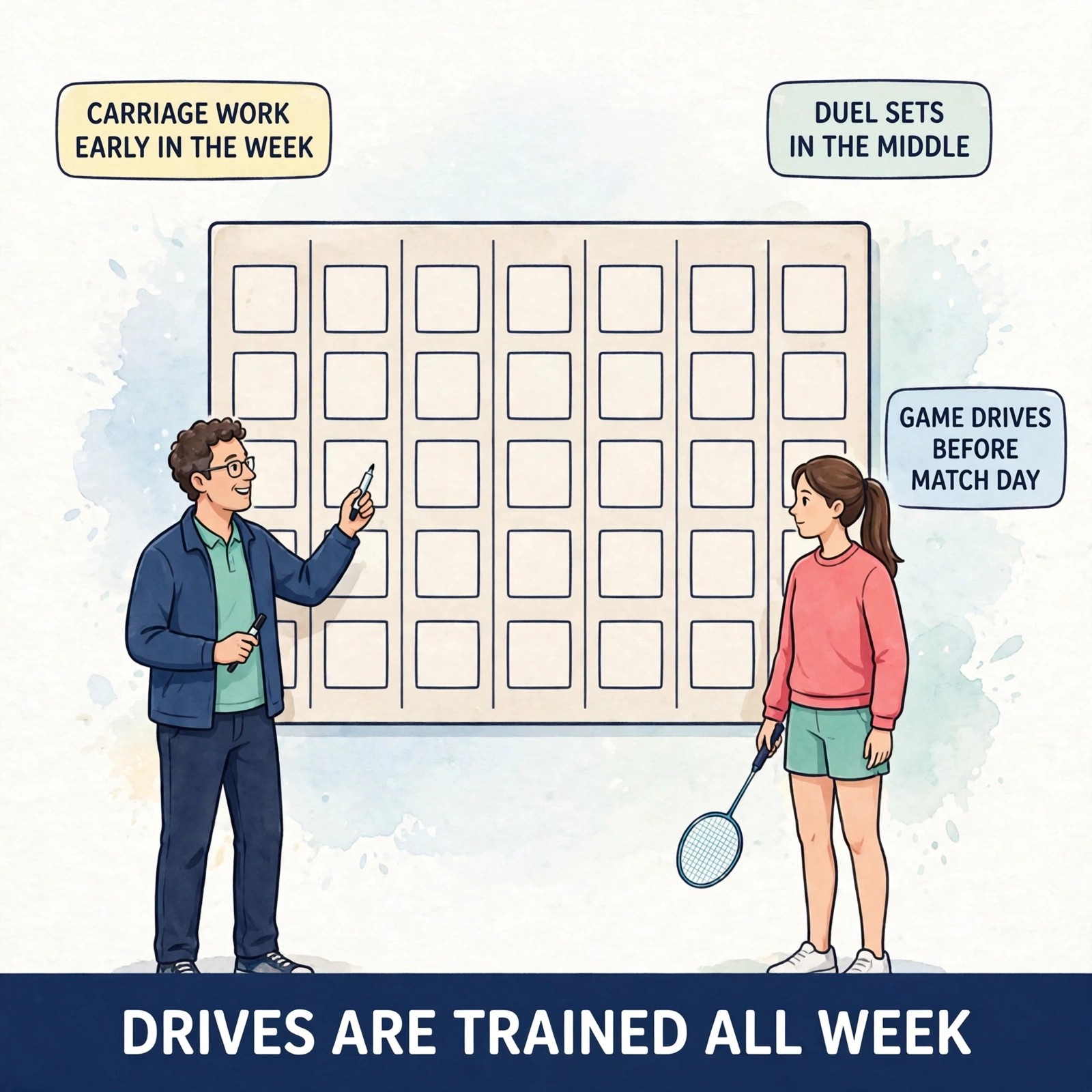
We train the drive in an order that raises the price of looping. First, carriage sets: the racket up, elbow out, grip checked, drives played against feeds at a pace the shape survives, crossings called flat or looped by a partner at the side. Second, duel sets: two players driving at each other from the middle court, the rally scored against whoever loops or lifts first. Third, change of line sets: the coach or a caller names straight or crosscourt late, the drive played off the same shape, lines counted. Last, game sets: drives inside conditioned rallies where the exchange is graded by the reply it forces. Each stage removes a hiding place the previous stage left.
Progress is counted in crossings and exchanges, not in how fast the drives felt. Flat crossings out of ten: drives that crossed at tape height without climbing, judged by a partner at the side post, the purest measure of the flight. Exchange lengths: how many drives your side sustains before looping, counted across duel sets, because the rally grades patience in numbers. And the reply split: rallies where your drive forced the lift against rallies where it was driven back harder, because that split is the shot’s actual job description. Feelings are unreliable in the mid court, since a looped drive feels powerful right up to the smash. The counts strip the story away.
The signs a drive has taken hold show up in the opponents before they show in the player. Opponents start lifting earlier: the flat exchange stops paying them, so they give the mid court back and defend from deep, which hands your side the attack the drives were building. Your own errors change shape: the misses become drives a fraction into the tape rather than loops a metre over it, the errors of a shot living close to its limits. And partners start calling for the drive rally, because the exchange has become a place your side wins. That is when the work widens, to the backhand drive as the mirror and the drive inside singles patterns, each grooved the same way, carriage first and counts beside it.
Myth vs Reality
Myths About Forehand Drives
Myth: a drive is a small smash, so it should be hit with a proper backswing and full effort. Reality: the drive is a push played at exchange speed, and the full swing is its most common fault. A backswing that would suit the back court makes the mid court contact late, shows the line early and leaves the racket travelling when the reply arrives, which in a flat exchange is almost at once. The heaviest drives look like almost nothing: carriage high, a short turn of the forearm, fingers squeezing through contact, head recovered before the shuttle lands. Speed in this shot is earliness wearing a disguise, and earliness is trained with shape, not effort.
Myth: drives should be aimed at the sidelines to stretch the receiver. Reality: the sideline is the error border of the mid court, and drives aimed at it donate wides without rushing the reply at all. The addresses that win exchanges are the body, which jams the swing, and the middle, which splits partners and slows both. A drive landing a racket length inside the line, at the hip, is worth more than a prettier one on the paint, because its value is measured in the reply it forces. Over a season the wide count explains why line aiming drivers lose exchanges to body aiming ones who hit a less glamorous target.
Myth: the drive is a defensive shot, something you play when you are in trouble. Reality: the drive is pressure, the shot that takes time away and builds the attack. It is played from a set carriage at a shuttle met early, which is the opposite of trouble, and its whole design is to force the lift your side smashes. Players who treat drives as emergency replies play them late, beside the body, with whatever shape panic offers, and then conclude the shot is weak. The shot is not weak. The emergency version is. Grooved as an attacking habit, the drive is the reason some mid courts feel rushed even when nobody is smashing.

Why Choose Us
Why Players Choose ST Badminton Academy
Players choose ST Badminton Academy for drive work because we coach the shot as an exchange skill with a flight attached, not as fast hands you either have or lack. Your carriage is checked before your speed is praised, your flat crossings are counted out of ten, and your duel sets are scored against the first loop so patience is measured rather than assumed. In a group of no more than four students, there is time to stand at the side post and call your crossing height shot by shot, which is where flat play is actually learned. Many sessions admire quick hands. We also count crossings, because the player whose numbers are honest knows exactly what to train next.
The sessions run the way this page describes. Drive work sits inside regular training: carriage sets early with crossings called aloud, duel sets scored against the first loop, change of line sets with the call made late, and game sets where exchanges are graded by the reply they force. Coaches watch the elbow and the racket carriage together, since the drive fails when either one drops, and the notebook records flat crossings out of ten and the longest exchanges for every drive block. A student can point to the week her loops halved, and to the drill that did it, and that traceability keeps the work honest when a bad match argues otherwise.
We are based in Setapak, Kuala Lumpur, and students join us from across the Klang Valley, some travelling in from Wangsa Maju, Gombak and Setiawangsa for evening sessions. Drive coaching sits inside regular badminton sessions, not in a separate flat play clinic: your carriage, your shape and your line changes are trained in the same hour as your net play, your defence and your games, because that is where the drive has to hold, inside exchanges against opponents trying to loop you first. A drive grooved only against gentle feeds is a rumour about yourself. The duel sets in the same hour settle whether it is true.
FAQs: Forehand Drive And Badminton Training in Malaysia (KL)
These are the questions players ask us most about developing the forehand drive, before they book and during their first weeks of working on it. The short version runs through all of them: carriage up, shape short, flight flat, and count crossings and exchanges. The longer answers follow, including the ones about drives climbing under pressure, practising flat play alone without a partner, and how a first session with us actually works.
Can a beginner learn the forehand drive in training in Setapak or Gombak?
Yes, the forehand drive is a kind first skill because the shape is short and the feedback is instant: every crossing is flat or it loops. Beginners start with carriage and flat feed work in our Setapak sessions, in groups of no more than four students, and count flat crossings from the first week.
What is the first drive habit a new player should build in KL?
The first habit is the carriage: racket up and in front, elbow carried away from the ribs, grip resting in the fingers. That position is the promise every drive comes from, because flat exchanges are decided by who meets the shuttle in front first, and a dropped racket has already answered late.
Why do my drives keep climbing into smashes at a serious level?
Under pressure the shape grows and the carriage drops: chasing a finish, players lengthen the swing until drives climb, and tired legs let the racket sink until contacts jam beside the body. Both are drifts, not lost talent. Counted duel sets with the score announced train the short shape at 19 all.
My drives work in drills but loop in matches. Should I hit them harder or shorten the shape first?
Shorten the shape first. A bigger swing makes the contact later and the flight higher, which is the loop you are trying to escape. We return to the push shape against flat feeds, count ten tape height crossings, and only then rebuild the duel at full exchange speed.
How can I practise the forehand drive when I train mostly on my own in between classes?
Yes, in parts. You can groove the carriage and the short push shape in front of a mirror, hold the racket up through daily shadow sets, and drive against a wall if you have one, counting flat returns. The duel itself needs a partner driving back, which is what sessions are for.
Do you coach the forehand drive beside badminton training near Wangsa Maju?
Yes. We coach the forehand drive from our base in Setapak, a short drive from Wangsa Maju, and players from that side train with us every week. The work sits inside regular sessions rather than a separate clinic, so your carriage, shape and line changes are coached beside your net play and games.
Where does ST Badminton Academy teach badminton training in Malaysia?
We teach at our base in Setapak, Kuala Lumpur, and students travel in from across the Klang Valley. Sessions run with no more than four students per group, because flat play is learned from crossings called shot by shot, and that coaching needs a coach close enough to watch your elbow.
How do I book a trial session to test my drive?
Message us to arrange a trial at a time that suits your week. Bring your racket and court shoes, and we will watch your mid court game for the first part of the session, then feed you ten flat drives and count the crossings, so your first repair comes from evidence rather than opinion.
What makes Mr Eric Chuar a suitable coach for the forehand drive in badminton?
Mr Eric Chuar coaches the academy sessions himself, with more than 15 years of coaching in Malaysia and Singapore, so the person judging your carriage is the person who built the programme. His drive coaching is plain spoken: racket up, shape short, flight flat, and count the crossings out of ten.
Badminton Forehand Drive Training in Action


We benchmark our forehand drive coaching against World Badminton (BWF) coaching standards and our own academy values: before any player trusts a training plan, they deserve honest checks. You can verify our coaches' credentials through the Badminton Association of Malaysia (BAM) coach education pathway.
One standard governs how we coach the drive: the crossing judges the flight, and the reply judges the shot. A coach here will ask how many of your last ten drives crossed flat and what the replies were before asking how fast any of them felt, and will check your carriage before admiring your hands. We also hold an honesty rule about what drive work can promise: a trained drive wins more flat exchanges and forces more lifts, and it cannot promise points on demand, because opponents train too. What coaching promises is a high carriage, a short shape and crossings counted in the open. Players deserve pressure built on evidence.
| Factor | Loopy Players | Flat Players FOREHAND DRIVE |
|---|---|---|
| Frequency | 1 or 2 times a week. Mostly for fun and sweat. | A flat player carries the racket up, meets the shuttle in front and pushes it at tape height, so the reply is rushed every time. |
| Drills Focus | Basic static feeding. Minimal footwork pressure. | Drive technique is built in order: the carriage, the short push shape, the flat flight, then the change of line. |
| Physical Conditioning | Rarely included. Just playing games on court. | Core, agility, and speed training included in every session to prevent injury and build stamina. |
| Tactical Awareness | "Just hit it over." No real game plan. | Video analysis, point construction, and learning to read the opponent's game. |
| Coach Ratio | Large groups (8-10 kids). Coach barely watches you. | Max 4 students. Mr Eric Chuar personally corrects every stroke and movement detail. |
| Goal Setting | Fun and exercise. | The flat player counts tape height crossings out of ten, so her mid court improves on a measure. |
| Long Term Result | Good recreational player. | A loopy player swings big and meets the shuttle late, so her drives climb into the smash the other side was waiting for. |
Badminton Forehand Drive Training in Kuala Lumpur
Your drive starts with one honest set of ten. This week, stand in the middle court with a partner feeding flat and play ten forehand drives, then write down two numbers: how many crossed at tape height without climbing, and how many looped high enough to be smashed. Then bring those numbers to a session with us and we will check your carriage and your contact point, and rebuild the fault the counts point at. No bigger swing first. Just a racket carried up, a short push, and a shuttle that stays flat.


