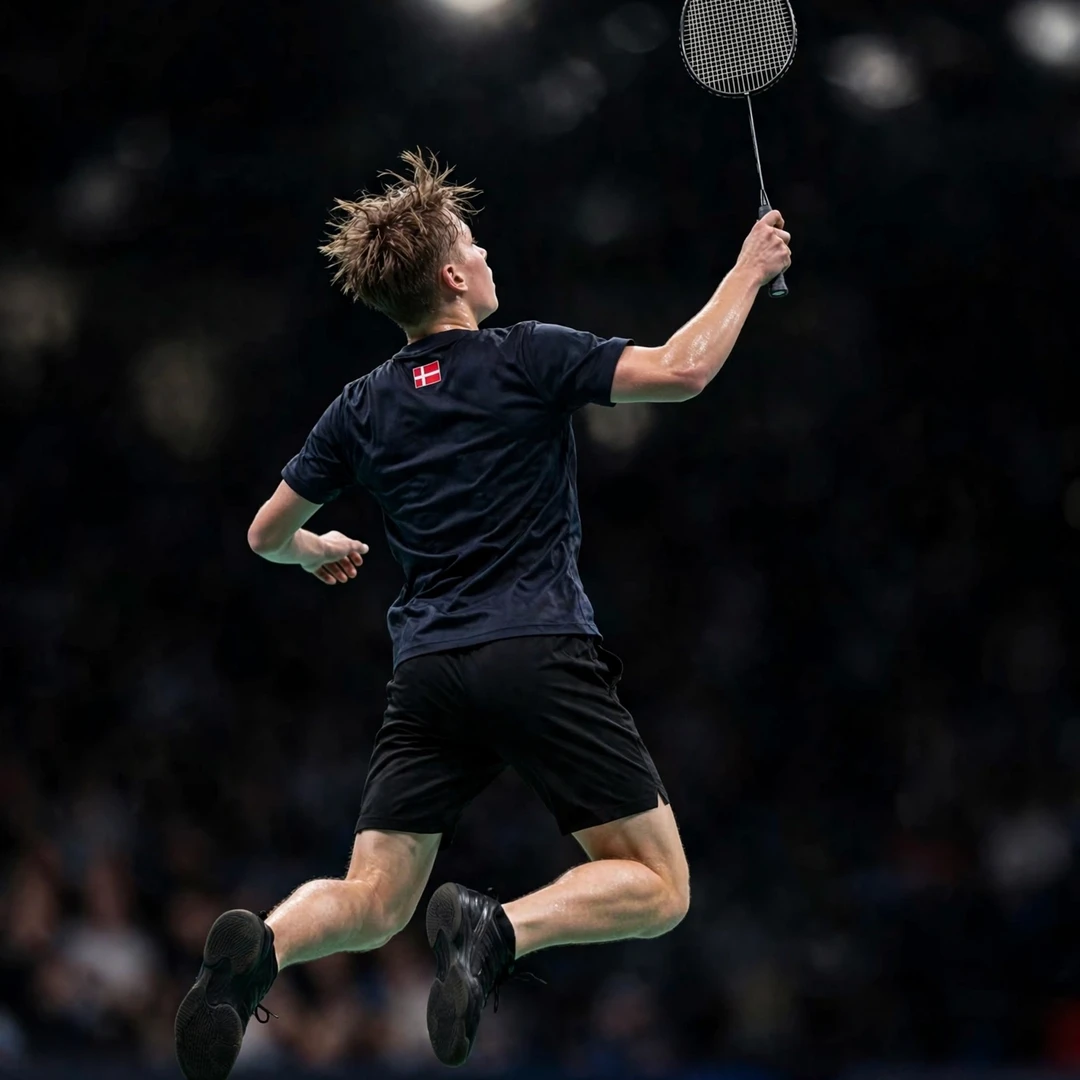
Korean Men’s Singles Badminton Star
Choi Jihoon

South Korea
Player Event: Men’s singles
Date of Birth: 21 February 2001, South Korea · Left-handed
Playing Style: Left-handed rally player with a heavy cross-court forehand, patient defence and a cool head in deciding games
Known For: Beating world No. 21 Chi Yu Jen at the 2026 Thomas Cup to spark Korea’s 3–2 comeback against Chinese Taipei, and reaching the 2023 Indonesia Masters II final as a qualifier
Journey: World-ranked at fifteen in 2016 · Took a game off Lakshya Sen at the 2022 Korea Open · Super 100 finalist in 2023 · Career-high world No. 78 in May 2026
Understanding Choi Jihoon (Korean Badminton Star)
Choi Jihoon is a South Korean men’s singles player who stands at world No. 87 in the Week 43 BWF world rankings of 20 October 2026, with 21,795 points. His story is one of the longest climbs in the top 100: world-ranked at fifteen, a game taken off a top-ten star as a teenager-ranked outsider, a first World Tour final in 2023, a lost year that dropped him outside the top 1,000 — and then a comeback that peaked with a career-high No. 78 and a Thomas Cup win the BWF called the turning point of a famous comeback. Read on for his early years, his breakthrough results and the left-handed rallying style young players can study.
Early Life in Korea and a World Ranking at Fifteen
Choi Jihoon was born on 21 February 2001 and came through South Korea’s famously deep junior badminton system, where a talented teenager trains and competes against many of the strongest juniors in Asia every week. Korea produces world-class players in every discipline, and the internal competition for places is fierce — which makes what Choi did next so unusual. In December 2016, at just fifteen years old, he appeared in the BWF world rankings for the first time, at No. 885. Most players his age are still years away from a senior ranking of any kind.
Climbing Through the Korean Junior Ranks
From that first ranking, the climb was steady rather than spectacular. By 2019 he had worked his way to around No. 375 in the world while still a junior — a strong position in a country where even the national junior squad is stacked with future internationals. The pandemic years stalled his momentum, as they did for a whole generation of Asian juniors, and through 2021 and 2022 he moved between roughly No. 350 and No. 500. What he had by then, though, was exactly what the Korean system is designed to build: a complete, reliable all-court game and years of high-level sparring behind him.
Taking a Game Off Lakshya Sen at the Korea Open
The wider badminton world first noticed him in April 2022, at the Korea Open, a Super 500 event in Suncheon. Choi was ranked No. 498, playing one of the biggest home events of the year, and his first-round opponent was India’s Lakshya Sen — a World Championships medallist then sitting inside the world’s top ten. The teenager-ranked outsider refused to be overawed: he took the first game 21–14, and held on so stubbornly that Sen needed 62 minutes to escape 14–21, 21–16, 21–18. Taking a game off a top-ten player, in a 62-minute fight, announced that Choi’s rallying game could live with elite pace and power.
The 2023 Breakthrough: A World Tour Final in Surabaya
His breakthrough season came in 2023. At the Indonesia Masters II in Surabaya, a Super 100 event, Choi came all the way through qualifying and kept winning: in the semi-finals he beat the tournament’s top seed, Chinese Taipei’s Su Li-yang, in straight games. That put him into his first BWF World Tour final, where Japan’s Takuma Obayashi — who would go on to become one of the most consistent Super 100 players on the circuit — beat him 21–8, 21–19. A runner-up finish as a qualifier remains, to this day, his best World Tour result, and it showed his ceiling: when his rallying game is flowing, he can beat seeded players back to back.

Career Milestone #1
From Qualifier to Semi-Finalist at the KL Masters
A few weeks later he did it again. At the KL Masters Malaysia Super 100 in Kuala Lumpur, Choi came through qualifying once more and produced the win of his season in the quarter-finals, stunning eighth seed Sameer Verma of India 21–9, 21–13 — leading from the first point, and closing the first game with a run of seven straight points. His run ended in the semi-finals against Malaysia’s Leong Jun Hao, who won 21–17, 21–16 and went on to take the title. In the same season he also qualified for the main draw of his home Korea Open, beating England’s Rohan Midha 21–7, 21–13 on the way.
By the end of 2023 Choi had reached No. 144 in the world — a career best at the time — built almost entirely on two autumn runs in Surabaya and Kuala Lumpur. The pattern of his game was now clear to anyone watching the Super 100 circuit: a left-hander who rarely beats himself, extends rallies until opponents crack, and saves his best badminton for the biggest names in the draw. The 2023 season also proved how fragile ranking progress is for players at his level: two good weeks had carried him more than 300 places, and everything depended on backing them up.

Career Milestone #2
The Lost Year and the Long Road Back
Then came the lost year. In 2024 Choi played little international badminton, and the 52-week ranking system is unforgiving: as his 2023 points expired, he slid all the way outside the world’s top 1,000. For most players, that is where the story ends — without a ranking there are no main draws, without main draws there are no points, and the climb back looks impossible. Choi’s career could easily have become a footnote: a two-week wonder from the autumn of 2023.
Instead, he rebuilt. Returning to the circuit full-time in 2025 meant starting again in qualifying draws and at smaller events across Asia and the Pacific — the Northern Marianas in the Pacific, Malaysia, Taiwan, Indonesia — collecting points a few hundred at a time. It is unglamorous work: early-morning qualifying matches, long travel, small halls. But week by week the ranking moved the right way, from outside the top 1,000 back inside the top 200, and by the end of 2025 he stood at No. 109 — already higher than his pre-2024 peak.
The practical lesson of the comeback is in its structure. Choi did not wait for wildcards or big invitations; he entered everything his ranking allowed, treated International Series and Challenge events as seriously as Super 100s, and let the points accumulate. His 2025 season also took him to the FISU World University Games in Germany’s Rhine-Ruhr region, representing Korea in the team and individual events — a reminder that at this level of the sport, a player’s calendar is built from many kinds of weeks, not just the televised ones.

Career Milestone #3
Comeback Season: Quarter-Finals Across Asia and the Pacific
The results followed the ranking. In 2025 Choi reached the quarter-finals of the Northern Marianas International in June and the Crowne Plaza Northern Marianas Open in August, the Malaysia International Series in September, the Kaohsiung Masters — a Super 100 in Taiwan — in the same month, and the Indonesia Masters II in October, returning to the event where he had made his first final. Five quarter-finals across five countries in five months is the profile of a player whose level has stabilised: no longer reliant on one hot week, but competitive everywhere he plays.
The Kaohsiung week showed both his level and his next target. He beat Indonesia’s Prahdiska Bagas Shujiwo 21–15, 21–9 in the round of 16 before losing his quarter-final to Japan’s Riki Takei, 16–21, 10–21 — Takei being another of the Super 100 circuit’s form players. A month later, at the Malaysia Super 100, he beat China’s Hu Zhe An in three games to reach the round of 16, and in November he reached the same stage at the Irish Open and the Scottish Open on the European leg. Early in 2026 he was back in Korean colours at the Badminton Asia Team Championships in Qingdao, China.
Nothing, though, compares with the last week of April 2026 in Horsens, Denmark. Choi was selected in Korea’s singles line-up for the Thomas Cup — the men’s world team championship — on a squad the BWF preview described as relying on untested singles players. In the group, he took a game off Denmark’s Magnus Johannesen before losing 12–21, 21–17, 15–21. Then came the tie against Chinese Taipei, with Korea trailing 0–2 and one defeat from elimination. Third singles: Choi Jihoon, ranked No. 85, against Chi Yu Jen, ranked No. 21 in the world.

Career Milestone #4
Thomas Cup Heroics and a Career-High No. 78
What happened next is the match of his life so far. Choi took the opener 21–17, lost the second 18–21, and — in the BWF’s own words — “kept his composure” to close the decider 21–16. The BWF report called it the win that gave Korea hope; from 0–2 down, Korea swept the remaining matches to win the tie 3–2, one of the great group-stage comebacks in recent Thomas Cup history. Choi had beaten a player ranked 64 places above him, on the sport’s biggest team stage, with his team’s survival on the line.
He finished the group stage with another win, beating Sweden’s Kim Linell 21–7, 21–17, and the spring of 2026 carried him to a career-high world No. 78 on 26 May 2026 — ten years after he had entered the rankings at No. 885. The season rolled on with a third seeding at the Northern Marianas Open in July and a round-of-16 run at his home Korea Masters. By Week 43 of 2026 he stood at world No. 87 with 21,795 points: inside the top 100, in the Korea national team picture, and with the biggest scalp of his career still fresh in the record books.

Playing Style
The Left-Handed Rallying Style
Choi plays the left-hander’s game the patient way. Because so few elite players are left-handed, his natural cross-court forehand bends rallies into the corner right-handers protect worst — their backhand rear corner — and his angles arrive from the side opponents drill against least. Rather than forcing winners early, he builds the rally: deep clears to both corners, flat drives that hurry the opponent’s feet, and only then the attack, finished with a steep left-handed smash or a sudden cross-court drive. It is an all-court game in which the attack is earned by geometry, not gambled on power.
The evidence for his rallying quality is in his biggest matches. As world No. 498 he made Lakshya Sen play 62 minutes and took the first game; in the KL Masters quarter-final he led Sameer Verma from the first point and closed games with runs of seven and eight straight points; at the Thomas Cup he outlasted world No. 21 Chi Yu Jen in a deciding game with his team 0–2 down. Players who win matches in those three ways — endurance, control and composure — share one foundation: defence and footwork reliable enough that they are still standing, and still thinking, at 16-all in the third.
For developing players, the transferable lessons are the habits behind that record. Left-handers should study how Choi uses the cross-court forehand to open the court before attacking straight; right-handers should copy the rally construction — push the opponent deep, change pace with drives, and attack only when the lift is short. His composure is just as coachable: between rallies he resets at the same speed whether he has won or lost the point, which is exactly the habit the BWF highlighted in Horsens. None of it needs rare talent. All of it is trainable.

Mental Strength
Composure and the Ten-Year Climb
The defining quality of Choi’s career is composure under stacked pressure. The Thomas Cup tie against Chinese Taipei is the clearest example: his team was 0–2 down, the Korean singles line-up had been described beforehand as untested, and his opponent was a top-25 player. Choi’s response was to play his normal game — long rallies, patient construction — for three full games. Pressure, for a player built by a decade of qualifying draws, is just another rally to construct properly.
His resilience is measured in ranking lines. First ranked No. 885 at fifteen in 2016; around No. 375 as a junior; a famous cameo against Lakshya Sen in 2022; a first World Tour final and a No. 144 peak in 2023; outside the top 1,000 in 2024; No. 109 by the end of 2025; and a career-high No. 78 in May 2026, earned alongside a Thomas Cup hero performance. Almost no player in the current top 100 has fallen as far and climbed back as high. Each collapse was answered not with a new game, but with the same game, played more often, in more places.
The practical lessons for young players are unusually clear in his story. Set the target in stages — a first world ranking, then the top 500, the top 150, the top 100 — because each stage needs different results. Enter the events your ranking allows rather than waiting for bigger ones: Choi’s comeback was built at tournaments in the Northern Marianas, Malaysia and Taiwan. And protect the long game: a player ranked at fifteen and peaking at twenty-five is not behind schedule — in a sport where careers run into the thirties, he is right on it.

Learning Reference
ST Badminton Academy Connection
ST Badminton Academy has no formal partnership with Choi Jihoon. We share his story because the route he took — a deep national junior system, years of smaller events, a ranking collapse answered by a patient rebuild — is the honest version of how professional badminton careers are actually made, and it matches what we tell the families we coach in Kuala Lumpur and Singapore. Almost every junior who dreams of the World Tour will face a version of his 2024: a year when the results stop. What matters is the response.
Our students study three of Choi’s matches as film work: the 2026 Thomas Cup decider against Chi Yu Jen, for rally construction under maximum pressure; the 2023 KL Masters quarter-final against Sameer Verma, for front-running a match from the first point; and the first game he took off Lakshya Sen at the 2022 Korea Open, for how a complete rallying game troubles even a top-ten opponent. His cross-court patterns, his between-rally routines and his left-handed angles are drills we can set for juniors the same week — no special equipment, just a feeder, a target and repetition.
We also use his story honestly with parents. Choi took ten years to travel from No. 885 to a career-high No. 78, with a fall outside the top 1,000 in between — and his biggest career moment came not at a glamorous Super 1000, but in a team tie his country was losing 0–2. That is what real development looks like, and it is why we build junior programmes in stages at ST Badminton Academy: ranking milestones, not single tournaments, are the measure of progress.
FAQs: Choi Jihoon Korean Badminton Player
Here are answers to frequently asked questions about Choi Jihoon, the South Korean left-hander whose Thomas Cup comeback win over Chi Yu Jen made him one of the stories of 2026.
Who is Choi Jihoon and which country does he represent in badminton?
Choi Jihoon is a men’s singles player who represents South Korea. Born on 21 February 2001, he is left-handed, stands at world No. 87 in the Week 43 BWF rankings of October 2026 with 21,795 points, and reached a career-high of No. 78 in May 2026. He is best known for beating world No. 21 Chi Yu Jen at the 2026 Thomas Cup and for reaching the final of the 2023 Indonesia Masters II as a qualifier.
What are Choi Jihoon’s biggest badminton achievements?
His biggest achievements are the win over world No. 21 Chi Yu Jen at the 2026 Thomas Cup in Horsens — the turning point of Korea’s 3–2 comeback from 0–2 down against Chinese Taipei — and the runner-up finish at the 2023 Indonesia Masters II, a Super 100 event he entered through qualifying. He also reached the semi-finals of the 2023 KL Masters Malaysia Super 100, beating eighth seed Sameer Verma on the way, and took the first game off top-ten star Lakshya Sen at the 2022 Korea Open.
What is Choi Jihoon’s playing style?
Choi is a left-handed rally player. His cross-court forehand bends rallies into the backhand corner of right-handed opponents, his defence and footwork let him extend exchanges until opponents make mistakes, and his flat drives and steep left-handed smash finish the points his construction creates. His composure in deciding games — shown most famously against Chi Yu Jen at the Thomas Cup — is the other half of the package: he plays the same patient game at 16-all in the third as at 3-all in the first.
How did Choi Jihoon perform at the 2026 Thomas Cup?
He was one of the heroes of Korea’s group campaign. Choi took a game off Denmark’s Magnus Johannesen, then, with Korea trailing Chinese Taipei 0–2, beat world No. 21 Chi Yu Jen 21–17, 18–21, 21–16 in the third singles to start a comeback Korea completed 3–2 — a result the BWF credited to his composure. He closed the group stage by beating Sweden’s Kim Linell 21–7, 21–17.
How can my child learn from Choi Jihoon’s training approach?
Copy his calendar and his patience first. Choi rebuilt his career by entering every event his ranking allowed — International Series, Challenge and Super 100 tournaments across Asia and the Pacific — and collecting points steadily, and by structuring each climb in stages. On court, borrow his specifics: daily net-skill touches, cross-court pattern drills for left-handers, long-rally conditioning, and a fixed between-rally routine so pressure points look like ordinary ones.
Did Choi Jihoon win any junior titles?
Choi’s rise was not built on junior titles. He was world-ranked at fifteen and reached around No. 375 while still a junior — strong progress inside Korea’s deep system — but his breakthrough results all came in senior badminton: the game off Lakshya Sen in 2022, the World Tour final in 2023 and the Thomas Cup win in 2026. His career is a useful reminder that junior titles are one pathway, not the only one.
What are Choi Jihoon’s best World Tour results?
His best World Tour results are the runner-up finish at the Super 100 Indonesia Masters II in 2023 — where he beat top seed Su Li-yang in the semi-finals — and the semi-final at the Super 100 KL Masters the same year. At Super 500 level he took a game off Lakshya Sen at the 2022 Korea Open and reached the main draw again in 2023, and in 2025 he added Super 100 quarter-finals at the Kaohsiung Masters and a round of 16 at the Korea Masters in 2026.
What playing style should young players learn from Choi Jihoon?
Young players should copy his patience and his patterns. Choi wins by constructing rallies — deep clears, cross-court forehands into the awkward corner, flat drives to hurry the opponent — and by defending well enough to still be composed at the end of the third game. Left-handers can study his angles directly; every player can copy the discipline, the stage-by-stage targets and the refusal to panic when a season, or a match, starts badly.
Does ST Badminton Academy have any connection with Choi Jihoon?
No. ST Badminton Academy has no official partnership with Choi Jihoon or the Badminton Korea Association. This profile is an educational resource for our students and parents, highlighting a player whose ten-year climb, lost-year comeback and Thomas Cup composure offer genuine lessons for junior players in Malaysia and Singapore.
Choi Jihoon Career Highlights


Career Statistics and Rankings
Choi Jihoon, born 21 February 2001, is South Korea’s left-handed comeback story: world-ranked at fifteen, a Super 100 finalist in 2023, outside the top 1,000 in 2024, and a Thomas Cup hero with a career-high world No. 78 in 2026. At world No. 87 in October 2026 and still only 25, he is building the next stage the same way he built every previous one — one rally, one event, one ranking line at a time.
| Development Area | Common Misconception | What Choi Jihoon's Career Shows REALITY |
|---|---|---|
| Junior Foundation | Talent alone decides who becomes a champion. | Choi was already in the BWF world rankings at fifteen — No. 885 in December 2016 — and climbed year by year through Korea’s deep junior system: a structured junior base came first. |
| Playing Style Priority | Kids should copy the flashiest attacking shots. | Choi built a complete rallying game first; his left-handed cross-court forehand is the finishing touch on reliable footwork, defence and net play. |
| Fitness Importance | Juniors can out-train everyone without rest. | Choi’s ranking slid outside the top 1,000 during a quiet 2024 — his comeback came from a full schedule of smaller events and steady points, not more hours. |
| Mental Approach | Top players never get nervous or upset. | With Korea 0–2 down at the 2026 Thomas Cup, Choi kept his composure — the BWF’s own description — to beat world No. 21 Chi Yu Jen: mental skills are trained, not inherited. |
| Attacking Training | Smashing harder is always the answer. | His 21–17, 18–21, 21–16 Thomas Cup win over Chi Yu Jen and the game he took off Lakshya Sen at the 2022 Korea Open came from rally patience and placement, not raw power. |
| National Milestones | Only world titles matter. | Choi's runner-up finish at the 2023 Indonesia Masters II and his KL Masters semi-final the same year made him a Korean national-team regular — Super 100 milestones build a career step by step. |
| Career Timeline | Champions peak once and fade fast. | From No. 885 as a fifteen-year-old in 2016 to a career-high No. 78 in 2026, Choi proves sustained development beats a short peak. |
Study Choi Jihoon's Work Ethic and Professional Approach
This profile explains who Choi Jihoon is and how young players can learn from his left-handed rallying game, his calendar discipline and his composure. For badminton training in Kuala Lumpur and Singapore, book a trial class with ST Badminton Academy via WhatsApp at +60 17-684 2136.