My Child Wants Competitive Badminton but I Want a Recreation Class (Training Goals Guide)
The application form asks about goals, and two honest answers collide. Your child, who talks about tournaments at breakfast, wants competitive badminton: matches, tests, a path with their name on it. You, who watch the same child cry over a lost school game, want a recreation class: friends, movement, fun that ends when the hour ends. Neither answer is wrong, and neither is a small thing. The trouble starts only when a label has to be picked before anyone has looked at what your child can actually do today. This page works through what the two wishes really ask, how readiness is honestly read, and how a family agrees a starting point both sides can honour.

Goals Check #1
What The Two Wishes Really Ask
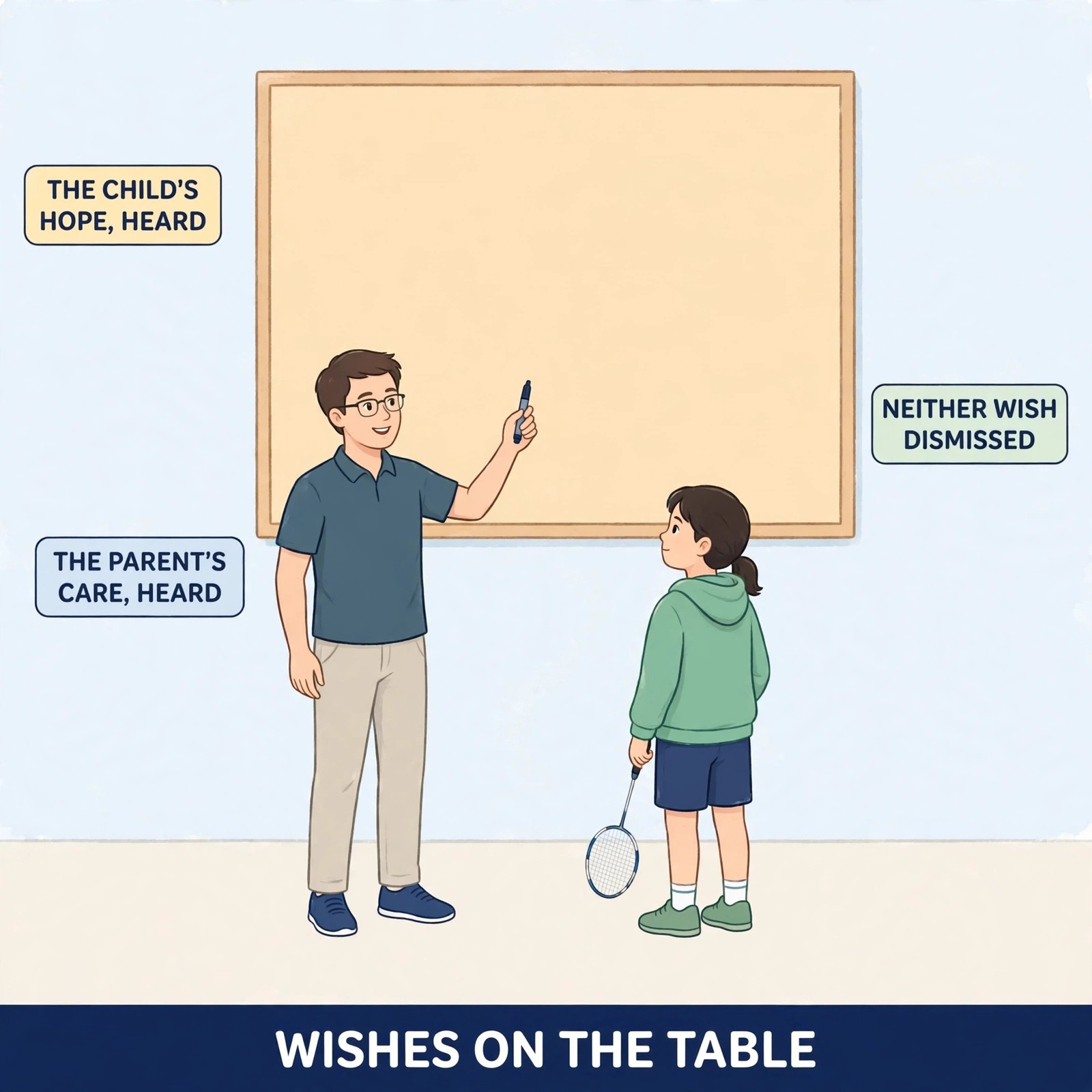
The two wishes, in the way this page uses the terms, are descriptions of an experience, not measurements of a player. The competitive wish says: I want to be tested, I want matches that matter, I want to find out how far I can go. The recreation wish says: I want this to stay enjoyable, I want my child moving, learning and laughing without the week bending around results. Both wishes are about what badminton should feel like from inside the family. Neither one measures what your child currently controls on court: how they get ready, reach the shuttle, make contact and recover for the next shot. Readiness lives in those tasks. Wishes live in the heart. A good plan needs both, in that order of honesty: wishes heard fully, readiness read plainly.
The cost of forcing either label is paid by the child in the middle. Push a child into a competitive track before their tasks hold and the tests stop being information and start being verdicts: confidence thins, lessons become auditions, and the sport they asked for becomes the sport they dread. Hold a child back from every test they crave and the opposite damage grows quietly: boredom, resentment, and the suspicion that the adults are not listening, which can end a sporting life as surely as pressure can. There is a third cost, paid by the family: the wishes become a contest between parent and child, argued at every form and every fixture, while the one question that could settle it, what does this child control today, never gets asked out loud.
Goals Check #2
Inside The Choice: Readiness, Tasks And Real Options
Readiness is read from current tasks, and only from current tasks. Watch what your child controls in an ordinary rally: ready before the serve arrives, reaching a routine shuttle with time to choose, making contact in balance, and starting the recovery without being reminded. Add one gentle pressure at a time: a quicker feed, a wider area, a choice where there was a certainty, and watch whether the sequence holds. That evidence, and nothing else, sets the honest starting point. Ambition is not evidence; it is fuel, and fuel is valuable, but it does a different job. A class label is not evidence either; it is packaging. The tasks are the player, stated plainly.
Ask what each class actually involves before arguing about its name. Recreation, done properly, is not the absence of teaching: real tasks, patient correction and visible progress at a kind pace, with games that stay games. A competitive path, described honestly, adds more than excitement: higher demands, regular tests, selection that does not include everyone, and losing treated as part of the curriculum rather than as an accident. Neither description is a sales pitch. Ask the academy to walk you through an ordinary week in each, what your child would be asked to do, and how readiness for the next demand is checked. Families often discover the two wishes were arguing about names for things that overlap far more than they feared.
Label first thinking repeats on a short list. Ambition used as an entry ticket, as if wanting a thing proves readiness for it. Recreation read as no teaching, as if enjoyment and instruction cannot share an hour. The forced form answer, where a family picks the ambitious box to avoid looking uncommitted. The promised outcome, where a place, a selection or a result is guaranteed by someone selling certainty. And the permanent decision, where today’s starting point is treated as a destiny nobody may revisit. Each fault has the same repair: hear both wishes, assess the current tasks, start where the tasks fit, and agree when the goal will be reviewed.

Goals Check #3
The Honest Cost: Pressure And Labels
Write the disagreement honestly on the application. Record your child’s interest in their words and your own practical limits in yours: the time the family can give, the pressure you are trying to protect them from, the school week that has to keep working. Ask the academy to clarify the arrangement it actually proposes rather than selling you the box you ticked. A misleading answer given to obtain a preferred class helps nobody: the coach plans for a child who does not exist, and the real child arrives to the wrong demands. Honest forms make honest placements, and an academy worth joining would rather read a complicated truth than a tidy fiction.
Hear your child’s wish properly before answering it. Ask what they enjoy about the idea of competing, and listen for the real object underneath: it may be the test itself, the team feeling, the kit and the occasion, a friend who plays, or the wish to be taken seriously. Each of those has more than one size. A child asking for tournaments may be asking for a first friendly match day, which is a very different demand from a season of selection. Children also borrow wishes, from videos, from classmates, from an older sibling’s story. None of that makes the wish fake. It makes it worth exploring kindly, at the kitchen table, before it hardens into a label on a form.
Hear the parent’s care properly too, because limits are information, not obstruction. The time a family can honestly give, the energy a school week leaves over, the worry about a child who takes losing hard: these are facts a good plan is built around, and a parent protecting a childhood is not a parent holding a player back. Say the limits plainly and early, the way you would say them about any commitment, and expect them to be treated as design material rather than as a lack of ambition. A plan that ignores the family’s real life will collapse by half term and take the child’s enthusiasm with it. A plan built inside it can run for years.

Goals Check #4
Choosing Together: A Starting Point Both Can Honour
Agree a starting point both sides can honour. In practice that means a class where your child’s tasks fit today, neither stretched into auditions nor parked below their level, with honest tests sized to their readiness: friendly games, small internal events, a first competition when the sequence holds under gentle pressure. Write the review point into the agreement from the start: after a fair stretch of lessons, the family and the coach look at the same tasks again and ask whether the goal still fits, whether the wish has grown, shrunk or changed shape. Goals are allowed to change. A starting point with a review is a plan. A starting point without one is a bet.
If the wishes stay different after an honest look, choose the reversible step. The smaller commitment that keeps both doors open: begin where the tasks fit, include the tests that fit with them, and let a stretch of real lessons produce the evidence the argument currently lacks. Avoid the two irreversible-feeling moves, the leap into a full competitive load on hope, and the flat refusal that closes the subject for years. Children change their minds as they grow, and so do parents, usually in the direction of whatever the evidence showed them. A reversible start lets the family learn its way to the answer instead of having to win it tonight.
A gentle word for the parent who lies awake over this form. The worry runs in both directions at once: push too hard and break something precious, hold back and waste something rare. Both directions come from the same place, which is love doing sums without enough information. The information exists, and it is ordinary: what your child controls in today’s tasks, watched kindly over a few lessons. Judge the pattern rather than one emotional evening, and let the review do its work. And if the worry keeps growing out of proportion to what the lessons show, it deserves a kind conversation of its own, with someone you trust, because no parent should have to carry a child’s whole sporting future alone at midnight.

Goals Check #5
Goal Drills That Fit The Starting Point
We settle goals in an order that respects everyone at the table. First, both wishes are heard in full, the child’s hope and the parent’s care, with neither translated into a label. Second, the current tasks are assessed in ordinary rallies, so readiness is evidence rather than opinion. Third, a starting point is proposed that fits today’s control, with honest tests sized to it and the family’s limits built in. Last, a review is agreed, where the same tasks and the current wishes are looked at again together. Each stage follows from the one before, and no stage requires anyone at the table to lose.
Progress on a goals plan is counted in task control and in honest competing. Control of the sequence under gentle pressure, ready, reach, contact and recover holding as demands rise one step at a time, is the headline figure. Beside it sit effort and respect inside games, because how a child competes is part of what a competitive path is for, and your child’s own report of enjoyment, because a plan the child dreads is failing whatever the counts say. Results are recorded as one line of context. When control rises and enjoyment holds, the goal conversation has new evidence. When either falls, the review hears about it early.
The signs the starting point fits are easy to live with. Your child looks forward to lessons and talks about the test coming up with more appetite than fear. Tests get asked for, sized honestly, and survived either way, with losing treated as information rather than weather. You can describe the plan to another parent without dread or apology: where they started, why, and when it gets reviewed. And the goals conversation at home becomes ordinary, something discussed over dinner like any other plan, instead of the argument everyone steps around.

Myth vs Reality
Myths About Goals And Labels
Ambition is not readiness, and the distinction deserves a slow look, because confusing the two is where most of the pain comes from. Ambition is a direction: toward tests, toward standards, toward finding out. It is precious, and a coach who cannot hear it should not be trusted with a child who has it. Readiness is a state: what the body and the mind currently control when the rally stops being kind. A child can be full of the first and short of the second, which is the most common picture in junior sport, and a child can quietly hold the second while claiming none of the first, which is commoner than most parents expect. Forcing ambition to do readiness’s job breaks both: the tests arrive before the tools, the results read as verdicts, and the ambition itself starts to look like the problem. The honest sequence is duller and kinder. Feed the ambition with tests sized to the readiness. Grow the readiness inside tasks that fit. Review both, on evidence, at agreed points. Competitive sport also includes selection and losing, and naming that early, plainly and without drama, is respect for the child rather than discouragement: a family that knows what the path contains can choose it with open eyes and enjoy it far longer.
Recreation is not the absence of teaching, and it deserves the same slow look from the other side. A recreation class, run well, teaches the real game: the same ready, reach, contact and recover sequence, the same patient correction, the same counted progress, at a pace and with consequences sized for enjoyment. The difference between the paths is not seriousness. It is demand and consequence: how much is asked at once, what a loss costs, how much of the family week the sport is allowed to claim. Parents sometimes choose recreation apologising, as if they were choosing less coaching, and children sometimes hear the word as a verdict on their ability. Both readings are wrong. Foundations built happily in a recreation class are the same foundations a competitive player stands on, and plenty of strong players started exactly there, moving across when readiness and appetite agreed. Ask what an ordinary session involves, what gets corrected, and what progress looks like inside it. If the answers describe real teaching, recreation is a choice to be proud of, not a consolation.
Goals change, and a good plan treats that as information rather than as a breach of contract. The child who begged for competitions in October may discover by spring that what they loved was the occasion, and settle happily into strong recreation play with the occasional test. The quiet recreation player may grow into their control, start asking for harder games, and be ready for more than the family originally imagined. Parents change too: limits loosen or tighten as work, school and siblings rearrange the week. None of this is inconsistency. It is a family learning, and a plan with reviews built in absorbs it calmly. The trap to avoid is the permanent label: competitive family, recreation child, decided once and defended forever, long after the evidence has moved on. Decide the starting point by today’s tasks. Review it on a rhythm everyone agreed when nobody was emotional. Let the goal be a living part of the plan, revised the way training itself is revised, in the open and without shame.

Why Choose Us
Why Players Choose ST Badminton Academy
Parents choose ST Badminton Academy for goal setting because we hear both wishes before we propose anything. We will ask your child what they hope for, ask you what you need to protect, assess the tasks your child controls in ordinary rallies, and propose a starting point that fits today, with tests sized honestly and a review agreed. In a group of no more than four students, the coach sees the whole sequence per child rather than grading the loudest result. We do not promise places, selections or outcomes, because nobody honest can. We would rather show you a child competing at the size that fits, enjoying it, and building toward more.
A first session with us shows the approach, if you know where to look. Tell us both wishes plainly at the start: what your child hopes for and what you want to protect. Watch whether we assess the current tasks before discussing any label, name the starting point we would propose and the evidence for it, and describe what tests look like at that size. Afterwards, ask three questions. Where would my child start, and why? What would the first honest test be? When do we review the goal together? The answers describe the whole method in miniature. Compare them with any academy that answered the goals question with a label and a promise, because a fitting start is built from watched rallies, not from a form.
Home talk keeps the agreement healthy between reviews. Ask your child what they enjoyed and what felt hard, and let both answers stand without immediate fixing. Praise effort, respect and honest trying before outcomes, and keep results in their place: celebrated when they come, instructive when they do not, never the measure of the child’s worth or the plan’s success. Never promise a place, a selection or a result on a coach’s behalf, even to end an argument kindly; a promise like that will be collected later, with interest. Carry disagreements about the goal to the review, between adults, and let your child simply play in the meantime. A family that talks this way gives a young player the rarest support in junior sport: adults who are calm about the destination and attentive to the next step.
FAQs: Training Goals And Badminton Training in Malaysia (KL)
These are the questions parents ask us most when a child wants competitive badminton and a parent wants a recreation class, before they book and while a starting point is settling. The short version runs through all of them: hear both wishes, read readiness from the current tasks, start where the tasks fit, size the tests honestly, and review the goal together. The longer answers follow, including whether wanting to compete means a child is ready, and how a first session with us actually works.
Can a child who wants to compete start gently in Setapak or Gombak?
Yes. A child who wants competitive badminton is coached with us in Setapak, a short drive from Wangsa Maju, in groups of no more than four students. We hear both wishes, assess the tasks your child controls today, and propose a starting point that fits, with honest tests at the right size.
What should a parent ask first about competitive and recreation classes in KL?
Ask what the proposed class actually involves: the tasks, the demands, and how readiness for the next step is checked. Follow with what happens when interests change. Ambition and labels cannot answer those questions. A starting point set by current task control can, and it can be reviewed as your child grows.
Why does a child’s wish to compete worry parents at a junior level?
Because the wish arrives with pressure attached: selection, losing, and the fear of pushing a child too hard or holding them back. Both worries come from care. The fair answer is an honest starting point, set by what your child controls in today’s tasks, and reviewed as wishes change over time.
My child wants competitions but I want a recreation class. Should we follow their wish or start where their tasks fit and review the goal together?
Start where the tasks fit, and review the goal together. The child’s ambition is fuel and deserves a full hearing, and the parent’s limits are information and deserve the same. Readiness is read from current task control, so the starting point honours both wishes without promising any place or result.
How can parents talk about training goals at home in between classes?
Ask what your child enjoys about competing: the test, the team, the occasion itself. Praise effort and respect before outcomes, keep results in their proper place, and never promise a place or a result on a coach’s behalf. Carry disagreements to the adults at the review, and let the child simply play.
Do you coach children toward competitions beside badminton training near Wangsa Maju?
Yes. We coach children with competitive wishes from our base in Setapak, a short drive from Wangsa Maju, and families from that side train with us every week. The path sits inside regular junior sessions, with tests sized to readiness and the goal reviewed with parents as interests change over time.
Where does ST Badminton Academy teach badminton training in Malaysia?
We teach at our base in Setapak, Kuala Lumpur, and families travel in from across the Klang Valley. Sessions run with no more than four students per group, because honest placement means watching rallies one child at a time, and that needs a coach close enough to see what each child controls.
How do I book a trial session to test my child’s training goals?
Message us to arrange a trial at a time that suits your week. Bring your child’s racket and court shoes, and tell us both wishes plainly: what your child hopes for and what you want to protect. We will watch the tasks, propose the fitting start, and agree when the goal gets reviewed.
What makes Mr Eric Chuar a suitable coach for training goals in badminton?
Mr Eric Chuar coaches the academy sessions himself, with more than fifteen years of coaching in Malaysia and Singapore, so the person assessing your child’s tasks is the person who built the programme. His goal setting is plain spoken: hear both wishes, fit the start to today’s tasks, and guarantee no results.
Training Goals Coaching in Action
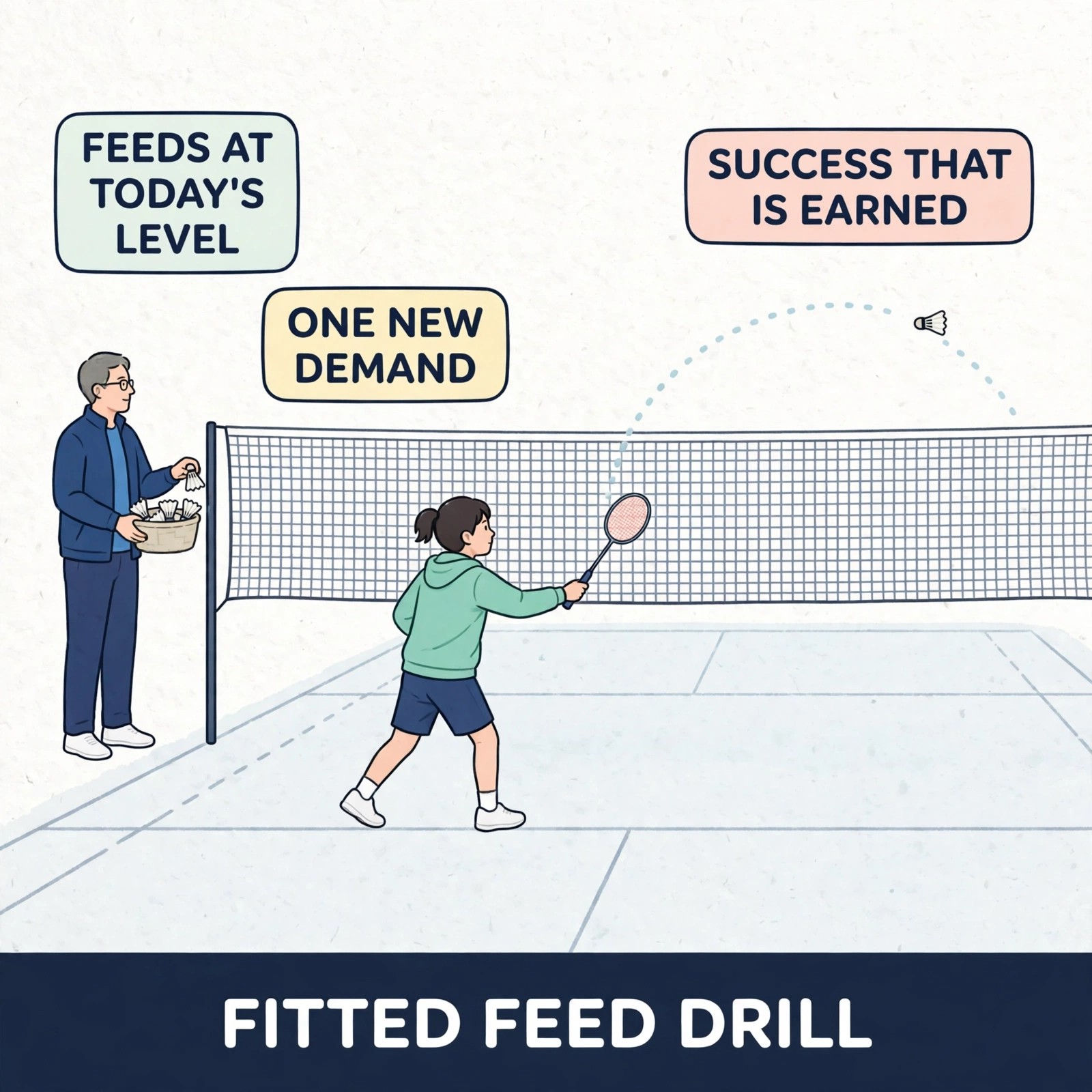


We benchmark our goal coaching against World Badminton (BWF) coaching standards and our own academy values: before any player trusts a training plan, they deserve honest checks. You can verify our coaches' credentials through the Badminton Association of Malaysia (BAM) coach education pathway.
One standard governs how we set goals: what the child controls in the current task judges the starting point first, and the family's wishes judge its direction second. A coach here will hear both wishes in full before proposing an arrangement, and will describe the demands of any path honestly, including selection and losing where they belong. We also hold an honesty rule about what a plan can promise: it cannot promise a place, a selection or a result, because opponents, draws and days decide those. What coaching promises is a fitting start, honest tests, and a review that keeps the goal alive.
| Factor | The Fitting Start Family | The Label First Family GOALS |
|---|---|---|
| Frequency | 1 or 2 times a week. Mostly for fun and sweat. | The label first family picks the ambitious box or the safe box before anyone watches a rally, then defends the choice all term. The child is either auditioning weekly or parked below their level, the two wishes harden into a family argument, and readiness itself is never actually measured. |
| Drills Focus | Basic static feeding. Minimal footwork pressure. | The fitting start family hears both wishes in full, assesses what the child controls in ordinary rallies, and starts where the tasks fit. Tests are sized honestly, family limits are built into the plan, and the goal is reviewed on a rhythm everyone agreed before feelings ran high. |
| Physical Conditioning | Rarely included. Just playing games on court. | Core, agility, and speed training included in every session to prevent injury and build stamina. |
| Tactical Awareness | "Just hit it over." No real game plan. | Video analysis, point construction, and learning to read the opponent's game. |
| Coach Ratio | Large groups (8-10 kids). Coach barely watches you. | Max 4 students. Mr Eric Chuar personally corrects every stroke and movement detail. |
| Goal Setting | Fun and exercise. | Because the counts follow task control, ready, reach, contact and recover under rising demands, a changing readiness shows up as evidence rather than as pressure. The coach sees which part of the sequence slipped, the parents see the same story, and the goal moves only when the tasks say so. |
| Long Term Result | Good recreational player. | The high-performance version produces a child competing at the size that fits, enjoying it, and building toward more. The casual version spends the term defending a label; the fitting version removes the guesswork in a fixed order and counts what is left. |
Training Goals Coaching in Kuala Lumpur
Your next conversation can start with both wishes said out loud. Tell us what your child hopes for and what you want to protect, then bring both to a first session with us. We will watch the tasks your child controls today, propose the starting point that fits, size the first honest test, and agree when the goal gets reviewed. No labels first. Just two wishes heard, one rally watched, and a plan the whole family can honour.


