All languages
 Chinese (Simplified)
 Chinese (Traditional)
 English
 Indonesian
 Japanese
 Korean
 Malay
 Thai
 Vietnamese


Best Holiday Camp in KL: Questions About Different Experience Levels (Levels Guide)
The question usually arrives in the first message a parent sends: my child has never played, but the camp group will hold children who have trained for a year, so will mine be lost. Or its mirror: my child plays every week, so will a mixed group hold them back. Both questions come from the same kind place, a parent trying to picture their own child inside a room they cannot see. The honest answer is that different experience levels in one group are the normal state of every camp and class, and whether they help or hinder depends on one thing: how the tasks inside the day are sized. This guide explains what to ask.

Levels Check #1
What Different Experience Levels Really Mean
Different experience levels means, plainly, different starting points. One child has never held a racket. One has played in the garden with family. One had a school taster last term. One attends weekly classes and owns their footwork already. Those are four different beginnings, and none of them is a rank, a promise or a problem. Experience is simply what a child has had the chance to try so far, and a camp intake will always mix it, because families start in their own season. The teaching question is never whether levels differ. They do. The question is what the coaching does with the difference.
It helps to say what a level is not. It is not a fixed label a child carries all week; a beginner on the first morning can be the confident one by the last day at one task and still a beginner at the next. It is not a measure of effort, talent or worth, and it is not settled by comparing children at the gate. And a mixed group is not a compromise a camp makes because it could not fill separate rooms. Done well, it is a design: the same hall, the same coach, and tasks shaped so that every child in the room is working at the edge of their own current skill.

Levels Check #2
Inside The Group: The Task, The Versions, The Helping
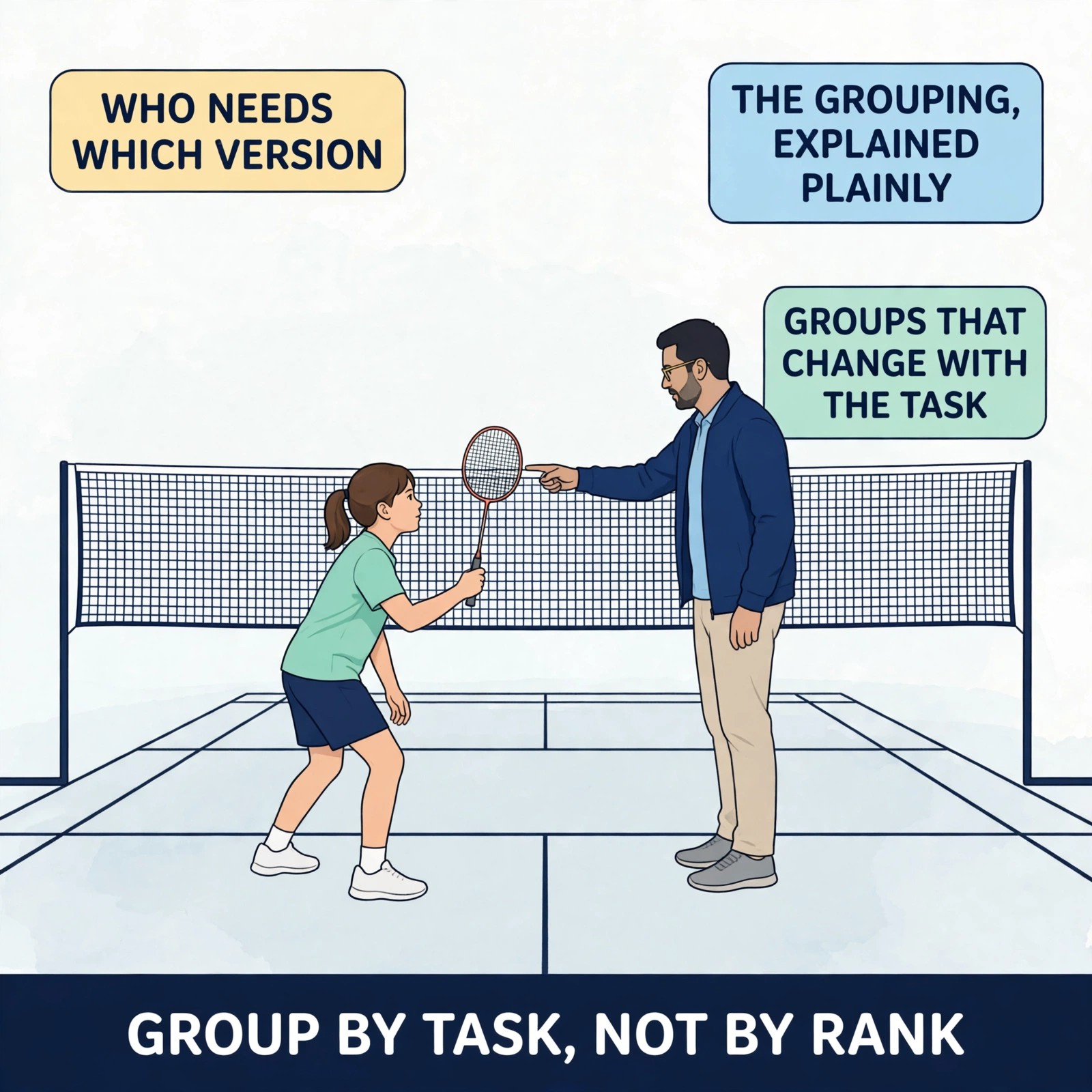
Start with the grouping question, because it decides the most: how are children grouped for each task. Ask whether groups form by the task in front of them and by honest starting point, rather than by arrival order or by whoever a child happened to stand beside. Grouping by task means the child who needs the kinder version of a drill works beside others attempting the same shape, whatever their history, and the groups dissolve and reform as the tasks change. A provider who groups this way can describe it plainly in a sentence or two. A provider who cannot describe it at all is telling you something as well.
Next, ask how one task becomes fair for different children. The honest mechanism is versions: the same drill, offered in a gentler shape and a harder shape, so each child attempts it at the edge of their own skill. The beginner feeds from closer, with more time. The experienced child feeds from further, with a tighter target or a choice to make. The task is shared, the lesson is shared, but the difficulty is personal. When a parent asks what their child will actually do all week, versions are the answer worth listening for, because a single version pitched at the middle serves nobody in the room for long.
Finish with the question parents of experienced children ask most quietly: what does my child gain from a mixed room. The answer is more than politeness suggests. A stronger child who feeds for a beginner learns control, because feeding a shuttle another child can reach is a skill of its own. A child who explains a grip learns whether they truly own it. And a child who has only ever measured themselves against beginners gets, in a mixed room, an honest picture of the standard above theirs. Helping is not time donated away from learning. Taught properly, it is one of the forms learning takes.

Levels Check #3
The Honest Cost: When One Pace Fits Nobody
The honest cost of ignoring levels lands first on the beginner. When one task at one difficulty is set for the whole room, it is pitched where the coach’s eye rests, usually the middle, and the true beginner spends the week reaching for work above their footing. Coping politely replaces learning: they copy the child beside them, survive the drill, and leave believing camps are for other children. Nothing cruel happened, and no one intended harm. The week simply never contained a task sized for them, and a week is long enough for a child to draw a lasting conclusion from that.
The second cost lands on the experienced child, and it is quieter. A week of tasks pitched below their edge teaches them that the room has nothing for them: rallies they win without moving properly, drills finished before they start. Boredom in a keen child curdles fast, and the behaviours it produces, the showing off, the careless shots, the sudden wish not to return, get read as attitude when they are really information. A child held below their level for days is not being rested. They are being told, in the only language camps speak, that their learning is not the point of the week.
The third cost arrives in the car park, in comparison. A mixed room gives parents a daily view of other children, and a parent watching without a frame will do the natural, unfair thing: measure their child against the strongest one present. The beginner looks behind; the experienced child looks ordinary beside someone stronger still. Both readings are artefacts of the comparison, not facts about the children. Levels differ, children develop at different rates, and a child’s progress only makes sense inside their own line of work, against their own starting point, which is why this guide keeps returning parents to exactly that line.
Levels Check #4
Choosing Lightly: Asking About Levels, Honestly Asked
So what should a parent actually ask before applying? Ask how groups form for each task. Ask how a task is given in versions, and who decides which version a child attempts. Ask how your child’s progress will be described to you: inside their own line, or against the room. Three questions, and the answers are easy for a real teacher to give. Put them to the provider directly, and ask for the current arrangements and practical details in confirmed form at the same time, since a holiday camp’s standing pages describe teaching, not this season’s logistics.
Judge the answers, and later the camp itself, across a fair stretch rather than a first impression. A beginner’s first morning will look wobbly beside a returner’s, and that picture proves nothing. What you are watching for over the days is movement inside your child’s own line: the task version growing harder as they settle, their name known, their questions answered by the coach running the day. And watch your child’s willingness, the plainest instrument families own. A child working at their own edge, in a group that has been explained to them, usually walks back in without being asked twice.
A gentle word for the parent lying awake running the two fears in turn: my child will be the weakest in the room, or my child will be wasted in it. Underneath both is the same wish, that the week be worthy of the child you know. Mixed levels are not the enemy of that wish; unsized tasks are. Judge any camp by whether it can tell you, plainly, what your own child will attempt on the first morning and how that attempt will grow. And if the worry keeps circling beyond anything the answers show, it deserves a kind conversation of its own, with someone you trust.

Levels Check #5
Level Habits That Keep Learning Fair
The level habits in this guide are plain enough to check from the door. First, groups form by task and starting point, and they change as the tasks change, so no child is parked in a corner of the room labelled by their history. Second, versions are named beforehand: the child knows which shape of the drill is theirs, and moving up a version is earned in the open, not granted as a favour. Third, helping is counted as learning, on fingers, in front of the group, so the experienced child’s week visibly grows too. A camp running those three habits is using its mixed room, not enduring it.
Notice what these habits build beyond badminton. A child who has learned inside a mixed room has practised something school and sport will ask of them for years: working beside people of different strengths without shame in either direction. The beginner learns that being newest is a stage, not a stain. The experienced child learns that skill carries a small duty of care, and that explaining is a deeper test than doing. Parents tell us the change they noticed first was not a shot. It was their child describing the group at dinner without ranking anyone in it, including themselves.
There is a moment in most camps when the design proves itself: a drill arrives in two versions, the room sorts itself calmly, and the beginner and the returner work side by side at the same task, each stretched, neither exposed. Nobody announces it. The beginner lands a first clean clear at their distance, the returner threads a tighter one at theirs, and the coach counts both in the same breath. That is the whole ambition of this guide, stated plainly. Levels will differ in every room your child ever enters. What matters is whether the teaching sizes the work to the child, and that can be asked about before you ever apply.

Myth vs Reality
Myths About Experience Levels
The myths around mixed levels are confident and tidy. The first says mixed levels hold everyone back, as if a room learns at one speed and the slowest child sets it. In truth, a room learns at the speed of its tasks, and tasks can be sized per child inside the same drill. The second myth says beginners should wait until they can already play before joining a group with experienced children. Waiting for the teaching to have happened somewhere else makes joining pointless; beginners are exactly who group coaching is built to receive, and every experienced child in the room began as one.
A third myth claims the experienced child must be separated from beginners to keep progressing, as if progress were a substance other children dilute. Progress lives in the difficulty of the tasks a child is set and the quality of the feedback they hear, not in the passports of the children beside them. A stronger child set harder versions, asked to feed and explain, and measured inside their own line can gain more from a mixed week than from a week of winning every rally in a room of equals. Separation is sometimes a fine choice. It is not a law of learning.
The truth underneath the myths is modest. Different levels are the raw material of every group, and the craft is in the sizing: groups by task, versions per child, progress described inside each child’s own line. Here, the promise is checkable. Ask us before you apply how your child’s first tasks would be sized, which version they would start on, and how their week would be described back to you, and judge the plainness of the answers. A camp that can describe one child’s week inside a mixed room, without ranking them against anyone, is a camp that has thought about levels properly.

Why Choose Us
Why Players Choose ST Badminton Academy
Families choose this academy for the teaching first: groups kept small, so the coach knows each child’s honest starting point because the family was asked for it, and versions can be sized by someone who watched the first attempts personally. For a levels question, that smallness is the practical heart of the matter. In a small group there is nowhere for a beginner to hide and no crowd for an experienced child to coast inside; the coach sees both, sets both a task at their own edge, and can say afterwards exactly what each child worked on.
Parents also choose how difference is spoken about here. Starting points are named honestly and without ranking, groups are explained to the children as task groups rather than as clever and slow tables, and a child moving up a version hears it described as their work growing, never as a promotion out of a lesser room. Nobody will announce where your child stands against the group, nobody will set the experienced children apart as a spectacle, and helping a partner is praised as the skill it is. Families describe honestly, and the academy groups honestly.
There is a final reason that grows on families across a camp. Children develop at different rates, and a mixed intake makes the fact impossible to miss: the child who started that morning beside the child with a year of classes, both learning, neither a verdict on the other. The teaching here holds that openly, describing each child’s progress inside their own line and refusing to promise the room a shared finishing point. Parents tell us the relief they felt first was hearing their child’s week described against their child’s own beginning, and realising how much kinder and truer that measure is.
FAQs: Experience Levels and Camp Groups in Malaysia (KL)
These are the questions parents ask us most about different experience levels in one camp group, before they apply and while a mixed intake is being weighed. The short version runs through all of them: groups by task, versions per child, and progress described inside each child’s own line. The longer answers follow, including what to ask us about current arrangements, and how a first session with us actually works.
Can children with different experience levels learn well in one camp group in Setapak or Gombak?
Yes. In small groups, tasks are given in versions sized per child, so a beginner and a returner can share one drill while each works at their own edge. Ask us how your child’s first tasks would be sized, and listen for grouping by task rather than by rank.
What should a parent ask first about levels and grouping in KL?
Ask how groups form for each task, how the task is given in a kinder and a harder version, and how progress will be described to you. Answers that name versions and your child’s own line are the honest ones; answers about levels in general are not.
Why do mixed levels worry parents at a junior level?
Because the comparison is visible at the gate: your child beside one who has trained for a year. The worry is natural, but a level is only a starting point, and children develop at different rates. Judge by movement inside your child’s own line across the week, not by the room at drop off.
My child has never played, while others in the group have trained for a year. Will the camp still fit, or should we wait?
It can fit well, provided the tasks are sized. Beginners are exactly who group coaching receives, and every experienced child began as one. Ask which version your child would start on and how it grows across the week. If a provider cannot describe that, the fit is doubtful, not your child.
How can parents talk about levels and progress at home in between classes?
Talk about your child’s own line: what they tried this week that they could not try last week. Leave other children’s names out of progress talk, including siblings, and praise the version moving up rather than a standing in the group. Progress described that way stays honest and stays kind.
Do you welcome level questions beside badminton training near Wangsa Maju?
Yes, gladly. Level questions are the questions this guide is built from, and they are answered plainly: how groups form, how versions are sized, and how your child’s week would be described back to you. Ask before you apply, and ask again at the door whenever the grouping changes.
Where does ST Badminton Academy teach badminton training in Malaysia?
We teach at our base in Setapak, with classes in the Setapak and Wangsa Maju area and in Singapore. Mr Eric Chuar coaches the academy sessions himself, with more than fifteen years of coaching in Malaysia and Singapore, and groups stay small enough that every child’s version is set by someone who watched them.
How do I book a trial session to test my child’s group and our level questions?
Message us and tell us honestly what your child has tried so far, from nothing yet to weekly classes. We will arrange a trial session, size the first tasks from your account, and afterwards describe your child’s work inside their own line, not against the group.
What makes Mr Eric Chuar a suitable coach for children in mixed level groups in badminton?
He coaches the academy sessions himself, in small groups, so he knows each child’s starting point because he watched the first attempts. He groups by task, names versions in the open, counts helping as learning, and never ranks a child against the room or promises a speed of progress.
Experience Level Coaching in Action


We benchmark our experience level coaching against World Badminton (BWF) coaching standards and our own academy values: before any player trusts a training plan, they deserve honest checks. You can verify our coaches' credentials through the Badminton Association of Malaysia (BAM) coach education pathway.
One standard governs levels here: no child is ranked against another, and every child is set work at the edge of their own current skill. Groups form by task, versions are named in the open, and helping is counted as the learning it is. We also hold an honesty rule about what grouping can do. Sizing tasks can give every child a fair week; it cannot promise a child will catch up to anyone, pass anyone, or progress at any named speed, and camps that imply otherwise are selling something other than teaching.
| Factor | The Sized Task Hall | The One Pace Hall LEVELS |
|---|---|---|
| Frequency | 1 or 2 times a week. Mostly for fun and sweat. | The one pace hall sets every task at one difficulty and calls the result fairness. Beginners spend the week coping politely above their footing, experienced children coast below their edge, and both groups leave having been measured against the room instead of taught inside their own line. |
| Drills Focus | Basic static feeding. Minimal footwork pressure. | The sized task hall gives the same drill in versions instead: a kinder shape and a harder shape, named in the open, so the beginner and the returner share one lesson while each works at the edge of their own skill. Groups form by task, and helping is taught as the skill it is. |
| Physical Conditioning | Rarely included. Just playing games on court. | Core, agility, and speed training included in every session to prevent injury and build stamina. |
| Tactical Awareness | "Just hit it over." No real game plan. | Video analysis, point construction, and learning to read the opponent's game. |
| Coach Ratio | Large groups (8-10 kids). Coach barely watches you. | Max 4 students. Mr Eric Chuar personally corrects every stroke and movement detail. |
| Goal Setting | Fun and exercise. | Because the count is versions moved up, tasks settled at each child's edge and children described inside their own lines, real teaching shows up as numbers rather than as noise. The coach sees whether the grouping, the sizing or the feedback was off, and one part of the day is repaired instead of a child being labelled too weak or too strong. |
| Long Term Result | Good recreational player. | The high-performance version produces children who can work beside any level without shame in either direction. The casual version spends the week broadcasting one pace; the sized version removes the guesswork in a fixed order and counts what each child's week actually built. |
Experience Level Coaching in Kuala Lumpur
Your start can be one honest conversation. Tell us what your child has actually tried, ask how their first tasks would be sized inside a mixed group, and ask us for the current arrangements and practical details in confirmed form. We will describe your child's likely first version plainly, and how it would grow across the week. Bring the child as they are when the day comes: their starting point is information, not a verdict. Message us to arrange a time that suits your week.