Badminton learning in Kuala Lumpur
From Feeding Drills to Independent Badminton Rallies: A Beginner’s Progression
Hitting a fed shuttle and sustaining a rally ask different things of a beginner. Learn how practice can bridge the gap without rushing straight into competitive games.
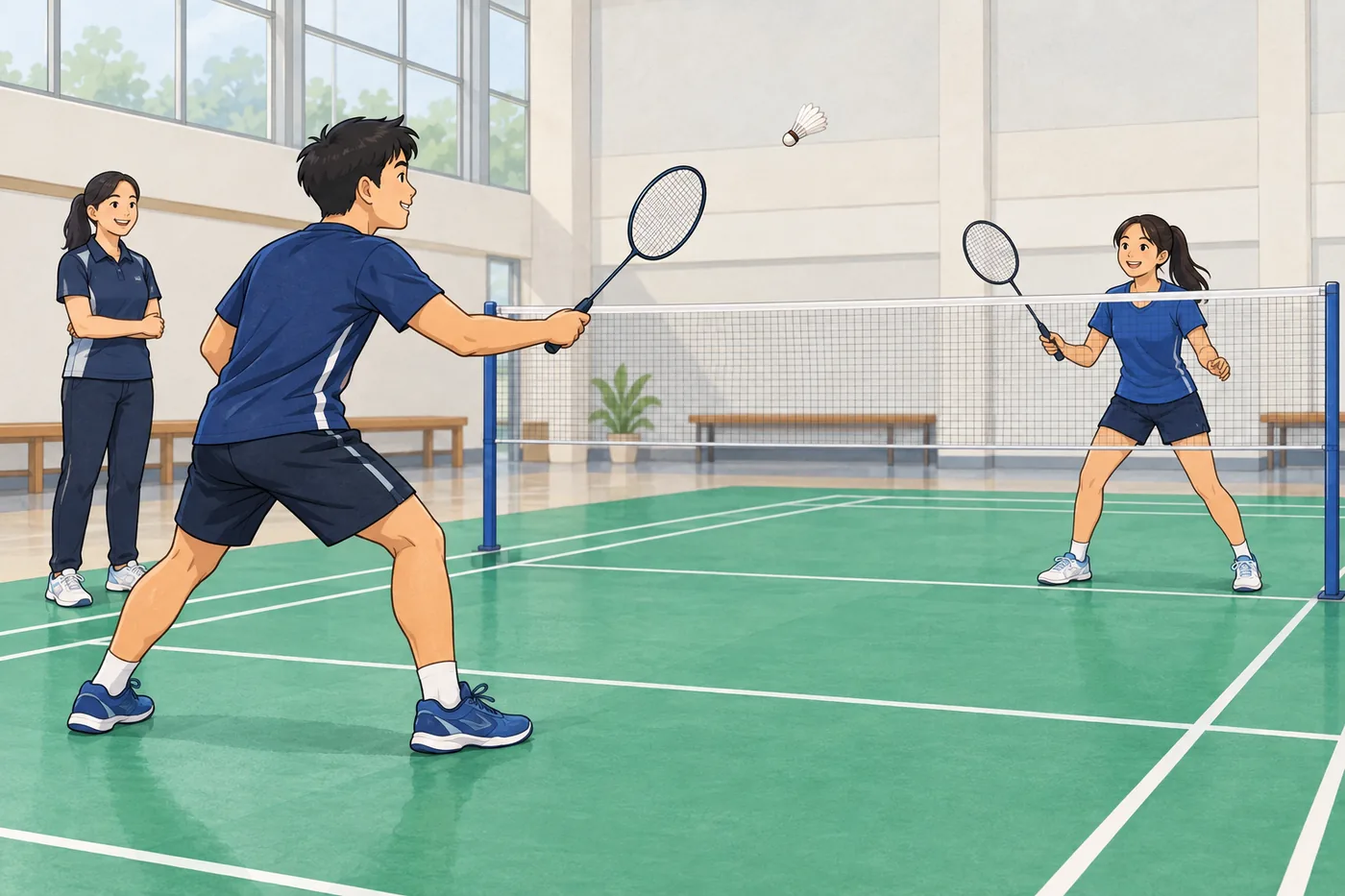
If you can hit shuttles during a feeding drill but struggle to keep a rally going, look at what changes between those two activities. A feed may arrive in a known place with time to reset. A rally asks you to respond to another player’s return and prepare to play again.
A useful badminton training progression makes those changes manageable. It does not require every beginner to complete the same drills in the same order or reach a fixed rally count before moving on. The coach should select tasks that fit what you can currently do.
The stages below provide a way to discuss that progression. They are not a self-coaching programme or a substitute for a coach observing your movement and contact. Use them to understand why a lesson includes a particular activity and what the next step might be.

Know what the feeding drill is meant to teach
In a feeding drill, the coach or a partner supplies shuttles so the player can practise an agreed action. The setup can be highly predictable or deliberately varied. Before judging the activity, ask what its present purpose is.
For a beginner, a predictable feed might provide a chance to try an explained contact action without having to manage an entire rally. It might also allow the coach to see a recurring difficulty more clearly. Neither purpose means that feeding should be the only form of practice.
Notice how the task ends. Does the player hit and stop because that is the instruction? Or are they supposed to prepare for another shuttle? A player who stops after every shot may simply be following the drill rather than demonstrating a poor attitude.
Consider Mei, an adult beginner who returns a series of feeds comfortably. In her first partner rally, she watches her own shot and misses the next return. Her useful question is not “Why am I suddenly bad?” It is “How do we practise the part between my first shot and the next one?”
Connect the shot to getting ready for the next return
The next activity can make preparation after the shot part of the task. The coach should explain what that preparation looks like for the particular situation. Avoid applying a fixed court position to every shot without understanding the context.
A simple practice may still use predictable feeds, but the player now completes the agreed action after each return. The coach can observe whether the player understands the sequence and whether the task needs to be slowed down or simplified.
There is no value in making a beginner hurry through an action they have not understood. If they become tangled in the sequence, separate the steps, demonstrate again and let them show their interpretation.
For Mei, this could mean practising a controlled return followed by the preparation her coach has demonstrated. She is not trying to win a point. She is joining two parts of the activity together. When reviewing the task, the coach asks whether she was available for another return, not merely whether the first shuttle landed in the intended area.

Build a cooperative exchange with a shared purpose
A cooperative rally gives both players a common task. Instead of trying to catch each other out, they attempt returns that their partner can reasonably play. The exact court area and shot choice should be agreed with the coach.
This matters because “Have a rally” can mean very different things to two beginners. One may attempt a difficult winner while the other expects a controlled exchange. The rally then breaks down without either player understanding the purpose of the practice.
- Confirm where the exchange will take place.
- Agree on the type of return the task allows.
- Check how to start, stop and restart the activity.
- Identify one thing each player is practising.
- Leave space between attempts for a brief review.
Do not treat your partner as a feeding machine. Both players are learning. If the exchange is consistently beyond what either can manage, ask the coach to adjust the activity or provide another demonstration. Blaming each other rarely clarifies the task.

Add a decision without changing everything at once
An entirely predictable exchange does not ask the same questions as an open rally. Once the task is manageable, the coach may introduce a small choice. For example, an incoming shuttle could go to one of two agreed areas rather than the same area every time.
The player now needs to notice which option has occurred. That is a change in the task even if the shot technique looks familiar. Adding faster feeds, larger movement, new shots and competitive scoring at the same time can make it difficult to identify which change caused the problem.
Discuss the new demand before starting. “Now I have to notice which side it goes to” gives the player a clearer purpose than “This drill is harder.” After a short attempt, check whether the player recognised the incoming situation and understood the intended response.
If the activity falls apart, return to something simpler and isolate the difficulty. This is an adjustment to the practice, not a punishment or a claim that the player has forgotten everything learned earlier.

Use constrained games as a bridge, not a separate rulebook
A coach may use a small game with an agreed restriction or objective to connect practice with point play. The activity could limit the playing area or reward a particular decision. These are practice conditions; they should not be confused with the official rules of badminton.
Explain the objective before keeping score. If the game is meant to encourage a controlled opening exchange, players need to know that. Otherwise, a beginner may reasonably focus only on winning the point and ignore the learning purpose.
Keep the review connected to the task: Did the player recognise the situation? Did they attempt the intended decision? What happened when the opponent returned somewhere different? The score alone will not answer those questions.
Mei might manage a cooperative exchange but lose the sequence when a point matters. Her coach can use a suitable practice game to observe that difference. The next step should come from what happens, rather than from a rule that every beginner must immediately play a full competitive match.
Check independence before increasing the challenge
An independent rally does not mean playing perfectly or never needing coaching again. It means that within an appropriate activity, players can take responsibility for enough of the process to keep practising meaningfully.
Use the following checks as discussion points, not an exam. A beginner may be independent in one task and still need support in another.
| Part of the activity | What to look for |
|---|---|
| Understanding | The player knows the purpose and can explain how to begin. |
| Partner cooperation | Both players understand the agreed practice conditions. |
| Preparation | The player attempts to prepare for the next return. |
| Restarting | The pair can restart sensibly after an error. |
| Reviewing | The player can identify one difficulty or ask a useful question. |
A coach may choose to revisit feeding work after seeing a difficulty in a rally. Progression does not have to run in one direction. A focused drill, a cooperative task and a game can each have a place in the same learning process.

Choose a class that explains the connection between activities
When asking about beginner badminton classes, do more than count how many drills appear in a lesson. Ask how the coach connects controlled practice with playing alongside another person.
A useful conversation might include: “If I can complete the drill but cannot rally, how would you decide what to work on?” There is no need for the coach to prescribe your entire programme before seeing you play. Look for a clear explanation of how they would observe the problem.
Tell the badminton coach about your actual experience. Someone who has played social games for years may need a different starting task from someone who has never held a racket, even if both describe themselves as beginners.
Between sessions, avoid improvising a demanding drill from a video simply because it resembles professional training. Ask what practice is appropriate for your present task and the safe space available. The aim is a useful next step, not the most impressive-looking exercise.
Questions about this badminton training topic
Are badminton feeding drills useful for beginners?
They can be useful when the coach has a clear purpose, such as observing or practising an explained action. Ask how that work will connect with partner practice and rallies.
Why can I hit feeds but struggle in a rally?
A rally changes the task: another player’s return may be less predictable, and you have to prepare to play again. Ask your coach which part of that change is currently difficult.
How many shots should a beginner rally before moving on?
There is no single count that suits every player and task. Discuss control, understanding and the purpose of the activity rather than treating one rally number as a universal qualification.
Should beginners avoid playing games until their technique is perfect?
A coach can select an appropriate game before every action is polished. The important questions are whether the task is manageable, safe and connected to a clear learning purpose.
Can two beginners practise together?
Yes, with a suitable activity and shared instructions. If neither player can sustain the task, ask for an adjustment instead of assuming one partner is responsible for every breakdown.
Discuss your training
For badminton training in Kuala Lumpur, describe what you can do in a drill and what becomes difficult in a rally. Contact ST Badminton Academy to discuss your starting point and the available training arrangement.