Badminton And Injury Prevention: Tips For Avoiding Common Ailments (Prevention Guide)
Badminton looks gentle and is anything but. A single session asks for hundreds of lunges, jumps, sudden stops and overhead swings, often on tired legs. Most common ailments do not arrive from one unlucky moment; they grow quietly out of habits: cold starts, sloppy landings, worn out shoes, and training loads that jump before the body is ready. This guide walks through the trouble spots one by one, ankles, knees, shoulders, elbows and backs, and the everyday habits that can help lower the risk. Nothing here makes a player injury proof, and we will not pretend otherwise. At ST Badminton Academy in Setapak, Kuala Lumpur, lowering the risk, season after season, is the honest goal, and these habits are part of normal coaching.

Prevention Check #1
Warm Up Well: The First Habit of Safe Play
The warm up is the cheapest safety habit in the sport. In plain terms it raises your body temperature, loosens stiff joints and wakes up the muscles you are about to ask for lunges, jumps and changes of direction. Cold muscles react more slowly, and slow reactions are how ankles roll and knees twist. A good warm up is dynamic: easy jogging around the court, side steps, leg swings, arm circles, shadow footwork and then gentle rallies that build in pace. Five to ten minutes, every session, including the social games. The first hard rally of the day should never be the first hard movement of the day.
Stretching has its place, and the place is mostly after play. Long, held stretches on cold muscles before a session are a poor trade for moving warm up work; save them for the cool down, when muscles are warm and the gentle pulls on calves, thighs, hips and shoulders help you finish the session well. Two quieter habits belong in this section too. Arrive hydrated and arrive fed: in Kuala Lumpur heat, a player who starts a session already short on water and food tires earlier, and tired players move badly. Safe play starts before the first shuttle is struck.

Prevention Check #2
Ankles and Knees: Land Well, Turn Safely
Ankles take the blame for many badminton layoffs, and the classic sprain happens on a landing: off balance after a jump, on the edge of a foot, or onto a surface that was not ready for you. The habits that help are simple to say and take practice to own. Land on the front of the foot and let the ankle, knee and hip bend together to share the load. Keep your feet pointing where you are travelling. Build the ankle’s reactions with balance work: single leg stands, stick landings, calf raises. None of this guarantees anything; it gives the ankle a better chance to save you.
Knees complain in two familiar ways. The first is mechanics: a knee that collapses inward on landings and deep lunges takes load it was not built to take. The fix is a shape, practised slowly until it is automatic: knees tracking over toes, a lunge length you can control, and a trunk that stays tall. The second is load: a quiet month followed by a sudden tournament weekend is the classic recipe for a sore knee. Build your weekly load gradually and the knee usually keeps up. Soreness that sits in one exact spot and keeps returning is not a training problem to push through; get it checked by a doctor or physiotherapist.
Turning safely is a footwork habit, not a talent. Most changes of direction should be steps: a split step, a push, a chasse, a lunge. The risky version is twisting hard on a planted foot, especially in grippy court shoes that are designed to stop you sliding. When you must pivot, keep the foot light and let the heel lift so the turn travels through the whole leg instead of one knee. In training, practise changes of direction at half pace before you ask for them at full speed in a game. Patterns learned slowly are the ones that survive tired legs in the third game.

Prevention Check #3
Shoulders, Elbows and Backs: The Overuse Spots
The shoulder works harder in badminton than in almost any other racket sport, striking overhead hundreds of times a session. What lowers the strain is smooth technique: contact point in front of the body, the whole body turning into the shot, and power shared between legs, trunk and arm instead of muscled by the arm alone. Warm the shoulders up with arm circles and easy clears that build in height. Be honest about fatigue too: tired shoulders change your action without asking permission, and long smash marathons on tired arms are where good technique quietly falls apart.
Elbow and forearm aches often trace back to simple, fixable things. A grip that is too small makes your forearm squeeze harder on every shot; a worn, slippery grip does the same job. Fresh grips are cheap insurance and take two minutes to change. Learn to keep your fingers relaxed between shots and squeeze only at contact; a forearm that never relaxes all session is a forearm that complains by Thursday. An ache on the inside or outside of the elbow that keeps returning week after week deserves an early professional check, not another month of playing through it.
Backs usually complain from two directions at once: a trunk that tires, and loads that arrive suddenly. The everyday answers are unglamorous. Build core habits into your week, the planks, carries and hinge patterns from normal strength work, so the back shares its load with stronger neighbours. Avoid the jump from a whole day of sitting stiffly at a desk straight into the hardest game of the week; move a little through the day, and warm up with extra care on those days. A back that nags in the same place for weeks belongs in front of a professional, not in another forum thread.

Prevention Check #4
Shoes, Court Floors and Racket Setup
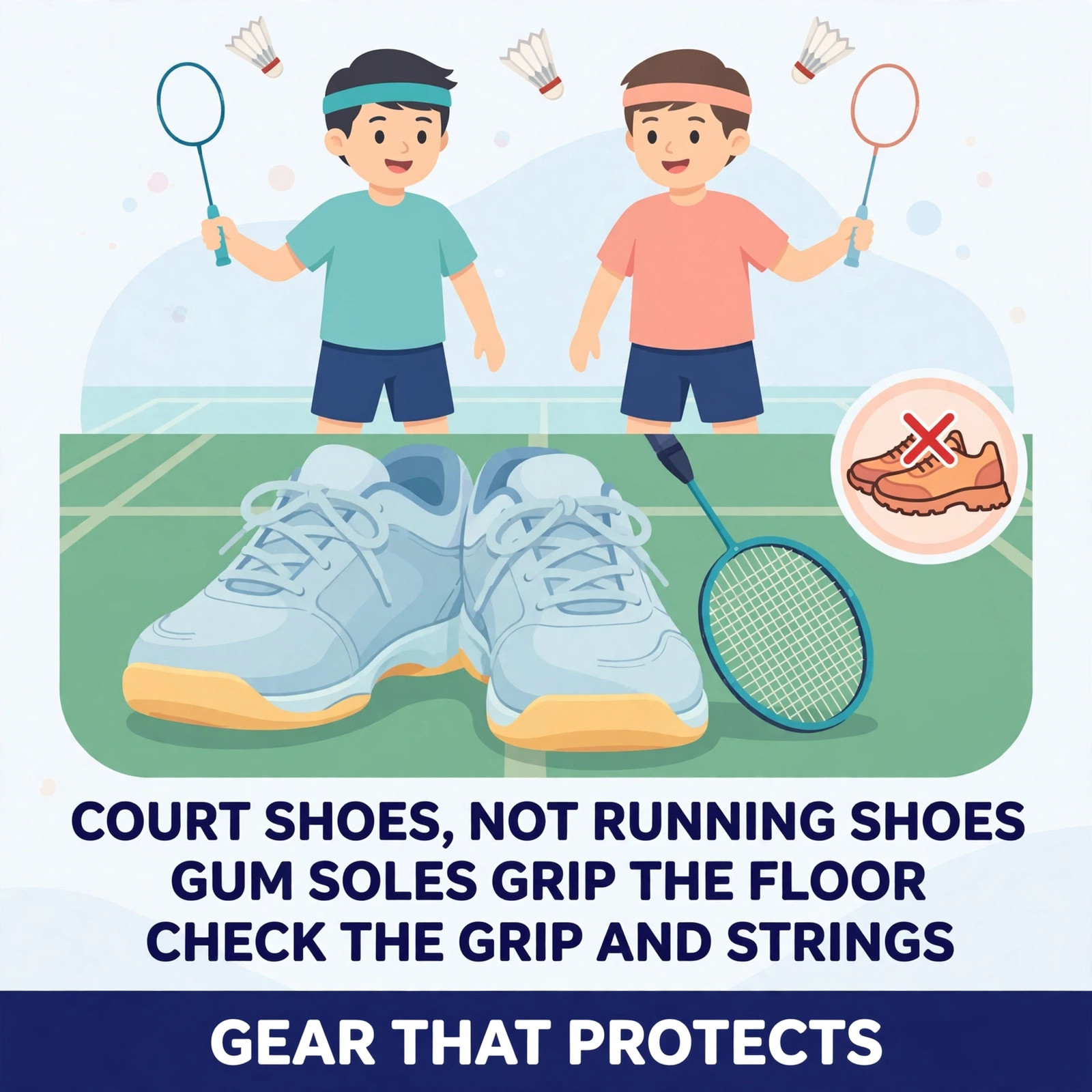
Shoes are safety equipment, not fashion. Proper badminton court shoes have gum soles that grip wooden and synthetic courts, a low profile that keeps the ankle stable when you move sideways, and cushioning that softens hundreds of small landings. Running shoes are built to travel in a straight line: their tall, soft heels can roll an ankle the moment you lunge or brake sideways. Check your shoes the way you check your strings. When the sole goes smooth, the heel counter collapses or the upper stretches loose, the shoe has finished its work, however loyal it feels.
The floor and the racket complete the gear check. A dusty or damp court turns good shoes useless, so wipe your soles, tell the hall staff if a patch is slippery, and never play across a wet spot to save a rally. On the racket, play with a string tension your arm can handle; very high tensions send more shock into the arm on every shot. Keep the grip size right for your hand, and glance over the frame for cracks when you change grips. The whole inspection takes a minute a week and quietly removes a list of avoidable problems.
The last checks are small and free. Wear loose, comfortable clothing you can lunge in, tie long hair back, and take off jewellery that can catch or scratch. Before the session starts, look at the space around your court: bags, bottles and spare rackets belong behind the back line or off the playing area entirely, because many turned ankles happen while walking backward after a rally, not during one. None of these habits is dramatic. Together, they remove the silly injuries, which are the ones players regret most.
Prevention Check #5
Load Gradually and Rest on Purpose
Load is the habit underneath all the others. Add a little at a time: one extra session in a week, or slightly longer sessions, but not both changes at once. Build toward a tournament over several weeks, then take an easier week after it. Your body adapts to what it can nearly handle, repeated; it breaks down under what arrives all at once. Coaches call this progression, but you can think of it as manners: never ambush your own body. The common ailments in this guide, sore knees, cranky shoulders, tired backs, are very often load errors wearing a disguise.
Rest is not the absence of training; it is the half of training where the body actually rebuilds. Muscles, tendons and joints adapt between sessions, not during them. Keen players need at least one full rest day a week, easy days between hard ones, and sleep treated with the same respect as a drill. Watch for the first sign of too much: footwork gets sloppy before anything hurts. Tired players land badly, turn badly and reach instead of moving. If your feet feel stupid two sessions in a row, the answer is rarely more training.
Finally, listen early. Small niggles are information, and the players who last are the ones who read them. Keep a simple notebook: sessions played, and any ache that showed up, where, and whether it faded in a day or two. Mention niggles to your coach while they are still small talk. Pain that changes how you move, swells, or keeps returning to the same spot for more than a week or so stops being a niggle: book a doctor or physiotherapist. An early check costs an afternoon. A late one can cost a season.

Myth vs Reality
Myths About Injury Prevention
Myth one: soreness means it is working. Soreness mostly means the work was new or heavy; it is not a score and it is not proof of progress. Players who chase soreness end up training tired, and tired players land badly. Judge your training by what improves over weeks: cleaner footwork, longer rallies, steadier results. A session can be excellent and leave you almost fresh, and a wrecking session can teach your body nothing but bad shapes.
Myth two: stretching alone keeps you safe. Stretching has a real place in the cool down, but most badminton injuries link to load, landing mechanics, fatigue and gear, not to how close your hands get to your toes. A flexible player in worn out running shoes, doubling their playing time in tournament week, is still carrying plenty of risk. Prevention is a system of small habits, not one magic exercise performed religiously at the side of the court.
The reality is quieter. Warm up every session, land well, turn with steps, load gradually, rest on purpose, look after your shoes and grips, and act early when something nags. No single habit on that list is dramatic, and not one of them can promise you a career without injury. Together, practised for a whole season, they stack the odds in your favour. That is the honest version of prevention: not a promise, a practice.

Why Choose Us
Why Players Choose ST Badminton Academy
Prevention is coached at ST Badminton Academy inside normal sessions, in groups with a maximum of four students, so the coach actually sees your landings. A knee that collapses inward gets corrected in the session where it happens, not in a review three months later. Warm up routines, landing shapes and load planning are taught as part of the sport itself, the same way grips and footwork are. Juniors learn these habits while they are still easy to teach, which is the best time of all.
We are equally plain about the limits. We can teach the habits that lower risk; we cannot diagnose pain, and we will not dress up coaching as medicine. When a player’s problem needs more than coaching, we say so early and point them to a doctor or physiotherapist. That honesty protects players twice: once by keeping training sensible, and once by getting real problems in front of the right people quickly.
Our base is Setapak in Kuala Lumpur, and our players come from across the city, including Wangsa Maju and Gombak. Sessions run for kids, teens and adults, from first timers to league players. The habits in this guide travel across every level, because ankles and knees do not ask what standard you play at. Whichever group you join, the standard is the same: warm up, move well, load sensibly, and speak up when something hurts.
FAQs: Badminton Injury Prevention in Malaysia (KL)
These are the questions players and parents ask us most about avoiding the common ailments. The short version runs through all of them: no single habit removes risk, the habits together lower it, and pain that behaves like an injury belongs in front of a doctor or physiotherapist. Coaching advice ends where diagnosis begins, and we keep that line clear.
Where can I learn safe badminton habits if I live in Setapak or Gombak?
Start at ST Badminton Academy in Setapak, where prevention is taught inside normal sessions, not sold as an extra. Players learn warm up routines, landing shapes, load planning and gear checks from their first weeks with us. Players from Gombak train here too, and parents hear the same plain advice, so habits continue at home.
How do warm ups fit into injury prevention for players in KL?
A dynamic warm up raises your temperature and prepares muscles and joints for lunges, jumps and sudden stops, so the first hard rally is not a shock. In Kuala Lumpur heat it also gives you a few minutes to settle your breathing and hydration before the pace rises. Five to ten minutes, every session.
How much should a junior train each week if they play at a school level?
There is no single right number. Most school players do well with a few sessions a week, at least one full rest day, and easier weeks after heavy tournament weeks. Watch the signs: falling grades in energy, sore spots that linger, footwork getting sloppy. When those show up, the load is too high, whatever the calendar says.
My shoulder aches after overhead shots, so should I rest it or keep playing?
A light ache that fades within a day after a hard session is common. Ache that sits in one spot, returns every session, or changes how you swing is different: stop the heavy overhead work, cut the load, and get the shoulder checked by a doctor or physiotherapist. Playing through it usually buys a longer break later.
What shoes should I wear for badminton, and why do running shoes cause problems?
Wear proper court shoes: gum soles that grip the floor, a low profile that keeps the ankle stable in side movements, and enough cushioning for jumps. Running shoes are built to go straight ahead, with tall soft heels that can roll your ankle when you lunge sideways. That roll is how many sprains happen.
Do you teach injury prevention habits to players near Wangsa Maju?
Yes. Prevention habits are part of normal coaching at our Setapak base, a short drive from Wangsa Maju. Players learn how to warm up properly, land well, plan their weekly load and check their shoes and grips. Parents of juniors get the same advice in plain words, so the habits survive outside the hall too.
Does your academy help young players build safe habits in Malaysia?
Yes. Young players learn the habits early, while they are still easy to teach: moving warm ups, quiet landings, rest days, honest loads and gear that fits. We make no promises that any child will never get hurt, because nobody honestly can. We teach the practice that lowers the risk, season after season.
Where does ST Badminton Academy coach badminton in Setapak?
We coach at our base in Setapak, Kuala Lumpur, in small groups of no more than four students, so every player’s footwork and landings are seen and corrected. Sessions run for children, teenagers and adults across the week. Setapak is easy to reach from Wangsa Maju, Gombak and the centre, and trials can be arranged through our WhatsApp line.
What makes Mr Eric Chuar a suitable coach for safe training in badminton?
Mr Eric Chuar has coached badminton in Malaysia for more than fifteen years and corrects footwork early, before tired shapes become injuries. He plans weekly loads player by player, teaches warm ups and landing habits as part of the sport, and sends players to medical professionals when a problem needs more than coaching.
Badminton Injury Prevention in Action


One Standard for Every Player and Every Session
Our standard for prevention advice is the same as our standard for technique: say what a habit does, say what it cannot do, and never dress up a guess as a fact. Players here get plans they can check against their own bodies and their own notebooks. If something keeps hurting, we change the load and point you to a professional, in that order.
| Factor | Skipping the Basics | Habits That Lower the Risk SAFETY |
|---|---|---|
| Frequency | 1 or 2 times a week. Mostly for fun and sweat. | A dynamic warm up before every session, and gentle stretching after. |
| Drills Focus | Basic static feeding. Minimal footwork pressure. | Court shoes checked weekly, grips fresh, string tension the arm can handle. |
| Physical Conditioning | Rarely included. Just playing games on court. | Core, agility, and speed training included in every session to prevent injury and build stamina. |
| Tactical Awareness | "Just hit it over." No real game plan. | Video analysis, point construction, and learning to read the opponent's game. |
| Coach Ratio | Large groups (8-10 kids). Coach barely watches you. | Max 4 students. Mr Eric Chuar personally corrects every stroke and movement detail. |
| Goal Setting | Fun and exercise. | Load added a little at a time, with rest days planned, not skipped. |
| Long Term Result | Good recreational player. | A player still enjoying the game season after season, with fewer forced breaks. |
Badminton Injury Prevention Coaching in Kuala Lumpur
You cannot wrap yourself in cotton wool and still play this sport, and nobody should try. What you can do is stack the small habits: warm up, land well, load gradually, rest, maintain your gear, and act early on the small warnings. Come and train with us in Setapak, and we will build those habits into your game from the first session.


