What Are The Top Tips For Preventing Burnout In Badminton Training? (Burnout Guide)
Burnout rarely arrives like an injury, with one bad moment you can point to. It creeps. Training that used to be the best part of your week starts to feel like another duty on the list. You go through the sessions, but the fun drains out of them, and then one day you realise you have been finding excuses not to go. This guide is about catching that slide early and answering it kindly: knowing the signs, resting properly, bringing variety back, talking early, and taking a real break when a break is what is needed. Burnout is not a character flaw and it is not the end of your badminton. Treated early, it is usually a planning problem with a human answer.

Energy Check #1
Know the Early Signs: Dread, Flat Games and Poor Sleep
It helps to say plainly what burnout is not. It is not ordinary tiredness after a hard week; that fades with two good nights of sleep. It is not laziness, and it is not weakness, and it often happens to the most committed players, the ones who never miss and always push. Burnout grows where load, pressure and monotony run for a long time without enough rest, variety or say in the plan. That is why the answers in this guide are structural: change the inputs, and the feeling usually follows. Shouting at yourself to try harder is the one input that reliably makes it worse.
Players are often surprised to learn that more training can be the wrong medicine. When the problem is an empty tank, adding sessions is like pressing the accelerator of a car that needs fuel. The honest first moves are smaller and kinder: a real rest, a week of play instead of drills, a conversation with your coach. This guide takes those moves in order, from spotting the slide to returning from a break with your love of the game intact. A word for the players who recognise themselves in this guide and feel annoyed about it: annoyance is common, because burnout feels like a betrayal of something you love. You did not stop caring; that is rather the point. People who do not care do not burn out on training. The caring is intact. What is empty is the tank, and tanks refill with rest, variety and time, not with scolding. Everything in this guide is built on that simple order of operations.

Energy Check #2
Rest Is Part of Training: Days Off and Real Sleep
The early signs are usually small enough to laugh off, which is why they get missed. You start dreading the drive to training, not the training itself. Sessions feel flat even when you play well. Small things irritate you: a partner’s error, a drill repeated once too often. Your sleep gets lighter, or you wake up tired after full nights. Friends say you seem less patient. Any one of these can be a bad week. Several of them together, lasting a few weeks, are a pattern worth respecting.
There is often a physical echo too. Legs that stay heavy, performances that stall no matter how hard you push, little aches that keep visiting the same places. The body and the mood are not separate departments; long before burnout feels emotional, it often shows up as a body that will not recover between sessions. Players tend to answer that signal with more effort, which is understandable and exactly backwards. The signal is asking for recovery, and recovery is a trainable, plannable part of the sport, as the rest of this guide sets out.
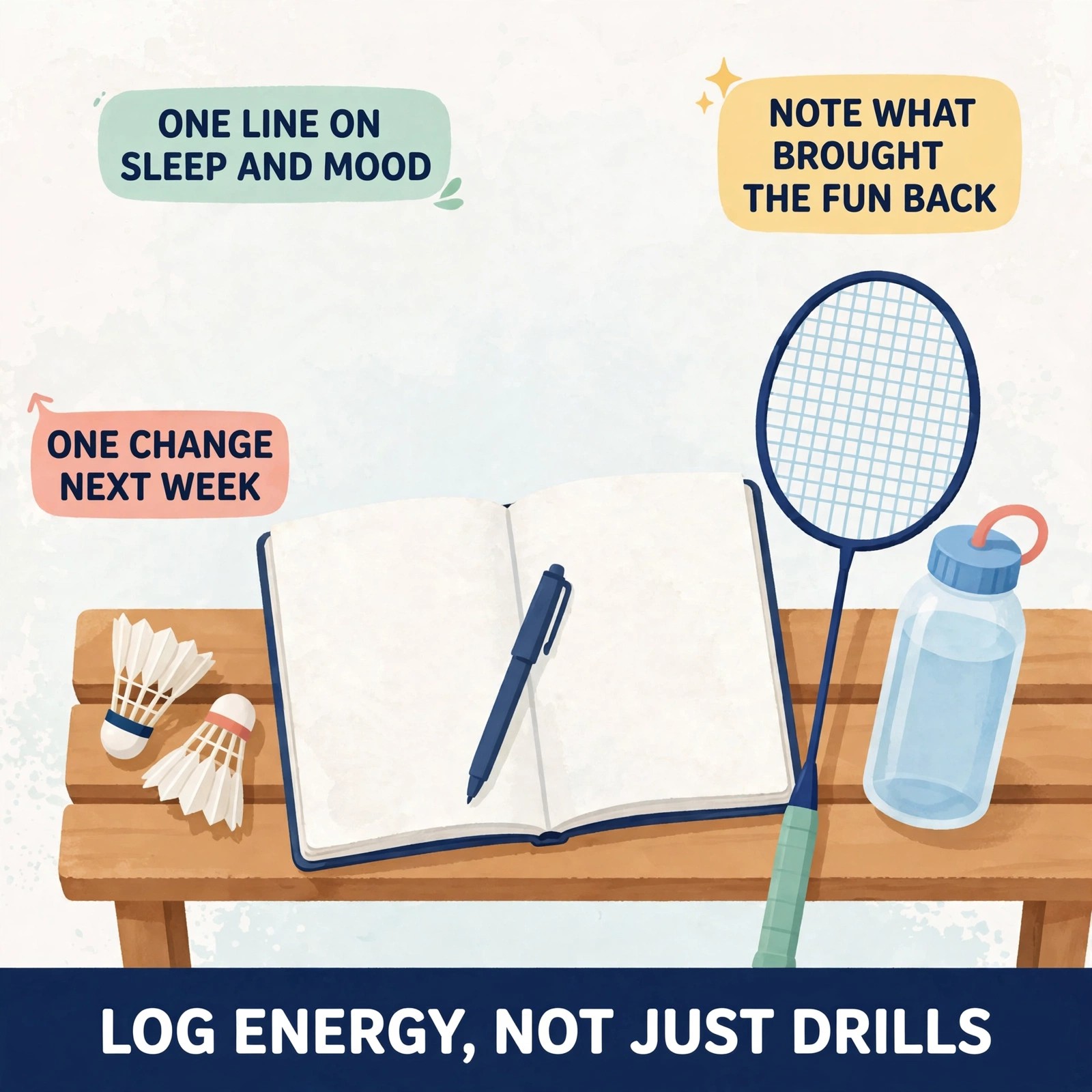
Do a simple honest check once a month: if training stopped being compulsory tomorrow, would you still go this week? If the answer is a fast yes, your balance is probably fine. If you hesitate, or feel relief at the imaginary escape, that is information, not failure. Write the answer in your log next to your sessions and sleep. Patterns you can see are patterns you can change; patterns you only feel tend to be blamed on your character, where they do not belong. Keep the check light. It takes two minutes, once a month, ideally right after a normal session rather than after your worst one. If the answer worries you two months running, that is your moment to act on the next sections: rest first, variety second, a conversation third. Acting at month two is a small repair. Acting at month eight is a rescue. Both work, but you will enjoy the small repair far more.
Energy Check #3
Variety That Refreshes: New Games, New Partners
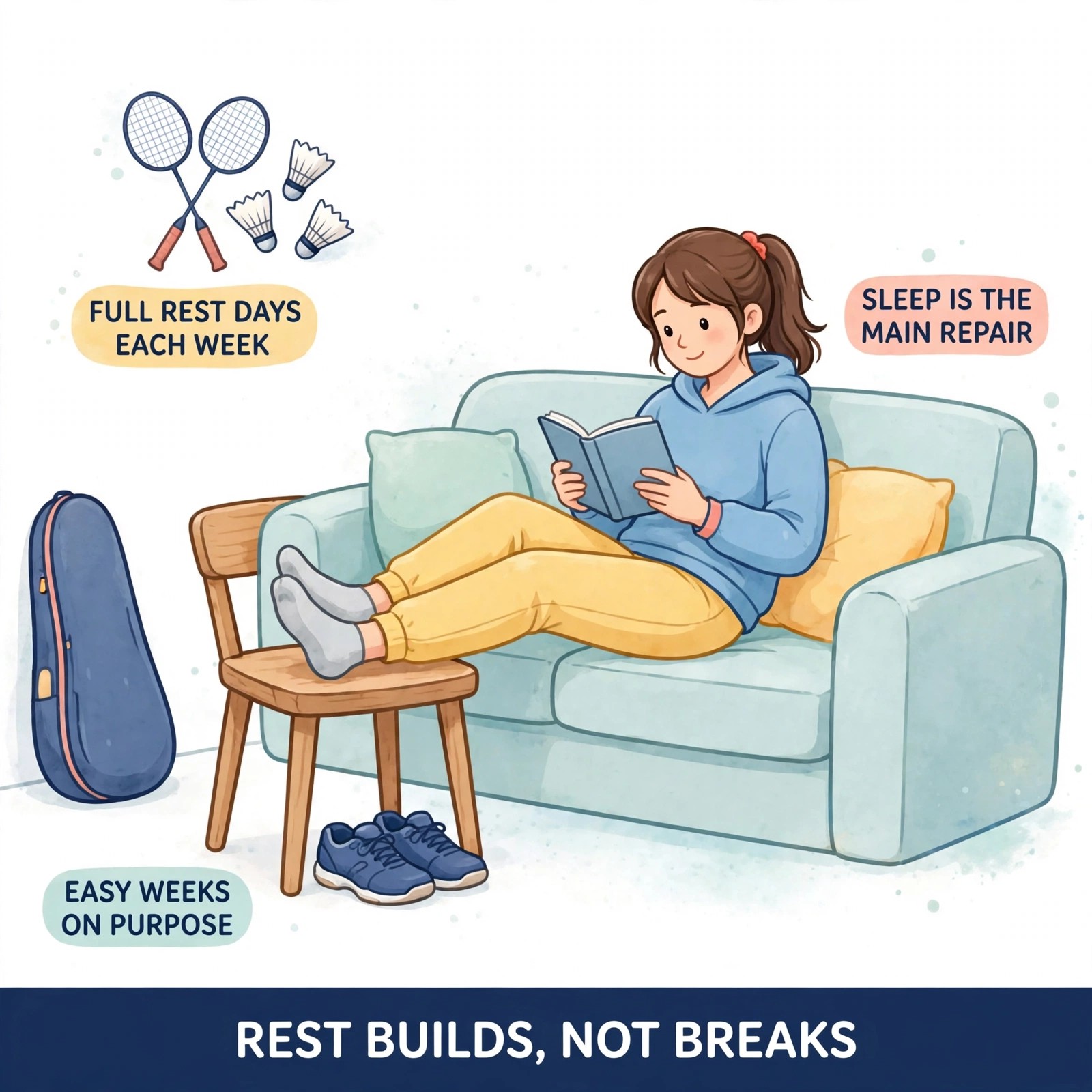
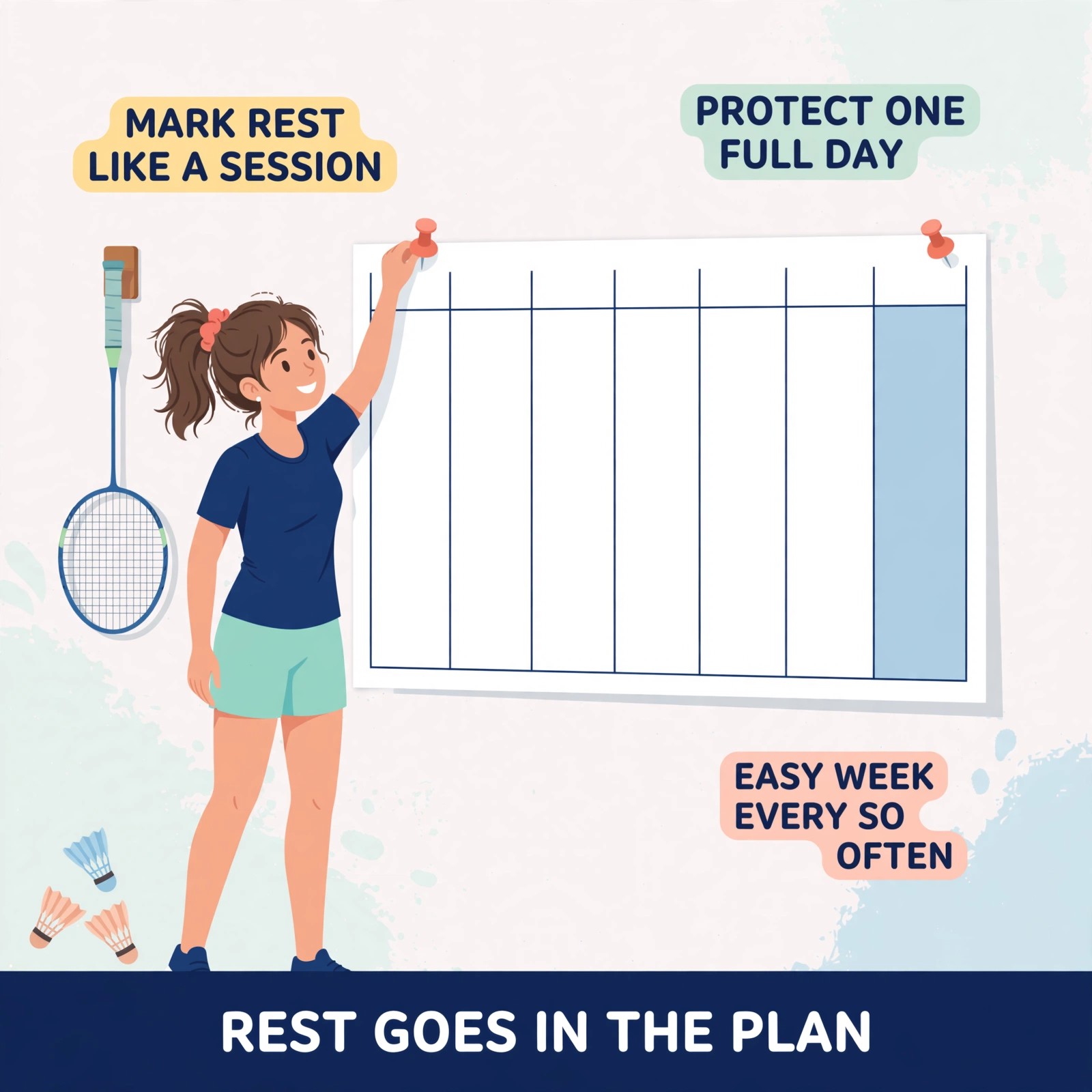
Rest is not the absence of training. It is the half of training where the body actually rebuilds and the mind refills. Every week needs full rest days with no court work at all, and every block of weeks needs an easier week where the load drops on purpose. Sleep is the main repair shift: regular hours, a dark cool room, and screens that go away before bed will do more for most players than any supplement shelf. If your plan has no rest written into it, it is not a serious plan; it is a countdown to a crash.
Notice the difference between resting and merely stopping. A planned rest day is chosen, protected and enjoyed without guilt, and you return from it hungry. A collapse is what happens when rest was refused until the body or the mood took it by force, usually at the worst time and for longer. Players who schedule rest rarely need long forced breaks. Players who treat every rest day as a small defeat tend to collect a large one later. Your coach would much rather plan your easy weeks than hear about your missing months.
Rest also has a mental side. A mind that only ever meets badminton as work will eventually file the whole sport under work. Keep some contact with the game that is pure pleasure: a social hit with friends, watching a great match with a drink in hand, teaching a beginner something small. These are not soft extras. They are how the love that started all this gets maintained, and love, in the long run, is the real engine of a training life. If evenings are your only training time, guard the hour after training as part of the rest too: food, a shower, something unconnected with the sport, and a bedtime that does not drift later as the weeks get busier. Players often rest their bodies while their minds keep training all night, reviewing errors in bed. A mind that never clocks off will eventually hand in its notice, whatever the body was ready for.

Energy Check #4
Talk Early: Tell Your Coach Before It Grows
Monotony is burnout’s quiet partner. The same drills, the same partners, the same hall, the same Tuesday: even a good program turns stale when nothing in it surprises you. The fix is variety with intent. Change the game before you change the goal: a new conditioned game, a session of matches instead of drills, a different partner whose feeds ask new questions, a friendly visit to another group’s social night. Variety works because it returns curiosity to the session, and curiosity is the opposite of dread.
Build small novelties into the month so they arrive before you are desperate for them. One session in four can be the playful one: trick shot practice, left handed rallies, target games with silly stakes, a mini tournament inside your group. In our groups of four, players often design these sessions themselves, which adds the other ingredient burnout removes: a sense of say. Training you help shape is much harder to dread than training that only happens to you.
Variety also means varying the load’s shape, not just its content. A week that mixes one hard session, one technical session and one play session feels completely different from three identical grinds, even at the same total work. Ask your coach to shape your weeks this way and say honestly which session type you look forward to. That answer is data. A program that knows what you enjoy can protect your enjoyment on purpose instead of hoping it survives. There is one more quiet source of variety: your role. A session spent helping a newer player, feeding for a junior group, or organising the social games uses your badminton in a completely different way and often reminds experienced players why they started. Players who only ever receive coaching can forget the pleasure of being useful on a court. If your academy offers the chance, take it occasionally. It refreshes parts of your sporting life that drills never reach.

Energy Check #5
Take a Real Break: A Planned Pause, a Gentle Return
The most underused tool in this whole guide is a sentence: coach, I am starting to dread training. Said early, while the problem is small, it almost always gets a practical answer. Coaches have seen this slide many times; adjusting load, adding variety and planning a break are normal coaching work, not special treatment. Said late, after months of silent pushing, the same sentence still helps, but the repair takes longer. There is no prize for suffering quietly, and no shame in a hard patch. Every long playing life contains a few.
Talk to your partners and family too, in plain words. The people around your training often spot the slide before you do, because they see the temper and the tiredness that you explain away. If a partner says you have stopped laughing on court, believe them the first time. And if you are a parent or partner reading this about a young player, take dread seriously and early: a break arranged kindly protects a whole sporting future far better than a season forced through tears.
What should you expect after you speak up? A changed week, quickly: less volume, more play, a rest day protected, a date set to review how you feel. If nothing changes after you have asked plainly twice, that itself is information about the environment, and a different group or coach may be part of the answer. You are allowed to protect your enjoyment of a game you play by choice. That protection is not quitting. It is how players stay players for decades.

Myth vs Reality
Myths About Burnout and Rest
Sometimes the right answer is a real break: a few weeks fully away from the court, planned, with a gentle return date set before you stop. A planned break is not a collapse and it is not the end of anything. It is a tool, used by experienced players the way they use an easy week, just bigger. During the break, live the other parts of your life fully. Do not sneak in secret fitness tests to check whether you still have it. You do, and rest will hand it back to you.
Return gently. The first sessions back should be short, easy and fun on purpose: favourite drills, friendly games, no testing. Fitness returns faster than people fear, and it returns fastest when the mind is happy to be there. One more thing, said plainly because it matters: if low mood or exhaustion lasts for weeks, follows you off the court and sits on everything, that deserves proper support. Talk to a doctor or a counsellor. That step is not about badminton at all; it is about you, and it outranks every tip in this guide.
Most players who take a planned break come back with something they had lost: they miss the game. Missing it is the healthiest feeling in sport, and you cannot manufacture it by force; you can only make room for it. Protect that feeling when it returns. Build your new plan around the version of training that produced it: the days, the people, the mix of work and play. Burnout, answered well, often leaves a player with a wiser program than the one they started with. When you rebuild after a break, write the lessons into the new plan where you can see them: the rest days marked first, the play session protected, the monthly check pencilled in. A plan that shows its repairs is stronger than one that pretends the hard patch never happened. And keep the standard gentle: the goal of the new plan is not to prove you are back. It is to still be enjoying this game, on your own terms, years from now.

Why Choose Us
Why Players Choose ST Badminton Academy
At ST Badminton Academy we treat energy and enjoyment as coaching information, the same as footwork. Groups are capped at four students, so a coach notices when a player’s spark goes missing, often before the player has words for it. We plan rest into training blocks, mix hard weeks with play weeks, and we would always rather adjust a plan in a conversation than lose a player to silent dread. Enjoyment is not the reward at the end of our coaching; it is one of the tools.
Our players stay with us for years, through exams, new jobs, babies and busy seasons, because the program bends instead of breaking them. When a player needs an easy month, the program has an easy month in it. When a young player needs a pause, we agree the pause and the return date together, so the door they walk back through is already open.
If your training has quietly stopped being fun, bring that to a trial session and say it in the first five minutes. We will not hand you a harder program. We will look at your load, your rest and your variety with you, and shape a week that gives the game back its lightness. That conversation is a normal part of our coaching, and it is free of judgement.
FAQs: Preventing Burnout In Badminton Training in Malaysia (KL)
These are the questions players ask us most about burnout in training. Every answer leans the same way: notice it early, rest on purpose, change the shape before you change the sport, talk while it is small, and remember that lasting low mood deserves proper support beyond anything a coach can offer.
I am a beginner. Can beginners burn out in training in Setapak or Gombak?
Yes, and often for a kind reason: beginners improve fast, get excited, and add sessions faster than their bodies and weeks can hold. The signs are the same at every level: dreading sessions, flat games, poor sleep. In our groups of four, coaches watch energy as well as technique, and adjust early.
What are the earliest signs of burnout I should watch for in KL?
Watch for a cluster lasting a few weeks: dreading the trip to training, sessions that feel flat even when you play well, a shorter temper, sleep that stops refreshing you, and legs that never feel recovered. One sign alone can be a bad week. Several together are your cue to rest and talk, not to push.
How much rest should a training week include at club level?
Every week needs full rest days with no court work, and every block of hard weeks deserves one easier week on purpose. Sleep does most of the repair, so protect regular hours before buying anything. Rest is planned in our programs, not taken guiltily after a crash, and players return from it hungry.
I have started dreading training. Should I push through it, or change something first?
Change something first. Dread is information: usually too much load, too little rest, or too little variety. Tell your coach plainly, take a proper rest, and make the next week easier and more playful. Pushing through sometimes works for one hard day; as a strategy for weeks of dread, it deepens the hole.
How long should a break from badminton be before I come back in Kuala Lumpur?
For most players, two to four weeks away is enough to miss the game again, with a gentle return: short, easy, fun sessions first. Set the return date before you stop, so the break stays planned. If low mood or exhaustion lasts and follows you off court, please see a doctor or counsellor.
Do you help players manage training load and rest near Wangsa Maju?
Yes. Load and rest planning is part of our coaching in Kuala Lumpur: hard weeks and play weeks are mixed on purpose, rest days are protected, and players are encouraged to report dread early. Groups are capped at four students, so changes in a player’s energy are noticed quickly and answered with adjustments, not pressure.
Where does ST Badminton Academy run badminton training in Malaysia?
The academy coaches in Kuala Lumpur, with our original base in Setapak and players joining from across the Klang Valley. Programs run for kids, teens and adults in groups capped at four students, with rest weeks and playful sessions built into the structure, so training can be kept up for years.
Can I book a trial session in Kuala Lumpur if I feel burnt out?
Yes, and telling us is exactly the right first step. We will not hand you a harder program. At the trial we will look at your current load, rest and variety together, then shape one gentle week with plenty of play, so you can feel training give energy back instead of only taking it.
Is Mr Eric Chuar a suitable coach for sustainable long term training badminton?
Mr Eric Chuar coaches the academy programs himself and plans them for the long term: load in waves, rest protected, variety built in, and honest conversations welcomed early. With over 15 years of coaching in Kuala Lumpur, he measures a program by the players still enjoying it years later, not by one heroic month.
Badminton Training Without Burnout in Action


One Standard for Every Session and Every Player
One standard runs through this guide and our coaching: players are people first. We will never glorify training through misery, and we will never promise that a plan can make burnout impossible. What we promise is coaching that watches your energy as carefully as your technique, plans rest without being asked twice, and treats a conversation about dread as the start of a fix, not a failure of character.
| Factor | Pushing Through | Training Sustainably ENERGY |
|---|---|---|
| Frequency | 1 or 2 times a week. Mostly for fun and sweat. | Rest days and easy weeks are written into the plan, and sleep is treated as the main repair work. |
| Drills Focus | Basic static feeding. Minimal footwork pressure. | Variety is scheduled before it is needed: new games, new partners and sessions played purely for fun. |
| Physical Conditioning | Rarely included. Just playing games on court. | Core, agility, and speed training included in every session to prevent injury and build stamina. |
| Tactical Awareness | "Just hit it over." No real game plan. | Video analysis, point construction, and learning to read the opponent's game. |
| Coach Ratio | Large groups (8-10 kids). Coach barely watches you. | Max 4 students. Mr Eric Chuar personally corrects every stroke and movement detail. |
| Goal Setting | Fun and exercise. | Dread is reported early and answered with adjustments, so hard patches stay small and repairable. |
| Long Term Result | Good recreational player. | A sustainable player: still enjoying the game years later, with energy that returns because it was protected. |
Badminton Training That Lasts in Kuala Lumpur
If any of this sounded familiar, do one kind thing this week: tell your coach or your partner, in plain words, how training honestly feels right now. And if you would like a program built with rest and variety inside it from day one, book a trial session with us and start that conversation on court.




