What Are The Top Tips For Managing Stress And Anxiety In Badminton Training? (Stress Guide)
Butterflies before a match. A stomach that tightens on the drive to training. Hands that feel slightly shaky in the first rally, then settle once the game gets going. Almost every badminton player knows some version of this, from the newest beginner to players with years of tournaments behind them. Stress and anxiety around training are normal, common and nothing to be ashamed of. They become a problem mainly when we fight them alone, pretend they are not there, or let them quietly decide which sessions we skip. This guide is about handling them honestly: naming nerves early, building routines that settle you, breathing and resetting between points, keeping expectations kind, and talking to people before the weight grows.
Calm Check #1
Name It Early: Normal Nerves Are Part of the Game
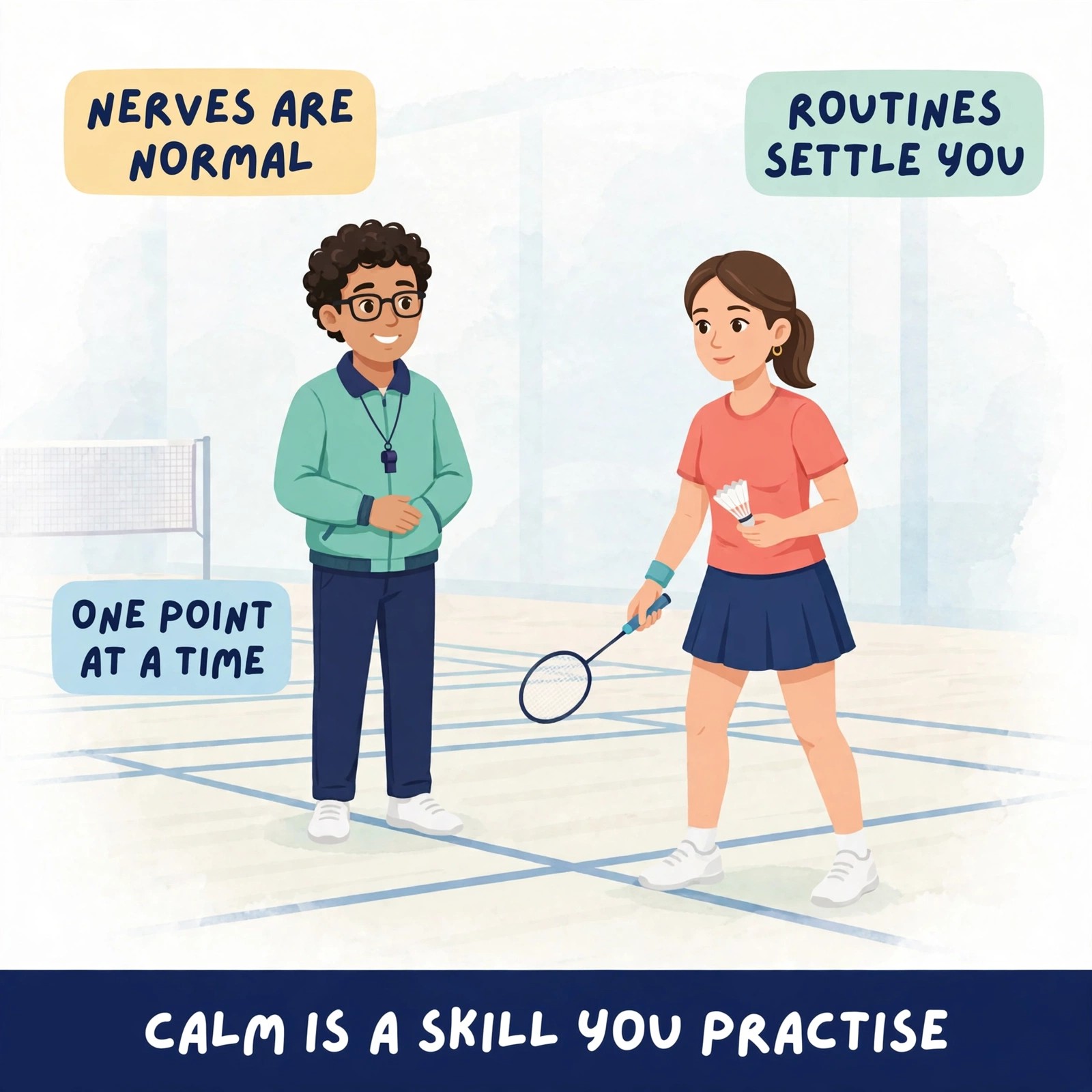
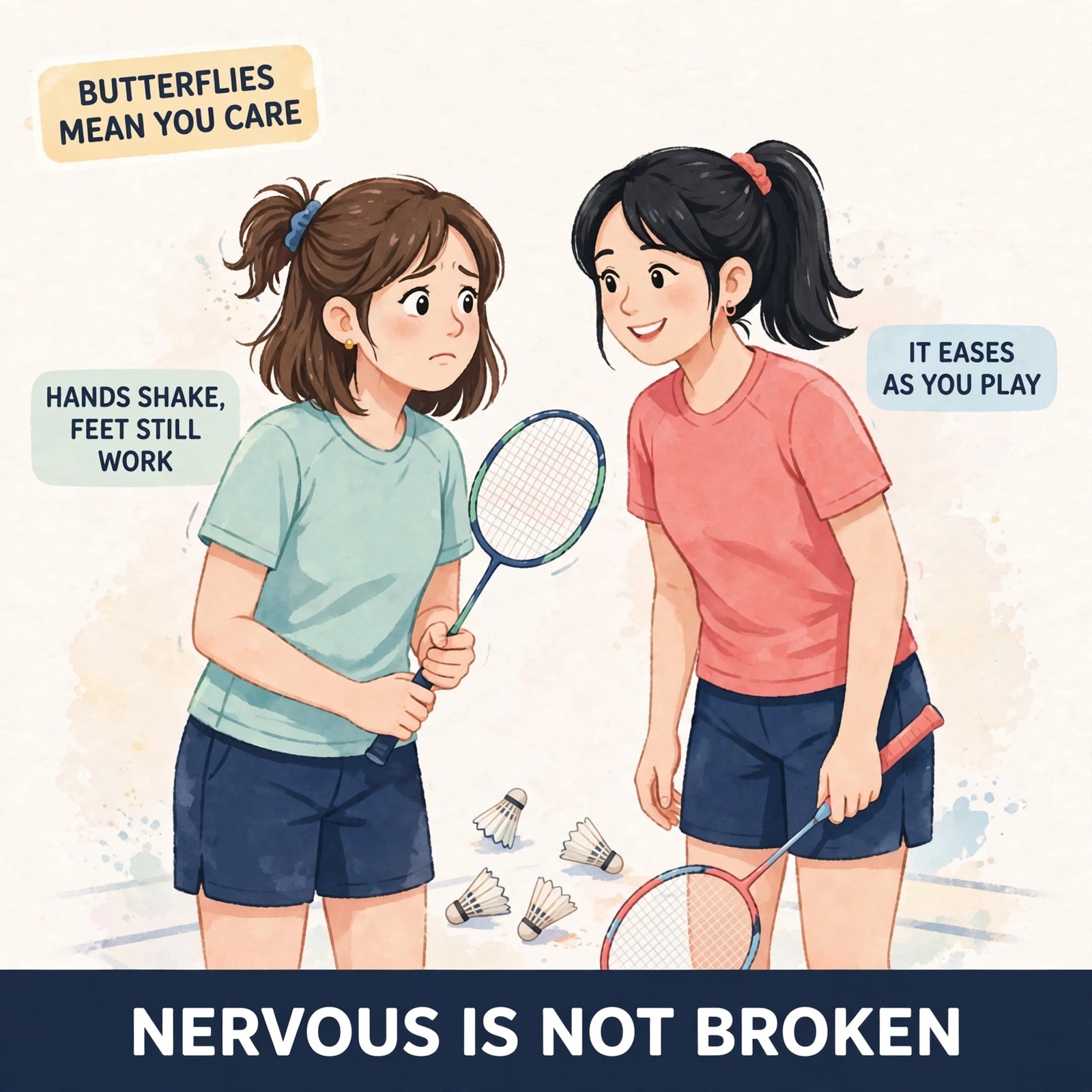
Nerves are a normal response to something that matters to you. Your body is preparing: heart rate up, senses sharper, muscles ready. In small doses that state actually helps you play. The trouble starts when we read the feeling as a verdict: I am nervous, therefore I am not ready, therefore today will go badly. Experienced players feel nerves too. Watch any seasoned competitor before a big match and you will see the same restless energy. The difference is rarely that they feel nothing. It is that they have stopped treating the feeling as an emergency, and they know from experience that it usually eases once the rallies begin.
So the first skill is simply naming it early, to yourself and, when it helps, out loud: I am nervous, and that is allowed. It sounds too small to matter, but a named feeling is easier to carry than a fought one. Arguing with your own nerves tends to make them louder, the way arguing with a heckler gives him the microphone. Naming also separates the feeling from the facts. You can be nervous and well prepared. You can be nervous and play well. Both things happen every week in every hall. Once that is accepted, the rest of this guide becomes practical: routines, resets and honest expectations, built while you are calm so they are there when you are not.
Calm Check #2
Routines That Settle You: Before and During Play
Routines settle nervous players because they give the mind something familiar to hold. The same warm up order, the same first minutes on court, the same small habits before a serve: each one is a piece of solid ground in a situation that feels uncertain. Build your routine on ordinary training days, when the pressure is low, and keep it simple enough to survive a busy hall and a changed schedule. A routine that needs perfect conditions is decoration. A routine that works in a noisy hall, with a borrowed racket, on a rushed evening, is a tool. Most players find that the first five minutes matter most: if those are familiar, the rest of the session usually follows.
The routine starts before the court. Pack your bag the night before or at a fixed time, leave with minutes to spare, and arrive unhurried, because rushing is fuel for nerves: every red light and slow queue starts to feel like a threat. Eat normally, arrive, change, begin the warm up the same way each time. None of this is superstition. It is the deliberate removal of small surprises, so that the only new thing in the session is the badminton itself. Players who feel their nerves spike on match days often find the spike started hours earlier, in a scrambled morning and a bag packed in a panic.
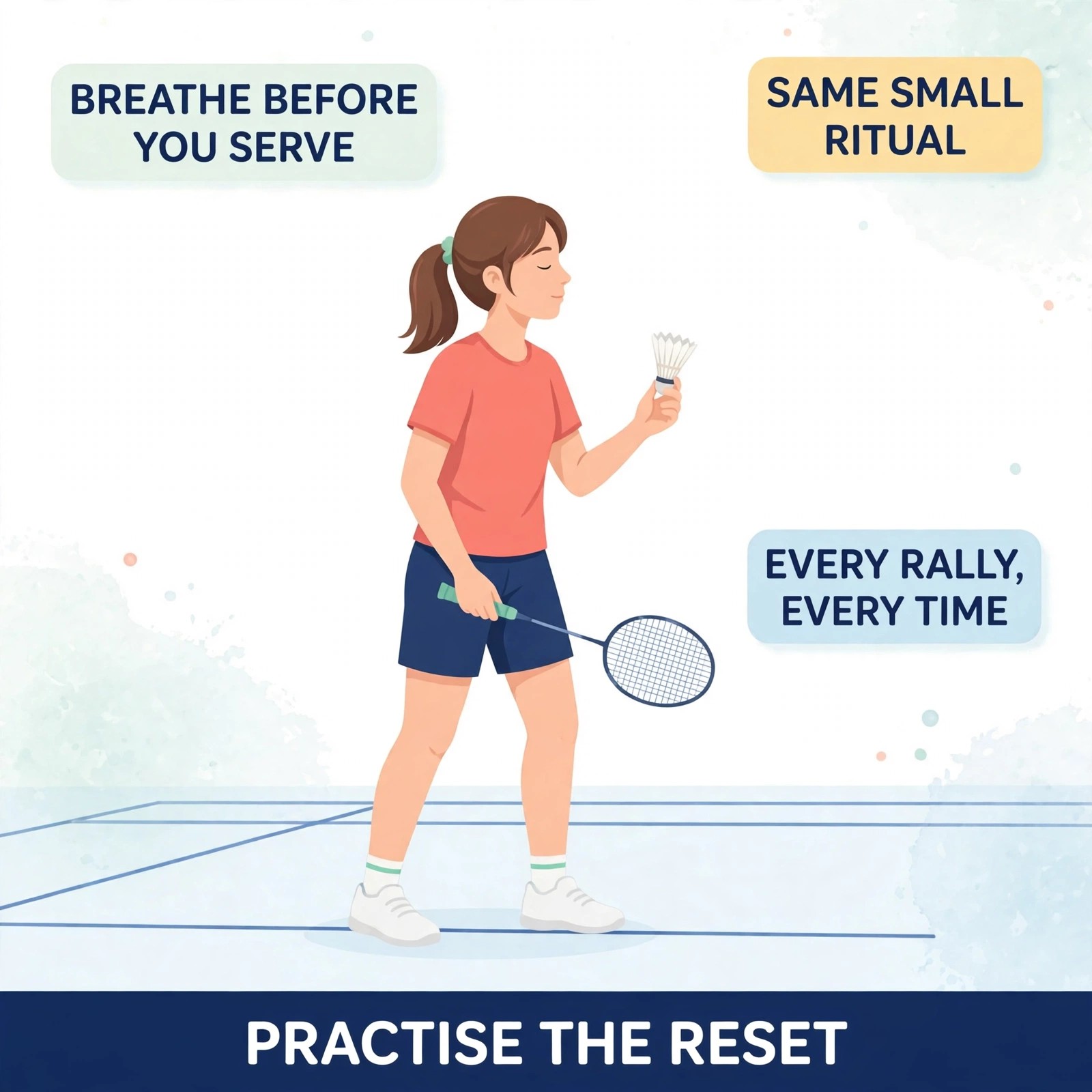
Inside the session, routines shrink to seconds. A small ritual before you serve: bounce the shuttle once, settle your feet, breathe, look at your target. The same few steps after a lost point, every time, win or lose. These tiny fixed sequences give your attention a job, and attention with a job has less room to wander into what if. Practise them in training until they are boring. Boring is the goal. In a tense match you will not rise to the occasion; you will fall back on whatever you have repeated most, so repeat the settling things. Write your small ritual down if it helps: three or four steps, in order, short enough to fit between two rallies without holding up the game. If a step stops working on a given day, keep the rest and carry on; the routine is a handrail, not a contract.

Calm Check #3
Breathe and Reset: One Point at a Time
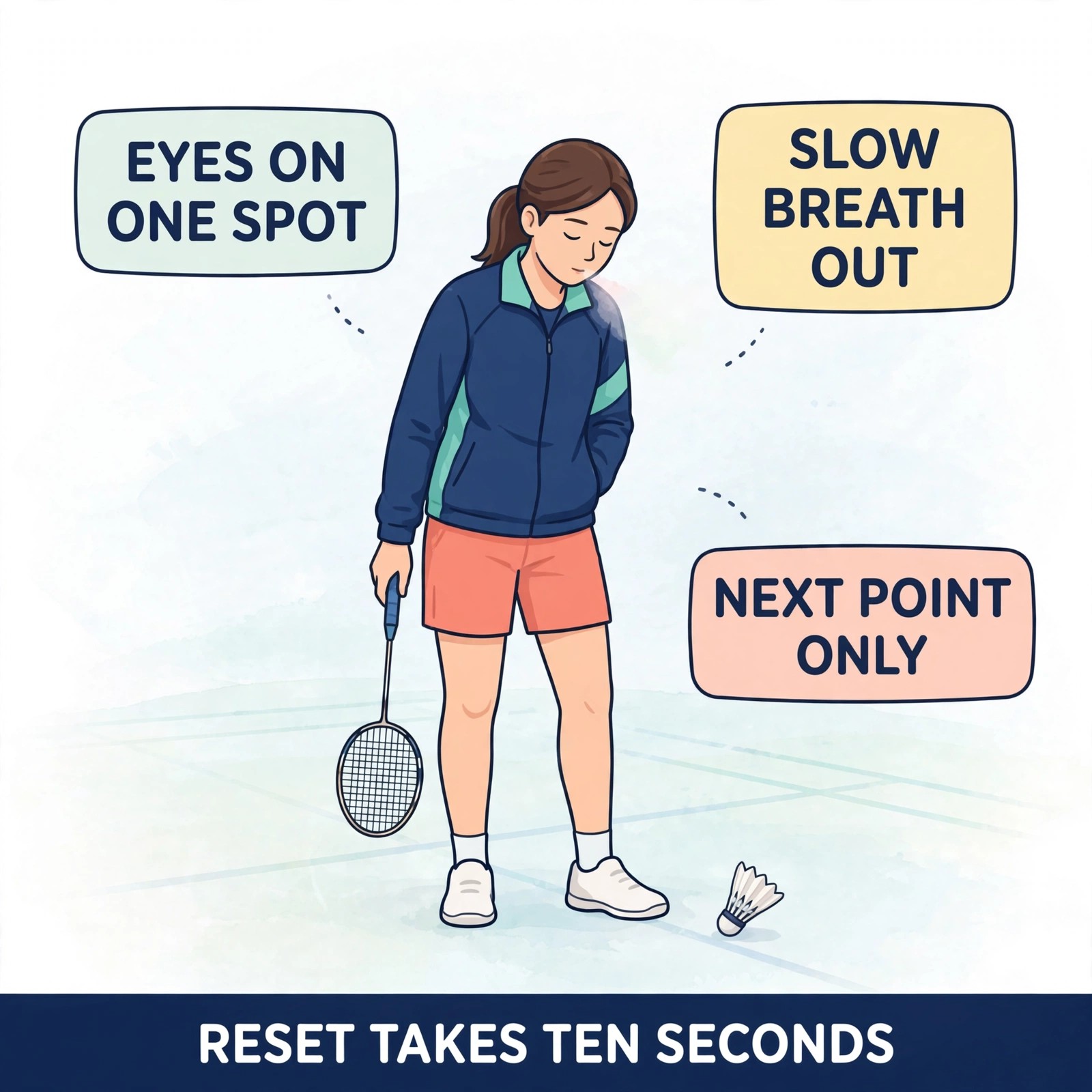
Between points, your breath is the fastest reset you own. You do not need any special technique. Breathe in gently, then let the breath out slowly, longer than the breath in, and feel your shoulders drop as it leaves. One or two slow breaths will not erase nerves, and this guide will not pretend otherwise. What they can do is take the edge off the spike: heart rate eases a little, the jaw unclenches, and your attention comes back from the last mistake or the next fear to the only place you can actually play, which is this rally. Practise the slow breath in training, between ordinary drills, so it is a habit before you need it under pressure.
The partner of the slow breath is a simple rule: one point at a time. The last point is finished, whatever it did. The next point has not happened and cannot be played yet. All you ever actually hold is the rally in front of you. This sounds like a slogan until you try it during a close game, when the score, the watching parents or the earlier errors all crowd in. Narrowing to one point is a skill, and like other skills it improves with reps: serve, play the rally fully, reset, repeat. When your mind runs ahead to the result, gently bring it back to the next shuttle. Not with anger. Just back, the way you would return to a drill.
Small physical resets help the mind follow. Loosen your grip on the racket between rallies, because a white knuckle grip usually means the whole body is braced. Let your shoulders drop, unclench your jaw, and rest your eyes for a second on one steady spot, the net tape or your strings, instead of scanning the hall. None of these are magic, and none take more than a few seconds. Together they send your body a consistent message that the emergency is over, and a body that believes that gives the mind a much better chance to settle.
Calm Check #4
Honest Expectations: Small Steps Over Perfect Days
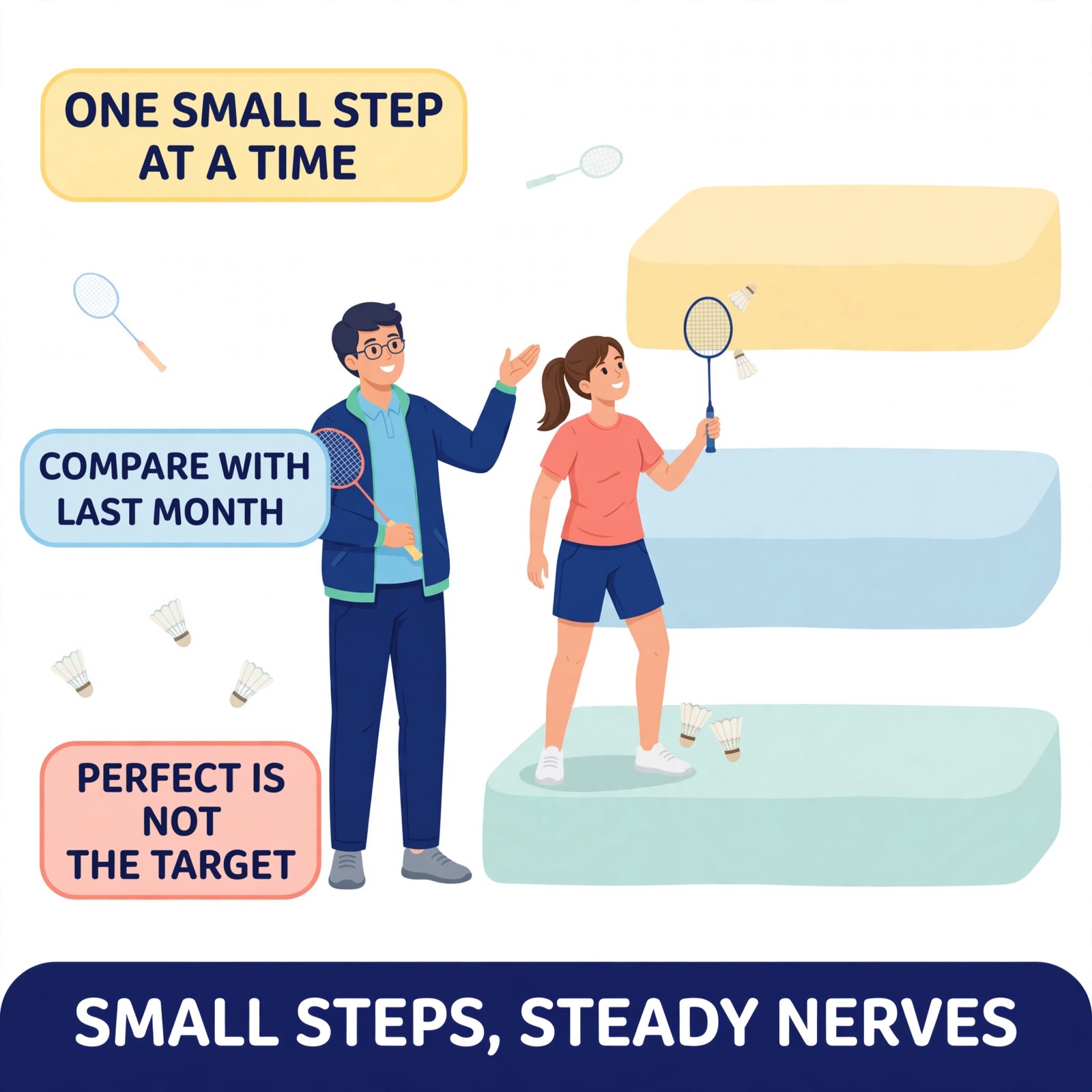
A quiet driver of training anxiety is the expectation of the perfect session. If a good day means no missed shots, no lost games and improvement you can see, then most days are failures by definition, and it is no mystery why training starts to feel threatening. Honest expectations sound different: today I will work on my backhand block; some will go in, some will not, and both kinds teach me something. A missed shot is information about what to practise. It is not evidence about who you are. Players who learn to read mistakes as data stay calmer, because the session stops being a judgement and becomes an experiment again.
Small steps protect that honesty. Set one aim for a session, small enough to be reachable on an ordinary day: cleaner contact on net shots, a steadier serve routine, calmer feet in the first ten minutes. Compare yourself with last month, not with the strongest player in the hall, whose years of training you are not seeing. And let progress be uneven, because it is uneven for everyone: plateaus, sudden jumps, and weeks where nothing moves. A player who expects the real shape of learning worries less, because a flat week stops looking like a disaster and starts looking like weather.
It also helps to separate the two voices that comment on your game. One is the coach in your head: specific, practical, interested in the next shot. The other is the critic: global, personal, and fond of words like always and never. You cannot delete the critic, but you can stop taking instructions from it. When a thought says you always choke, translate it into coach language: my serve rushed twice under pressure; I will practise the routine. The translation is not positive thinking. It is accurate thinking, and anxiety feeds much more happily on the vague version than on the specific one. This is also why talking to a coach or a trusted partner calms more than thinking in circles does: another person hears the specific version, and the specific version usually has a next step attached to it.
Calm Check #5
Talk and Support: Coach, Partners and Proper Help
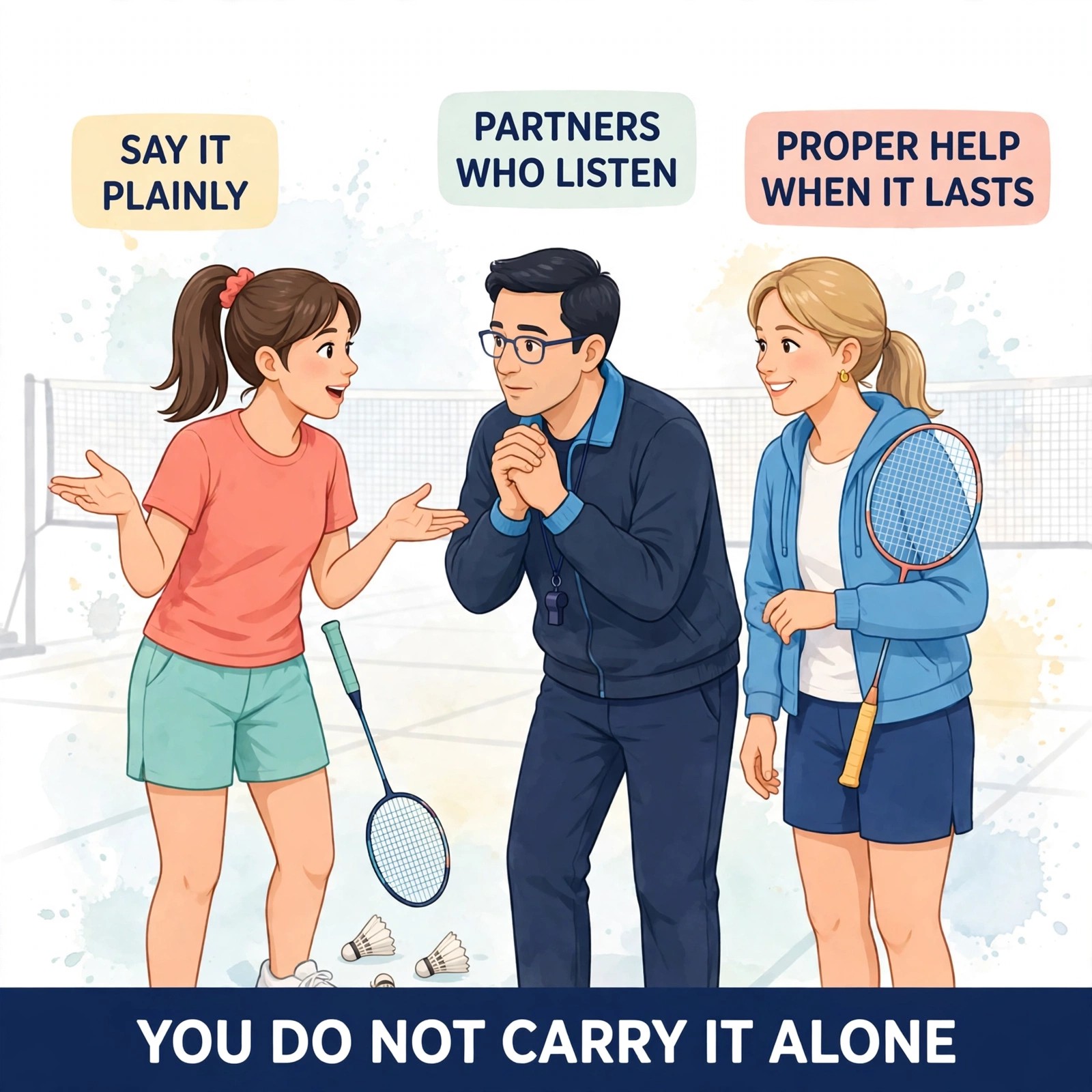
Talking early is the most underused calming tool in sport. Tell your coach, plainly, that nerves are part of your game at the moment. Coaches adjust more than players realise once they know: feeds get steadier while confidence rebuilds, pressure in drills rises in smaller steps, and match plans get built around your reset routine instead of ignoring it. Hiding nerves usually does the opposite: the coach reads your quietness as low effort, raises the pressure, and both of you leave frustrated. One honest sentence at the start of a hard patch can prevent weeks of that misunderstanding.
Partners and family carry part of this too. The training friend who knows you get nervous before matches will not tease you about it at the worst moment. The parent or partner who understands that a quiet drive home is processing, not sulking, makes the next session easier to face. Choose people who listen more than they lecture, and be that person for someone else when their turn comes. A hall full of players who treat nerves as normal is a calmer hall for everybody in it, and clubs really do differ this way. It is one of the things worth asking about when you choose where to train.
There is a line past which nerves stop being a coaching topic, and honesty means naming it. If anxiety keeps interfering with school, work or sleep, if it follows you far beyond the court most days, or if dread of training becomes dread of everything, please talk to a doctor or a counsellor. That is not a failure of toughness and it is not outside the spirit of this guide. Proper support helps many people, and getting it early is the same wisdom as getting a sore knee checked early. On court we will keep doing our part: routines, resets and honest talk. Off court, let the right professionals do theirs.
Myth vs Reality
Myths About Stress and Anxiety
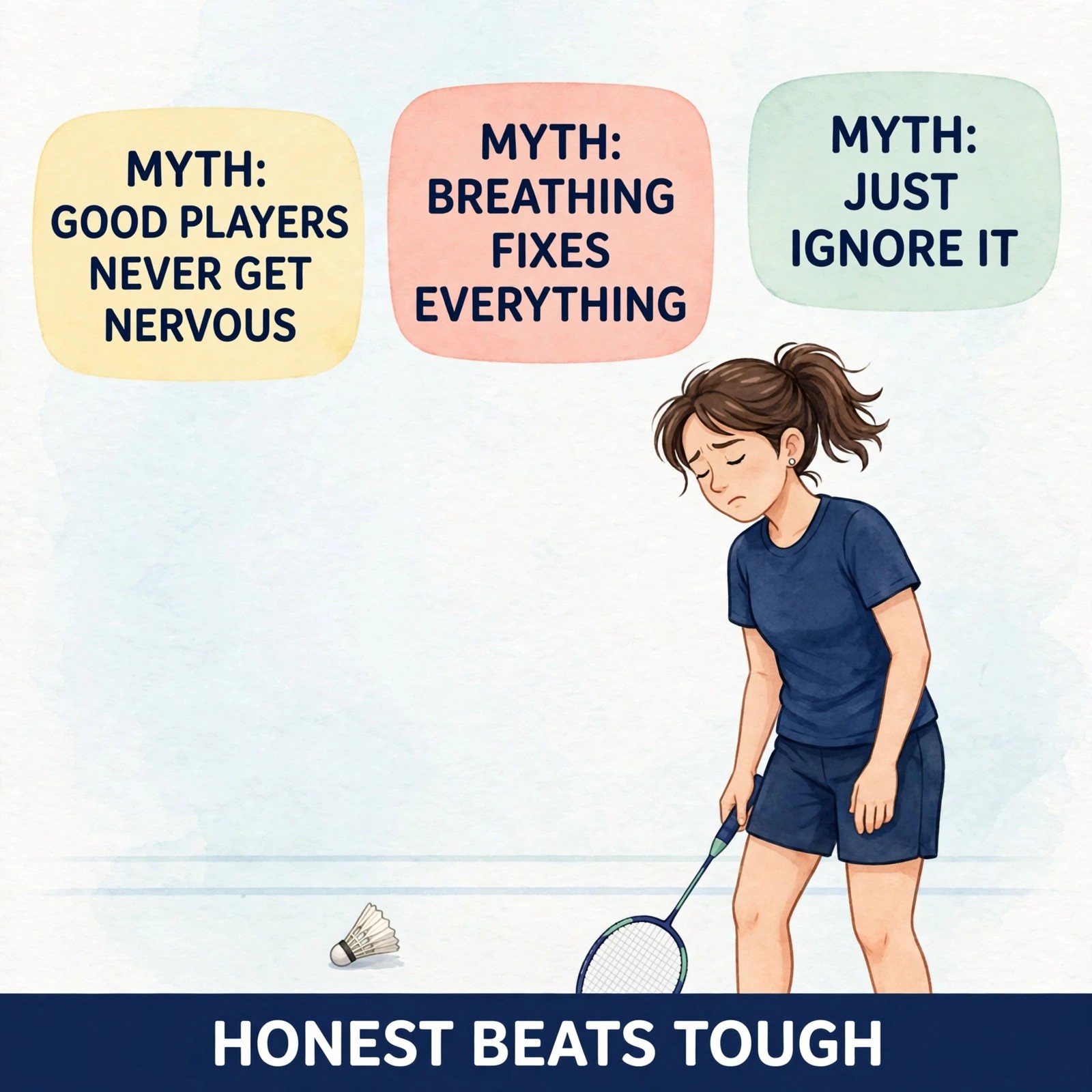
Three myths keep training anxiety heavier than it needs to be. The first says good players never get nervous, so nerves must mean you do not belong. The second says calming tricks like breathing fix everything, so if you are still anxious, you must be doing them wrong. The third says the strong response is to ignore the feelings completely and push through. Each of these sounds tough. Each of them quietly makes things worse.
The facts are kinder and more useful. Nerves appear at every level of this sport, including the very top, and plenty of great performances have started with shaky hands. Breathing and routines genuinely help most players on most days, and they are still not magic: they lower the volume rather than switching the feeling off, which is why they work best alongside honest expectations and real support. And ignored feelings rarely disappear. They usually wait, then arrive louder, at worse moments: the night before the tournament, or the third game of a close match.
Handled honestly instead, anxiety becomes something you can plan around, like a weak backhand or a busy work season. You build the routine, you practise the reset, you keep the expectations kind, you talk early, and you get proper help when the weight is bigger than sport. That is not a lesser version of toughness. In our experience it is what toughness actually looks like when it lasts.
Why Choose Us
Why Players Choose ST Badminton Academy
Our groups are capped at four students, and for nervous players that size matters. In a big class, anxiety hides until it explodes or the player quietly stops coming. In a group of four, a coach sees it early: the rushed serves, the apology after every miss, the player who goes silent in games. We can name it kindly, adjust the session, and build the player’s reset routine into the drills themselves, so calming down is practised like footwork, with reps, feedback and progress you can feel across a few weeks.
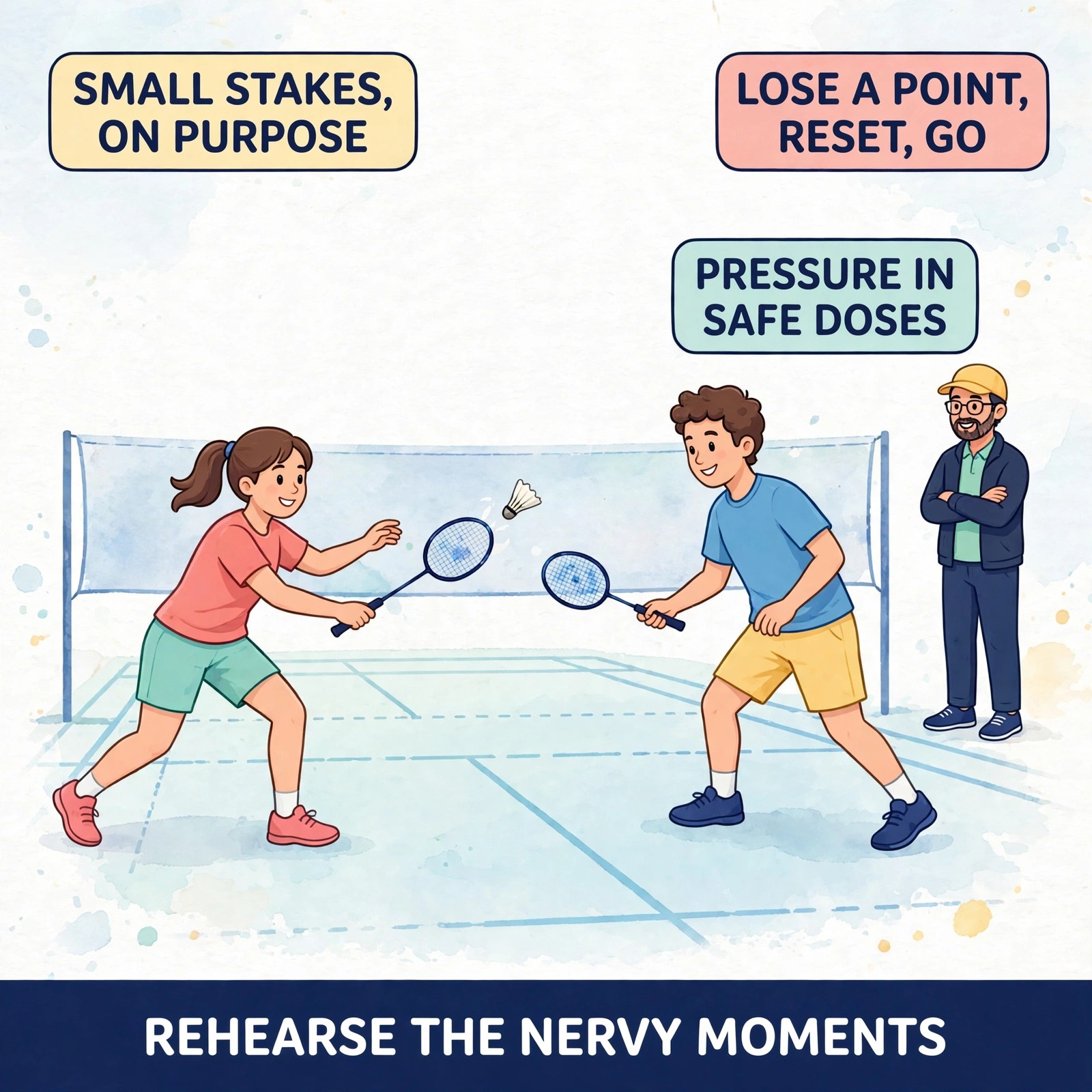
We also raise pressure on purpose, but in safe doses. Short scoring games, gentle stakes, points played under a little noise: these are rehearsals for the nervy moments, sized so the player succeeds often enough to trust the routine. Mistakes in our sessions are treated as information out loud, because the way a coach talks about errors becomes the way players talk to themselves about errors. If we would not say it to a player, we work on helping the player stop saying it to themselves.
And we talk. Players can tell us when nerves are loud, when a tournament is weighing on them, or when life outside is crowding in, and the plan will bend without drama. We are coaches, not therapists, and we will say so honestly: what we offer is calm structure on court, honest expectations, and a nudge toward proper support when something looks bigger than badminton. For many players that combination is exactly the size of help they needed to start enjoying training again.
FAQs: Managing Stress And Anxiety In Badminton Training in Malaysia (KL)
These are the questions players ask us most about stress and anxiety in training. The short version is always the same: name it early, lean on routines, reset between points, keep expectations honest, and talk before it grows. The longer answers are below.
I am a beginner. Is it normal to feel nervous in training in Setapak or Gombak?
Yes, completely normal. Nerves mean the session matters to you, and beginners feel them in front of new people, new drills and a new hall all at once. In our groups of four, coaches expect nerves, name them kindly, and build your settling routine from the first session, so the feeling shrinks to its real size quickly.
What routine helps settle nerves before a session in KL?
Keep it simple and repeatable: bag packed in advance, arrive unhurried, the same warm up order, and the same first minutes on court every time. Familiar steps give your mind solid ground. Practise the routine on calm days too, because a routine built only on nervous days never gets the easy repetitions it needs to become automatic.
How can I calm down between points at club level?
Use the seconds the game already gives you. After each point, turn away briefly, loosen your grip, breathe in gently and let the breath out slowly, then look at one steady spot and think only about the next rally. Practise this reset in training drills, not just matches, so it is a habit before you need it under pressure.
I get very anxious before matches. What can I work on in training first?
Start with the routine and the reset, trained on ordinary days: a fixed pre-match sequence, a slow breath between points, and expectations set as one small aim per game. Add gentle pressure in training, short scoring games with small stakes, so nervy moments get rehearsed safely. Tell your coach, too, so feeds and pressure can be sized to you.
When is anxiety more than normal nerves, and who should I talk to in Kuala Lumpur?
If anxiety keeps interfering with school, work or sleep, follows you far beyond the court most days, or grows instead of easing over weeks, please talk to a doctor or a counsellor. That is proper support, not weakness, and it helps many people. On court, keep telling your coach as well, so training can be shaped kindly around it.
Do you help nervous players settle during training near Wangsa Maju?
Yes. Settling nervous players is normal coaching work in our Kuala Lumpur sessions: routines built into warm ups, resets practised inside drills, pressure raised in small safe steps, and mistakes treated as information out loud. With no more than four students per group, a coach notices nerves early and can adjust before they grow into dread.
Where does ST Badminton Academy run badminton training in Malaysia?
The academy coaches in Kuala Lumpur, with our original base in Setapak and players joining from across the Klang Valley. Sessions run for kids, teens and adults in groups capped at four students, with calm structure, honest expectations and reset routines built into training, so nervous players are coached as carefully as confident ones.
Can I book a trial session in Kuala Lumpur if I am a nervous beginner?
Yes, and please tell us when you book. Nervous beginners are welcome here, and knowing in advance lets us shape the trial kindly: a small group of no more than four, a steady warm up, gentle first drills, and no sudden pressure. Many of our calmest players arrived as our most nervous ones.
Is Mr Eric Chuar a suitable coach for players who get anxious badminton?
Mr Eric Chuar coaches the academy sessions himself and works the way this guide sets out: nerves named early, routines built patiently, pressure dosed carefully, and honest talk welcomed. With over 15 years of coaching in Kuala Lumpur, he measures success with anxious players by one thing first: that they start looking forward to training again.
Calmer Badminton Training in Action


One Standard for Every Session and Every Player
One standard runs through this guide and through our coaching: honesty over toughness. We will never promise that a breathing trick removes anxiety, and we will never tell a struggling player to simply try harder. What we promise is calm structure, small groups, mistakes treated as information, and straight talk about when proper support is the right step. Nerves are part of this sport. Handled well, they do not have to be the part that ends it.
| Factor | Hiding Nerves | Handling Them Honestly CALM |
|---|---|---|
| Frequency | 1 or 2 times a week. Mostly for fun and sweat. | Nerves are named early and treated as normal, so they shrink to their real size instead of growing in the dark. |
| Drills Focus | Basic static feeding. Minimal footwork pressure. | Routines and a slow breath between points give the mind steady work, so one point at a time becomes possible. |
| Physical Conditioning | Rarely included. Just playing games on court. | Core, agility, and speed training included in every session to prevent injury and build stamina. |
| Tactical Awareness | "Just hit it over." No real game plan. | Video analysis, point construction, and learning to read the opponent's game. |
| Coach Ratio | Large groups (8-10 kids). Coach barely watches you. | Max 4 students. Mr Eric Chuar personally corrects every stroke and movement detail. |
| Goal Setting | Fun and exercise. | Expectations stay honest and support is used early, so hard days are shared instead of carried alone. |
| Long Term Result | Good recreational player. | A calmer player: still nervous sometimes, and still playing well, because the nerves are handled, not hidden. |
Calmer Badminton Training in Kuala Lumpur
Start small this week: pick one routine, the same warm up order or a slow breath before every serve, and use it in every session, calm or not. Then book a trial session with us and tell us honestly if nerves are part of your game. We will plan around them with you, kindly and practically, from the first rally.




