What Are The Top Drills For Enhancing Your Badminton Crosscourt Drop Shot Technique? (Drop Guide)
Some shots win points. The crosscourt drop wins space. Played well, it drags your opponent out of the middle, across the full diagonal of the court, and leaves the straight side of the court empty behind them. Played badly, it is a slow gift that floats into their forehand. The difference is rarely talent. It is preparation, slice, landing and recovery, and every one of those parts can be drilled. This page works through the drills that build a crosscourt drop your opponent cannot read early: the clear shape that hides it, the slice that bends it across, the corner it must land in, and the feet that bring you back before the reply comes.
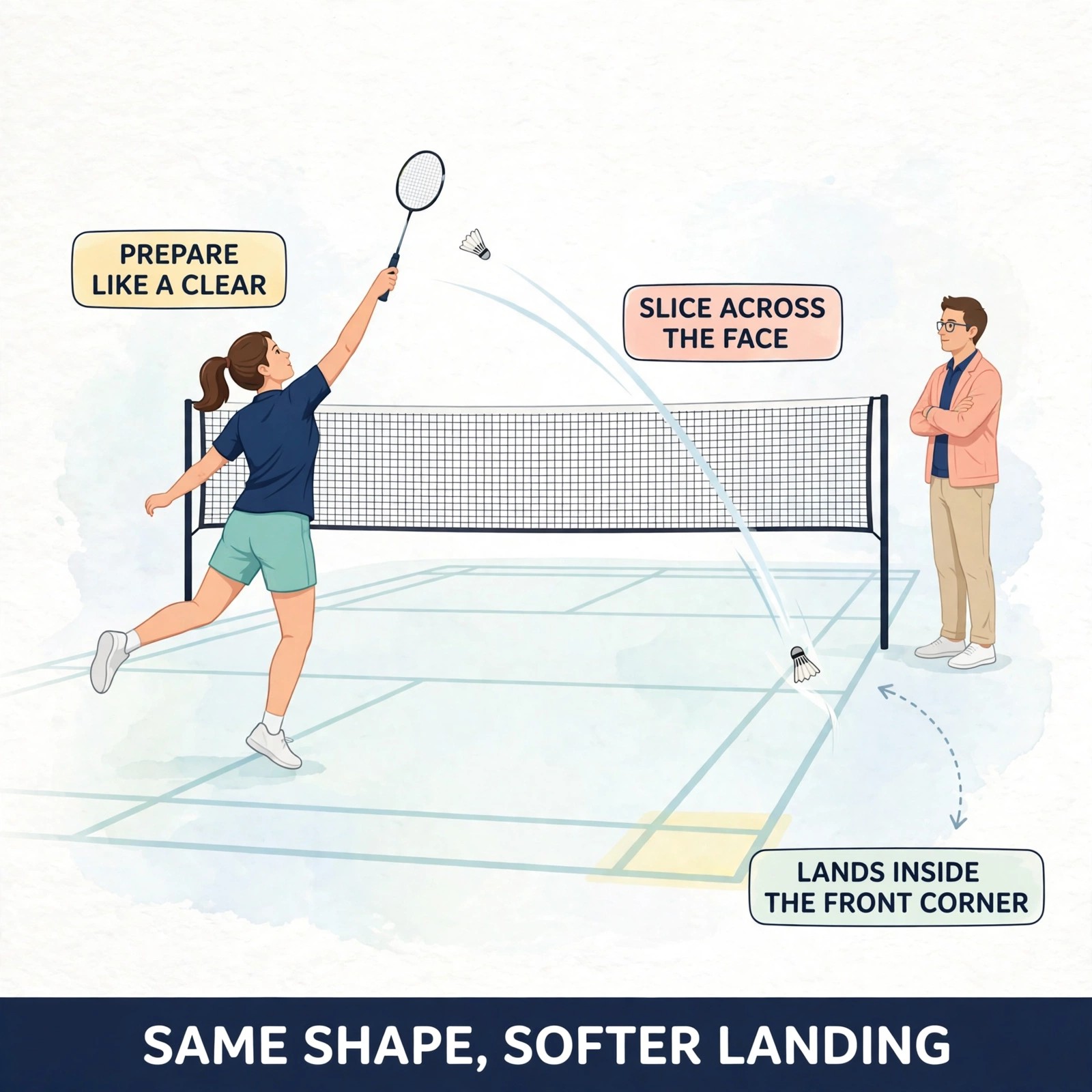
Drop Check #1
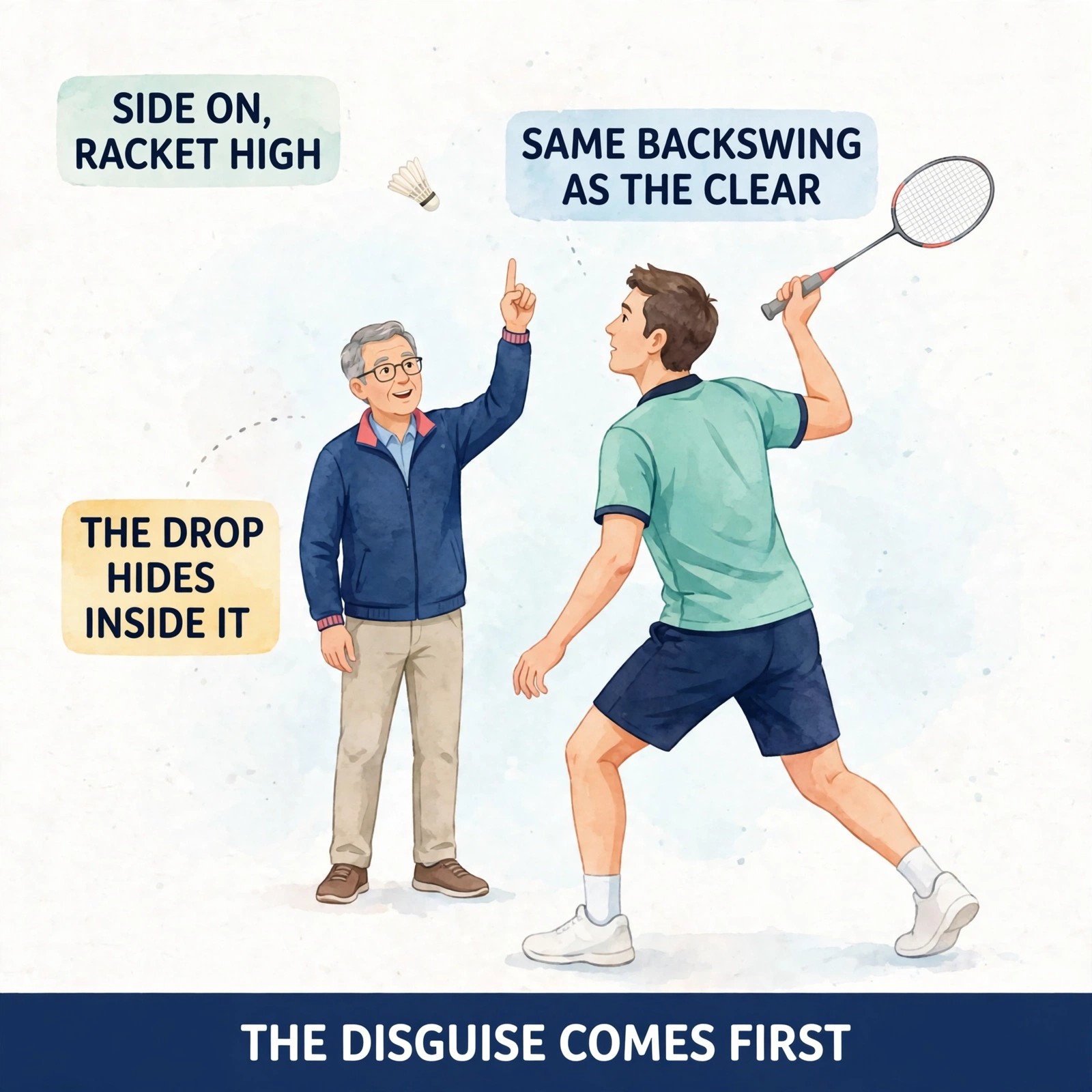
Same Preparation As The Clear: The Disguise Comes First
Start with the shape, because the crosscourt drop is a clear in disguise. From the rear court you turn side on, racket drawn back high behind your head, non racket arm up for balance, exactly as you would for a clear or a smash. Nothing about the preparation tells the receiver which of the three shots is coming. That sameness is the whole weapon. Players who drop their racket early, open their chest too soon or start the swing slower for the drop are announcing the shot a full second before they play it, and a second is forever at the net. Drill the preparation until all three shots share one picture: side on, high, patient, and identical until the last moment.
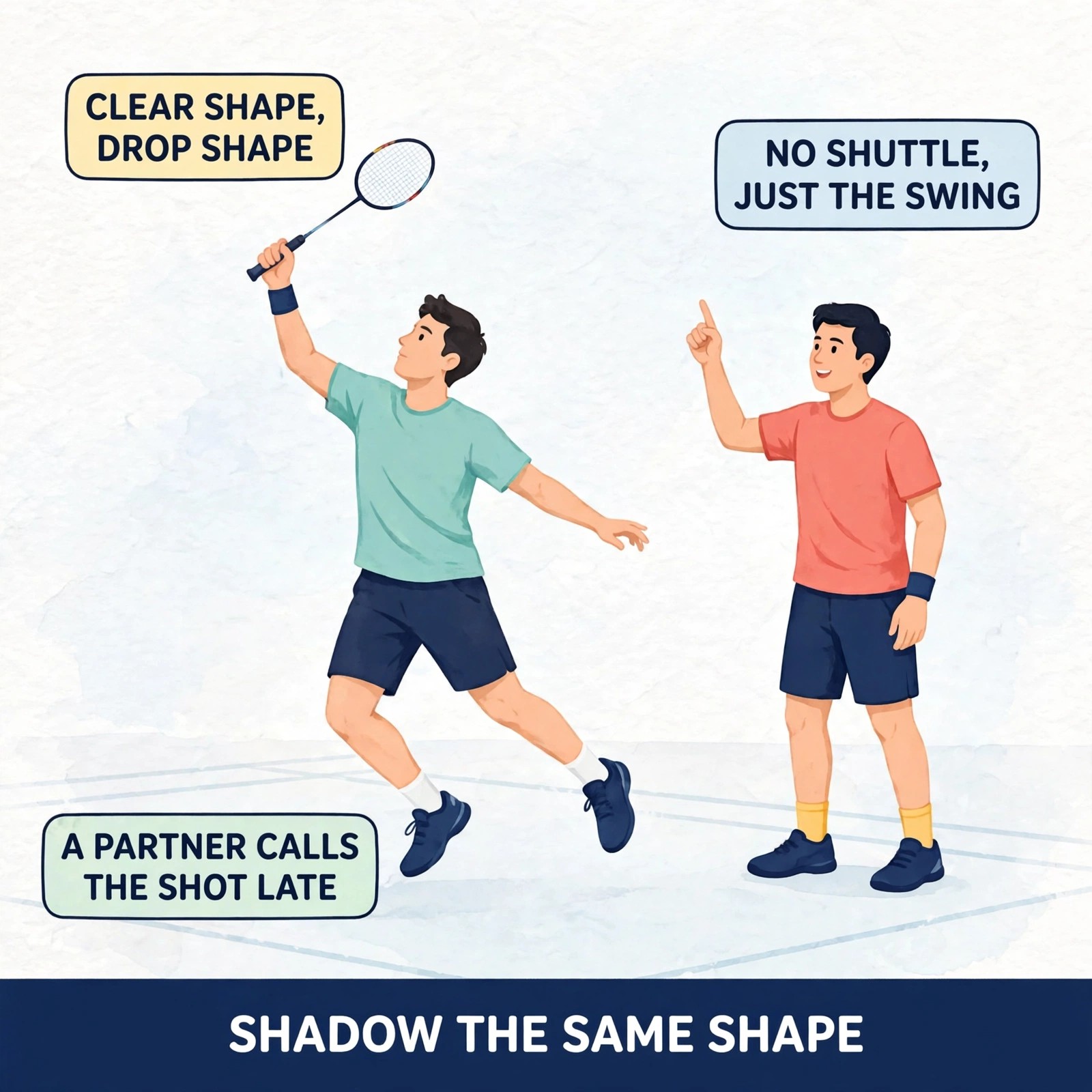
Drill the shape before you drill the landing. Shadow the preparation in the rear court with no shuttle: turn, draw the racket back, freeze, and have a partner or coach check that nothing in the picture says drop. Then hit easy high feeds and play clear, clear, drop in random order while your partner calls out which shot they read and when they read it. If they can name the drop before contact, the shape is leaking. Common leaks are a slower backswing, a wrist that bends early and a body that stops turning. Fix the leak, not the landing. Accuracy work on a readable drop is wasted work, because in a match it will be read no matter where it lands.
Drop Check #2
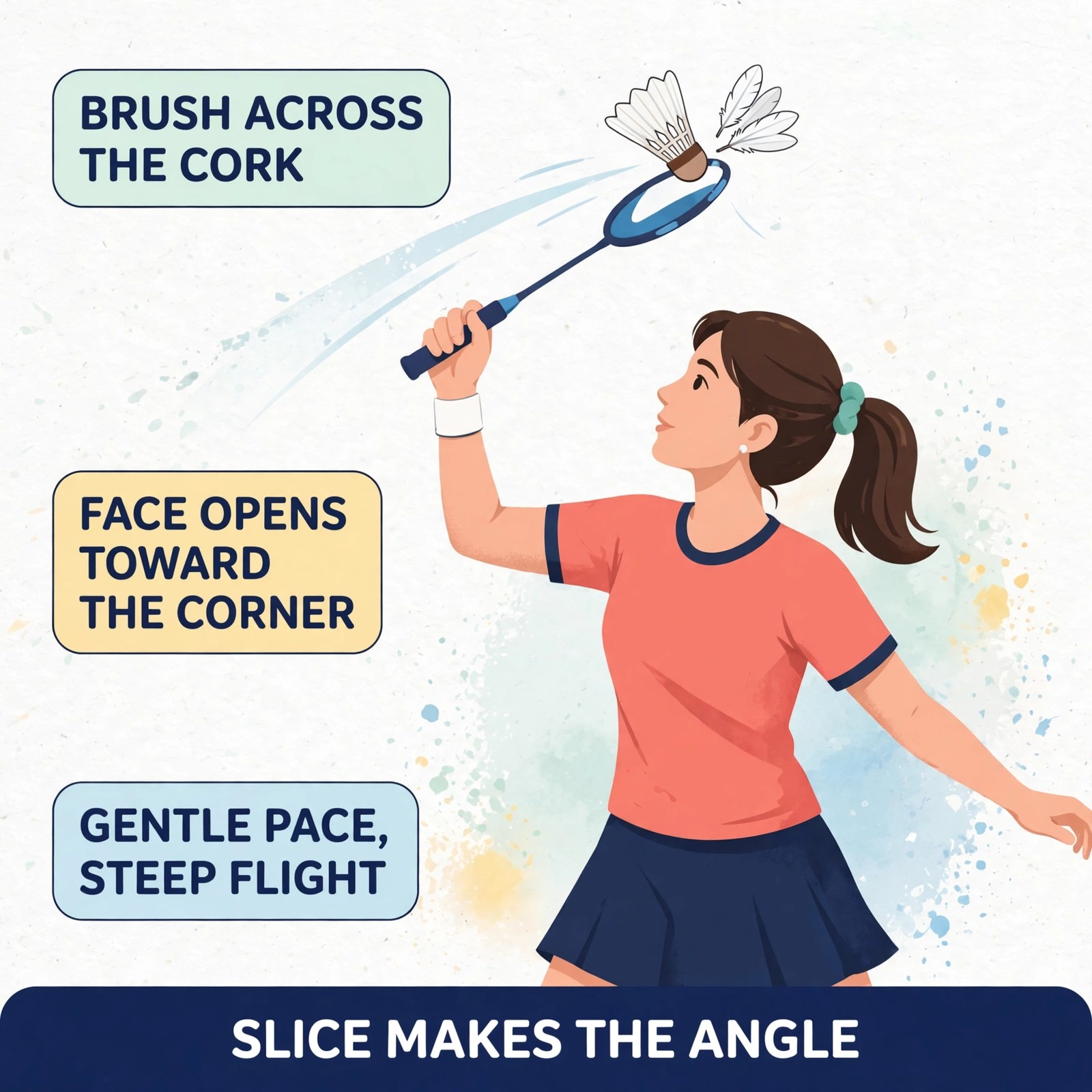
Slice And Angle: How The Crosscourt Drop Is Played
The crosscourt drop itself is played with slice. As the shuttle arrives high in front of you, the racket face brushes across the cork rather than driving straight through it. That brushing contact does two jobs at once. It takes pace off the shuttle so the shot can drop close to the net, and it angles the shuttle across the court toward the far front corner. The swing still looks like a clear until very late; only the last moment of contact changes. Keep the arm action full and relaxed. Players who slow the whole swing down to play softly produce a drop that floats high and sits up for the opponent. Slice gives you softness without slowness.
Contact point decides whether the slice works. Meet the shuttle high and in front of your front shoulder, at the same point you would meet a clear. From there the face opens slightly toward the cross corner as it brushes across the cork. Met late, beside the body, the same slice drags the shuttle wide or dumps it into the net, because the face angle you need is no longer available. A useful feel: the shuttle should leave the strings travelling across your body line, not along it. If your follow through finishes pointing at the corner you aimed for, the face did its job. If it finishes pointing down the middle, you pushed the shot instead of slicing it.
Understand how the crosscourt drop differs from its straight cousin, because they share a preparation and nothing else. The straight drop travels the short road down the line and can be played with a finer margin over the tape. The crosscourt drop travels the long diagonal, the longest trip a drop shot can make, so it needs a touch more height over the net and a slightly earlier contact to arrive with control. It also lands in the corner furthest from where your opponent expects a tired player to aim. That distance is the point of the shot. You are not only dropping the shuttle. You are moving a person across thirteen metres of court, rally after rally.
Drop Check #3
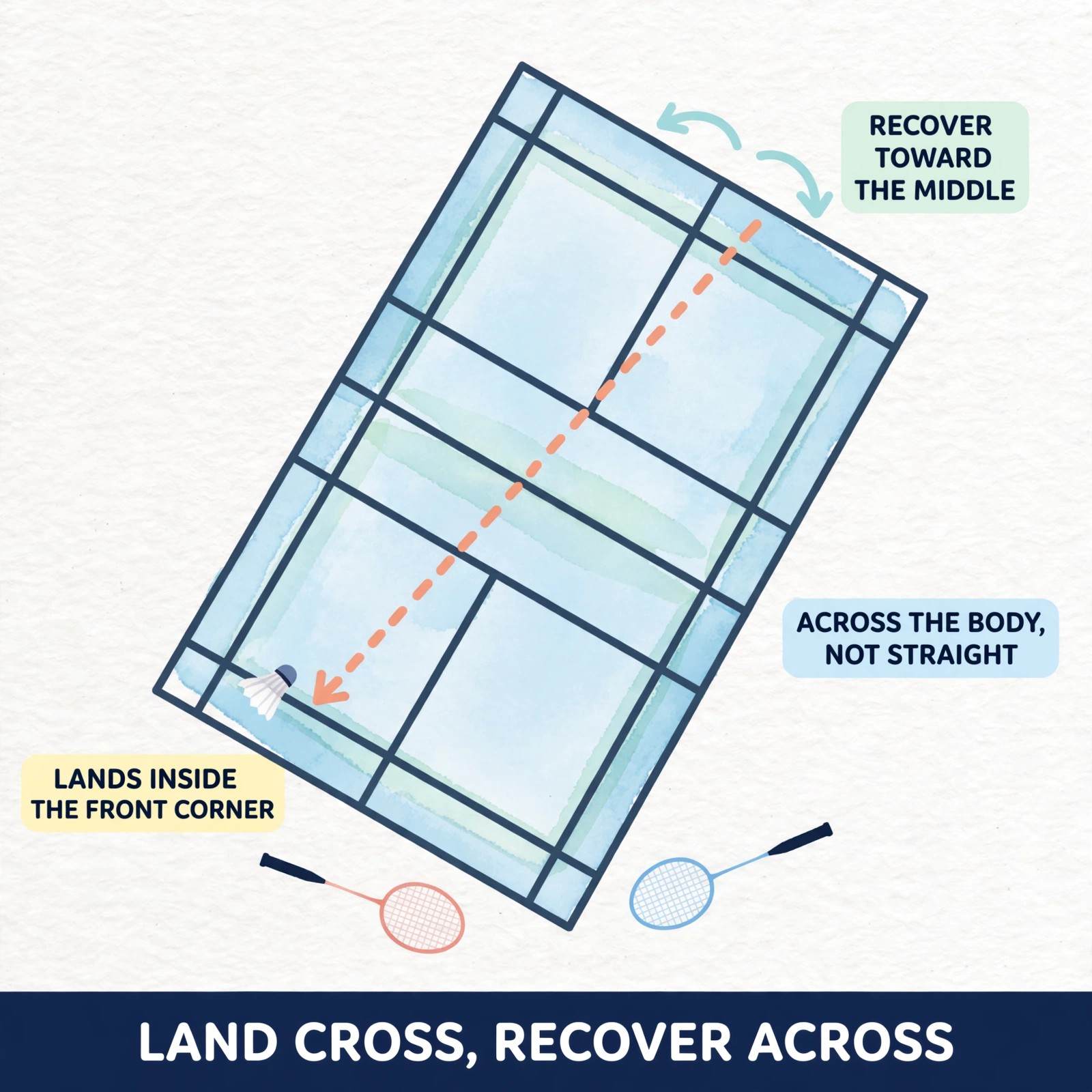
Landing Zone And Recovery: The Two Halves Of The Shot
A crosscourt drop is only half finished when it crosses the net. It must land inside the front cross corner, close to the net and close to the side line, with enough margin that a gust of bad luck does not push it wide. Aim for a landing patch you could cover with a racket bag, sitting inside the corner where the service line meets the tramline. Shots landing a metre inside that corner are safe but harmless, because the opponent reaches them in one step. Shots kissing the line are deadly and fragile. The drills on this page count landings inside the patch, and that count, not how pretty the shot looked, is the score that matters.
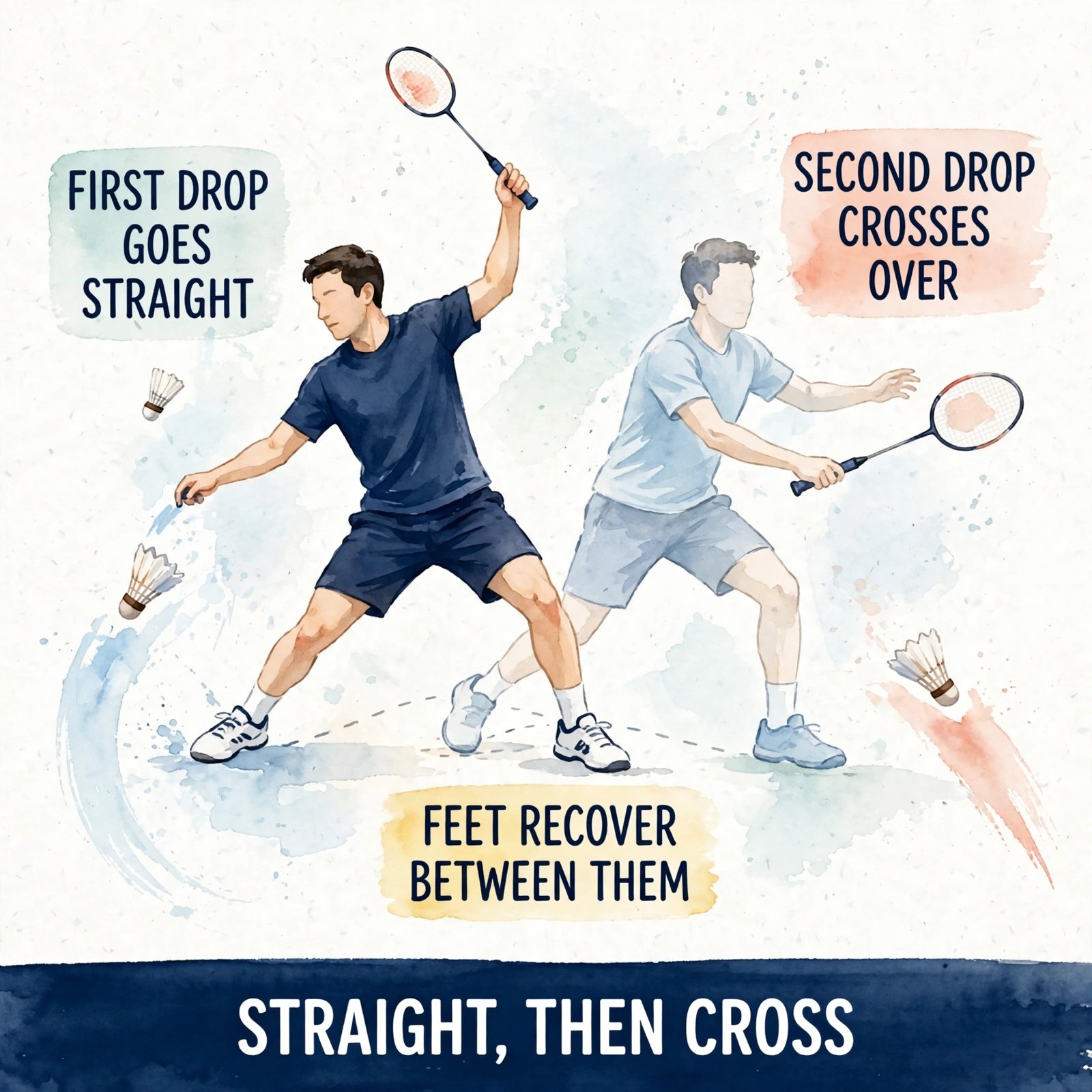
Then comes the recovery, the part club players skip. A crosscourt drop pulls the play to the far corner, and your next job begins the moment the shuttle leaves your strings: push back across the court toward the middle and be ready before the reply crosses. Your opponent has two honest answers, a straight net shot or a lift back across, and both demand that you are already moving. Players lose the point after their best drops because they stood and admired the shot travelling. Drill the drop and the recovery as one movement. Shuttle leaves, feet start. When the recovery is automatic, the crosscourt drop stops being a gamble and becomes a pattern you can run all match.
Know the shot’s price before you spend it. A crosscourt drop opens your own court on the straight side, and if it is played from a poor position, deep, stretched or off balance, a good opponent will simply push the reply straight past you into the space you left. So the rule is simple: the crosscourt drop is played from balance, from a strong rear court position, as a choice. From defence or desperation, play the straight reply and rebuild. Coaches see this fault every week: the most attacking drop on the page played from the weakest position on the court. Position first, angle second. The drills below build the shot from feeds where the position is earned, not given.
Drop Check #4
Feeding Drills That Build The Crosscourt Drop
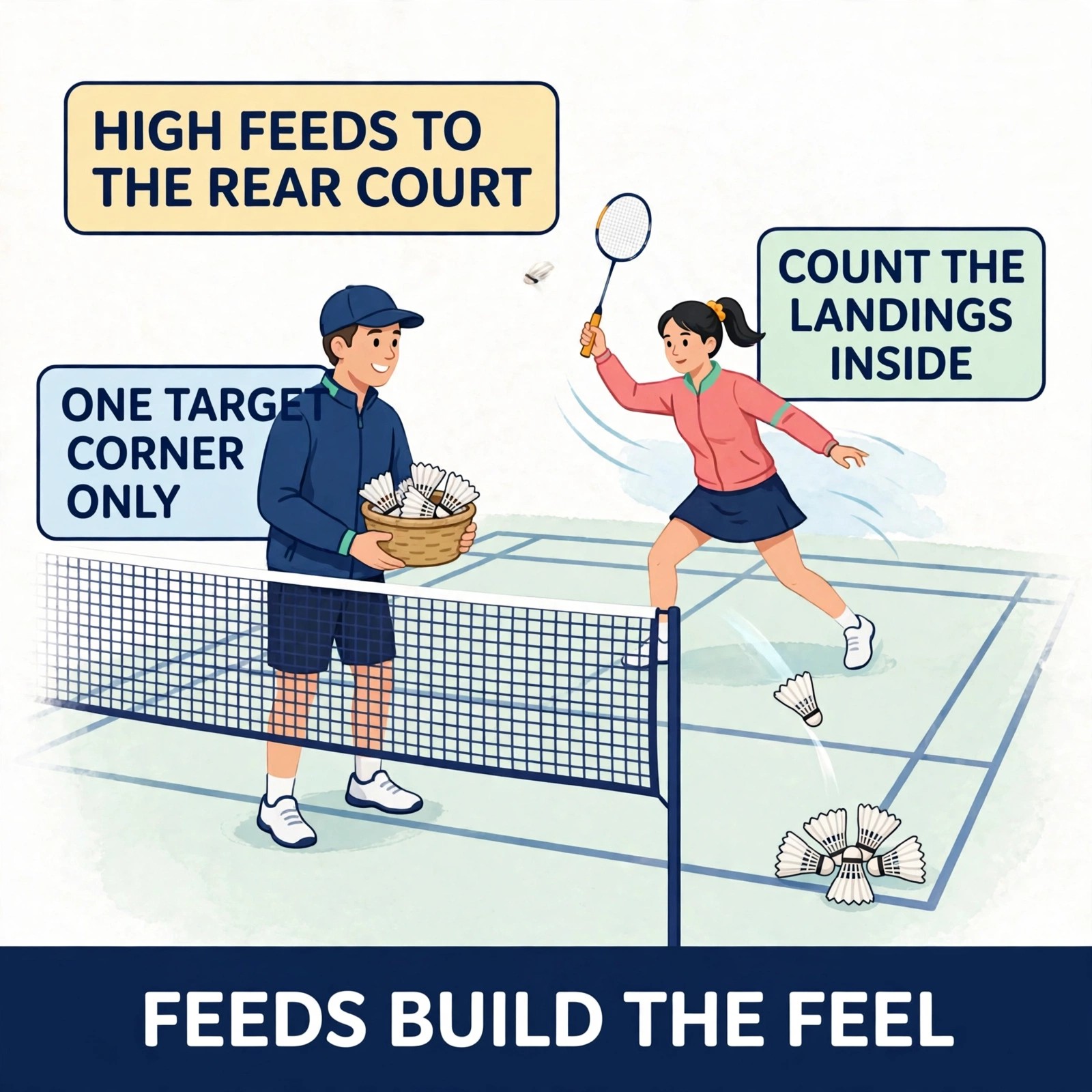
The base drill is a feeding drill. A coach or partner at the net feeds high lifts to your rear forehand corner, one every few seconds, and you play crosscourt drops to one target corner only. Sets are short, ten to twelve drops, then rest. Count how many land inside the target patch. Eight inside from twelve is a working standard for a club player; below that, slow the feeds down before you add difficulty. The feeder’s job matters as much as yours: lifts must reach the back tramline with time for a full preparation, because rushed feeds teach a rushed shape, and a rushed shape reads early in matches.
Once one corner holds, widen the drill. The feeder now lifts to both rear corners, and you play the crosscourt drop from each side, forehand corner to forehand corner, backhand corner to backhand corner. The backhand side crosscourt drop, played with the same sliced action over the head where possible, takes longer to settle, and that is normal. Follow with the two shot combination: first drop straight, second drop cross, from the same feed, same preparation. This is where the disguise earns its keep, because your partner, standing at the net trying to read you, should be guessing. When they stop being able to call the direction early, the combination is ready for rallies.
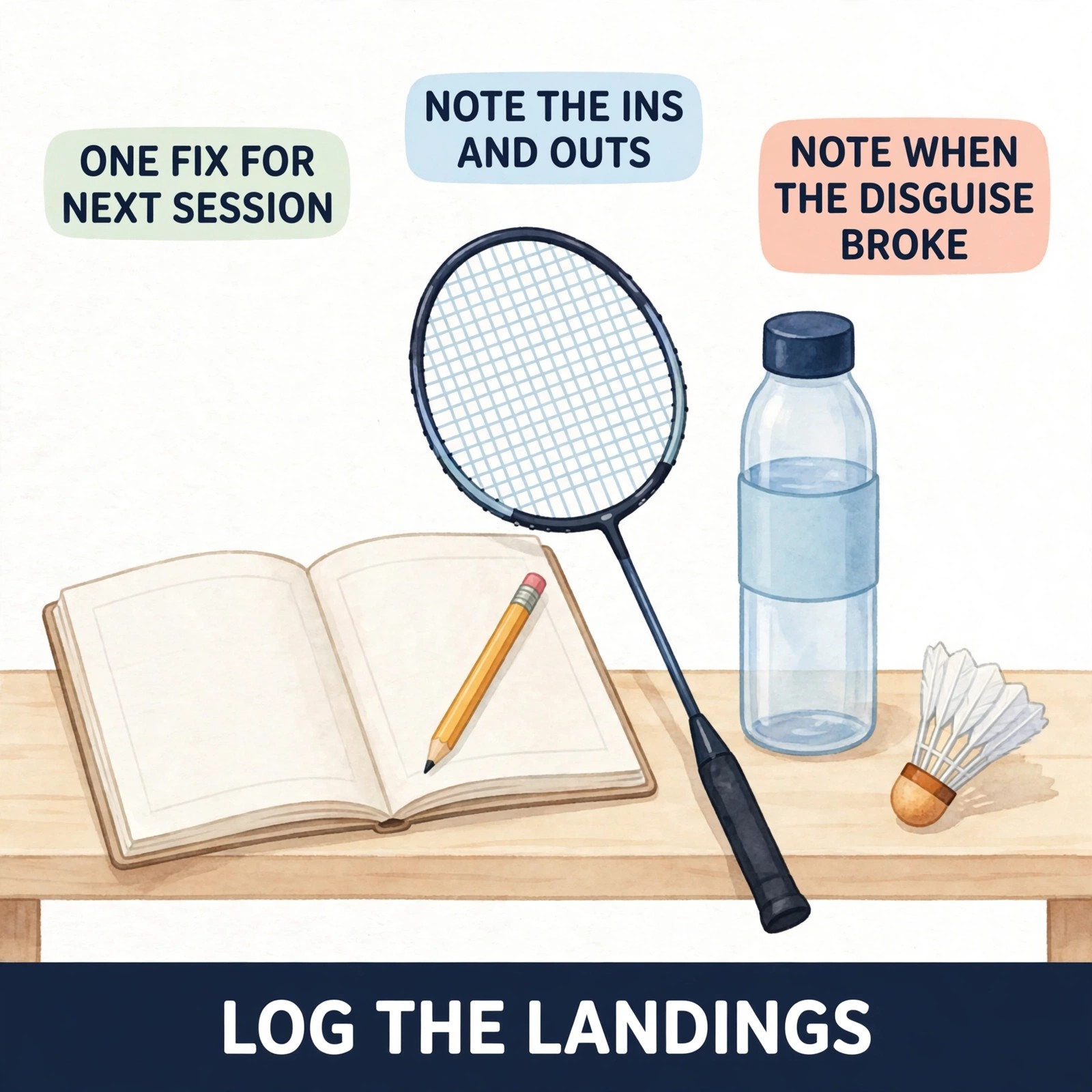
Guard the quality of every set. The crosscourt drop is a feel shot, and feel drains as legs tire: landings drift long, then wide, then the slice turns into a push. End the set when the shape breaks, not when the basket empties. Write the count in the log while you rest: feeds, landings inside, and the fault that appeared most. Over a month those three numbers tell you whether the shot is growing. Players who only remember their best drops in a session train their memory, not their drop. The log is dull and honest, and dull and honest is what technique work looks like from the inside.
Drop Check #5
Pressure Drills: The Drop With A Reader In Front
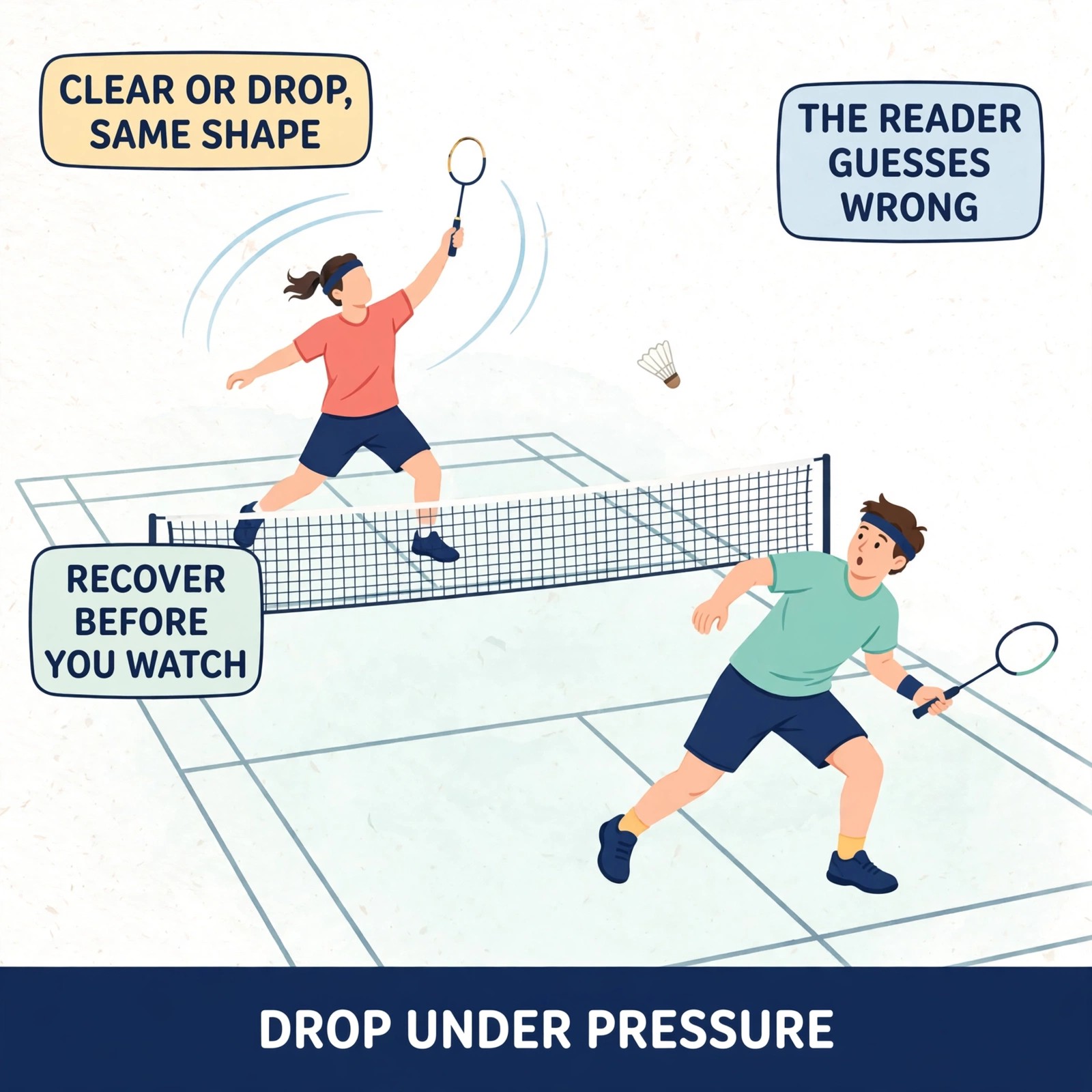
Pressure drills put a reader in front of the shot. Your partner stands at the net on the receiving side and scores a point every time they call cross or straight before your shuttle crosses the net; you score for every drop that lands inside the corner after being called late or wrong. Play in short games. This drill changes everything, because accuracy alone no longer wins it. You learn to hold the shape a fraction longer, to keep the clear threat real by playing the clear when they creep in, and to feel the difference between a drop that lands well and a drop that arrives as a surprise. The second one wins matches.
Build the shot into rally patterns next. Start each rally from a lift, and the rear court player must play either a clear or a crosscourt drop as the second shot, nothing else. The receiver plays freely from there. Ten rallies, then swap roles. Patterns like this teach shot selection, not just shot production: you start to feel which picture invites the crosscourt drop, a receiver camped on the straight side, a slow recovery from their last shot, a backhand corner they protect late. Selection is where club rallies are actually lost. Players rarely miss because their slice failed; they miss because they chose the crosscourt drop on the one rally where it was the wrong answer.
In matches, spend the shot with a plan. The crosscourt drop works hardest against opponents who guard the straight side out of habit, who recover slowly to the cross corner, or who stand a step too deep expecting clears. It works worst as a habit. Play it every time you reach the rear forehand corner and any decent opponent will simply wait on that side and take it early. Keep the straight drop and the clear honest, and the crosscourt drop stays a question they must answer fresh each rally. That is the correct ending point for all this drilling: not a trick shot, but a threat your opponent has to respect on every single rally.
Myth vs Reality
Myths About Crosscourt Drops
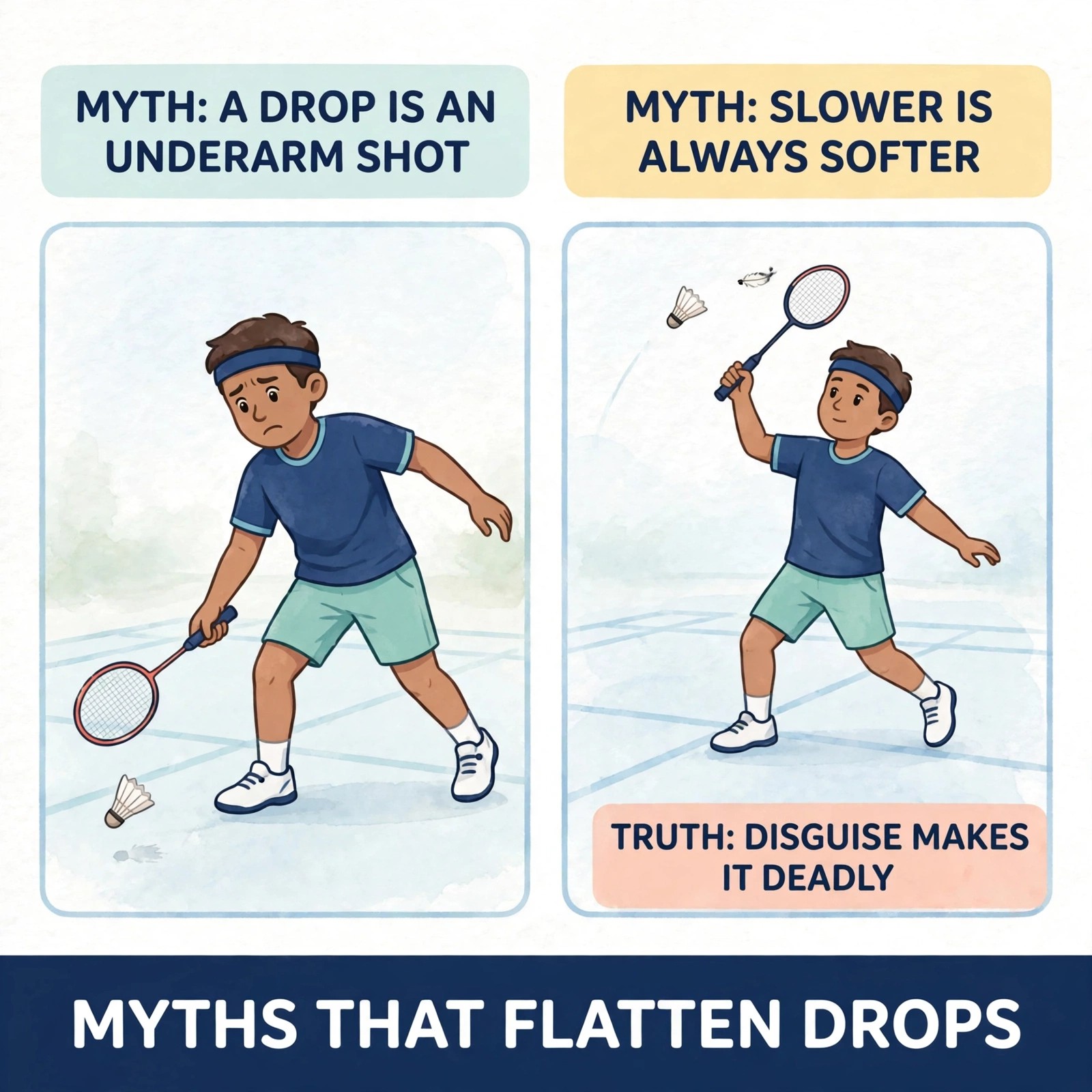
Crosscourt drop talk carries three myths that refuse to die. The first says the drop shot is a gentle underarm stroke played from the front of the court. That describes a net shot, not this one. The crosscourt drop on this page is an overhead shot from the rear court that shares its preparation with the clear, and coaching it as a soft underarm scoop produces exactly the floating gift opponents love. The second myth says softer means slower: swing gently and the shuttle will drop kindly. In practice a slowed swing floats the shuttle high over the tape, where it can be killed. Softness comes from slice, not from a sleepy arm.
The third myth says the crosscourt drop is a trick to save for special occasions, one fancy shot per match. Used that way it never gets the repetitions it needs and usually fails the one time it is tried. It is a working shot, built by counted drills and used whenever the picture invites it. A related mistake is judging the drop by how close to the tape it passes. Tape skimming looks wonderful and misses often. The shot is judged by where it lands and whether it was read, full stop. Height over the tape is a means. The corner and the surprise are the ends.
Strip the myths away and the shot is plain: one preparation shared with the clear, a sliced contact that bends the shuttle across, a landing inside the front corner, and feet that recover before the reply. None of that needs talent you were born with. It needs counted feeds, an honest log and a partner willing to read you out loud. Players who build it that way own a shot that moves opponents across the full diagonal all match long. Players who chase the myths own a scoop and a float. The drills decide which one you get.
Why Choose Us
Why Players Choose ST Badminton Academy
At ST Badminton Academy, drop shot work sits inside a structure: preparation, slice, landing, recovery, then pressure, each stage with its own drills and counts. Groups are capped at four students, which lets the coach stand close enough to watch the shape of your preparation, not just where the shuttle lands. When a crosscourt drop fails in our sessions we name the link that failed, the shape, the contact, the landing or the feet, and the next drill is chosen for that link. Nothing is left as a general instruction to try harder, because trying harder is usually what broke the shape in the first place.
The room’s standard is counted, not felt. In crosscourt drop sets, the log records three numbers: landings inside the target corner, drops read early by the partner, and recoveries completed before the reply crossed. A set where the landings improve but the reads stay early is a disguise problem wearing an accuracy costume, and it sends us back to shadow work. A set with good disguise and drifting landings sends us back to feeds. Standards like this keep players honest in the kindest way: the numbers say what to fix next, so nobody has to guess or argue with the mirror.
That standard runs across our Kuala Lumpur sessions for kids, teens and adults. Juniors meet the crosscourt drop as a game first, landing shuttles in a corner target to score, with the overhead shape arriving disguised as play. Teen players run full feeding sets and reader games, and start keeping their own landing counts. Adults usually arrive with a straight drop and a clear already working, so the crosscourt drop is added as the third threat and drilled until partners stop reading it. The stages differ by age and level; the shape of the shot never does.
FAQs: Badminton Crosscourt Drop Shot, Drills and Training in Malaysia (KL)
Crosscourt drop questions are usually audit questions: where does it land, and when do they read it. Here are the answers we give on court.
My crosscourt drops keep floating high. Can drills fix that if I train in Setapak or Gombak?
Usually yes. Floating drops normally come from a slowed swing, not from weak touch. We rebuild the full clear shape, add the slice at contact, and count your landings inside the target corner from graded feeds. When the shape holds under faster feeds, the float usually goes with it.
What is the difference between a crosscourt drop and a straight drop for a player in KL?
Distance and intention. The straight drop travels the short road down the line, while the crosscourt drop crosses the full diagonal to the far front corner, moving your opponent much further. Both share the same overhead preparation as the clear, and the crosscourt version needs a touch more height over the tape.
How many of my drops should land in the corner at club level?
We count landings inside a target patch in the front corner rather than chasing percentages. Eight inside from a set of twelve feeds is a working club standard. Below that, the fault is usually the shape or the slice, and the set slows down until the count recovers.
Is the crosscourt drop an overhead shot or a soft shot played at the net?
Overhead, from the rear court. The crosscourt drop shares its preparation with the clear, which is what hides it. A soft shot at the net is a net shot, a different skill. If your drop starts underarm or from a lowered racket, opponents will read it every time it comes.
Should I practise the crosscourt drop from feeds or straight into rallies?
Feeds first, always. Feeds give you the same picture again and again, so the shape, the slice and the landing can be fixed one at a time. Rallies test the finished shot and add a reader, which is the final stage. Players who start in rallies practise their faults at match speed.
Do you coach crosscourt drop drills near Wangsa Maju?
Yes. Crosscourt drop work runs inside our Kuala Lumpur sessions in the order on this page: preparation, slice, landing, recovery, then pressure. Groups are capped at four students, so the coach watches your preparation shape closely and counts your landings in the corner, not just your good shots.
Does your academy help adult players build a crosscourt drop in Malaysia?
Yes, and adults often add this shot fastest, because most arrive with a clear and a straight drop already working. We add the crosscourt drop as the third threat from the same preparation, then drill it until partners stop reading it. The landing count tells us when it is ready.
Can I book a trial session in Kuala Lumpur and have my crosscourt drop counted there?
Yes. Train in a group of no more than four and we will feed lifts to your rear court, count your landings inside the front corner, and have a partner read your preparation out loud. You will leave knowing your count, whether your drop is read early, and the first fix that matters.
What makes Mr Eric Chuar a suitable coach for drop shot training in badminton?
Mr Eric Chuar coaches the academy sessions himself, with over 15 years of coaching in Kuala Lumpur. He teaches the drop as a counted skill: one preparation, a sliced contact, landings inside a target corner. In groups of no more than four he can watch each player’s shape, so faults are fixed where they start.
Crosscourt Drop Training in Action

One Standard for Every Session and Every Player
Our standard for every player learning this shot is plain: one preparation shared with the clear, a sliced contact in front at full reach, landings counted inside the front cross corner, and a recovery that starts as the shuttle leaves. When any link is missing, we say so and drill that link. Nobody is told their drop is fine when the counts say it is floating, and nobody is told to scrap the shot when only the disguise needs an hour of shadow work.
| Factor | Scoop And Hope | Same Shape Crosscourt Drop DROP |
|---|---|---|
| Frequency | 1 or 2 times a week. Mostly for fun and sweat. | Preparation is shared with the clear: side on, racket high, and nothing announces the drop early. |
| Drills Focus | Basic static feeding. Minimal footwork pressure. | Contact is a slice across the cork, taking pace off the shuttle and angling it across the court. |
| Physical Conditioning | Rarely included. Just playing games on court. | Core, agility, and speed training included in every session to prevent injury and build stamina. |
| Tactical Awareness | "Just hit it over." No real game plan. | Video analysis, point construction, and learning to read the opponent's game. |
| Coach Ratio | Large groups (8-10 kids). Coach barely watches you. | Max 4 students. Mr Eric Chuar personally corrects every stroke and movement detail. |
| Goal Setting | Fun and exercise. | The shuttle lands inside the front cross corner, the furthest landing a drop shot can reach. |
| Long Term Result | Good recreational player. | A player whose drop is guessed late, feet already recovering before the reply is played. |
Crosscourt Drop Badminton Training in Kuala Lumpur
Come and have your crosscourt drop counted. Book a trial session in Kuala Lumpur, train in a group of no more than four, and leave knowing your landing count, whether partners read your drop early, and the first fix that matters for your shape or your slice. Bring your current drop exactly as it is. The audit works on the shot you own today, and the drills on this page are the same ones we will use to rebuild it.




