What Are The Best Exercises For Building Strength In Badminton Training (Strength Guide)
Ask a room of badminton players what strength training means and most will picture a gym, heavy bars and sore legs that ruin the next session. That picture puts players off, and it is also wrong for this sport. Badminton strength is not about size. It is the strength to lunge deep to the front corner and push back, to hit a clear from behind your body in the third game, to land from a jump smash and be balanced for the next shot. This page works through the exercises that build that kind of strength: legs first, then upper body and core, then power and landing, and how to add load slowly with clean technique so training helps your game instead of stealing from it.
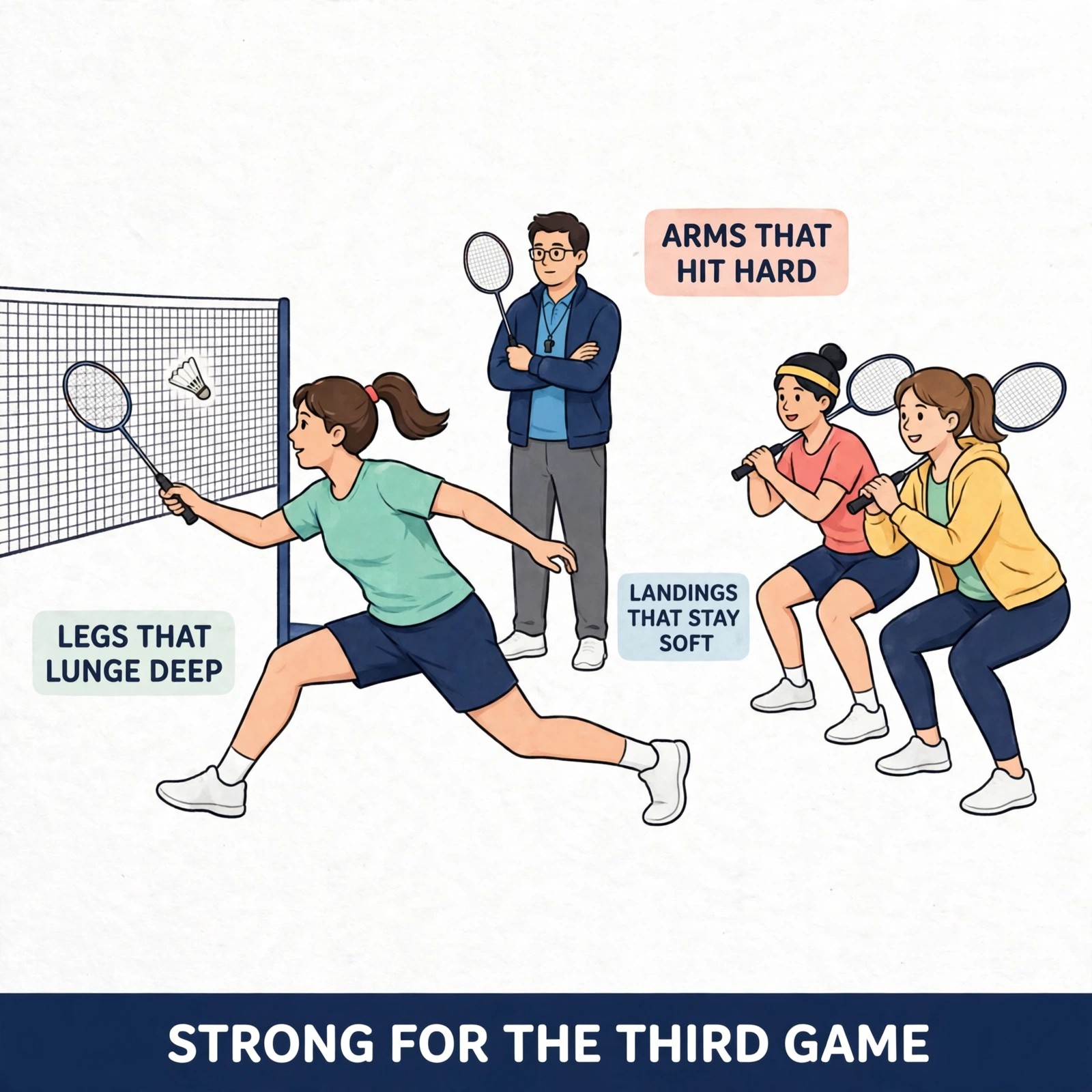
Strength Check #1
Why Strength Matters On Court: Power With Control
Badminton is a game of repeated short efforts. A rally asks for a fast first step, a deep lunge, a hard overhead swing, a jump or a scissor kick, then recovery to base before the next shot, again and again for an hour or more. Every one of those actions runs on strength. The legs drive the lunge and the push back. The trunk transfers power from the legs to the arm and keeps you upright when you are stretched wide. The shoulder, arm and forearm turn that power into racket head speed. When any link is weak, another link works overtime, and that is often where aches begin. Strength training, done properly, is how each link learns to carry its fair share.
There is also a steadiness benefit that players feel before they can name it. A stronger player lands more quietly, holds a low ready position longer without their thighs burning, and keeps their technique late in a match when a weaker player starts reaching and lunging with a bent back. None of this needs a gym membership to start. The first tools are your own bodyweight, good coaching on positions, and patience. Weights and equipment can come later, in small steps, once the movements are clean. The order matters more than the equipment: learn the shape first, practise the shape under control, then add load to a shape that already works.
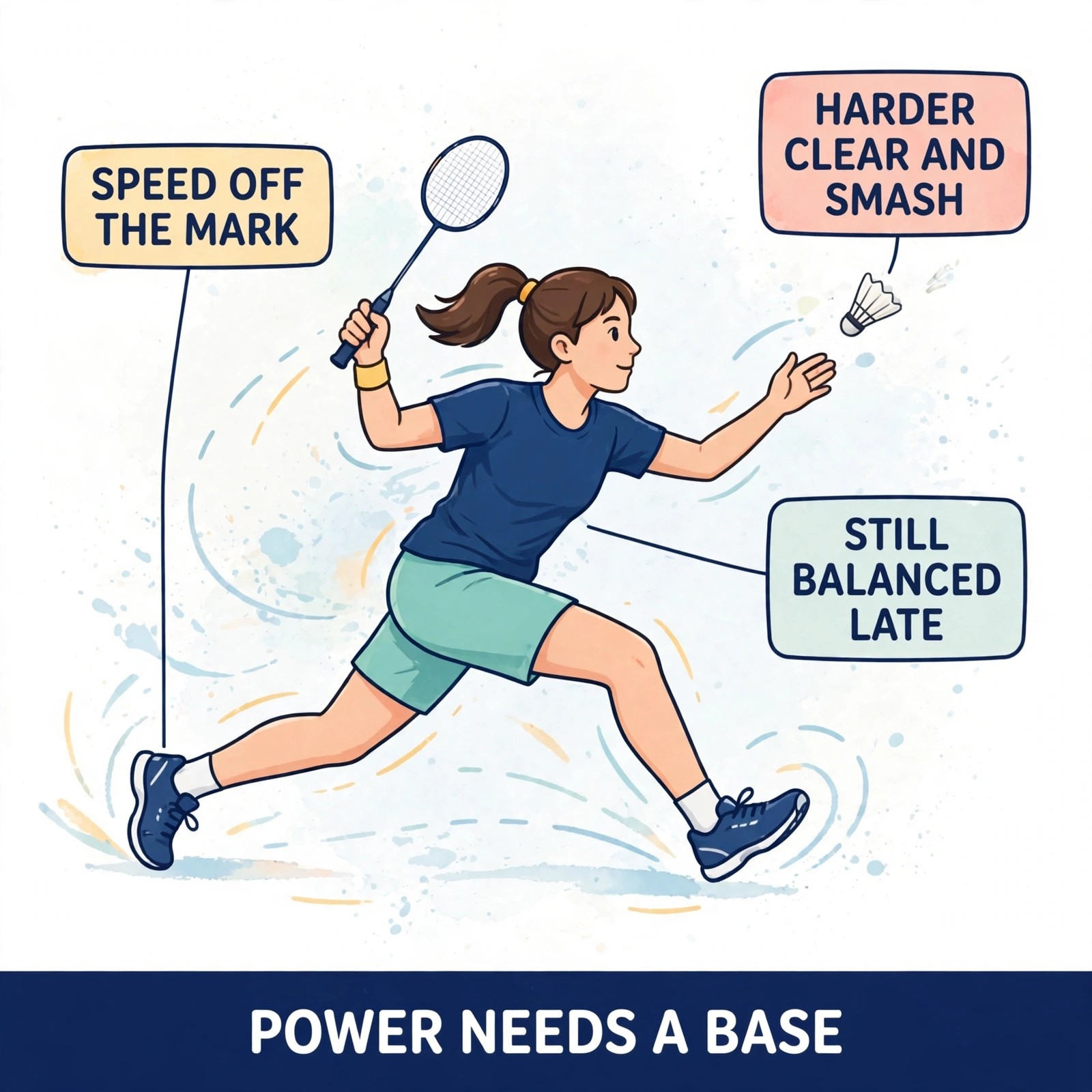
Strength Check #2
Legs First: Squats, Lunges And The Badminton Lunge
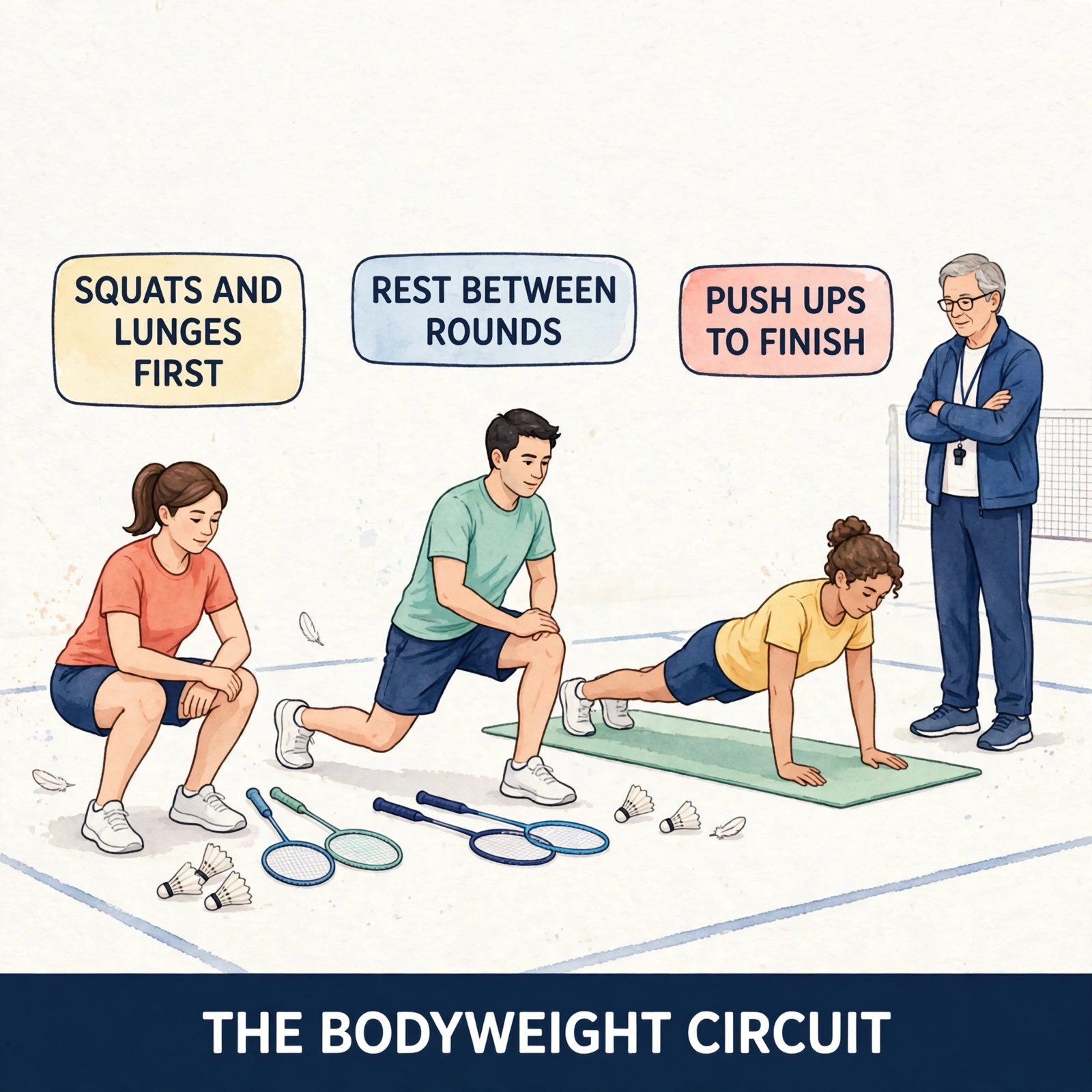
Start with the squat, the foundation under almost everything in this sport. A clean bodyweight squat teaches hips, knees and ankles to share work while the chest stays tall. Practise it slowly: feet about hip width, knees tracking over the toes, heels down, sit back and stand up without your knees collapsing inward. The kettlebell squat, holding a light bell at the chest, is a sensible later step for players whose bodyweight squat is already clean, because the load sits close and the position is easy to coach. What we do not do is chase a heaviest possible lift. No player in our hall is tested on a one rep maximum, and no badminton player needs to be. Submaximal, clean, repeatable work is the goal.
The lunge is the squat’s partner and the most badminton shaped strength exercise of all. Forward lunges build the step and plant pattern of the front court. Reverse lunges are kinder while a player learns, because the working leg stays in place and balance is easier. Side lunges build the wide defensive stance and the push back from the backhand corner. Walking lunges add the travelling element, moving under control from one end of the hall to the other. Isometric holds, pausing in the bottom of a lunge for a slow count, build the endurance a player needs to hold good positions in a long rally. Each version earns its place, and each one should look like the movement it is training: upright, balanced, and quiet.
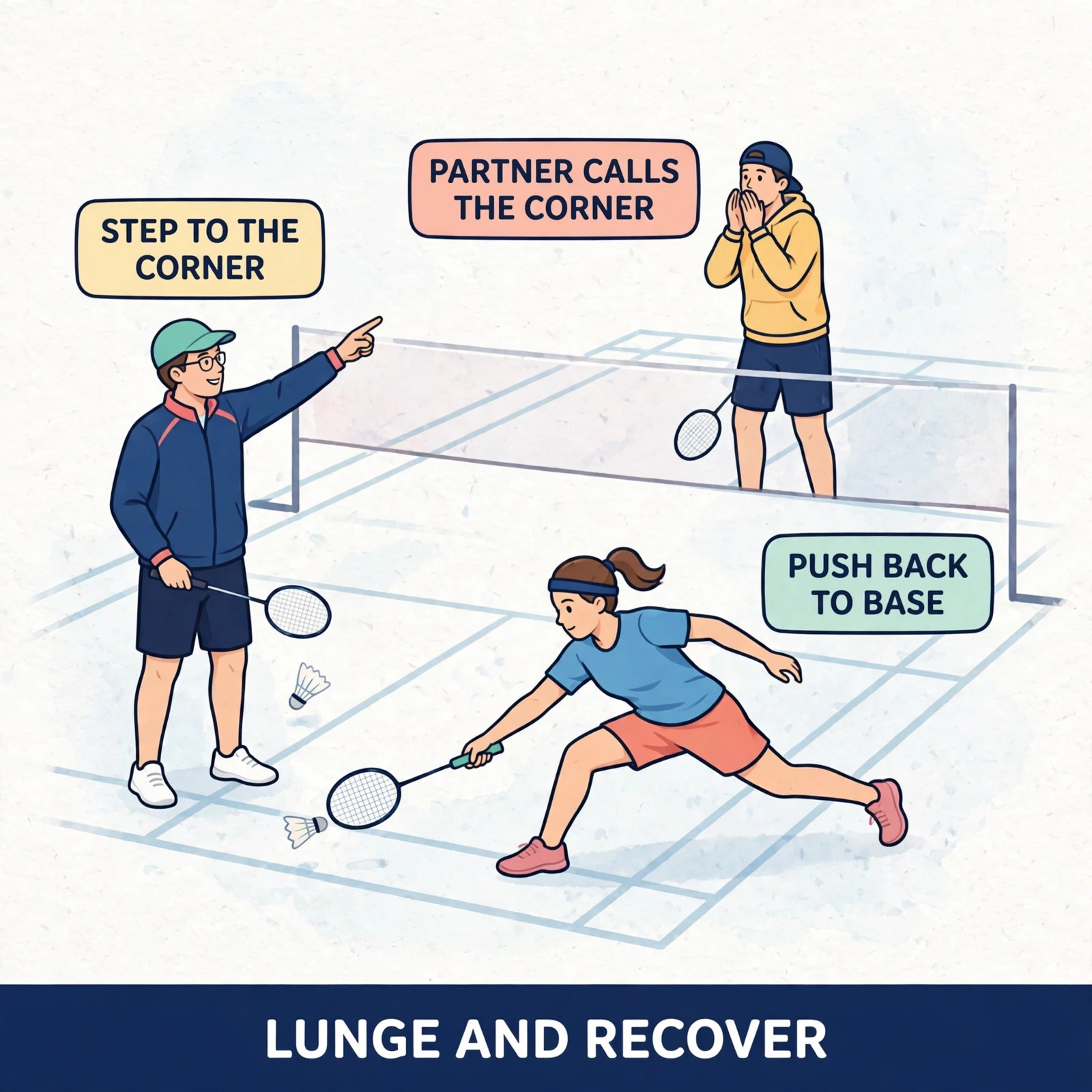
Badminton adds one demand that general leg work misses: the lunge must end in a push back. On court you never admire your lunge; you recover from it. So train the return as part of the exercise. Step out, plant, play the shadow shot, and drive back to the middle with the same leg. When that return is strong, the whole court feels smaller, because a player who recovers fast can afford to take the shuttle earlier. Jumping lunges exist in our programme too, but they sit near the end of the progression, for players whose basic lunge is clean and quiet. Explosive versions of a messy movement only rehearse the mess faster, so the order is fixed: shape, strength, then speed.
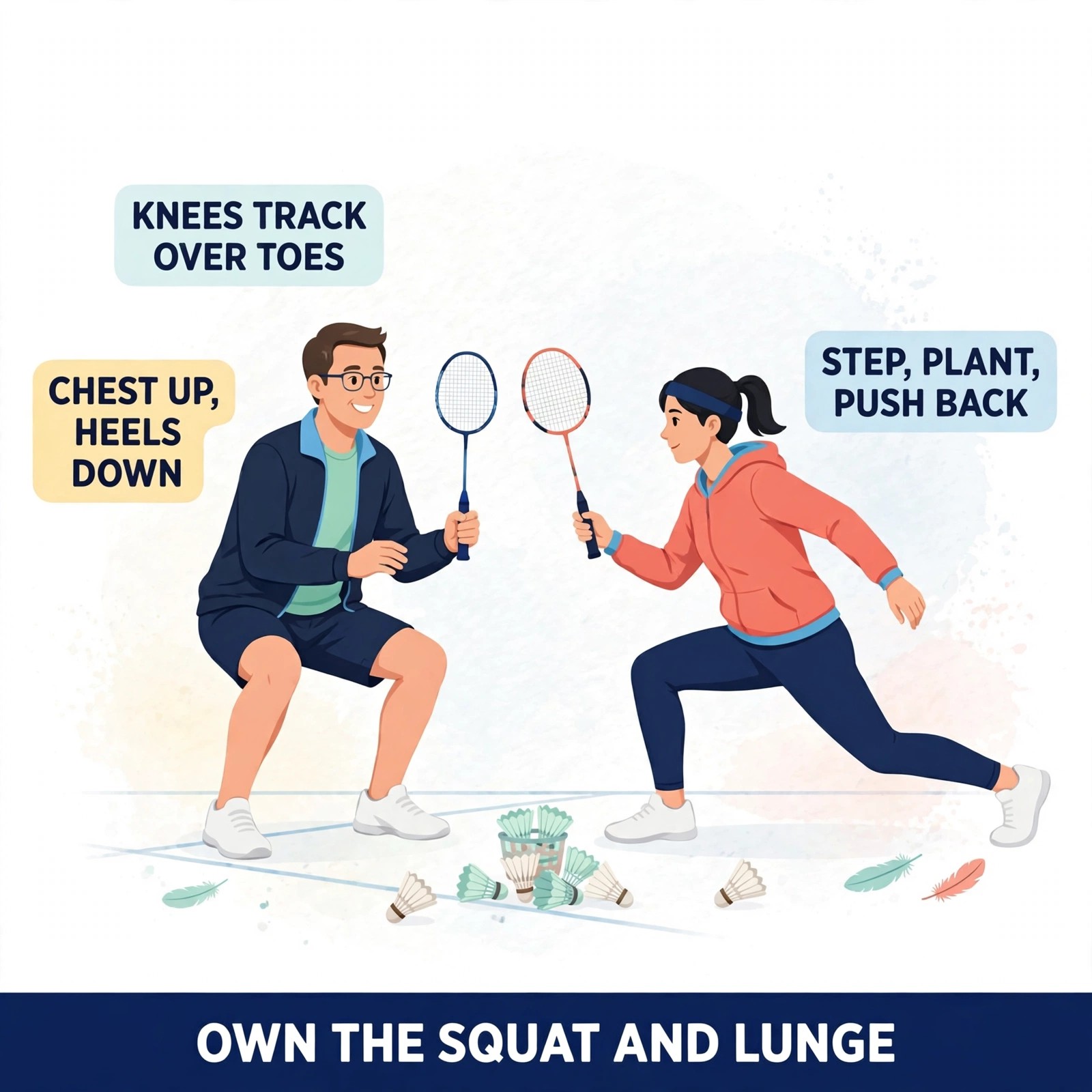
Strength Check #3
Upper Body And Core: Press, Pull And Brace
The upper body works in two directions in badminton: pressing and pulling. Push ups are the pressing base, done anywhere with no equipment, and they scale honestly, from wall push ups for a true beginner to full floor push ups with a straight body line. The point is the line: hips neither sagging nor lifted, chest moving to the floor and back as one piece. Partner contests about who can do the most are left out of our hall, because the last sloppy repetitions teach exactly the shapes we are trying to remove. Quality counted out loud beats quantity claimed afterwards, and a set ends when the line breaks, not when pride demands two more.
Pulling work balances the pressing, because the back and rear shoulder do quiet work in every overhead stroke and every recovery to base. Rows with a band or a light weight, and pull ups or assisted pull ups where a bar exists, teach the shoulder blades to move and settle properly. This matters for badminton players who spend their court life reaching up and forward; without pulling work, shoulders creep forward and strokes get cramped. Medicine ball throws, used in the source material for many training pages and in our hall too, belong to the power section of this page, but the throwing base is built here: a braced trunk, a full body turn, and a release that uses the legs rather than the arm alone.
The core’s job in badminton is not to crunch; it is to stay quiet while the limbs move fast. Planks, side planks and dead bug style work teach the trunk to resist twisting and bending when a player is stretched into a corner. That resistance is what lets leg power reach the racket instead of leaking out through a collapsing middle. Keep the doses modest and the positions clean: a short plank held perfectly teaches more than a long one held with a sagging back. Breathe normally, keep the ribs down, and stop the set when the position goes. Core work appears in most of our weeks in small amounts, like seasoning rather than the main dish, because its job is support, not exhaustion.
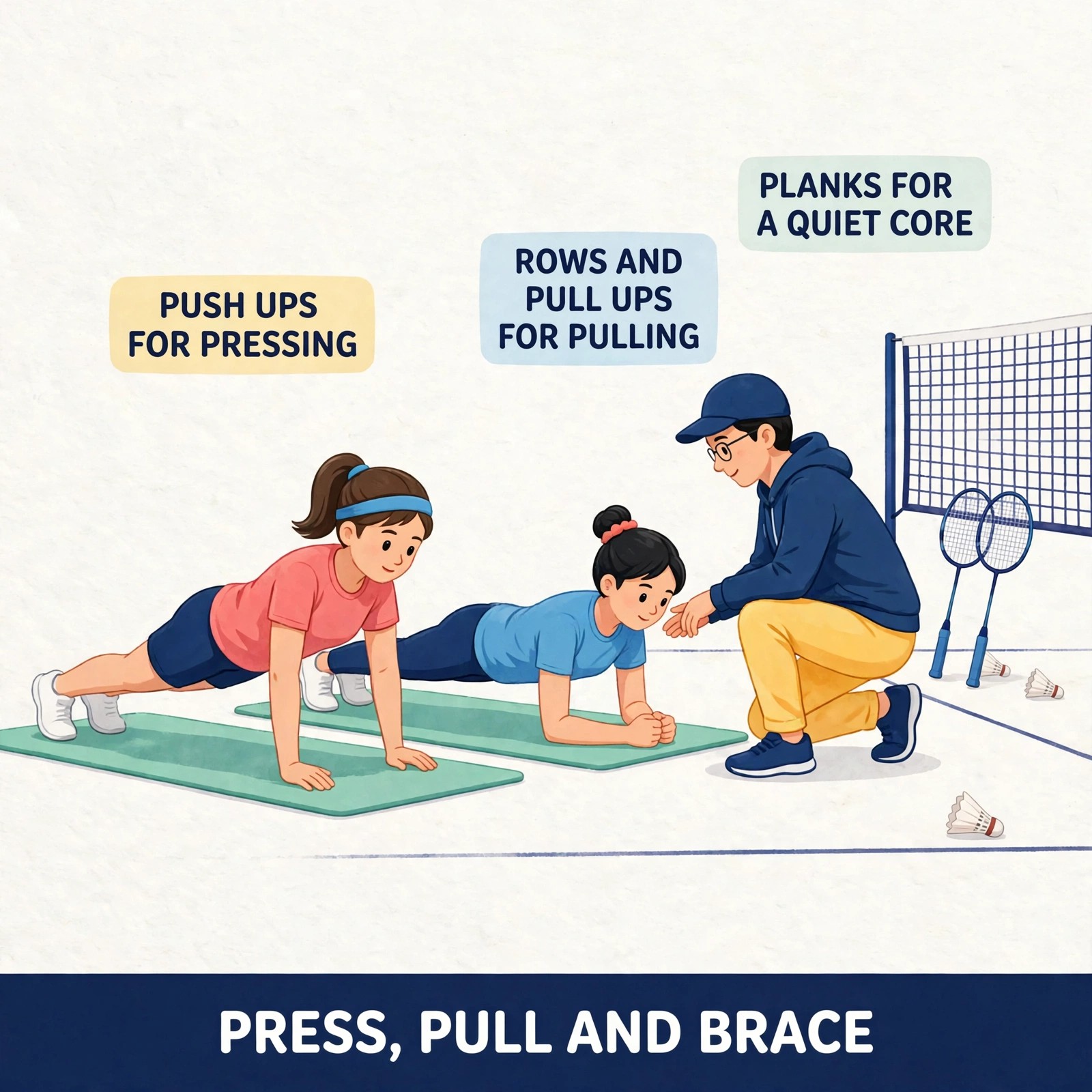
Strength Check #4
Power And Landing: Jumps, Throws And Safe Plyometrics
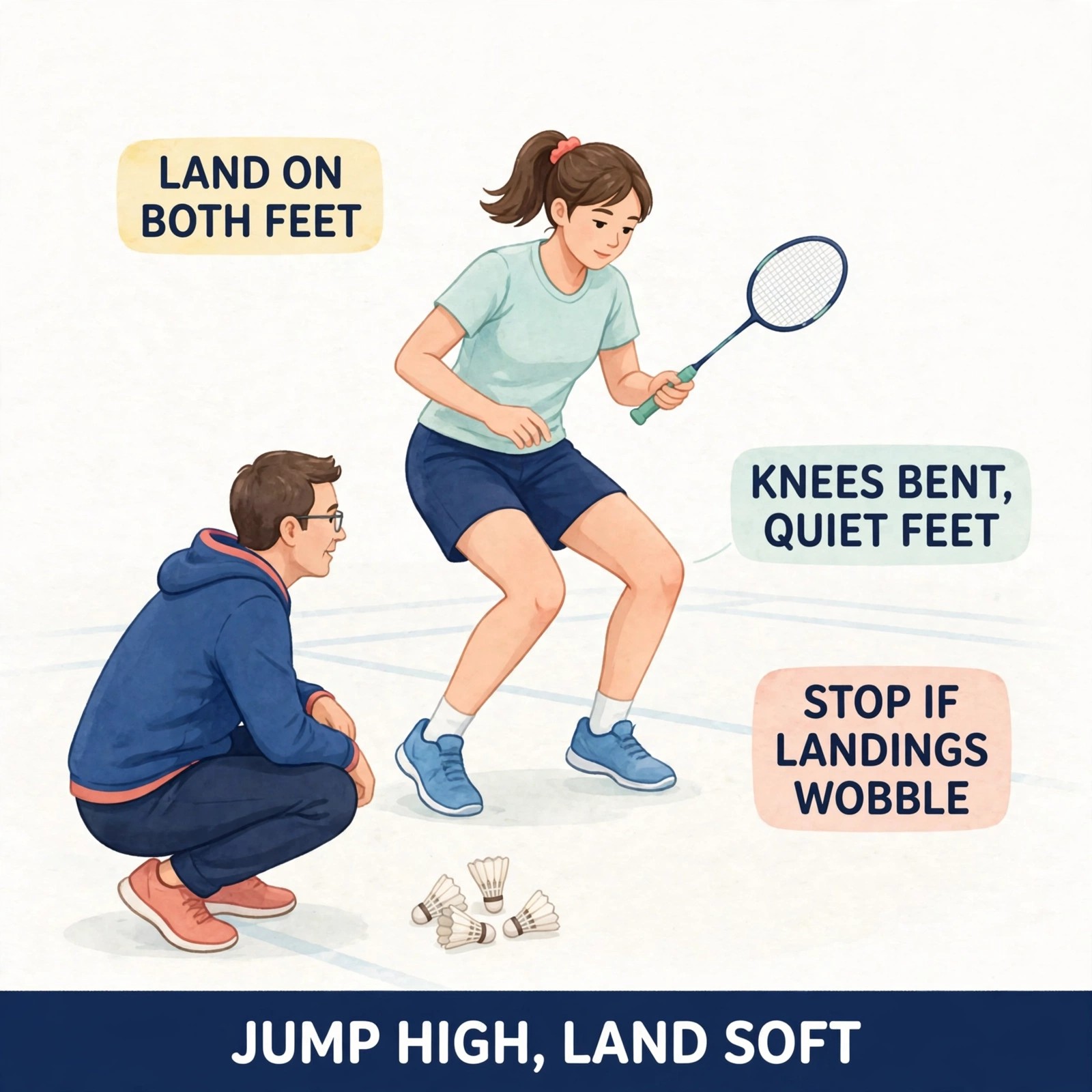
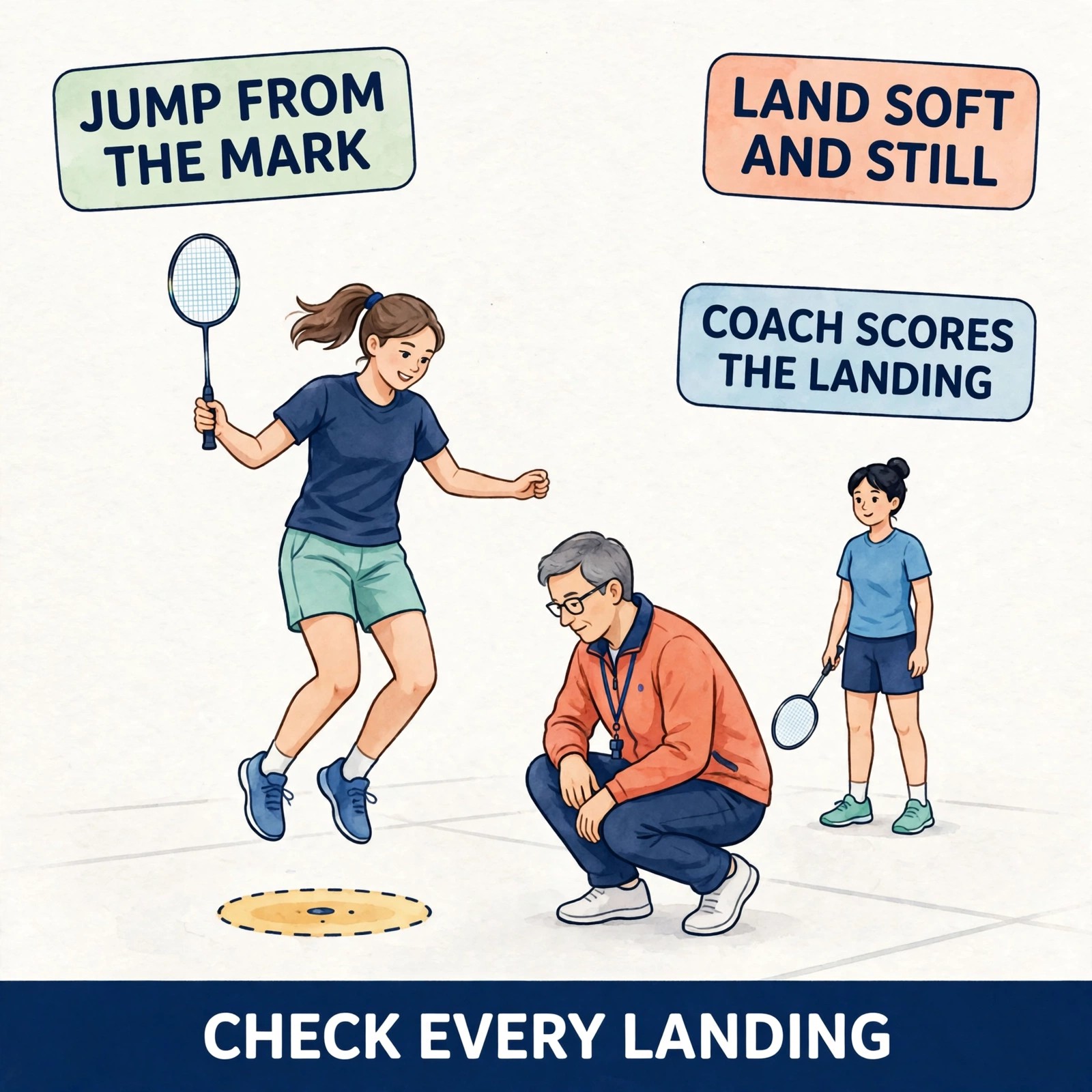
Power is strength expressed quickly, and badminton needs it in the jump, the smash and the first step. Plyometric work, jumps, hops and bounds, builds it, but it is the most dosage sensitive training on this page. Start with landing before height: small jumps that finish in a soft, balanced, quiet landing on both feet, knees bent and tracking over toes. Only when landings are consistently quiet do the jumps grow, into countermovement jumps, scissor jumps that copy the overhead footwork pattern, and single leg hops for players whose two leg landing is automatic. The floor should barely hear you. A loud, stiff, wobbling landing is the body saying the dose is too big today.
Medicine ball throws are the upper body’s plyometric partner. A rotational throw against a suitable wall, or to a partner where space allows, links the legs, trunk and arm in the same order as a smash: ground first, hips next, arm last. Keep the ball light enough that the throw stays fast and the shape stays clean. Slow grinding throws with a heavy ball train a different quality and tire the shoulder before the session’s court work. In our hall the throws are counted in small sets with full rest, and they stop the moment speed drops. Power work is seasoning too: a little, done sharply, inside a week that still leaves the player fresh for matches.
Balance and coordination work ties the power together, because force is wasted if it arrives in the wrong direction. Single leg stands that progress to reaches, slow shadow lunges with a pause, and change of direction steps at walking pace all teach the ankle, knee and hip to organise quickly. This is unglamorous work, and players vote for it anyway once they feel the difference: the wide defensive lunge that used to wobble now holds, and the recovery step starts sooner. Good balance also protects the landing work above it. A player who cannot stand still on one leg for a slow count has no business hopping on it, and our progressions respect that order without apology.
Strength Check #5
Technique Before Load: Progress Slowly, Stop On Pain
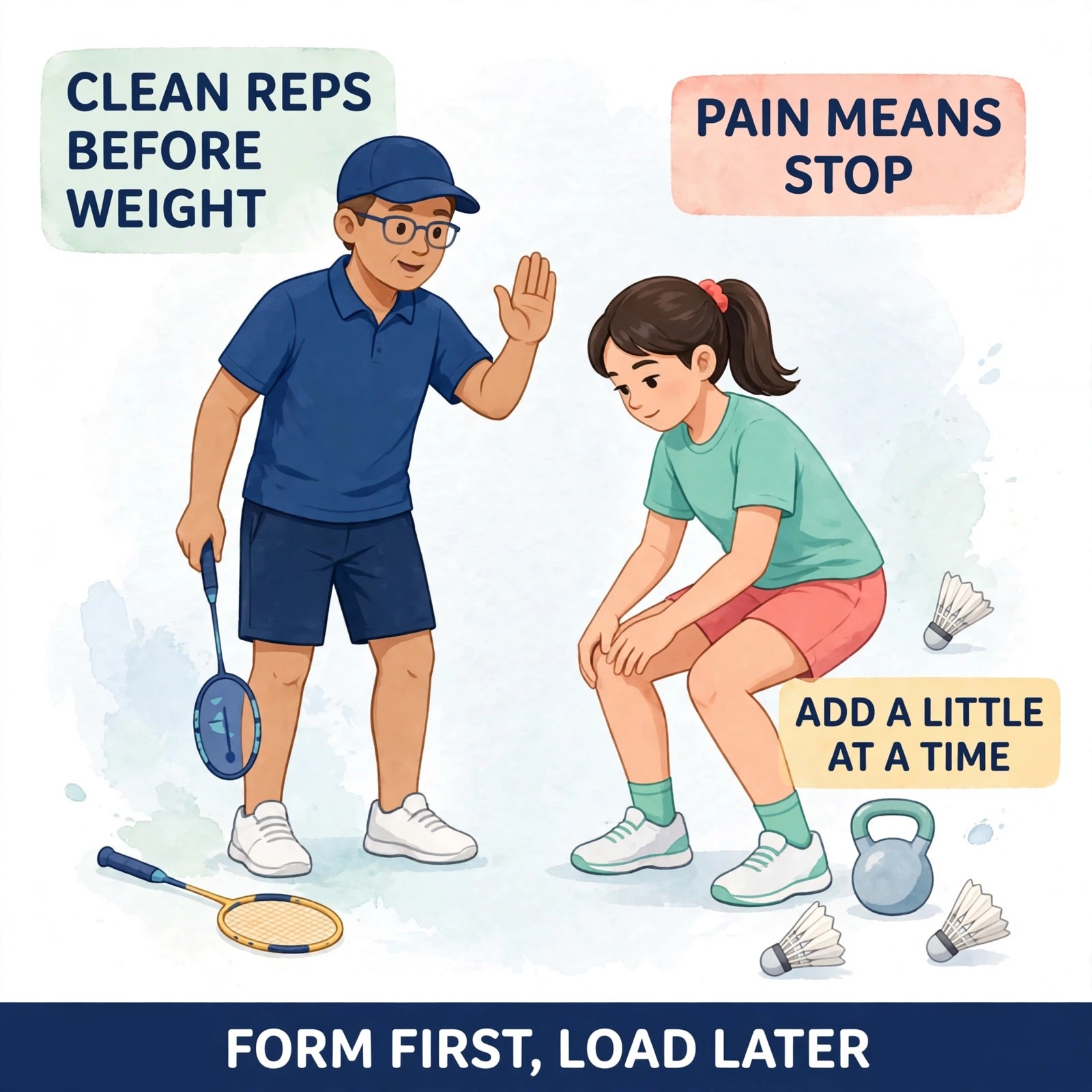
Every exercise on this page follows one rule: technique before load, always. A squat that collapses at bodyweight will collapse worse under a bar. A lunge that wobbles will not be fixed by a dumbbell in each hand; it will be rehearsed badly, under load, until it hurts. So each movement has a standard that must be met before anything is added: full control through the range, balance kept, breathing steady, and the same shape on the last repetition as the first. When the standard is met for a couple of weeks, load or difficulty rises in a small step, one change at a time, so the player always knows what caused any change in how training feels.
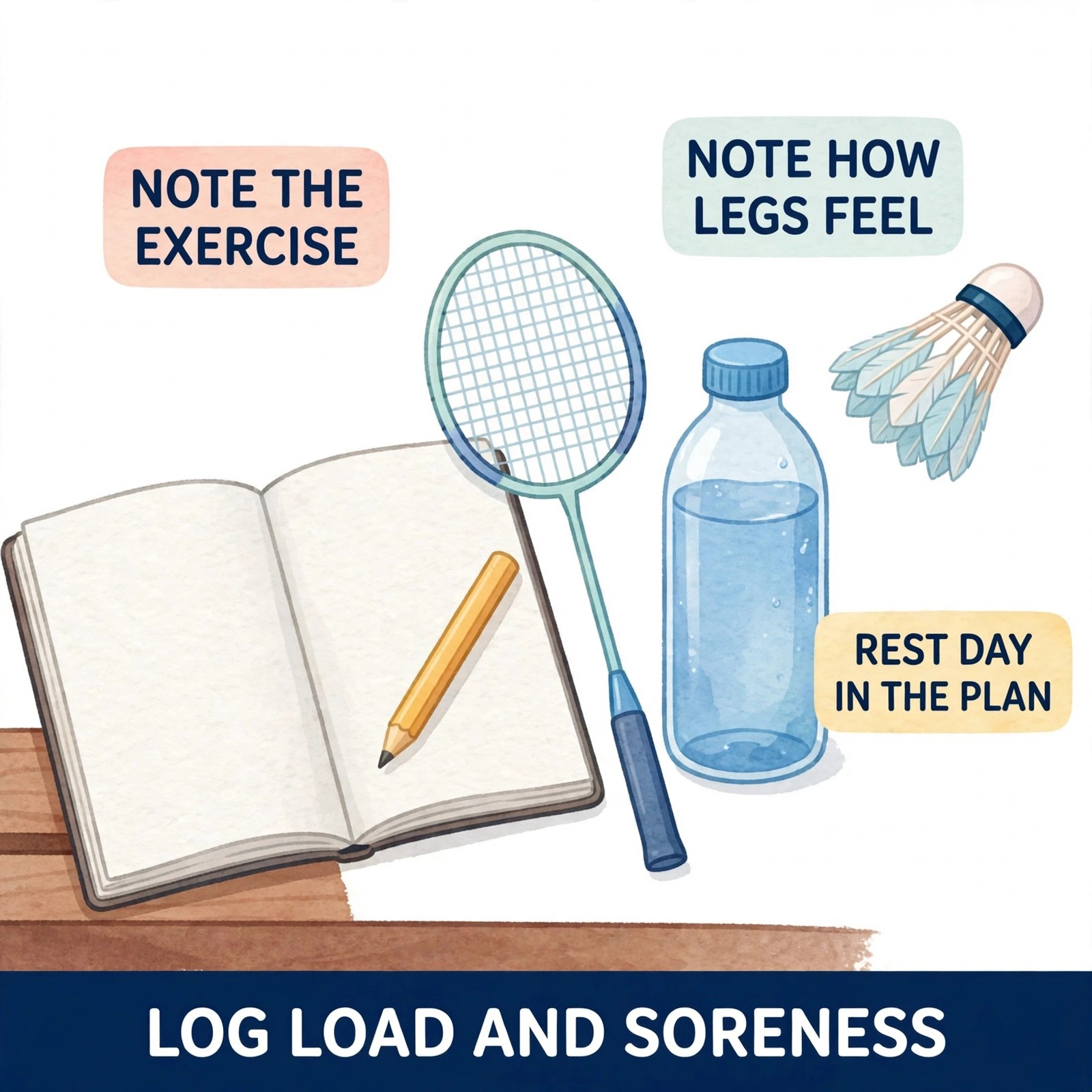
Progression also respects the court. Strength work supports badminton; it does not replace it, and a week is only so long. Two focused strength sessions a week is a sensible ceiling for most school and club players alongside their court sessions, placed so that the heaviest leg work does not sit the day before a match or a hard footwork session. Soreness that fades within a day or two after a new exercise is ordinary while the body adapts. Soreness that grows week to week at the same load means the steps are too big. Log the exercise, the load and how the legs felt the next morning; that one honest page prevents most arguments between ambition and evidence.
Now the part that outranks every exercise: pain is information, and some of it is a stop sign. Stop the exercise for sharp pain, for pain inside a joint, for pain that changes how you move, and for any numbness, tingling or weakness in a limb. Joint pain that does not settle within a few days, pain that keeps returning to the same spot, swelling after training, or pain that wakes you at night are not training problems to push through. They are reasons to see a doctor or a physiotherapist and get the structure checked. In our hall a player who reports pain early loses a week at most. A player who hides it can lose a season. Reporting early is the strength habit we praise most.
Myth vs Reality
Myths About Strength Training
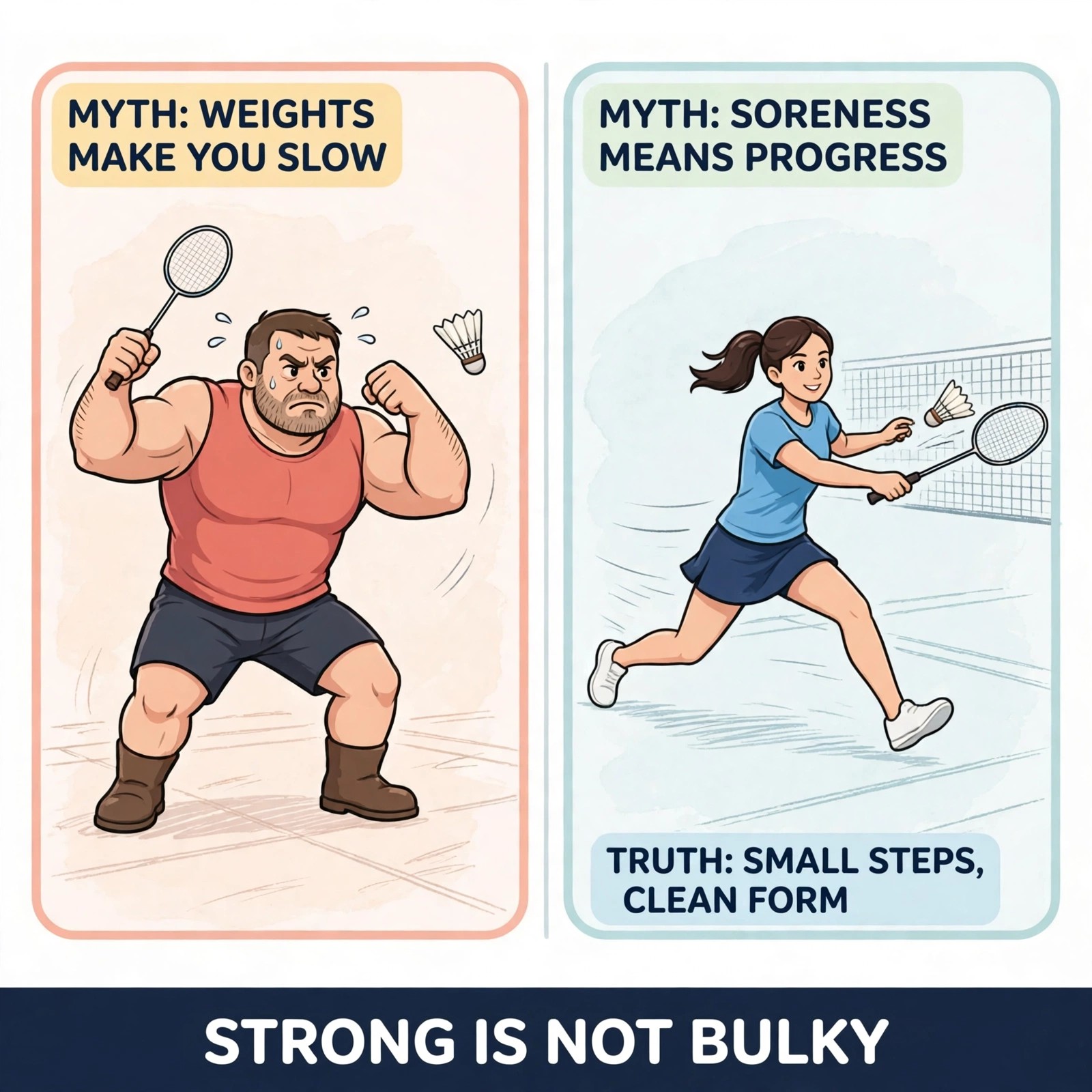
The first myth says lifting makes badminton players slow and bulky. Players do not accidentally become bodybuilders; muscle size of that kind takes years of eating and training aimed at nothing else. Strength work at badminton doses makes the existing muscle better at its job: faster to switch on, stronger through the lunge range, and steadier late in matches. The players who do feel slow after starting gym work are usually feeling fatigue, not slowness: a heavy leg session the day before training will blunt anyone’s first step. Place the work sensibly, keep the doses honest, and the same legs that squat on Tuesday push back faster on Friday.
The second myth says soreness proves the session worked, so a good week should hurt. Soreness mostly proves the work was new. Chasing it leads players to wreck themselves before the sessions that actually build their game, and it hides the signal that matters: performance. Are the lunges cleaner, the landings quieter, the third game steadier? Those are the measures. A player can be productively stronger with barely any soreness once the body knows the movements, and a player can be extremely sore from a badly dosed session that taught nothing. In our hall we would rather a player leaves a strength session feeling they could have done a little more than crawl out of it.
The third myth says strength training is dangerous for young players, full stop. What is dangerous is unsupervised maximal lifting and copied adult programmes. Supervised, technique first training built on bodyweight movements, sensible progressions and the stop rules on this page is a different thing entirely, and it supports the joints that growth and court volume are loading anyway. Our rule for juniors is stricter, not looser: positions must be perfect, loads stay modest, jumping volume stays low, and any pain report ends the exercise that day. Parents are welcome to watch a session and see the standards for themselves. Caution is a coaching quality; fear of all training is not.
Why Choose Us
Why Players Choose ST Badminton Academy
At ST Badminton Academy, strength work is built into the training week the way this page describes: legs first, technique before load, power in small sharp doses, and stop rules that nobody argues with. Groups are capped at four students, so the coach sees every squat and every landing, and corrections land on the repetition that needs them rather than in a general talk afterwards. Players keep a simple log of exercise, load and next day soreness, which the coach reads before setting the next step. Nobody is tested on a heaviest lift, nobody trains through sharp pain, and the court sessions always come first in the week’s planning.
Parents sometimes ask whether their child really needs strength work on top of court training. Our answer is that the court itself makes the demand; the strength work is how we prepare the body to meet it safely. A junior playing four sessions a week lunges hundreds of times. The only question is whether the legs doing those lunges are prepared or merely hopeful. Fifteen focused minutes, twice a week, done properly inside the training plan, is usually enough to change how a young player moves and lands within a term. Bring us your questions at a trial session and watch a group work; the standards are easier to believe when you see them.
Adult club players use the same system at their own starting point. A returning player after years away begins with bodyweight positions and balance, not with the loads they remember from school. A league player with strong court habits adds pulling work and landing quality to protect shoulders and knees across a long season. The exercises are ordinary; the coaching is in the order, the doses and the honesty about signals. That is the whole method: build the base, add a little at a time, log what happens, and let the court be the judge. Strength earned this way shows up exactly where it should, in the third game, when the other player starts to reach.
FAQs: Strength Exercises For Badminton Training in Malaysia (KL)
Questions about strength work usually start with a sore pair of legs. Here are the answers we give on the bench.
Can a beginner start strength exercises for badminton in Setapak or Gombak?
Yes, and bodyweight is exactly where a beginner should start. In our Setapak groups of no more than four, new players learn the squat, the lunge, the push up line and balance work with no load at all, and nothing is added until the positions stay clean for a couple of weeks running.
What is the first strength habit a new player should build in KL?
Technique before load, practised as a habit from the first week. Learn the squat and lunge shapes slowly, keep every landing quiet, and start a simple log of exercise and next day soreness. KL players who build those three habits early find the later strength work almost boring, which is exactly how safe progress feels.
Why do my legs still feel heavy days after training at club level?
Usually the dose jumped, or heavy leg work is sitting too close to your hard court days. New exercises bring a day or two of soreness while the body adapts. Legs that feel heavier every week at the same load are a signal, not a challenge. Shrink the steps, move the session, and watch the log honestly.
My knee hurts when I lunge in training. Should I push through or get it checked?
Get it checked, and stop lunging on it meanwhile. Pain inside the knee that changes how you move is a stop sign, not a training problem to push through. Rest it, note when it started, and let a doctor or a physio examine it before your next hard session. Early answers are usually short ones.
How can I fit strength work around my badminton training?
Twice a week, in small focused doses, placed away from matches and hard footwork days. Two or three exercises per session, positions clean, load added in small steps only when the log says the last step settled. In training with us the strength work sits inside the plan, so court training always comes first.
Do you coach strength work for badminton near Wangsa Maju?
Yes. Our academy is based in Setapak, a short drive from Wangsa Maju, and strength work is coached inside normal sessions there: positions checked on every repetition, load kept modest and logged, landings watched closely. Groups stay at no more than four students, so the coach sees your squat and your landing, not just the drill sheet.
Where does ST Badminton Academy teach badminton strength training in Malaysia?
We teach in Setapak, Kuala Lumpur, and strength coaching lives inside ordinary badminton training rather than as a separate gym course: legs first, technique before load, power in small sharp doses, stop rules respected without debate. Students join us from across the Klang Valley, from school juniors to league adults building a base.
How do I book a trial session to assess my strength?
Book a trial session with us in Setapak and bring your playing racket and training shoes. Train in a group of no more than four, and the coach will check your squat, lunge and landing, choose your first exercises, and start the log we use to set every later step of load.
What makes Mr Eric Chuar a suitable coach for strength and badminton?
Mr Eric Chuar coaches the academy sessions himself, with more than 15 years of coaching in Malaysia and Singapore. He teaches positions before load, reads every player’s soreness log before adding a step, and is strict about stop rules: sharp pain, swelling and numbness end the exercise and go to a professional.
Badminton Strength Training in Action
We benchmark our strength coaching against World Badminton (BWF) coaching standards and our own academy values: before any player trusts a training plan, they deserve honest checks. You can verify our coaches' credentials through the Badminton Association of Malaysia (BAM) coach education pathway.
Our standards for strength training are plain. We teach positions before load: bodyweight squats, lunges, push ups and pulling work with clean lines, then small steps of difficulty, then power work only for players whose landings are quiet. Every player keeps a log of exercise, load and next day soreness. We name no heaviest lift as a target, because there is none; the court is the test. Sharp pain, joint pain that does not settle, swelling and numbness stop training and go to a doctor or a physio, every time, without debate.
| Factor | Heavy And Hurt | Strong And Steady STRENGTH |
|---|---|---|
| Frequency | 1 or 2 times a week. Mostly for fun and sweat. | Load grows in small steps, only after technique stays clean. |
| Drills Focus | Basic static feeding. Minimal footwork pressure. | Legs, upper body and core are trained for the lunges, shots and landings of badminton. |
| Physical Conditioning | Rarely included. Just playing games on court. | Core, agility, and speed training included in every session to prevent injury and build stamina. |
| Tactical Awareness | "Just hit it over." No real game plan. | Video analysis, point construction, and learning to read the opponent's game. |
| Coach Ratio | Large groups (8-10 kids). Coach barely watches you. | Max 4 students. Mr Eric Chuar personally corrects every stroke and movement detail. |
| Goal Setting | Fun and exercise. | Pain is information: sharp or joint pain stops the exercise and gets checked. |
| Long Term Result | Good recreational player. | A stronger player: lunges deeper, recovers faster, and lands soft late in the third game. |
Badminton Training With Strength Coaching in Kuala Lumpur
Come and build a base your game can stand on. Book a trial session in Kuala Lumpur, train in a group of no more than four, and leave with your starting positions checked, your first exercises chosen, and a log started for load and soreness. Bring your playing racket and training shoes. We will show you exactly where your strength work begins.




