How to Play Badminton With Speed and Agility: Techniques and Training Methods (Agility Guide)
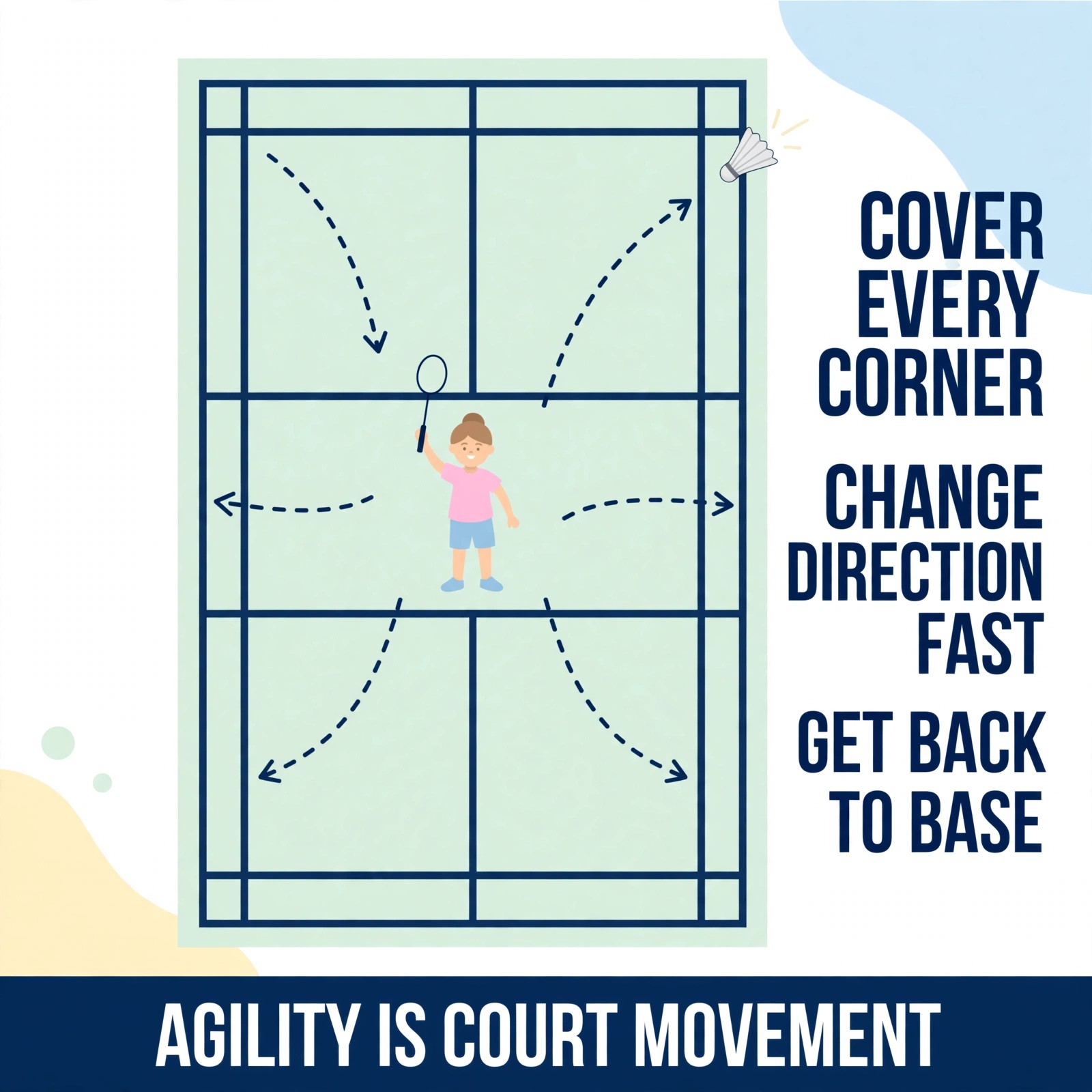
Agility is the part of badminton fitness you can see. It is the player who spins out of the back corner, lands balanced, and is somehow already moving toward the net. It is not sprinting speed. A badminton court is small, and nobody reaches top speed on it. Agility is controlled movement in every direction: starting well, travelling with the right steps, stopping without falling, and turning to go again. This guide explains how court movement really works, the six patterns that cover the court, how to change direction without losing balance, and how to train it all without wrecking your knees.
Agility Check #1
Start From Base: Balance, Stance and the Split Step
Start with what agility is not. It is not a ladder drill, though ladders can help your feet stay light. It is not raw pace, because the longest run on a singles court is only a few metres. Agility is the skill of moving your body where the rally needs it, at the right time, and arriving able to hit a good shot. Three things make it up: balance, patterns and brakes. Balance keeps you upright while you move. Patterns are the learnt step sequences for each area of the court. Brakes let you stop and turn without your momentum carrying you past the shuttle.
The good news is that all three can be coached. Players who look clumsy on court are rarely slow. They are usually using the wrong steps, arriving off balance, or recovering the long way round. Fix the steps and the same legs suddenly look quick. Work through the sections below in order: base position first, then the six patterns, then recovery and direction changes, then how to use movement inside real rallies. Train the patterns slowly until they are automatic, and only then add speed. Fast feet doing the wrong steps just get you to the wrong place sooner.
Agility Check #2
The Six Court Patterns: One Trusted Route to Every Area
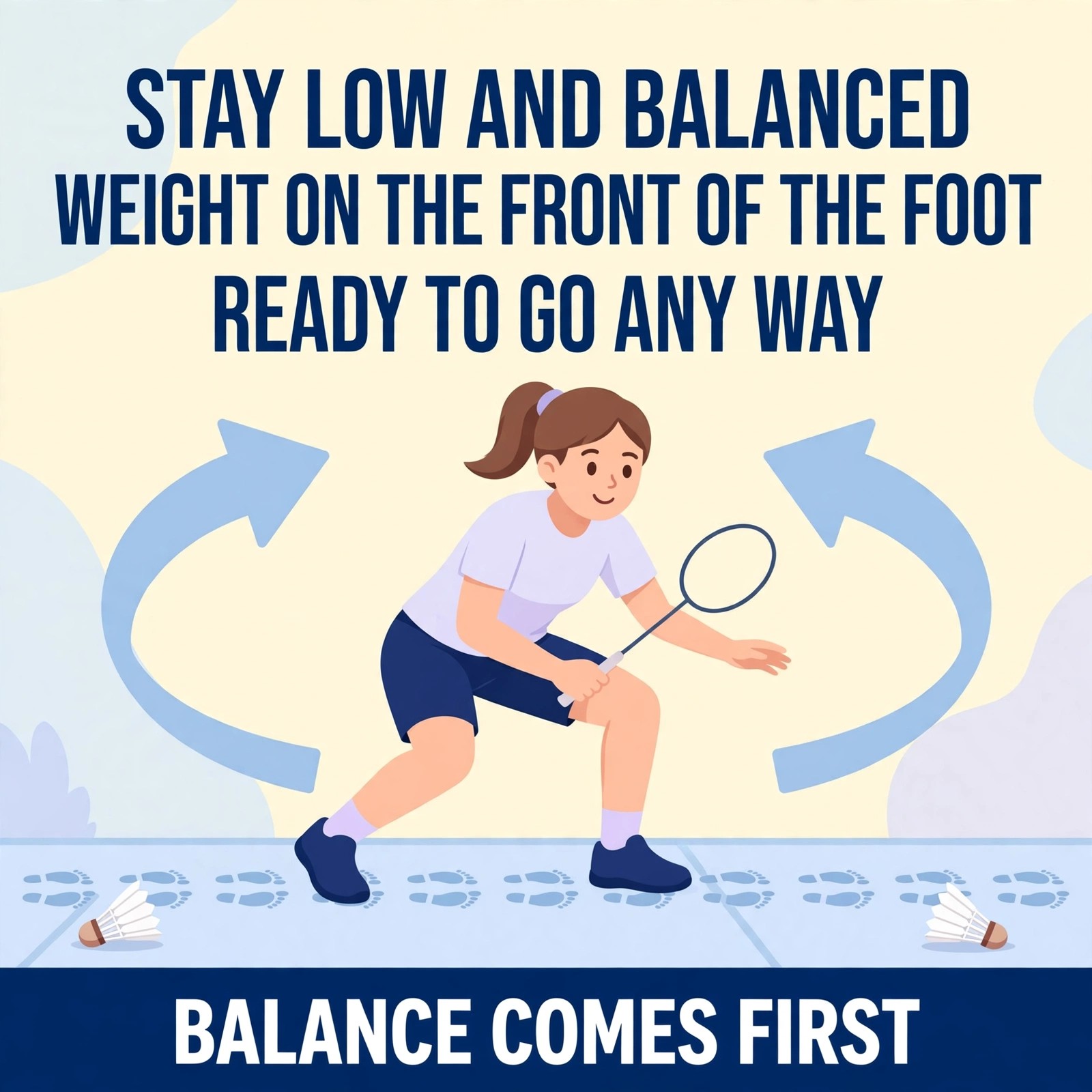
Everything starts from base: the home position a step or so behind the centre of the court, where you return after each shot. Stand low, hips down, chest up, weight over the front of your feet. Heels that rest heavy on the floor anchor you. A light forefoot stance keeps your calves loaded and ready to push in any direction. Your knees should track over your toes, not cave inward, and your racket stays up in front. From this crouch, movement can begin toward any corner without a preliminary shuffle. Players who stand tall and flat footed must first sink and shift before they can go, and that delay is where rallies are lost.
Balance is dynamic, not a pose. As you move, your head should stay fairly level and your body quiet, while your legs do the travelling. Leaning far forward or backward throws your weight outside your feet, and the next step becomes a rescue instead of a choice. A simple test: wherever you stop on court, you should be able to freeze for a full second without toppling or taking a catch step. Use that test in practice. If you cannot freeze, you arrived out of control, and the shot you played was a hope rather than a decision. Slow down until the freeze works, then build speed back up.
The split step ties base position to movement. As your opponent strikes the shuttle, land from a small hop with feet apart and knees bent, already sinking toward the direction the shot demands. Landing this way loads both legs so the first travelling step can push hard. Without the split step, players stand and watch the first moment of every shot, then chase. With it, the chase becomes a planned route. Keep the hop small and the landing soft. Your base is not a place you stand still. It is a spring you keep reloading between shots.
Agility Check #3
Lunge and Recover: The Trip Out Is Only Half the Job
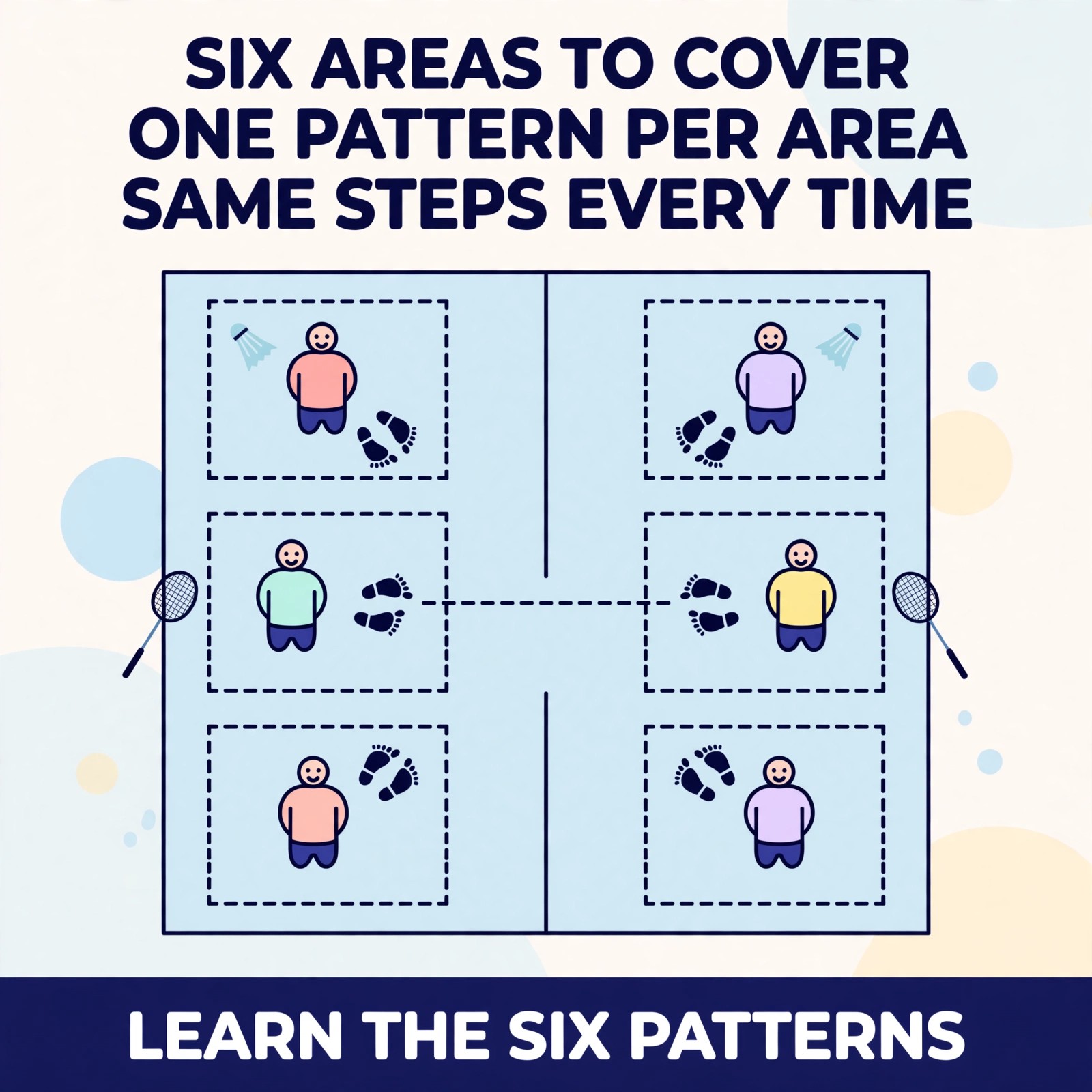
The court divides into six areas, and each has a trusted step pattern. The two front corners are reached with a lunge: small steps in, then a long final stride on the racket leg, heel down first, knee tracking over the toes. The two sides are covered with a side lunge or a quick cross step into a block or drive position. The two back corners use turning steps: a pivot and cross behind for the forehand side, and either a round the head movement or a backhand step pattern on the other side. Six areas, six habits. Learn them one at a time and the whole court shrinks.
Why patterns at all? Because choosing steps mid rally wastes the very time agility is meant to save. When the pattern for a corner is automatic, your brain is free to watch the shuttle, judge its height, and plan the shot. Players without patterns improvise every trip: sometimes a lunge, sometimes a run, sometimes a hop. Improvised movement arrives late and lands messy. Patterns also protect your joints. A proper lunge loads the leg muscles in the right order, while a panicked straight legged reach dumps the force into the knee. Groove the patterns slowly, corner by corner, until your feet pick them on their own.
A practical way to learn is the six point circuit. Stand in base. Move to one area using its pattern, touch your racket down lightly where the shuttle would be, and recover to base through the middle. Repeat for all six areas, slowly. Then chain two areas together, then three. Only when the circuit feels smooth do you add a feeder or any real speed. Most players need a few weeks of slow circuits before the patterns hold up in games. That is normal. You are rewriting years of habits, one corner at a time.

Agility Check #4
Changing Direction: Plant, Turn and Push Without Losing Balance
Reaching the shuttle is only half of every trip. The other half is getting back. Recovery starts in the lunge itself: land on a bent leg with your weight able to push back, not collapsed forward over your toes. Push hard through the front foot, take quick steps toward base, and arrive early enough to split step for the next shot. The common club error is admiring the shot: players watch their nice net shot land while the opponent lifts deep, and the back corner finds them standing still. Your eyes can watch the shuttle, but your feet should already be travelling home.
Recovery speed decides how aggressive you can be. A player who recovers fast can take chances at the net, because a lift does not strand them. A slow recoverer must play safe and deep, giving the opponent time. In training, judge every drill by the return trip, not the shot. Feeders should watch whether you pass back through base balanced, ready and on time. In matches, make your recovery automatic: shot, push, steps, base, split. When that chain breaks, rallies stretch you wider and wider until a corner finally opens that nobody could cover.
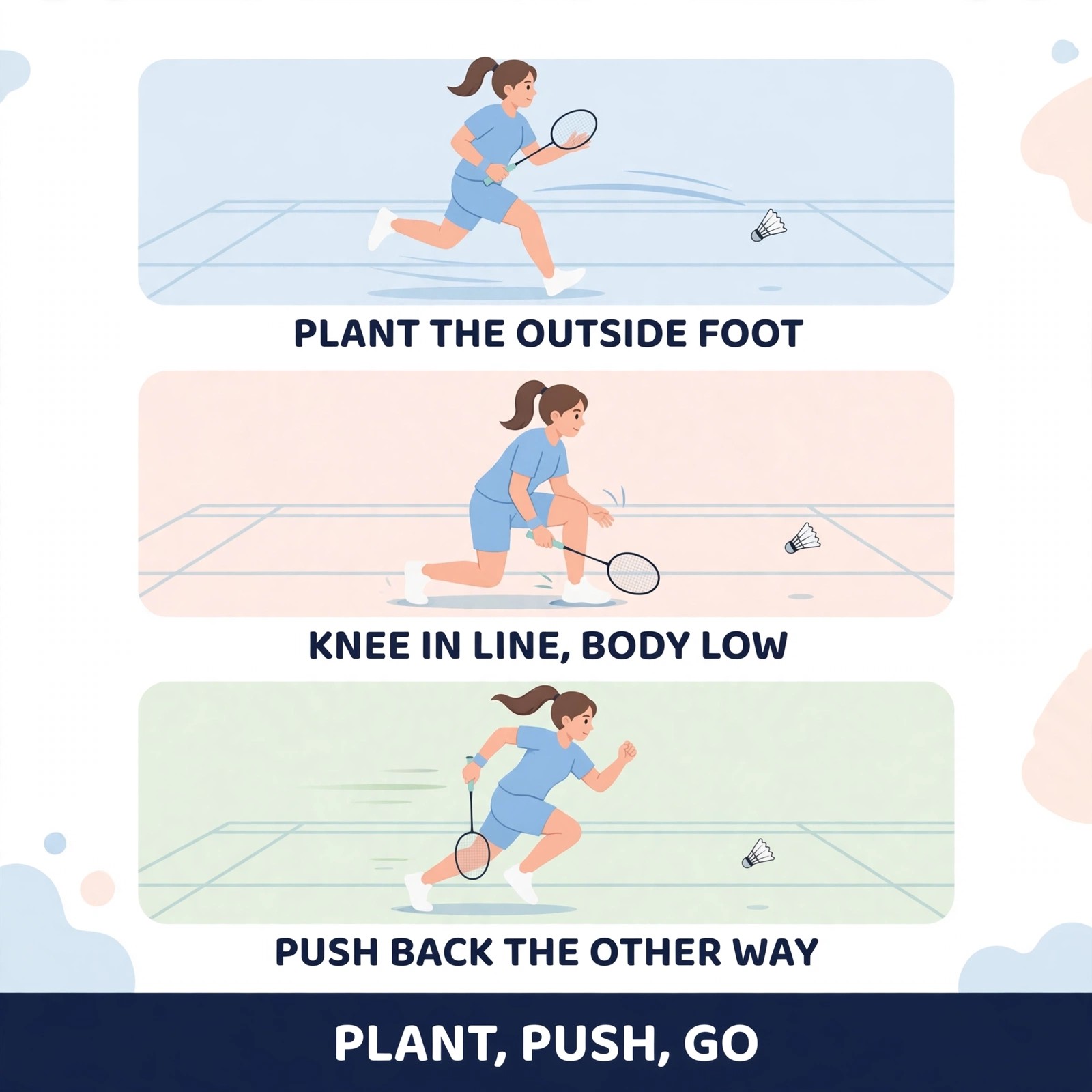
Direction changes ride on the same mechanics. Run hard one way, plant the outside foot with the knee in line over the toes, drop your hips, and push back the other way. The plant foot is your brake and your engine in one. Keep the plant step firm rather than huge, since an overlong plant dumps your weight too far past your foot and the turn becomes a stumble. Ankles and knees handle these forces well when the leg is aligned and the muscles around them are trained progressively. Sharp pain is a stop signal, not a challenge: ease off and get checked if it repeats.
Agility Check #5
Agility Inside a Rally: Using Movement to Run the Point
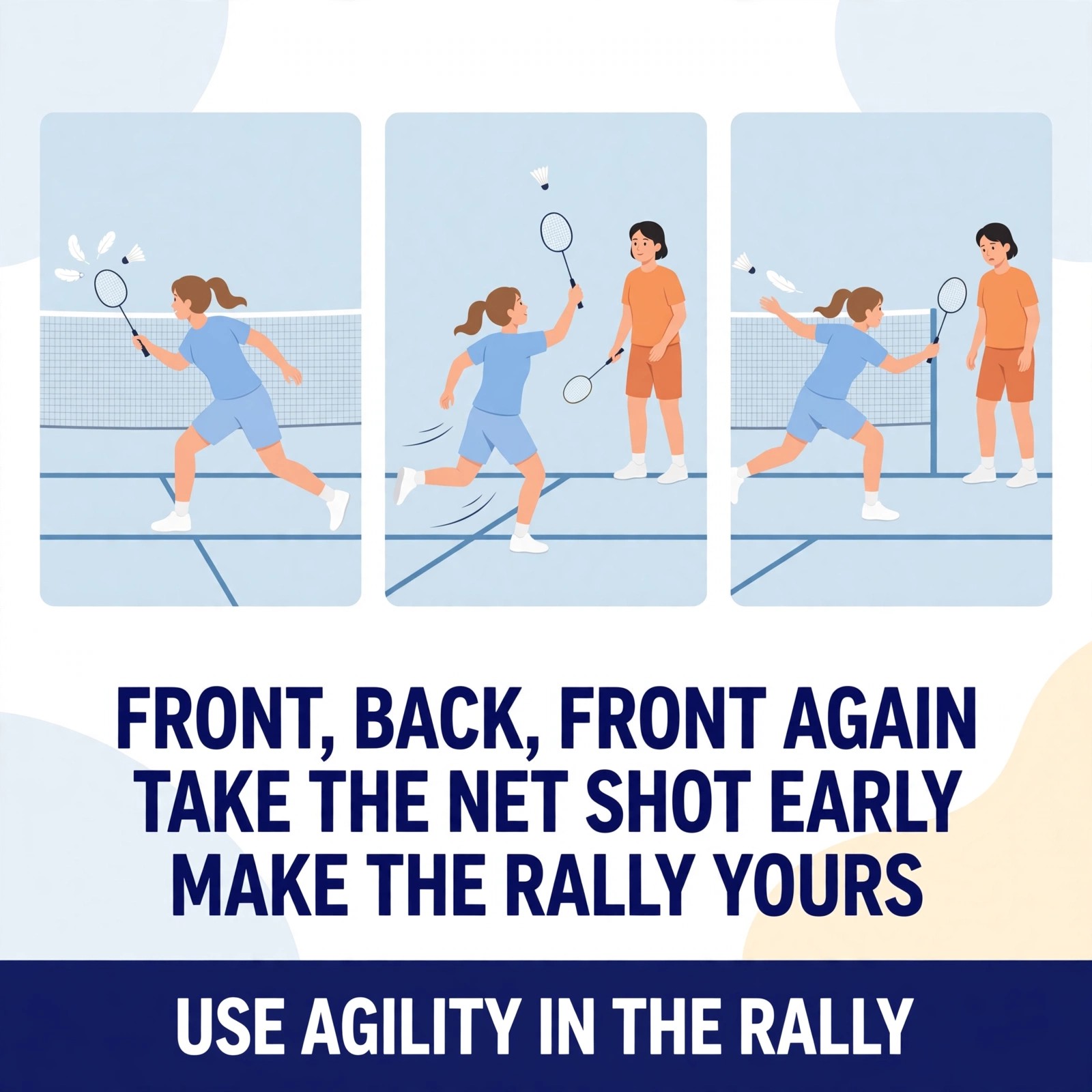
Agility earns its keep inside rallies, not in drills. Picture a rally built on movement: you take a net shot early at the front, recover, turn and reach a clear deep at the back, recover again, then step in and meet the next shot early at the net once more. Your opponent has hit three decent shots and lost the rally anyway, because your movement kept taking time away from them. This is the how to play part of agility: using corners, recovery and early arrivals to run the rally on your terms. Drills build the engine. Rallies are where you spend it.
Early arrival is the prize. Getting to the shuttle early means options: you can hold, flick, drive or play soft, and your opponent must respect all of them. Arriving late means survival shots only. So judge your movement by arrival time, not by effort. Two calm steps that land you early are better agility than a desperate dive that wins one point and loses your balance for the next three. As your patterns and recovery improve, you will notice you can choose shots again. That choice, more than any single drill, is what good movement buys.
Singles rewards full court agility most, but doubles uses it too: fast side to side coverage in defence, sharp rotation between front and back, and quick recovery after smashes. The patterns shrink in doubles, yet the same rules apply: base, split, pattern, recover. Whatever format you play, move with intent. Every trip should start on time, follow a pattern, and end at base ready for the next shot. When all three happen by habit, you will feel the court getting smaller, and smaller courts are where confident badminton lives.
Myth vs Reality
Myths About Agility and Court Movement
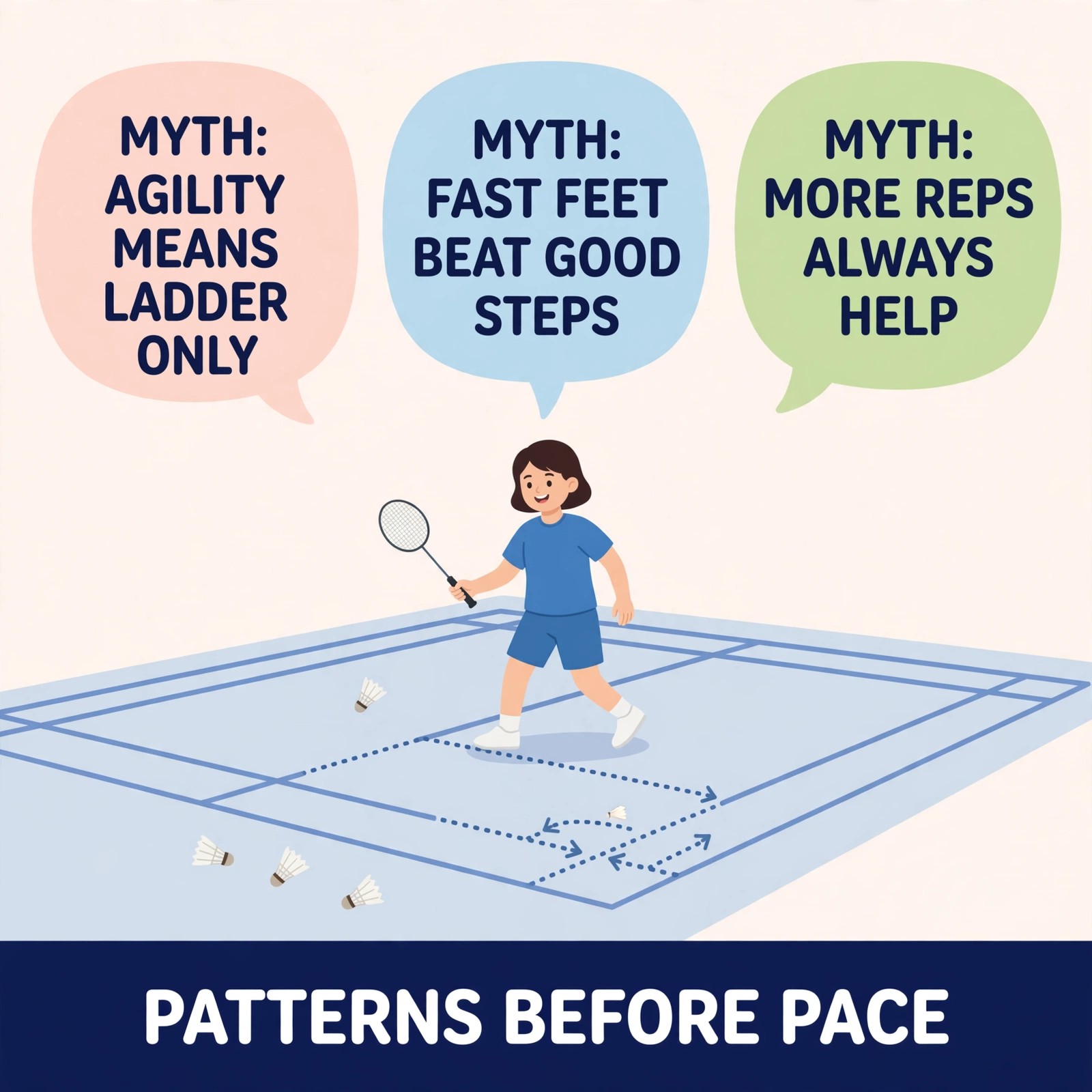
Three myths hold players back. The first says agility training means ladder drills and nothing else. Ladders train light feet, but they do not teach lunges, turns or recovery. The court patterns matter more. The second myth says fast, busy feet beat good steps. Busy feet doing the wrong pattern still arrive off balance. Steps first, speed second. The third myth claims more repetitions always help. Movement practised while exhausted teaches exhausted movement. Agility work should be done fresh, in short sets, with form checked often.
The honest picture is kinder than the myths. Agility is mostly technique, and technique can be learnt at any age. You do not need the spring of a teenager. You need a low base, six grooved patterns, honest recovery steps and the patience to train them slowly before training them fast. Players who do this work feel the change in ordinary moments: the back corner stops being a panic, the lunge stops hurting their rhythm, and long rallies stop feeling like a chase. The court has not changed. Their movement has.
Keep the order right and the results follow. Balance first. Patterns before pace. Recovery judged as strictly as the shot. Short sets while fresh, one corner fixed at a time. Write down the corner that still feels slow and give it two weeks of honest work. Agility is not a mystery quality some players are handed. It is a set of steps, learnt properly, and it is available to anyone willing to walk the patterns slowly before running them fast.
Why Choose Us
Why Players Choose ST Badminton Academy
Players train agility at ST Badminton Academy because movement is coached here as a skill, not a fitness punishment. In small group sessions, with a maximum of 4 students per coach, your lunges, turns and recovery steps get watched and corrected in detail. Coaches break the six patterns down corner by corner, then rebuild them inside real rallies so the steps survive match pressure. Shadow circuits, ladder work and random corner feeds all have their place, in that order, and always with form first.
The academy runs group training for adults and juniors across Kuala Lumpur and Setapak. Sessions mix footwork patterns with shots from the start, because movement that cannot hit a shuttle is only dancing. Over a term, students feel rallies change: back corners become reachable without panic, lunges land balanced, and recovery stops being the weak link. Training loads are built up sensibly, knees and ankles are respected, and sharp pain is always a reason to stop and get advice, never to push through. Progress is steady, honest and built to last.
If your feet feel like they are always negotiating with the shuttle instead of meeting it, come and learn the patterns with us. Book a trial session, bring your racket, and let a coach watch you move to the six areas. Most players discover their problem corner within ten minutes, and their first fix within the session. From there, the work is clear: one pattern at a time, slowly, then at rally speed. Better movement is learnable, and it changes every shot you own.
FAQs: Badminton Speed, Agility and Court Movement in Malaysia (KL)
Below are the questions players ask us most about agility, footwork patterns and court movement training at ST Badminton Academy. If your question is not covered, message us and we will help you plan your first session.
Do I need good balance before agility training in Setapak or Gombak?
No, and the difference matters. Speed is how fast you travel once moving. Agility is starting, stopping, turning and arriving balanced on a small court. Badminton rallies need agility far more than top speed. The best training reflects that: short movements in every direction, grooved step patterns for the six court areas, and recovery back to base between shots.
How do I start agility training at home or on court in KL?
Start with shadow circuits at walking pace. Move from base to each of the six areas using the proper pattern, touch down lightly, and recover through the middle. Add pace only when you can stop and freeze in balance at every corner. Ten focused minutes, two or three times a week, teaches your feet more than long tired running sessions.
Does ladder training help, and how much should I do at my level?
Ladder work keeps feet light and quick, but it is a support act only. The real agility in badminton is the six court patterns: front corner lunges, side steps and blocks at the sides, and turning movements at the back. Spend most movement time on those patterns on court, and use the ladder to warm up or finish.
Can adults train agility safely, whatever their starting fitness?
Yes, with sensible progress. The step patterns are technique, and technique can be learnt at any age. Adults build loads gradually, keep lunges at a knee friendly depth, and warm up well. Sharp or repeated joint pain means stop and seek advice from a doctor or physiotherapist. Many adult students find their movement and confidence improve within a term.
What should I do if my knee hurts during footwork drills?
Take it seriously. A tired ache in leg muscles after new drills is common, but sharp pain in the knee or ankle, or pain returning in the same spot, means stop and see a doctor or physiotherapist. Never push through joint pain for a drill. Good coaching adjusts load and volume, because long term movement matters more than one session.
Will better agility improve my shots near Wangsa Maju?
For most players, yes, once the patterns settle. Better movement gets you to the shuttle earlier and more balanced, and early arrivals produce better shots from the same technique. Players often notice their existing shots improving before their fitness does, because they are no longer hitting while falling over or stretching late. Movement is the platform every shot stands on.
Where does ST Badminton Academy run agility focused training in Malaysia?
Sessions run at our Setapak base and at halls around Kuala Lumpur, for adults and juniors through the week. Groups are kept small, with a maximum of 4 students per coach, so footwork gets individual correction. Your first visit can be a trial. Message us with your area and preferred days and we will match you to a group.
How is agility training different from quickness training?
Message us on WhatsApp or through the website contact form. Tell us your playing level and which part of the court feels hardest to reach. We will suggest a group and a session time. Bring your racket and court shoes. In the trial, a coach will watch your six patterns, find your problem corner, and set your first movement focus.
What shoes and gear do I need for agility sessions in badminton?
Wear proper non marking court shoes for safe grip and support, plus comfortable sports clothes. Bring your own racket if you have one and a water bottle. Shuttlecocks are provided in sessions. If it is your first visit, arrive a little early so we can meet you, hear about your game, and place you in the right group.
Agility Training in Action


One Standard for Every Session and Every Player
Every agility session at ST Badminton Academy follows the same coaching standards. Patterns are taught slowly before speed is added, and form is checked before volume grows. Groups are capped at a maximum of 4 students per coach. Movement loads build progressively, joint pain is treated as a stop signal, and no one is pushed through it. Practice is structured and honest, with no shortcuts sold. Players move better because the steps are coached properly, repeated often, and tested inside real rallies every week.
| Factor | Stiff Movement | Tidy Court Movement AGILITY |
|---|---|---|
| Frequency | 1 or 2 times a week. Mostly for fun and sweat. | Six court patterns learned slowly, then sharpened, with recovery to base every time. |
| Drills Focus | Basic static feeding. Minimal footwork pressure. | Lunges, side steps and turns practised at a pace the player can hold in balance. |
| Physical Conditioning | Rarely included. Just playing games on court. | Core, agility, and speed training included in every session to prevent injury and build stamina. |
| Tactical Awareness | "Just hit it over." No real game plan. | Video analysis, point construction, and learning to read the opponent's game. |
| Coach Ratio | Large groups (8-10 kids). Coach barely watches you. | Max 4 students. Mr Eric Chuar personally corrects every stroke and movement detail. |
| Goal Setting | Fun and exercise. | One weak corner fixed at a time, checked in real rallies, not just drills. |
| Long Term Result | Good recreational player. | A player who arrives early and balanced, changes direction cleanly and runs the rally. |
Badminton Agility Coaching in Kuala Lumpur
Make the court smaller. Come to ST Badminton Academy in Kuala Lumpur and learn the six patterns, the recovery steps and the direction changes that put you in charge of rallies. Book a trial session this week, bring your racket, and find your problem corner in the first ten minutes. Better movement is a set of steps away.






