How To Develop A Powerful Badminton Forehand: Techniques And Training Methods (Forehand Power Guide)
A powerful forehand clear that still reaches the back line in the third game is not an arm trick. Watch where the power actually comes from and it starts at the floor: the legs load, the body turns, the arm swings through last, and the fingers finish the job at contact. Players who try to muscle the shot with the arm alone get a tired shoulder and a shuttle that dies at mid court. This guide breaks forehand power into its real parts, corrects the grip myths that sneak in from other racket sports, and gives training methods that build each part in order.
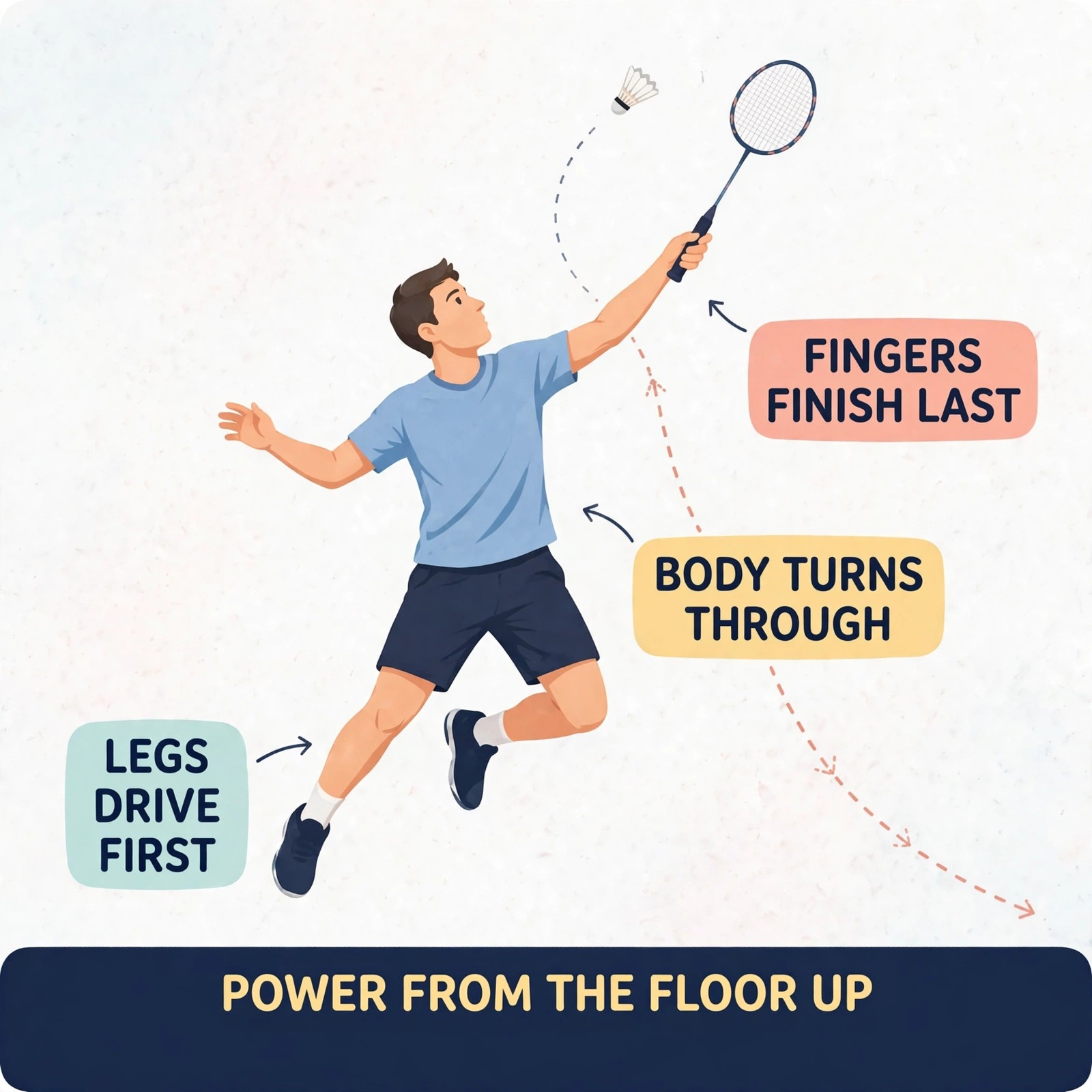
Forehand Check #1
Power Starts in the Legs: Get Behind the Shuttle
Power starts with position. To hit hard with the forehand, you must be behind the shuttle with your weight able to move into the shot. That means moving back early, taking the last steps side on, and letting the racket side leg load as the shuttle drops toward you. From there the push off the back leg starts the whole chain. Players who reach up from underneath the shuttle, falling backward, have no leg drive to borrow, and no arm swing can replace it. The first power drill is not a swing at all. It is arriving behind the shuttle, balanced, again and again.
The steps are simple to describe and take weeks to own. Split step as the opponent strikes, turn the shoulders as you move back, and take chasse or scissor steps so you arrive side on with the non racket side pointing toward the net. Your weight sits on the back leg at the moment of preparation, chest open, racket up and back. Then the shot begins from the ground: back leg pushes, hips turn, and the body unwinds toward the net. Practise the arrival without a shuttle first, freezing in the loaded position, until side on and behind feels like the only way to be there.
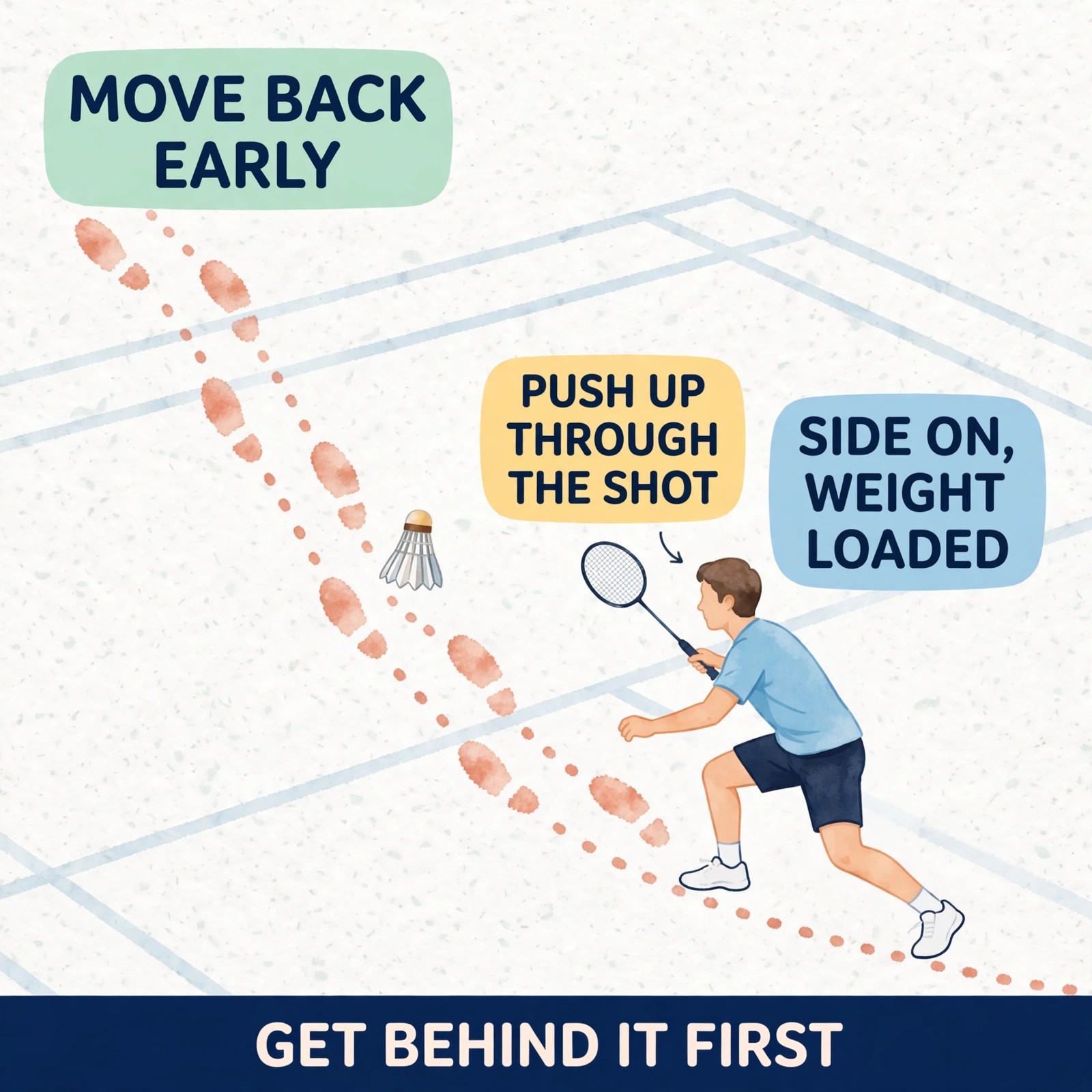
Forehand Check #2
Turn and Load: Rotation Does the Heavy Work
Rotation does the heavy work that arms cannot. The turn of the body is a chain with an order: hips start, shoulders follow, the upper arm comes through, the forearm rotates, and the fingers finish at contact. Each link adds speed to the next, which is why a relaxed player with a good chain outhits a strong player who swings with the arm only. Break the order, start with the arm, and the later links have nothing to add. You feel it at once: the swing feels heavy, the contact feels dead, and the shuttle floats.
The scissor kick is the visible part of the chain in the back court. As you strike, the back leg pushes and the legs swap in the air, landing you turned back toward the court, ready to recover. It is not a jump for height. It is the body completing its turn and giving the weight a path into the shot and out again. Players who stay side on after contact hit one good shot and then watch the reply go past. Train the turn and the landing together, because power that strands you is only half a shot.
A useful check is sound and feel. A chained forehand cracks off the strings and the effort feels spread through the legs and trunk. An arm only swing feels local, tight and tiring, mostly in the shoulder. Film yourself from the side once a week: if the hips and shoulders barely turn, the chain is not running, whatever your arm is doing. Fix the turn before adding any speed or strength work. Rotation first is not a slogan; it is the sequence the power actually travels through.
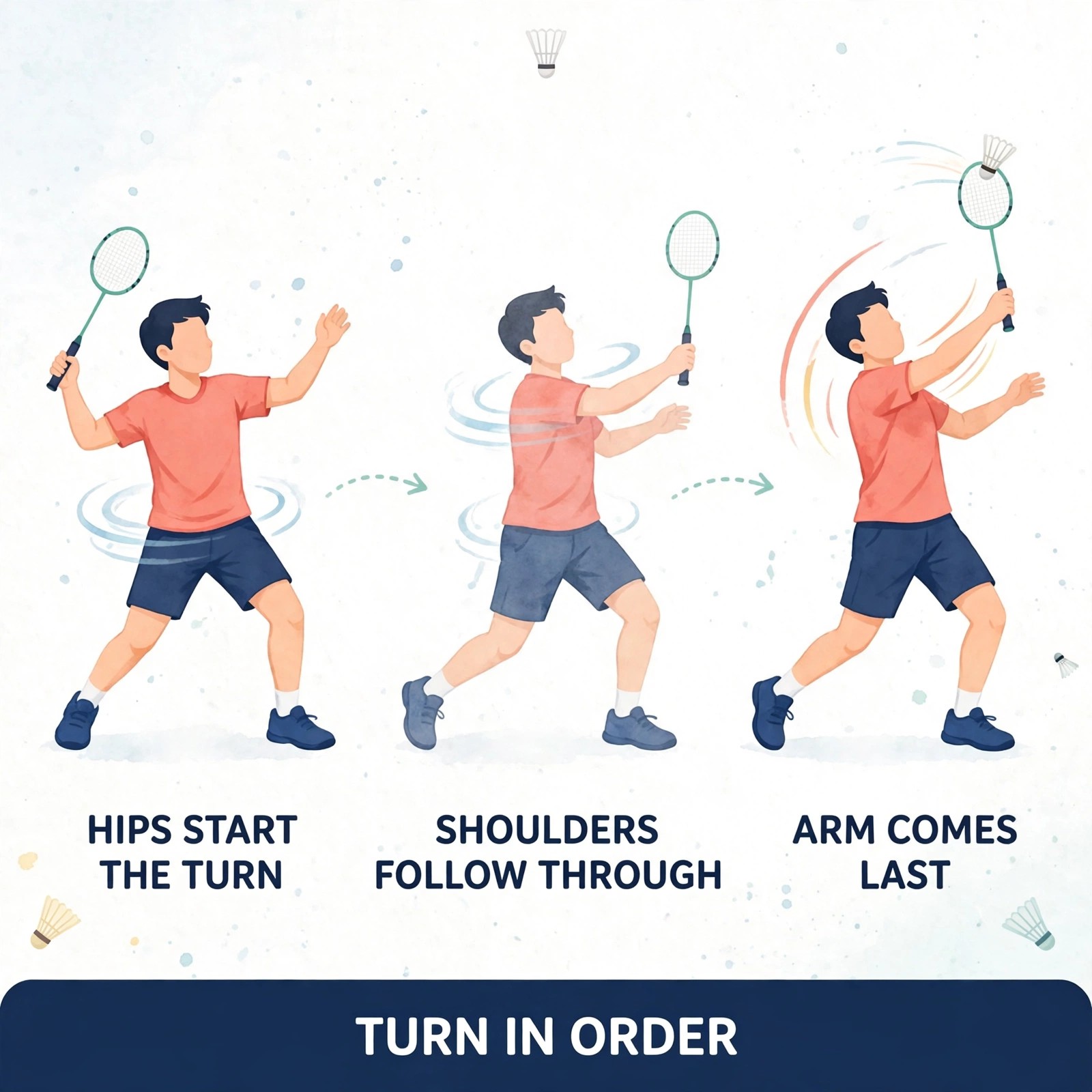
Forehand Check #3
The Relaxed Grip: Loose, Then Fingers at Contact
The grip is where tennis habits do the most damage. Badminton forehand power uses the basic forehand grip: shake hands with the handle, the thumb and index finger forming a clear V on top, the fingers wrapped softly with small gaps, the hand relaxed. Tennis grips like the continental or semi western turn the racket face the wrong way for a shuttle and lock the forearm out of the swing. If a coach or a video from another sport has put your thumb flat across the back of the handle for forehand overheads, that is a backhand grip in the wrong place. Reset to the handshake shape.
Relaxed is the working word. Hold the handle softly through the preparation and most of the swing, loose enough that someone could almost pull the racket from your hand. A tight grip from the start tenses the whole forearm, slows the racket head, and tires the arm within a few rallies. The looseness is not carelessness: it is what lets the forearm rotate at full speed and lets the fingers do their work at the last moment. Shake the tension out of the hand between rallies and check the V is still there before the next shot.
The fingers finish the shot. In the last instant before contact, the fingers squeeze the handle, and that squeeze snaps the racket head through the final part of its arc. Coaches call it finger power, and it is the difference between a swing that pushes the shuttle and one that strikes it. You can train it anywhere: hold the racket in the basic grip, keep the arm still, and practise the short squeeze that flicks the head up and stops it clean. Small, quick and repeatable. In the full swing it should feel like the final link clicking into place, not a grab.
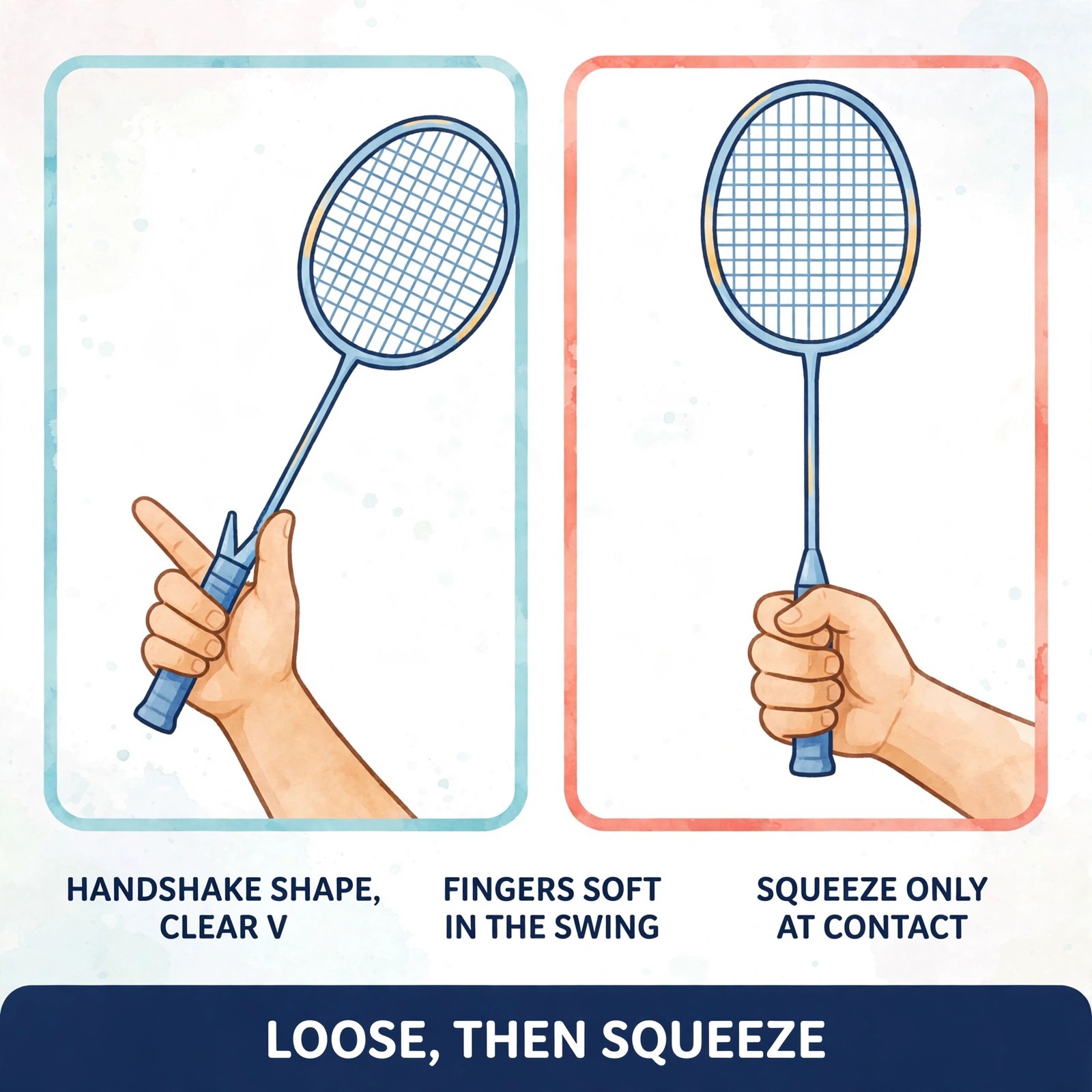
Forehand Check #4
Contact High and in Front: Where Power Lands
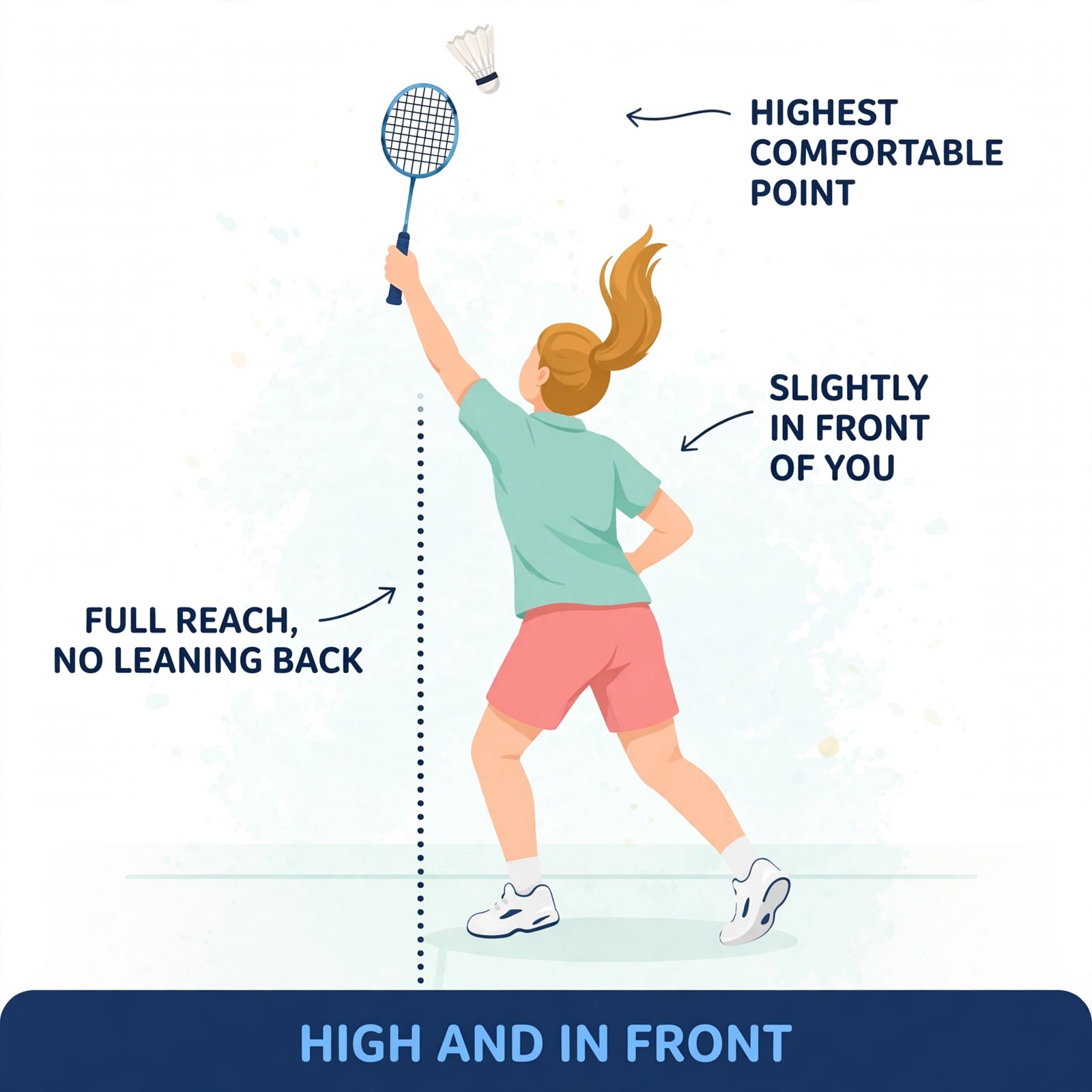
Contact point decides how much of the chain reaches the shuttle. Forehand power lands when contact happens at the highest comfortable point, slightly in front of the body, with the arm near full reach but not locked stiff. There, the turn has finished, the forearm has rotated, and the racket face meets the shuttle square and moving fast. Contact taken beside the head or behind it leaks power in every direction: the face twists, the angle flattens, and the shot sails or fades. This is why getting behind the shuttle matters so much. Position buys the contact point.
Comfortable is the honest limit. Reaching beyond your balanced high point adds nothing: the shoulder strains, the face opens, and the shuttle goes up instead of through. Work inside the point where you can strike cleanly while balanced, and let better footwork move that point higher over time. A simple drill check: if you land off balance or your shoulder aches after a set of clears, the contact point or the turn is wrong, and more effort will only groove the fault. Stop, reset the shape at slow speed, and build again.
Angle is the partner of height. From a high, in front contact, the same shape produces a clear that travels the full court, a drop that stays tight, or a smash that goes down, which is what makes a strong forehand hard to read. Defenders cannot sit on one reply. Keep the preparation identical for all three, make the choice late, and let the contact point do the talking. Power that can only produce one shot gets defended early. Power with disguise keeps the back court dangerous even when the rally slows down.
Forehand Check #5
Training Methods That Build Forehand Power
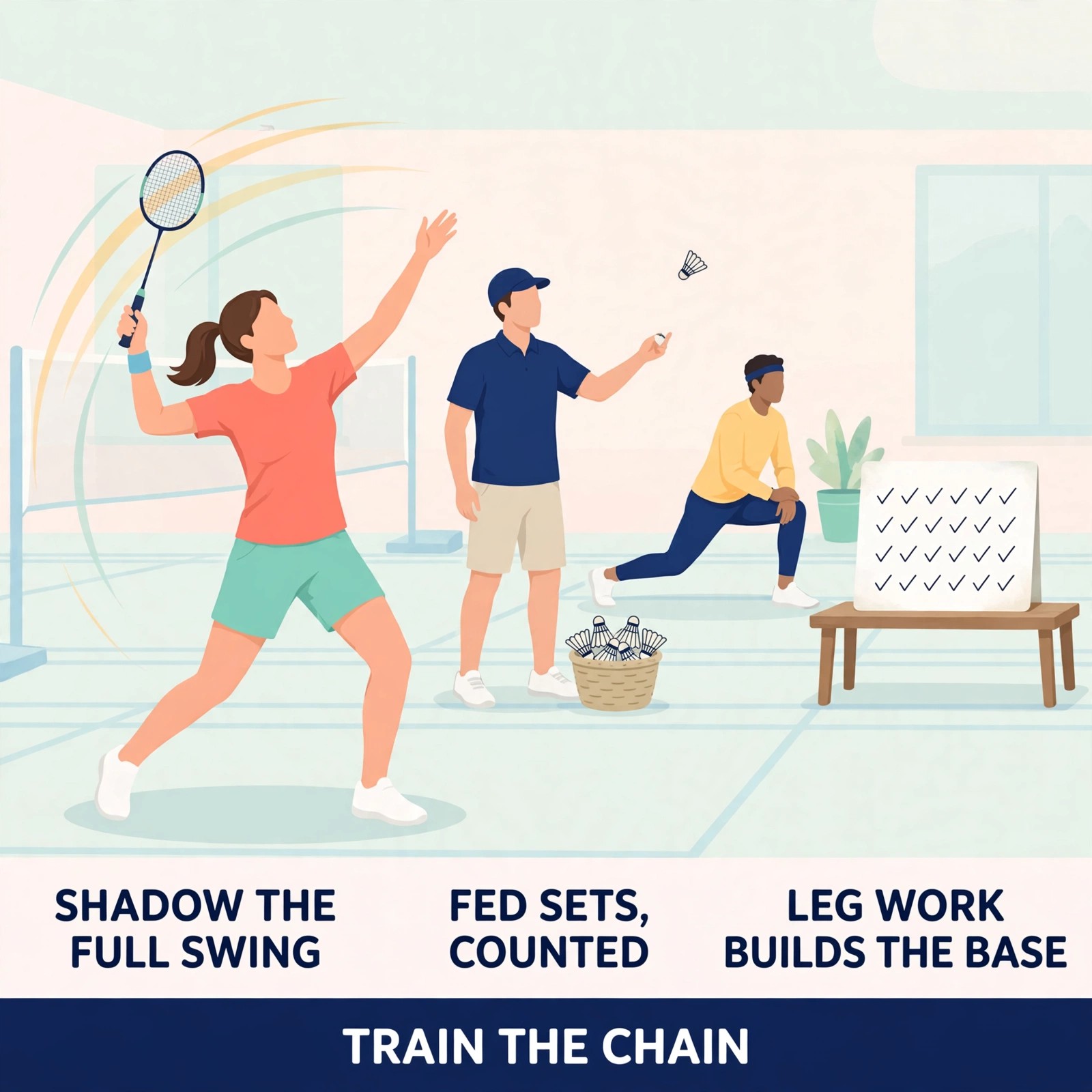
Training forehand power means training the chain in pieces, then joining it. Shadow swings groove the turn and the contact shape without a shuttle to chase. Fed multi shuttle sets to the deep forehand corner build the arrival and the strike under mild pressure, counted in clean full length shots. Bodyweight lunges and split squats build the leg drive the chain starts from. Short finger squeeze work sharpens the finish. None of this needs special equipment, and all of it works better in short, fresh sets than in long tired ones, because tired swings groove the faults you are trying to remove.
Order the week simply. One session leans on technique: shadow work and slow feeding, checking the turn and the grip on video. One session leans on volume: multi shuttle sets with counts, resting before the shape breaks. One session can test the chain in games, with a rule that points only count from shots played behind the shuttle. Write down what you counted. If clean full length forehands are rising across the month, the chain is building. If the count stalls, the honest answer is usually the arrival or the turn, not effort.
Respect the shoulder while you build. Power work loads the same joints repeatedly, so stop a set when the shape goes, warm up the arm and shoulder before hard hitting, and keep the weekly increase gradual. Sharp pain is a stop signal, not a challenge: rest it, and if pain keeps returning when you play, see a doctor or a physiotherapist before loading it again. A strong forehand is a long project, and the players who finish it are the ones who never had to stop for months with a damaged shoulder.
Myth vs Reality
Forehand Power Myths That Waste Your Swing
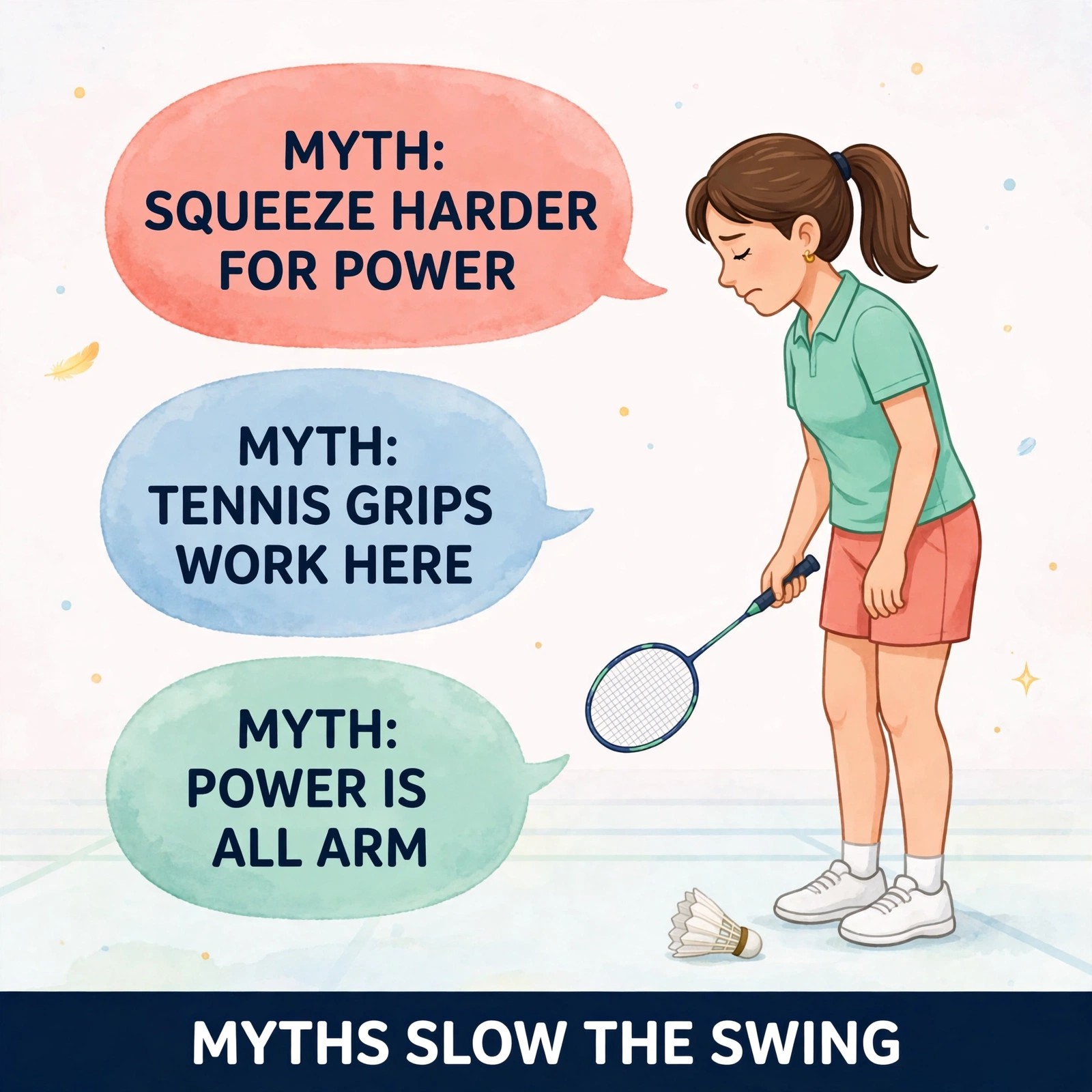
The loudest forehand myth says power is arm strength, so players grip tighter and swing harder. The chain says otherwise: legs and rotation supply most of the speed, the relaxed hand lets the head travel fast, and the fingers finish. A death grip is visible in a players forearm within two rallies, all tension and no crack at contact. The second myth imports tennis: the idea that a forehand needs a tennis grip family, or that a famous tennis name has anything to teach a shuttle. Different implement, different flight, different grip. Keep the handshake shape.
A third myth promises that a heavier racket or a higher tension will hand you power. Equipment changes feel, and a string bed that suits you helps the strike feel clean, but no frame supplies the turn your body did not make. Players chase gear because gear is easy to buy and chains are slow to build. The honest order is body first, grip second, equipment last. Another myth says power is a talent you are born with. The chain is mechanics, and mechanics can be coached, drilled and counted at almost any age or starting level.
Keep the order of work and the myths lose their power. Behind the shuttle first, because position buys everything else. Turn second, because rotation is the engine. Grip and fingers third, because they deliver the speed to the strings. Contact point fourth, because it decides how much of the chain lands. Training methods last, because they only build what the first four pieces define. Build in that order, count clean strikes instead of admiring effort, and your forehand becomes the shot opponents stop testing within a few weeks of honest work.
Why Choose Us
Why Players Choose ST Badminton Academy
Players choose ST Badminton Academy because the groups stay small: a maximum of four students per group, so a coach actually sees your arrival position, your turn and your grip, rally after rally. Forehand power faults hide in busy sessions. In a small group they get named, shown and fixed on the spot, which is how a chain gets built properly instead of grooved wrong.
The coaching is honest about stages. We will tell you when your turn is ready for full pace feeding and when it is not, and we count clean full length strikes instead of handing out easy praise. Players improve faster when the feedback is plain, and power work most of all, because a chain either runs in order or it does not, and the shuttle tells the truth either way.
Training runs in Kuala Lumpur with our original base in Setapak, and players come in from around the Klang Valley. Wherever you join, the format is the same: small groups, a clear stage plan for your forehand, and drills that finish with counted sets so you can feel the chain working under pressure before you take it into a real match.
FAQs: Badminton Forehand Power, Grip and Training Methods in Malaysia (KL)
Short answers to the forehand power questions players ask us most: where power comes from, grips, contact, home practice and how training here works. For anything longer, the honest way is to come and try a session and let a coach watch your forehand chain before anyone talks plans.
Can a beginner build a powerful forehand early in Setapak or Gombak?
Yes, and forehand power is coachable from the start, because it is a chain of movements, not a talent. Beginners learn the arrival behind the shuttle, the turn and the relaxed basic grip in groups of four, with feeding at a kind pace. The first gains come quickly once the arm stops doing all the work.
What is the first forehand power habit to build in KL?
Build the arrival and the turn first. Getting behind the shuttle with your weight loaded lets the legs start the chain, and hips and shoulders turning in order supply most of the speed. Position, turn, relaxed grip, fingers at contact: that order builds power that survives long rallies.
Why does my forehand clear die at the mid court at club level?
Nine times out of ten, the chain is broken before contact. Check in order: were you behind the shuttle, did the hips and shoulders turn, was the grip relaxed until the fingers squeezed, and did contact happen high and in front? Film one set from the side and the broken link is easy to spot.
My forehand feels weak even when I swing hard. Should I grip tighter or relax the hand?
Relax the hand. A grip held tight from the start locks the forearm, slows the racket head and tires the arm, so harder effort produces a weaker shot. Hold the basic grip softly, let the turn do the work, and squeeze with the fingers only in the last instant before contact.
How can I practise forehand power alone at home during the week?
Shadow the chain. Without a shuttle, stand side on, load the back leg, and swing the full overhead shape slowly, freezing at the contact point to check height and grip, then scissor back. Add short finger squeeze sets and a few split squats. Ten focused minutes, three times a week, is enough.
Do you coach forehand power near Wangsa Maju?
Yes. The academy runs coaching across Kuala Lumpur, with our original base in Setapak and sessions serving players from Wangsa Maju and the wider Klang Valley. Forehand power work is part of regular training: arrival, rotation, grip and counted feeding sets, in groups of a maximum of four students. Book a trial to start.
Where does ST Badminton Academy coach forehand training in Malaysia?
The academy coaches in Kuala Lumpur, with our original base in Setapak and players joining from across the Klang Valley. Sessions run for kids, teens and adults in groups capped at four students, so your turn and contact point get corrected every session. Book a trial and we will show you the stage plan for your forehand.
How do I book a trial session to test my forehand before joining training?
Send us a message and tell us your level and where you play now. We will arrange a trial in a group of no more than four students, and a coach will watch your arrival, turn, grip and contact in real rallies. No hard sell, no long commitment. You play, we coach, then you decide.
What makes Mr Eric Chuar a suitable coach for forehand coaching in badminton?
Mr Eric Chuar coaches the academy sessions himself and builds forehand power the way this guide sets out: position, turn, relaxed grip and finger finish, with counted drills at each stage. He works with juniors and adults in Kuala Lumpur, keeps groups at four students or fewer, and gives plain feedback on your chain.
Badminton Forehand Training in Action


One Standard for Every Session and Every Player
One standard covers every forehand build at the academy: the arrival is behind the shuttle, the turn runs in order, the grip stays relaxed until the fingers finish, and progress is counted in clean full length strikes, never in compliments. If a stage is not ready, we say so and keep building it. That honesty is why our players keep gaining power after the first month, when easy gains usually stop.
| Factor | Arm Only Swinging | Whole Body Power FOREHAND |
|---|---|---|
| Frequency | 1 or 2 times a week. Mostly for fun and sweat. | The legs drive first: get behind the shuttle, load the back leg and push through the shot. |
| Drills Focus | Basic static feeding. Minimal footwork pressure. | The body turns through contact in order: hips, shoulders, arm, then the fingers finish. |
| Physical Conditioning | Rarely included. Just playing games on court. | Core, agility, and speed training included in every session to prevent injury and build stamina. |
| Tactical Awareness | "Just hit it over." No real game plan. | Video analysis, point construction, and learning to read the opponent's game. |
| Coach Ratio | Large groups (8-10 kids). Coach barely watches you. | Max 4 students. Mr Eric Chuar personally corrects every stroke and movement detail. |
| Goal Setting | Fun and exercise. | The grip stays loose until contact, so the racket head is still accelerating when it meets the shuttle. |
| Long Term Result | Good recreational player. | A powerful forehand: built from the floor up, repeatable at the end of a long rally. |
Badminton Forehand Coaching in Kuala Lumpur
Opponents will keep testing your forehand corner whether you build the chain or not. Start the build properly: get behind the shuttle, turn in order, keep the grip loose until the fingers finish, and train each link with counted drills. Book a trial session with ST Badminton Academy in Kuala Lumpur, play in a group of four or fewer, and let a coach map the first stage of your forehand power with you.




