How To Develop A Winning Badminton Net Game: Strategies And Techniques (Net Technique Guide)
The front of the court is where rallies are won quietly. A tight net shot does not look dramatic, but it forces lifts, steals time and sets up everything that follows. This guide builds the net game as technique first: how the shuttle is taken, how spin is brushed on, how loose replies are finished, and how the lunge and racket carriage underneath make all of it repeatable. There are no tricks in it and no luck. Just contact, touch and feet, trained in the right order until the front court feels like home ground.
Net Check #1
The Tight Net Shot: Contact High, Touch Soft
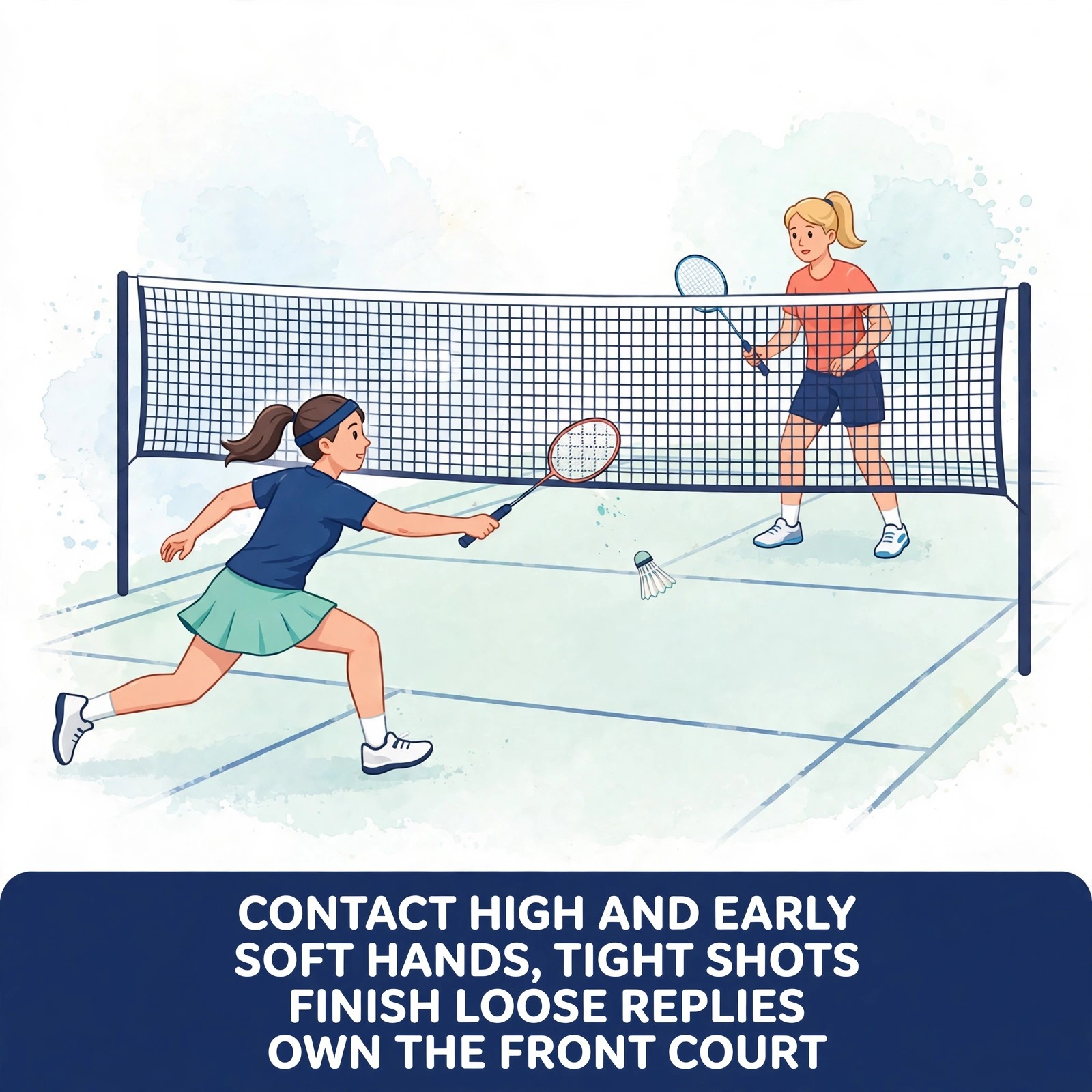
A good net shot starts before the racket moves. The shuttle should be taken as high as you can reach it, close to the tape, while it is still rising or just at its peak. Taken there, it only has to travel a few centimetres up before it falls, which is why it can hug the net so closely. Taken late and low, it must be lifted over the tape first, and every extra centimetre of height on your side is a gift to the opponent waiting to pounce on it.
The touch itself is a cushion, not a push. The racket face meets the shuttle with a soft, slightly angled face and the fingers stay relaxed, so the shuttle rolls over the strings instead of bouncing off them. Players who stab at the shuttle send it sitting up; players who cushion it watch it tumble and die. Practise the contact at walking pace first, with a partner feeding by hand at the net, until that soft landing becomes your normal one rather than your lucky one.

Net Check #2
Spinning Net Shots: Slice, Tumble and Control
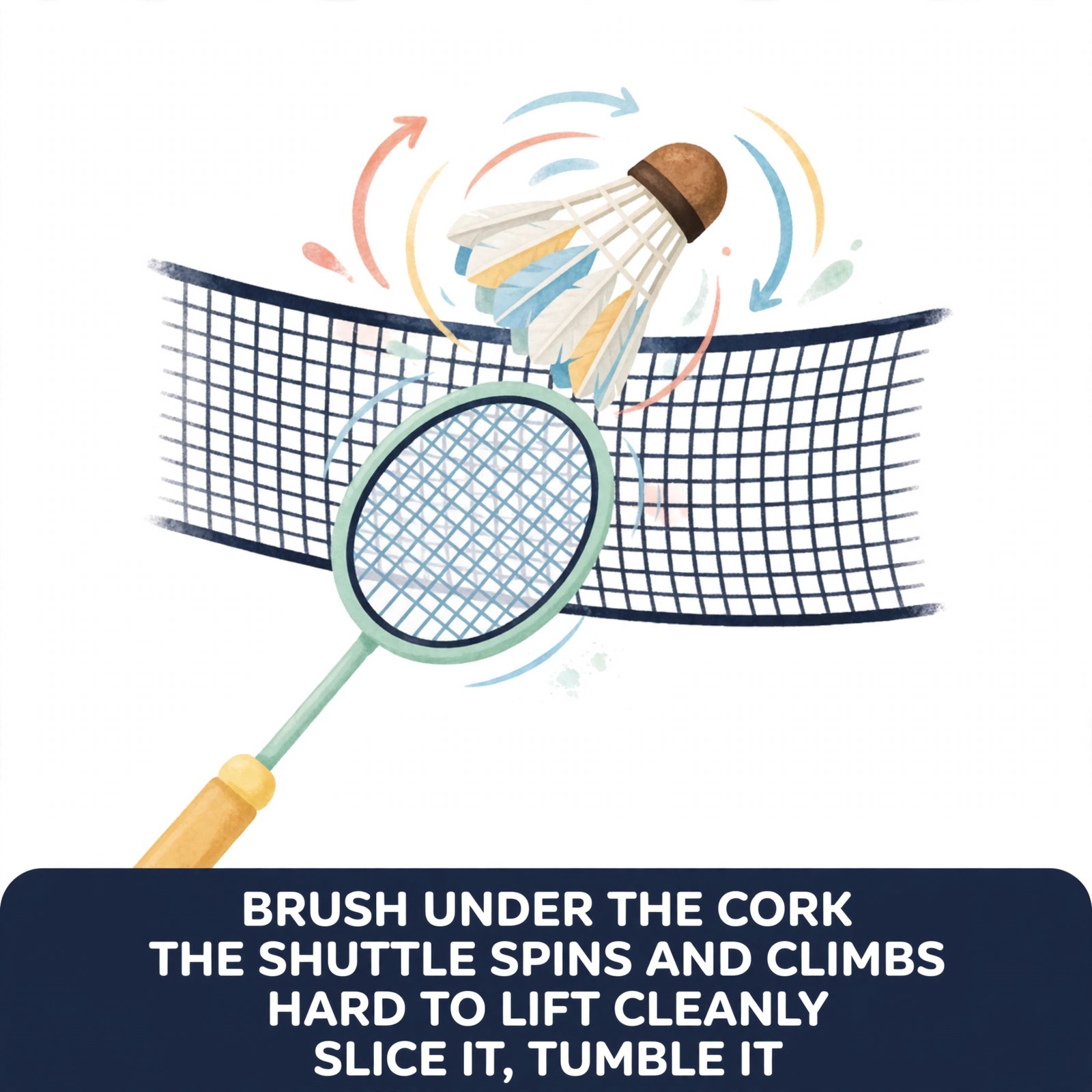
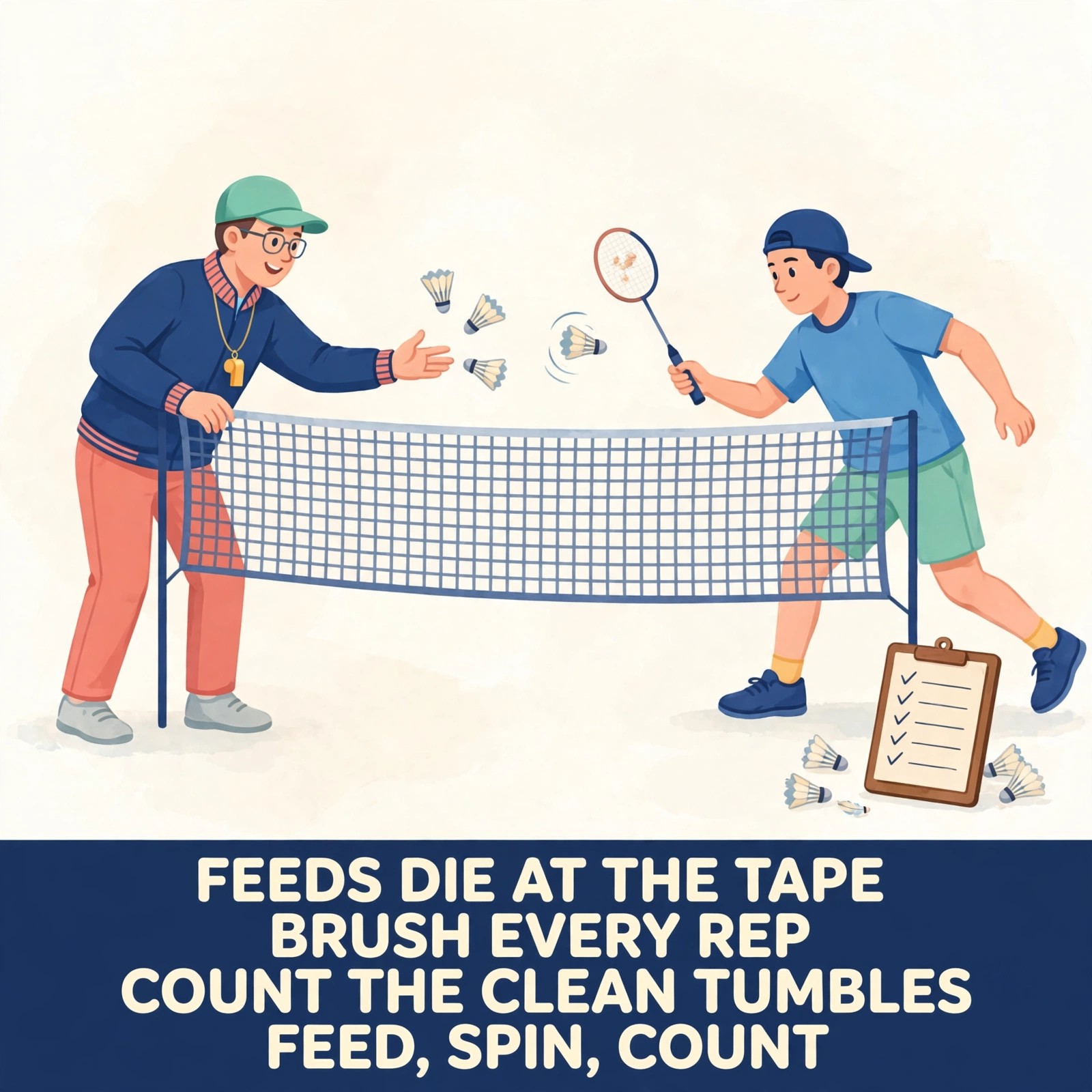
A spinning net shot is a normal net shot with one extra ingredient: the racket brushes under the cork as it makes contact. That sideways brush puts spin on the shuttle, so instead of flying straight over, it tumbles end over end, rights itself late and drops steeply on the other side. The opponent cannot lift it cleanly until it has finished tumbling, and by then their racket is too low to do much damage with the reply. That stolen moment is the whole point of the spin.
Build the spin in stages. Start with the plain tight net shot from the section before, played from a short lunge, and make ten in a row land close before you add anything. Then add a small brush, keeping the same swing and the same contact point, and watch how the shuttle behaves. If the shuttle starts flying sideways or clipping the tape, the brush has grown into a swipe. The real brush is a few centimetres of movement, done mostly with the fingers, not a swing of the arm.
Control matters more than spin for its own sake. A wild spinning shot that climbs too high hands the opponent the whole tumbling period to walk in and kill it at leisure. The useful version stays tight: it crosses low, tumbles once or twice close to the tape and drops inside the front service line on the other side. Judge every rep by where the shuttle lands and how low it crosses, never by how fancy the spin looked from your side of the net.
Net Check #3
The Net Kill: Finishing Loose Replies Cleanly
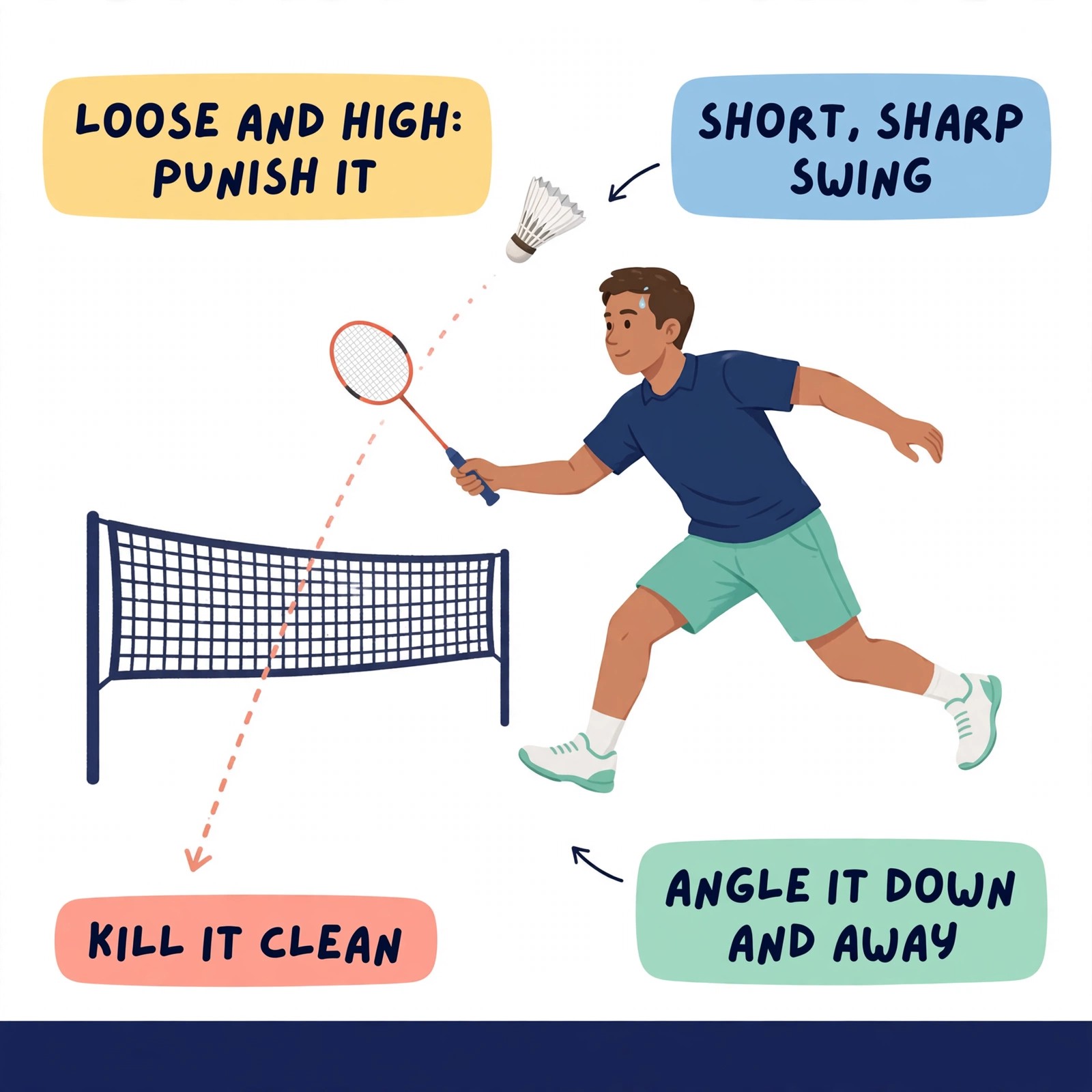
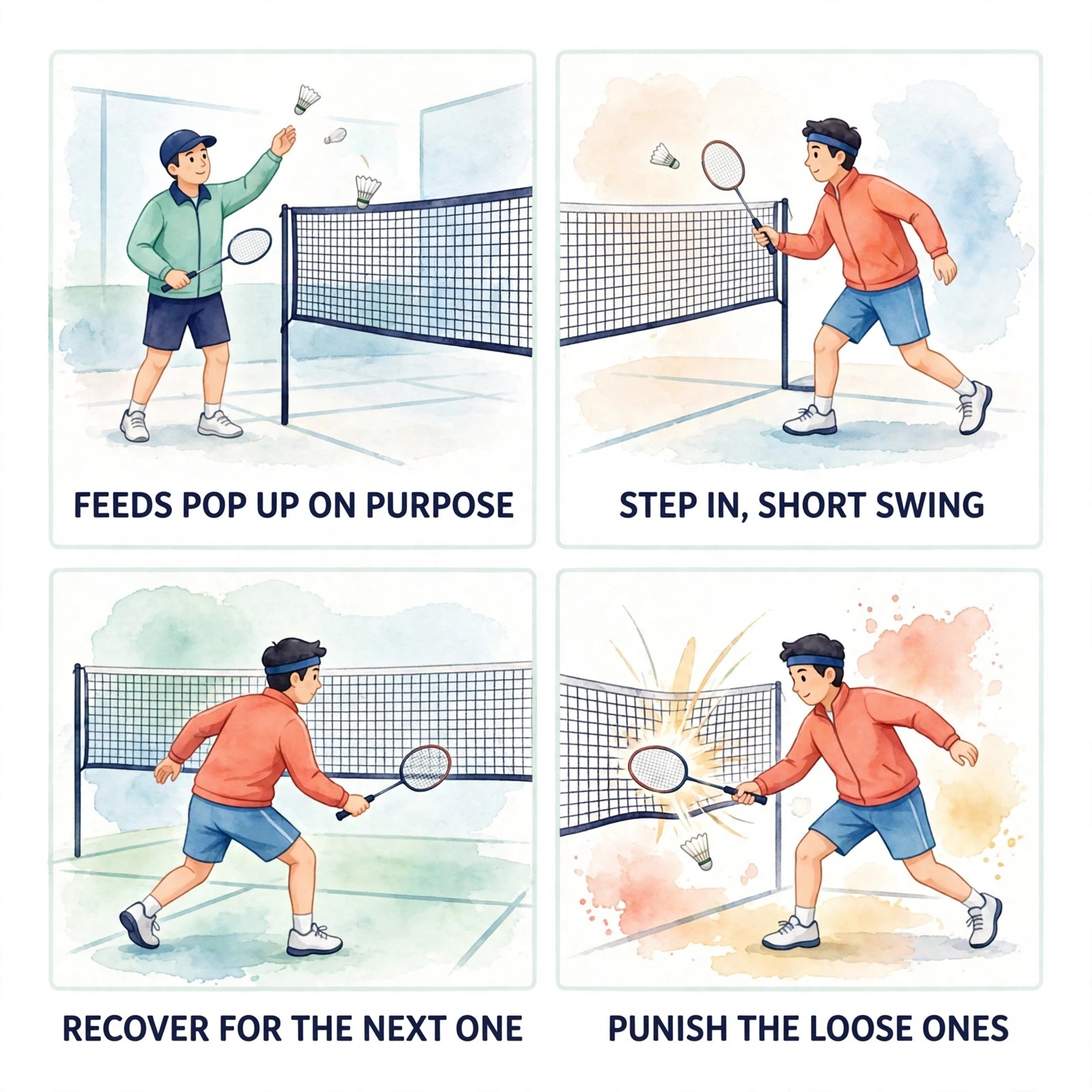
The net kill is the full stop at the end of a good net rally. When the opponent reply pops up loose and high over the tape, it should be finished, not played with. The kill is hit with a short, sharp swing, the contact taken in front of the body and the racket angled down, so the shuttle dives into the floor before anyone can react. It looks like the simplest shot in badminton. The real skill is arriving early enough, and keeping the swing compact while your heart is racing.
Most missed kills are footwork errors, not racket errors. The player waits, watches the shuttle pop up, then lunges and reaches, and by then it has dropped to tape height, where a kill becomes a gamble. The fix is to start moving on the opponent contact, step in with the racket leg and take the shuttle at its highest point. Practise with feeds that pop up on purpose, and count a rep as good only when your step started before the shuttle crossed the net toward you.
Angling matters as much as pace. A kill hit straight back at a defender whose racket is already up can be blocked by luck, while a kill angled down and away, toward the open sideline, gives the block nothing to meet. Choose the angle as you step in: the decision takes a split second and it is made with the eyes, before the swing starts. Players who decide late hit the tape or the ready racket; players who decide early finish rallies.
Net Check #4
Cross Net and Hairpin: Changing the Angle
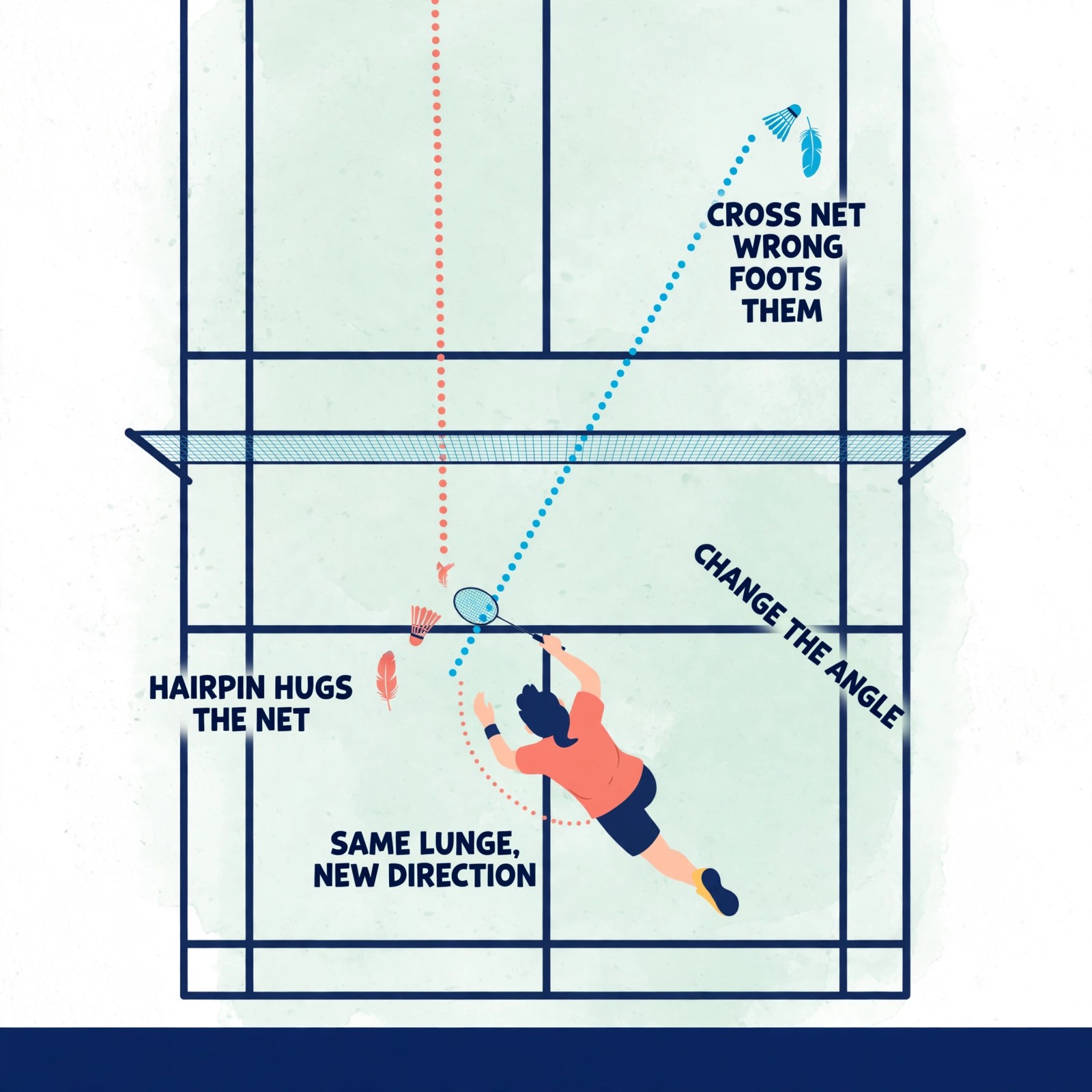
The hairpin is the straight answer at the net. Played from close in, it climbs just over the tape and drops straight down the other side, hugging the net all the way down. It is the shot that shows your touch is under control, because there is nowhere to hide a heavy contact: too firm and it floats deep, too soft and it dies in the tape. Play it with the same lunge and the same soft face as the tight net shot, and let the shuttle roll over and fall.
The cross net shot is the same lunge with a different ending. Instead of sending the shuttle straight, the racket face angles it diagonally, so it travels over the low middle part of the net and lands in the far front corner. Used at the right moment it wrong foots an opponent who has crept toward the straight reply. Used too often it gets read and cut off early, so it works best as a change, played when the opponent has clearly started leaning the other way.
Both shots share one rule: the preparation must not change. If your hairpin lunge looks one way and your cross net lunge looks another, a watching opponent reads the shot before it leaves your racket. Keep the feet, the reach and the racket carriage identical, and let only the final angle of the face decide where the shuttle goes. That sameness is what turns two decent shots into one problem the opponent has to solve at full speed, with no clue which corner to cover.
Net Check #5
Feet First: The Lunge and Racket Carriage
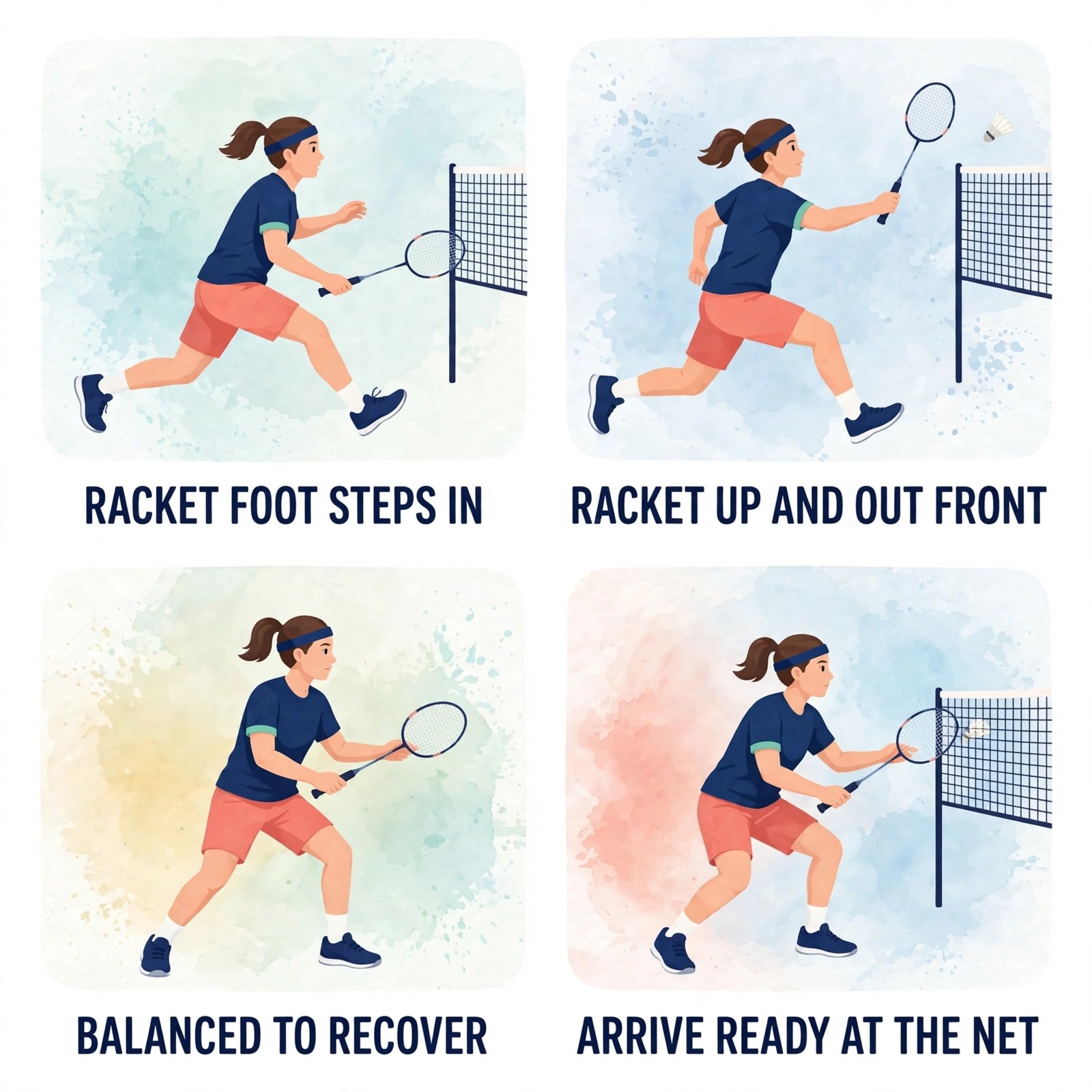
Every net technique in this guide stands on the same base: a lunge that arrives balanced. The racket leg steps in toward the shuttle, the heel lands first and rolls into the step, the knee stays over the foot and the back leg trails for balance. Land like that and you can play the shot and push back in one rhythm. Land on the wrong foot, or upright and reaching, and even a good touch turns into a scramble to get out of the way of the reply.
Racket carriage is the other half of the arrival. The racket travels up and out in front of the body as you move in, head high, so the shuttle is met early and the opponent sees a racket already waiting at the tape. A racket carried low, or dragged behind the body, arrives late to everything: late to the tight shot, late to the spin and far too late to the kill. Watch strong front court players and you will notice the racket arrives before the feet have even finished moving.
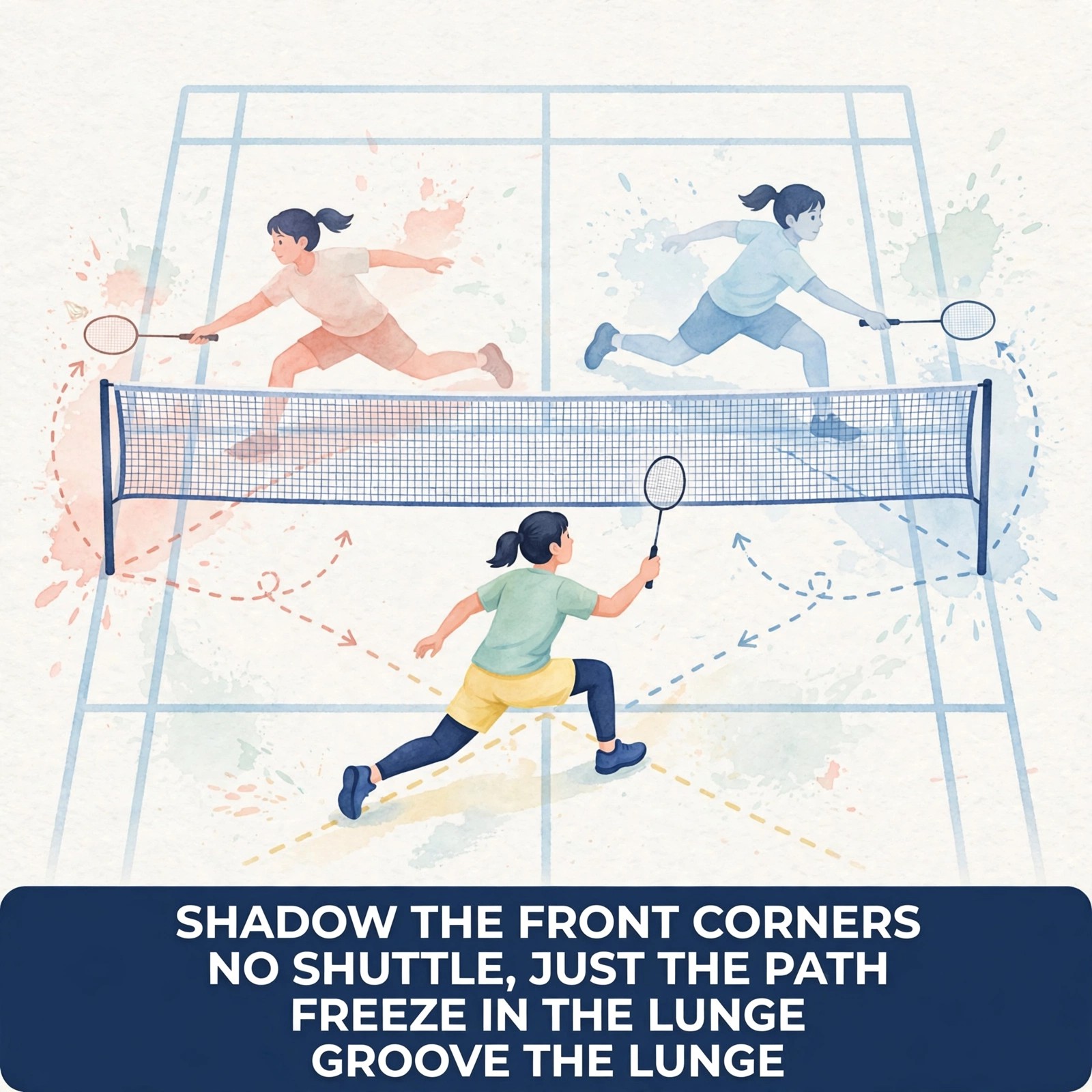
Train the two together, without a shuttle first. Shadow the lunge to both front corners with the racket up, freeze for a second in the finished shape, then recover to base and go again. When the shape holds at slow speed, add hand feeds at the net, then full rallies. Many players try to learn net touch while their feet are still arriving late, and blame their hands for the result. Fix the arrival first, and the hands usually turn out to be better than they thought.
Myth vs Reality
Net Shot Myths That Cost You Points
Three ideas hold net players back more than any technical fault. The first is that a net shot just has to get over somehow, and any contact will do. It will not: a shuttle poked over without control sits up, and a shuttle sitting up at the net is an invitation. The second is that good net play is luck, or a talent you are born with. The third, and the one that costs the most points, is that a bigger swing makes a better net kill.
Net touch is trained, like every other skill in this sport. The players with the softest hands at your club were not born with them; they have simply cushioned more shuttles, from better lunges, over more sessions. And the net kill rewards the opposite of a big swing. The short, sharp action leaves no time for the swing to wander off line, which is why the cleanest kills often look almost lazy from the side of the court, right up until the shuttle hits the floor.
The honest summary is dull and useful. Take the shuttle high, cushion it, brush it when you want it to tumble, finish the loose ones with a short swing, and arrive on the right foot with the racket up. Do those things in that order and the front court stops being a place where rallies scare you. It becomes the place where you start winning them, one quiet, tight, well touched shot at a time.

Why Choose Us
Why Players Choose ST Badminton Academy
We do not just rally at the net; we build front court players. ST Badminton Academy Malaysia is different because our head coach, Mr Eric Chuar, has over 15 years of coaching experience in Singapore and Malaysia, and he corrects technique personally in small groups. Net technique is exactly the kind of skill that needs an outside eye, because a contact taken a few centimetres too low feels exactly the same as a good one from inside your own lunge.
Our small group policy, with a maximum of 4 students, means your contact point is checked rep by rep. Players building a net game follow a clear order: the tight shot first, spin next, then the kill and the cross net, all standing on lunges that get grooved before any speed is added. The coach feeds by hand at the net, where your touch can be watched closely and corrected while it is still a habit in the making, not one set hard over years.
We focus on long term player development. A real net game changes how opponents have to play you: they stop pushing flat into the front court, they lift more often, and your whole game gets more time and more attacking chances. That is built with honest feeding, counted landings and steady correction, rather than a weekend of trick shots that look good once in a drill and vanish in the first real match.
FAQs: Badminton Net Shots, Spin and Net Kills in Malaysia (KL)
Here are answers to common questions from players in Kuala Lumpur about net shot technique, spinning net shots, net kills, and how coaching at ST Badminton Academy works.
Can a beginner build a net game from zero in Setapak or Gombak?
Yes. Beginners often learn the cleanest net habits, because the lunge and the contact point are taught together from the first week. Start with the tight net shot at slow speed, add the spin when your landings stay close to the net, and let the kill arrive once your feet are getting you there on time.
What makes a net shot so hard to attack in KL?
Two things: height and spin. A shuttle taken early, up at tape height, gives the opponent no room to attack it, and one that tumbles as it crosses cannot be hit cleanly until it settles. Combine a low crossing with a close landing and most opponents stop gambling and choose the safe lift instead.
Why do my net shots keep sitting up at club level?
Usually the contact is late, or the racket face is too open. If the shuttle has dropped below tape height before you touch it, it has to be lifted over, and a lifted net shot sits up waiting. Stabbing at it with stiff fingers makes things worse. Arrive earlier, reach up to meet it, and cushion the contact.
My net kills keep hitting the tape. What am I doing wrong?
Fix the steps first. A kill swung harder from a late, reaching lunge only hits the tape faster. When your step starts on the opponent contact and the shuttle is taken at its highest point, a short and quiet swing is more than enough. Power was never the missing part of your kill; the arrival was.
How can I practise spinning net shots on my own during training?
Shadow the lunge and the brush at home first, so the shape is grooved without a shuttle. On court, stand at the net with a basket or a tube of shuttles and feed yourself by hand over the tape, brushing each one and counting how many land inside the front service line on the other side.
Do you coach net technique near Wangsa Maju?
Yes. ST Badminton Academy is based in Setapak, a short drive from Wangsa Maju, Melati Utama and Danau Kota. Net technique is coached in small groups of no more than four students, so your lunge, your contact point and your touch are reviewed and corrected personally by the coach in every single session.
Where does ST Badminton Academy coach net technique in Malaysia?
We coach in Setapak, Kuala Lumpur, and the technique travels well: contact high, cushion soft, brush for spin, finish the loose ones. Players from Gombak, Sentul, Ampang and nearby areas train with us each week in small, focused groups where front court play is built step by step, not left to chance.
How do I book a trial session to work on my net game before training?
Message us on WhatsApp and tell us your net game is the part you want checked. We will place you in a small group session where the coach can watch your front court play, check your lunge and contact point, and show you the order we would build them in. One session is enough to leave with a plan.
What makes Mr Eric Chuar a suitable coach for net technique coaching in badminton?
Mr Eric Chuar has coached in Singapore and Malaysia for over 15 years and teaches net technique the way it holds up in matches: feet first, contact high, touch counted. Because he coaches small groups personally, your net shots are reviewed in the session itself, rep by rep, not weeks later from a video.
Badminton Net Technique Training in Action

One Standard for Every Session and Every Player
Developing a net game at ST Badminton Academy KL follows one standard: contact high, touch soft and feet first. Every front court session works at the step you are actually on, with a maximum of 4 students per group, so technique is corrected while it is being built, not after bad habits settle.
| Factor | Poking It Over | Trained Net Technique NET |
|---|---|---|
| Frequency | 1 or 2 times a week. Mostly for fun and sweat. | The contact is taken high at the tape and cushioned, so net shots cross low, land close and give the opponent nothing to attack. |
| Drills Focus | Basic static feeding. Minimal footwork pressure. | Spin is brushed on with control, the kill finishes loose replies with a short swing, and cross net and hairpin share one shape. |
| Physical Conditioning | Rarely included. Just playing games on court. | Core, agility, and speed training included in every session to prevent injury and build stamina. |
| Tactical Awareness | "Just hit it over." No real game plan. | Video analysis, point construction, and learning to read the opponent's game. |
| Coach Ratio | Large groups (8-10 kids). Coach barely watches you. | Max 4 students. Mr Eric Chuar personally corrects every stroke and movement detail. |
| Goal Setting | Fun and exercise. | Feet and racket arrive first: the lunge is balanced, the racket is up early, and the recovery is part of the same movement. |
| Long Term Result | Good recreational player. | A trained net player: quiet hands, tight shuttles and a front court the opponent stops wanting to visit. |
Badminton Net Technique Coaching in Kuala Lumpur
This guide gives you the full route: take the shuttle at tape height, cushion the tight shot, brush on the spin, finish the loose replies with a short kill, and groove the lunge underneath all of it. If your front court needs that building, ST Badminton Academy in Setapak can coach you through it in a small group. Message us to book a trial session.




