Best Badminton Coach for Kids: Match the Lesson to the Learner
Parents searching for the best badminton coach in KL or Malaysia often notice a coach’s playing background first. Relevant experience can be valuable, yet a child also needs a lesson that fits the task they can currently understand and attempt. A badminton class for kids should not become a miniature copy of an elite training session simply because the demonstration looks impressive. Suitable teaching makes the purpose clear, adjusts difficulty and gives the learner a usable next action. This guide explains practical observations for a badminton academy without inventing age limits, class availability or guaranteed results. The educational images are AI-generated illustrations, not photographs of STBA students or lessons.

Check 1 · Starting point
Observe current ability before choosing the task
Age is relevant to organising a children’s lesson, but it is not a complete description of a learner. Two children of the same age may have different badminton experience, familiarity with instructions or ability to manage the current exercise. Begin by observing what the child can explain and attempt now. A coach needs that starting point before deciding how much movement, decision-making or racket control to ask for in a task. Do not turn a birthday into an automatic skill assessment.
Ask the coach what is being observed and how the activity fits the child. The answer should describe a practical task, not just a label such as beginner or advanced. A learner may manage a stationary contact activity but still need support when a partner and movement are added. Describe those conditions accurately. The purpose is to find an understandable next challenge, rather than compare children unfairly or assume everyone who enters the same room needs identical instruction.
Check 2 · Adaptation
Adjust the exercise without losing its purpose
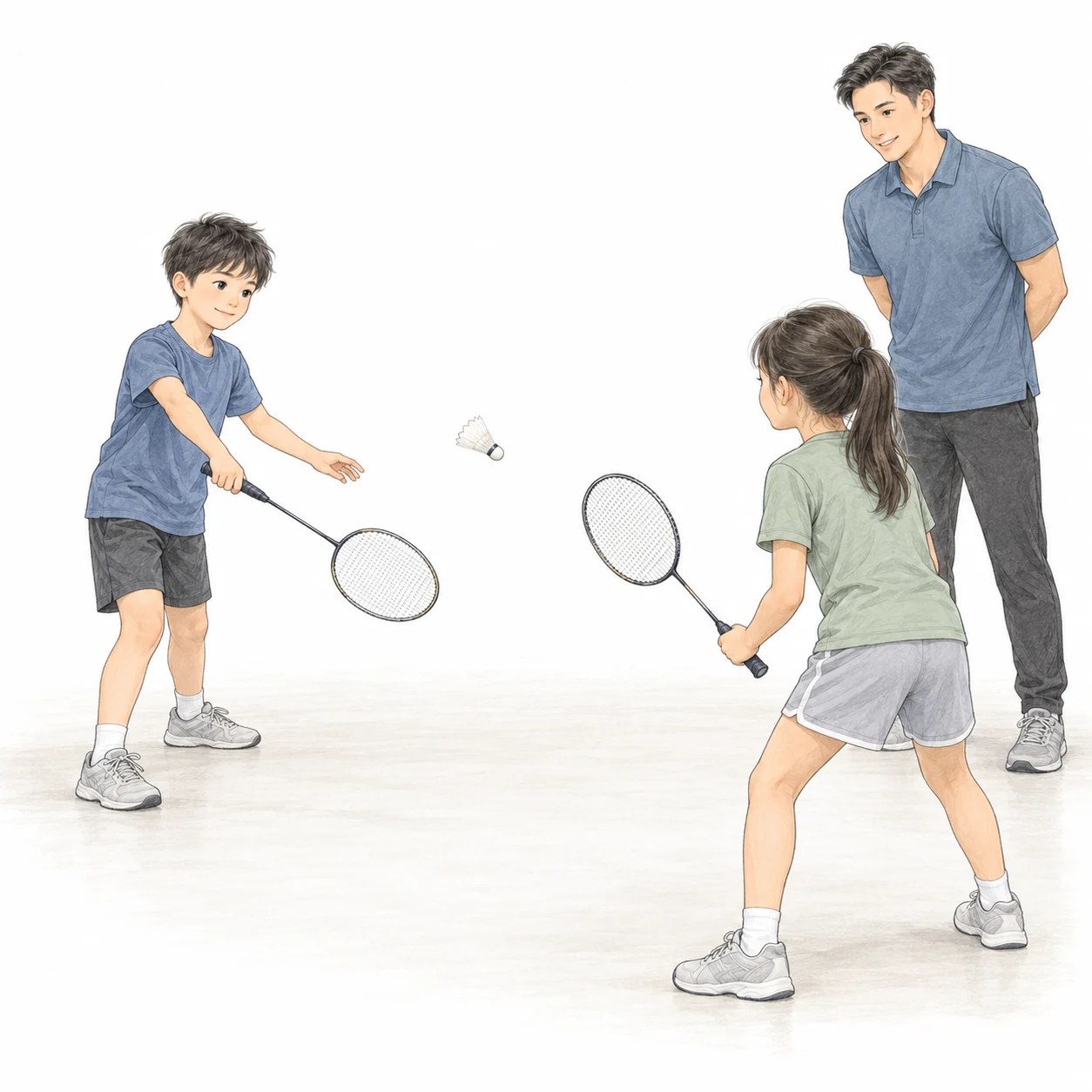
An age-appropriate task still needs a teaching goal. The coach can explain what is being learned and adjust a manageable element when the activity is too difficult or too easy. The feed, target, movement requirement or amount of assistance may change while the main purpose stays clear. A simplified task is not automatically a lower-quality lesson. It can reveal whether the learner understands an action before speed and uncertainty make the observation harder to interpret.
In a hypothetical lesson, a child might struggle to reach an unpredictable feed and organise contact together. The coach could make the feed more predictable and teach the unclear connection before combining the demands again. This is an illustration of task adjustment, not an account of a real student’s progress. Parents can ask why the change was chosen and what the next attempt should show. Avoid demanding a harder version merely because another child looks ready for it.

Check 3 · Explanation
Use language and demonstrations the child can follow
A useful explanation gives the learner an action to try. It may combine a brief demonstration, a clear target and a simple question to check understanding. Professional terminology can help when the child understands it, but a long list of terms is not evidence that teaching has succeeded. Observe whether the child can describe or show the next step. The coach should notice uncertainty rather than assume silence means comprehension or that copying once proves the purpose was understood.
Give the learner time to respond. If the answer is unclear, the coach can rephrase or demonstrate the task again without turning confusion into a personal criticism. A child may need less information at one moment and more detail when the connection becomes familiar. Parents can support consistency by using the cue agreed with the coach. Several adults shouting different instructions may make the lesson less clear, even when each adult sincerely wants the child to improve.

Check 4 · Feedback
Make correction specific and usable
Feedback should connect to the task the child is attempting. Ask what the learner can change on the next try and why that change matters. One useful cue may be more manageable than several corrections given simultaneously. This does not mean other details are unimportant; the coach chooses a priority and returns to further details when appropriate. The review should distinguish what the child completed independently from what required a prompt, a demonstration or an easier feed.
A supportive lesson can still be demanding. The coach can ask the child to try, listen and participate while making the instructions understandable. Avoid judging quality by how loudly an adult speaks or how exhausted a session looks. Observe the relationship between the explanation, the learner’s attempt and the follow-up. If a child remains confused, ask how the task will be adjusted. Productive effort is connected to a clear purpose, not simply to repeating an action without understanding.

Myth vs Reality
Experience matters, but fit still needs observation
Myth: a former national player is automatically the best badminton coach for every child. Reality: playing experience may offer useful insight, demonstrations and knowledge of the game. The learner still needs explanation, suitable task design and feedback. Evaluate these teaching actions directly. This is not a claim that national players are poor coaches, or an assertion that STBA outranks everyone. A sporting title is relevant background; it does not replace observing whether this child can follow this lesson.
Myth: all children of the same age should practise the same difficulty. Reality: age alone does not show previous learning, present understanding or the help needed for a particular task. Shared activities can include appropriate adjustments without treating learners as less important. Ask how the coach organises the exercise and recognises different starting points. Do not infer an admission age or a grouping policy from this general teaching guide; actual intake requirements must be read through the academy’s application process.
Myth: a suitable children’s class guarantees fast results. Reality: a clear lesson can identify a useful next step without promising a date for mastery, a medal or a future playing level. A hypothetical sequence shows how instruction might progress, not how every child must develop. Ask what will be observed next and what support remains necessary. Recognising a child’s effort is worthwhile, while reporting learning honestly requires evidence from the attempts rather than a confident prediction.

Check 5 · Organisation
Make group practice understandable for each learner
In a group activity, children need to know their role, where the task happens and what signals the next turn. A clear demonstration is useful only if the learners can actually attempt the task under suitable supervision. Ask how waiting, feeding and returning are organised. A child who spends an activity unsure when to begin may need a role explanation, not criticism for failing to copy the most experienced learner. The organisation should serve the teaching goal.
Keep the discussion grounded in the observed session. Do learners understand the current activity, have manageable opportunities to try and receive relevant feedback? The coach’s judgement is needed for space, task demands and the children present. Supervised spacing and clear instructions support organised practice, but they do not eliminate every risk or guarantee a health outcome. Parents should describe a concern concretely and ask how it will be addressed, rather than make assumptions from one crowded photograph or a promotional clip.

Check 6 · Parent conversation
Ask for the next learning task, not an elite imitation
After class, ask one specific question: what were you trying to do, and which cue helped you try it? Allow the child to answer in their own words. Ask the coach what will be taught next and whether any practice outside class is appropriate. Avoid requiring the child to demonstrate every skill to relatives or compare themselves with a professional video. An elite example can be interesting, but the current lesson must still make sense for the learner’s present ability.
For ST Badminton Academy in Setapak, Kuala Lumpur, begin with the online application and describe the child’s current experience and learning needs. Read the intake rules rather than assuming an age range, trial arrangement, fee or available place. Use the training contact information for questions still unresolved. The application starts the enquiry and does not guarantee a training outcome. Useful badminton training connects a suitable task, an understandable explanation and an opportunity to attempt the next action with the support the learner currently needs.
Questions about suitable badminton coaching for children
These answers discuss teaching fit. They do not establish STBA admission ages, class schedules, fees or availability.
Does a former national player always suit beginner children?
Playing experience can be valuable, but suitability also depends on the teaching delivered. Observe how the coach explains the task, adjusts difficulty and gives usable feedback. Do not assume a title guarantees fit, or that former players cannot teach. Assess the learner’s actual experience of the lesson.
Can age alone decide the correct exercise?
Age provides context, but it does not fully describe badminton experience or understanding. Ask what the learner can currently attempt and where support is needed. The coach should explain the task’s suitability. This guide does not create an admission age or replace the academy’s intake requirements.
Does simplifying an exercise mean the training is weak?
Not necessarily. A simpler feed, target or decision can help identify an unclear connection. The exercise should retain a stated learning purpose. Ask why it was simplified and what the learner should attempt next. Difficulty is useful when it serves learning, rather than merely looking impressive.
How can I tell whether the explanation was understood?
Ask the child to describe the target or show the next action in a suitable activity. The answer need not use professional vocabulary. Observe the attempt and the support required as well. Repeating a phrase or copying once is limited evidence, so the coach should continue checking through appropriate practice.
Should the coach correct every detail immediately?
The coach can choose a manageable priority for the next attempt and return to other details when appropriate. Ask which cue the learner should use. Many simultaneous corrections can make the task unclear. Parents should avoid adding conflicting instructions without discussing the current teaching focus.
Can a supportive class still ask for effort?
Yes. Clear instructions and appropriate tasks can coexist with expectations to listen, try and participate. Evaluate whether the effort has an understandable purpose and whether feedback helps the next attempt. Loud correction or visible exhaustion alone does not demonstrate that the child learned the intended task.
What should I observe in a group lesson?
Look at role clarity, task organisation, suitable opportunities to attempt the exercise and relevant feedback. Ask how the coach responds when a learner remains unsure. Avoid making a complete judgement from one image or promotional clip; the observed activity and its teaching purpose need context.
Should my child copy a national player’s entire routine?
An elite example may be interesting and informative, but a child’s current task should fit present ability and understanding. Do not copy the whole routine without appropriate coaching. Ask which part is relevant, how it will be adapted and what the learner should try now.
What should we do before asking for a class place?
Start with the online application and read the intake rules. Describe the child’s experience and specific learning needs. Use the training contact information for unresolved questions about the process. Do not assume a trial, fee, age policy or available place from this educational guide.
Teaching scenes: an appropriate task for the learner
Four steps for appropriate children’s instruction
The numbers identify teaching steps, not growth statistics. Repeat or adapt a step when the learner needs further support.
| Teaching question | Less helpful approach | Useful teaching approach Learner-focused practice |
|---|---|---|
| Starting point | Use age as the whole skill assessment | Observe the current task and support needed |
| Exercise choice | Copy an elite routine without adaptation | Choose a task with a clear suitable purpose |
| Explanation | Assume terminology proves understanding | Check an action the child can explain or show |
| Feedback | Give several competing cues together | Choose one usable priority for the next attempt |
| Group practice | Assume every learner understands their turn | Explain roles and organise suitable attempts |
| Progress expectation | Promise the same deadline for every child | Review the response and choose the next task |
Describe the lesson your child currently needs
Begin with the online application and explain the child’s experience, understanding and the task that needs support. Read the intake rules and use the training contact information for unresolved questions. Do not assume admission policies or available places; an application starts the enquiry rather than guaranteeing an outcome.