
 All languages
 Chinese (Simplified)
 Chinese (Traditional)
 English
 Indonesian
 Japanese
 Korean
 Malay
 Thai
 Vietnamese


What Are The Best Drills For Improving Your Badminton Clear Shot Technique (Clear Shot Guide)
The clear is the shot that holds the whole singles game together. A good clear leaves the rear court with height and pace, travels the full length of the court, and lands close to the back tramlines while the hitter recovers to base facing the next shot. A weak clear lands mid court, hands the opponent an easy smash, and turns every rally into survival. This page works through the drills that build a clear properly: feeding work for the hitting shape, movement work for the run out and back, multi shuttle sets, pressure games, and a simple log that shows whether your length is improving week by week. Nothing on this page needs special talent or a bigger swing. It needs the right order of work, honest counting, and enough weeks of the same drills for the shot to settle into your game.

Clear Check #1
Why The Clear Comes First: Depth, Time And Control
Before the drills, it helps to know why the shot comes first in training. The clear is the reset tool of singles badminton. When you are stretched, tired or out of position, one deep clear buys the seconds you need to walk back to base and breathe. When you are on top of a rally, the same shot pins your opponent to the rear court and opens the front for the drop. Every other shot in your game either defends the clear or feeds off it. Training it early means the rest of your singles game has a foundation to stand on from the first session. Coaches who skip it usually spend later months wondering why a player’s whole game collapses the moment a rally stretches past ten shots.
Coaches can also judge a player’s whole game from this one shot. The clear shows your overhead preparation, your grip change, your rotation and your recovery in a single movement. If any link is weak, the shuttle lands short and tells the truth immediately. That honesty is why the clear sits at the top of the training order here. Fix the clear and the drop shot, the smash and the cross court game all get easier, because they share the same preparation. Leave it weak and every drill you add later is built on sand. The shot also travels well across formats: the same deep clear that anchors singles buys time in doubles when you are pinned at the back.
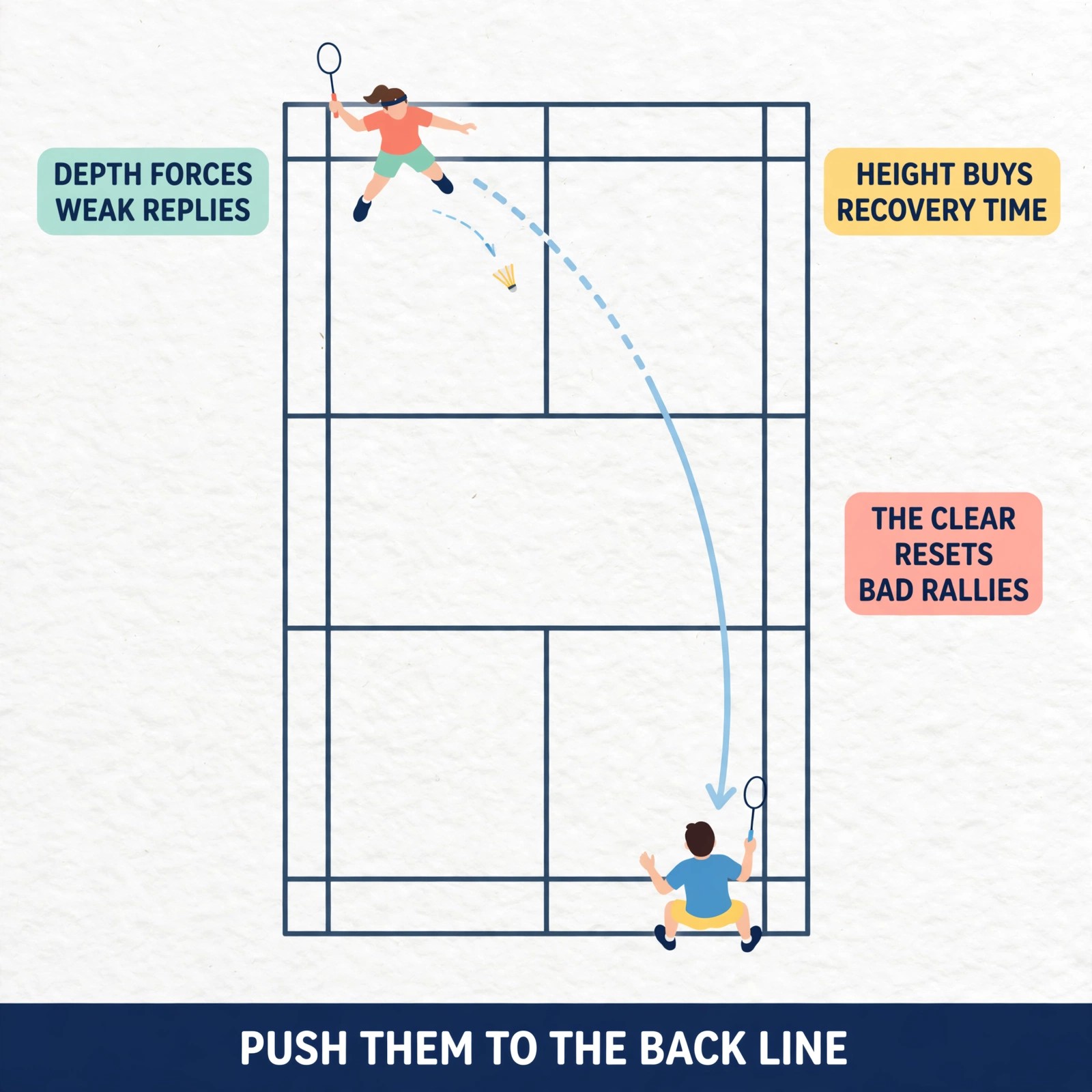
Clear Check #2
The Clear Shape: Grip, Contact And Rotation
The clear itself is a small chain of actions. Start side on behind the shuttle with your non racket shoulder pointing at the net. The forearm stays relaxed through the backswing, then pronates sharply at contact so the racket face squares up a moment before impact. Contact happens high, slightly in front of the body, never behind the head. The shoulder and trunk rotate through the shot, the racket arm follows across the body, and the back foot scissors through so you land already facing the net. Drill the chain slowly first; the power comes from the order of the actions, not from effort. A useful picture is a throw: nobody throws a stone by pushing it, and nobody clears well by pushing the shuttle either.
Grip and contact point decide most clears before the swing even starts. Hold the racket with a relaxed forehand grip, fingers soft, so the forearm can turn without fighting the handle. Players who squeeze the grip early lock the wrist and push the shuttle flat. Contact should feel like a throw: the shuttle meets the strings at the highest comfortable point, with the arm long but not stiff. If your clears land short, check the contact point before you blame your strength. A shuttle taken late, beside the ear instead of in front of it, loses metres of length no matter how hard you swing. Film two clears a week from the side if you can; the contact point shows up clearly even on a phone camera.
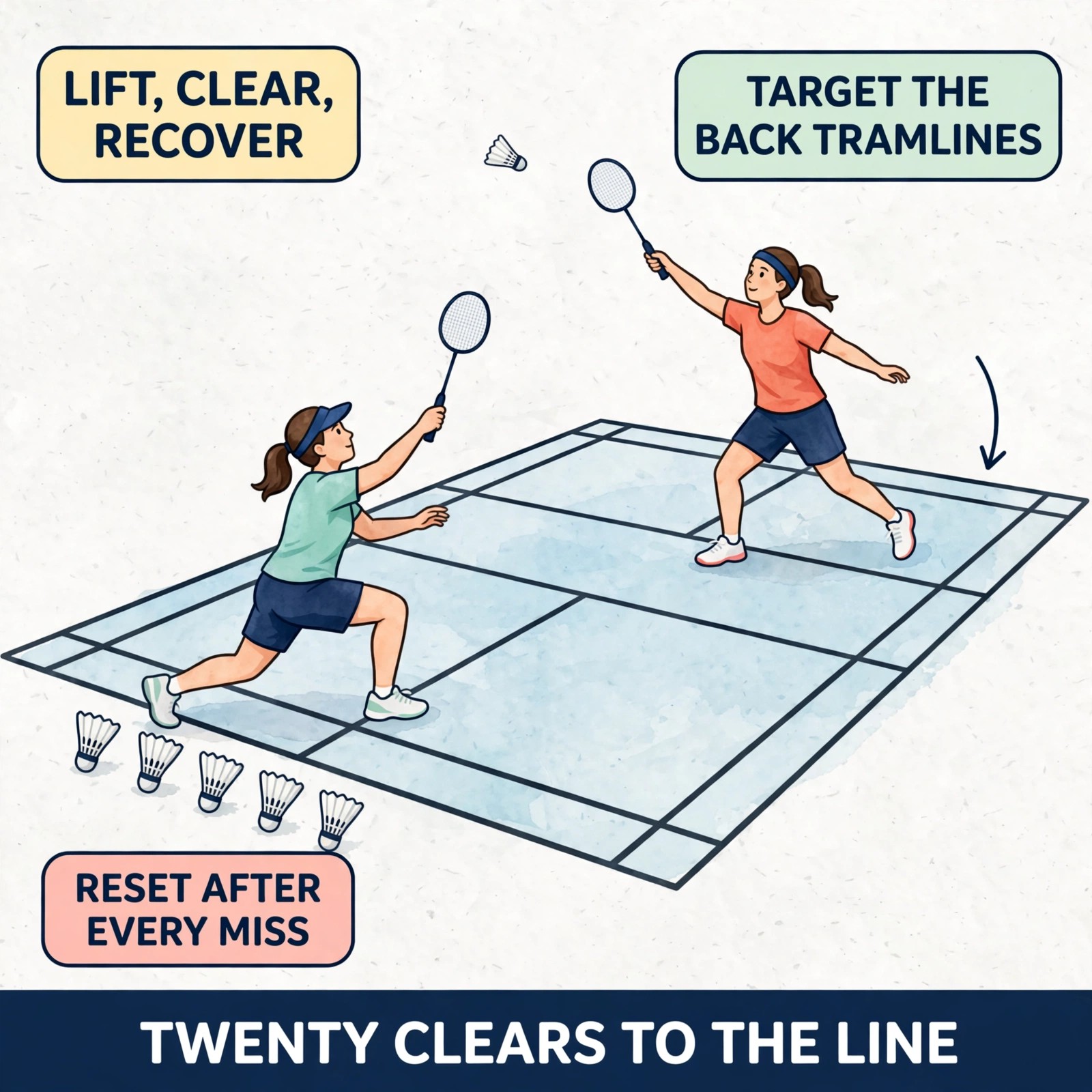
Depth is judged at the other end of the court, so train your eyes there. A training clear should land inside the doubles back service line area, close to the rear tramlines, and force the receiver to hit from behind the body. Clears that land around the mid court line are gifts. When you practise, name the landing zone before you hit: back tramline, deep middle, or cross court corner. Naming the target turns a vague push into a measured shot, and it gives your feeder something honest to count. Depth first, then disguise; a pretty action that lands short loses rallies. When the landing is deep, even a plain clear forces full length movement out of the opponent on every single exchange.

Clear Check #3
Feeding Drills: Build The Clear With Counted Sets
Feeding drills give the clear its shape because the feeder controls the height and pace of every incoming shuttle. Start with coach fed lifts to the rear court, hit clears back deep, and count only the ones that land in the back zone. Twenty feeds, full recovery between shots, quality over speed. When the count holds, the feeder varies the feed: some flatter, some to the round the head side, some after a drop at the net. The hitter learns that the clear is not one swing but a family of swings that all end in the same deep corner. Keep a cone or a towel in the target zone at first; a visible target sharpens counting and removes arguments about whether a clear was deep enough.
Multi shuttle feeding is where the shape gets tested. The feeder sends shuttles in quick sets, mixing lifts and drives, and the hitter must clear from wherever the rally finds them: deep corner, mid court, even off balance. The rule stays simple. If you are behind the shuttle, clear it. If you are early and balanced, you may choose. Sets of eight to twelve shuttles with a short rest between sets keep the quality honest. Count how many shuttles reach the back zone across the whole set, not just the first two while you are fresh. The drop off between the first shuttles and the last ones is the number that tells you how match ready the shot really is.
Feeding works best when the feeder has a plan too. A good feeder watches the hitter’s feet, not the shuttle. If the hitter stops recovering to base, the next feed goes to the opposite corner. If the swing gets lazy and pushes, the feed comes flatter to punish the push early. This two way reading is what separates drilling from hitting. Both players are training: one builds the shot, the other builds the eye that will later read opponents. Swap roles every set so both sides of the lesson land, and keep the counts written down rather than remembered. A notebook on the bench sounds old fashioned; it is also the reason some players improve twice as fast on the same court time.

Clear Check #4
Movement Drills: Corners, Scissor And Recovery
The clear is only half a shot if the feet do not travel. Movement drills link the rear court corners to base: scissor kick back from the forehand corner, chassé and lunge from the round the head side, then a full recovery facing the net. Shadow the pattern first without a shuttle, slow enough that every landing is balanced. Then add feeds, one corner at a time, and only later random corners. The test is the recovery, not the hit. If you land facing sideways or stumble back to base, the next shot in a real rally is already lost. Coaches score the recovery out of ten in these drills, and the score usually predicts match results better than the quality of the hit itself.
Footwork for the clear follows a simple promise: arrive early, leave balanced. Arriving early means the last step is a lunge or a jump that puts your body behind the shuttle with time to spare. Leaving balanced means the scissor action turns your hips back toward the net as you land, so the first recovery step is small and quick. Players who admire their clear while drifting backwards give away the front court. Build the habit in shadow work: hit position, land, two small steps, base. Repeat until the recovery starts before the shuttle lands. Ten quiet shadow rounds a session cost almost no energy and pay for themselves the first time a rally reaches fifteen shots.
Random corner drills finish the movement picture. The feeder points or calls a corner as the shuttle leaves the racket, and the hitter moves, clears, and recovers under mild time pressure. Keep the speed honest: a drill you survive by guessing teaches guessing. If the calls come too fast to move properly, slow the feed rather than shortening the steps. Over weeks the same drill gets faster because the movement gets better, not because corners get cut. That difference is the whole point of drilling movement instead of merely running around a court. Finish each movement set with two rallies of free play so the pattern has to survive contact with a real, unscripted shuttle.

Clear Check #5
Clear Under Pressure: Length When Legs Are Heavy
Pressure drills teach the clear to survive tired legs. Play conditioned games where every third shot must be a clear, or where a rally only scores if it includes a clear that lands in the back zone. Fatigue does something specific to this shot: the swing shortens, contact drops, and length quietly disappears. Training under that fatigue, in short controlled sets, teaches the body to keep the chain long when it wants to snatch. Pre decide your safe pattern before the rally starts: when stretched on the forehand side, clear straight; when pushed wide on the backhand side, clear cross court. Deciding early removes the mid rally debate that shortens swings and produces the mid court gifts attackers dream about.
Score pressure works the same way. Start games at 18 all, play to two clear points, and watch what happens to length when the score gets tight. Most players discover their clear is five percent shorter when it matters, which is exactly the margin that loses matches. The fix is not courage; it is rehearsal. The more often the clear is practised at the end of hard sets and at tight scores, the less special those moments feel. Calm is mostly familiarity wearing a match shirt. Keep a note of the score at which your length first dips; that score is your personal training target for the next month.
Keep pressure drills short and honest. Three hard rallies, a pause, a note in the log, then again. If the quality collapses completely, the set was too long or the feed too hard, and the lesson turns into survival habits you do not want. The goal is a clear that looks the same in the last rally as the first: same preparation, same contact, same depth. Film one set a month if you can. Your memory of your own technique under pressure is kind; the camera is not, and the camera is the one telling the truth. Even without a camera, a partner counting landings aloud gives the set an honesty that feel alone never provides.

Myth vs Reality
Myths About Clear Drills
The first myth says clears are beginner shots that strong players outgrow. Watch any high level singles match and count the clears in the first rally: the shot sets the depth of the whole exchange, and the player who cannot clear full length defends the whole match from mid court. Strong players clear more than beginners, not less. They just clear with disguise, so the same preparation also produces the drop and the smash. The clear is not the shot you leave behind as you improve. It is the shot your improvement is measured by. Ask any senior player what they warm up first on a new court in a new hall: the clear, every time, because the hall’s length and drift are read through it.
The second myth says length comes from arm strength, so the answer is to swing harder. Most short clears are timing problems wearing a strength costume. Contact behind the head, a locked grip, a swing that starts before the feet settle: each one steals metres that no amount of effort buys back. Players who relax the grip, take the shuttle in front, and let the forearm rotate often gain a full zone of depth in one session without getting any stronger. Strength matters over a long match, but it is the last ingredient, not the first. The players who gain length fastest are usually the ones who stopped muscling the shot, not the ones who found a bigger muscle.
The third myth says you should always clear to the backhand corner because everyone is weak there. Good opponents know this too, and they wait for it: the cross court clear to a ready backhand side is the easiest smash invitation in the game. Clear selection follows the rally, not a slogan. Clear away from balance, clear behind a player who has rushed forward, clear straight when they have drifted wide. The back tramline is a big target with two corners and a middle. Use all of it, and the corners start working again. Variety also protects your shoulder: a game built on one repeated cross court clear loads the same pattern hundreds of times a week.

Why Choose Us
Why Players Choose ST Badminton Academy
At ST Badminton Academy, clear work sits inside the overhead programme exactly as this page describes: one preparation for clear, drop and smash, feeding sets counted by landing zone, movement patterns drilled before random corners, and pressure games once the shape holds. Groups are capped at four students, so the coach sees the contact point and the recovery of nearly every clear in the set, and corrections land while the set is still running. Students log their deep landing counts each week, which keeps progress honest and gives the next session a clear starting point. Trial students feel the method in one set: feed, count, adjust one thing, count again, and watch the number move before the session ends.
Sessions run at our Kuala Lumpur halls and follow the same order used here: shape first, movement second, pressure last. A new student starts with fed lifts and a landing count, learns the scissor recovery in shadow work, and only meets random corner feeds when the base pattern is steady. Nobody is thrown into conditioned games to sink or swim. The drills scale by changing the feed, the target zone and the rest between sets, never by skipping the foundations. That is how a junior, an adult returner and a school player can share a court and all improve. The structure also makes home practice possible: shadow the recovery, then count ten clears against any willing feeder at the local hall.
Parents and adult players often ask how progress is judged. For the clear, the measure is plain: out of twenty fed lifts, how many clears land in the back zone, and does the count survive at the end of a hard set. We write it down. When the number stalls, the log usually shows why: contact point drifting back, recovery steps shrinking, or sets creeping too long. Fixing the clear rarely needs a new drill. It needs the same drills, done at the right size, with the count kept honestly week after week. When the count climbs two zones in a month, students see it in the log before they feel it in matches, which keeps motivation steady.
FAQs: Badminton Clear Shot Drills And Technique in Malaysia (KL)
Clear questions usually start with a shuttle landing mid court. Here are the answers we give on the bench.
Can a beginner learn clear shot drills in training in Setapak or Gombak?
Yes, and the clear is where we usually start. In our Setapak groups of no more than four, beginners take fed lifts, hit for the back zone, and count deep landings from the first weeks, so length grows on a base of one overhead preparation shared with the drop and the smash.
What is the first clear habit a new player should build in KL?
Count the landing, out loud, on every clear. Call it deep, mid or net before the next shuttle is fed. That one habit turns casual hitting into depth training, and KL players who build it early improve their drop and smash too, because all three are judged by the same honest landing.
Why do my clears keep landing mid court at club level?
Almost always contact or timing, not strength. A clear taken late or beside the ear loses metres before the swing starts, and a locked grip pushes the shuttle flat. Arrive earlier, keep the grip soft, meet the shuttle high and in front. Your feeder can call your contact point during sets.
My clears have no power even when I swing hard. Should I swing harder or fix my contact point?
Fix the contact point first. Power in the clear comes from forearm rotation at a high, early contact, not from a bigger swing. Swinging harder with late contact just tires the shoulder and shortens the shot further. Bring it to a session and we will check the chain in order: feet, grip, contact, rotation.
How can I practise clear drills with a partner in training?
One feeds lifts to the back line, the other clears and counts deep landings out loud. Start with twenty straight clears, swap roles, then add cross court and a landing target. In training with us partners feed to a named standard, because a wandering feed teaches the hitter nothing at all.
Do you coach clear shot drills near Wangsa Maju?
Yes. Our academy is based in Setapak, a short drive from Wangsa Maju, and clear work is coached inside normal sessions there: feeding sets counted by landing zone, scissor recovery drilled, pressure games once the shape holds. Groups stay at no more than four students, so the coach sees nearly every contact.
Where does ST Badminton Academy teach clear shot drills in Malaysia?
We teach in Setapak, Kuala Lumpur, and the clear is coached as the base of the overhead family rather than a warm up shot: shape, movement, pressure, in that order. Students join us from across the Klang Valley, and each player’s depth is tracked with a landing count reviewed every week.
How do I book a trial session to check my clear?
Book a trial session with us in Setapak and bring your playing racket. Train in a group of no more than four, and the coach will check your contact point, count your first feeding set honestly, and set the landing target your clear should be reaching this month. You will leave knowing your real starting number.
What makes Mr Eric Chuar a suitable coach for clear shot drills and badminton?
Mr Eric Chuar coaches the academy sessions himself, with more than 15 years of coaching in Malaysia and Singapore. He teaches one overhead preparation for clear, drop and smash, counts landings instead of praising effort, and fixes the chain in order, so students know exactly which link their next drill is repairing.
Badminton Clear Shot Training in Action

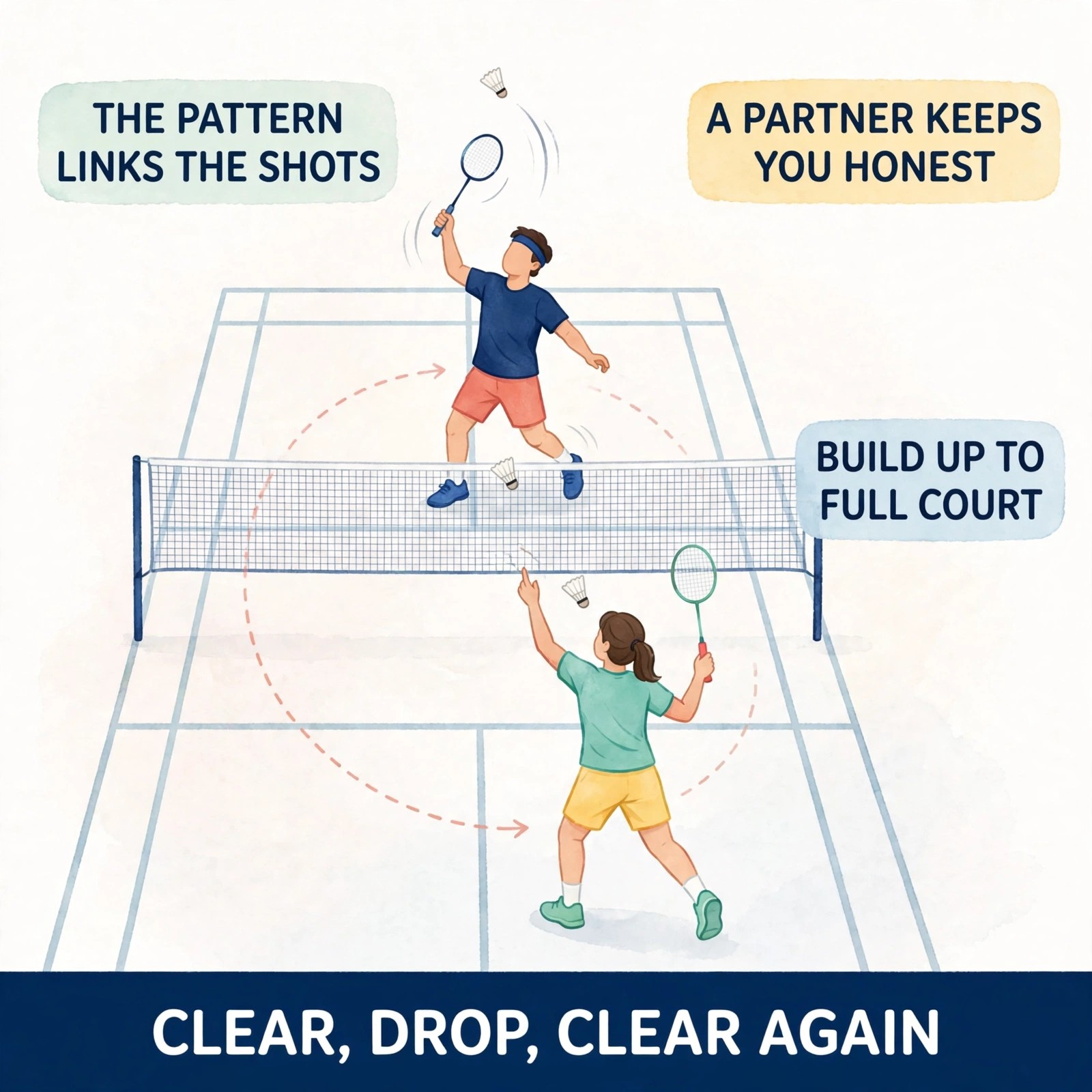

We benchmark our clear coaching against World Badminton (BWF) coaching standards and our own academy values: before any player trusts a training plan, they deserve honest checks. You can verify our coaches' credentials through the Badminton Association of Malaysia (BAM) coach education pathway.
Our standards for clear coaching are plain. We teach one overhead preparation so the clear, drop and smash grow together. Feeding sets are counted by landing zone, never by effort. Movement patterns are drilled before random feeds, and pressure games arrive only after the shape holds under normal feeds. We promise no instant length, because there is none; depth comes from contact point, rotation and recovery, repeated in the right order. When a clear improves here, the student can point to the count that proves it. That evidence matters on the flat weeks, when effort is real but results feel slow; the log shows the shot is still moving.
| Factor | Hope And Hit | Measured Depth CLEAR |
|---|---|---|
| Frequency | 1 or 2 times a week. Mostly for fun and sweat. | Depth is counted by landing zone, so progress is a number, not a feeling. |
| Drills Focus | Basic static feeding. Minimal footwork pressure. | Feeding, movement and pressure work arrive in order, each stage earning the next. |
| Physical Conditioning | Rarely included. Just playing games on court. | Core, agility, and speed training included in every session to prevent injury and build stamina. |
| Tactical Awareness | "Just hit it over." No real game plan. | Video analysis, point construction, and learning to read the opponent's game. |
| Coach Ratio | Large groups (8-10 kids). Coach barely watches you. | Max 4 students. Mr Eric Chuar personally corrects every stroke and movement detail. |
| Goal Setting | Fun and exercise. | One overhead preparation serves clear, drop and smash, so nothing has to be relearned. |
| Long Term Result | Good recreational player. | A clear player: pins opponents deep, recovers early, and chooses the front court on her own terms. |
Badminton Training With Clear Coaching in Kuala Lumpur
Come and give your clear a structure. Book a trial session in Kuala Lumpur, train in a group of no more than four, and leave with your contact point checked, a feeding set counted honestly, and a landing target chosen for your current level. Bring your playing racket and the shots you already own. We will count your first set of clears together, show you where the length is leaking, and set the drill order for your next month of practice.


