What Are The Best Drills For Improving Shot Selection In Badminton Training (Shot Selection Guide)
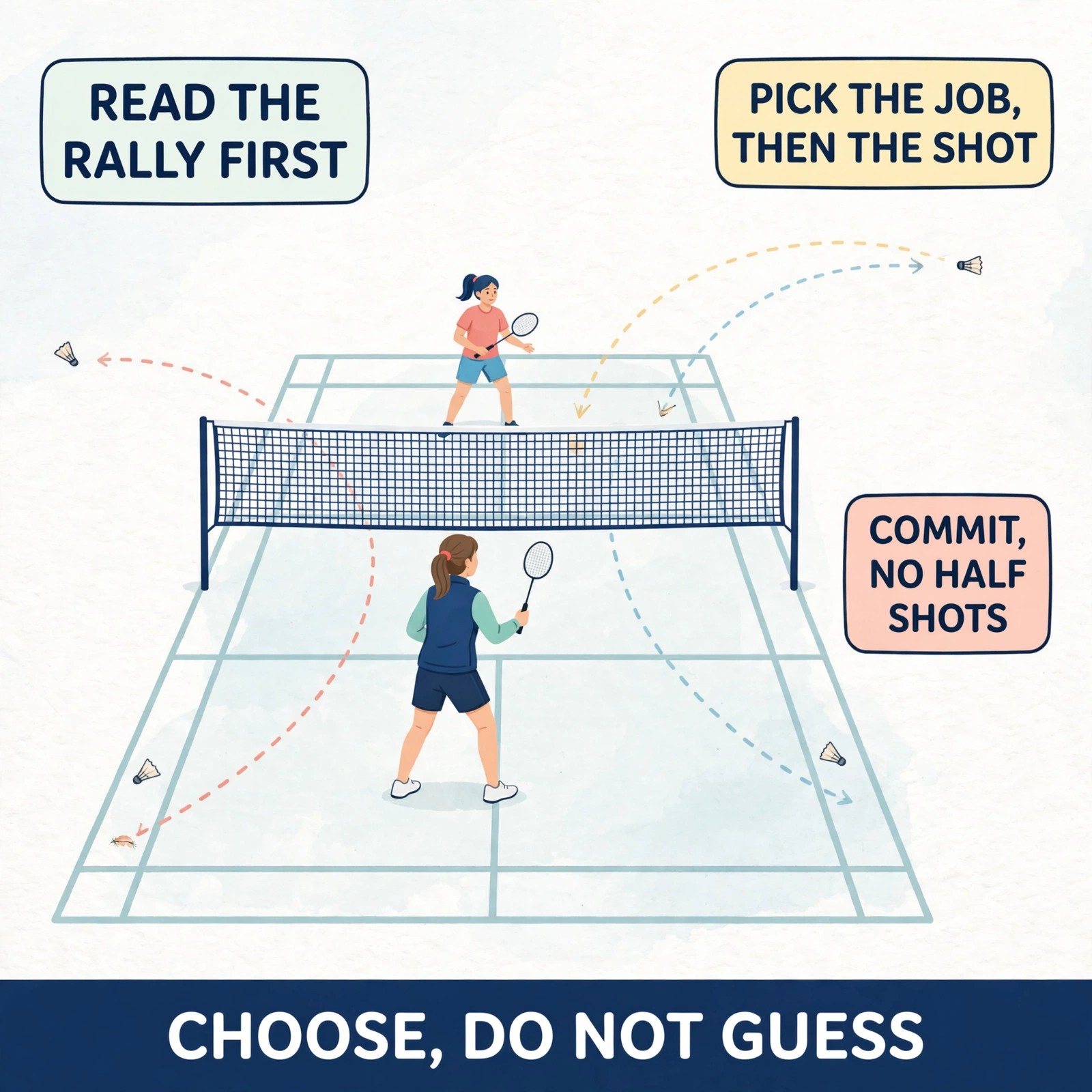
Most rallies are lost before the shuttle is hit. A player reaches the shuttle in good time, racket up, feet set, and then plays the one shot the opponent was waiting for. Shot selection is the skill of choosing well in that half second: reading the rally, knowing your options, and picking the shot that fits your position and your opponent’s. This page works through the drills that build that choosing: reading work, a simple decision ladder, two choice feeds, conditioned games that pay for good choices, and a log that turns match mistakes into next week’s practice. None of this asks for faster hands. It asks for earlier eyes, a shorter list of options, and the patience to let the rally come to the shot you actually planned.
Selection Check #1
Shot Selection: The Skill That Turns Shots Into Wins
Shot selection matters because technique alone does not win rallies. Two players can own the same clear, drop and drive, yet one wins because her shots arrive in an order the opponent cannot settle against. Selection is what turns a toolbox into a game. It decides when to attack, when to reset, when to move the opponent and when to simply stay in the rally. Coaches call it game sense, but it is not a gift some players are born with. It is a trained habit of reading cues early and choosing from a short, well rehearsed list. Players who feel they lack game sense usually just lack reps at deciding; their technique sessions never once asked them to choose.
There is a second reason to train it early. Every technical drill you run feeds this skill, because a shot you can play under pressure becomes an option, and a shot you cannot trust stays invisible in matches. Players rarely choose shots they do not believe in. So selection training grows on both sides at once: your reading gets sharper, and your menu of trusted shots gets longer. This page keeps the two together, pairing each reading idea with the drill that makes it real, so choosing well becomes something you practise, not something you hope for on match day. A useful test: if your last ten training sessions contained no decision at all, your selection has had no training, whatever your strokes have had.
Selection Check #2
Reading The Rally: Racket, Hips And Position
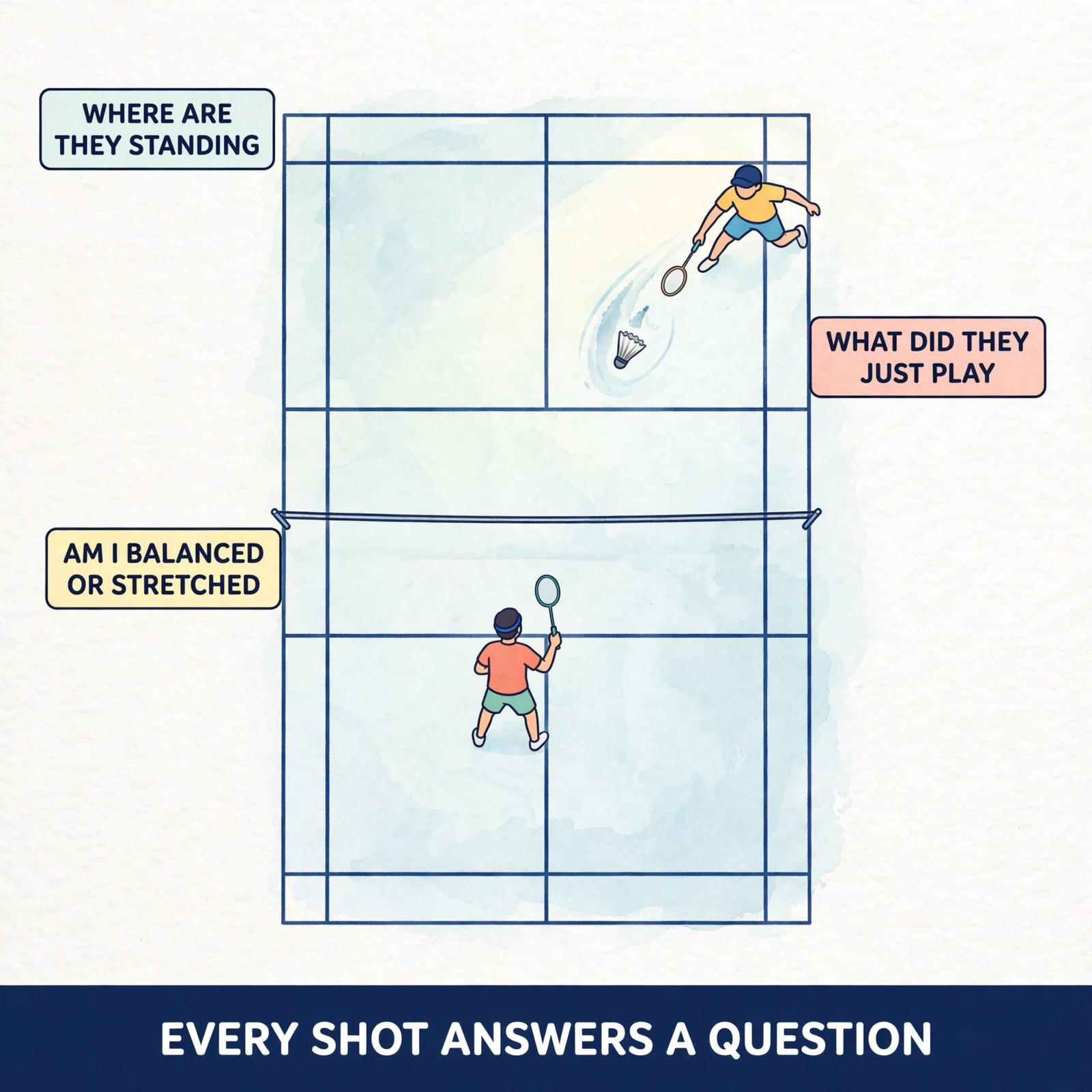
Reading a rally starts before the shuttle reaches you. Watch the opponent’s racket face in the last moment before contact: an open face and a low take usually mean a lift or a clear, a closed face close to the tape means a net shot, a big backswing with the body turned often means a smash or a fast drop. Watch their hips too. A player whose hips have committed to one side cannot change direction quickly. These cues buy you the extra fraction of a second that good selection runs on. Drill them by calling the shot aloud as your partner hits during slow feeds. Start with only two calls, lift or net, and add the smash call once the first two arrive before contact rather than after it.
Position tells the second half of the story. Note where the opponent stands after their shot: pulled to the front corner, stuck deep on one side, or balanced at base. A player recovering from the front corner has left the rear court open. A player camped deep is waiting for your lift, not your net shot. Your choice should aim at the space their position has given up, or at the movement they least want to make. This is not guesswork. It is arithmetic with feet: their court has six corners, and their last shot always leaves one of them slower to reach. In practice the read takes one glance: play your last shot, then look at their feet before you look at the shuttle.
The last reading skill is reading yourself. Your balance, your grip and your distance from the shuttle limit your menu more than the opponent does. Stretched wide with the racket low, your honest options are a lift or a block; the cross court winner is not on the table no matter how open the corner looks. Calm selection means knowing which shots your position allows and taking the best of those, every time. Players who accept that limit stop donating points. Their rallies get longer, their opponents work harder, and the attacking chances arrive on their own. Coaches call this playing the percentages; players just notice they have stopped losing points they reached in plenty of time.

Selection Check #3
The Decision Ladder: Safe, Move Or Attack
Good choosing runs on a ladder, not on inspiration. Start at the bottom rung: if you are stretched and late, play the safe shot that resets the rally, usually a high lift to the back tramline. Middle rung: if you are on time and balanced, move the opponent with a shot to the corner farthest from where they stand. Top rung: if you are early, in front of the shuttle and the opponent is out of position, take the attacking shot. Three rungs, decided by your balance first and the score second. Run the ladder until it is boring; boring ladders win matches. Write the ladder on the first page of your training log so every review starts from the same three questions.
The ladder works because it removes the hardest part of choosing: inventing a shot under time pressure. In a fast rally there is no time to design anything, only time to recognise which rung you are standing on. Recognition is trainable. Feeding drills where you call the rung aloud before you hit, out of one, two or three, build the call into the movement. At first the calls come late and the feet stall. Within a few sessions the call and the first step arrive together, and your shot choice starts looking calm from the outside. Keep the calls honest in games too for one set a week; quiet cheating in practice becomes loud confusion in matches.
Keep the ladder honest about the score as well. At 19 all, the top rung needs a bigger invitation than at 10 to 4: the same attacking shot that is brave early in the game is a donation at the end of it. Teach the ladder with a score attached. Feed sets where the hitter starts each rally at a called score, and the choice is judged against both the position and the points. Selection is never only about geometry. It is geometry plus nerve, and nerve is just the ladder practised under enough small pressures that a real one feels familiar. Most players find their ladder holds at 10 to 4 weeks before it holds at 19 all, which is normal and trainable.

Selection Check #4
Choice Drills: Two Options, Called Early
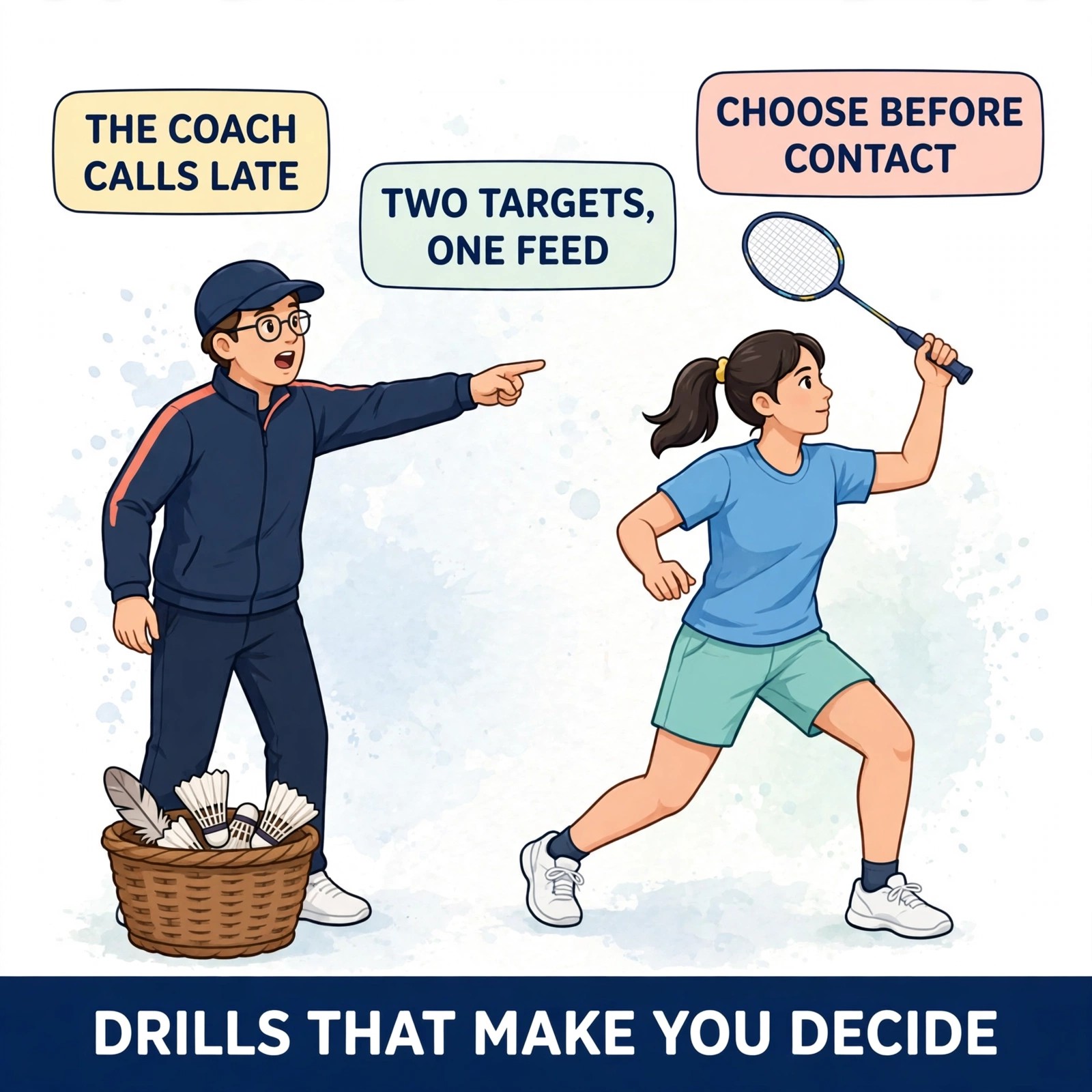
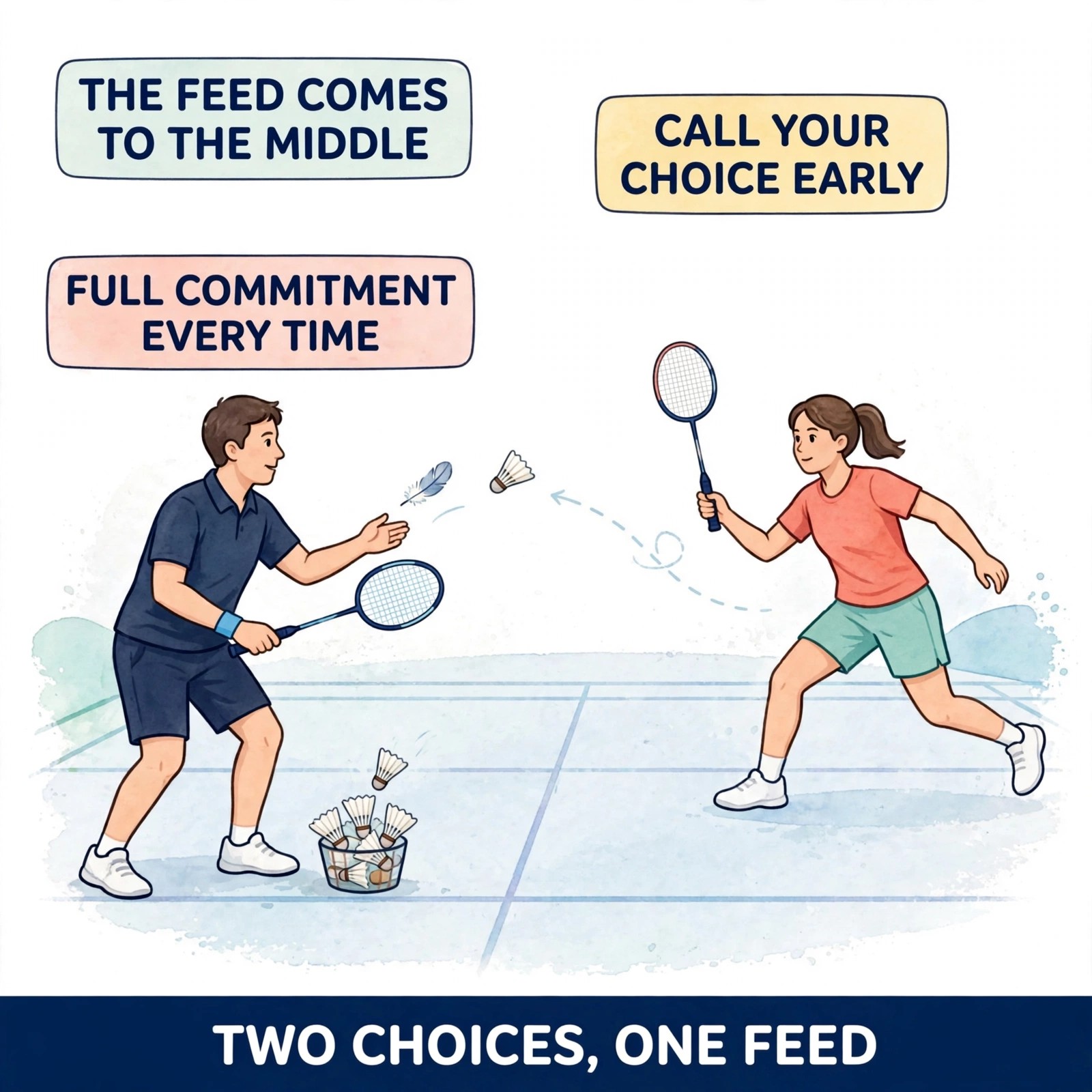
Two choice drills are the workhorse of selection training. The feeder always sends the shuttle to the same spot, the middle forehand area, and the hitter must choose between exactly two shots: a clear to the back or a drop to the front, a drive past the body or a block to the net. The feed does not change; only the decision does. Call your choice early, out loud, and commit fully. Half hearted choices are marked as errors even when they land in, because in a match the half hearted shot is the one that gets killed. Ten minutes of two choice work inside a normal session is enough to start; the skill grows on frequency, not on marathon drills.
Build the drill in layers. First, the feeder shows the target corner with a point before feeding, and the hitter practises recognising the early cue. Then the point disappears and the hitter reads the feeder’s body instead. Then a second feeder option appears, and the hitter must read which of two feeds is coming before choosing. Each layer removes one comfort. What stays constant is the rule: decide early, say it, do it fully. Selection trained this way transfers to matches, because matches are also just cues arriving faster and faster with no pause button. If a layer makes the hitter guess instead of read, step back one layer; guessing is the habit this whole page exists to remove.
Conditioned games carry the drill into open play. Award a point only when the rally is won after a set up shot, not from a hopeful smash. Or play games where a clear that lands in the back zone counts double, so players learn to earn the attack instead of forcing it. The coach scores the choice, not only the outcome: a well chosen shot that clips the tape still earns its mark, and a lucky winner from a bad choice does not. Players adapt quickly once they see that choosing well is what the game is paying for. Rotate the condition every few minutes so one pattern cannot be farmed; the reading has to restart with every new rule.
Selection Check #5
Selection Under Pressure: Choosing Well When It Counts
Pressure shrinks the menu in a predictable way. Tired players stop seeing the front court; nervous players stop trusting the lift. Selection under pressure is therefore trained, not lectured. Play end of session games at called scores, with the ladder still in force: stretched means reset, balanced means move them, early means take it on. Pre decide your safe shot before the game starts, the one shot you trust at 20 all, and give yourself permission to use it without shame. Review the rallies afterwards, not the score: which choices followed the ladder, and which ones panicked. Naming the safe shot aloud in front of your group helps too; a declared shot carries a small promise that survives tired legs.
Fatigue hides good choices by narrowing your vision, so pressure sets should be short and repeated. Four hard rallies, a breath, a quick review of one choice, then again. Watch for the moment the calls stop: when the hitter goes quiet, the reading has stopped too, and the shots become swings. That quiet moment is the exact thing being trained. Each week it should arrive later in the set. When it stops arriving at all during training sets, match pressure starts to feel like just another set you have done before. Track the quiet moment in the log with the rally number; watching it drift later across a month is satisfying proof.
One more pressure habit is worth building: the reset breath. Between rallies, take one slow breath out while you walk back to base, and run the ladder in your head for the next rally: where will I be, what will I take. It sounds small, and it is, which is why it survives pressure when bigger routines collapse. The players who choose well late in matches are rarely the calmest people in the hall. They are the ones whose choosing was drilled into a routine too small to break. The breath also buys a second to notice the opponent’s position, which is the raw material the next choice is made from.

Myth vs Reality
Myths About Shot Selection
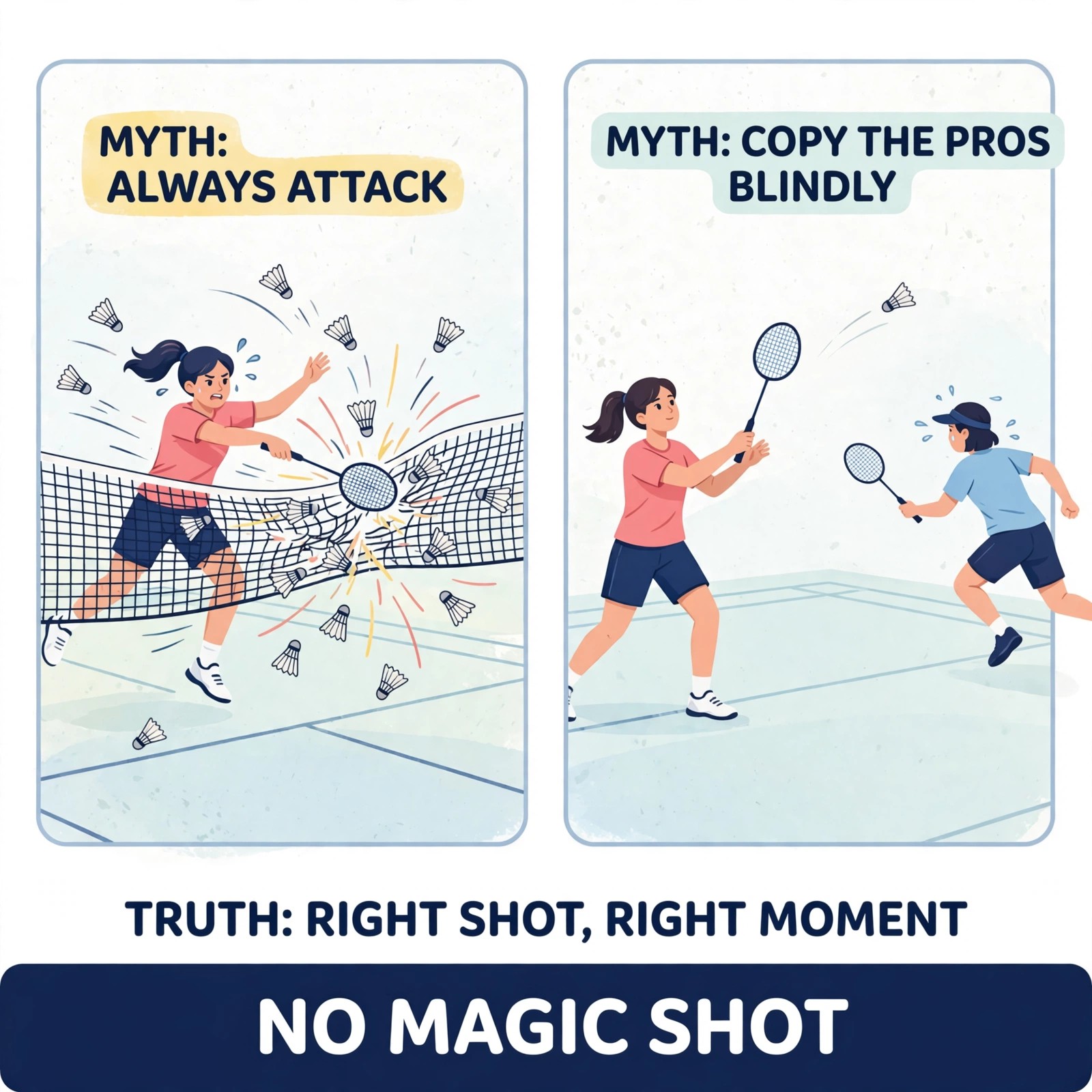
The first myth says winners should always attack, so selection means finding the smash. Constant attack against a set defence is the fastest way to donate a match: the smashes get flatter, the returns come back faster, and the attacker does the running. Watch strong players and count how many shots pass before the attack comes. The winner was selected long before it was hit, built by clears and drops that moved the defender a half step at a time. Attack is the last shot of a selection story, not the whole story. A practical check for club players: if your smashes outnumber your clears and drops combined, your selection, not your power, is the problem.
The second myth says good selection means copying what the professionals play. Professional choices are built on professional speed: shots that are open to a player who arrives a half second early are closed to the rest of us. Copy the reasoning, not the shot. Ask why the professional chose the cross court there: because the opponent’s hip had turned, because the rally had earned it. Those reasons exist at club level too, with different shots attached. Selection is portable. The exact highlight shot usually is not. Watching one professional rally a week with a notebook, calling the choice before the shot, is fine homework between sessions.
The third myth says there is a magic shot that solves rallies: the trick serve, the disguised flick, the one winner that works on everyone. There is not. Any shot played twice becomes a read, and any read becomes a counter. What never expires is choosing the right shot for the position in front of you, because the position is new every rally. Players hunting for a magic shot stop training their reading, and their game stalls at the first opponent who has seen the trick before. Placement and timing beat magic at every level of this sport. Keep one or two surprise shots by all means, but treat them as seasoning; the ladder still has to cook the meal.
Why Choose Us
Why Players Choose ST Badminton Academy
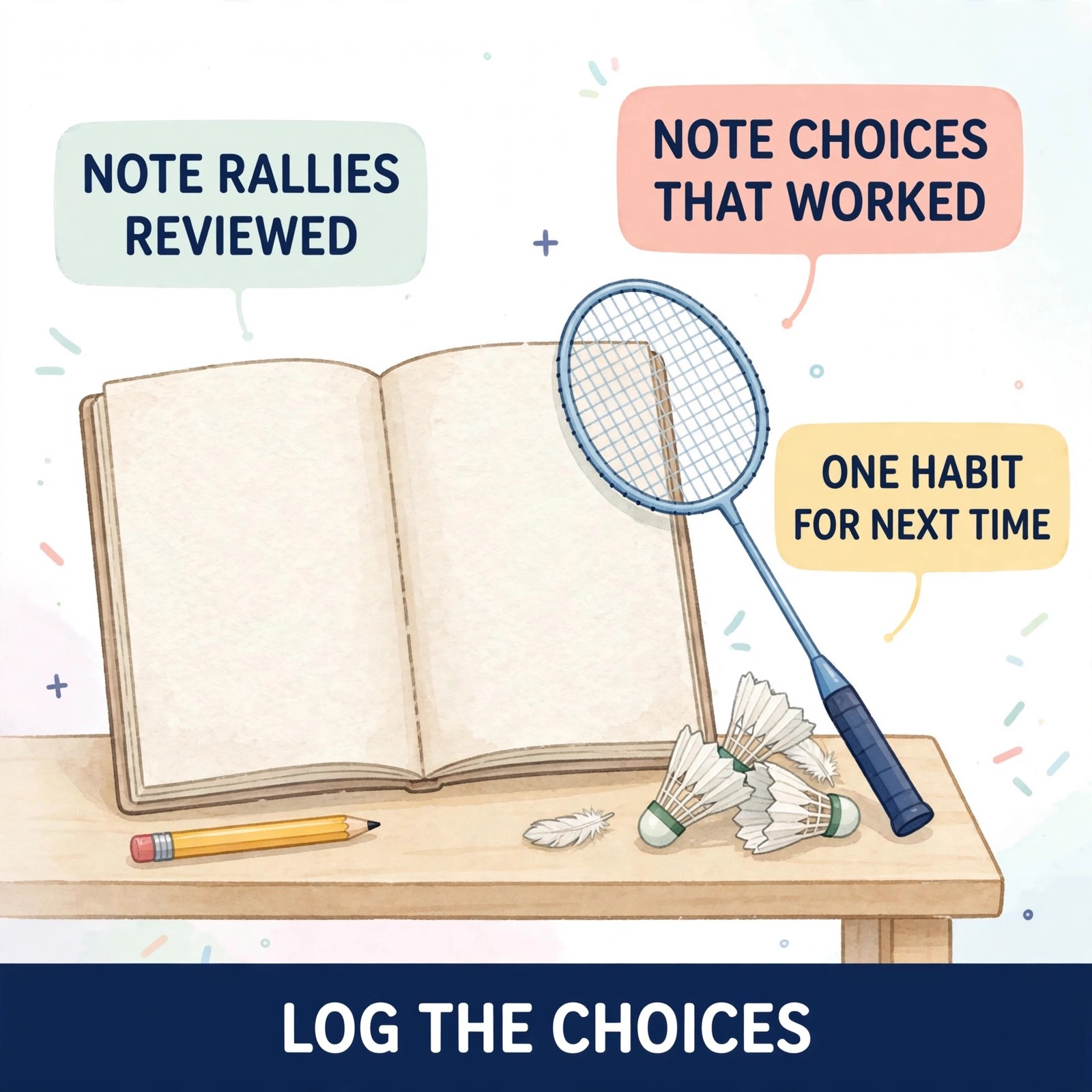
At ST Badminton Academy, shot selection is coached as a skill of its own, in the order this page describes: reading cues first, then the three rung ladder, then two choice feeds, then conditioned games where the coach scores the choice as well as the result. Groups are capped at four students, which matters here more than anywhere: selection feedback has to arrive in the moment, rally by rally, and a coach can only do that with a small group. Students keep a simple choices log, reviewed weekly, so the same mistake stops being a surprise and becomes a drill. The log stays short on purpose: rallies reviewed, choices that worked, one habit for next time, three lines after each session.
Sessions run at our Kuala Lumpur halls and follow a steady rhythm: a reading warm up, ladder calls during feeding, one two choice drill, then conditioned games to finish. New students often arrive expecting more technique and are surprised how much of their losing was choosing. Within a month the pattern usually shows: the same three or four choice errors repeat across every match they play. Once those are named, training gets very focused. Fix the repeated choice and the whole game lifts, because points stop leaking from positions the player was already reaching. For many students this is the fastest visible progress of their first season, because nothing about their strokes had to change first.
Parents watching junior matches sometimes ask why a child with clean strokes loses to a scrappier player. The answer is usually on this page: the scrappier player chooses better. She hits fewer winners and far fewer donations. Our job is to make the choosing visible so it can be trained like a stroke: call it, count it, log it, drill it. When a student’s log shows the same position producing better choices week after week, that is real progress, and it shows on the scoreboard before it shows anywhere else. It also changes how a loss feels: a child who knows why points were lost has somewhere to go next week.
FAQs: Shot Selection Drills And Reading in Malaysia (KL)
Shot selection questions usually start with a rally that was there to be won. Here are the answers we give on the bench.
Can a beginner learn shot selection in training in Setapak or Gombak?
Yes, because selection starts as a reading habit, not an advanced tactic. In our Setapak groups of no more than four, beginners learn to watch the opponent’s racket, call shots during slow feeds, and use a simple three rung ladder, so good choices grow alongside the strokes themselves from the first term.
What is the first selection habit a new player should build in KL?
Call the shot before you hit it. In feeding and slow rallies, name clear, drop or drive out loud as you move. The call forces the decision early, and KL players who build it find their feet start moving sooner too, because a decided player never stands still waiting to see what happens.
Why do I keep choosing the wrong shot in rallies at club level?
Usually you are choosing from your favourite shots instead of from your position. Stretched players attempt winners, balanced players lift for no reason, and the pattern repeats because nobody has named it. Run the ladder for a month: stretched resets, balanced moves them, early attacks. Your log will show the change quickly.
I reach the shuttle in time but still lose the rally. Should I attack more or choose better?
Choose better first. Attacking more from the same positions gives the opponent more of what they are already handling. Check whether your rally was built: did a clear or drop move them before the attack came. Bring a recent match to a session and we will map the choices together, rally by rally.
How can I practise shot selection drills with a partner in training?
Use two choice feeds. Your partner always feeds to the same middle spot, and you must pick one of two named shots, calling the choice early and committing fully. Ten minutes inside a normal session is enough. In training with us the feeder varies the feed only after the calls come early.
Do you coach shot selection near Wangsa Maju?
Yes. Our academy is based in Setapak, a short drive from Wangsa Maju, and selection is coached inside normal sessions there: reading work, the ladder, two choice drills and conditioned games where the coach scores the choice as well as the result. Groups stay at no more than four students for rally by rally feedback.
Where does ST Badminton Academy teach shot selection in Malaysia?
We teach in Setapak, Kuala Lumpur, and shot selection is coached as a skill of its own rather than left to match experience: cues named, choices called, logs kept. Students join us from across the Klang Valley, and each player’s repeated choice errors become the drills their next block is built from.
How do I book a trial session to review my shot selection?
Book a trial session with us in Setapak and bring your playing racket and your hardest recent match in mind. Train in a group of no more than four, and the coach will replay its key positions in feeding, show you where the choice went wrong, and set your ladder for the month ahead.
What makes Mr Eric Chuar a suitable coach for shot selection and badminton?
Mr Eric Chuar coaches the academy sessions himself, with more than 15 years of coaching in Malaysia and Singapore. He teaches selection as reading plus a ladder, scores choices in conditioned games rather than only outcomes, and makes players keep a short log, so game sense is trained openly instead of hoped for.
Badminton Shot Selection Training in Action


We benchmark our selection coaching against World Badminton (BWF) coaching standards and our own academy values: before any player trusts a training plan, they deserve honest checks. You can verify our coaches' credentials through the Badminton Association of Malaysia (BAM) coach education pathway.
Our standards for selection coaching are plain. Reading comes before tactics, and the ladder comes before flair. Choices are scored in conditioned games, not only outcomes, because lucky winners teach bad habits and unlucky good choices teach good ones. We promise no magic shots and no overnight game sense; choosing well is built from called decisions in feeding, reviewed in a log, repeated until the calls go quiet because they have become automatic. When selection improves here, the student's own log shows it first. Coaches review that log with the student, not about the student, so the habit of self reading keeps growing between sessions.
| Factor | Favourite Shots | Right Shots SELECTION |
|---|---|---|
| Frequency | 1 or 2 times a week. Mostly for fun and sweat. | Choices follow position and balance through a simple ladder, not mood or hope. |
| Drills Focus | Basic static feeding. Minimal footwork pressure. | Reading is trained with calls during feeding, so decisions arrive earlier each week. |
| Physical Conditioning | Rarely included. Just playing games on court. | Core, agility, and speed training included in every session to prevent injury and build stamina. |
| Tactical Awareness | "Just hit it over." No real game plan. | Video analysis, point construction, and learning to read the opponent's game. |
| Coach Ratio | Large groups (8-10 kids). Coach barely watches you. | Max 4 students. Mr Eric Chuar personally corrects every stroke and movement detail. |
| Goal Setting | Fun and exercise. | Conditioned games pay for good choices, teaching players to build rallies before finishing them. |
| Long Term Result | Good recreational player. | A selecting player: stays calm when stretched, moves opponents when balanced, and attacks only what she has built. |
Badminton Training With Selection Coaching in Kuala Lumpur
Come and give your game a choosing structure. Book a trial session in Kuala Lumpur, train in a group of no more than four, and leave with your reading cues named, your ladder set for your current level, and one repeated choice error turned into a drill. Bring your playing racket and your hardest recent match in mind. We will replay its key positions in feeding, find where the choice went wrong, and show you the training that fixes it.


