
 All languages
 Chinese (Simplified)
 Chinese (Traditional)
 English
 Indonesian
 Japanese
 Korean
 Malay
 Thai
 Vietnamese


What Are The Best Drills For Developing Your Badminton Jump Smash Technique (Jump Smash Guide)
The jump smash is the loudest shot in badminton, and the easiest to practise badly. A player leaves the floor, meets the shuttle at the top of their reach and drives it down at an angle a standing smash cannot match. When it works, the rally ends. When the timing, the contact point or the landing is off, the same shot dumps into the tape, sails flat for an easy drive, or costs the player the next rally because they are still picking themselves up. This page builds the shot in the order it actually happens: legs and landing first, then the turn and the swing shape, feeding sets off real lifts, target work with honest counting, and pressure sets where the jump has to survive tired legs.
Jump Smash Check #1
The Jump Smash: Height, Steepness And Honest Power
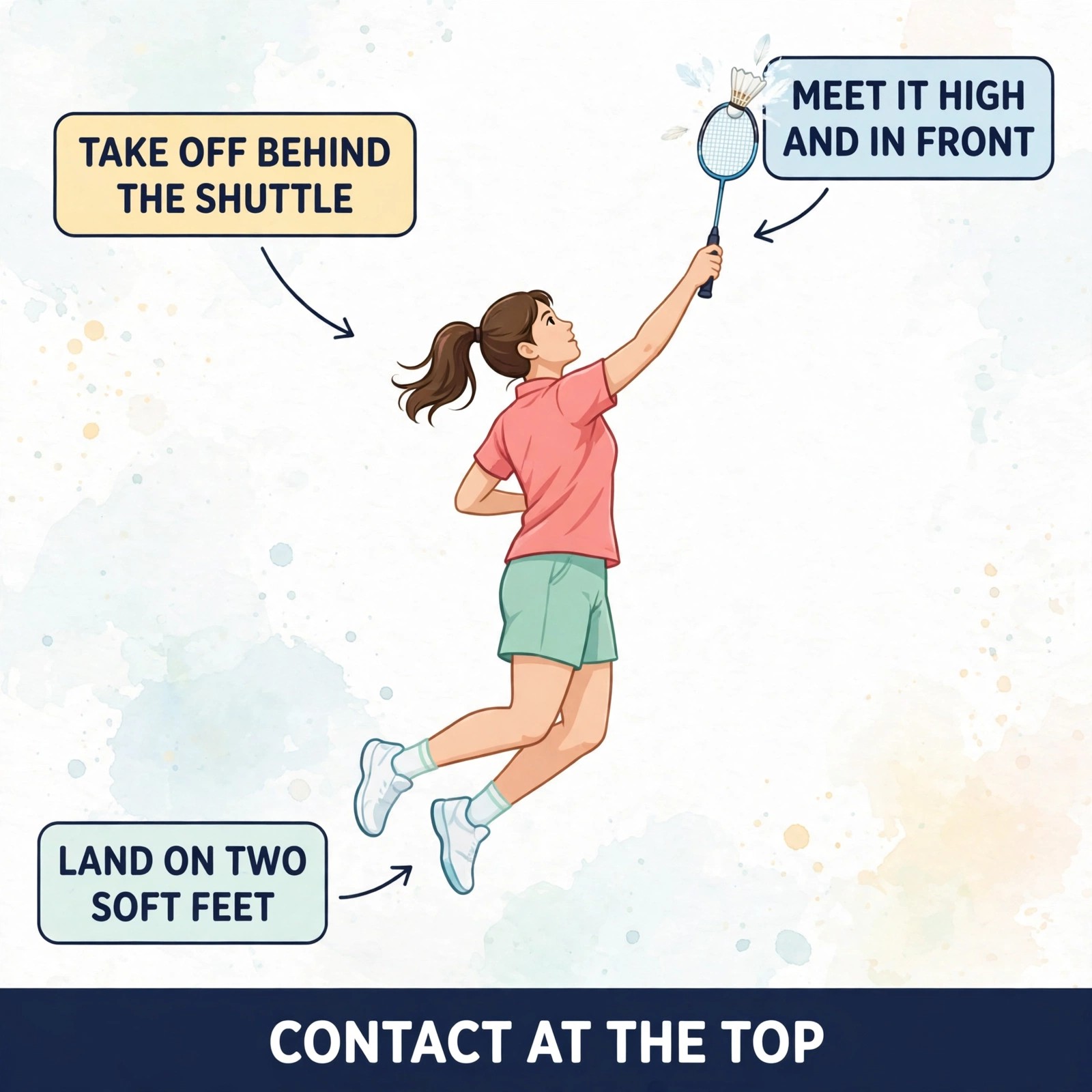
Start with what the height buys you. A standing smash is limited by your reach: the shuttle leaves the racket at head height or a little above, so its downward path has a ceiling on steepness. Jump, and the contact point rises well above that ceiling. The same swing now sends the shuttle down at a much steeper angle, landing closer to the net and giving the defender far less time. That is the whole value of the shot. It is not about looking athletic. A jump smash hit flat from a low contact is worse than an ordinary smash, because you have spent your balance to buy nothing. The drills on this page protect the one thing that matters: contact high, in front, with a landing that lets you play the next shot.
Coaches can judge a jump smash before the shuttle lands. The clues are in the air: a quick two foot take off from behind the shuttle, the body turning side on as it rises, the racket reaching up early, and contact made at full stretch slightly in front of the head. The landing gives the rest away. Good jump smashers come down on two feet with soft knees, already moving back to base. Struggling ones land on one straight leg, stumble a step, or land so far under the shuttle that the swing had to reach backwards. Every drill that follows trains one of those clues at a time: the take off, the turn, the contact point, and the landing, in that order, before any of them are asked to survive a rally.

Jump Smash Check #2
The Jump Smash Shape: Turn, Reach And Full Swing
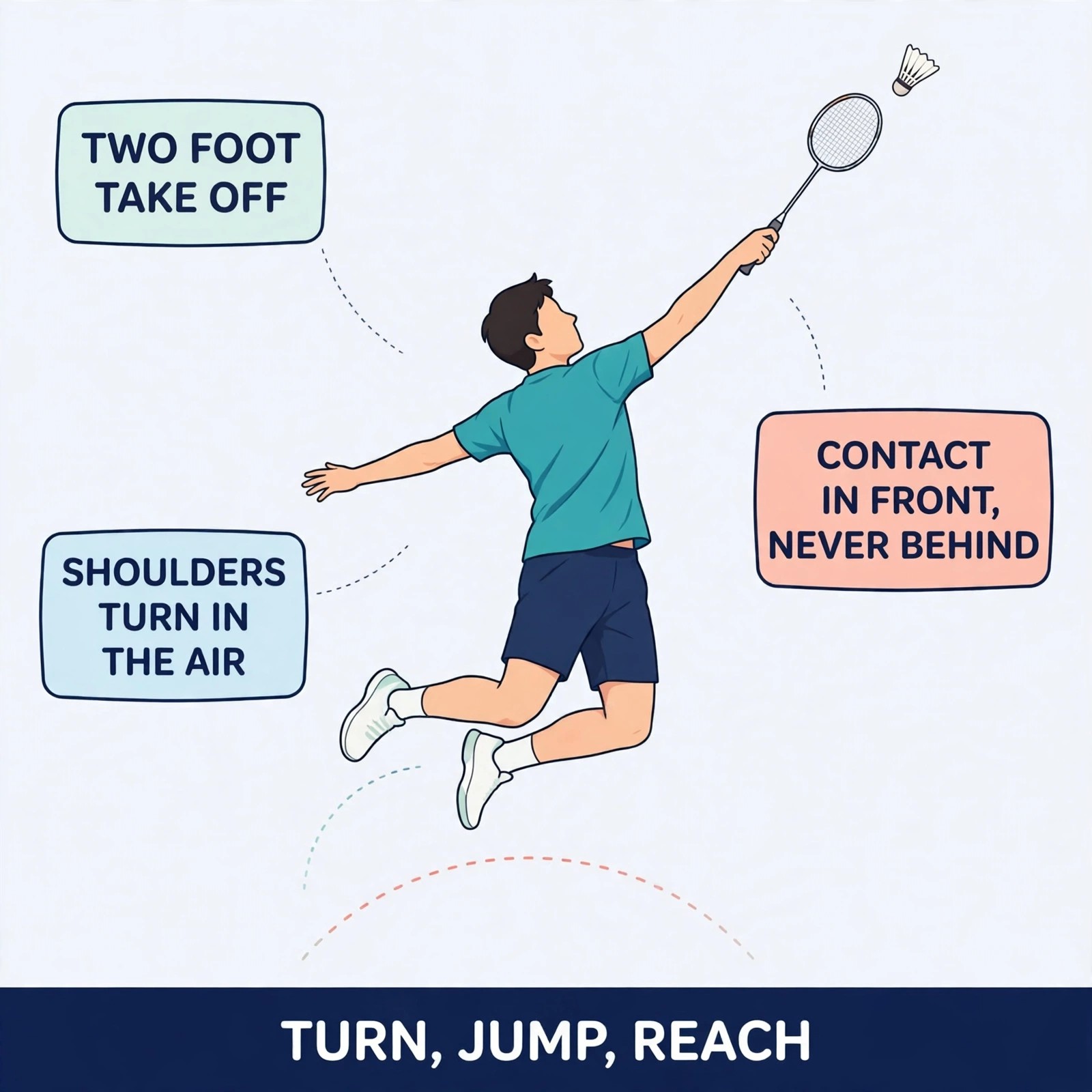
The shape starts on the floor, behind the shuttle. You move back early, plant both feet in the rear court with your body turned side on to the net, and take off while the shuttle is still near the top of its flight. Jump too early and you are on your way down at contact, which flattens everything. Jump too late and the shuttle is beside your head, which does the same. The take off itself is quick rather than huge: a sharp dip of the knees, both feet leaving the floor together, the body rising just enough to lift the contact point. Most club players need far less height than they think. They need the jump timed so the highest point of the jump and the highest reachable contact arrive at the same moment.
In the air, the shot is the same smash you already own, played from a higher shelf. The shoulders turn as you rise, the racket goes up early behind your head, and the non racket arm points toward the shuttle to hold your balance and your aim. Then the trunk rotates, the elbow leads, the forearm turns through contact, and the shuttle is met at full stretch in front of your body, never above or behind your head. Players who meet it behind them lose the angle and usually lose their landing too, because their weight is travelling backwards as they come down. Keep the swing honest: same preparation as your standing smash, same follow through across the body. The jump adds height to the shape. It does not ask for a new one.
The landing is part of the shot, and it is the part players skip in practice. Come down on both feet together, forefoot first, knees bending to take the force, chest up, and land close to where you took off rather than drifting toward the net. A landing that travels forward steals your recovery; a landing on one straight leg sends the force into a single knee and ankle. Treat landing practice as general conditioning guidance, not a test of toughness: build the number of jumps in a session up slowly over weeks, keep the court surface clean and grippy, and wear proper court shoes. Sharp pain in a knee, ankle or heel cord during jump work is a stop signal. End the drill, rest it, and get it checked if it keeps coming back. No smash is worth a season.
Jump Smash Check #3
Feeding Drills: Same Lift, Higher Contact
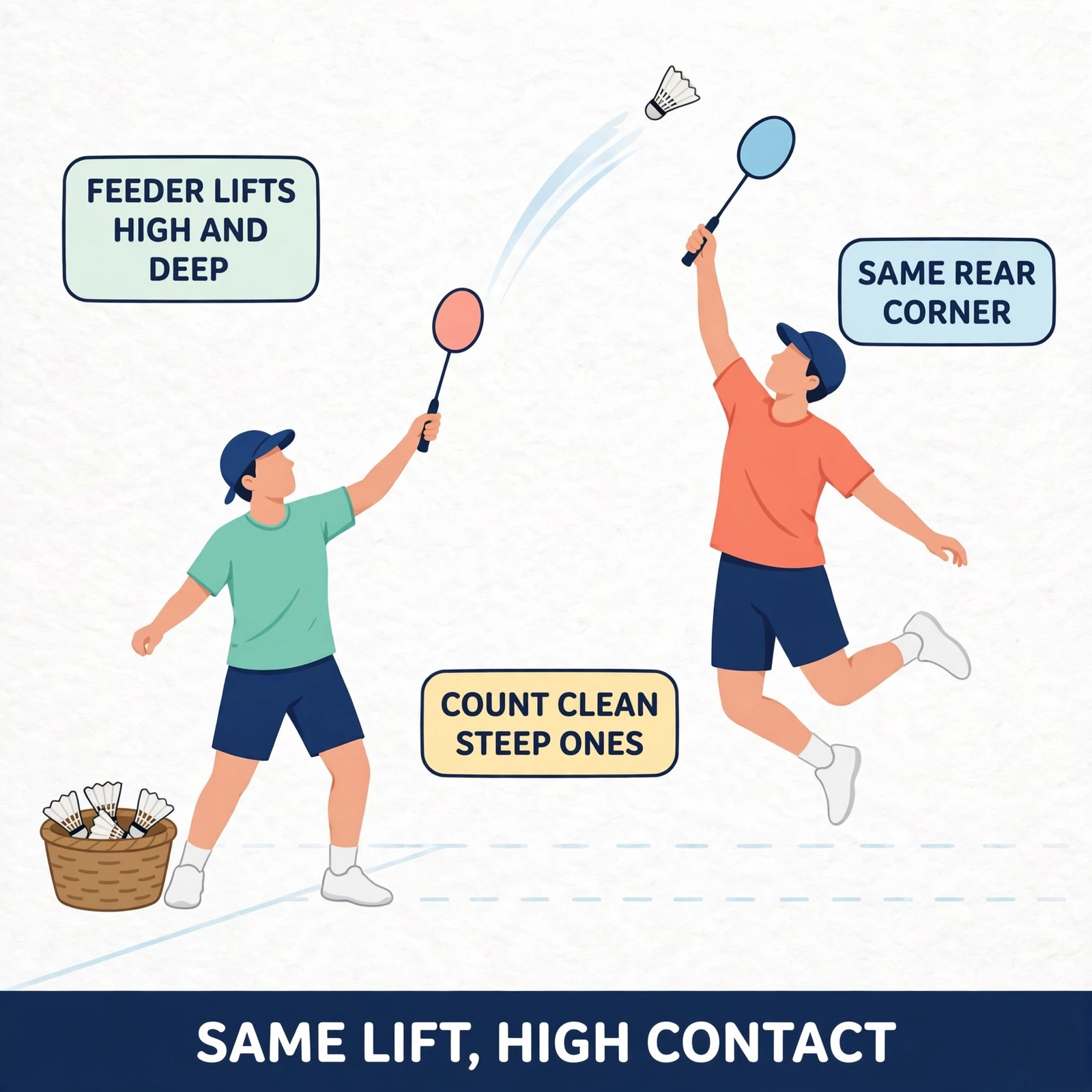
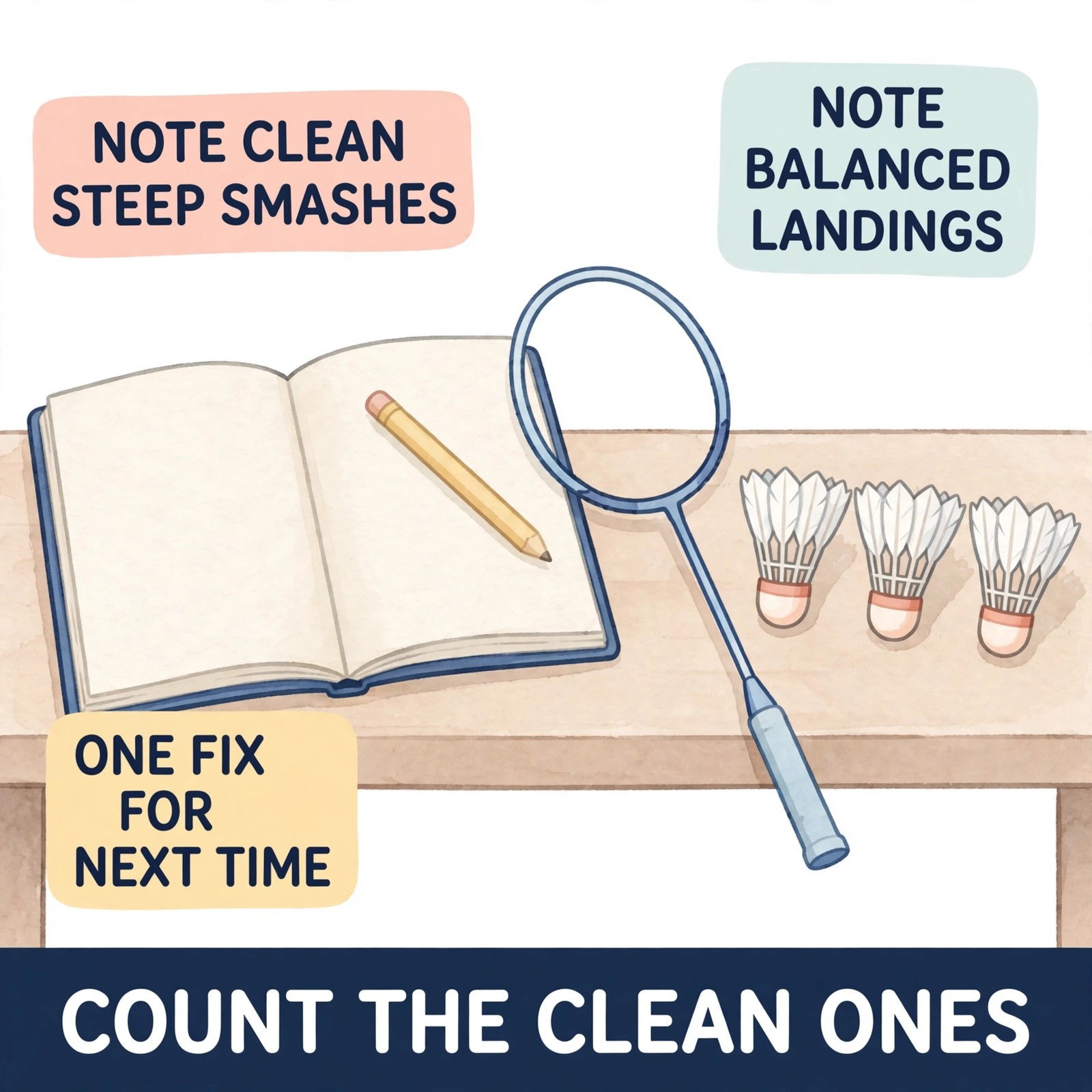
The base drill is fed lifts from one spot. Your partner stands at the front and lifts high and deep to the same rear corner, again and again, while you take off and jump smash each one. Judge two things only: was the contact high and in front, and did the shuttle land steeply inside the court rather than floating long or clipping the tape? Ten feeds a set is plenty while the jump is new. The sameness is the point. With the lift fixed, every flat smash is information about your timing or your take off position, and you can change one thing at a time. When the same corner gives you seven clean, steep smashes out of ten with balanced landings, the drill has done its first job.
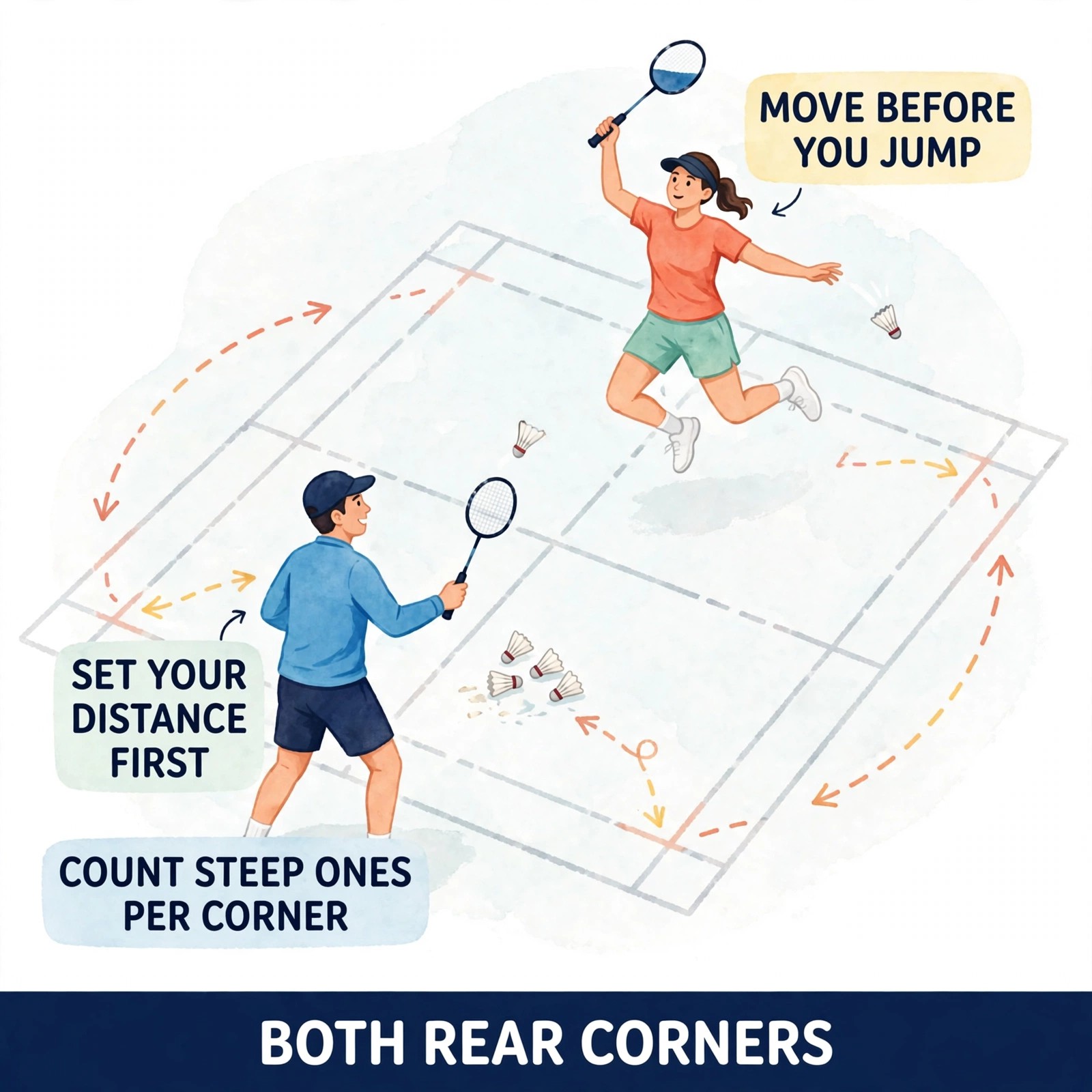
From there, the feeding starts to move you. The feeder varies the lift, a little shorter, a little wider, sometimes to the other rear corner, so your feet have to travel before they take off. This is where most jump smashes fall apart, because the jump was grooved from a standing start and real rallies never offer one. Arrive under control first: the last two steps set your distance from the shuttle, and a take off launched while you are still drifting backwards produces the flat, falling smash everyone recognises. Mix in ordinary standing smashes from the same feeds too. The shared shape matters, and choosing on each feed whether this lift deserves the jump is the first piece of match sense the drill can teach.
The third step joins the shot to the rally. The feeder lifts, you jump smash, and the feeder plays a reply, a block to the net or a drive past you, which you must answer. This matters because a jump smash spends your position: for a moment you are in the air at the back of the court, and where you land decides whether the next shot is yours or theirs. Land balanced and moving, and the block becomes a net shot you can reach. Land stumbling, and the same block wins the rally. Drill the recovery as hard as the smash itself: jump, land, two quick steps toward base, eyes up. Players who treat the smash as the end of the rally keep donating the shot that comes after it.
Jump Smash Check #4
Target Drills: Steep Angles And Honest Counting
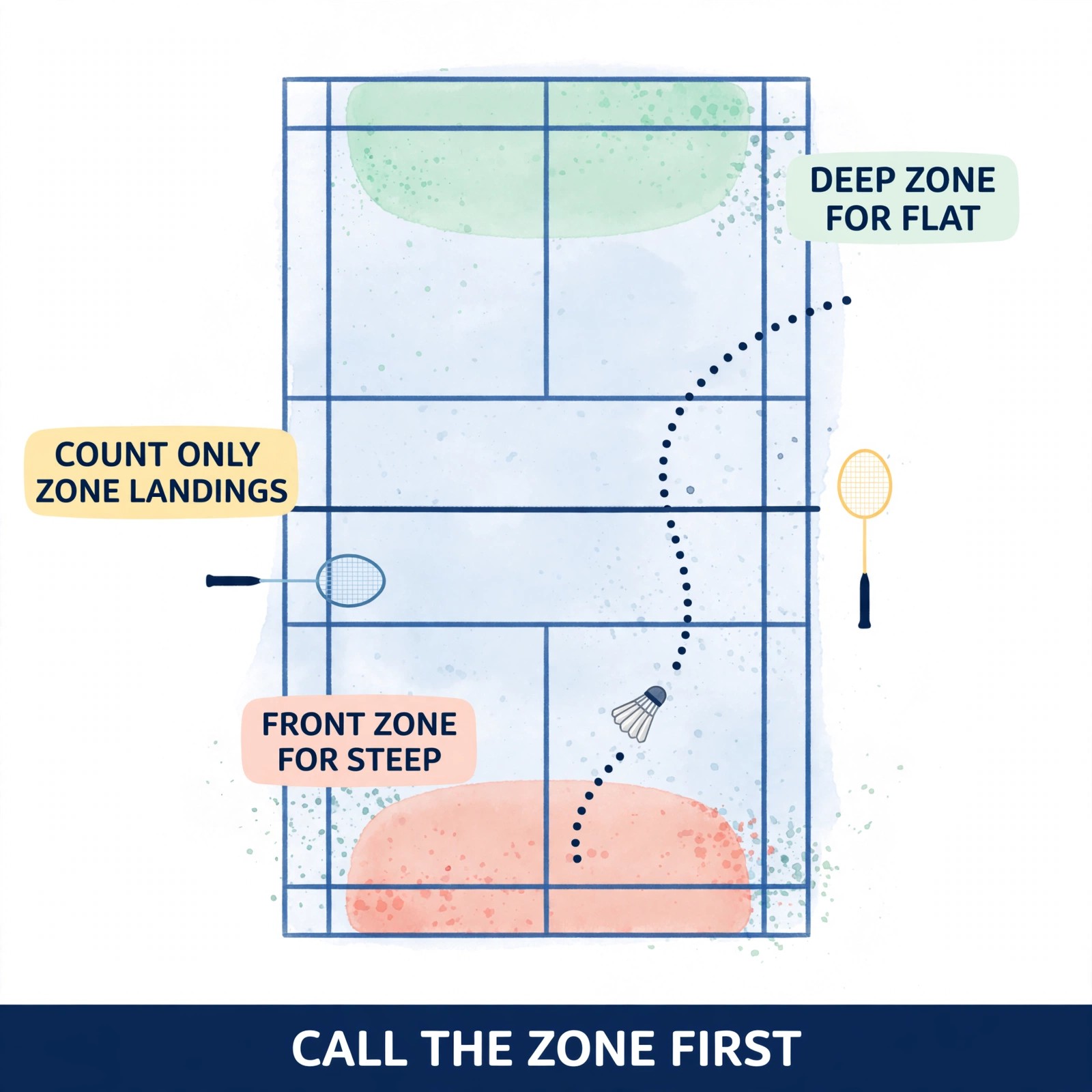
Target work gives the jump its honesty. Mark two landing zones with court tape or spare shuttles: one in the front tramline area for the steep smash, one deeper for the flatter, faster one. Fed from the same lift, call your target before each jump and count only smashes that land inside it. Steepness is the usual lesson. Players chasing power hit through the shuttle and send it long or flat; players aiming at the front zone discover that a high contact and a downward racket angle do the work without extra force. Ten jumps, two zones, one count each. When the steep count climbs without the tape errors climbing with it, the angle is becoming a habit instead of an accident.
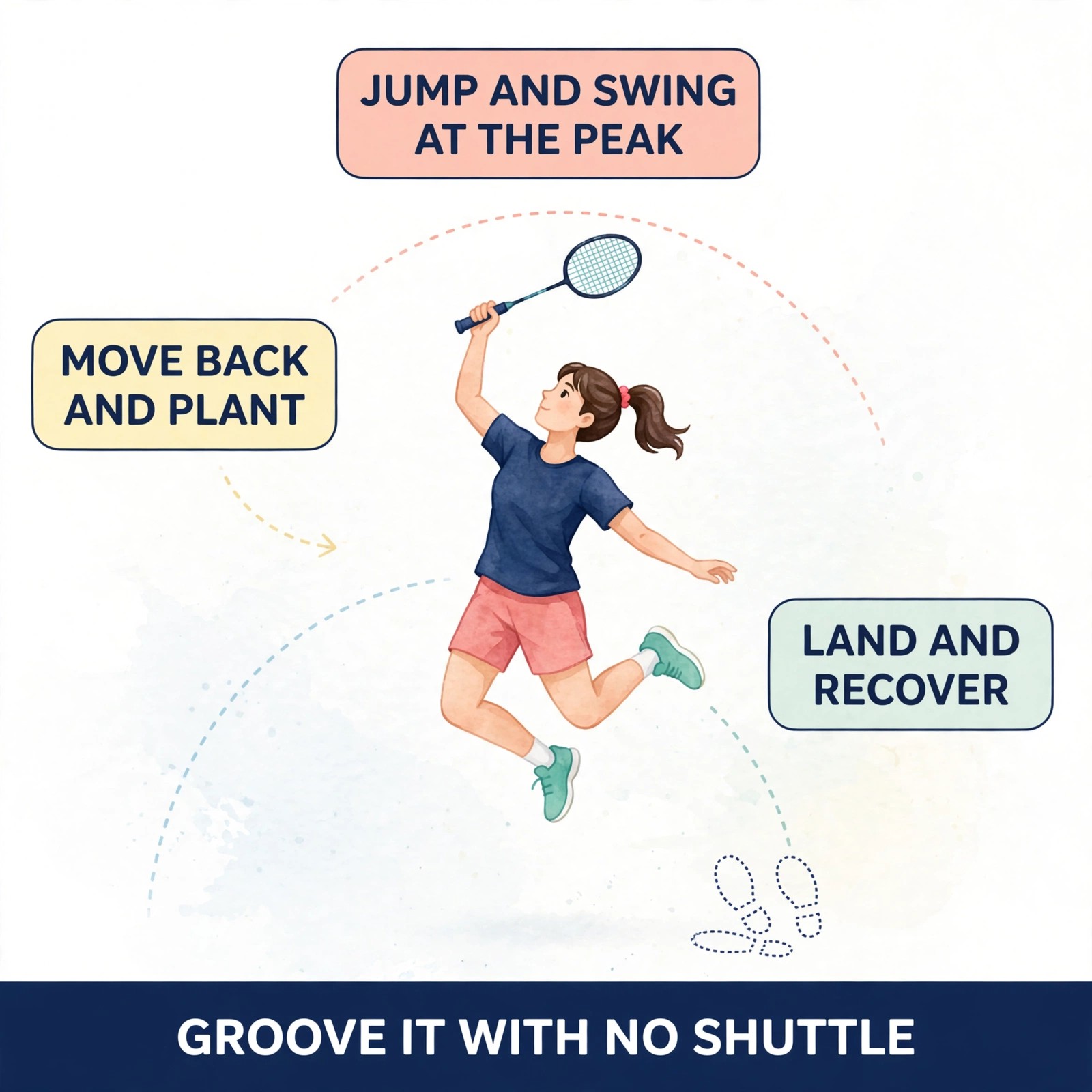
The quiet drill is the shadow jump. No shuttle, no feeder: stand at the rear court, run the full pattern, move back, plant, jump, swing at an imagined shuttle at its highest point, land, recover, and repeat at walking pace before you build it up. Shadow work feels too easy and fixes the faults feeding cannot, because with nothing to hit, your whole attention sits on the turn, the take off timing and the landing. Film one set a week on a phone if you can. Players are usually surprised by what they see: the jump drifting forward, the contact imagined behind the head, the landing on one leg. One visible fault, fixed in shadow work, transfers to the fed drill faster than a hundred hopeful smashes.
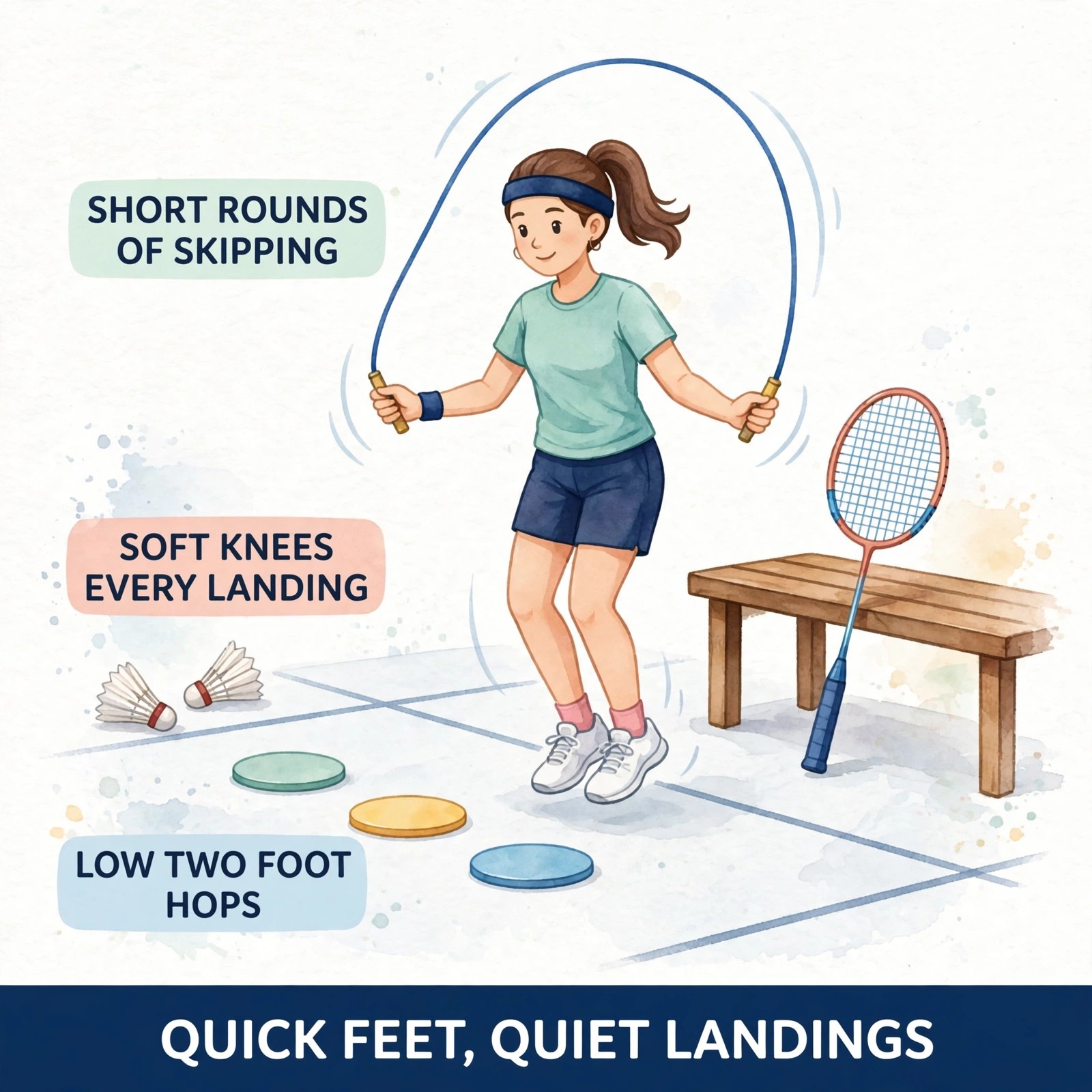
Jumping ability supports the shot, trained in small, plain doses. Skipping with a rope for short rounds, low two foot hops in place with soft landings, bodyweight squats and calf raises done slowly: none of this needs a gym or a programme with your name on it, and all of it serves the same goal, legs that leave the floor quickly and land quietly. Keep the doses modest and the build gradual, adding a little each week rather than a lot in one heroic session. This is general conditioning that supports court training, and it follows the same rule as the jump work itself: sharp pain means stop, rest, and get it checked if it returns. Strong legs matter. Healthy legs matter more.
Jump Smash Check #5
Jump Smashes Under Pressure: Tired Legs And Late Arrivals
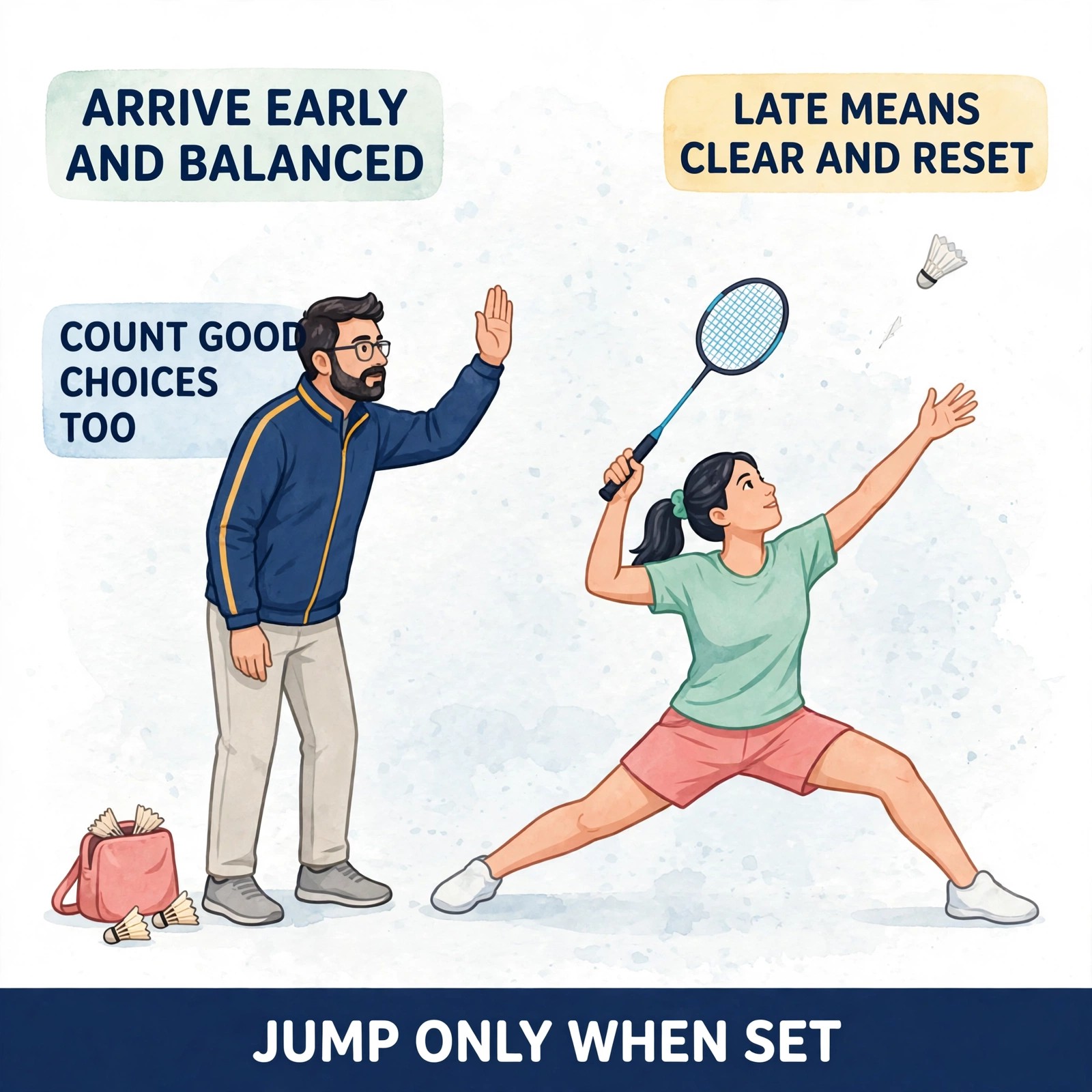
Pressure changes the jump smash in one predictable way: players jump when they should not. Beaten wide to the rear corner, arriving late with the shuttle dropping beside them, they leave the floor anyway and produce a falling, flat shot from a body that was never set. So pressure practice starts with the choice, not the shot. The feeder moves you with a clear to one corner, then lifts again: if you arrived early and balanced, jump and finish it. If you arrived late and reaching, play the clear, reset, and earn a better lift. Coaches count good choices alongside clean smashes. A jump smash is an attacking decision, and attacking from a lost position is just donating with style.
Tired legs ask the harder question. Late in a match, the take off slows, the jump drops a little, and the landing, always the first thing to go, turns heavy and one sided. So the drill pairs them on purpose: six point footwork at honest pace, then straight into a set of fed jump smashes while the legs are heavy. Count clean, steep smashes out of ten in that state, and count balanced landings with them. A fresh count flatters everyone; a tired count tells the truth about what will still be there in the third game. When the tired count climbs toward the fresh one, and the landings stay soft, the shot has become something you own rather than something you perform.
A word on using the shot sparingly. The jump smash is expensive: it costs your balance, your position and a piece of your legs every time you play it. Players who jump at every lift teach their opponents to wait for it, and a waited for jump smash is just a smash. The standing smash, the stick smash and the clear all protect it, because an opponent who must respect three replies cannot camp on any one of them. Save the full jump for the lifts that deserve it: high, a little short, arriving while you are set. The threat of the shot wins rallies on the days you never play it, as long as opponents believe it is coming.
Myth vs Reality
Myths About Jump Smashes
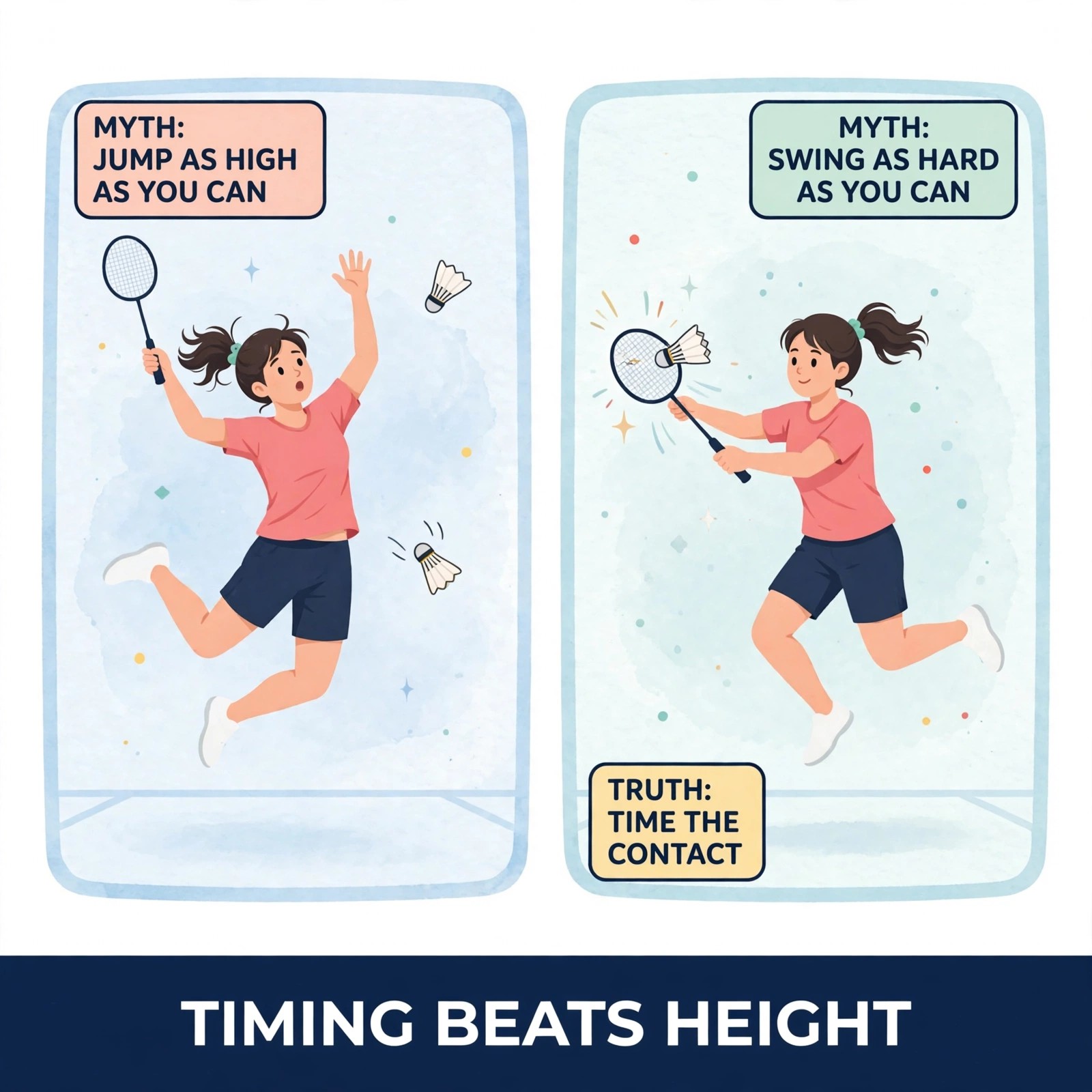
The first myth says the higher you jump, the better the smash, as if the shot were a height contest. Watch what a huge jump actually does to most players: the take off starts too early, the body is falling before contact, and the swing has to hurry to catch the shuttle on the way down. The result is a flat smash hit by a player who is no longer in control of the landing. The contact point matters, not the jump itself, and a small, well timed jump that meets the shuttle at the top of your reach beats a spectacular one that meets it late. Train the timing. The height you need is the height your timing gives you.
The second myth says the jump smash is an arm shot, won by whoever swings hardest. The arm is the last link in the chain, not the engine. The pace comes from the legs driving the body up and around, the trunk rotating, the forearm turning through contact, in that order. Players who arm the shot tire within a set, and their flat, forced smashes tell on them: plenty of effort, little angle, easy drives coming back. Players who use the whole chain look almost lazy at contact, because the work was done by the body before the racket arrived. If your jump smash feels like a fight, the fault is rarely effort. It is sequence.
The third myth says the jump smash belongs to tall players and professionals, too advanced for ordinary club training. Height helps, the way height helps everywhere in this sport, but the shot was never locked away. A shorter player with a timed jump meets the shuttle higher, relative to their own reach, than a tall player swinging from the floor, and the steepness follows the contact point, not the measuring tape. What the shot does demand is honesty about level: the shape, the landing and the counting habits on this page come before match use, at any height. Built in that order, the jump smash is a normal club skill. Skipped steps are what make it look like a trick reserved for the pros.
Why Choose Us
Why Players Choose ST Badminton Academy
At ST Badminton Academy, jump smash training follows the order on this page: take off and landing mechanics first, the shared smash shape second, fed sets from one corner counted by clean steep landings, moving feeds, target zones, and pressure sets where the choice to jump is scored as well as the shot. Groups are capped at four students, which matters for this shot more than most, because the faults live in details a big group hides: a drifting take off, a contact point behind the head, a landing on one leg. A coach watching four players sees them on the rep where they happen. Each player’s three counts, clean smashes fresh, clean smashes tired, and balanced landings out of ten, are logged and reviewed every week.
Students join us from across Setapak and the wider Klang Valley, from juniors adding a first attacking shot to adult club players whose smashes are hard but flat. The work scales to the player: newer players spend longer on shadow jumps, landing mechanics and low volume fed sets, while experienced players go straight to moving feeds, target calls and decision sets off rally patterns. What does not change is the standard. Every jump smash is judged by its contact, its angle and its landing, never by how powerful it felt, and every player knows their clean count before they leave the court. Nobody is asked to jump at match intensity until the landing is quiet in practice first.
If you are not sure where your smash stands, a trial session answers it quickly. The coach watches your standing smash shape, checks your take off and landing in shadow work, then feeds a set of ten lifts at honest pace and counts your clean, steep jump smashes and your balanced landings. Most players are surprised by which part fails first: rarely the swing, usually the timing of the jump or the landing nobody had ever watched. You will leave knowing your real starting number and the single fix that moves it fastest, whether that is the take off position, the contact point, or simply jumping less often and choosing better.
FAQs: Jump Smash Drills And Landing Safety in Malaysia (KL)
Jump smash questions usually start with a shuttle that flies flat when it matters. Here are the answers we give on the bench.
Can a beginner learn jump smash drills in training in Setapak or Gombak?
Yes, with the steps in the right order. In our Setapak groups of no more than four, beginners start with shadow jumps and landing mechanics, then take fed lifts from one corner at low volume, counting clean steep smashes out of ten from the first weeks of jump training.
What is the first jump smash habit a new player should build in KL?
Land like you mean to play the next shot. Two feet down together, knees soft, chest up, already moving back to base. KL players who build that one habit stop donating the rally after the smash, because a jump that ends in a stumble is only half a shot.
Why does my jump smash keep going flat at club level?
Almost always a low or late contact. If the shuttle is met beside or behind your head, or on your way down from the jump, the angle is gone before the swing starts. Leave earlier from further back, reach up in front, and meet it at your top point. Bring ten fed lifts and we count the steep ones.
My jump smash is either weak or it hits the net. Should I jump higher or fix my contact point?
Fix the contact point first. Jumping higher from the wrong place only raises a bad position, and weak smashes are usually a reach or timing fault, not a height fault. Get behind the shuttle, take off as it peaks, and meet it up in front. Bring your landing under control and the steepness follows without any extra jump.
How can I practise jump smash drills with a partner in training?
Use fed lifts from one corner. Your partner stands at the front and lifts high and deep to the same spot while you jump smash each one, counting clean steep landings out of ten. Then vary the lift without warning. In training with us the feeder lifts to a named standard, high and honest, never floated kindly.
Do you coach jump smash drills near Wangsa Maju?
Yes. Our academy is based in Setapak, a short drive from Wangsa Maju, and jump smash work is coached inside normal sessions there: landing mechanics first, fed sets counted by clean steep landings, target zones and decision sets after. Groups stay at no more than four students, so the coach sees every take off and every landing.
Where does ST Badminton Academy teach jump smash drills in Malaysia?
We teach in Setapak, Kuala Lumpur, and the jump smash is coached as a decision plus a landing, not a leap of faith: arrive set, contact high in front, land ready. Students join us from across the Klang Valley, and each player’s clean smash counts, fresh and tired, are logged and reviewed every week.
How do I book a trial session to test my jump smash?
Book a trial session with us in Setapak and bring your playing racket. Train in a group of no more than four, and the coach will check your landing in shadow work, feed ten lifts, and count your clean steep smashes. You will leave knowing your real starting number and the first fix to work on.
What makes Mr Eric Chuar a suitable coach for jump smashes and badminton?
Mr Eric Chuar coaches the academy sessions himself, with more than 15 years of coaching in Malaysia and Singapore. He teaches the jump smash in order, landing before power, counts steep landings instead of praising effort, and stays close enough to correct a take off on the rep where it happens, so students build a smash that survives matches.
Badminton Jump Smash Training in Action
We benchmark our jump smash coaching against World Badminton (BWF) coaching standards and our own academy values: before any player trusts a training plan, they deserve honest checks. You can verify our coaches' credentials through the Badminton Association of Malaysia (BAM) coach education pathway.
Our standards for jump smash coaching are plain. Landing before power, counted sets over hopeful volume, and the contact point judged on every rep rather than praised in general. We promise no overnight smash; a reliable jump smash is built from timed jumps and quiet landings repeated weekly, and it arrives on the same timetable for everyone who does the reps. Landing work follows general conditioning sense: build jump numbers slowly, keep landings soft and balanced, and treat sharp pain in a knee, ankle or heel as a stop signal, not something to train through. We will say so in the session rather than after it.
| Factor | Bench Jumpers | True Jump Smashers JUMP |
|---|---|---|
| Frequency | 1 or 2 times a week. Mostly for fun and sweat. | The jump smash is taken at the highest reachable point, so the shuttle can be angled steeply down. |
| Drills Focus | Basic static feeding. Minimal footwork pressure. | The turn, reach and swing stay the same as the ordinary smash; only the contact point rises. |
| Physical Conditioning | Rarely included. Just playing games on court. | Core, agility, and speed training included in every session to prevent injury and build stamina. |
| Tactical Awareness | "Just hit it over." No real game plan. | Video analysis, point construction, and learning to read the opponent's game. |
| Coach Ratio | Large groups (8-10 kids). Coach barely watches you. | Max 4 students. Mr Eric Chuar personally corrects every stroke and movement detail. |
| Goal Setting | Fun and exercise. | Landings are part of the shot: two feet, knees soft, balanced, ready to move again at once. |
| Long Term Result | Good recreational player. | A true jump smasher: owns the highest contact on court, threatens every loose lift, and lands ready for the reply. |
Badminton Training With Jump Smash Coaching in Kuala Lumpur
Come and give your smash some height. Book a trial session in Kuala Lumpur, train in a group of no more than four, and leave with your take off checked, ten lifts counted honestly, and the habit that flattens your smash named as your first fix. Bring your playing racket and your usual court shoes. The lift is coming; be in the air when it arrives.


