
 All languages
 Chinese (Simplified)
 Chinese (Traditional)
 English
 Indonesian
 Japanese
 Korean
 Malay
 Thai
 Vietnamese


What Are The Best Drills For Developing Your Badminton Push Shot Technique (Push Shot Guide)
The push shot is the rudest polite shot in badminton. Played from the front and mid court with a short punch instead of a swing, it sends the shuttle flat over the tape, past the player in front of you, at a height too low to smash and a speed too quick to ignore. It is how front court players turn defence into attack in one contact, and how doubles pairs win the flat exchanges that decide their games. This page works through the drills that build a push properly: the high racket shape first, feeding sets fed flat and answered flatter, target work through the body and past the hip, return of serve practice, and pressure sets where the shuttle refuses to lift and so do you.

Push Check #1
The Push Shot: Flat, Early And Through The Body
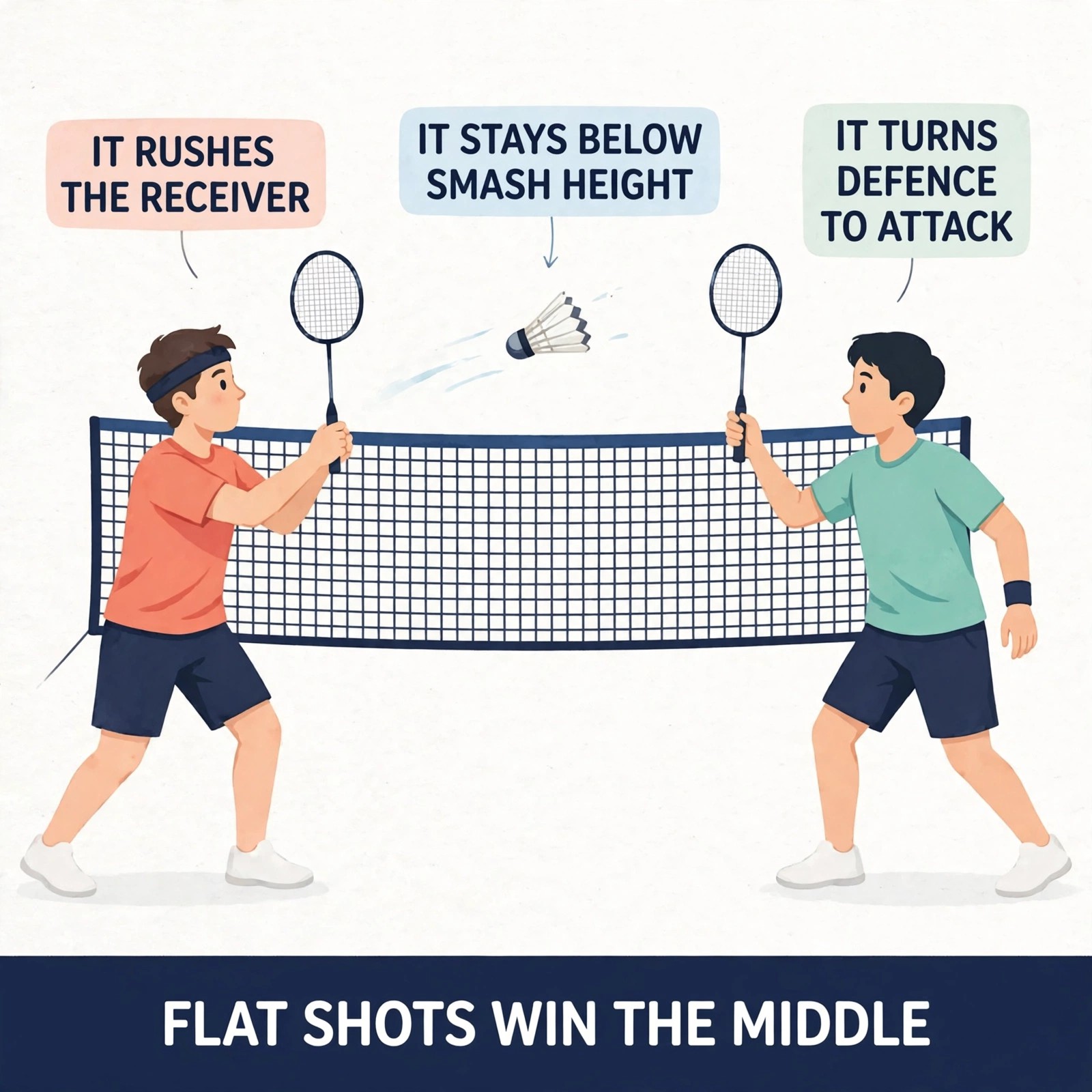
Start with what the push does to the other side. A lift gives opponents time and height; a push gives them neither. Played flat at chest height, it rushes the receiver into a half ready reply, often a block that sits up or a lift played from a poor position. In doubles, strings of pushes are how pairs seize the attack without smashing at all, driving the shuttle through the middle and past the front player until a loose one appears. In singles it answers tight net shots that would otherwise force a lift. The push is therefore not a smaller clear or a lazier net shot. It is a pressure tool, and it is judged by one thing: how flat and how early it was played.
Coaches judge a push by the racket before contact. Good pushers carry the racket up in front of the body, elbow out, face ready, so the shot is a short punch from a prepared position. Poor pushers drop the racket after every shot and have to lift it back into place, which costs the fraction of a second the push exists to steal. The second clue is the backswing, or rather its absence: the push starts almost where it finishes. Players who wind up turn a push into a drive with a telegraph, and the shuttle arrives announced. The drills on this page build the ready shape first, then the punch, then the targets, then the pressure, in that order.
Push Check #2
The Push Shape: Racket Up, Small Backswing
The shape starts with where you stand and what your racket is doing while you wait. At the front court, stand tall enough to threaten the tape, racket up in front of your chest, elbow bent and out, the racket face pointing roughly where a push would go. From there the shot is short: the forearm and fingers punch the face through the shuttle with a small step toward it. There is no loop, no wind up, no recovery of the racket from beside your ankle. Between shots the racket returns to the same ready address. Train that return as part of the shot, because a push played from a dropped racket is a rumour of a push, and opponents step into rumours.
The contact itself wants the shuttle early and in front. Meet it at or above tape height whenever the rally allows, because a push played from below the tape must first climb, and climbing pushes are lifts with better intentions. Step in to take it rather than reaching from a planted stance: the step is what lets a small action produce a fast, flat shuttle. The face points through the target, not up at it, and the fingers tighten at contact to give the punch its snap. Watch your misses for the pattern. Pushes that sail long usually come from a face opened at contact; pushes in the net come from meeting the shuttle late and low. Both are geometry, and geometry can be drilled.
Forehand and backhand pushes share the same ready shape, which is the point of it. On the backhand side the thumb moves up the wide bevel of the handle and the face stays in front, so a shuttle arriving at your left hip gets the same flat answer as one at your right shoulder. Pairs who only push well on the forehand side get hunted on the other within a rally or two. The grip stays soft between shots so the change is instant, and the elbow stays out so neither side needs a new preparation. In training, feed both sides without warning from the first week. A ready shape that only works on one side is half a shape.

Push Check #3
Feeding Drills: Pushes Fed Flat And Fast
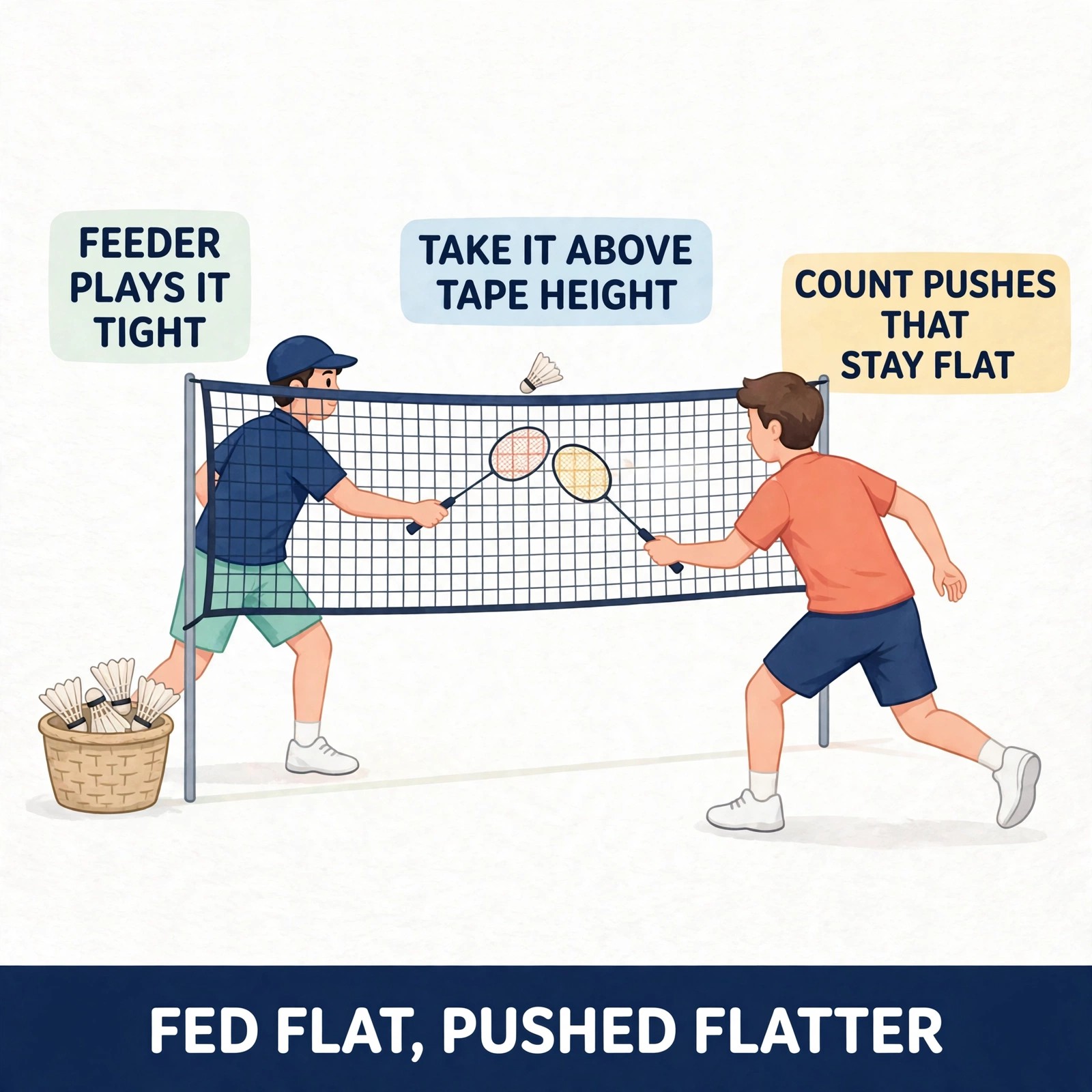
The base drill is feeding at the net. Your partner plays tight, flat feeds from close in, the kind of loose net shots and half blocks that pushes exist to punish, and you step in and push each one back flat. Judge only the flight: flat over the tape and falling by the mid court is a push; anything that climbs is a miss, whatever it felt like. Twenty feeds a set. Keep the pace kind at first, because the early take and the small action need to be grooved before they are hurried. When flat becomes the default rather than the achievement, the feeder speeds up and starts choosing sides, and the drill becomes the rally it was rehearsing.
Targets give the push its manners. A flat shuttle through the middle is good; a flat shuttle aimed is better. The two honest targets are the receiver’s body, chest and shoulder line, where rackets get cramped, and the space beside the hip on the racket side, where a reaching player opens their own front court. Set target games in feeding: body pushes and hip pushes called by the coach, counted separately. A push that misses flat is still a push played wrong if it lands in the front player’s hitting zone at a kind height. In our sessions the feeder stands in as the receiver and calls the quality aloud, because the person being pushed at is the only honest judge of whether it rushed them.
The third drill joins the push to the rally that follows it. Push the feed, then stay up: racket high, base at the front, ready for the block that a good push provokes. This is where pushes win points in real games, not on the push itself but on the reply, popped up for your partner in doubles or pushed again, flatter, in singles. Players who push and then retreat to admire it convert pressure into a reset. The drill forbids retreat: push, hold your ground at the front, take the next one earlier still. Three contacts in a row at the front, each one flatter, is the pattern the drill is building, and it feels like bullying because, within the rules, it is.
Push Check #4
Doubles Push Work: Front Player, Fast Hands
Return of serve is where the push earns its keep in doubles. The low serve arrives tight and flat, and the receiver who steps in and pushes it past the server changes the whole rally’s ownership in one shot. Practise it as its own drill: serves fed low, receiver starting close to the line, meeting the shuttle at tape height and pushing through the server’s shoulder space or wide to the tramline side. The server in the drill serves and holds, so the receiver can groove the step and the punch. Then the server starts moving, and the receiver must pick the space the server has just left. That reading, serve, step, space, is a match skill hiding inside a technique drill.
The front player push is the doubles partner drill. Your partner at the rear feeds loose shots toward you at the net, half lifts and soft blocks, and your job is to stay high, stay up, and push every loose one flat and down the middle or through the front opponent’s body. The habit being built is refusal: refusing to lift, refusing to play a soft net shot from a winning position, refusing to let a loose shuttle become a neutral one. Front players lose rallies by being kind. The drill counts pushes played out of every ten loose feeds, and the misses are not the pushes that hit the tape; they are the feeds you chose to lift.
Singles players sometimes file the push under doubles and skip it, which costs them the tightest net exchanges. When an opponent’s spinning net shot comes in tight, your choices are the lift, the answering net shot, or, when the shuttle sits up even slightly, the push flat past them or across their body. That third option changes how boldly they play the net against you. Practise it from net feeds: answer one with a net shot, the next with a push, same ready shape, same arrival. When your partner cannot tell which answer is coming until contact, the push has joined your singles game properly.

Push Check #5
Pushes Under Pressure: Low Serves And Tight Nets
Pressure at the front arrives as speed. The exchanges get flat and fast, the shuttle keeps coming back at your chest, and the push shape is tested exactly where it breaks: the racket drops between shots, the elbow tucks in, and the player starts swiping across the shuttle instead of punching through it. The drill is a flat rally with a rule: no lifting, first pair to five clean exchanges, then swap the feeder’s pace up. Under that rule the shape either holds or the rally ends, and both outcomes teach quickly. Count how many exchanges your ready shape survives, and let that number, rather than your best single push, be the one you chase.
The second pressure is the score. Late in a game, front players tighten: the grip squeezes, the punch becomes a poke, and pushes that were flat at ten all start climbing at eighteen all. So pressure sets are played to a score from the start, feeder keeping a loud count, first to seven pushes that stay flat, with a forfeit the adults choose and the juniors negotiate far too hard. The point is not the forfeit. The point is rehearsing the flat punch while your hand wants to squeeze, in training, at low stakes, until the squeeze stops being your response to an important shuttle. Match points are won by habits that were built when nothing was at stake.
Know the pushes to refuse. A shuttle below tape height and tight, played at full stretch, cannot be pushed flat without first becoming a lift, and pretending otherwise feeds the smash. Play the honest net shot or the deep lift and reset. A push is also the wrong answer when your own base is empty behind you and the opponent is set at the mid court reading it; a flat shuttle to a set player is a drive rally you started from the worse position. The drills build the shot; the counting builds the judgement, because a player who logs flat pushes also learns the arrivals that produce them and the ones that never will.

Myth vs Reality
Myths About Push Shots
The first myth says the push is a small swing, a clear scaled down. Scale a clear down and you get a wind up, a loop and a late contact, which is everything the push is not. The push is a punch from a ready address, closer to how you would knock on a door at chest height than to any overhead action. Players taught the small swing version telegraph every push they play for a season, and their partners at the net wear the consequences. Judge any coaching of the shot by this test: if the racket drops and winds up, it is not a push, whatever the lesson plan calls it.
The second myth says pushes belong to doubles only. Doubles made the shot famous, because the front player lives on it, but singles players meet the same shuttle: the loose net shot, the half block, the serve return in the games where the rules allow the receiver to crowd. A singles player with no push answers every one of those with a lift or a soft net shot, and better opponents learn they can play the net without fear. Keep the shot in both games. The ready shape travels, the punch travels, and the opponent’s respect for your front court travels with them.
The third myth says flat is reckless, that pushing invites the drive rally and sensible players lift for safety. The lift is the true invitation: it hands the smash to a set opponent and asks your defence to perform. A flat push makes the other side play the next shot at speed, from chest height, going backwards or sideways. Risk lives in both answers; the push simply moves the risk onto the opponent’s racket. What is reckless is the half push, climbed and slow, and that is a shape problem the drills on this page exist to fix, not a reason to lift all evening.

Why Choose Us
Why Players Choose ST Badminton Academy
At ST Badminton Academy, push shot training follows the order on this page: the ready shape with the racket up between shots, flat feeding counted by pushes that stay flat, target games through the body and past the hip, return of serve and front player sets, and pressure rallies where lifting is banned. Groups are capped at four students, and the front court needs that closeness: the faults are a dropped racket, a tucked elbow, a face opened at contact, small things that vanish in a crowd. Each player’s counts, flat pushes out of twenty fed, returns pushed past the server, and exchanges survived, are logged and reviewed every week.
Students join us from across Setapak and the wider Klang Valley: doubles pairs whose flat game keeps collapsing at the front, juniors learning that the net is a place to attack from, and adult club players who lift too much and defend too often for their own liking. The work scales to the player. Beginners start with the ready address and kind feeds at walking pace; experienced pairs go straight to target calls, return of serve reading and no lift pressure rallies. The standard stays fixed: the flight judges the shot, flat and early or it did not count, and nobody’s push is praised for effort while it climbs.
If you are not sure where your push stands, a trial session answers it quickly. The coach feeds twenty flat feeds at honest pace and counts how many of your pushes stay flat, then tests your return of serve against a moving server. Most players find the same surprise: the punch is fine, and the ready shape between shots is what leaks, a racket that drops for half a second at a time. You will leave with your real counts and the one fix that moves them fastest, whether that is the elbow, the step in, or the grip that squeezes when the score gets loud.
FAQs: Push Shot Drills And Fast Hands in Malaysia (KL)
Push shot questions usually start with a shuttle that climbs when it matters. Here are the answers we give on the bench.
Can a beginner learn push shot drills in training in Setapak or Gombak?
Yes, because the push is a small action that beginners can groove early. In our Setapak groups of no more than four, beginners learn the ready shape with the racket up, punch kind feeds flat over the tape, and count pushes that stay flat out of twenty from the first weeks.
What is the first push habit a new player should build in KL?
Keep the racket up between shots. Elbow out, face in front of your chest, ready address held while you wait, so the push is a short punch instead of a rescue. KL players who build that one habit stop arriving late at the front, because the lateness was the dropped racket, not the feet.
Why does my push keep lifting into a smash at club level?
Almost always a climbing contact. A push met late and below tape height has to rise before it travels, and rising shuttles are smashes waiting to happen. Step in, meet it at tape height with the face pointing through the target, and keep the action a punch. Bring twenty feeds to a session and we will count the flat ones.
My push is either too soft or it sits up. Should I swing harder or take it earlier?
Take it earlier. A bigger swing makes the climb worse and announces the shot; the push gains its pace from position, not effort. Step toward the shuttle, meet it higher, and let the fingers snap at contact. Power in this shot is a rumour started by players who were in the right place at the right time.
How can I practise push shot drills with a partner in training?
Use flat feeding at the net. Your partner plays tight, loose feeds from close in while you step in and push each one back flat, judging only the flight. Count pushes that stay flat out of twenty, then swap sides without warning. In training with us the feeder calls the quality aloud, as the person being pushed at.
Do you coach push shot drills near Wangsa Maju?
Yes. Our academy is based in Setapak, a short drive from Wangsa Maju, and push shot work is coached inside normal sessions there: ready shape first, feeding counted by flat flights, target games and return of serve after. Groups stay at no more than four students, so the coach sees every dropped racket.
Where does ST Badminton Academy teach push shot drills in Malaysia?
We teach in Setapak, Kuala Lumpur, and the push is coached as the front court’s pressure tool: racket up, small punch, flat flight, judged by the person receiving it. Students join us from across the Klang Valley, and each player’s flat push counts, fresh and under a score, are logged and reviewed every week.
How do I book a trial session to test my push?
Book a trial session with us in Setapak and bring your playing racket. Train in a group of no more than four, and the coach will feed twenty at honest pace, count your pushes that stay flat, and test your return of serve. You will leave knowing your real starting number and your first fix.
What makes Mr Eric Chuar a suitable coach for push shots and badminton?
Mr Eric Chuar coaches the academy sessions himself, with more than 15 years of coaching in Malaysia and Singapore. He coaches the ready shape as part of the shot, bans lifting in pressure rallies, and counts flights instead of praising effort, so students build a front court game that holds at eighteen all.
Badminton Push Shot Training in Action


We benchmark our push shot coaching against World Badminton (BWF) coaching standards and our own academy values: before any player trusts a training plan, they deserve honest checks. You can verify our coaches' credentials through the Badminton Association of Malaysia (BAM) coach education pathway.
Our standards for front court coaching are plain. Ready shape before speed, counted flights over hopeful volume, and pressure rehearsed with a score on it rather than saved for matches. We promise no instant flat game; a reliable push is built from a racket that stays up and a punch that stays small, repeated weekly until the hand trusts it at eighteen all. Sharp pain in the wrist or elbow during front court practice is a stop signal, not something to push through, in every sense, and we will say so in the session.
| Factor | Lifters And Clearers | Early Pushers PUSH |
|---|---|---|
| Frequency | 1 or 2 times a week. Mostly for fun and sweat. | The push is taken early and in front, flat over the tape, before the opponent settles. |
| Drills Focus | Basic static feeding. Minimal footwork pressure. | The action is a short punch from a racket held up, not a swing, so the shuttle stays low and quick. |
| Physical Conditioning | Rarely included. Just playing games on court. | Core, agility, and speed training included in every session to prevent injury and build stamina. |
| Tactical Awareness | "Just hit it over." No real game plan. | Video analysis, point construction, and learning to read the opponent's game. |
| Coach Ratio | Large groups (8-10 kids). Coach barely watches you. | Max 4 students. Mr Eric Chuar personally corrects every stroke and movement detail. |
| Goal Setting | Fun and exercise. | Pushes aim through the body or into the hip space, where lifts and smashes are hard to play well. |
| Long Term Result | Good recreational player. | An early pusher: rushes the front court, owns the flat exchanges, and turns defence into attack in one shot. |
Badminton Training With Push Coaching in Kuala Lumpur
Come and give your front court a punch. Book a trial session in Kuala Lumpur, train in a group of no more than four, and leave with your ready shape checked, twenty feeds counted honestly by their flight, and the habit that leaks named as your first fix. Bring your playing racket and your usual court shoes. The shuttle will come in flat; after this, so will your answer.


